Meep Meep Watch

President Obama Departs White House En Route To Colorado

I’m sure my Republican readers will wince at that headline – or mock it. The news narrative of the summer is the floundering of the president in any number of ginned-up stories: he “lost” the Middle East (as if that’s a bad thing); he’s created a crisis in illegal immigration (even though the bulk of the blame goes to a Bush-era law); he’s responsible for total gridlock (as if Ted Cruz did not exist); he’s been snookered by Putin; he’s been humiliated by Netanyahu; he’s the “worst president since World War II”, and on and on.

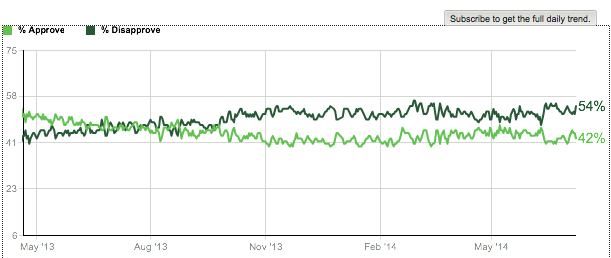
But let’s revisit last fall when Obama was in his first second term swoon. At that point, with the implosion of healthcare.gov, the very survival of the ACA, his signature domestic achievement, was in serious doubt. In the wake of Obama’s sudden bait-and-switch in Syria, when he threatened a strike and then accepted a Putin-brokered deal with Assad on WMDs, his foreign policy skills were about to get systematically downgraded by the American public. The economy was still sluggish, with no guarantee of a robust revival. Here’s Gallup’s picture of the president’s stark reversal of polling fortune, almost rectified before Iraq exploded a month or so ago:
Screen Shot 2014-07-10 at 10.04.06 AM

In April of last year, his approval ratings were exactly the inverse of what they are today. And with every passing day in his second term, his ability to leverage his power attenuates.

But let’s return to last year’s crises. Less than a year after the ACA was regarded as near-dead, the implementation has exceeded most expectations. Today’s Commonwealth Fund report tallies the results:

The uninsured rate for people ages 19 to 64 declined from 20 percent in the July-to-September 2013 period to 15 percent in the April-to-June 2014 period. An estimated 9.5 million fewer adults were uninsured. Young men and women drove a large part of the decline: the uninsured rate for 19-to-34-year-olds declined from 28 percent to 18 percent, with an estimated 5.7 million fewer young adults uninsured. By June, 60 percent of adults with new coverage through the marketplaces or Medicaid reported they had visited a doctor or hospital or filled a prescription; of these, 62 percent said they could not have accessed or afforded this care previously.

And the rate of increase in per capita healthcare costs has moderated substantially since the Bush administration. Perspective is everything, of course, and politically, the ACA is still (on balance) a loser, especially among the older, whiter Medicare recipients who are over-represented in mid-term elections. But still: isn’t this by the measure of last fall a pretty stunning comeback? And the purist “repeal!” chorus has dimmed to a faint version of replace or fix.

So turn your gaze to Syria, where the entire foreign policy establishment moaned in concert at Obama’s fecklessness last September. We were all told that it was unbelievably naive to think that Assad would ever fully cooperate and relinquish his stockpile of WMDs as a reward for not getting bombed. It was a pipe-dream to think Putin was serious about being constructive as well. Well: a couple weeks back, the last shipment of WMDs was removed from the country, with very limited use in the intervening period, and is now undergoing destruction. I don’t know of any similar achievement in non-proliferation since Libya’s renunciation of WMDs under Bush. No, we didn’t resolve the sectarian civil war in Syria/Iraq, but we did remove by far the biggest threat to the West and to the world in the middle of it. Why is that not regarded as an epic triumph of American diplomacy, backed by the threat of force?

Now look at the economy where Obama has been stymied by the GOP for a very long time – both federally and in the states where local government austerity put an unprecedented drag on the recovery. Well: again, we have an unemployment rate back to where it was before the Great Recession hit. If the momentum continues, we could have an unemployment rate below 6 percent before too long. It’s taken for ever – but the hit was deep and the debt overhang large. And speaking of debt, we also have this data to chew on:

usgs_line.php

No, there hasn’t been any progress in reducing our long-term debt or our unfunded liabilities in entitlements. But when the GOP refuses to countenance any new revenues, I can’t blame the president. And to have reduced a budget deficit from 10 percent of GDP to just over 2 percent in the wake of a massive recession is something a Republican president would be bragging incessantly about.

There’s still a lot in play. The critical negotiations with Iran remain as tricky as ever – but that we have a chance of controlling Iran’s nuclear program without war is already a remarkable fact. Again: a function of skilled, relentless diplomacy backed by serious sanctions. The menace of Putin has not gone away – even though a very good case can be made that in that head-to-head, Putin is now licking his wounds a little, after Ukraine has signed that trade deal with the EU, and Ukraine’s military is regrouping. Immigration reform is in limbo. But I’d argue that on the wider political plain, Obama has been winning the strategic war with the GOP. The last twelve months have been an unmitigated disaster for Republican outreach to Hispanics; the Republicans have hurt themselves with many more women on the question of contraception, than they have helped themselves with orthodox Christians; the Palin impeachment chorus is poison to the middle of the country; and the Democrats have a clear and female front-runner against a divided and small-bore GOP bench in 2016. If Clinton were to win, it would be as decisive a strategic advance as when George H W Bush cemented Reagan’s legacy.

I’m applying the criteria that Obama has applied to himself. Is his long game bearing fruit? So far, it seems to me, the question answers itself.

(Photo: U.S. President Barack Obama departs the White House July 8, 2014 in Washington, DC. Obama was scheduled to travel to Denver, Colorado. By Win McNamee/Getty Images.)

Andrew Asks Anything: Matthew Vines

vines-banner

A little while back, I got to meet Matthew Vines and have a sprawling, intensely honest conversation about being gay and Christian, about Biblical inerrancy and whether those who oppose marriage equality can all be described as bigots (they can’t). Subscribers can listen to the full podcast on Deep Dish here. For those of you new to this, Matthew is the author of the remarkable new book, God and the Gay Christian: The Biblical Case in Support of Same-Sex Relationships, and also the founder of The Reformation Project.

If you’re interested in the perspective of a gay Harvard drop-out who is devoting his life to religious change and reformation in his home state of Kansas and around the world, he makes for quite the interesting coffee companion. I’ve called his book a depth charge against religious homophobia. I think you’ll see from our conversation why that’s not as outlandish an opinion as it may seem at first blush.

As usual, these podcasts are not designed as interviews; they’re conversations, using the unique capacity of the web to give you a full hour and a half of over-hearing two people talk about the world in ways radio and TV simply cannot match.

But here’s a quick taste of what’s there (and we’ll be featuring a few short clips over the next few days). First up, we discuss both of our realizations, in relatively conservative home backgrounds, that we were gay as well as Christian:


And here’s a discussion of the unique and impossible prohibition that traditional Christianity has imposed on its gay sons and daughters:


Again, the full podcast is here for subscribers.

Is Hobby Lobby The End Of ENDA?

Screen Shot 2014-07-09 at 9.48.59 AM

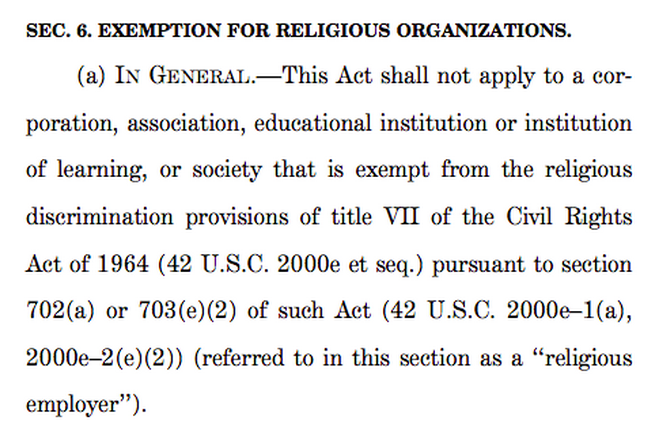
Several major gay rights advocacy groups, including the ACLU, the National Gay & Lesbian Task Force, Lambda Legal, and GLAAD (but not HRC), have dropped their support for the current version of ENDA in the wake of the Hobby Lobby ruling, which they believe makes the exemption seen above much more powerful:

The groups said the federal Employment Non-Discrimination Act (ENDA) contains religious exemptions that are far too broad. Beyond typical exemptions for explicitly religious organizations like churches and ministries, ENDA includes provisions that would allow religious employers, such as a religiously affiliated hospital, to refuse to hire LGBT people. “ENDA’s discriminatory provision, unprecedented in federal laws prohibiting employment discrimination, could provide religiously affiliated organizations — including hospitals, nursing homes, and universities — a blank check to engage in workplace discrimination against LGBT people,” the groups argued. “The provision essentially says that anti-LGBT discrimination is different — more acceptable and legitimate — than discrimination against individuals based on their race or sex.”

But it is different in so far as a majority of major religions still sincerely hold that gay relationships are inherently sinful, indeed “objectively disordered” – and many base their views on literal readings of inerrant Scripture or centuries-old natural law. That includes the current, widely admired Pope. And even the gay left groups accept the legitimacy of some kind of religious exemption for ENDA. So the question is: how broad a religious exemption is needed in general and in the wake of Hobby Lobby?

Supreme Court Rules In Favor Of Hobby Lobby In ACA Contraception CaseOn the first question, I ask myself what it would feel like for a religious organization to employ, say, a married lesbian. Does it truly affect a hospital’s ability to care for patients or to uphold certain beliefs if the nurse or janitor or doctor is gay? Of course not. A college or high school with respect to an openly gay teacher? A closer call – but only if they violate professional duties by, say, advocating things in the classroom that a religious group would disagree with, and not by just “being gay while working”. A corporation making automobiles? Please.

So I would probably narrow the current ENDA religious exemption a little – remove the word “corporation”? – but not by that much. And one reason I differ from my fellow gay and straight allies on this is that I fear they are understandably reacting to the emotional toll of the rhetoric being used by some on the culture war right and thereby over-reacting to a relatively narrow holding in Hobby Lobby. They are, particularly, missing the key points of Kennedy’s concurrence and forgetting the business push-back within the Republican coalition we saw in Kansas against any broad anti-gay employment discrimination statutes. To put it simply: I don’t believe that there’s a threat of the kind posited by many who see the world in utterly Manichean culture war terms. I fear that both sides are whipping themselves up into a lather that is largely unjustified.

But on the religious exemption in federal contracting, Supreme Court Issues Rulings, Including Hobby Lobby ACA Contraception Mandate CaseI favor none whatsoever. I gave my full reasons here. But my view is that if the government mandates something, you have a right to opt out in some circumstances on the grounds of religious freedom. But if you are actively seeking federal money, you have no right to attach discriminatory conditions to it. The right to religious freedom does not extend to the right to government subsidy and the right to discriminate. Pick one, Rick.

Then there’s the bizarre situation in which gay groups are effectively saying that they’d rather have no employment non-discrimination bill at all, than one with a religious exemption. This would be like saying you’d rather there were no ACA because of the Hobby Lobby decision – i.e. that the first ever government mandate for contraceptive insurance coverage should be voided entirely because a few companies can get an exemption from it.

It’s an easy position to take right now, of course, as Geidner notes, because this bill is going nowhere anyway in this Congress and probably not the next either. And it may be best seen as a form of jockeying in order to put countervailing pressure on the administration given the major religious right lobbying recently. But if it really came down to it – and gay groups actually opposed ending employment discrimination for gays because of the religious exemption, what they’re really saying is that they’d rather engage in culture war against the religious right than vastly improve the lot of millions of gay people. I think that’s short-sighted and a sad reflection on how polarized we have become.

Of course I appear to be an outlier here (as usual). I believe the greater narrative is one of huge advances in gay rights, and that some accommodation to the fast-losing side is actually more likely to sustain our victory than ratcheting the culture war dynamic still further. But understandable emotions – fueled by right-wing trolling – see the world as always darkening for gay people. So here’s how Joe Jervis sees it:

Years and years of hard-fought battles resulted in the Senate passage of ENDA in November 2013 by a vote of 64-32. I exulted in that moment, truly. But no hope of the bill progressing in the GOP-dominated House coupled with the Hobby Lobby ruling means that the entire LGBT rights movement must now focus on having LGBT Americans included under the broad protections of the Civil Rights Act of 1964.

Some are loudly arguing that LGBT opposition to ENDA is yet another case of the perfect being the enemy of the good, a cry that was also made when many of us objected after transgender protections were stripped from the 2007 version of ENDA. But as some of you have pointed out, exempting the very people most likely to discriminate from an anti-discrimination bill just does not make sense in the post-Hobby Lobby world.

Why not – if the actual result is their cultural and social isolation and punishment in the marketplace? Ask yourself: has the firing of gay teachers made the Catholic church seem more Christian and likely to appeal to more people? Please. With every decision like that, they lose an entire generation. What too many miss is how the marketplace has a role here. The reason so many major corporations have non-discrimination policies when it comes to gay people is not because they hold a view on the question; it’s that they don’t want to lose good employees or good customers. And the power of gay money in changing the world is far too easily dismissed by people whose job it is to focus on government. I think the market and the culture are fast accelerating gay integration, and we can afford a little moderation in giving space to our beleaguered opponents.

Yes, this may mean tolerating some nasty anti-gay discrimination from a few companies or religious institutions for a while, but the anti-ENDA campaigners have already shown that’s something they can live with – by preventing passage of ENDA indefinitely as it now stands. I think the compromise I favor does far less damage, while allowing the country to move ever forward on the integration of gay people in society.

Morrissey adds some perspective:

In the case of employment discrimination … courts have routinely ruled that government has a compelling interest in ensuring equal treatment regardless of religious beliefs, even those sincerely held. In fact, they have ruled that way even on commerce discrimination, most recently in the case of the bakers and photographers who didn’t want to participate in same-sex weddings. Statutory enforcement such as that in ENDA has been commonly considered the least-burdensome method of addressing that compelling interest. Hobby Lobby didn’t change a single stroke of that precedent. Even if the exemption clause in ENDA is broader than that in RFRA, the overall thrust of the statute and intent of Congress in passing it would still move the LGBT lobby’s goal forward on the ground first, and probably in courts, too — which would still end up having to do the same kind of balancing test that RFRA requires, using existing precedent.

Exactly. But the culture war has too much emotional energy right now for such cooler heads to prevail.

(Photos from Getty)

The Conversion Of Evangelicals On Marriage

Evangelicals

Though they lag behind other denominations, evangelicals are steadily becoming more supportive of marriage equality:

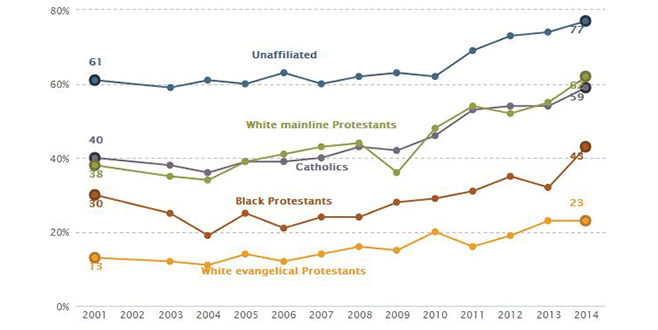
Over the past decade, evangelical support for gay marriage has more than doubled, according to polling by the nonpartisan Public Religion Research Institute. About a quarter of evangelicals now support same-sex unions, the institute has found, with an equal number occupying what researchers at Baylor University last year called the “messy middle” of those who oppose gay marriage on moral grounds but no longer support efforts to outlaw it. The shift is especially visible among young evangelicals under age 35, a near majority of whom now support same-sex marriage. And gay student organizations have recently formed at Christian colleges across the country, including flagship evangelical campuses such as Wheaton College in Illinois and Baylor in Texas.

Even some of the most prominent evangelicals—megachurch pastors, seminary professors and bestselling authors—have publicly announced their support for gay marriage in recent months. Other leaders who remain opposed to gay unions have lowered their profiles on the issue. After endorsing a gay marriage ban passed in California in 2008, Rev. Rick Warren, pastor of one of the country’s biggest megachurches, said in 2009 that he had apologized to all “all my gay friends” and that fighting gay marriage was “very low” on his list of priorities. Just last month, the Presbyterian Church, a Protestant denomination with a significant, though declining, minority of evangelicals, voted to allow ministers to perform same-sex weddings in states where they are legal.

What can this mean, I wonder? I’d like to think that arguments like Matthew Vines’ about how the Bible verses related to homosexuality have been misinterpreted are behind it. And for any major shift to occur, I think those arguments will have to gain adherents. But what we have here, I’d say, is a shifting understanding of what homosexuality is, as a result of huge social and cultural changes.

For the longest time, evangelical Christians associated gay people solely with deviant sex – and the fledgling gay community, understandably entranced with sexual liberation, did little to dissuade them. But as the culture has shifted to see gay people as actual human beings whose lives encompass so much more than sex, and as gay couples have movingly expressed their desire to commit to one another, and as gay citizens continue to volunteer in the armed services with distinction and honor, the very idea of homosexuality that informed most evangelical conversations on the topic has changed. Even those within the evangelical or traditional Catholic orbits – like the dedicated gay celibates who call themselves B-Siders – have shifted away from shame or self-loathing toward something different:

The B siders I spoke with were quick to offer critiques of homophobia within Christian communities, which surprised me, considering that they’d organized their lives around adhering to their rules. Ron Belgau, who co-founded the Spiritual Friendship blog to address the question of how celibate LGBT people can find intimacy and connection within Christian communities, summed up their frustrations by saying: “Most of [the Roman Catholic Church’s] thinking is no you can’t have sex; no you can’t go into the priesthood—they shut various doors, but there’s a need to talk about, OK, no we can’t have sex but what can we do? How can we serve the church?” Eve Tushnet, another B sider I spoke with, is writing a book to address this same conundrum. For her, the most important issue is not rule-following but “the question of how do you lead a good, fruitful life within a Catholic tradition [and] increase the tenderness and beauty in the world?”

I’m not sure celibacy is a viable long-term argument for countless gay Christians who, by virtue of their very humanity, yearn for intimacy, companionship, love and sex. But openly gay celibate people within the churches really does change the tone and content of the debate. Again, it is the collapse of the closet that galvanized this, and will continue to. The reason I’m not completely optimistic is because – Matthew’s remarkable arguments aside – the evangelical fixation on a ludicrously literal adherence to Biblical text means that they really will, at some point, have to acknowledge either that they’ve been reading the Bible wrong, or that their absolute prohibition on gay love and family, whatever the human impact, is unalterable. I suspect that many will continue to choose the latter. It would require too wrenching a shift in their own identity to embrace the identity and humanity of all their fellow citizens.

The Challenge Of Reform Conservatism

This blog has long been generally supportive of the attempt by a handful of sane and intelligent conservative thinkers to brainstorm some kind of future for the American right. And who wouldn’t be? If the alternative is the brain dead 1979 redux position of someone like Kimberley Strassel, you gotta love Ross Douthat. But it strikes me there are deep challenges for this fledgling group of now Tanenhaus-blessed scholars, and they may be hard to overcome.

The first is the lack of any clear unifying theme or rallying cry that can meld policy to politics. “Reform” seems too vague and goo-goo a thatcherreagan.jpgtheme to catch on. On the core axis of more or less government, the reformicons rightly answer smaller, better government – but the “better” part always ends up a little duller than “smaller”. A child tax credit may or may not be a decent idea – but it’s very hard to fit it into the broader tradition of less government dependency. Ditto attempts to alleviate student debt, or to encourage the hiring of the long-term unemployed, or the block granting of anti-poverty funds to the states. All of them are hard to do when you demonize government itself as regularly as the Republican rank and file.

Perhaps the best scenario for a raft of such small, but potent policy proposals would be a Republican version of the Clinton administration – which bored the pants off ideologues but still connected with the tangible needs and concerns of most people. Alas, it’s hard to imagine a Clintonism of the right without a Clinton. It was Bill’s astonishing charm, loquaciousness, relentlessness and seduction that made these tedious laundry lists so popular. I do not see any such charismatic figure with such a direct and personal grasp of so many policy issues on the right. Maybe he or she will show up as a charismatic and brilliant governor. Or maybe not. If Ted Cruz is the new archetype of a Republican, never.

Within British conservatism, there are, in contrast, two competing traditions – Whig and Tory – that mitigate this problem. The Whiggish triumviratetimsloangetty.jpgfaction had its high watermark under Thatcher, a conservative who embraced market liberalism as the best foil to socialism. But the Tory faction never disappeared completely. Its rallying cry – and historical legacy – is “One Nation” Toryism, rooted in Disraeli’s conservative embrace of the working classes, and abhorrence at the vast social and economic inequalities of his time. It has no problem at all with government and its benefits. This would be a natural and identifiable tradition to embrace in Britain for a set of reformers like the Levin brigade. In America? No Disraeli ever existed – and no Bismarck either. Eisenhower may be the best analogue. And re-introducing Eisenhower to the next generation is a pretty heavy lift. The trouble with American conservatism is that it is, in essence, so new, and so wedded to a particular era, that it doesn’t have the depth and reach of a European conservatism that can provide a leader like Angela Merkel.

And then the reformicons are operating at a disadvantage in a culturally polarized America. It would be great if this were not the case – but since a huge amount of both parties’ base mobilization requires intensifying the cultural conflict, and since the divide is rooted in real responses to changing mores, it will likely endure. And that kind of climate makes pragmatic conservatism again less likely to get a hearing.

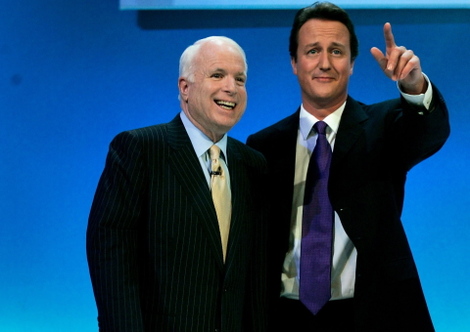
So, for example, I’m perfectly open to new ideas on, say, helping working class families with kids. But some pretty basic concerns about the current GOP on cultural issues – its open hostility to my own civil marriage, its absolutism on abortion, its panic at immigration, its tone-deafness on racial injustice – push me, and many others, into leaning Democrat for a while. And it’s important to note that even the reformicons are die-hard cultural and religious conservatives in most respects. On those questions, there is no airing of the idea of reform. mccameronbrunovincentgetty.jpgDavid Cameron’s post-Thatcher re-tooling of British conservatism took at least two major issues associated with the left-of-center – marriage equality and climate change – and embraced them fully. If the reformicons could do something like that, they would begin to gain traction outside of a few circles in DC and in the country at large. But they won’t; and, given the rigidity of the GOP base on those issues, can’t.

Then there’s the absence of any foreign policy vision. The fixation on domestic policy is welcome – but the greatest disaster in Republican government in the last decade was the Iraq War, and, more broadly, the massive over-reach of big government in trying to re-make the world into a democratic wonderland. To some extent, Rand Paul and Mike Lee have shown an ability to tackle this question – and favor a serious continuation of Obama’s de-leveraging of the US abroad, along with a further dismantling of the Cheney infrastructure for the war on terror. But the reformicons have never issued a clear rejection of Cheneyism, and indeed seem, f0r the most part, like unreconstructed neocons abroad. I can’t see any of them demanding some concessions from Israel for a two-state solution, for example, or any policy toward Iran but war. But they’re mainly silent on these burke.jpgquestions – which also marginalizes them. The most important Republican debate, it seems to me, is about the role of the US in the world in the 21st Century. Hegemon? Democratizer? Or simply great power? On this, the reformicons are silent. Their predecessors in the debates of the 1970s weren’t.

But maybe I’m being too glum. There are always unforeseen events to alter the future. Reagan’s 1980 victory was not seen until a few weeks before the November election. It’s certainly possible, although unlikely, that a Republican could win the presidency in 2016. But what I’d look for in the meantime in the reformicon future is what contribution they could make in the last two years of the Obama presidency. If the GOP controls both Houses, the country might look to them for some legislative action that the president could sign onto. If the country sees signs of actual policy progress, affecting their actual lives, thanks to reform conservative ideas and a pragmatic liberal president, then the atmosphere could change. Alas, I see the likelihood of that, in our current context, and in the run-up to 2016, to be close to impossible. It may take another epic national defeat for the GOP to take the reformers seriously. It took three consecutive lost national elections for the Tories to find Cameron. And part of me thinks that the best hope for the reformicons in the long run will be a Hillary Clinton victory in 2016.

I wonder how many of them, as they go to sleep at night, have quietly agreed with that.

Perspective, Please

Supreme Court Issues Rulings, Including Hobby Lobby ACA Contraception Mandate Case

Below, I reflect on the astonishing success of the marriage equality movement in the last two decades. On an issue that became a must-win for the Christianist right, the American people have delivered a resounding rebuff. Think also of other profound shifts in social policy during the Obama administration: universal health insurance, to take an epic example; the shift in drug policy away from mere law enforcement; the speed with which marijuana legalization marches forward; the rise and rise of women in the economy and the academy and politics. Then consider the broad demographic shifts – the sharp increase in the religiously unaffiliated, the super-liberal Millennial generation, the majority-minority generation being born now, and a bi-racial president possibly followed by a woman president. When I see the panic and near-hysteria among some liberals in response to the Hobby Lobby ruling, I have to wonder what America they think they’re living in.

Damon Linker notes how over the long run, the religious right is still losing big – and this is the proper context to understand a ruling like Hobby Lobby:

Where once the religious right sought to inject a unified ideology of traditionalist Judeo-Christianity into the nation’s politics, now it seeks merely to protect itself against a newly aggressive form of secular social liberalism. Sometimes that liberalism takes the relatively benign and amorphous form of an irreverent, sex-obsessed popular culture and public opinion that is unsympathetic to claims of religious truth. But at other times, it comes backed up by the coercive powers of government.

That’s how the Hobby Lobby case needs to be understood: as a defensive response to the government attempting to regulate areas of life that it never previously sought to control … From advancing an ideological project to transform America into an explicitly Catholic-Christian nation to asking that a business run by devout Christians be given a partial exemption from a government regulation that would force it to violate its beliefs — that’s what the religious right has been reduced to in just 10 years.

And this is where I part company with some of my fellow supporters of universal healthcare and marriage equality. Although I disagree with Hobby Lobby’s position on contraception (I think widespread contraception is the best bulwark in modernity against the much graver problem of abortion and that sex need not be about procreation at all), I still live in the same country that they do. And in cases where values collide, I favor some sort of accommodation. Call me a squish; but I want to live in a civil polity, not a battlefield of absolutes. (As for marriage equality, I feel the same way. I just do not believe anyone’s religious freedoms are in any way curtailed by civil marriage licenses for gay people; and that no devout person’s marriage is affected either.)

Or look at it this way: with the ACA, for the first time ever, all insurance covers a wide array of contraception options.

That’s a huge step forward for social liberalism, and it was allowed by the Roberts court. A few organizations and closely-held companies want to be exempted from that coverage for religious reasons. They just got it. The administration can still respond by crafting a compromise along the lines of that given to purely religious groups, or by other methods. Yes, there’s a precedent here that could be expanded. But, as Ross notes today, Kennedy’s concurrence suggests not by much. And overall, this battle has been decisively won by secular liberals and their allies (who include many religious people as well). What’s really being done here is negotiating the terms of surrender. And in general, I think victories are more durable if they are allied with a certain degree of magnanimity.

You can read countless screeds against this decision, for example, that nowhere even mention that for some devout people, the mandate might actually be a genuine problem of conscience. Is liberalism indifferent to the conscientious dissent of minorities? The truth is: I don’t think so. But many cannot yet see that the religious right is no longer a majority, fast becoming a small minority, unable to win at the ballot box, and needing some accommodation with respect to majoritarian rule.

That used to be a liberal value. And I hope, before too long, it will again.

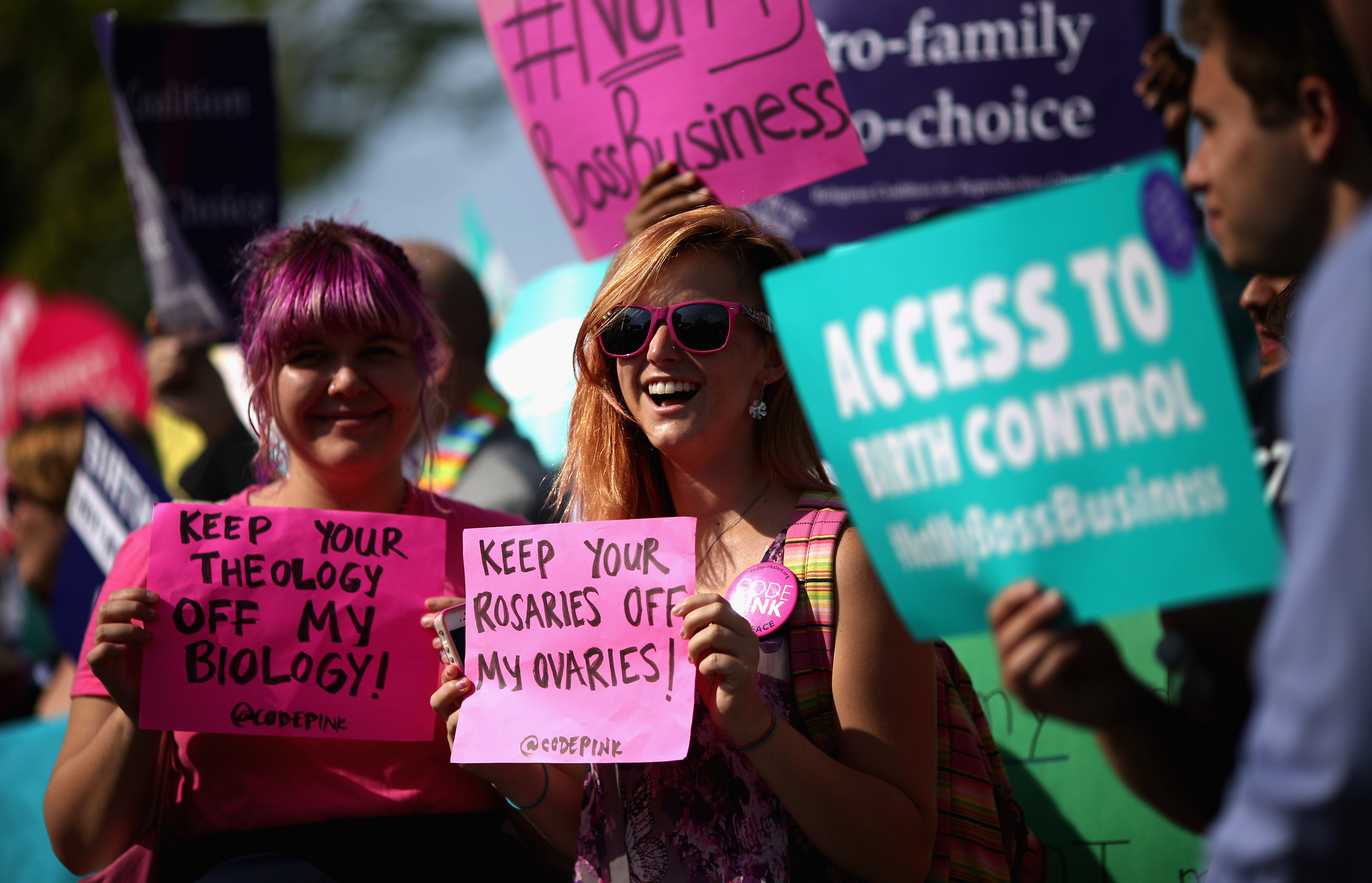
(Photo: Supporters of employer-paid birth control rally in front of the Supreme Court before the decision in Burwell v. Hobby Lobby Stores was announced June 30, 2014 in Washington, DC. By Chip Somodevilla/Getty Images.)

Why Am I Not So Alarmed By Hobby Lobby? Ctd

Iud

Some second day thoughts. (You can read a variety of new overnight bloggy reactions to the case here.)

First off, it still seems to me that the fury over banned contraception is de trop. Of the twenty forms of contraception mandated as covered in the ACA, Hobby Lobby agreed to fund all but four of them, the ones that could, in their view, be seen as abortifacients. I think they’re pretty obviously wrong about that as a scientific matter. In which case, the best counter-argument is to make is exactly that: their religious consciences are simply empirically misinformed. But that is not the argument being proffered.

Secondly, this case is effectively an affirmation of our new, libertarian order. Ross has a great blog post on this today. For the first time, evangelical Christians are pretty much a minority on a major social question (a few forms of contraception), and they are therefore, like many minorities before them, looking to the Court to protect them. Money quote from Ross:

On other culture-war fronts — same-sex marriage, most notably — the old dynamic still sort of shows up, with judges repeatedly overturning democratically-enacted (though, in many cases, no longer majority-supported) laws that religious conservatives tended to support. But on religious liberty, the old order is increasingly reversed, with conservative believers looking to the courts rather than the vox populi for protection against moves made by the elected branches, and especially the current national executive.

Why is this not overall a good development? I remain of the view that if this precedent leads to discrimination in employment against purported sinners, then it will be a death-knell for Christianity in America. If Christianity becomes about marginalizing groups of people, it will be a betrayal of the Gospels and a sure-fire path to extinction. And the Christianists will not win with that argument, as the marriage equality experience demonstrates. But if evangelical or orthodox Catholic Christians seek merely to protect themselves from being coerced by government in overly aggressive fashion – remember that the Obama administration lost this fight because they chose the maximalist position with respect to employer-provided health insurance and did not choose another, less invasive path of providing contraception – then I think that’s a paradigm worth encouraging.

Religion is best when it does not seek to impose itself on other people.

This, indeed, is the core heresy of Christianism – a desire to impose religious rules on others who do not share the faith. But when it seeks merely to carve out a space in a secular culture where it can operate as autonomously as possible, it is imposing nothing on anyone. It is merely seeking an exemption for itself. Yes, Hobby Lobby prevents its own employees, who may not be evangelical Christians, from getting four types of contraception. But nothing in the ruling prevents other ways of providing those options that do not violate anyone’s consciences. A single-payer provision, for example, would not incur any religious freedom issues. Which means that this decision is, in essence, a libertarian one. And the more the evangelical right seeks merely to protect its own rights, rather than imposing on anyone else’s, the better.

There is, in other words, a kernel here that could unwind Christianism as a domineering force in our multi-faith and multi-cultural polity. Perhaps liberals and old-school conservatives should cheer that, instead of hyperventilating quite as much as they did yesterday.

(Photo: An Iud by BSIP/UIG Via Getty Images)

The Best Of The Dish Today

I’m grateful for your many emails on the Hobby Lobby ruling. Almost all of them are dissents. And there’s one core point that we didn’t underline today that’s worth noting. When you consider this a “narrow” ruling because it is restricted to “closely-held” companies (i.e. those with “more than 50 percent of the value of its outstanding stock owned directly or indirectly by five or fewer individuals at any time during the last half of the tax year” and “not a personal service corporation”), you find that over 90 percent of companies in this country fit the bill. That’s not-so-narrow in the broad scheme of things. Alison Griswold notes:

According to a 2009 research paper from NYU Stern School of Business, these corporations account for 52 percent of private employment and 51 percent of private-sector output in the country.

Will they all decide they cannot furnish certain medications, based on religion? Of course not. But they could. And when the potential scope of this sinks in, and especially if more than a few companies start curtailing their female employees’ health coverage for religious reasons, I’d say you’re going to have a very divisive reaction.

Which raises the politics of this. I’d say it’s terrible for the right in everything but the short term. It may fortify the base, but the fact that this decision focuses exclusively on medications for women, and not for men, will surely fortify the other base even more. Even if you worry about religious liberty, why does religion in 21st Century America always seem to be about policing the sex lives of everyone but straight men? That may not be the intent of the ruling, but it is somehow always the effect. It’s not good PR. And neither is this attitude:

I have a feeling that the lack of any female votes in the majority will also sink in. If the Republicans want to add fuel to the Democrats’ charge of a “War on Women”, they just got a tank of gasoline. And this could even be a real fault-line in upcoming national politics. Bobby Jindal is now running as the religious freedom candidate; Hillary Clinton will be the first woman candidate for president with bells on. She has already declared the ruling “deeply disturbing.”

I’d say the gender gap just widened a bit more; and the Democrats – especially young and single women – have just been given a reason to turn out this November and in 2016. As often with culture war battles, the winners can easily become losers. And I don’t need to remind the right that those who have no problem with contraception are a growing, big majority demographic and those opposed to contraception are a tiny and declining one. If you’re going to take a stand on religious conscience, why does it have to be restricting women’s choices in their insurance coverage?

In non-Hobby Lobby news, we noted Facebook’s creepy manipulation of  users’ emotions – all for your own good, you understand; Putin got his comeuppance as Ukraine signed a trade pact with the EU; and I penned a mediation on our age of libertarianism – and its growing impact on foreign policy.

The most popular (well, read, anyway) post of the day was Why Am I Not So Alarmed By Hobby Lobby? followed by Jesus vs John Galt. I can’t help wondering if part of the Court’s rationale isn’t somehow informed by American conservatism’s bizarre and disturbing attempt to create a Randian Christianity.

Many of today’s posts were updated with your emails – read them all here.  You can always leave your unfiltered comments at our Facebook page and @sullydish. 15 more readers became subscribers today. You can join them here – and get access to all the readons and Deep Dish – for a little as $1.99 month.

See you in the morning.

We’re All Libertarians Now (Except David Brooks)

GERMANY-HISTORY-WALL

[Re-posted from earlier today]

In a characteristically astute and bracing essay, Mark Lilla recently remembered – with mixed feelings – “the grand drama of political and intellectual life from 1789 to 1989.” It strikes me as an important piece, because it comes at a propitious time to regroup and rethink recent history a bit more seriously. The world really did change in 1989, finally ending a period of two centuries of ideological struggle – a struggle that gave meaning and structure to billions of people on both sides. By the 1990s, the organized, intellectual armies of right and left effectively and slowly peeled away from a battlefield in which democratic capitalism (with varying levels of social welfare) had triumphed by default.

And I think Mark is specifically emphasizing: by default. Yes, the right, in many ways, won the philosophical argument. But the right’s victory left us domestically with a profoundly unreflective libertarianism:

Whatever ideas or beliefs or feelings muted the demand for individual autonomy in the past have atrophied. There were no public debates on this and no votes were taken. Since the cold war ended we have simply found ourselves in a world in which every advance of the principle of freedom in one sphere advances it in the others, whether we wish it to or not.

The core idea of this post-ideological new age was simply expanding the freedom of the individual – and it was embraced economically by the right, socially by the left, and completely by the next generation of pragmatic liberaltarians. Here’s what Mark posits as the core of the libertarian ethos:

This outlook treats as axiomatic the primacy of individual self-determination over traditional social ties, indifference in matters of religion and sex, and the a priori obligation to tolerate others. Of course there have also been powerful reactions against this outlook, even in the West. But outside the Islamic world, where theological principles still have authority, there are fewer and fewer objections that persuade people who have no such principles. The recent, and astonishingly rapid, acceptance of homosexuality and even gay marriage in so many Western countriesa historically unprecedented transformation of traditional morality and customssays more about our time than anything else.

Think also of the astonishing speed with which marijuana seems on its way to legalization.

One thing I’d emphasize: this outlook also deeply informs our view of the world and America’s place in it, in ways we are less familiar with. Just as government or some governmental authority Berlin During The Cold War: Then And Nowaxiomatically shouldn’t curtail an individual’s right to do what she wants and be who she wants, so a super-power, even a benevolent one, has no right to dictate the choices and fate of any other individual country, however despotic and evil its regime might be. This libertarian foreign policy is observed even in the breach. There is, for example, nothing to stop Putin from annexing Crimea – but he loses international standing and is increasingly isolated as a consequence. Ditto Israel’s constant excesses in the occupied West Bank; it goes on ad infinitum, but so too will Israel’s pariah status as a result. And, of course, the cause célèbre of this entire movement is the Iraq War, a catastrophe now regarded as utterly illegitimate by everybody on the planet, apart from a few Cheney dead-enders and Tony Blair.

In fact, the only addendum I would add to Mark’s argument is that libertarianism has had a much bigger impact in foreign policy than we care to admit.

To wit: if your axiomatic worldview is live and let live, and it permeates all your non-thinking prejudices, then interventionism abroad has a much higher bar to meet than in the past when it was justified by a dangerous and global state enemy or by a firm belief in a world-historical mission. In the wake of the triumph of the West in the 1990s, this was not obvious. So we over-played a somewhat triumphalist hand, expecting Western values, having vanquished Soviet and Nazi ideology, to spread spontaneously around the globe. So we pressed NATO to the Russian border, expanded the EU to 28 states, charted maps of democracy’s invincible rise across Asia and then, in a fit of hubris, actually decided to force it upon Iraq and Afghanistan of all places as a panacea to all the Islamic world’s ills as it struggles fitfully to come to terms with modernity.

We know better now – but that lesson means that the bar for intervention is future is likely to be extremely high. Legitimacy matters – and in the last ten years or so, America has lost most of its international legitimacy, whether the neocons and liberal interventionists recognize it or not. The question is: how do we respond to this? And there are, it seems to me, a liberal and a conservative option.

The liberal one is to fight back in defense of universal values, American droit de seigneur (also known as American exceptionalism), and democratization as a sacred duty. Which is why, when push comes to shove, David Brooks is a liberal. His column in response to Lilla’s essay uses a peculiar word – “spiritual” – to define his crusade:

Such is life in a spiritual recession. Americans have lost faith in their own gospel. This loss of faith is ruinous from any practical standpoint. The faith bound diverse Americans, reducing polarization. The faith gave elites a sense of historic responsibility and helped them resist the money and corruption that always licked at the political system. Without the vibrant faith, there is no spiritual counterweight to rampant materialism. Without the faith, the left has grown strangely callous and withdrawing in the face of genocide around the world. The right adopts a zero-sum mentality about immigration and a pinched attitude about foreign affairs. Without the faith, leaders grow small; they have no sacred purpose to align themselves with.

So in response to the end of ideology, Brooks wants a new-old one, a national commitment to “universal democracy” (undefined) that is sacred. If we don’t have that faith, we are somehow reduced. I guess I’m just being an atomized individual, but my own “counter-weight to rampant materialism”, for example, is Christianity. But this faith is, for David, insufficient. It doesn’t strengthen the nation! I must join some Berlin During The Cold War: Then And Nowcollective, secular spiritual mission to complete my life and one, moreover, that goes out into the wider world to find monsters to destroy or countries to civilize. The fact that this ideological mission is deeply out of step with this moment in world history and has just been discredited on a massive, comprehensive scale sails past the need for it to exist in Brooks’ mind. Which is my best read on the cognitive dissonance in the column.

But there is another, saner response to this, and Lilla points the way. It is to re-exercize the intellectual muscles that created and then defended the idea of democratic capitalism – and to use them, first of all, to address the democratic deficits in our own too-often bought-and-paid-for republic, to build and defend intermediate institutions that check individualism’s acidic power – families, churches, neighborhoods, school-boards, sports leagues, AA meetings. And so we match gay freedom with gay marriage and military service, embracing libertarianism but hitching it to institutions that also connect it to the community as a whole. Abroad, the sane response to our political and intellectual moment is to abandon the crude idea that democracy – purple fingers and all – is all that matters, and direct our attention at the specific things that make a difference in very different societies, and away from the grand principles and systems that cannot be imposed by force or even constant suasion.

Lilla puts it this way:

The big surprise in world politics since the cold war’s end is not the advance of liberal democracy but the reappearance of classic forms of non-democratic political rule in modern guises. The break-up of the Soviet empire and the “shock therapy” that followed it produced new oligarchies and kleptocracies that have at their disposal innovative tools of finance and communication; the advance of political Islam has placed millions of Muslims, who make up a quarter of the world’s population, under more restrictive theocratic rule; tribes, clans, and sectarian groups have become the most important actors in the post-colonial states of Africa and the Middle East; China has brought back despotic mercantilism. Each of these political formations has a distinctive nature that needs to be understood in its own terms, not as a lesser or greater form of democracy in potentia. The world of nations remains what it has always been: an aviary.

For which you need an aviarist, not an ideologue.

Even though it seems foolish to deny that most countries still seem headed over time toward Western norms (Fukuyama remains basically correct), in the here and now, all sorts of hybrids are forming and will form, as they always have. Our goal in foreign policy is to understand them better by using the vast apparatus of political philosophy bequeathed to us by our Western canon, and tapping into our collective reserves of diplomatic and military experience, and adjust accordingly. That means bracketing the simple democracy-spectrum and looking for how to deal with various forms of oligarchy, kleptocracy, or emerging democratic society. Now and again, a little nudge might help (see the Balkans in the 1990s). But for the most part, the changes we want will happen without us (Tunisia, anyone?), and the places where we simply act as if the world were a blank page ready to be filled by democracies (Israel, Libya, anyone?) will turn out to be a case study in the frequent destiny of good intentions.

What Mark is saying, it seems to me, is that only conservatism, properly understood, can rise to the challenge of governance in this post-ideological age. And conservatism in America is, alas, as widely misunderstood as it is routinely ignored.

(Photos: 1) Roses stuck in a gap of the memorial of the Berlin Wall on November 9, 2013 on occasion of the 24th anniversary of the fall of the Wall. By Stephanie Pilick/AFP/Getty Images. 2)In the first composite image, a comparison has been made between Berlin in the 1960s and Berlin now in 2014. In the color photo above traffic, cyclists and a horse-drawn carriage carrying tourists make their way across the intersection of Friedrichstrasse and Zimmerstrasse at former Checkpoint Charlie on April 1, 2014 in Berlin, Germany. In the black and white photo Soviet tanks (behind) and U.S. tanks confront one another at the same location on October 26, 1961. By Keystone-France/Gamma-Keystone via Getty Images. 3) In the second composite image, the color photo shows a man walking a dog past the memorial to the Church of Reconciliation, which was demolished by East Berlin authorities to make way for a widening of the Berlin Wall, in Bernauer Strasse on February 25, 2014 in Berlin, Germany. In the black and white photo people in West Berlin look at an early version of the Berlin Wall in front of the church at the same location sometime in 1961 or 1962. By Imagno/Hulton Archive via Getty Images.)

Why Am I Not So Alarmed By Hobby Lobby?

Supreme Court Rules In Favor Of Hobby Lobby In ACA Contraception Case

The obvious damning answer is that I am a man and no one has taken anything away from me – indeed the all-male majority who upheld Hobby Lobby’s religious rights specifically barred any procedure other than female contraception. If they did that for prescriptions for Truvada, for example, I might react differently. And I take that point. But its flipside is that this was a very narrow ruling, and the limiting of it to closely-held corporations, in which a small group of people with identical religious convictions can dictate the details of health insurance coverage they pay for, is not the great exemption for religious beliefs that some were fearing. It does not apply to publicly traded companies, for example. Here’s the reassuring language from Alito:

This decision concerns only the contraceptive mandate and should not be understood to hold that all insurance-coverage mandates, e.g., for vaccinations or blood transfusions, must necessarily fall if they conflict with an employer’s religious beliefs. Nor does it provide a shield for employers who might cloak illegal discrimination as a religious practice.

Of course, employment discrimination against gay people is legal discrimination in many states, so this may not seem much comfort. But I suspect that if closely-held religious companies start firing people explicitly because they are gay and therefore not kosher, the prospects for both a federal employment non-discrimination law and a heightened scrutiny ruling for gays improve considerably. And the recourse in this case is a pretty simple one: just extend the existing third party arrangements for religious institutions to closely held, religiously based companies. The main worry – Ginsburg’s – that this could create a dangerous and expansive precedent seems a little overblown to me. If anything, the real precedent is the Religious Freedom Restoration Act, and that remains at the Congress’s discretion, not the Court’s.

But none of this is to say I find this development a positive one for religion.

A Christianity that seeks to rid itself of interacting with sinners or infidels is not a Christianity I recognize. A Christianity that can ascribe the core religious nature of a human being to a corporation is theologically perverse. Corporations have no souls. They do not have a relationship with God, as Jonathan Merritt points out here. And a Christianity that seeks to jealously guard its own defenses rather than embrace the world joyfully and indiscriminately is not one that appeals to me.

But in some ways, this can be seen as a libertarian ruling. It reframes the argument of the religious right toward the libertarian one of self-defense, rather than of the imposition of religious standards on others. And as long as women can have easy access to free or subsidized contraception through Obamacare by another method, it can rest sturdily on that foundation.

The worry, it seems to me, is that it further restricts the area of neutral public life. It turns the world of business into something much more like a world of theology. It chips away at the notion of a naked public marketplace, where we can leave our faiths behind and simply buy and sell goods and not worry about anyone else’s religion or lack of it. And that’s a loss. But if it is restrained adequately and imposed narrowly, not that great a one. And if we can lean on the side of religious freedom – even of the defensive and narrow variety – without restricting the actual access to some forms of contraception, why shouldn’t we?

(Photo: Sister Caroline (L) attends a rally in Chicago with other supporters of religious freedom to praise the Supreme Court’s decision in the Hobby Lobby case on June 30, 2014. Oklahoma-based Hobby Lobby, which operates a chain of arts-and-craft stores, challenged the provision and the high court ruled 5-4 that requiring family-owned corporations to pay for insurance coverage for contraception under the Affordable Care Act violated a federal law protecting religious freedom. By Scott Olson/Getty Images)