The “Simplification” Of The Issues

Refugees Fleeing ISIS Offensive Pour Into Kurdistan

Every now and then, a blast of cold sanity greets the world. At least that was my reaction reading Tom Ricks respond to the idea that if Obama had somehow been able to leave 10,000 troops in Iraq, all would now be well. Au contraire:

That’s nonsense. If we had the force there, what we’d be doing now is facing this question: Do we retreat ignominiously and get the troops out of the country, or do we use them in a wayor do we find ourselves forced to use themin a way we don’t want to, supporting Maliki without reservation? Or do they just sit there inside their camp gates and everybody mocks the Americans for doing nothing?

So I think by not having troops on the ground there it greatly simplified the issues for the United States and actually gave the United States more leverage rather than less, because clearly Obama does not simply want to act on Maliki’s behalf. I think Obama sees Maliki more at fault here than he does the Sunnis.

Exactly. But what does it mean to say that we now have a “simplified” set of issues? Here’s what I think: we have a real fork in the road here.  Only the deranged believe the Iraq war was anything but a disaster. But the question now is: will further intervention make already-horrible matters worse or slightly better?

My best bet (and, of course, I could be wrong) is that it will make matters immensely worse, entangling us in a completely lose-lose scenario from which we have only just extricated ourselves. I can’t see how we intervene neutrally; I can’t see how Iraq can be put back together again without some kind of sectarian and national catharsis; and I don’t think the US should be taking a position – and an inconstant one at that – in the epochal Sunni-Shia battle that goes back centuries. In fact, I think it’s verifiably insane that we should even think of taking such a position.

So what are the obvious costs of staying out? The main one is the danger posed to the US by a Jihadist haven in Sunni Syria and Iraq. But do we have a real grasp of that danger? Recall that – thanks to Obama – the chemical weapons threat has been removed from the table, just in time. Do they want to come find us here? Well, Mr al-Baghdadi has so threatened, but not even Dick Cheney thinks he’s ready to attack the US yet. Americans who have gone on Jihad in Syria? You bet. And if we don’t have extremely close monitoring of them, we need to.

But we’ve seen from the past that terror attacks can just as likely come from Jihadist servicemembers as well as troubled Boston teens from the Caucasus. Deciding that the religious fanatics in Syria are an imminent threat to the US – as opposed to all the other possible imminent threats – makes little sense to me, given that they currently have their hands extremely full preparing to face off against Shiite militias on their sacred soil. Perhaps that’s why the Cheneys have been going around doing their mushroom cloud act again. It’s only if you’re scared shitless will you do the kind of radical re-invasion of Iraq that Cheney is – yes he is – advising.

But what if we refuse to be scared shitless? What if we take a deep breath and see the resilience of Islamist terror as something we have little control over, as the Middle East enters a convulsive new era – except to exacerbate it by invasion, torture and, after a certain point, drones. What if we treat other people’s civil wars as if they are other people’s civil wars? If the Saudis and the Iranians want to get in each others’ faces, why should we insist on getting in between them, and inevitably failing anyway? The key for us to make sure WMDs are not in any equation to prevent any real catastrophe – which is why the agreement with Iran is more important now than before. If we can do that – and we’re almost there – it seems much saner to wait and see than rush in and regret.

The deeper debate is between those of us who long to see the US with a much, much lighter footprint in that hellish region, see energy independence as a real opportunity to pivot away for good, and get on with more pressing needs at home, and more relevant questions abroad – and those who see the US as an indispensable hegemon in the Middle East for ever. Check out Dick Cheney yesterday on the Hugh Hewitt show – a hathos-fest if ever there was one:

[ISIS’] long term goal and objective appears very much to be that of driving the U.S. out of the Middle East. That’s very high on their list of priorities. And remember, that was Osama bin Laden’s objective when he came here and hit us on 9/11, to drive the U.S. out of the Middle East. Obama’s policies, in effect, have been taking us in that direction.

Well, he’s not wrong there, is he? But I bet you if you asked the average even Republican voter, they’d say that’s a thoroughly good thing. And they’d say that in part because the Bush-Cheney administration was a virtual crash-course in its merits. Trillions of dollars, hundreds of thousands of death, thousands and thousands of wounded or traumatized soldiers … and for what? You think Iraq’s Shiites have the slightest fondness for us? You think the invasion and occupation helped American power projection across the globe? You think it won over the hearts and minds of the Arab or Muslim worlds?

What Osama bin Laden wanted, it seems to me, was to bait the West into a direct fight on Muslim soil. That immediately elevated the cause of jihad, internationalized it, galvanized a generation of religious fanatics, and, even better for the radicals, broke a country in the heart of the Middle East so that sectarian violence could be exploited for further radicalization. Obama’s great achievement has been to steer the US, so far as possible, away from taking that poisoned bait. Cheney’s achievement was to fall for it, hook, line and sinker.  I say this as someone who also took the bait – with good intentions and in good faith, but blinded by trauma and ignorance. The choice we face is really between those two long-term strategies for surviving the Islamist wave. I favor Obama’s. I favor the future over the past.

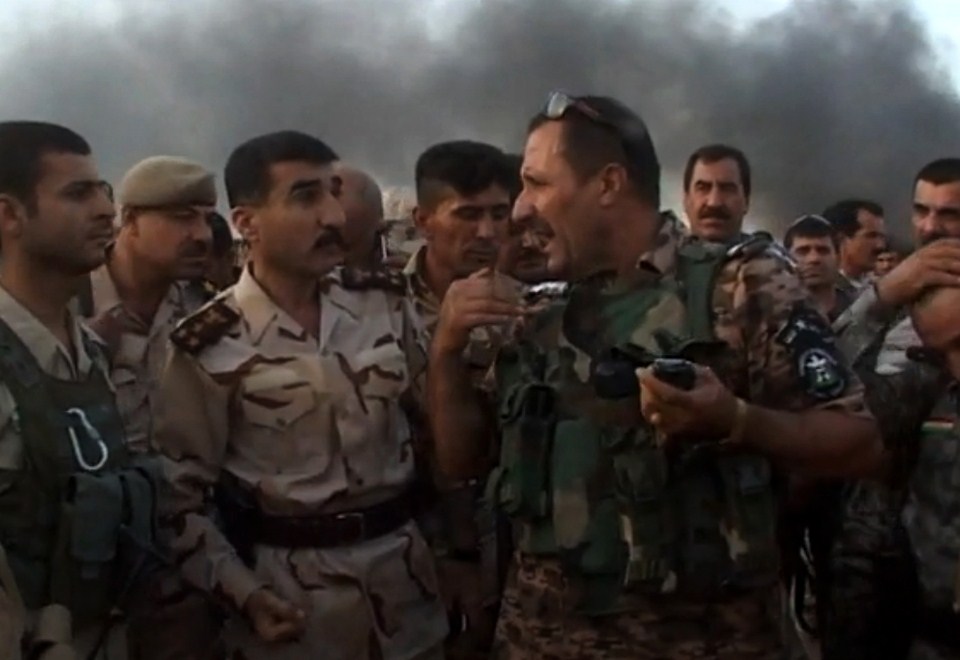
(Photo: Kurdish soldiers with the Peshmerga keep guard near the frontline with Sunni militants on the outskirts of Kirkuk, an oil-rich Iraqi city on June 25, 2014 in Kirkuk, Iraq. By Spencer Platt/Getty Images)

Raging Against Obama – And History

President Obama Delivers Statement On Situation In Iraq

[Re-posted from earlier today]

If you’re looking for a majestically sweeping indictment of everything president Obama has achieved in foreign policy over the last six years, go read Walter Russell Mead’s screed. The rise of an ISIS-led Sunni insurgency in Iraq is, apparently, “a movement that dances on the graveyard of his hopes.” No one wants to take on the emperor with no clothes or “the full and ugly course of the six years of continual failure.” He’s not done yet: “Rarely has any American administration experienced so much ignominious failure, or had its ignorance and miscalculation so brutally exposed.” And on it goes. The Obamaites “have piled up such a disastrous record in the Middle East” that they couldn’t be trusted to “negotiate their way into a used car lot.” And the final denouement:

The President isn’t making America safer at home, he doesn’t have the jihadis on the run, he has no idea how to bring prosperity, democracy, or religious moderation to the Middle East, he can’t pivot away from the region, and he doesn’t know what to do next.

Inevitably, when one reads a piece like this, you expect the author to tell us what he would do next. If the results of specific Obama policies have been so disastrous, then surely he must be able to point to several mistakes, offer an alternative in hindsight, or, heaven forfend, provide a constructive proposal today. But you will, alas, find no such thing in the screed. The most you’ll get it this:

How could the U.S. government have been caught napping by the rise of a new and hostile power in a region of vital concern? What warning signs were missed, what opportunities were lost—and why? What role did the administration’s trademark dithering and hairsplitting over aid to ISIS’s rivals in the Syrian opposition play in the rise of the radicals?

Indeed, I’m sure those questions will be debated by pundits and historians. But Mead has no answers. He supported arming the “moderate” Syrian rebels, sure, but even he acknowledged this could end up in tears. And when you grasp his admiration for ISIS’ strategic chops, it seems quite likely that American arms could have ended up in the Jihadists’ hands. After all, one result of the US’ arming, training and equipping the moderate Iraqi army are the humvees and arms being paraded around Iraq by the Sunni-ISIS insurgency today. Arming any single side in a complex, metastasizing conflict is fraught with unintended consequences and the constant risk of blowback. But even if we’d been able to arm genuinely “moderate” Syrian rebels, does anyone believe they would prevail in an internecine war with the true fanatics?  From the record of the last year or so, almost certainly not.

Mead also manages to blame Obama for the failure of the democratic revolution in Egypt. Quite how the US president could have changed the course of Egyptian politics in a period of massive unrest and revolution is not entirely clear. And that’s really the deepest flaw in the case against the president. There is an assumption – even now! – that the world is controlled by the US and that everything in it is a result of American hegemony. So there are no places on earth where the US is not a factor, and any bad things that happen are ipso facto a consequence of poor foreign policy. The planet is “Obama’s brave new world,” and the actual actors in it, from Moscow to Fallujah, from Qom and Cairo, are denied the real agency they have and keep exercising. And of course, whatever Obama has done has failed. When we don’t intervene, as in Syria, the result is a disaster. When we do intervene, as in Libya, the result is “an unmitigated disaster from which not only Libya but much of north and west Africa still suffers today.” So what does Mead suggest? This is as good as it gets:

The U.S. might do better to try to strengthen the non-ISIS components of the Sunni movements in Syria and Iraq than to look to Tehran and the Kremlin for help.

As they still say in Britain’s Private Eye, er…. that’s it. We should actually be arming the very Sunni forces that are trying to take Baghdad, and somehow hoping they’ll turn around and beat the fanatics if we ask nicely. Well, thank you very much, Mr Mead. How could the administration have ignored your genius for so long?

I think what’s missing from Mead’s harrumph is any sense that the world is, in the end, not about us; that the Arab and Muslim worlds are in a historic convulsion that has been fed by countless tributaries from the past and will forge many unexpected paths in the future; that the generational shifts, the impact of new technology and media, the decay of traditional Islam, the rise of an Internet Islamism, the legacies of the sectarian war in Iraq and the Assad despotism in Syria, and the rise of a new Shiite awareness … all these represent forces we have no way of arresting, let alone controlling, let alone micro-managing, as Mead suggests. Our role, if we are not to become insane, is not to manage the unmanageable; it is to understand that some historical processes have to take place and that some of them will not necessarily be in our interests.

Interventionists, in other words, can become like addicts.

Yes we need the courage to change the things we can change (like our surveillance, security and intelligence apparatus), but also, critically, the serenity to accept the things we cannot change (like the future of the younger Arab and Muslim generations or that of the ancient Sunni-Shia struggle), and the wisdom to know the difference. Interposing ourselves even now as the indispensable overseer and arbiter of the fate of Iraq and Syria and the Middle East is to further engage in the fantasies that still linger from the elysian period of 1989 – 2001. If we haven’t learned from the last decade and a half that our assumption of that control is a self-defeating chimera, then we’re incapable of learning anything.

Even with unlimited resources, a decade of effort and death and suffering on a vast scale, we were unable to change the reality of Iraq: a divided traumatized, sectarian mess, where the Sunnis believe they have a right to rule, the Shia have somehow regained power, and the Kurds could give a shit about either. Maybe it should have occurred to us that there has not been majority Shiite rule in Iraq for so long for a reason. Maybe Maliki’s dictatorial impulses were not some wanton decision to destroy Iraq, but a rational move if you are actually trying to govern Iraq as it is, just as Saddam’s despotism was. What amazes me about critics such as Mead is that they have learned no deeper lessons from this; they still, rather pathetically, cite the surge as a success, when it clearly did nothing but bribe a phony peace into temporary existence in order for us to leave … and the old order of things return. And they still cling to a worldview in which everything is run from Washington.

But it isn’t. Our long-term goal is the emergence of a peaceful, democratic Middle East that does not export terror and medieval fanaticism across the globe. And we’ve seen the first spasms of that process: the ousting of tyrants, the failures of revolutions (with one notable success in Tunisia, one place where we haven’t intervened), and the ructions of a youth movement in Iran. But we have barely seen the next phase – and it will surprise us, I’m sure. The great religious wars in Europe burned (literally for some) for a couple of centuries. And it was only the bitter, collective experience of those endless, brutal, bloody wars that persuaded the majority that they weren’t worth fighting any more. At some point we have to ask: why are we spending lives and treasure and attention to prevent that outcome from coming sooner rather than later?

(Photo: Barack Obama yesterday by Chip Somodevilla/Getty.)

The Case Against The Case Against 8

I watched the HBO documentary on the Prop 8 case over the weekend – and also had a drink in Ptown and then a lively breakfast discussion with the directors, Ryan White and Ben Cotner, who were as intelligent and as sincere as you could hope for in two young documentarians. And the first thing to say about the doc is that it is not as egregious or as misleading as the Becker book or the Olson-Boies exercize in self-love and credit-grabbing. Instead, its main impact on most viewers will be a net-positive in its portrayal of the moral and legal arguments for marriage equality. And the focus is mercifully on the human story of the plaintiffs, the best angle for a documentary that won’t bore you. I found its most affecting scenes to be toward the end, as the two plaintiff couples finally get their chance for a civil marriage that cannot and will not be taken away. You have to have a heart of stone not to be moved. And there are internal trial preparations that really spell out why civil marriage is non-negotiable if equal protection means anything in a civilized society. It was indeed great to hear arguments many of us honed in earlier, lonelier times come back in the words of the trial.

Maybe it’s because I’m used to these arguments at this point, but the film dragged a bit for my taste. It lost what would have been a key opportunity as it was being filmed  – because the trial was supposed to be televised and then wasn’t. Without those scenes, the film focuses, understandably, on the plaintiffs. The trouble with this strategy is that, in a highly-visible lawsuit, they’ve been selected precisely because they are picture-perfect, squeaky-clean representatives of the gay community. There are no quirks in their background that could be exploited by the other side in the legal drama (or appeal to viewers); their families are all supportive; their blond, attractive children are behind them; their only conflicts, so far as we can tell, are which ornament to place where on the Christmas tree (a scene that is included in the soft-lens political-ad style of the movie). Similarly, there are no flaws whatsoever in any of the “good guys” and all the opponents are hateful, irrational bigots. No one among the good guys has a fight in the movie; no one even as so much as a disagreement. Ted Olson and David Boies get a treatment like subjects in an old Catholic “Lives of the Saints” primer. Griffin is portrayed as in the trailer above: a lone bucker of the trend who single-handedly brought gay equality to America. The number of hugs per frame is beyond counting.

It all feels like a really slick p.r. campaign – or a propaganda movie they’d show at some endless gay fundraiser – rather than an objective or inquisitive documentary. That was Hank Stuever’s view as well. It’s a movie not about a civil rights moment, he argues, but about “the values of show business and mass marketing.” And when you’re marketing something, you show no wrinkles or flaws. You carefully stage every single thing to advance the product.

So there are no interviews with any marriage equality opponents to make their case. There are no interviews with anyone who worried about the lawsuit’s possibly unintended consequences (they are dismissed by Chad Griffin in the film as in-fighting cowards). There is no mention of Olson’s unique demand in the history of marriage equality litigation to be paid $6.4 million rather than work pro bono. There is no interview with Charles Cooper, their chief legal opponent. No facts or ideas of arguments are allowed to get in the way of the triumph of Chad Griffin’s will. And that includes the actual denouement of the case, which was, as Mark Joseph Stern notes today, a clear and demonstrable failure.

Everyone knew from the get-go that this case could well turn on the rather mundane legal issue of “standing,” rather than on any deeper constitutional issues regarding the civil rights of gay citizens. That was one reason I was fine with the suit – because I thought it could play a role in the public education necessary to overturn Prop 8 at some point, and would probably not do any real harm on a federal level because it would likely be dismissed on technical grounds. But that’s emphatically not how the film portrays it.

This was always, from the film’s perspective, and in the words of Griffin’s PR partner, Kristina Schake, in the movie “one of the most important civil rights cases ever before the Supreme Court.” That’s demonstrably untrue – but remains, like all the statements from Schake and Griffin, unquestioned in the film. (There is no narrator, so the subjects of the documentary who gave the film-makers exclusive video access, essentially dictate the message of the entire film – which, since they are the p.r. maven behind all of this, is only fitting.) The case had the great and wonderful effect of ending Prop 8, but outside California, it only upheld Supreme Court federal precedents on the matter of “standing.” And the entire rationale of filing the suit was to change the federal situation, not the state one. So, on its own terms, the lawsuit failed. And yet the film does all it can to hide that fact, introducing the “standing” issue only when they had no choice at the very end (and never before), and breezing right past it to conflate the Windsor case and the Perry case as if they were both landmark victories.

So the re-writing of history is done by omission, elision and sleight of hand, rather than by egregious slander. And so the Perry decision is counter-posed just before a series of breakthroughs in marriage equality, as if it were cause and effect. You’d have no idea that marriage equality was already nationally at 46 percent support – up from 27 percent in 1996 – before Prop 8 came along at all. Or that we already had marriage equality for four years in America, with momentum building fast.

We are also told, by Chad Griffin, that before Ted Olson, marriage equality wasn’t even a Democratic issue, let alone a Republican one – “it was only the left of the left” that supported it. Getting Olson “changed everything” in making the national debate bipartisan. But this again is untrue. The marriage equality movement was born as much on the right as the left, and has had gay conservatives and Republicans on its side since the late 1980s. As for Republican figures, Dick Cheney, the Republican vice-president of the United States for eight years was for it; Alan Simpson, Republican folk hero, was for it; Bill Weld, the Republican governor of Massachusetts, where marriage equality first became a reality, was for it in the 1990s; and you’d think the Californians would also be aware that the Republican governor of California, Arnold Schwarzenegger, supported it as well as around 30 percent of Republican voters. Absolutely getting Ted Olson to argue the case was a major coup, as was his adoption of most of the arguments conservatives had been making on this subject for years. But the idea that he alone changed the partisan debate on this is surreal.

Then there are distortions about those who opposed this lawsuit. We are told – again with no balancing counter-view – that the Perry federal suit was “years before this was supposed to be happening.” Really? Then how did the Windsor case arrive at the same time – and with much broader impact? Does anyone think that Prop 8 would have survived the Windsor decision anyway? Several other state bans have fallen by the wayside since, because of the Windsor – not the Perry – case. And that, of course, tells you something about the irrelevance of this case to the broader marriage movement. It was, in the end, unnecessary; it failed to move the federal needle a jot; and it needlessly divided and embittered a usually united, if fractious, coalition.

None of this will be apparent to the vast majority of people who watch this film. The emotional human power of the plaintiff’s stories will obliterate any skepticism an audience might have about the historical accuracy of the film, and liberal supporters of marriage equality will simply stand and cheer (as well they might on the core question). Anyone opposing marriage equality will be turned off by this movie’s crude assumption that only raw hatred can explain their views. As for the rest of us who have lived through a history this movie ignores or dismisses in its massive over-selling of this single case, well, we’ll just have to wait for a documentary or a history that does justice to the whole sweep of it. And that may be a long time coming. The opportunists and self-promoters have to have their say first.

About That Iraqi Democracy: Forget About It

One might be forgiven for thinking that the catastrophic war in Iraq was designed to bring democracy and sovereignty to that nation after a brutal, foul dictatorship. That, after all, was what we were told from the get-go, along with the alleged threat of non-existent weapons of mass destruction. Many service-members died to bring that democracy about; almost 200,000 Iraqis died in the bloody transition. And they elected a prime minister; and re-elected him in fair elections. And yet now, courtesy of the CIA’s unofficial spokesman, David Ignatius, we hear that Maliki is nonetheless going to be deposed by the US:

President Obama sensibly appears to be leaning toward an alternative policy that would replace Maliki with a less sectarian and polarizing prime minister — and then begin using U.S. military power on behalf of this more broadly based government. The White House is already mulling a list of alternative prime ministers.

So the whole pretext of Iraqi democracy was a sham, and we now know this without a shadow of a doubt. The next leader of Iraq will be IRAQ-UNREST-VOLUNTEERSpicked in Washington, and not by the people of that country. And the right of an elected government to choose its own policies and direct its own governance – for good or ill – has been effectively rendered null and void. There’s never any welfare reform with imperial welfare. They are to be dependents for ever. And, of course, the CIA’s previous regime changes in the Middle East – Iran, anyone? – do not even merit a mention. Just because they have screwed it up every single time doesn’t mean they don’t have the absolute right to screw it up again. Because the residue of their own disasters can be used to justify yet more ones. Just ask Fred Hiatt.

As with most imperial projects – and what other word can be used to describe the embedded assumptions in Ignatius’s column? –  Washington will use local power-brokers to implement its designs. Ignatius is perfectly candid about the rawness of the imperialism involved:

The people who will pull the plug on Maliki are Kurdish leader Massoud Barzani and other Iraqi kingmakers. The United States should push them to signal unmistakably that Maliki is finished. And they must do so in coordination with Iran, which will effectively have a veto on the next Iraqi prime minister, whether we like it or not.

Notice the lack of any subjunctive. The Kurdish leader will do what he is told; the Sunni tribes must cooperate with Iran. This is the mindset of the CIA, a beyond-the-rule-of-law organization that has done more damage to this country’s interests and values than any other organ of state. The contempt of these imperialists (who brought torture into the American bloodstream) for the autonomy of any other country is a striking as their contempt for American values.

So Ignatius admits that this illegal intervention needs “political cover”from other interested parties in the region (all of whom have ulterior motives and almost all of whom have contributed to this burgeoning sectarian warfare). And the goal now is to intervene simultaneously in Syria’s civil war, to the tune of training up to 10,000 “Syrian moderates” (try not to laugh out loud or burst simultaneously into tears).

And the entire point of this exercise is to get another war up and running – and soon – in Syria and Iraq:

Targeting ISIS perhaps could begin with its safe havens and infiltration routes along the Syria-Iraq border, where there’s less chance of hitting Sunni tribesmen. “We know where their base camps and training camps are, which is where we can start — and it’s important to start,” says U.S. Central Command adviser Derek Harvey.

Yes, “it’s important to start”. Sure, we don’t know where any of this could lead – but the one thing we have learned this past decade and a half is to launch a war first and figure out those questions later. Intervening in two sectarian countries just adds to the challenge, I guess. It’s so good to know someone advising Central Command has absorbed the lessons of the past so well.

I’m distressed by the news out of DC and alarmed by Obama’s presser, but I haven’t given up on the president yet.

Ignatius is voicing the CIA’s agenda, as usual, not necessarily the president’s. In his presser today,

Mr. Obama insisted that the United States would not press for Mr. Maliki’s replacement by a new leader. “It’s not our job to choose Iraq’s leaders,” he said. But he added, “Right now, there’s too much suspicion, there’s too much mistrust.”

And yet 300 military “advisers” and the possibility of air-strikes is how wars start. And the president has been woefully supine when it comes to confronting the lawless incompetence of the CIA for the past six years; and once military strikes begin, we’re back to square one, trying to control a country we do not understand and cannot master, taking the bait of all sorts of interested parties, who will use us as they have used us in the past to promote their own agendas. The president also signaled he is leery of Ignatius’ utopian notion of 10,000 “Syrian moderates”:

He cited the difficulties in deciding whether to arm members of the opposition. “If you have former farmers or teachers or pharmacists who now are taking up opposition against a battle-hardened regime,” he said, “how quickly can you get them trained?”

And how do you know that after they’ve been trained and equipped, they won’t turn around on a dime like the Iraqi army just did? This is the Arab Middle East. There is no trust there. And there are no reliable allies.

In my view, this is not a conflict in which you can half-intervene. By some miracle, we extricated ourselves at great loss. And yet the breezy tone in Ignatius’s column and the decision by Obama to send Special Forces advisers to Iraq suggest something more ominous still. So let me reiterate something: in my view, the one thing Obama pledged never to do he must never do. For me, re-entering the Iraq war – which is what US-targeted airstrikes with Special Forces on the ground against ISIS would do – is a deal-breaker. In one move, it could obliterate Obama’s entire foreign policy legacy of deleveraging the empire and effectively treat the American people as irrelevant. It would also instantly make the United States a prime target for these religious fanatics.

So this is truly a test of the president’s mettle. Will he stand up for the American people and follow his own instincts or cave to the CIA and the hyperventilating Beltway? His presser today both reassured but also worried me. I worry because I have learned the hard way that the elites in Washington like to treat the world as a garden to tend, they have never seen a crisis they don’t think they can solve, and they love to imagine themselves in the vanguard of the good and the true, even if all their recent interventions have led to mass murder and lies. This goes for Democrats as well as Republicans. And when the imperial complex sees a new opportunity to enlarge its power and money and relevance, they tend to have their way. Because they always have their way, and until we elect someone with the spine to rescue us from this eternal, corrosive, imperial quicksand, they always will.


UPDATE: A couple of sentences in Ignatius’ piece have been changed. Details here.

Iraq: You Broke It, You Bought It? Ctd

Bush Asks Congress For $74.7 Billion In War Aid

Noah Millman responds to me by insisting he does not favor military intervention in what’s left of Iraq, but that my own formulation of “letting go of global hegemony” is too glib and too blithe. As for the US having an indirect responsibility to the people of Iraq, having invaded their country eleven years ago, here’s the money quote:

My definition of “indirect responsibility” is simply to say that once you have positioned yourself as a global hegemon, declared yourself “indispensable” and arrogated to yourself rights that are not granted to any other state, of course you are indirectly responsible for just about everything that happens, to a greater or lesser degree depending on the situation. The madness lies not in my description of reality but in the reality itself. We should seek to change that reality. Perhaps I am overly pessimistic, but I assume that this will be a difficult and lengthy labor, with many setbacks along the way. I am hard-pressed to name another hegemonic power that acceded peacefully to a more multi-polar reality.

And on that point, we can surely agree. There are, indeed, very few empires that “let go” without hanging on indefinitely and then succumbing to a sudden collapse. One wonders what would have happened to the British Empire without the Second World War. But that’s only the case with respect to meddling in other countries’ internal affairs, trying to shape the form of government in other countries, or feeling obliged to prevent evil whenever it emerges. It seems to me perfectly possible for the US, by virtue of its naval and air power to secure the critical shipping lanes for international trade and travel, to bolster democratic allies with trade, intelligence, and mutual security arrangements, while eschewing the kind of global micro-management that was once justified by the Cold War or rationalized by unchallenged unipolar power from 1989 – 2001. Will that mean some regional actors filling the vacuum?

Of course. Hence Russia’s bullying of its near abroad and the Chinese attitude in the Pacific.

But these regional shifts do not, it seems to me, directly injure American national interests – what on earth did meddling in Libya achieve? – and can, in fact, lead to somewhat better outcomes, in as much as they might facilitate a more stable balance of power between countries with a much better grasp of their own neighborhoods than we have. Will this mean unpleasant outcomes for some? Alas, yes. But a foreign policy based on preventing unpleasant outcomes for millions of foreigners is not a foreign policy at all. It is a pretentious posture, underwritten by solipsism and hubris.

So, yes, there will be blood. But given our massive – historically unprecedented – global over-reach, some of this is inevitable as we retrench to saner, more sustainable limits. Is this difficult and nerve-wracking process without risk? Of course not. Is the alternative begging for the sudden collapse so many over-reaching, self-bankrupting empires have experienced? You bet it is.

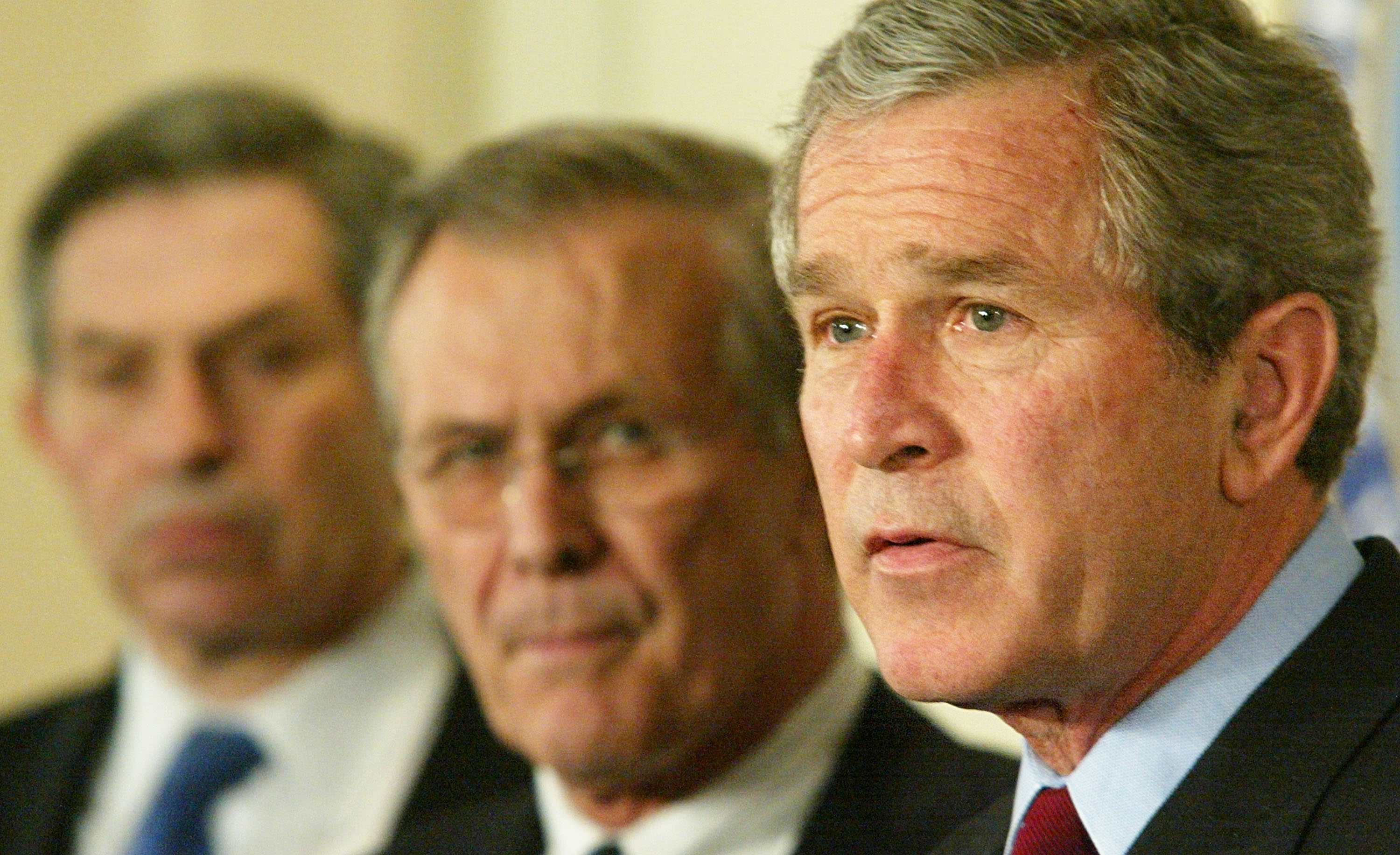
(Photo: three neocon musketeers in 2003, by Alex Wong/Getty.)

No Drama Obama And Iraq

US-POLITICS-OBAMA

While Iraq unravels, Lexington appreciates Obama’s temperament:

In and of itself, his cool, cerebral analysis is often more rational and less hypocritical than the criticism raining down on him from his political opponents. Republicans in Washington, knowing full well that voters have precisely no appetite for a return to Iraq, content themselves with accusing the president of allowing the world to fall apart and emboldening wicked men and dangerous foes through a lack of attention and “weakness”. By this they seem to mean that Mr Obama should stop saying that American force may not be capable of fixing the world. They do not mean that they actually want Mr Obama to do anything with American force.

Which merely goes to show there is only one grown-up in Washington these days, and we’re lucky he is in the White House. I was particularly impressed with the president’s insistence on continuing his California fundraising trip. What he’s doing by this business-as-usual approach is to try and defuse the Beltway’s cable-news-driven hysteria of the minute – usually larded up with insane levels of parochialism and partisanship – so that a saner foreign policy can be realized. Amy Davidson also sees Obama’s even keel:

It is not a simple matter, if it ever was, of the people we really like (and who like us) against the ones who don’t. (Try factoring in the role of ISIS in fighting the Assad regime, in Syria, and our possible shared interests with Iran in Iraq, and you’re left with a chalkboard of squiggly equations.) One question to emerge from our wars is our susceptibility to a certain sort of blackmail by regimes we support: without me, there is Al Qaeda and chaos. When Andrea Mitchell, of NBC, asked Senator John McCain, who had been railing against the Obama Administration’s decision to withdraw troops in Iraq, whether Maliki could really be persuaded to change his ways, McCain replied, “He has to, or he has to be changed.” How that would be accomplished was, as always in Iraq—a land we seem to associate with the granting of wishes—left unclear.

That “he has to be changed” remark tells you a lot. It comes from a very 20th Century mindset that saw the world as essentially a “garden to tend,” in David Brooks’ metaphor, and that views other countries as mere objects of American fire-power and will. It usually comes from an essentially benign place – McCain doesn’t want to unleash terror or mayhem or sectarian massacres – but that’s not often how it goes down (see “Shock and Awe” and Abu Ghraib). Davidson later quotes a segment of the president’s interview with David Remnick as a lens into his current thinking. Obama said:

You have a schism between Sunni and Shia throughout the region that is profound.

Some of it is directed or abetted by states who are in contests for power there. You have failed states that are just dysfunctional, and various warlords and thugs and criminals are trying to gain leverage or a foothold so that they can control resources, populations, territory… . And failed states, conflict, refugees, displacement—all that stuff has an impact on our long-term security. But how we approach those problems and the resources that we direct toward those problems is not going to be exactly the same as how we think about a transnational network of operatives who want to blow up the World Trade Center. We have to be able to distinguish between these problems analytically, so that we’re not using a pliers where we need a hammer, or we’re not using a battalion when what we should be doing is partnering with the local government to train their police force more effectively, improve their intelligence capacities.

Jonathan Alter notes that, with regards to this crisis, 2014 Obama is behaving a lot like the 2003 one:

[Obama’s] resistance to foreign adventurism helped propel him to the presidency and keep him there. It’s no coincidence that in a nation weary of war he was the first man elected twice with absolute majorities since Dwight D. Eisenhower more than half a century ago. … Amid the cable noise, it’s impossible to overstate just how little Obama cares about Republican criticism of his foreign policy. He is in no mood to hear I-told-you-so lectures from those who were on the wrong side of a war that has already led to the loss of 4,500 American lives and cost a trillion dollars, including $25 billion to bolster an Iraqi “army” hardly worthy of the name. It’s as if Gerald Ford and Henry Kissinger were under attack in 1975 from Robert McNamara and McGeorge Bundy for not finishing the disastrous war the Democrats started.

Philip Klein doubts the public will blame Obama for the collapse of Iraq, noting that “most people viewed the disintegration of Iraq as inevitable, and they didn’t want to pay the price in blood and treasure in perpetuity, waiting endlessly for the creation of an Iraqi government that could stand on its own”:

CNN/ORC poll taken in December 2011, around the time of the U.S. withdrawal, found that Americans expected Iraq would get overrun by terrorists, but overwhelmingly supported withdrawal anyway.

Specifically, the pollsters offered a series of scenarios and asked if they were likely or unlikely to happen in the “the next few years.” The results: 54 percent said it was unlikely Iraq would “continue to have a democratic government that will not be overthrown by terrorists”; 60 percent said it was unlikely Iraqi security forces would “be able to ensure safety and security in Iraq without assistance from the United States” and 63 percent said it was unlikely Iraq would “be able to prevent terrorists from using the country as a base of operations for planning attacks against the United States.” Despite this pessimism, 78 percent of Americans in the same poll said they approved of the decision to withdraw. …

The only way this becomes a political problem for Obama is if he intervenes and things don’t improve or get dramatically worse. Which is likely another reason why he’s reluctant to get involved.

And the two presidents he most resembles in this are classic conservatives: Dwight Eisenhower and George H.W. Bush.

(Photo: Nicholas Kamm/Getty)

The Grilling Of Hillary Clinton On Marriage Equality

A tip of the hat to Terri Gross who simply and persistently tried to get out of Clinton why she supported the Defense Of Marriage Act in 1996, and why and when she changed her mind on marriage equality. Listen to the full exchange here:

Clinton says she didn’t support gay marriage in the 1990s but subsequently changed her mind. When and why she changed her mind is what Gross was trying to get at. Had she changed it by the time she and her husband left the White House? Or when George W Bush endorsed the Federal Marriage Amendment in 2004? Was she still opposed to marriage equality when Massachusetts became the first state to enact it legislatively in the same year? The answers to these questions remain mysterious.

But one thing isn’t mysterious: she was not just another evolving American. She was the second most powerful person in an administration in a critical era for gay rights. And in that era, her husband signed the HIV travel ban into law (it remained on the books for 22 years thereafter), making it the only medical condition ever legislated as a bar to even a tourist entering the US. Clinton also left gay service-members in the lurch, doubling the rate of their discharges from the military, and signed DOMA, the high watermark of anti-gay legislation in American history. Where and when it counted, the Clintons gave critical credibility to the religious right’s jihad against us. And on the day we testified against DOMA in 1996, their Justice Department argued that there were no constitutional problems with DOMA at all (the Supreme Court eventually disagreed).

What I’d like to hear her answer is whether she regrets that period and whether she will ever take responsibility for it. But she got pissed when merely asked how calculated her position on this was.

Here’s my guess:

Unlike Obama, she was personally deeply uncomfortable with this for a long time and politically believed the issue was a Republican wedge issue to torment the Clintons rather than a core civil rights cause. I was editor of TNR for five years of the Clintons, aggressively writing and publishing articles in favor of marriage equality and military service, and saw the Clintons’ irritation with and hostility to gay activists up close. Under my editorship, we were a very early 1991 backer of Clinton – so I sure didn’t start out prejudiced against them. They taught me that skepticism all by themselves, and mainly by lying all the time.

So when did she evolve? Maybe in the middle 2000s. Was political calculation as big an influence as genuine personal wrestling? She’s a Clinton. They poll-tested where to go on vacation. Of course it was. But she’s also a human being and probably came around personally as well. She’s not a robot, after all. But I think of her position as the same as the eponymous gay rights organization the Clintons controlled in the 1990s, the Human Rights Campaign. As long as marriage equality hurt the Democrats, they were against it. Now it may even hurt Republicans, they’re for it. So Hillary is for it now. We’ve just got to hope the polling stays strong.

No, We Don’t Need To Go Back Into Iraq

Dexter Filkins assigns three reasons for the continuing disintegration of a country destroyed by the US invasion and occupation. The first two are the sectarian implosion in Syria and the sectarian authoritarianism of Nouri al-Maliki. But he then blames the Obama administration for not fighting harder to keep a minimal force in Iraq over Maliki’s and the American people’s wishes as the occupation came to a merciful close in 2011. IRAQ-UNRESTSomehow, that residual force would have restrained Maliki in his Shiite excesses, as the US did from 2006 onward, in the middle of a swirling civil war. The old guard in Washington will jump at this conclusion – with the neocon right and neocon left (what else do we call the liberals who never see a conflict in which the US should not be involved for the betterment of humankind?) rallying behind a new interventionism or, worse, a Captain Hindsight desire to pummel Obama again, while offering no real alternative.

It’s always a tempting idea that if we had stayed a little longer, all would have been well. It’s worth recalling the neocon desire to stay in Iraq for decades if necessary, in order to somehow forcibly impose a democratic structure on a sectarian, authoritarian and pathological non-state. But this is based on the fundamental illusion that the surge achieved anything of substance in altering sectarian divisions or Islamist extremism and thereby we ever had a success to sustain. We didn’t. We were able to temporarily pacify – by bribes and military maneuvering – a civil war that had always simmered below the Iraqi surface and had flared brutally even as we had 100,000 troops in the country. The idea that a few hundred could have prevented Iraq’s return to its historic sectarian entropy strikes me as absurd. It is not crazy for a Maliki ally to air this idea to Filkins in order to exonerate Maliki in the ensuing blood bath. What’s crazy is to take it at face value.

Yes, we broke Iraq in 2003. But another eight years of occupation, and billions in expense, fulfilled what obligation we had to the place. Does its disintegration mean more peril for the US?

We cannot know. But right now, it is a classic battleground for the ancient Shia-Sunni religious war still raging in the Middle East – with Iran and Saudi Arabia deep in the conflict. We have and must have no dog in that fight. And if we were to intervene again, we would only increase the likelihood of our being a target for some of the extremists now thriving there – on both sides. Mercifully, they hate each other more than they hate us – unless we give them yet another reason to turn their attention to the West.

The interventionists, remember, wanted us backing the Sunnis in Syria and now want us to back the Shia and Kurds in Iraq to prevent a newly fanatical Sunni insurgency. It makes you dizzy after a while. After a while, we’d just be taking turns backing one side or another, all the while painting a giant target on our own back.  But the hegemonic impulse to take every problem in the world as our own remains strong – especially among elites who love the idea of throwing their weight around in a world they have demonstrated they do not understand and cannot control.

I fear that the sane, smart decision to tell Maliki that we are not coming over the horizon to save him may not hold against the interventionists within the administration or against the Washington elite’s desire to keep running the world as they used to. If Obama succumbs, as he did in the disastrous Libya intervention, then much that he has achieved in de-leveraging the US from its neo-imperial burden would be at risk.

This is their religious war, and not ours. Neither an American soldier nor an American cent should be spent to alter its trajectory.

Our Cold Civil War Intensifies, Ctd

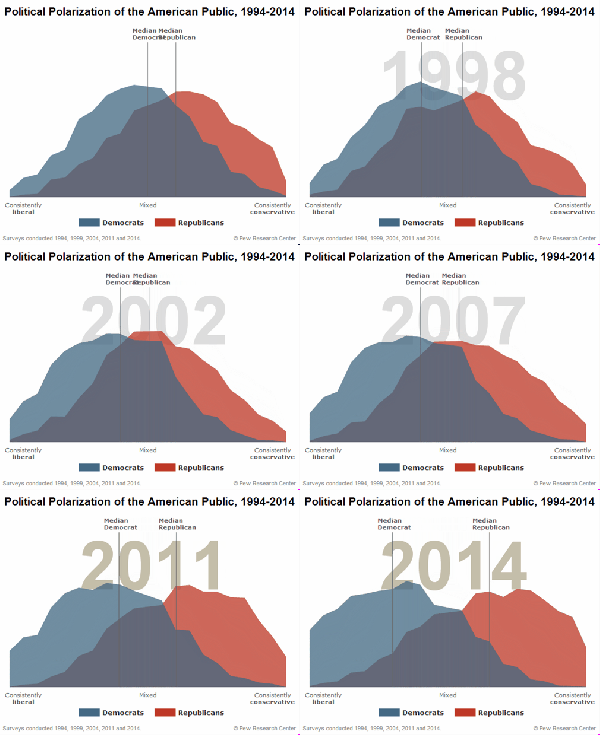
In 2007, I gamely hoped that Obama’s liberal pragmatism could somehow overcome the deep cultural and political split in the country that had opened up in the Vietnam era and had defined the entire boomer generation. I remain of the view that Obama’s policies have remained moderate – on healthcare, immigration, the deficit, and foreign policy. But the cultural churn of polarization has only intensified in the country at large. In fact, the polarization seems to have intensified in the Obama years, rather than moderating, as a fascinating Pew survey 856551367of 10,000 subjects reveals. The GIF at the right can mesmerize after a while, but watch it a few times.

The late 1990s sees a shift by both parties to the relative left, and in the early Bush years, there’s a shift by the GOP to the left as well. Since this is a measure of consistently liberal or conservative positions, it may be scrambled by the response to 9/11. The only three years in which the parties showed signs of moving toward each other were 2000 – 2003. From 2004 on, the GOP moves relentlessly rightward, while the Democrats move to the left more firmly from 2010 onward. Yes the two seem to reinforce each other in their mutual alienation.

But what’s truly depressing is how ideology now trumps virtually everything else in American politics. Geography matters less and less in sustaining mixed and moderate electoral districts; gerrymandering has intensified the process; but deeper cultural shifts help explain a lot of the rest. The urban/rural divide is a chasm; as is the racial one. And ideology seeps deep into everyday life. So inter-marriage between the Union and the Confederacy the consistent Democrats and the consistent Republicans is becoming rarer:

Three-out-of-ten (30%) consistent conservatives say they would be unhappy if an immediate family member married a Democrat and about a quarter (23%) of across-the-board liberals say the same about the prospect of a Republican in-law.

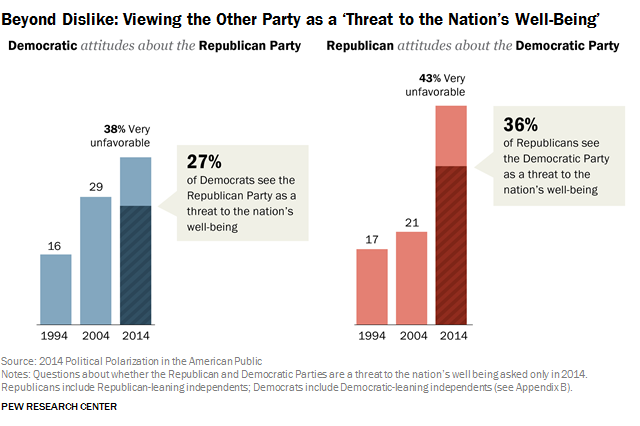
The reason that I don’t think a cold civil war is too hyperbolic is the following chart. It doesn’t just show increased differences between the two parties; it reveals profound and growing antipathy, with each of the respective partisans believing the other is a threat to the country as a whole:

PP-2014-06-12-polarization-0-02

The GOP is more hostile to the Dems today than in the Gingrich revolution year of 1994. What that tells me is that polarization and radicalism can simply create their own mutually reinforcing vortexes of intensity. There’s one kinda bright side to this picture of two nations somehow entangled with one another. And that’s that there is a middle of the country that is not so extreme:

The majority do not have uniformly conservative or liberal views. Most do not see either party as a threat to the nation. And more believe their representatives in government should meet halfway to resolve contentious disputes rather than hold out for more of what they want.

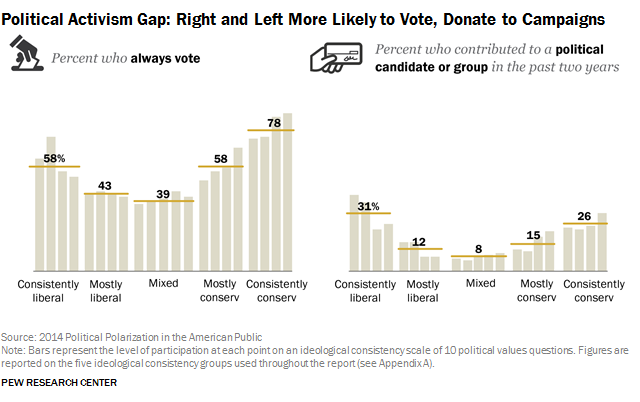
The trouble is: this group is the least likely to vote or participate in the political process:

PP-2014-06-12-polarization-0-03

Christopher Ingraham puts it succinctly:

Because of their sheer numbers this group of mixed-preference voters could – should! – be the core of a centrist coalition. But because of their disengagement, their influence on the political process is diminished relative to the more partisan voices in the mix. This tells me that polarization may be driven as much by apathy at the middle of the political spectrum as it is by energy at the more raucous ideological ends. Instead of a silent majority we have a silent plurality – and as Washington goes to war with itself, it’s not paying attention.

And you wonder why cable news is now so shrill. It’s not just the fault of Roger Ailes. It’s also us.

Our Cold Civil War Intensifies, Ctd

So marriage equality is now either legal or bans on it have been found unconstitutional in 27 states. Has the GOP adjusted? Yes – by lurching even further to the anti-gay position. Rick Perry went to San Francisco yesterday to compare homosexual orientation to alcoholism, and to recommend reparative therapy for gays, even after the ex-gay movement has effectively collapsed. And a budding young Tea Party Republican in Oklahoma is ambivalent about whether gays should be stoned to death or not. The Southern Baptist Convention is also doubling down on reparative therapy for transgender people and for gays, if Al Mohler’s response to Matt Vines is any indicator.

There seems to be no middle ground here. And in this case, this has meant that marriage equality is winning. I wonder if the Republicans have yet grappled with that fact – and worry about its broader ramifications. They could have championed civil unions a long time ago and defused the issue; but they couldn’t for fundamentalist religious reasons – so we now have the prospect of full marriage rights for gays across the country far sooner than might otherwise have been the case. The same with healthcare reform.

In Obama they had a president who would have dearly loved some Republican buy-in, and could have drafted a reform bill that would have included many more conservative proposals (not including the Romneycare blueprint). Ditto on immigration: the path to citizenship could be more onerous and border security even more draconian than even Obama’s deportation-fest. Yet the absolutist principle of nothing close to any amnesty of any kind means their only effective policy is the impossible attempt to find and deport eleven million people.

They better hope their populist revolt can win the presidency. If it doesn’t, it’s the GOP right who will have cemented a far more liberal future for America than any Democrat could have hoped for.