Has The World Never Changed?

I understand that’s a ridiculously broad question, but it arises from a ridiculously broad analysis:

Obama says Putin is on the wrong side of history and Secretary of State John Kerry says Putin’s is “really 19th-century behavior in the 21st century.” This must mean that seeking national power, territory, dominion — the driving impulse of nations since Thucydides — is obsolete. As if a calendar change caused a revolution in human nature that transformed the international arena from a Hobbesian struggle for power into a gentleman’s club where violations of territorial integrity just don’t happen.

Is it possible things are just a little bit more complicated than that? It could be that the impulse for national power, territory, dominion is now not obsolete, but simply much more attenuated now than it once was (and that argument is easily compatible with Kerry’s phrase). And the case for that is pretty strong. I mean: if nations have one driving impulse – “seeking national power, territory, dominion” – and if the record shows no change or evolution in this eternal truth, how do we explain huge tranches of recent history?
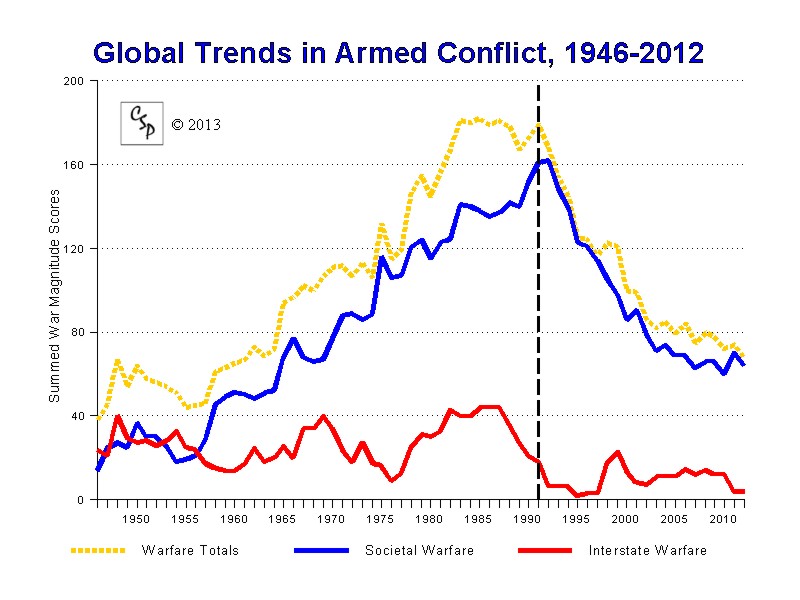
war2012Why on earth, for example, would European countries pool sovereignty in the EU? How could they be deluded into thinking that giving up “national power” could be a good thing? And why, for that matter, would this arrangement remain attractive to other countries as well, not least of which Ukraine? Why on earth did the US invade and conquer Iraq only to leave it a decade later? Why did we not seize the oil-fields with our military might to fuel our economy? What was Krauthammer’s hero, George W Bush, doing – singing hymns to human freedom rather than American hegemony?

Why, for that matter, have military incursions into other countries become rarer over time? Why has the level of inter-state violence in human affairs declined to historically low levels?

The answers to that question are, of course, legion, and I’m not trying to settle the debate here. I’m just noting that if the classic aims of territory acquisition and dominion never change, Krauthammer has a lot of explaining to do.

Even with Putin, I think it’s worth noting that his current Tsarist mojo is not exactly triumphalist. Krauthammer concedes as much:

Crimea belonged to Moscow for 200 years. Russia conquered it 20 years before the U.S. acquired Louisiana. Lost it in the humiliation of the 1990s. Putin got it back in about three days without firing a shot.

So this is less like Hitlerian aggression and more like a sad attempt to re-seize one tiny portion that was part of Russia proper far longer than it was “lost”. More to the point, Putin “got it back” only in the wake of Ukraine deposing its democratically-elected, Russophile leader in a violent, popular putsch. Yes, if your contention is that the desire for territory/dominion/power is “obsolete,” you’re a fool. But if your contention is that this impulse plays a much less critical role in international affairs than in almost all previous periods in human history, you’d be merely making an empirical observation.

The truth is that global interdependence – the immensely complex and proliferating global economy that vastly expanded as communism collapsed under the weight of its own lies – clearly mitigates the classic impulse that Krauthammer approves of. It doesn’t abolish it – but it shapes it.

One reason we won’t see major armed conflict over Ukraine, for example, is because the Germans and Brits have too much to lose in terms of their economies – and Russia does too. In the end, economic power is the basis for military power. Economic power, in the global capitalist economy, is also related to soft power, to where human capital wants to go, and where money wants to flow. Becoming a global pariah is not GERMANY-CARNIVAL-ROSE-MONDAY-STREET-PARADEgood for that kind of thing – and it has a direct relationship to power as a whole. And one reason why Putin’s attempt to coerce Ukraine is not as win-win as Krauthammer suggests is that controlling and occupying countries by brute force is much more difficult than it used to be. The most advanced military machine in history occupied Iraq for a decade and lost. Ditto Afghanistan – for both the Soviets and the Americans. Ditto, for that matter, the Israelis on the West Bank. In each case, the occupying power’s cost-benefit analysis looks weaker than ever. And if Putin attempts to invade or annex Crimea, his headaches are sure to become even worse, as he manages Russia’s steep decline by beginning an armed conflict within what used to be the Soviet Union’s undisputed territory.

Then there is the simple matter of collective memory. For many Americans and for Krauthammer, the key referent is the Second World War which America won with almost none of the devastating trauma experienced by Germany, Britain or the Soviet Union. But in Germany and Britain right now, the collective memory is much more indelibly that of the Great War, where small matters of territory – like Crimea – metastasized through miscalculation into a generational catastrophe. Hence the resilience of the EU, even as it seems to cripple the economies of its weaker members through punishing austerity. Hence also, of course, the survival of the UN and the countless instruments of collective security we’ve built in its wake.
Concerns Grow In Ukraine Over Pro Russian Demonstrations In The Crimea RegionIn other words, power rests on money; and money rests on the global economy. Russia is able right now to get away with its somewhat lame attempt to annex Crimea because its core economy is so primitive and petro-based. But even then, its potential vulnerability to economic retaliation – through global trade and travel and finance – makes this a mug’s game at some point.

Putin, of course, may not see it this way. And understanding that is critical to dealing with him. But that means, in Merkel’s alleged phrase, that he is in “another world.” That may be disastrous, of course, when you’re running an autocracy with nukes. But in the real world, he is misreading his country’s and his own actual interests. In the real world, the invasion and occupation of Iraq was a huge defeat for the US. In the real world, permanently occupying the West Bank is national suicide. And in that sense, Putin is not a symbol of the world order reverting to its eternal nineteenth century dynamic. He is a symbol, in fact, of how that dynamic has ended, and how attempts to restart it are unlikely to result in the glorious military victories some still seem so eager to celebrate.

(Chart from systemicpeace.org. Photos from Getty)

A Conversation With Richard Rodriguez: Will The World End With A Prayer?

rodriguez-post-img

The most striking aspect of Richard Rodriguez’s latest book, Darling: A Spiritual Autobiography, was its attempt to understand 9/11 in an empathetic way. His response to that atrocity was to draw closer to Islam, not to push it as far away as possible. He saw Islam as a desert religion like Christianity and tried to see what had happened to create a monstrous fanaticism of the Taliban and al Qaeda variety, and to look into his own Catholic faith for reasons as well. I was challenged by this, and wanted to talk about it. So here we have the podcast. Richard insists on the connection between Islam and Christianity, perhaps most vividly in the Arabic-rooted Spanish words of his own Catholic grandmother, and the intimacy of inter-religious conflict:


We went on to talk about martyrdom in both Islam and Christianity, and the distinction, important to me, between fundamentalism and faith:


For the full conversation on Deep Dish, click here. If you aren’t a subscriber, click here to sign up for complete access to all things Dish.

Yes, The CIA Spied On Congress

Why? The torture report, of course:

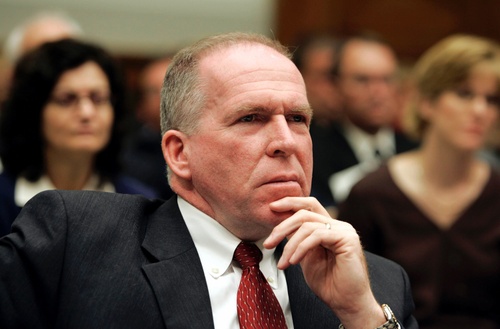
Late last night, McClatchy reported that the CIA inspector general has asked the Justice Department to investigate allegations that johnbrennanbrendansmialowskigetty.jpgthe CIA illegally monitored Congressional staff investigating the Agency’s secret detention and interrogation programs. The Senate Intelligence Committee spent four years and $40 million investigating the use of waterboarding and enhanced interrogation techniques in secret overseas prisons, producing a reportedly “searing” 6,300 page finding excoriating the Agency’s actions.

As part of this investigation, intelligence committee staff were required by the CIA to use Agency computers in a secure room in Langley to access millions of sensitive documents. Congressional investigators reportedly agreed to use those computers under the condition that their work not be monitored by the CIA, in accordance with due respect for the separation of powers and the integrity and independence of the investigation. Apparently, the spy mentality proved too strong to resist, as earlier this year the committee determined that their work had in fact been monitored in possible violation of their agreement.

What we have here is a rogue agency, believing it is above the law, above Congress and indeed immune to even presidential oversight. John Brennan, a man who never piped up as the CIA was orchestrating war crimes in a manner unprecedented in US history, is now revealed as running an agency that broke the law and attacked the very basis of a constitutional democracy by targeting the Congress for domestic spying! The CIA is legally barred from any domestic spying, let alone on its constitutional over-seers.

It’s enough to make you think that the CIA committed crimes so damning and lied so aggressively during the torture regime that it is now doing what all criminals do when confronted with the evidence: stonewall, attack the prosecution, try to remove or suppress evidence, police its employees’ testimony, and generally throw up as much dust as possible. That they continue to do this is a real challenge to this president. How much longer is he going to let these goons prevent the truth from being known? Why is he allowing Brennan to continue to run an agency when, under his watch, it has laid itself open to a criminal investigation of its own alleged obstruction of justice?

Ed Morrissey rightly fumes:

This is among the worst possible accusations that could be levied against an intelligence service in a constitutional republic. For the CIA, it would be doubly worse, since the CIA’s charter forbids it to conduct any kind of domestic intelligence; that jurisdiction belongs to the FBI, and it’s significantly limited. The legislature oversees CIA, not the other way around, and if the CIA is snooping on their oversight work, that would undermine their authority.

An agency that can commit war crimes and get away with it seems to believe it can also undermine the very basis of a constitutional democracy and get away with it. This agency needs to be cut down to size and pronto. Its record in recent years has been execrable – the latest evidence being their failure to detect Russia’s intentions in Crimea. They are far too busy protecting their collective asses to do their job. Brennan needs to go forthwith. And the report needs to be published, in its original form, with all the vital details included. These war criminals cannot be appeased any longer. They need to be brought back under constitutional control.

(Photo: John Brennan via Getty Images)

The Tidal Wave For Marriage Equality

US-JUSTICE-GAY-MARRIAGE

Yes, I have to keep pinching myself. For the longest time, in my marriage equality stump speech from the 1990s, I would end by citing Hannah Arendt’s classic case for ending the anti-miscegenation laws:

Even political rights, like the right to vote, and nearly all other rights enumerated in the Constitution, are secondary to the inalienable human rights to ‘life, liberty and the pursuit of happiness’ proclaimed in the Declaration of Independence; and to this category the right to home and marriage unquestionably belongs.

What I was trying to do was to get (at that point) mainly gay people to see how the denial of the right to marry was effectively a nullification of the Declaration of Independence for gay Americans. The right of gay people to marry was more profound in truth and in law than the right of gay people to vote. “So why aren’t you fighting for it?” I’d declare. Until they did. Getting straight people to see this was actually easier over the years (tell a straight person he doesn’t have the right to marry the woman he loves and you’ll get some powerful pushback). But now look:

Americans think the equal protection clause of the U.S. Constitution gives gays the legal right to marry. In a closer but still significant division, 50 percent say it does, while 41 percent say not, with the rest undecided.

So a Supreme Court ruling that did not find civil marriage as a core constitutional right for gay couples would now be against public opinion. Ross and Rod are surely more right than they might imagine. This is becoming not a victory for gay equality but a rout. The new Post/ABC poll, for example, finds for the first time that there is a plurality in favor of marriage equality in every age group. Even the over-65s are now in favor, by 47 – 43 percent. The next generation (under 40s) sees the issue as a no-brainer with a massive 72 – 22 percent in favor.  40 percent of Republicans are now supportive, with 23 percent strongly supportive. And, in fact, the intensity factor – long on the side of fundamentalists – now operates in favor of gays and their friends and families.

By the end of the Obama presidency, gay Americans may well achieve a near-total victory in their quest for equality.

And the backlash, as we saw with the Arizona debacle, is likely to be ferocious but also, at this point, self-defeating. I’m honestly staggered by the swiftness and totality of this victory in public opinion. But also, of course, incredibly heartened. Our gamble was correct: if we speak our truth, others will listen; if we explain our pain, others will salve it; if we are guided by our consciences, and make our arguments sincerely, Americans will come around. I wish more Christians would see this for what it really is: a huge moral achievement, an expansion of human consciousness and compassion, an extension of mercy and of dignity to many long shunned and excluded for irrational and often hateful reasons, and, above all, the alleviation of  profound and ancient and unnecessary human pain and suffering.

I wish more Christians could see that this movement has been and remains God’s work on earth. But that wish, every day, becomes more and more of a reality. The long, dark Lent of gay history is slowly inching toward Easter.

(Photo: Michael Knaapen and his husband John Becker react outside the Supreme Court on June 26, 2013, after DOMA was struck down. By Mladen Antonov/AFP/Getty Images.)

Surrender Douthat!

My apologies upfront: that was simply an irresistible headline. On Sunday, Ross complained that conservatives are not being allowed to negotiate the terms of their surrender on marriage equality:

We are not really having an argument about same-sex marriage anymore, and on the evidence of Arizona, we’re not having a negotiation. Instead, all that’s left is the timing of the final victory — and for the defeated to find out what settlement the victors will impose.

Michael Potemra seconds:

Contrary to the lessons being taught by our toxic culture, not every momentary advantage needs to be followed up with the crushing and humiliation of one’s enemies. So the question should not be, “Can we succeed in getting society to treat those who disagree with us as moral lepers?” but “Is it right to do so?” Churchill famously started one of his books with a credo that included the phrase “In Victory: Magnanimity.” Magnanimity is definitely not a virtue that today’s culture prizes — but this is a moment that calls for it.

Rod’s summation:

American Christians are about to learn what it means to live in a country where being a faithful Christian is going to exact significant costs. It may not be persecution, but it’s still going to hurt, and in ways most Christians scarcely understand. Maybe this will be good for us. Maybe. We’ll see.

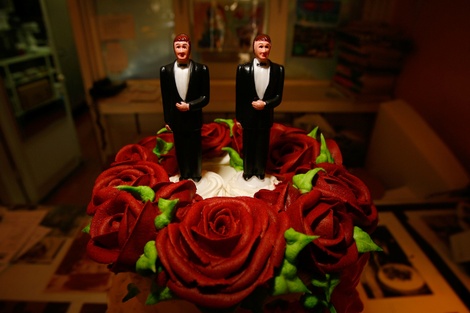
It seems to me there is an important distinction here. If the gay rights movement seeks to impose gay equality on religious groups by lawsuit, or if it seeks to remove tax exempt status for institutions that refuse to include gays for theological reasons, then I agree that such attempts to weddingcakedavidmcnewgetty.jpghumiliate and coerce opponents should be resisted tooth and nail. Such spiking of the ball is a repugnant and ill-advised over-reach, and, to my mind, a betrayal of the soul of the movement. We should be about the expansion of freedom for everyone, not its constriction. We should be in favor of persuasion, not coercion. The question of allowing any individual or business to discriminate against gay people and gay couples is, however, a much trickier area. In any public accommodations, I think it’s counter-productive and morally disturbing. But my own strong preference is for as much live-and-let-live as possible: i.e. not filing lawsuits against anti-gay businesses but supporting pro-gay ones in the marketplace.

Still, championing the ability to fire gay people on religious grounds does not seem to me to be a winning argument for those opposing marriage equality. A majority of even Republicans favor laws banning workplace discrimination against gays, and the national majority is immense: around 68 percent for and only 21 percent against. In the same poll, 80 percent of Americans thought this was already the law! That’s a hill I would not aim to die on, if I were the Christianist right.

But what Ross and Michael and Rod are really concerned about, it seems to me, is the general culture of growing intolerance of religious views on homosexuality, and the potential marginalization – even stigmatization – of traditional Christians.

I sure hope that doesn’t happen, but it’s not something a free society should try to control by law. There is a big difference between legal coercion and cultural isolation. The former should be anathema – whether that coercion is aimed at gays or at fundamentalist Christians. The latter? It’s the price of freedom. The way to counter it is not, in my view, complaints about being victims (this was my own advice to the gay rights movement a couple of decades ago, for what it’s worth). The way to counter it is to make a positive argument about the superior model of a monogamous, procreative, heterosexual marital bond. There is enormous beauty and depth to the Catholic argument for procreative matrimony – an account of sex and gender and human flourishing that contains real wisdom. I think that a church that was able to make that positive case – rather than what is too often a merely negative argument about keeping gays out, or the divorced in limbo – would and should feel liberated by its counter-cultural message.

Rod wonders if being the counter-culture “will be good for us.” In my view, it really could be. Since Constantine, Christianity’s great temptation has been to doubt the power of its truths and to seek to impose them by force. And its greatest promise has been when it truly has been the counter-culture – in the time of Jesus and the decades after, or, say, in the subversive appeal of Saint Francis’ radical vision. Why see this era as one of Benedictine retreat rather than of Franciscan evangelism? Why so dour when you can still be the counter-cultural salt of the earth?

(Photo from Getty)

“In Another World”?

Russian President Vladimir Putin Attends Military Exercise Near Saint Petersburg

Reading all the grim reports from Ukraine this morning, this quote really stood out. It’s a report of what Angela Merkel reportedly told Barack Obama in a phone-call last night, after speaking with Vladimir Putin:

She was not sure he was in touch with reality, people briefed on the call said. “In another world,” she said.

That is the truly worrying thing. But it is always worth trying to see things from the point of view of our foe, to see if his madness makes some kind of internal sense, and to see if we have any blind-spots that may hinder us from the smartest response. Greg Dejerejian notes:

One need not be a Putin apologist to recognize some salient facts: 1) the Maidan movement included ultra-nationalists and even neo-fascists, 2) the Yanukovych transition deal was crudely scuppered leaving the Russian side caught unawares and looking flat-footed (never appreciated by Vladimir Putin); and 3) this was followed by deeply provocative measures by the new Government in Kiev to move to extinguish Russian minority language rights. More assertiveness was surely on tap, as the mood was manifestly one of triumphalism.

I fell prey to this myself, buoyed by obvious and instinctive support for any country resisting the boot of the Kremlin, and too blithe about the consequences of a revolution that overthrew a democratically elected president. But as we now know only too well, Ukraine is deeply divided between its pro-Western West and its pro-Russian East; any attempt to resolve this underlying tension decisively was bound to risk real rifts within the country and tempt Russia to intervene. Anatol Lieven has a must-read:

President Viktor Yanukovych’s rejection of the EU offer led to an uprising in Kiev and the western and central parts of Ukraine, and to his own flight from Kiev, together with many of his supporters in the Ukrainian parliament. This marks a very serious geopolitical defeat for Russia. It is now obvious that Ukraine as a whole cannot be brought into the Eurasian Union, reducing that union to a shadow of what the Putin administration hoped. And though Russia continues officially to recognize him, President Yanukovych can only be restored to power in Kiev if Moscow is prepared to launch a full-scale invasion of Ukraine and seize its capital by force. The result would be horrendous bloodshed, a complete collapse of Russia’s relations with the West and of Western investment in Russia, a shattering economic crisis, and Russia’s inevitable economic and geopolitical dependency on China.

It seems vital to me that we see what Putin is doing from his point of view. What seems to us like an unprovoked, Sudetenland-style invasion is both mercifully less than that (so far) and also, critically, a function of Putin’s string of recent setbacks. He has already lost a huge amount. And he is now recklessly and thoughtlessly acting out as a result. Dmitri Trenin describes Moscow’s current worldview thus:

In Moscow, there is a growing fatigue with the west, with the EU and the United States. Their role in Ukraine is believed to be particularly obnoxious: imposing on Ukraine a choice between the EU and Russia that it could not afford; supporting the opposition against an elected government; turning a blind eye to right-wing radical descendants of wartime Nazi collaborators; siding with the opposition to pressure the government into submission; finally, condoning an unconstitutional regime change. The Kremlin is yet again convinced of the truth of the famous maxim of Alexander III, that Russia has only two friends in the world, its army and its navy. Both now defend its interests in Crimea.

How to deal with an authoritarian leader, increasingly paranoid about the West, his greater regional aspirations turned to dust, who is now wielding military power in a manner more reminiscent of the Cold War than of anything since? One obvious response is counter-provocation, of the kind that John McCain and the Washington Post editorial board would instinctively prefer. It seems to me that, given how Putin has reacted to Western pressure so far, this would merely invite more recklessness.

The saner approach is to try and mollify some of Russia’s legitimate concerns about Ukraine – the rights of the pro-Russian Ukrainians in the East, for example, some of which were suspended (and now restored) by the new Kiev government, while persuading him of unstated but profoundly adverse consequences if he ratchets up the use of force even further. David Ignatius – unlike the breathless neocons on the WaPo editorial page – makes the case very effectively this morning. What our goal must be now, above everything, is avoiding any pretext for a Russian invasion of Eastern Ukraine.

And the truth is: this is very much in Russia’s actual interests. Its stock market and currency are in free-fall this morning, but a full-scale invasion of Ukraine would mean a mutual bloodbath, effectively destroying Russia’s standing in the world, tearing up its relations with the major powers, including, possibly China, and rendering it a rogue, primitive, paranoid power, whose elites would be cut off from the global trade and financial markets they rely on. There must be some faction in the Kremlin able to see this, even if it only occupies a small part of Putin’s mind.

But it will not be enough. Ukraine has long occupied a powerful place in the Russian imagination. Pride and identity are at stake now, and they make a catastrophe much likelier. And so the West needs both to be firm about military intervention but also cognizant of Russia’s genuine fears and insecurity in the wake of recent events. Djerejian again:

Further aid to Ukraine should likely be made conditional on ensuring minority rights in Eastern and Southern Ukraine are better respected, and critically, that no preemptive military activity by Kiev in those areas take place … By moving to soften the tone and policy in Kiev, better respecting Russia’s historic interests (please let us retire talk of NATO Membership Action Plans and such), and offering honest broker type conflict resolution channels (not bidding up an East-West show-down in Pavlovian fashion as if inevitable) the following goals could possibly be accomplished in the short-term: 1) delaying or ideally preventing formal annexation of Crimea; 2) restraining Putin from invading Eastern Ukraine and 3) most important, helping defuse the specter of a horrible civil war in the heart of Europe’s eastern flank.

These options do not have the emotional satisfaction of McCain’s outrage and Cold War nostalgia. They will not satiate the neoconservative lust for conflict or for simple black-and-white moralism in foreign affairs. They may be politically difficult for the president to sustain. But they might actually be the only way to defuse some of the extremely dangerous dynamics now in play in Euro-Asia. This is all happening, one should recall, on the 100th anniversary of the outbreak of the Great War. I’ll leave the last word to Lieven:

A century ago, two groups of countries whose real common interests vastly outweighed their differences allowed themselves to be drawn into a European war in which more than 10 million of their people died and every country suffered irreparable losses. In the name of those dead, every sane and responsible citizen in the West, Russia, and Ukraine itself should now urge caution and restraint on the part of their respective leaders.

The alternative is unthinkable.

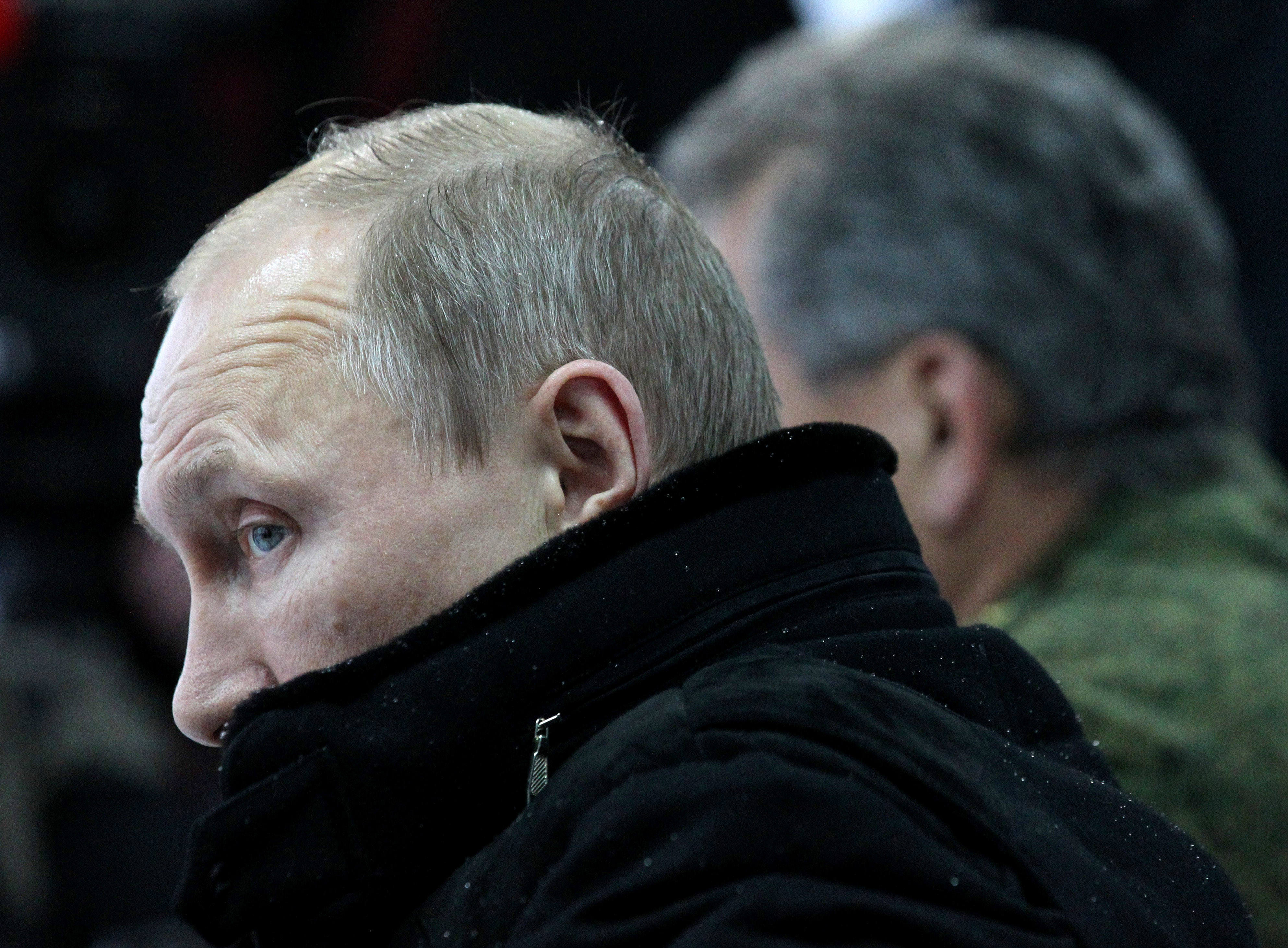
(Photo: Russian President Vladimir Putin watches a military exercises at Kamenka polygon on March 3, 2014 near Saint Petersburg, Russia. By Sasha Mordovets/Getty Images)

The Morning After In Arizona

This embed is invalid


[Re-posted from earlier today]

Here’s the money quote from Jan Brewer’s veto statement last night:

Senate Bill 1062 does not address a specific and present concern related to religious liberty in Arizona. I have not heard of one example in Arizona where a business owner’s religious liberty has been violated … Religious liberty is a core American and Arizona value, so is non-discrimination.

As I’ve mulled this over and over, I have a few straggling thoughts. Against the bill: it had two terrible features. The first was the breadth of the religious liberty invoked. The real innovation in Arizona was the extension of religious liberty claims against other citizens, rather than against the government itself. That’s a big leap, and trivializes religious liberty in some ways. No individual can coerce, even with a lawsuit, the way the government can. The second is the environment in which this bill was introduced. In Arizona, gay citizens have no right to marry, and no legal protection against being fired simply for being gay. Indeed, a fundamentalist Christian or Muslim needs no new law to discriminate quite brutally against gay people under the rationale of religious liberty. To argue that the real problem here is the victimization of fundamentalists is therefore bizarre. In fact, it’s a grotesque inversion of reality.

As for the case for allowing fundamentalists to discriminate against anyone associated with what they regard as sin, I’m much more sympathetic. I favor maximal liberty in these cases. The idea that you should respond to a hurtful refusal to bake a wedding cake by suing the bakers is a real stretch to me.

Yes, they may simply be homophobic, rather than attached to a coherent religious worldview. But so what? There are plenty of non-homophobic bakers in Arizona. If we decide that our only response to discrimination is a lawsuit, we gays are ratcheting up a culture war we would do better to leave alone. We run the risk of becoming just as intolerant as the anti-gay bigots, if we seek to coerce people into tolerance. If we value our freedom as gay people in living our lives the way we wish, we should defend that same freedom to sincere religious believers and also, yes, to bigots and haters. You do not conquer intolerance with intolerance. As a gay Christian, I’m particularly horrified by the attempt to force anyone to do anything they really feel violates their conscience, sense of self, or even just comfort.

So I’m with Big Gay Al, and always have been. Let bigots be bigots. Let gays be gays. And when those values conflict, let’s do all we can not to force the issue. We’re living in a time of drastic change with respect to homosexuality. It is perfectly understandable that many traditional-minded people, especially in the older age brackets, are disconcerted, upset and confused. So give them some space; instead of suing them, talk to them. Try seeing things from their point of view. Appeal to their better nature as Christians. And start defusing by your tolerance the paranoia and hysteria Roger Ailes lives off.

America And The Lessons Of The 21st Century

[Re-posted from earlier today]

Whenever I read the blog-posts of Walter Russell Mead, or the fulminations of Leon Wieseltier, or the sputtering harrumphs of John McCain, or the neoconservative or liberal internationalist horrified respect for Vladimir Putin’s Great Game of geo-politics, I find myself on the other side of a vast, intellectual chasm. I’ve tried at times in my head to engage the arguments, and have consistently found myself at a loss. It’s not the arguments for this or that military or diplomatic intervention that stump me. It’s the entire premise behind them.

At times, I’ve put it down to a very different response to the Iraq War. Many of these voices decrying Obama’s restraint in the face of evil or US President Barack Obama speaks duringdistant conflict have not drawn the same lessons I did from that defining episode in American foreign policy in the 21st Century. I saw that war as an almost text-book refutation of the logic behind US intervention in this century. The Iraqis were not the equivalent of Poles in 1989. They were deeply conflicted about US intervention and Western liberalism and came to despise the occupying power. The US was not the exemplar of liberal democracy that it was in the Cold War. It was a belligerent state, initiating Israel-style pre-emptive wars, and using torture as its primary intelligence-gathering weapon. Its military did not defeat an enemy without firing a shot, as with the the end-game of the Soviet Union; it failed to defeat an enemy while unloading every piece of military “shock and awe” upon it. A paradigm was shattered for me – and shattered by plain reality. A realist is a neocon mugged by history.

But the more I ponder this, the more I wonder if it isn’t also rooted in an entirely different response to the end of the Cold War as well. I remember vividly some early disputes at TNR as the Soviet Union collapsed. Marty, in particular, was just as vigilant toward the new Russian government as he had been toward the Communist one (and that was during the elysian years of Yeltsin’s doomed, democratic experiment). I found this utterly baffling. For me, the fight against Communism was not a fight against Russia. They were separate entities; one was a global, expansionist ideology, capable of intervening across the planet; the other was a ruined but still proud regional power. Indeed, if we were to prevent a return to Communist norms, I believed we should expect Russia to flex some muscles in its area of influence, for the mccainmariotamagetty.jpgOrthodox church to return as some sort of cultural unifier, for Russia to return to, well, being Russia, with some measure of self-respect. Magnanimity in victory was a Churchillian lesson I took to heart. I hoped – and hope – for more, but came to understand much more vividly what I had unforgivably forgotten after 9/11 – the perils of trying to force democratic advance in alien cultures and polities.

For me, the end of the Cold War was a blessed permission to return to “normal”. And “normal” meant a defense of national interests and no countervailing ideological crusade of the kind the Communist world demanded. In time, it seems to me that the basic and intuitive foreign policy for the US would return to what it had been before the global ideological warfare against totalitarianism from the 1940s to the 1980s. The US would become again an engaged ally, a protector of global peace, but would return to the blessed state of existing between two vast oceans and two friendly neighbors. The idea of global hegemony – so alien to the vision of the Founders – would not appeal for long, at least outside the Jacksonian South. As Islamist terror traumatized us on 9/11, however, I reverted almost reflexively to the Cold War mindset – as did large numbers of Americans. It was the rubric we understood; and defining Islamism as the new totalitarianism helped dispel what then appeared as the delusions of the 1990s, when peace and prosperity seemed to indicate an “end of history”, in Frank Fukuyama’s grossly misunderstood and still brilliantly incisive essay.

From the perspective of 2014, however, the delusions seem to have been far more profound in the first decade of the 21st Century than in the last decade of the 20th. The conflation of Islamism with Communism was far too glib – not least because the former was clearly a reactionary response to modernity, while the latter claimed to be modernity’s logical future; and the latter commanded a vast military machine, while the former had a bunch of religious nutcases with boxcutters. And the attempt to use neo-colonial military force to fight Islamism was clearly doomed to produce yet more Islamists – as the Iraq and Afghanistan interventions proved definitively. More to the point, Americans now understand this in ways that many in the elite don’t:

Screen Shot 2014-02-25 at 1.17.15 PM

From 93 percent to 48 percent is quite some shift in 12 years. Sometimes, when I’m criticized for changing my mind on the wars against Islamist terror, as if I were some kind of incoherent madman, I can’t help chuckling. I can see why it might seem fickle or unprincipled or irrational if I were alone. But when there’s a stampede among Americans on exactly the same lines, I’m clearly not an outlier. People changed their minds because the facts forced them to. The polling on the Iraq war is even worse:

Screen Shot 2014-02-25 at 1.23.03 PM

Again, the shifts are dramatic: from 23 percent believing the war was a mistake at the start to 53 percent ten years later. A third of Americans reversed themselves.

Now, you could argue that these results are just a function of obvious failures in war-planning, or war-fatigue, or the recession. But I think that condescends too much to American public opinion. In thinking about intervention, America no longer has some global ideological rival to counter, and in so far as America does (i.e. Islamist terrorism), there is a widespread understanding that our military attempts to stymie it have been costly failures at best and cripplingly counter-productive at worst. This is a real shift, and I can only recommend Ross Douthat’s latest blog-post that explicates it further.

What Ross is arguing is that Sam Huntington was right to see the persistence of conflict and warfare where the civilizations meet and clash:

Crises keep irrupting along the rough borders that Huntington sketched — where what he called the “Orthodox” world overlaps with the West (the Balkans, the Ukraine), along Islam’s so-called “bloody borders” (from central Africa to Central Asia), in Latin American resistance (in Venezuela’s Chavismo, Bolivia’s ethno-socialism, and the like) to North American-style neoliberalism, and to a lesser extent in the long-simmering Sino-Japanese tensions in North Asia.

But these conflicts mean less to us, because so much less is at stake than it once was. And the reason for that is that Fukuyama was also right:

Huntington’s partial vindication hasn’t actually disproven Fukuyama’s point, because all of these conflicts are still taking place in the shadow of a kind of liberal hegemony, and none them have the kind of global relevance or ideological import that the conflicts of the 19th and 20th century did. Radical Islam is essentially an anti-modern protest, not a real alternative … China’s meritocratic-authoritarian model has a long way to go to prove itself as anything except a repressive Sino-specific kludge … Chavismo and similar experiments struggle to maintain even domestic legitimacy … and what Huntington called the Western model is still the only real aspiring world-civilization, with enemies aplenty, yes, but also influence and admirers in every corner of the globe.

Ross’ is a really elegant overview of the real, historical context for the deployment of American military and even diplomatic and economic power in this century. Military power can achieve less and, more importantly, its success or failure in any specific context matters less. Obama’s restraint is not weakness; and trying to match Putin’s militarist bluster is a mug’s game. The most important thing the president says about Iran is not the need to prevent its developing an operational nuclear weapon, but the articulation of the truth that, compared with America’s global enemies in the past, Iran is a puny power, a failing economy, and a bankrupt ideology. Yes it can still do damage, and we should do our best to restrain it as best we can. But a full-scale war to disarm it? The costs would so vastly exceed the tiny benefits that you really have to be stuck in 1984 to contemplate it. We had the first iteration of this debate in 2008 – between the 20th Century nostalgic, John McCain, and the 21st Century realist, Barack Obama. And Obama won. And won again.

That verdict has not yet changed. And for good reason. What lies ahead is simply the task of resisting some primal impulse to return to the Cold War mindset. Which is what, I’d argue, Chuck Hagel’s plans for slimming the military are really all about.

(Photos: Getty Images)

The Tiger Gets Hungrier

INDIA-ANIMAL-TIGER

For a long time now, the Republican party has essentially decided to ride the tiger of right-wing extremism to electoral victories and total Washington gridlock. The real action on the right side of the aisle has been on the far right, with each new anti-Obama movement and eruption out-doing the last in terms of upping the ante. Shock-jocks have defined the message, aided and abetted by key leadership figures. And so, in the latest manifestation, we have the former vice-president, Dick Cheney, telling Sean Hannity the following last night:

They peddle this line that now we’re going to pivot to Asia, but they’ve never justified it. And I think the whole thing is not driven by any change in world circumstances, it is driven by budget considerations. He would much rather spend the money on food stamps than he would on a strong military or support for our troops.

So a former vice-president is out there, saying the president prefers to spend money on food stamps than on “support for our troops.” He could have made an argument why he thinks we should maintain the stratospheric levels of defense spending that have been in place since 9/11; he could have argued that the US needs to maintain the ability to fight two major land wars simultaneously in perpetuity. He could have said a lot of things. But he decided to accuse the commander-in-chief of not supporting the troops and actually wanting to keep people in poverty. There is this belief out there that Republican extremism comes from the base and not the elites. But Cheney proves otherwise.

Now we get the extreme religious liberty bills across the country that are clearly a function of gay panic among fundamentalists and a decision to capitalize on it for electoral gain; we have a Republican lobbyist pulling a publicity stunt by drafting a law to ban gay players from the NFL; we have a state senator, using sarcasm in such a way as to describe mothers as “hosts” of unborn children; we have gubernatorial candidates proudly campaigning with a man who called the president a “subhuman mongrel”; and the list goes on and on:

attempting to make contraception illegal (North Carolina), requiring sonograms and their images of fetuses to be presented to women seeking abortions (several states), advocacy of secession (Colorado and Texas), making enforcement of federal laws regarding guns a crime (Missouri), adopting a tax code that puts a greater burden on the poor and middle class while advantaging the rich (North Carolina and Kansas), mandating photo identification for voting while making the availability of those IDs only in Department of Motor Vehicle offices where the non-driving majority of those without IDs never go (a number of states), refusing federal funds for expanding access to Medicaid for millions who need such access and protection (21 states, all with Republican governors) and, attempting to mandate the teaching of “creationism” in schools (several states).

Now, it’s true that some kind of pushback seems to have begun.

Nugent felt obliged to apologize; McCain is now against the Arizona law that puts religious liberty on steroids; the Chamber of Commerce has tried to push back on the more extreme Tea Party candidates. But the truth, it seems to me, is that the kind of cost-free extremism fostered by Fox News and Jim DeMint and Sarah Palin has a logic and momentum all its own. And at some point, a party that seems increasingly defined as angry, contemptuous of the president, constantly rabble-rousing (Jindal yesterday) and hostile to immigrants, gays, Latinos, African Americans and women will become so tainted in an increasingly diverse, pluralistic and multi-racial society it may take a generation to recover. Right now, there seems little cost to continuing to ride the tiger of senior rightwing rage – as the GOP looks confidently toward the mid-terms. The checks on it, however welcome, seem tactical and defensive rather than structural and positive. The lack of any unifying, multi-cultural message is gaping. Until these problems are more deeply addressed, until someone is capable of tackling them with clarity and reformist urgency, an entire generation may be lost to the left.

For Obama to win them over is one thing; for the GOP to tell the younger generation to get lost is quite another.

(Photo: Noah Seelam/AFP/Getty)

Erick Erickson Has A Point

The right-wing pundit, who supported the Kansas discrimination bill, feels that his side’s position is being distorted:

If a Christian owns a bakery or a florist shop or a photography shop or a diner, a Christian should no more be allowed to deny weddingcakedavidmcnewgetty.jpgservice to a gay person than to a black person. It is against the tenets of 2000 years of orthodox Christian faith, no matter how poorly some Christians have practiced their faith over two millennia.

And honestly, I don’t know that I know anyone who disagrees with any of this. The disagreement comes on one issue only — should a Christian provide goods and services to a gay wedding. That’s it. We’re not talking about serving a meal at a restaurant. We’re not talking about baking a cake for a birthday party. We’re talking about a wedding, which millions of Christians view as a sacrament of the faith and other, mostly Protestant Christians, view as a relationship ordained by God to reflect a holy relationship.

This slope is only slippery if you grease it with hypotheticals not in play.

But the wording of the bills in question – from Kansas to Arizona – is a veritable, icy piste for widespread religious discrimination. And that’s for an obvious reason. If legislatures were to craft bills specifically allowing discrimination only in the case of services for weddings for gay couples, as Erickson says he wants, it would seem not only bizarre but obviously unconstitutional – clearly targeting a named minority for legal discrimination. So they had to broaden it, and in broadening it, came careening into their own double standards. Allow a religious exemption for interacting with gays, and you beg the question: why not other types of sinners? If the principle is not violating sincere religious belief, then discriminating against the divorced or those who use contraception would naturally follow. I’ve yet to read an argument about these laws that shows they cannot have that broad effect.

But here’s where Erick has a point:

It boggles my mind to think any Christian should want the government to force their [pro-gay] view of Christianity on another believer.

That’s my feeling too. I would never want to coerce any fundamentalist to provide services for my wedding – or anything else for that matter – if it made them in any way uncomfortable. The idea of suing these businesses to force them to provide services they are clearly uncomfortable providing is anathema to me. I think it should be repellent to the gay rights movement as well.

The truth is: we’re winning this argument. We’ve made the compelling moral case that gay citizens should be treated no differently by their government than straight citizens. And the world has shifted dramatically in our direction. Inevitably, many fundamentalist Christians and Orthodox Jews and many Muslims feel threatened and bewildered by such change and feel that it inchoately affects their religious convictions. I think they’re mistaken – but we’re not talking logic here. We’re talking religious conviction. My view is that in a free and live-and-let-live society, we should give them space. As long as our government is not discriminating against us, we should be tolerant of prejudice as long as it does not truly hurt us. And finding another florist may be a bother, and even upsetting, as one reader expressed so well. But we can surely handle it. And should.

Leave the fundamentalists and bigots alone. In any marketplace in a diverse society, they will suffer economically by refusing and alienating some customers, their families and their friends. By all means stop patronizing them in both senses of the word. Let them embrace discrimination and lose revenue. Let us let them be in the name of their freedom – and ours’.