Who’s Afraid Of The Truth?

Allow me to recommend Jim Fallows’ latest post on freedom of speech and Max Blumenthal’s grueling book about the extremist elements in contemporary Israel, Goliath. The core point is that, whatever you believe about the arguments of the book, or of its author, it remains a powerfully reported account of actual people currently living in Israel, their attitudes and beliefs. You might imagine that Blumenthal’s selection of racist, extremist elements in Israeli culture obscures a larger truth, as we noted recently. But, even then, it is still a lesser truth that should be engaged, not ignored. He marshalls facts. He talks to people directly. The idea that a book that delves into such empirical questions must somehow be repudiated or ignored is a deeply illiberal idea.

Jim argues:

[Blumenthal] has found a group of people he identifies as extremists in Israel—extreme in their belief that Arabs have no place in their society, extreme in their hostility especially to recent non-Jewish African refugees, extreme in their seeming rejection of the liberal-democratic vision of Israel’s future. He says: These people are coming, and they’re taking Israeli politics with them. As he put it in a recent interview with Salon, the book is “an unvarnished view of Israel at its most extreme.” Again, the power of his book is not that Blumenthal disagrees with these groups. Obviously he does. It comes from what he shows.

To see for yourself, just watch a few minutes of the video Blumenthal and his associates made a few months ago, about recent anti-African-immigration movements. The narration obviously disapproves of the anti-immigrant activists, but that doesn’t matter. The power of the video comes from letting these people talk, starting a minute or so in.

I don’t know how you can watch the video above without thinking of previous attempts in human history – a “cancer on our body!” – to demonize, persecute and expel marginal minorities in defense of a racially homogeneous country. Period. In a particularly glaring twist, the New York Times commissioned the video then simply refused to air it.

Now I know I can be tedious about this kind of thing, and one shouldn’t engage a book merely because some want it branded anathema. But nonfiction is at its most urgent when forcing us to confront uncomfortable reality.

You can and should criticize that reality for being untrue, or deceptive, or simply false. But not engaging it at all on empirical grounds is a sign of fear, not wisdom. That was my argument for airing “The Bell Curve” a couple of decades ago; it’s my argument for presenting Steve Jimenez’s reporting on the tragedy of Matthew Shepard on the Dish. It’s why my instinctive response to those who want a book ruled out of the discourse, is to read it as a human being or air it as an editor.

It’s staggering to me that the New York Times, for example, has not reviewed (even critically) either Goliath or The Book of Matt. Why not? Either because they are cowards or because they genuinely believe that examining arguments that undermine core factions or lobbies – gay or Jewish – is somehow offensive in itself. Neither of these is a good argument. Both sustain denial.

Fighting HIV Without Condoms?

Condom

About fifteen years after most gay men figured it out, Mark Joseph Stern stumbles onto the truth that, with HIV no longer a death sentence in developed countries, the era of simply scaring gay men away from unprotected sex is over. And, unlike so many well-meant public health campaigns, he is prepared to tell the obvious truth:

Bareback sex feels better for both partners. At some point, almost every gay man will learn this fact—so why lie about it?

Indeed. That one fact combined with one other – that middle-class gay men can suppress the virus indefinitely with the cocktail – has to be integrated into a sane, safer sex message. I’ve been banging on about this for years, of course, and there have been initiatives, in San Francisco particularly, where these insights have indeed been integrated into public health campaigns. And they’ve been among the most successful in restraining infection. But Stern goes one step further:

If we don’t give gay men the promise of the reward, a foreseeable end to the hassles of condoms, they’re bound to get frustrated and either slip up or give up. Giving men the goal of a committed relationship—and with it, the perk of unprotected sex—might convert barebacking from a forbidden fruit to a reward worth working toward.

Yes, and no. First off, can we retire the term “barebacking” and simply refer to it as sex without condoms, i.e. the activity formerly known as sex? Stigmatizing latex-free sex as “barebacking” may have had some logic in the plague years, but it can be psychologically toxic today. It renders the most intimate of sexual interactions a pathology, and that can’t be right.

Second, the prize of non-rubbered sex in a monogamous relationship is a little more fraught than Stern makes it out to be. It makes huge sense if both men are HIV-positive. In that case, there is no danger that sex outside the marriage – sometimes lied about, or hidden, or unspoken – can lead to indirect infection, because both men are infected already. But if both men are negative, it puts much more pressure on monogamy and on a marriage than might be wise. One slip and you’re not only betraying your partner, you could also be deeply damaging his health. Although it’s noble as an ideal, the standard here may be simply practically too high, certainly over a lifetime, for most men to achieve. And the consequences of failure can be terrible for a relationship.

I think we should leave it to married couples or committed lovers to figure their way through this – and avoid harshness and easy judgment. We’re all human and in sexual desire, more human and flawed than in most other areas. But, as a practical matter, you don’t have to restrict non-rubbered sex solely to monogamous married couples to have an impact on infection rates.

The more important goal is for HIV-positive men to have sex mainly with other HIV-positive men, restricting the virus to a pool of the already infected. This is called “sero-sorting” and it has happened for years (it was my strategy back in the day for making sure I never put anyone at risk). It has cut infection rates markedly where it has prevailed. But for the HIV-negative, sero-sorting is a lot trickier. You simply cannot know if your sex partner is positive or not. He may not even know. Leaving rubbers behind is a big risk always in this context, even though it is far, far smaller than it once was. A more practical option for HIV-negative men is to go on Prep – take preventive HIV drugs to make infection far less likely even without condoms, and to use condoms outside a truly monogamous relationship or marriage.

So add it up: tout the intimacy of rubber-free monogamy for some; encourage HIV-positive men to have sex with other HIV-positive men; get as many HIV-negative men onto preventive drugs that can drastically lower the risk of infection; and, above all, encourage disclosure and testing so that gay men, rather than being treated like children, can assess all the information and make informed choices. This wouldn’t be a panacea, but it would be a constructive way forward.

(Photo: By BSIP/UIG Via Getty Images.)

New Dish, New Media Update

[Re-posted from earlier today]

It’s hard to believe that only a year ago, Patrick was busy cramming LLCs for Dummies, as we jumped off the cliff to independence. This will be the last update this year – completing a promise I made to readers of maximal transparency about this experiment – before we hit the acid test of annual renewals next month.

When asked what our goal was for 2013, for want of any better measurement, I suggested our editorial budget at our last corporate home, The howler beagleDaily Beast. That was $900K in 2012. Well, we’re now at $818K – still agonizingly short of our goal, but plenty good enough to survive for now. I haven’t taken any profits or salary this year to make sure we have a sturdy fiscal ballast for whatever comes (or doesn’t) on renewal day next January 2. We’ve also added staff we didn’t have at the Beast – a technology wizard (former intern Chas Danner aka Special Teams) and a general manager for the whole enterprise (Brian Senecal) – and for the kind of posts on culture, religion, philosophy and art that are rare on the web but integral in my view to any civilized conversation. Almost everyone on the team started out as an intern; and everyone has health insurance from the internship on.

I can honestly say I’ve never worked with a more talented and decent crew of colleagues and friends than I do now. In our little boat on a very choppy media sea, we’ve been remarkably happy this past year. We’ve had a hell of a lot of fun and we’ve worked our guts out, as I’m sure you can see. Putting out this blog every day, while also finding a way to add Deep Dish, has not been not easy, even though my brilliant young team make it seem so.

You’ve also come through for us throughout the year after a spectacular start, for which we’re immensely grateful. Here’s the month by month revenue chart from March onward:

Screen Shot 2013-12-04 at 9.17.32 PM

You can see the late surge, which we really need to continue if we want to make our goal. But we now have a total of 32,100 subscribers – a pretty staggering number in just one year with no business department and no marketing. If we can achieve a solid rate of renewals next month, we’ll be able to plan and budget in a way we haven’t been able to in this first ice-breaking, nerve-wracking year.

But this last update of 2013 is really about those of you who have read the Dish regularly all year and have yet to get around to subscribing. We know these are tough times, and we know procrastination runs deep in human nature. But our readers are our only revenue source – in stark contrast with almost every other site on the web. That keeps us honest and prevents us from sinking to the desperation of “sponsored content” or the page-view seeking gimmicks you see in so many other places. If you want this model to succeed, we need all of you. And we need you now.

So take a moment if you haven’t subscribed yet, get that credit card out of your wallet, and [tinypass_offer text=”join the experiment”]. 41,000 of you have used every one of your free read-ons – which means you really are a Dishhead (sorry, you’re busted) but haven’t yet actually put your money where your eyeballs are. We need you; and, more to the point, we want you to be fully part of this, to join the 32,000 others who have made this year (and the next) possible.

It takes a couple of minutes and costs only $1.99 a month or $19.99 a year. Click [tinypass_offer text=”here”] to subscribe. And have a great Christmas season from all of us to all of you.

Rumsfeld’s Reality – And Obama’s

Drawing upon Rumsfeld’s memoir, Bradley Graham’s Rumsfeld biography, and The Unknown Known (which director Errol Morris discusses above), Mark Danner tries to get inside the mind of the former defense secretary:

Having watched from the Oval Office in 1975 the last torturous hours of the United States extracting itself from Vietnam—the helicopters fleeing the roof of the US embassy in Saigon—Rumsfeld would be condemned to thrash about in his self-made quagmire for almost four years, sinking ever deeper in the muck as nearly five thousand Americans and hundreds of thousands of Iraqis died. He was smart, brash, ambitious, experienced, skeptical of received wisdom, jealous of civilian control, self-searching, analytical, domineering, and he aimed at nothing less than to transform the American military. The parallels with McNamara are stunning.

And month after month in his arrogance and tenacity he would deny an insurgency had taken root. Month after month, as the shortcomings of the army he had sent into Iraq—too small, too conventional, not configured or equipped or trained to fight an insurgency and thus fated in its impotent bludgeoning to make it ever worse—became impossible to deny, he would go on denying them, digging in his heels and resisting the change he had to know was necessary. And even as it became undeniable that Rumsfeld’s war, far from deterring or dissuading prospective terrorists, increasingly inspired and fostered them—that the image of strength and dominance he sought had become one of bumbling and cruelty and weakness—the power of his personality and of his influence over the president meant that for month after month, year after year, he was able to impose his will—and define the world we still see around us.

I think it’s worth comparing – even though the differences are as stark as the similarities – the response to failure in Iraq in Bush’s second term with the response to the failure of healthcare.gov in Obama’s. Bush and Rumsfeld and Cheney simply refused to acknowledge any failure at all. They were incapable of it. But more important, their fellow Republicans absolutely refused to break ranks or air criticism. The neocons knew their central project had collapsed in the sands of Mesopotamia and in the tortured gulag of black sites around the world, but they sure as hell weren’t going to rock the boat before the mid-terms. Bush was famously asked to name a failure of his in his first term in the 2004 debates – and couldn’t. In his second Inaugural, instead of reflecting on the catastrophe in front of everyone’s eyes, he upped the ante to the goal of using force of arms to wipe all tyranny off the face of the earth!

Now compare Obama, who swiftly copped to a massive error, allowed himself to be knocked about like a punching bag at a press conference, squarely explained why in his mind he had not actively deceived Americans about not losing their plans, and pivoted to fixing the error.

The Democrats, far from remaining in lockstep unity, are all over the map, as they so often are. Their instant panic is almost as bad as the Republicans’ denialism. But only almost. Because of their skittishness and his own integrity, Obama is capable of acknowledging reality and adjusting to it in ways Bush never was. He has not publicly told Kathleen Sebelius that she is doing a heckuva job. He hasn’t actually joked about people losing their insurance, as Bush once did about not finding weapons of mass destruction, at the White House Correspondents’ Dinner.

Rumsfeld was both completely divorced from reality, while also constantly affirming that he, and he alone, was in close contact with it. That proved to be a particularly damaging – and arguably sociopathic – combination for this country and the world. Obama is very different. We wanted a president who could admit error, take responsibility and adjust. We got one. Even though so many have now forgotten what a rare and precious thing that is.

Racism Isn’t Over

That tweet reminds me again of how anti-Christian contemporary Republicanism is. The notion that racism can “end” misreads a core Christian truth about human nature. Our vulnerability to hatred, condescension, fear of others, resentment, and generalizations about “the other” are intrinsic to what it means to be human. Racism, like greed or envy or pride, will never end. We are all always susceptible to these flaws, to what Christians have called “original sin,” and which is perhaps better expressed in the concept of the “The Human Propensity To Fuck Things Up.” Of course, these core sentiments that are part of our primate inheritance can wax and wane, they can be unleashed or restrained, and they can be instantiated in institutions and laws and customs, or not. But hatred is for ever. It knows no geographical or historical boundaries. It is intrinsic to being human, which means it is intrinsic to being American.

What Parks and so many others did was chip away at the legal architecture of institutionalized hatred and loathing. This matters – because we humans are an impressionable herd and can be encouraged to acts and thoughts of great evil by authoritative permission. So slavery was not just an evil in itself; but an incalculable fomenter of evil. Ditto segregation.

Ending these abominations can severely reduce the lazy hatred of tribe for the other – but they will never extinguish it from the human soul. The same should be said for ending the legal architecture that kept gay people in the category of “the other”. I have no illusions whatsoever that gay kids will ever be free from the taunts of others – because they are so very different at a time in life when groupthink is so overwhelming and cruel. Which is why the only long-term effective response to these hatreds is forgiveness, not revenge, to escape the cycle by self-esteem, not more anger, however justified. Eradicating hatred is a utopian folly, still entertained on the left (as in the absurdity of hate crime laws), but now also embraced by the right as a way to deny any power to history or to the fallenness of humankind. It is a Christian heresy. Which is why it has taken root in today’s “exceptionalist” far right.

For them, simply being American is itself absolution from sin. I remember once hearing Newt Gingrich actually claim that America had abolished envy. He was serious. And how can one forget that Michele Bachmann truly believed that the Founding Fathers ended slavery in their lifetimes? Once a country has replaced God as an object of worship, it can, of course, do no wrong. And history must be rewritten to account for that. This is a fantasy and a lie, and conservatism, properly speaking, should have nothing to do with it.

Rush Limbaugh Knows Nothing About Christianity

756px-Hoffman-ChristAndTheRichYoungRuler

[Re-posted from earlier today]

Well, after Sarah Palin, another scholar of Catholicism has weighed in on Pope Francis. Rush Limbaugh has a truly gold-star hathos alert in a recent diatribe, brilliantly titled:

It’s Sad How Wrong Pope Francis Is (Unless It’s a Deliberate Mistranslation By Leftists)

Does it get more awesomely hathetic than that?

In some ways, of course, Limbaugh is onto something. The Pope of the Catholic Church really is offering a rebuttal to the Pope of the Republican party, which is what Limbaugh has largely become. In daily encyclicals, Rush is infallible in doctrine and not to be questioned in public. When he speaks on the airwaves, it is always ex cathedra. Callers can get an audience from him, but rarely a hearing. Dissent from his eternal doctrines means excommunication from the GOP and the designation of heretic. His is always the last word.

And in the Church of Limbaugh, market capitalism is an unqualified, eternal good. It is the ever-lasting truth about human beings. It is inextricable from any concept of human freedom. The fewer restrictions on it, the better. In that cocooned, infallible context, of course, Pope Francis is indeed a commie:

Listen to this.  This is an actual quote from what he wrote.  “The culture of prosperity deadens us.  We are thrilled if the market offers us something new to purchase.  In the meantime, all those lives stunted for lack of opportunity seem a mere spectacle.  They fail to move us.”  I mean, that’s pretty profound.  That’s going way beyond matters that are ethical.  This is almost a statement about who should control financial markets.  He says that the global economy needs government control.  I’m telling you, I’m not Catholic, but I know enough to know that this would have been unthinkable for a pope to believe or say just a few years ago.

Really? Limbaugh specifically invokes the great anti-Communist Pope, John Paul II, as an alleged contrast with this leftist gobbledegook. So let us look at John Paul II’s discussion of capitalism and communism in his 1987 Encyclical, Sollicitudo Rei Socialis:

The tension between East and West is an opposition … between two concepts of the development of individuals and peoples, both concepts being imperfect and in need of radical correction … This is one of the reasons why the Church’s social doctrine adopts a critical attitude towards both liberal capitalism and Marxist collectivism.

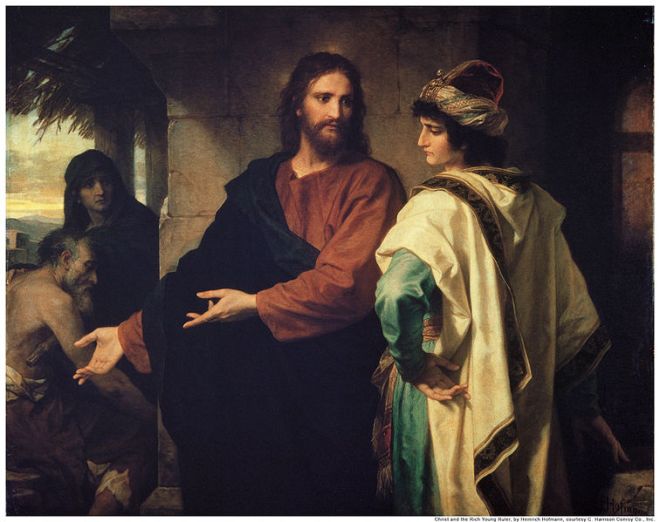
My italics. The church has long opposed market capitalism as the core measure of human well-being. Aquinas even taught that interest-bearing loans were inherently unjust in the most influential theological document in church history. The fundamental reason is that market capitalism measures human life by a materialist rubric. And Jesus radically taught us to give up all our possessions, to renounce everything except our “daily bread”, to spend our lives serving the poverty-stricken takers rather than aspiring to be the wealthy and powerful makers. He told the Mark Zuckerberg of his day to give everything away to the poor, if he really wanted to be happy.

Limbaugh has obviously never read the Gospels. He has never read the parables. His ideology is so extreme it even trashes, because it does not begin to understand, the core principles of capitalism, as laid out by Adam Smith. Market capitalism is and always has been a regulated construction of government, not some kind of state of nature without it. Indeed without proper regulation to maintain a proper and fair and transparent market, it is doomed to terrible corruption, inefficiency, injustice, and abuse.

But let us return to Limbaugh’s hero, John Paul II, this time in Centesimus Annus, written in the wake of Soviet Communism’s demise:

The Marxist solution has failed, but the realities of marginalization and exploitation remain in the world, especially the Third World, as does the reality of human alienation, especially in the more advanced countries. Against these phenomena the Church strongly raises her voice. Vast multitudes are still living in conditions of great material and moral poverty. The collapse of the Communist system in so many countries certainly removes an obstacle to facing these problems in an appropriate and realistic way, but it is not enough to bring about their solution.

Indeed, there is a risk that a radical capitalistic ideology could spread which refuses even to consider these problems, in the a priori belief that any attempt to solve them is doomed to failure and which blindly entrusts their solution to the free development of market forces.

My italics again. Could anyone have offered a more potent critique of current Republican ideology than John Paul II? Could anything better illustrate John Paul II’s critique of radical capitalist ideology than the GOP’s refusal to be concerned in any way about a fundamental question like access to basic healthcare for millions of citizens in the richest country on earth?

Sorry, Rush, but if you think this critique of capitalism is something dreamed up by the current Pope alone, you know nothing about Catholicism, nothing about John Paul II, and nothing about Christianity. But I guess we knew that already, even though the ditto-heads still believe, like that particularly dim bulb Paul Ryan, that Ayn Rand and Jesus Christ are somehow compatible, when they are, in fact, diametrically opposed in every single respect.

Notice, however, as I noted yesterday, that the Church in no way disputes the fact that market capitalism is by far the least worst means of raising standards of living and ending poverty and generating wealth that can be used to cure disease, feed the hungry, and protect the vulnerable. What the Church is disputing is that, beyond our daily bread, material well-being is a proper criterion for judging human morality or happiness. On a personal level, the Church teaches, as Jesus unambiguously did, that material goods beyond a certain point are actually pernicious and destructive of human flourishing. I hesitate to think, for example, what Limbaugh would have made of Saint Francis, the Pope’s namesake. Francis, after all, spurned the inheritance of his father’s flourishing business to wash the bodies of lepers, sleep in ditches, refuse all money for labor, and use begging as the only morally acceptable form of receiving any money at all. In the Church of Limbaugh, there is no greater heretic than Saint Francis. Francis even believed in the sanctity of the natural world, regarding animals as reflecting the pied beauty of a mysterious divinity. Sarah Palin, in contrast, sees them solely as dinner.

Which gets to the deeper issue of materialism.

Nothing better demonstrates the antipathy of the current Republican right to Christianity – indeed its constant, relentless war on Christianity – than the following refreshingly candid confession of spiritual barrenness from Limbaugh:

I want to go back to this quote from the pope again, from his — there’s the name for the document.  I can’t think of it and I don’t have it in front of me.  “The culture of prosperity deadens us.  We are thrilled in the market offers us something new to purchase.  In the meantime, all those lives stunted for lack of opportunity seem a mere spectacle.  They fail to move us.”  I’m not even sure what the connection there is.

We are thrilled if the market offers us something new to buy?  I guess there’s something wrong with that.  We’re not supposed to be thrilled if there’s something new to buy.  That’s how I interpret it.  Now, let me give you a fascinating stat I just learned today.  The iPhone 5S, which is the top-of-the-line iPhone, was announced way back in September, and has been in shortage ever since.

They have been unable to meet the demand, for whatever reason.  They have just recently caught up, and would you like to know how they did it?  They have put one million people on different assembly lines, 600 employees per assembly line at the factory in China at the one factory, where they are making 500,000 iPhones a day, and they still haven’t caught up to demand.

That’s a lot of people who are thrilled with something new to buy.

Er, yes, Rush. But the Pope is not making an empirical observation. In so far as he is, he agrees with you. What he’s saying is that this passion for material things is not what makes us good or happy. That’s all. And that’s a lot for Limbaugh to chew on. And if the mania for more and more materialist thrills distracts us from, say, the plight of a working American facing bankruptcy because of cancer, or the child of an illegal immigrant with no secure home, then it is a deeply immoral distraction. There’s something almost poignant in Limbaugh’s inability even to understand that material goods are not self-evidently the purpose of life and are usually (and in Jesus’ stern teachings always) paths away from God and our own good and our own happiness. Something poignant because it reveals a profound ignorance of one of the West’s deepest cultural inheritances in Christianity.

Limbaugh’s only recourse when faced with actual Christianity is to conspiracy theories about translations of the Pope’s words. Perhaps it’s the commies who have perpetrated a massive lie through their control of the media. That was Sarah Palin’s response to, when confronted with, you know, Christianity for apparently the first time. But you sense that even Rush is beginning to realize there is something more to this, something that could be very destructive to his sealed, cocooned, materialist ideology of one. Hang on a minute, you almost hear him saying to himself …

Yes, Rush, hang on a minute. Christianity is one of the most powerful critiques of radical market triumphalism. And it’s now coming – more plainly and unmistakably in our lifetimes – to a church near you.

(Painting: “Christ and the Rich Young Man” by Heinrich Hofmann.)

Women Are The Future Of Catholicism

800px-Tolentino_Basilica_di_San_Nicola_Cappellone_14

In his Evangelii Gaudium, Francis wrote, “The reservation of the priesthood to males, as a sign of Christ the Spouse who gives himself in the Eucharist, is not a question open to discussion, but it can prove especially divisive if sacramental power is too closely identified with power in general.” If you see the priesthood as just one element of power within the Church – and circumscribed to men alone merely by virtue of historical artifact (the Gospels) or a theological metaphor (Christ as the groom to the Church as bride) – then I suppose this makes some sense. But that is emphatically not what the priesthood as traditionally meant. It has meant absolute authority and power, unequaled in any parish, and only constrained  by bishops and cardinals.

The Pope has spoken of women as the future of the Church. I couldn’t agree more. Their long, ignored, demeaned sacrifices and pastoral and educational and maternal role in the living church signifies how much more could be achieved if the female genius were released from the chains of misogyny and prejudice in the future. But without opening up the priesthood, Francis must surely propose some transformative administrative change to reflect that potential: female cardinals, for example? Perhaps an all-female curia to balance the worker-bees of the all-male priesthood? Or a re-imagined all-female diaconate? To balance out the all-male priesthood, we need, it seems to me, an all-female position of equal power. We need a Mary and a Mary Magdalen to balance Peter and John.

Erin Saiz Hanna makes a different point:

Where Francis misses the mark is suggesting that women are seeking ordination simply as means to gain power. While women’s decision making and leadership is certainly vital, the fact of the matter is women are called by God to serve alongside their brother priests. For a pope who seems so in tune with the marginalized, how does he not see that women are weeping and yearning for justice in the church? How can his sense of social justice not extend to the women of the church and their capacity for ordained ministry?

By including women as priests, the church would model Jesus’ radical example of equality and solidarity with women. It would also have a powerful and positive impact on a world stunned by economic crisis and continually reeling from sexism, racism, homophobia and other forms of oppression.

Douthat reads the Pope very differently:

The suggestion here, addressed to all readers but especially to a certain kind of dissenter, is that there may be space for reform — for a fuller “recognition” of women within the church, and a fuller share in ecclesiastical “decision-making” — within the limits imposed by a male priesthood.

Which suggests, in turn, that a plausible mission for liberal Catholicism in the age of Francis would be to identify such areas of reform, where the church could move in their direction without overturning settled doctrine, rewriting capital-T Tradition, or betraying the clear language of the gospels.

The role of women in church governance is one such place. The possibility of ending the rule of celibacy (or at least expanding the exceptions), highlighted today by my colleague Bill Keller, is another. The possible changes being bruited to the rules surrounding communion for remarried Catholics is a potential third example. And no doubt there are more.

For my own part — if liberal Catholics don’t mind a little advice from a conservative — I think the first area is by the far the most promising, since it offers a way for the church to say, in effect, “yes and no” to the cultural revolutions of the 1960s and 1970s: Yes to the dignity of women, yes to their further empowerment, but no to the idea that this dignity and empowerment depends on jettisoning Catholic (and biblical, and New Testament) ideals about sex and chastity, male-female difference, the indissolubility of marriage and the elevated place of celibacy in Christian life.

I’d be eager for a conciliation on the lines Ross lays out: a meaningful, transformative, reform within the tradition rather than from outside it.

Home And Wet

Patriotism is a funny thing, and mine is somewhat complicated. On the one hand, I’m a classic American immigrant, in as much as I tend to idealize this country more than many who were born here, still get enthralled by the idea of going to Dallas or Miami or even Detroit (they’re just so American!), and get very defensive and angry in the presence of dumb-ass European anti-Americanism. But I cannot find it in me not to keep loving the place I was born and grew up in. I remain intensely loyal to England, and the longer I live, the more its quiet, sturdy virtues (and vices) appeal. I was never that comfortable in it – I’m much more characterologically American – but I now find it a crucible of accumulated human wisdom that looms larger than ever in my imperfect understanding of the world. Its stoicism, humor, empiricism, and pragmatism all seem more valuable to me now than when I was an ambitious youngster, chafing against the restraints they all imposed.

But when I go back, it’s the little things that really warm your soul. Of course, my New York experience may have made me more susceptible to London’s charms, and the astonishing idea that a cab might voluntarily stop to let you cross a street is still reverberating around my head. But then you realize this small set of manners is a cumulative collective achievement. Beneath the packed busy streets, there’s a quiet, low-level order that can become so familiar you lose sight of it. On the tube, for example, despite being crammed in like a container of skinny McDonald’s fries, people actually wait for passengers to get off the train before getting on (with some helpful corralling from conductors). On the escalators, people reliably stand on the right, while the left lane is for striders. Parks are ubiquitous, and convey a constant sense of the English countryside in the densest of urban neighborhoods. Buildings, from domestic architecture (I was constantly struck by simple Georgian beauty or Edwardian elegance) to commercial buildings (some of the new structures are breathtakingly good), are not obviously disposable or purely utilitarian. The exceptions are those constructed when post-war austerity met architectural isms – but mercifully those are slowly being demolished. The resulting affect is a constant struggle for a livable city, as well as a workable one. Maybe that is what has made London perhaps the premier global city. The whole world can find a home here and increasingly does, from the newest Polish immigrant and Brazilian dreamer to the Russian oligarch and the American banker.

Perhaps London has honed these habits so relentlessly because it has no serious British competitor. London is it. So people have made the best of it – over twenty centuries of communal living. The level of politeness you see had to be learned through the centuries, as the least disagreeable way of getting along in such close crammed quarters, and passed along to successive generations. It simply makes life easier en masse, even if it can be inconvenient in any one case for the individual. It reminds me of the wonderful and probably apocryphal conversation between a gardener in an Oxford College and an American tourist. The American asks: “Tell me how you get the lawn so amazingly smooth and perfect?” The gardener replies: “Well, you find the best sod, fertilize carefully, weed constantly, and mow religiously. Do that for about three hundred years and you’ll get the same result.” Yes, my dear late Lady Thatcher, there really is something called society. And England played a huge part in creating it.

And then the specifics that never get old: the reliable, crisp proficiency of the theater (now in a boom); the candy (my new love is something called the Twirl, which is essentially a Flake covered in chocolate); the radio (a constant unifying force of middle Britain); the tabloids, recently atwitter with a great story that united the “naughty vicar” staple, the “crooked banker” reliable, and “the decadent gay” classic. Take it away, the Daily Mail! And all propelled by the great power of a simple English pun. Yes, he was the “Crystal Methodist.” Which hack could resist that story … for days and weeks on end?

Other English imperishables:

Hyde Park at dusk at 3.45 pm. A country walk with my brother and a Springer Spaniel. A reunion with old grammar school friends. A fancy awards dinner with the British political establishment. A series of cuppas with my family. A Doctor Who episode that both charts a totally new future for the Doctor and yet is dripping with nostalgia for the past. Two cabbies: one a classic Private Eye cockney who proceeded to tell me how over-run England is by foreigners, especially “gippos” from the new EU states of Romania and Bulgaria; the other a Muslim immigrant in my home town of East Grinstead who peppered me with questions about the mechanics of gay sex. And now with a Starbucks on every corner, and a gluten-free Pizza Express in the Tudor beamed high street.

Yes, as Orwell once noted in far grimmer times:

In whatever shape England emerges from the war it will be deeply tinged with the characteristics that I have spoken of earlier. The intellectuals who hope to see it Russianized or Germanized will be disappointed. The gentleness, the hypocrisy, the thoughtlessness, the reverence for law and the hatred of uniforms will remain, along with the suet puddings and the misty skies. It needs some very great disaster, such as prolonged subjugation by a foreign enemy, to destroy a national culture. The Stock Exchange will be pulled down, the horse plough will give way to the tractor, the country houses will be turned into children’s holiday camps, the Eton and Harrow match will be forgotten, but England will still be England, an everlasting animal stretching into the future and the past, and, like all living things, having the power to change out of recognition and yet remain the same.

It has and it will. And its role in shaping the future of humankind is far from over.

(Thumbnail image by André Zehetbauer)

The Pope And The American Right

Pope Francis Visits Sardinia

I borrow the title of the post from Ross Douthat who has a typically nuanced take on the subject. Maybe it’s best to start with where we agree. Pope Francis’ criticism of the market as the core relationship between human beings is not in any way new in Catholicism. Nor is it some form of ideological leftism. It’s simply an orthodox call to remind us of our fundamental duty to the poor and the sick and the vulnerable, our manifest obligation to treat every human we encounter with dignity and worth – both personally and through the social structures we democratically assent to. It is primarily something that only each human soul can accomplish: social justice cannot replace interpersonal caritas, as some theocons have long rightly argued. The former is accomplished via the latter. And yes, a Pope’s treatment of social and economic matters is not doctrinally dispositive. There is room for dissent here, and prudential disagreement in good conscience.

Of course, the theoconservatives were among the last to allow any prudential, conscientious disagreement with papal pronouncements when they held sway in the Vatican. Those of us who dissented on priestly celibacy or the civil equality of homosexual persons or the ban on all contraception or the new and extremist doctrine on end-of-life issues were routinely dismissed as outside the fold. But as the theoconservative project, like the neoconservative one, lies in rubble and manifest failure, there’s no need for tit-or-tat now that the papal shoe is on the other foot (and no longer Prada).

There is, for example, little doubt that the free market has brought more wealth, comfort and health to Israeli Prime Minister Benjamin Netanyahu Meets With Pope Francismore human beings than any other form of economic model in human history. The last 300 years have improved our material lot more than the previous 200,000. Socialism is a grim failure of a system, communism even worse. But what all these systems have in common is a materialist vision of what makes human life worth living. That’s not a criticism in particular. Most such systems do not have within their remit a deeper understanding of human existence, a grounding in something other than prosperity. A Catholic, however, has exactly that grounding, which enables us to examine all such systems from different, higher ground.

And the way in which market capitalism has become a good in itself on the American right is, well, perniciously wrong. As soon as a system ceases to be a means to a human good, and becomes an end in itself, it has become a false idol. Perhaps the apotheosis of that idol worship was the belief – brandished on the degenerate right in the past decade or two – that markets are self-regulating. Of course they’re not, as Adam Smith would have been the first to inform you. Another assumption embedded on the American right is that more wealth is always a good thing. The Church must say no. This is a lie. Wealth is a neutral thing above a certain basic level of non-drudgery. Above that, it can be an absolutely evil, deceptive thing, distorting human souls, warping their dignity, vulgarizing their character. An American right that worships at the altar of both free markets and material wealth, and that takes these two idols as their primary goods, is not just non-Catholic. It is anathema to Catholicism and to the Gospels.

The neoconservative version of American exceptionalism is equally anathema to Catholicism. No country on earth is any more inherently moral than any other. It may achieve great things in advancing human good, as the US has clearly done. But as soon as you identify one country with all human good, and believe that its model, let along its divine providence, is dispositive for the whole of humankind, you are also worshiping a false God. It is that self-worship that allows a country to commit evil and justify it. Torture is such an evil. The American justification of it by the false doctrine of exceptionalism is something the Devil would have celebrated as a great triumph in the Screwtape Letters. And the American Catholic right’s acquiescence to it – including the last Pope’s – is a dark and indelible strain.

This is a critique of English exceptionalism as well, of course, and of colonialism as the purest expression of national self-love. It applies to the lie of communism as well as a global panacea- and to all systems that seek to impose a human set of ideas on mass populations by force of law, and that deny the innate dignity and equality of all of us. So yes, much of the right’s critique of communism, fascism, social democracy and the secular hubris of progressivism endures. But we must add to it the panacea of capitalism.

So in the spirit of conversation, let us get specific about two key issues now on the table: healthcare and Iran.

Now it seems to me that the Church is rightly neutral about the means of achieving the end of universal care. It is not a single-payer Church or an Obamacare Church. But it cannot and is not neutral in any way when it comes to the core moral imperative that each individual in our society, especially the most vulnerable, be able to get care in the wealthiest country on earth. In so far as the Republican party is absolutely indifferent to the millions of Americans without health insurance, in so far as they have relentlessly opposed one feasible plan for universal insurance without offering an alternative that could achieve the same thing, the Republican party simply cannot be supported by Catholics right now. Now there are good-faith proposals for a conservative approach to universal healthcare, as we’ve discussed on the Dish, so this critique does not apply to them. But it sure does apply to the GOP leadership.

Similarly on Iran, there is plenty of space within Christian realism to worry that our current attempt at engagement is foolish, that the Iranian regime is not susceptible to change or any peaceful presence in the world. But to refuse even to try and test the possibility of peace – which seems to be the neoconservative position – is clearly against Church teachings to seek peace at all times whenever possible. Pre-emptive war is just as anathema to Catholic “just war” teaching, as, of course, is torture. How much time have theo-conservatives spent this past decade examining the crime of the Iraq war and the evil of torture? I suspect the Pope’s answer would be: not nearly enough. And it’s high time they did.

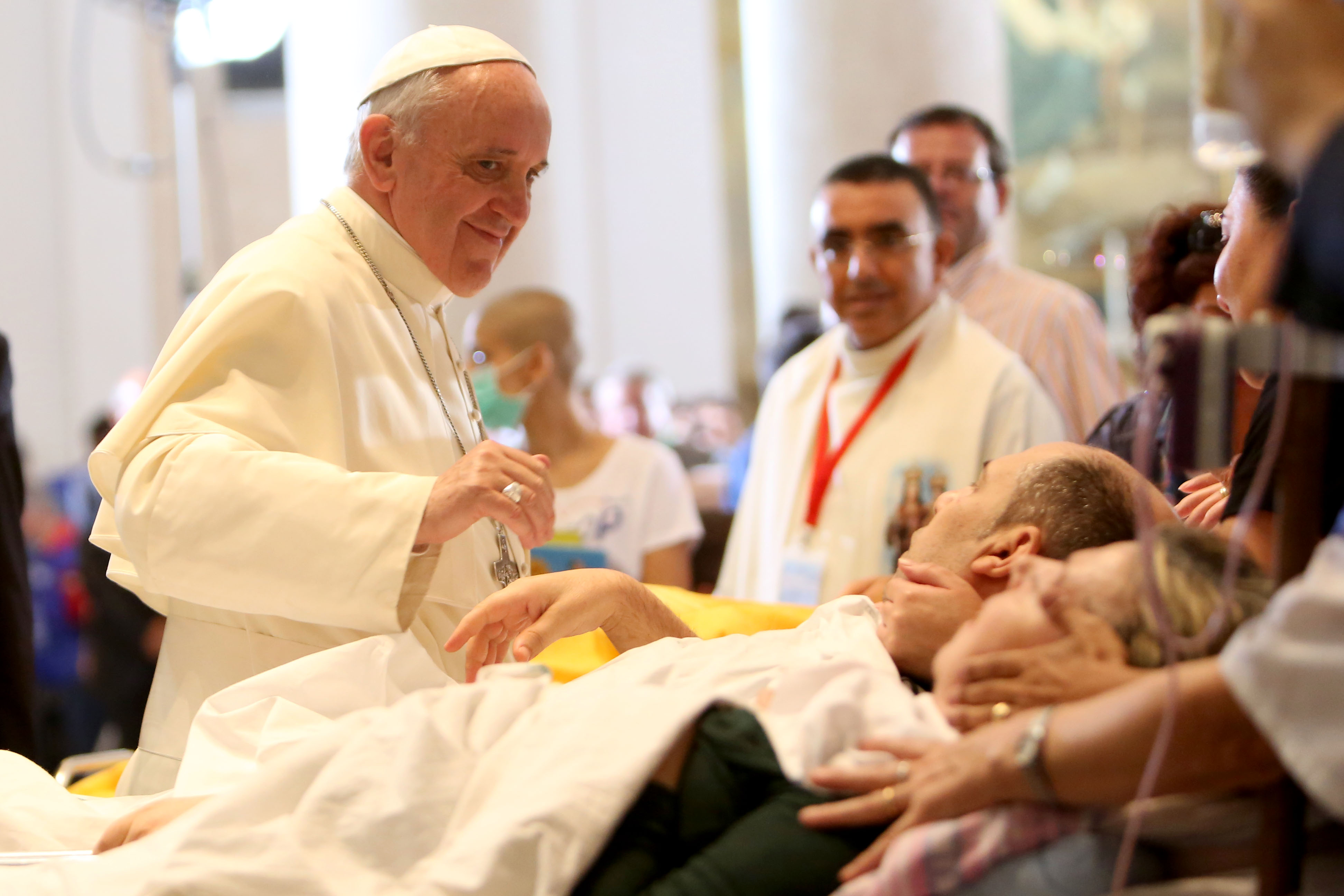
(Photos. Top: The Pope visits the sick on September 22, 2013 in Cagliari, Italy. By Franco Origlia/Getty Images. Right: Pope Francis receives Israeli Prime Minister Benjamin Netanyahu in a private audience at his library on December 2, 2013 in Vatican City, Vatican. By Vatican Pool/Getty Images.)

The Party Of No, No, No, No And Never

Dana Milbank destroys Ari Fleischer this morning – and deservedly so. Fleischer’s instant reaction to even the news of an agreement – without any knowledge of its details – was to denounce it. Dana calls the faster-than-a-jerking-knee response “mindless.” And how could one argue against that? To denounce something before you even know what it is … well, what else do you call it?

It is indeed mindless to denounce a temporary agreement for a six month negotiation to end the possibility of Iranian nuclear bombs without offering any feasible alternative. The one proffered – to actually tighten the sanctions that have already brought the Iranian regime to its knees – cannot work to achieve the desired result. Such sanctions would destroy Rouhani’s standing and credibility, split apart the global coalition on sanctions, help cement in Khamenei’s mind that no deal is possible with the West without national humiliation and regime change, and do nothing to, actually, you know, stop Iran’s nuclear program. It is a de facto argument for war as the only acceptable policy toward Iran.

So their policy is effectively another pre-emptive Middle East war on a country with no nuclear weapons with unknowable consequences and without any allies that would only delay, at best, an Iranian nuclear program. Does any of that sound familiar to you? Such a war would, moreover, strengthen the regime, dis-empower the opposition and all but guarantee that any Iranian regime would try even harder to get a nuclear deterrent.  You will find nothing, nothing in the GOP analysis that even begins to absorb the fact that the Iranian opposition also supports a civilian nuclear program. So they are also intent on picking the one fight with Iran that would unite the regime and the people.

Yes, Dana is right. The word for this is mindless. It is an attitude – a nasty, belligerent, impulsive attitude, the kind of attitude that gave us the Iraq war and Abu Ghraib, and made the world less, rather than more safe. Or consider Syria. The GOP was determined to stop a military strike and also denounced the UN-Russian deal to secure and destroy Syria’s WMDs! So that’s a no and a no. And the last no was to a policy that has been remarkably successful in ending a major source of WMD worry in the region. They opposed a policy that made Israel more secure.

As for healthcare, words fail.

They are running for Congress next year entirely on a platform of repeal and sabotage. They have offered nothing faintly serious to grapple with the dysfunctional socialized system America now labors under – no program to end the free rider problem or the pre-existing conditions problem or the uninsured problem or the costs problem. None, none, none and none. One reason I’ve been grateful for Ramesh Ponnuru and Yuval Levin’s proposals is that at least they exist, have some real merits and might be an alternative. But what’s staggering is how lonely their position is within the actual GOP.

This total nihilism on policy and nullification strategy toward the president, whatever he does, is also mindless for another reason. It is not good for the GOP. At some point, they will not get back the White House without an alternative, and the prospect of ending the insurance the ACA would provide without any alternative is a fool’s errand. It will backfire in the end, even though it may feel very good at the beginning. They are setting themselves up once again to appear as callous, intemperate and denialist. In the end, the American people will pick the party and the president with the constructive ideas rather than the destructive attitude. In this, the Republicans have entrenched Obama’s legacy and done nothing to shape it to more conservative ends. Again: mindless.

I care about this not just because I care about the country, but because I also deeply believe in a strong conservative force in politics. We don’t have that right now, whatever they say. We have a nihilist force. And it is cloaking itself in a political tradition they have long ago left in the dust.