This Is Where We Are

This embed is invalid

 
This is a fascinating speech from today’s rally at the World War II veterans’ memorial. It’s fascinating because it’s a riveting, candid insight into the forces that are behind the government shut-down and the debt-ceiling blackmail of the country and the world. They do not believe this president is a legitimate president. It is beyond their understanding that he was re-elected handily, or that he commands, even during this assault on our system of government, far more support than the Tea Party. Let’s not be mealy-mouthed. This speaker, Larry Klayman of Freedom Watch, accuses the president of treason in this speech, of deliberately pursuing policies to kill members of the armed services, because he is an Islamist, and allegedly “bows to Allah”. What he is saying is the president is a deliberate mole of foreign agents determined to destroy the American way of life. And there is no pushback from the crowd and no pushback from GOP leaders.

This is what we’re dealing with. This is not an alternative budget; it is not another way of insuring millions and cutting healthcare costs; it is not a contribution to anything but to the logic of nullification of an election. It is yet another declaration of cold civil war – a call for a nonviolent refusal to be governed by a re-elected president because he is pursuing policies with which an electorally defeated minority disagree. Simply pursuing those policies has rendered Obama a “monarch” who is arguing “his way or the highway.” But all Obama is doing is implementing a campaign promise and settled law, while governing under a continuing resolution that reflects the sequester’s level of spending, a level agreed to by the Republicans. He wants a budget agreement between the House and Senate in a conference that the Republican House has long resisted entering. He has said that he is happy to negotiate with anyone on anything as long as the blackmail of a government shut-down and of a threatened global depression are ended. And his record shows that he has compromised again and again – as his own most fervent supporters look on in dismay.

I’m not privy to the negotiations now going on in the Senate and can only glean from outsiders what the meetings with legislators have been like. But I’m not distorting the raw facts of the situation here, or trying to distract from them. And I’d love a much more expansive Grand Bargain on taxes and entitlements, that could ease our long-term debt (but it would have to be a bargain, not merely a set of Republican demands). But the rank threats of unimaginably radical consequences if a re-elected president doesn’t junk what he was re-elected to do are so foul in their lack of concern about the common good, so poisonous in their slander of a president, and so contemptuous of our orderly system of government, that it is vital the threats do not work and are not accommodated. No president of any party has any right to legitimize such an attack on the American system of government and the way it conducts business – by elections, debates, compromises and budgets, not threats of total government shut-down and the collapse of the dollar if our global credit rating is effectively destroyed overnight.

I hoped we’d be nearing some kind of deal at this point, rather than witnessing this upping of the ante from the forces that truly live on the fringes of the far right, but which, without any resistance, have now defined the Republican party. It is no accident that among those addressing this rally to blackmail the country and the world were Sarah Palin and Ted Cruz. I can see a very powerful populist electoral ticket with both of those on it – either of a third Tea Party or of an even more  radicalized GOP. And perhaps that is the only way to expunge this nihilist extremism from our system. Except that it may succeed in expunging the system and the economy before we can test it where in a democracy we are accustomed to test it: in elections, not in the chaos of economic blackmail.

The Abatement Of Cruelty

Matthew Scully has written a powerful, emotional and, to my mind, largely persuasive piece about the moral necessity of changing our collective treatment of farm animals. It is framed – somewhat relentlessly – as an argument designed to make pro-life conservatives look afresh pigs.jpgat the moral question of animal cruelty, which is, perhaps, a good thing if he wants to break through the noise. But it can alienate readers who may not share Matthew’s pro-life passion – which is a shame because the argument is worth a hearing in its own right – an urgent hearing about an urgent moral atrocity that many of us enable every day of our lives without even realizing it fully.

What I love about Matthew’s essay is that it refuses to let the reader off the hook. It made me deeply uncomfortable about my own eating habits, which I recognize are simply morally unacceptable. Some screeds are so screechy they make you more comfortable in your own position. This screed – though unnecessarily abrasive at times – doesn’t.

The great thing about the essay – apart from its splendid demolition of that preposterous bore, Anthony Bourdain – is its simplicity. What we do to pigs in factory farms is so morally wrong, so violating of even basic moral norms, that we have to stop it.

This week, we found new evidence that the brains of dogs, when examined under MRIs, react very similarly to human brains in terms of emotion, feeling, and suffering. Every dog owner knows this already, but the excuses that we cannot fully, scientifically, know that these animals are capable of feeling have now run completely dry:

Although we are just beginning to answer basic questions about the canine brain, we cannot ignore the striking similarity between dogs and humans in both the structure and function of a key brain region: the caudate nucleus. … In dogs, we found that activity in the caudate increased in response to hand signals indicating food. The caudate also activated to the smells of familiar humans. And in preliminary tests, it activated to the return of an owner who had momentarily stepped out of view. Do these findings prove that dogs love us? Not quite. But many of the same things that activate the human caudate, which are associated with positive emotions, also activate the dog caudate. Neuroscientists call this a functional homology, and it may be an indication of canine emotions.

The ability to experience positive emotions, like love and attachment, would mean that dogs have a level of sentience comparable to that of a human child.

Our deep familiarity with dogs makes this unsurprising. It is one reason we find dog-fighting or cruelty or mistreatment so abhorrent. But the brain structure of dogs is very similar to pigs, whose intelligence is close to identical. Which is why Matthew’s strongest paragraphs seem to me to be these:

Why is it right or fair to pamper dogs (the lucky ones) and torture pigs? In some corners of the world they torture and eat both, and by what coherent standard can we tell those savage people that they’ve got it wrong? In the underground meat markets of Thailand, Vietnam, and South Korea, as CNN reports, “a common belief is that stress and fear releases hormones that improve the taste of the meat, so the dogs are placed in stress cages that restrict their movement,” among many sufferings that end only when they “have their throats cut in front of other dogs who are awaiting the same fate.” If such practices are morally out of bounds, that’s news to American agribusiness.

It’s all just cultural preference, habit, and custom, as Asian connoisseurs of meat from dogs (or horses, monkeys, dolphins, whales, and on and on) will be quick to tell you. Morally, the differences between pigs and dogs, and between our treatment of them, are purely conventional, the technical term for meaningless. Appeals to convention may be well and good in matters of taste or social etiquette — there is no One True Way to greet guests or prepare party favors. But if we are being morally rigorous, then citing “custom” is just a tautology: We do it because we do it. In this case, you could switch the picture here in our own country all around — dogs to the abattoir, pigs on the couch — and convention and custom would be just as defensible. Or, more to the point, just as indefensible. We can be consistently kind or consistently cruel, but anything in between has the whiff of moral relativism, right and wrong decided by whim.

The main force against this, of course, is market capitalism. What Scully wants would mean much lower profits for Big Ag, a constituency well-tended to by the GOP, even as they slash food stamps for the poor (yeah, they really are compassionate, these conservatives, aren’t they?). And his argument is, at root, a moral and properly conservative critique of capitalism.

That’s why, by his account, Karl Rove simply gave him an arched eye-brow for bringing up the subject as something that might be included in a GOP platform some day. No party that would love Sarah Palin is ever going to sacrifice profits for animal welfare.

But I wish him well, even though I think he alienates liberals and pro-choice independents unnecessarily in his tone in parts. Perhaps given the raw partisanship that courses through what’s left of the right, it’s the most effective strategy for persuasion among Republicans. But what we are talking about here is an enlargement of human empathy – and slash and burn partisan rhetoric is not too helpful in that difficult endeavor.

He’s also rightly very, very defensive about working for a vice-presidential candidate, Sarah Palin, who has openly declaimed her utter contempt for animal welfare on multiple occasions and fought to kill wolves from helicopters leaving them to die excruciating, long deaths (Scully excuses her because of the pro-life testimony of the birth of Trig, the fantastic story of which he seems to take at face value). One obvious, glaring, unbelievable part of his essay is also his remaining inability to condemn the torture program of his former political masters – even to the point of citing torture advocate Andrew McCarthy in his defense. I’m sorry, Matthew. But no ringing condemnation of private sector cruelty against animals can stand without also acknowledging the horrifying treatment of humans that the Republican party still endorses, and even finds a subject worthy of foul, chuckling humor.

His recommendation – veganism – also seems to me a bit de trop. Yes, we can live without meat. But our species evolved as meat-eaters and we were once capable of husbanding animals humanely on traditional farms. It does not seem to me to be wrong to eat meat as such, but rather wrong to eat meat produced in the way almost all of it now is. Going vegan is an admirable choice in this context, but there are less drastic moves: to seek out meat from humane farmers as well as eating less of it. There are also types of meat. I think we can make distinctions of degree between, say, the emotional experience of a chicken and a pig. But the commodification of living beings is what troubles Scully, and it should trouble any Christian, and certainly any Catholic in a church headed by a man by the name of Francis.

In the larger sense, though, we are in Scully’s debt. His prose erupts at times with the righteous fury of the prophet. Because this is a great moral evil amidst us – and he is a true Prophet about that.

Update: This post prompted a reader thread.

There Is No There There

Boehner, House Leaders Speak To Press After Republican Conference Meeting

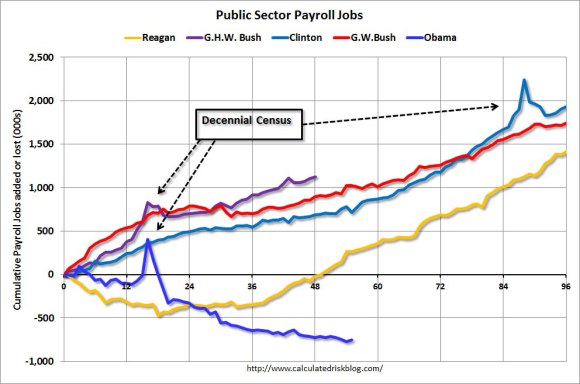
What does the GOP want? It’s a question I keep asking myself. They say they want to kill Obamacare because it is allegedly killing jobs. But in order to do that, they are threatening a default that would wipe out more jobs than the collapse of Lehman. They say they want to reduce the deficit, but the deficit has been falling extremely fast these past few years – in part because of the sequester they got out of their last hostage-taking event in 2011. Government spending has already been pummeled in this recovery – far more so than in past recoveries.

usgs_line.phpThey say they want to reverse what they see as the end of American freedom because of the dawn of public subsidies for private insurance policies, based on a Heritage Foundation idea and implemented by their last presidential nominee in his home state. Okay, so how about running a campaign for Congress and presidency that explicitly promises to repeal Obamacare entirely? Oh, yes, they already did that and lost. How about upping the ante and making it explicit in the campaign that this is the very last chance to end Obamacare and save America? Oh, yeah, I forgot. They did that too.  So what do they want? I’m not sure they even know.

My best guess is that since they failed to make Obama a one-term president, they now intend to do what has become their custom with second-term Democratic presidents: impeach him. How to do it? Risk blowing up the entire global economy, bet on Obama caving at the end by some kind of dubious executive action, and then prosecute him for it. And what would that do exactly? It would not end Obamacare. But it would throw us instantly into both a Second Great Depression and a severe constitutional crisis.

public-sector-jobsI simply do not see here any actual constructive strategy to help the country recover from the worst recession in decades. I see absolutely no strategy to deal with what everyone agrees is a deeply dysfunctional and grotesquely inefficient healthcare system. I see no viable way to bring down the long-term debt, because such a goal can only be achieved in our system with compromises from both parties, and the GOP is offering nothing that only the Democrats want. That’s why this is such a serious crisis, because the key driver of it has no real idea what it wants to do except destroy a re-elected president.

This is a function of many factors the Dish has covered for years – the intellectual bankruptcy of conservatism under George W Bush; the rise of fundamentalist thinking in religion, economics and politics; the cultural marooning of the white rural conservativesoulpbc.jpg poor; the substitution of a political party with a media-industrial complex that simply wants conflict for ratings and money; the collapse of anything that might be called a conservative intelligentsia able to converse with a liberal intelligentsia on common, empirical grounds; the cowardice of Republican elites in the face of their know-nothing wing, epitomized most brutally by John McCain’s selection of a delusional crazy person as his vice-presidential candidate in 2008; and the recourse to purism of an almost absurdist variety on the right – see Mark Levin’s influential view that the entire Constitution needs to be made over.

The GOP vacuum – for what else can we call such a nihilist temper tantrum? – was best encapsulated for me by a story in yesterday’s NYT. It featured a district gerry-mandered for Palinism, one that seems very reminiscent of the Greenberg-Carville focus groups cited here. This is where my heart sank:

Mr. Tripcony, the surveyor, said he underwent heart surgery not long ago without health insurance, “a bad blow.” He has been making payments against the cost. He had heard of the online marketplace for insurance that opened on Oct. 1 under the Affordable Care Act.

“I just don’t trust it,” said Mr. Tripcony, who has an equal distrust of President Obama. “I don’t like him, and I don’t feel comfortable with anything he’s got to do with.”

Mr. Tripcony said he had a better idea for a system to provide health care at a fair price. “I think it should be the same for everybody,” he said. “One big company, whether owned by the government or private.” Informed that he had described the single-payer system that Mr. Obama abandoned when Republican critics called it socialized medicine, he said, “Yeah, I know, it’s crazy.”

He said he might eventually seek health insurance under the new system. “In a couple of months, when they get the Web sites working, I may do it.”

Mr Tripcony is doing us a favor. He is telling us the truth. This crisis has almost nothing to do with actual policy – as you can see from a base Republican’s rational support for a single-payer healthcare system and willingness to get Obamacare insurance. There is nothing to the current Republican strategy but blind, irrational hatred for a re-elected president: “I don’t like him, and I don’t feel comfortable with anything he’s got to do with.” Somehow, this “feeling” must be granted some “relief”, or they will bring down the world economy. But any relief granted on these terms would simply pave the way for more economic terrorism and blackmail in the future, which would mean an end to our system of government.

The GOP have driven themselves into a tight, airless corner of ideological purity and self-destruction. The trouble is: their own self-destruction means ours as well. And the world’s.

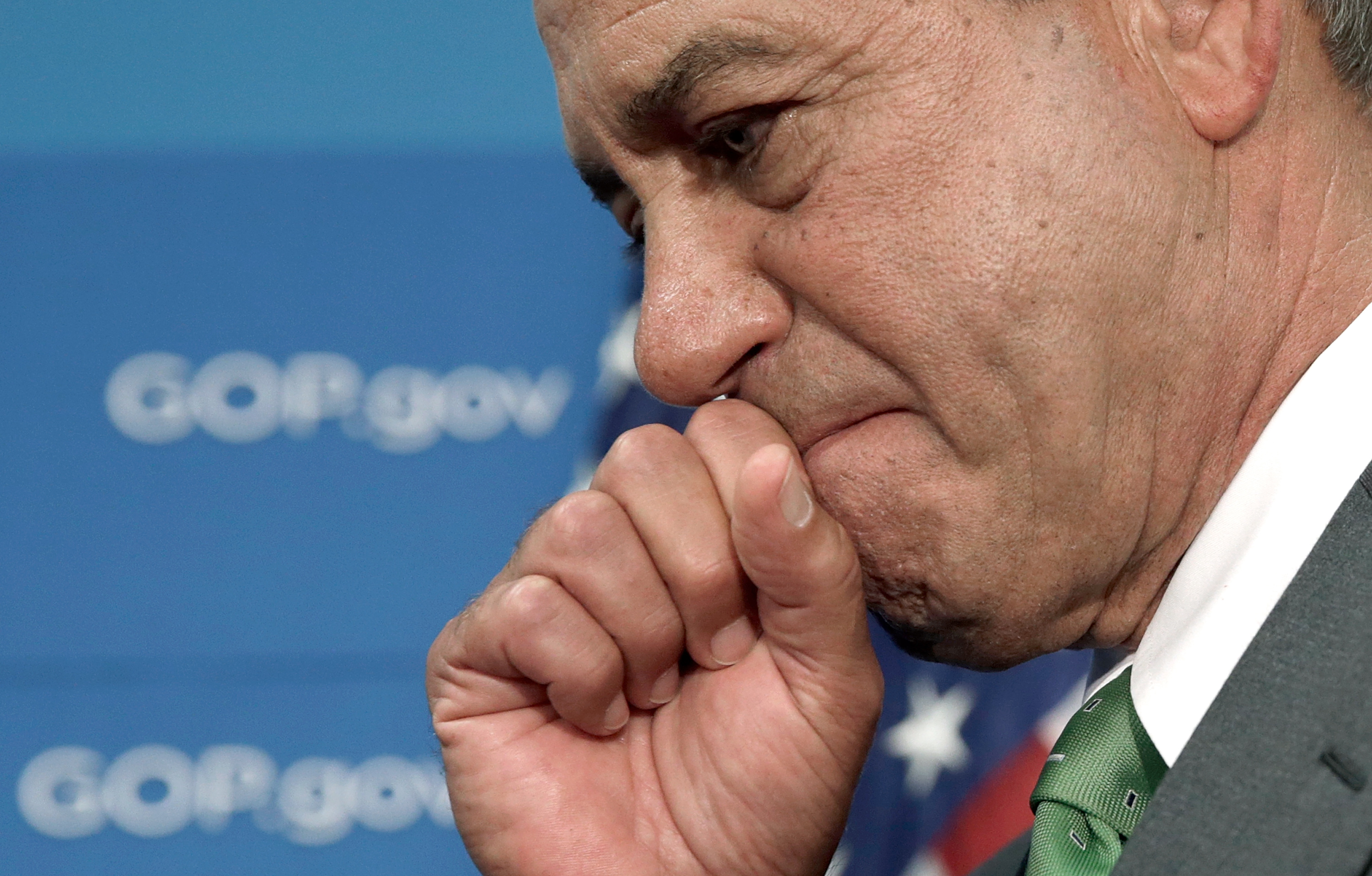
(Photo by Getty Images; graphs by US Government and Calculated Risk; cover from The Conservative Soul)

This Revolutionary Pope

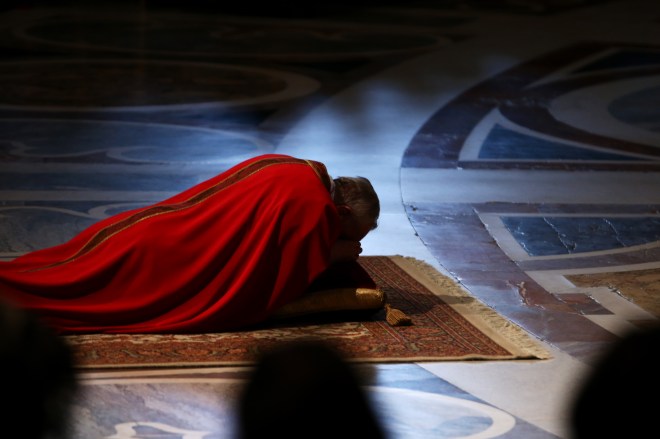
Pope Francis Attends Celebration Of The Lord's Passion in the Vatican Basilica

Last week, as the House Republicans held a gun to the country’s head, I failed to address yet another remarkable interview by Pope Francis, this time to the Italian journalist Eugenio Scalfari, who is an atheist, in La Repubblica. Like his America interview, I urge you to read it, whether you are an atheist, an agnostic, a believer or anything in between. I tried to absorb it all this weekend, and found it difficult. Difficult because it was so overwhelming in its power, and because I need time to pray and think some more about what he said. I mean, what can one say immediately about a Pope who can say:

Proselytism is solemn nonsense, it makes no sense. We need to get to know each other, listen to each other and improve our knowledge of the world around us.

Or this:

Heads of the Church have often been narcissists, flattered and thrilled by their courtiers. The court is the leprosy of the papacy.

Or this:

A religion without mystics is a philosophy.

Or this:

I say that politics is the most important of the civil activities and has its own field of action, which is not that of religion. Political institutions are secular by definition and operate in independent spheres.

It is as if the Catholicism that has been forming and re-forming in my own mind and soul for years suddenly became clearer, calmer, simpler. This Catholicism, like Saint Francis’, is about abandoning power and all the trappings of power; it is about leaving politics alone in an independent sphere, in stark contrast to Christianism which is primarily politics and ultimately about power; it is a faith rooted in mystery and mystics; about love and mercy; about the core teachings of Jesus again – made fresh.

I would say that it is a miracle. Francis’ emergence as Francis is a miracle. Literally:

Before I accepted I asked if I could spend a few minutes in the room next to the one with the balcony overlooking the square. My head was completely empty and I was seized by a great anxiety. To make it go way and relax I closed my eyes and made every thought disappear, even the thought of refusing to accept the position, as the liturgical procedure allows. I closed my eyes and I no longer had any anxiety or emotion. At a certain point I was filled with a great light. It lasted a moment, but to me it seemed very long. Then the light faded, I got up suddenly and walked into the room where the cardinals were waiting and the table on which was the act of acceptance. I signed it, the Cardinal Camerlengo countersigned it and then on the balcony there was the ‘”Habemus Papam”.

Made every thought disappear. And what appears when thought has been left aside? Light!

God is the light that illuminates the darkness, even if it does not dissolve it, and a spark of divine light is within each of us. In the letter I wrote to you, you will remember I said that our species will end but the light of God will not end and at that point it will invade all souls and it will all be in everyone… Transcendence remains because that light, all in everything, transcends the universe and the species it inhabits at that stage.

This is a Pope speaking to an atheist as an equal and in love. Which is where the church must begin again. It’s sad to me that so many orthodox Christians in America cannot yet see this.  Here’s Dreher, in an otherwise positive response to the interview, finding the remarks “incoherent from a Christian perspective”:

I don’t get the universalism behind encouraging people to “move towards what they think is Good.” What the Wahhabist thinks is Good is not the same thing as what the secular materialist thinks is Good, and is not the same thing as what the Amish farm woman thinks is Good. I mean, obviously there will be some overlap, but if the Pope believes there is no reason to insist on Christian particularity, if Jesus is true for him, but not for everyone, then why evangelize at all?

Was Rod reading? “Proselytism is solemn nonsense.” No wonder Russell Moore, a conservative Southern Baptist, calls the interview “a theological wreck. No wonder, at First Things, Mark Movsesian argues that

Some things he said in the interview are a frankly a little shocking.

He told the interviewer, Eugenio Scalfari, “Proselytism is solemn nonsense.” That’s a rather dismissive way to treat millennia of Christian apologetics. The pope’s views on conscience were also odd, from a Christian perspective. “Everyone has his own idea of good and evil and must choose to follow the good and fight evil as he conceives them,” the pope said. “That would be enough to make the world a better place.” With respect, “do what you think is right” is not the Christian view of conscience. That sounds more like Anthony Kennedy than St. Paul. And would the world really be a better place if everyone did what he thought was right? How about jihadis?

Always with the Jihadis, those lost, damaged souls. K-Lo, of all people, defends what Francis said about conscience:

This isn’t “anything goes,” but it’s an exercise in mercy and justice.

What it is is an exercise in engagement, rather than power. This was Saint Francis’ genius, and Paul’s and Augustine’s. They were in their world as well as not of it. Pascal-Emmanuel Gobry has the best take:

[W]hen the Pope says “Everyone has his own idea of good and evil and must choose to follow the good and fight evil as he conceives them”, that could be interpreted as a brief for moral relativism. Of course, the only problem with that interpretation would be that it would be arrant nonsense. Because, you know, he’s the Pope, and also an orthodox Catholic, as he has demonstrated on countless occasions…

The problem here, as always, is pride. We think like politicians. We parse words for whether they help the Republican Party of the Church or the Democratic Party of the Church, whereas we should be humbly receiving the teachings of the Vicar of Christ. When those teachings seem shocking to us, common sense alone dictates that, instead of rending our garments, we should, with humility and charity, check ourselves to see what we can learn.

That’s what I’m still doing. But what leaps out of the interview is a scoop, as John Allen noted and few others did. The scoop is that this Pope has undergone a mystical spiritual awakening – after that great silence and great light before he accepted the papacy. Allen remembers interviewing the new pope’s sister in April, who said “that something was different about her brother since he took over the church’s top job.” He continues:

Recently, I spoke to one of the cardinals who elected Francis (not an American, by the way), who had been received by the pope in a private audience. The cardinal told me he had said point-blank to Francis, “You’re not the same guy I knew in Argentina.”

According to this cardinal, the pope’s reply was more or less the following: “When I was elected, a great sense of inner peace and freedom came over me, and it’s never left me.”

In other words, Francis had a sort of mystical experience upon his election to the papacy that’s apparently freed him up to be far more spontaneous, candid and bold than at any previous point in his career.

One should never doubt the mystical imprint upon the contours of a papacy.

Isn’t it interesting that this story got largely ignored, while a sentence or two that allows Christianists to complain about “relativism” got so much attention? Why not simply examine, and take to heart, what Francis said about his namesake? Here’s what he said:

[Francis] is great because he is everything. He is a man who wants to do things, wants to build, he founded an order and its rules, he is an itinerant and a missionary, a poet and a prophet, he is mystical. He found evil in himself and rooted it out. He loved nature, animals, the blade of grass on the lawn and the birds flying in the sky. But above all he loved people, children, old people, women. He is the most shining example of that agape we talked about earlier…

Francis wanted a mendicant order and an itinerant one. Missionaries who wanted to meet, listen, talk, help, to spread faith and love. Especially love. And he dreamed of a poor Church that would take care of others, receive material aid and use it to support others, with no concern for itself. 800 years have passed since then and times have changed, but the ideal of a missionary, poor Church is still more than valid. This is still the Church that Jesus and his disciples preached about.

This is still the church we can rebuild today.

Read the recent Dish thread on Pope Francis here.

Why They’ll Die On This Hill

The Democratic group headed up by Stan Greenberg and James Carville has just put out a report on their recent focus group discussions with Republican voters. It’s a sobering read (pdf) – and definitely helps explain the primal scream now threatening to take down the entire American system of elective government.

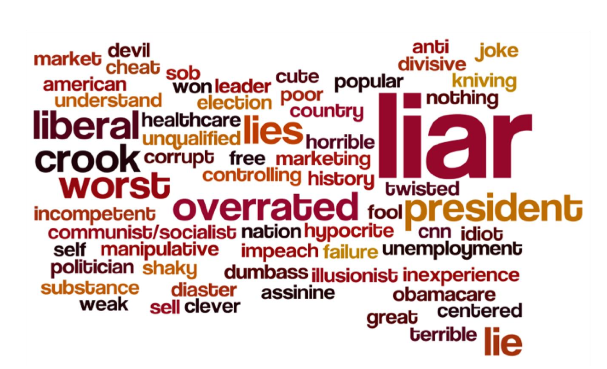
Here, for starters, is the word cloud for what these voters say when talking in like-minded focus groups about president Obama:

Screen Shot 2013-10-04 at 11.30.54 AM

The base Republican voters in these focus groups view themselves as besieged by minorities seeking free benefits, and see Obama as the Pied Piper of those hoping to abuse the system. They are not explicitly racist about the president or about the beneficiaries of the new goodies (though they had no such qualms during Bush’s Medicare D entitlement). But they believe they are losing an America that a Roanoke evangelical describes like this:

Everybody is above average. Everybody is happy. Everybody is white. Everybody is middle class, whether or not they really are. Everybody looks that way. Everybody goes to the same pool. Everybody goes – there’s one library, one post office. Very homogeneous.

This is the America they believe is being taken away from them. Some money quotes:

“The government’s giving in to a minority, to push an agenda, as far as getting the votes for the next time”. (Evangelical man, Roanoke)

“There’s so much of the electorate in those groups that Democrats are going to take every time because they’ve been on the rolls of the government their entire lives. They don’t know better.” (Tea Party man, Raleigh)

But this is the core conclusion of the study and why it helps us understand our current predicament – nothing represents their sense of loss and anger more powerfully than Obamacare:

When Evangelicals talk about what is wrong in the country, Obamacare is first on their list and they see it as the embodiment of what is wrong in both the economy and American politics. In fact, when asked what she talks about most, one woman in Colorado replied, “Obamacare, hands down, around our house.” In Roanoke, it was the first thing mentioned when asked “what’s the hot topic in your world?”

To participants in these groups, Obamacare “just looks like a wave’s coming, that we’re all going to get screwed very soon. ” (Evangelical woman, Colorado Springs)

“Obamacare’s just another intrusion on the Constitution … And I just – I’m appalled. I’m appalled by what’s going on in our country.”(Evangelical man, Roanoke)

“It’s putting us at the mercy of the government again.” (Tea Party woman, Roanoke)

“[Our rights] are slowly being taken away… like health care.” (Tea Party woman, Roanoke)

I’ve long argued that you have to see the bigger cultural and religious picture when analyzing what has happened to American conservatism these past two decades or so.

The bewildering economic and social and demographic changes have created a cultural and existential panic among those most heavily concentrated in those districts whose members are threatening to tear down the global economy as revenge for losing two presidential elections in a row. They feel they have already lost and have nothing to gain from any constructive engagement with a president they regard as pretty close to the anti-Christ of parasitic minorities. They feel isolated in a more multi-cultural country. They feel spied upon and condescended to. They have shut out any news sources apart from Fox. It does not occur to them, for example, that Obamacare might actually help them. And you get no actual specifics on policies they like or dislike. It is all abstractions based on impressions.

More to the point, the bulk of these Republicans no longer believe in the Republican party. They identify more strongly with the Tea Party or Evangelical groups or Fox News than the GOP. On social issues, the defining issue is homosexuality – not abortion. That intransigence will alienate them them even further from the future mainstream. Their next big issue: denying climate change. Right now, I see no way to integrate these groups and people into the broader body politic or conversation. Their alienation is so deep it is close to unbridgeable. And further defeats will make their isolation worse, not better, their anger more, not less, intense.

This is the deeper crisis we face – and without strong economic growth, it is hard to see how it can be ameliorated in the near future. Perhaps if moderate Republicans – a mere quarter of the whole – jumped ship to the Democrats, then the electoral losses would be so great as to demand some kind of reform. But the center is not holding. And I fear it will get even worse than this until it gets better.

Except it’s hard to imagine political dysfunction getting worse than risking the first ever default by the Treasury of the United States because a key minority feels “disrespected.”

“Breaking Bad” By Niccolo Machiavelli


In some ways, Breaking Bad was, for me, a hymn to Machiavelli. Walter White – in order to secure his honor as well as his survival – leaves traditional morality and virtues in the desert to seek power and money and respect. And he does so with such brilliance and fortitude and elan that Old Nick himself would have marveled at the spectacle of untrammeled evil and empire building. If a man is truly a man through force and fraud and nerve, then Walter becomes the man he always wanted to be. He trounces every foe; he gains a huge fortune; he dies a natural death. Compared with being a high school chemistry teacher? Niccolo would scoff at the comparison. “I did it for me.”

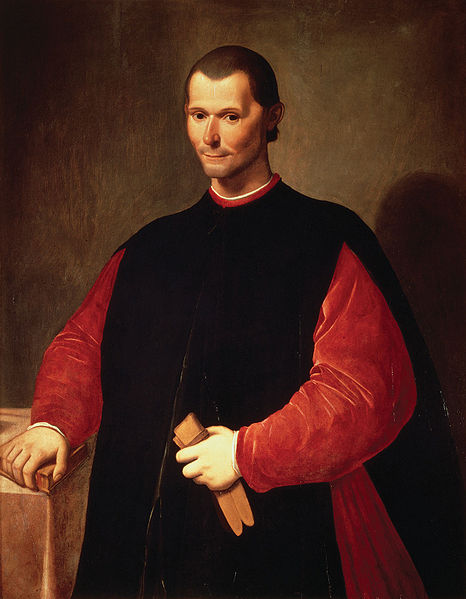
Like Richard III or Richard Nixon, Walt is consumed all along by justified resentment of the success others stole from him, and by a rage that his superior mind was out-foxed by unscrupulous colleagues. He therefore lived and died his final years for human honor – for what 466px-Portrait_of_Niccolò_Machiavelli_by_Santi_di_TitoMachiavelli calls virtu, a caustic, brutal inversion of Christian virtue. And there is some worldly justice in this – he was cheated, he was diminished, his skills were eventually proven beyond any measure in ways that would never have happened if he had never broken bad. And breaking bad cannot mean putting a limit on what you are capable of doing. What Machiavelli insisted upon was that a successful power-broker know how to be “altogether bad.” You have to leave a woman choking on her own vomit to her death. You have to murder a child on a toy scooter.

But the script cheats. Why? Because Walter is already dying. The calculations you make about your future do depend very much on how far you can see ahead. And the cost-benefit analysis of “breaking bad” when the alternative is imminently “dying alone” is rigged in favor of the very short term, i.e. zero-sum evil. If Walt had had to weigh a long, unpredictable lifetime of unending fear and constant danger for his family and himself, he would have stopped cooking meth. As, indeed, he did, when finally given the chance – only to be yanked back into the life of a mobster by his brother-in-law, bored, sitting on a john. Nice Shakespearean touch that, I thought.

And was he happy? Yes, but in a way that never really reflects any inner peace. He is happy in a way that all millionaires and tyrants are happy. His will is done. But we know that this does not lead to actual, enduring happiness. Which is why, for me, Machiavelli’s great flaw is that the life of such a brutally powerful figure, ruling by force and fraud, is a mug’s game. Isn’t the consequence of his proud immorality a never-ending insecurity? Do not most mob bosses live in fear every day and die by the same methods they employ? Did we not see that happen to Gus? Even to Mike? Did Saddam have a happy ending? Or Richard III? These are lives mesmerizing in action but miserably, existentially insecure. Remember Mike’s face as he took a last look at his grand-daughter. You call that happiness?

So for me, Breaking Bad should be taught alongside Machiavelli – as a riveting companion piece.

It should be taught because it really does convey the egoist appeal of evil, of acting ruthlessly in the world, of becoming a man in a battle of wills and lies, of seeing even a murdered innocent child as a necessary unpleasantness. It should be taught because it reveals the power of nerve, of deception, and of courage. But it should be taught also because it reveals Machiavelli’s fundamental, soul-destroying, life-hollowing emptiness.

The benefits only work if your life is nasty, brutish and short. The costs are seen in the exhausted, broken eyes of Skyler, the betrayal of an only painfully faithful son, the murder of a brother-in-law, the grisly massacre of dozens, the endless nervous need to be on the alert, to run and hide and lie and lie and lie again, until life itself becomes merely a means to achieve temporary security. In the end, this is not living. It is running, running, in the end, from yourself. There is no resting place there, no peace, no day after. There is only always the day before. The day before you are killed by the forces you unleashed to kill others.

Stewart Patrick explains further:

Machiavelli differs from later realists like Hobbes—and more contemporary “neorealists” like the late Kenneth Waltz—in recognizing that human agency matters as much as the structural fact of international anarchy in determining both foreign policy behavior and ultimate outcomes in world politics. Through historical examples of successes and failures, Machiavelli reminds us that individuals matter. Yes, the world is perpetually changing, buffeting the state in all directions. But even if “there’s a Providence that shapes our ends”—as Shakespeare’s Hamlet observes—a leader’s choices can have a pivotal impact on politics, both domestic and international.

Machiavelli explores the interplay between material forces and human agency through the concepts of fortuna and virtu.

All princes (and indeed, all people) are subject to societal and natural factors larger than themselves. Still, “free will cannot be denied,” Machiavelli insists. “Even if fortune is the arbiter of half our actions, she still allows us to control the other half, or thereabouts.” Though fortune be capricious and history contingent, the able leader may shape his fate and that of his state through the exercise of virtu. This is not to be mistaken for “virtue”, as defined by Christian moral teaching (implying integrity, charity, humility, and the like). Rather, it denotes the human qualities prized in classical antiquity, including knowledge, courage, cunning, pride, and strength.

Walter possessed all in abundance. And he used them to destroy countless bodies and souls, including the only ones he truly loved, including, in the end, his own.

Recent Dish on Machiavelli here and here.

UPDATE: Reader feedback on this post here.

Is The Shutdown Racist?

Mitt Romney Attends Tea Party Rally In New Hampshire

Joan Walsh nods:

On the day the Affordable Care Act takes effect, the U.S. government is shut down, and it may be permanently broken. You’ll read lots of explanations for the dysfunction, but the simple truth is this: It’s the culmination of 50 years of evolving yet consistent Republican strategy to depict government as the enemy, an oppressor that works primarily as the protector of and provider for African-Americans, to the detriment of everyone else. The fact that everything came apart under our first African-American president wasn’t an accident, it was probably inevitable.

I’d say it came apart during the impeachment of Bill Clinton, the first sign of madness when the Democrats first truly wielded power after the Southern Strategy bore fruit under Reagan. Remember that Clinton was from the beginning regarded as illegitimate because he didn’t get more than 43 percent of the vote. Let us recall Bob Dole’s words after Clinton’s 1992 clear electoral college victory:

There isn’t any Clinton mandate. Fifty-seven percent didn’t vote for him. I’ll represent the 57 percent.

Or Tommy Thompson with an equally surreal view of the Constitution:

Only 43 percent of the people voted for Bill Clinton — that is not much of a mandate. . . . Republicans won nine legislative houses across the country. . . . Republicans have just as much of a mandate as the Democrats.

When you compare this with the Republican view of the 2000 election when George W Bush lost the popular vote and, undeterred by any sense of restraint, doubled down on massive unfunded tax cuts and pre-emptive wars along with budget-busting new entitlements, you get a better sense of who feels entitled to rule in this country, and who is routinely regarded as “illegitimate.”

Now, of course, this merely suggests that it is simply being Democrats that render the last two Democratic presidents inherently illegitimate – since only one was African-American. But remember how Clinton was regarded as “the first black president” by many, including those on the left? Remember his early days fighting for civil rights in Arkansas? You think a white Southerner overturning the success of the Southern Strategy would be deemed acceptable to the Southern right which increasingly dominated the GOP?

Nonetheless, Charles C. W. Cooke rightly notes:

Gerald Ford, Jimmy Carter, Ronald Reagan, Bill Clinton, and George H. W. Bush, all of whom presided over fractious shutdowns, might find this insinuation rather perplexing. In the last 40 years, only President George W. Bush was spared such a conflict.

The one president whose legitimacy was actually in some actual doubt escaped the revolt entirely. Hmmm. Quod erat demonstrandum.

More to the point, the other shutdowns were not about demanding the repeal of an already-enacted, constitutionally-approved signature achievement of a re-elected president – only a few years after a massive financial crisis and during a global recession. They were bargaining positions in which both sides had something to offer and a compromise to reach. All the GOP has to offer this time is … shutting down the government. This is not negotiation; it’s blackmail. And blackmail after all the proper avenues for stopping, amending, delaying and reforming the health bill have been exhausted. I mean they repealed the bill 41 times already – proof positive that all constitutional means for opposition have been exhausted. That‘s what makes this different. It’s not about playing hard by the rules. It’s losing and throwing the board-game in the air and threatening the destruction of the US and global economy in consequence. It’s unbelievable.

But when I mention race, I should unpack my point. It’s not a simple one, and I do not mean to be glib or too casual in throwing that word around.

I’m talking about the difference between opposition to a president’s agenda and a belief that he is somehow an impostor, illegitimate, and a usurper for reasons that seem, in the end, to come down to racial and cultural panic.

Do I have to recount the endless accusations against Obama of such?  No president has been subjected to endless litigation of his birth certificate or his religious faith (as if the latter mattered anyway). No president has been heckled in a State of the Union address with the words “You lie!” as Obama was. There was no claim that George W Bush was illegitimate because he muscled through a huge Medicare expansion as he was destroying this country’s fiscal standing having lost the popular vote to Al Gore. The Democrats didn’t threaten to shut the government down to stop anything he did. And no Republican, facing a major economic crisis, has received zero votes from the opposition in his first year. Both Bushes and Reagan won considerable Democratic support for tax cuts and tax hikes in their early years. The opposition accepted the legitimacy of the election. That’s the difference.

But Clinton was nonetheless regarded as illegitimate despite being what in any other era would be called a moderate Republican. Ditto Obama, whose stimulus and healthcare law were well within conservative policy consensus only a decade ago. I supported both presidents as a moderate small-c conservative (until Clinton revealed himself as sadly lacking the character not to self-implode). So I have long been puzzled not by legitimate opposition to various policies but by the frenzy of it. Call it the education of an English conservative in the long tortured history of American pseudo-conservatism.

In the end, I could only explain the foam-flecked frenzy of opposition to Clinton and Obama by the sense that the Civil Rights Revolution of the 1960s was the defining event for a certain generation, that the backlash to it was seen as a restoration of the right people running the country (i.e. no minorities with real clout), and that Clinton’s and even more Obama’s victories meant this narrative was revealed as an illusion. This is compounded by racial and cultural panic – against gays, immigrants, Muslims, Latinos etc – and cemented by a moronic, literalist, utterly politicized version of Christianity. This mindset – what I have called the “fundamentalist psyche” – is what is fueling the rage. It’s what fueled the belief that Romney was on the verge of a landslide. It is inherently irrational. It knows somewhere deep down that it is headed for defeat. But it will take down as much of the country, economy and constitution as it can while doing so.

For this time, as they surely know, Reconstruction will not be on their terms. They have no agenda because the multi-racial, multi-cultural, moderate-right country they live in is a refutation of their core identity. So race and culture fuel this – perhaps not explicitly or even consciously for some, but surely powerfully for many. And we are reaching a perilous moment as their cultural marginalization intensifies and their political defeat nears. After that, the rage could become truly destabilizing, unless some kind of establishment Republican leadership can learn to lead again. America and the world need to batten down the hatches.

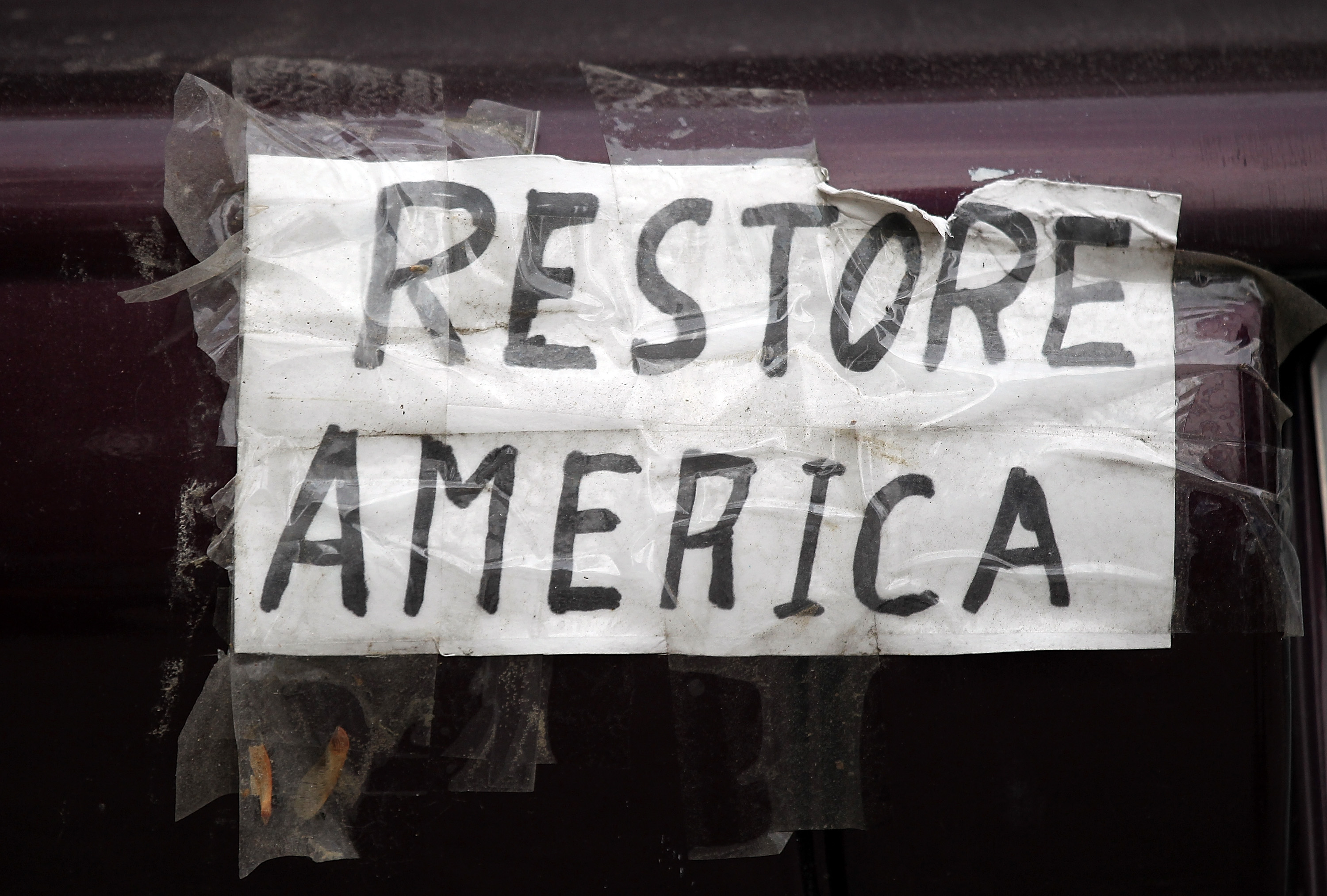
(Photo: A homemade bumper sticker is seen on the back of a car during a Tea Party rally on September 4, 2011 in Concord, New Hampshire. By Justin Sullivan/Getty Images)

“What Kind Of World Do These People Live In?”

Senate Majority Leader  Harry Reid

“When I think of the Republican Party, I don’t think of principled conservative legislators who are men and women of vision strategy. I think of ideologues who are prepared to wreck things to get their way. They have confused prudence — the queen of virtues, and the cardinal virtue of conservative politics — with weakness. I know I’m very much a minority among conservatives in this, but the behavior of Congressional Republicans pushed me out of the party two years ago, even though I almost always vote Republican, or withhold my vote.

I am not a liberal, and do not want to vote for liberals, especially on social policy. But I told a Louisiana conservative friend the other day that the Congressional Republicans are making me consider the previously unthinkable: throwing my vote away by voting for a Democrat in the special election next month to replace my GOP congressman, who just resigned to take another job. The GOP candidates in this local race are hot and heavy to overthrow Obamacare. I think about how poor this district is — 26 percent of the district lives in poverty, making it one of the poorest Congressional districts in America — and how badly we need jobs and economic growth, and I think: What kind of world do these people live in?” – Rod Dreher.

You can tell I’m in the same camp, although I gave up completely on the GOP a decade ago as I saw its craven acquiescence to an imperial presidency, its love of massive, unfunded spending, its dogged support of wars of doomed nation-building, and its Christianist loathing of almost anything vibrant in modernity. But these past few days, by pure accident, I’ve thought about them in a slightly new perspective. I’ve been in Washington, DC, for a bunch of minor medical procedures: my thrice-yearly testosterone implant; my flu shot; a booster pneumonia shot; an HPV vaccine; an impending colonoscopy; an HIV blood test; and last, but by no means least, a repair of an umbilical hernia that has had me immobile since Friday. My compromised immune system requires constant check-ups, and the Dish now pays for my COBRA insurance – which will soon have to be traded in for Obamacare because my options are running out.

A word to Republicans: why would you want to deny someone these basic forms of healthcare? Or force them into bankruptcy because of them?

I could struggle on for a while without them and without my HIV meds. But sooner or later, I’d start running out of money, probably get a bad case of pneumonia, or an uptick in likelihood of cancer if my HIV breaks out again, or a hernia operation that was urgent rather than precautionary, or a debilitating bout of flu likely to make my asthma-ridden lungs even weaker in the future. This is the fragile reality I live in as a spectacularly privileged, if immuno-suppressed inhabitant of one of the most advanced societies on earth. But take any of it away and my well-being and basic health begin to fray.

Are you, Republicans, prepared to say that the countless working Americans who cannot now afford any of this should carry on without it indefinitely? People only have one life, you know. It can erode pretty quickly. On what moral grounds do you consign people to this fate when it is currently unnecessary?

I understand the important arguments about cost control, and any number of arguments about how to construct a system like this. I think I’ve heard them now for close to three decades – and we’ve all benefited from the arguments. But these needs are about as real as any can be. And our system has passed a remedy of sorts. It will need adjustment, reform, cost-cutting, and constructive criticism to make it work as well as it might. But seriously, after all we’ve gone through, you’re prepared to bring our entire system of government to a halt in order to prevent sick people from getting access to this kind of treatment?

What hallucinating, self-serving monsters have you become?

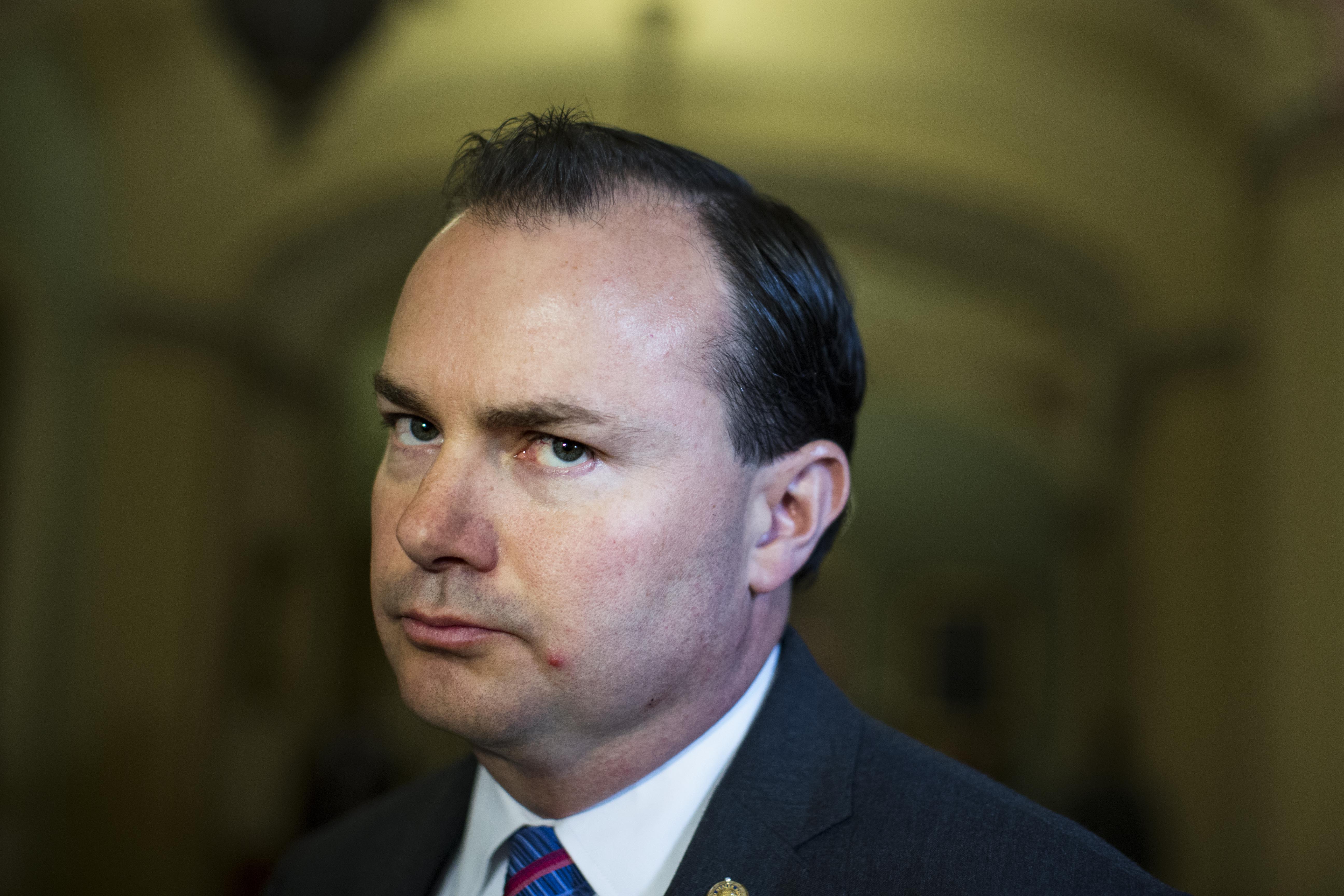
(Photo: Conservative Senator Mike Lee (R-UT), Senator Ted Cruz’s partner on defunding Obamacare, after the Senate voted to amend the House’s spending bill by removing language defunding the Affordable Care Act and voted to fund the government at a $986 billion annual level through Nov. 15, on September 27, 2013. By Melina Mara/The Washington Post via Getty Images.)

The Nullification Party

1380633347-crop-promovar-mediumlarge

I’ve been trying to think of something original to say about the absurdity now transpiring in Washington, DC. I’ve said roughly what I think in short; and I defer to Fallows for an important dose of reality against the predictably moronic coverage of the Washington Post.

But there is something more here. How does one party that has lost two presidential elections and a Supreme Court case – as well as two Senate elections  –   think it has the right to shut down the entire government and destroy the full faith and credit of the United States Treasury to get its way on universal healthcare now? I see no quid pro quo even. Just pure blackmail, resting on understandable and predictable public concern whenever a major reform is enacted. But what has to be resisted is any idea that this is government or politics as usual. It is an attack on the governance and the constitutional order of the United States.

When ideologies become as calcified, as cocooned and as extremist as those galvanizing the GOP, the American system of government cannot work. But I fear this nullification of the last two elections is a deliberate attempt to ensure that the American system of government as we have known it cannot work. It cannot, must not work, in the mindset of these radicals, because they simply do not accept the legitimacy of a President and Congress of the opposing party. The GOP does not regard the president as merely wrong – but as illegitimate. Not misguided – illegitimate. This is not about ending Obamacare as such (although that is a preliminary scalp); it is about nullifying this presidency, the way the GOP attempted to nullify the last Democratic presidency by impeachment.

Except this time, of course, we cannot deny that race too is an added factor to the fathomless sense of entitlement felt among the GOP far right. You saw it in birtherism; in the Southern GOP’s constant outrageous claims of Obama’s alleged treason and alliance with Islamist enemies; in providing zero votes for a stimulus that was the only thing that prevented a global depression of far worse proportions; in the endless race-baiting from Fox News and the talk radio right. And in this racially-charged atmosphere, providing access to private healthcare insurance to the working poor is obviously the point of no return.

Even though the law is almost identical to that of their last presidential nominee’s in Massachusetts, the GOP is prepared to destroy both the American government and the global economy to stop it. They see it, it seems to me, as both some kind of profound attack on the Constitution (something even Supreme Court Chief Justice John Roberts viewed as a step too far) and, in some inchoate way, as a racial hand-out, however preposterous that is. And that is at the core of the recklessness behind this attack on the US – or at least my best attempt to understand something that has long since gone beyond reason. This is the point of no return – a black president doing something for black citizens (even though the vast majority of beneficiaries of Obamacare will be non-black).

I regard this development as one of the more insidious and anti-constitutional acts of racist vandalism against the American republic in my adult lifetime. Those who keep talking as if there are two sides to this, when there are not, are as much a part of the vandalism as Ted Cruz. Obama has played punctiliously by the constitutional rules – two elections, one court case – while the GOP has decided that the rules are for dummies and suckers, and throws over the board game as soon as it looks as if it is going to lose by the rules as they have always applied.

The president must therefore hold absolutely firm. This time, there can be no compromise because the GOP isn’t offering any. They’re offering the kind of constitutional surrender that would effectively end any routine operation of the American government. If we cave to their madness, we may unravel our system of government, something one might have thought conservatives would have opposed. Except these people are not conservatives. They’re vandals.

This time, the elephant must go down. And if possible, it must be so wounded it does not get up for a long time to come.

Saint Stephen The Ironist

I’m biased, because I have gotten to know the man a little over the years, and have barely missed a single show since he started, but I have to agree with Jessica Winter that, in an era in which Catholicism, until very recently, has seemed positively callous, distant and authoritarian,  Stephen Colbert is “the greatest thing to happen to American Catholics since Vatican II”:

He provides day-to-day proof that devout Catholicism can coexist with critical thinking, irreverence, a guiding belief in equal rights, and a fundamentally anti-authoritarian worldview – by, for example, dishing on the papal doctrine of social justice for the poor with Colbert Report chaplain Jim Martin (editor of America magazine), or breaking character during a congressional panel on rights for migrant farm workers by paraphrasing Scripture: “Whatever you did for the least of my brothers, you did for me.” Colbert is America’s Sunday school teacher and “Catholicism’s best pitch man,” as Patheos.com’s Matt Emerson put it in a beautifully argued 2011 piece. But until now, what he’s been pitching hasn’t necessarily been what the Vatican has been selling.

That’s all changed now. Catholics have a pope who loves the poor, embraces critical thinking, and has a delightful sense of humor  the same holy trinity of virtues that Stephen Colbert, the new America’s Catholic, exemplifies.

And what Colbert does is talk to a generation that has largely turned off any public statements from the American Catholic hierarchy. The Millennials have been a lost generation to Christianity – because, in my view, the most prominent representatives of Christianity are simply from a different universe than those building lives and loves in the 21st Century. Colbert shows that Catholics can be hilarious and serious, ironic and yet deeply sincere.

If I were to sum up the various forms of popular culture that I have come to love in this century, I’d say they both start from a place of total irony and yet express beyond it a deep, humane sincerity. Living in 2013 means living in a world saturated in knowingness, framed by quotation marks, awash in the mash-ups of post-everything fragments of a once-more coherent and uniform culture. There is no going back. But there are two core choices in this ironic age: to wallow in its relativist chaos, or to love it for what it says about our freedom in modernity and refuse to give in to cynicism or nihilism. Indeed to insist on the constant possibility of redemption in an agnostic, atheist as well as religious sense.

South Park does this. It’s shockingly blasphemous in both secular and religious meanings of that word. And yet it is deeply sincere and has a clear, consistent moral worldview. The same can be said of the Simpsons. And, yes, what I love about the Pet Shop Boys is that they revel in modernity’s irony and technology and yet return again and again to the need for compassion, empathy, hope and love. Colbert is arguably the most skilled at the furthest edges of irony and sincerity. Nothing on television is as ironic as his stock character; and yet you cannot watch his arch, hilarious, scathing performances night after night and not feel the deeply serious call to decency and love underneath.

He’s a good man, Stephen Colbert. And his irony – which masks everything – becomes, after a while, a kind of humility. He has given me a lot of hope these past few years – because, for all his jokes, he has never lost sight of either faith or charity.

Previous Dish on Colbert’s living faith here and here.