That Sickening Feeling

Bush Asks Congress For $74.7 Billion In War Aid

I’ve spent much of the day reading, reading and reading all I can about the events in Syria that I missed while on vacation. The more I read, the more opposed I became to what seems to me a potentially disastrous new war in the Middle East. And yet the more I absorbed the full incoherence of the argument for another utterly unpredictable war (you’ve probably read William Polk already but if not, do), and the more the arguments of John Kerry fell apart upon Senate inspection, and the more a look-back at the past two weeks revealed truly staggering policy confusion and doubt in the administration, the more it seemed that momentum was, incredibly, for another war.

And today’s media coverage felt like Iraq replayed as in a bad dream. The liberal internationalists, in an Ahmandownpour of self-righteousness, cannot wait to jump into another sectarian war we cannot control and would be unable to win. The neocons are still – staggeringly – being booked on television! Bret Stephens and Jennifer Rubin actually pulled out yet another Munich analogy  this week (seriously, it’s always Hitler with them) – only to be backed up by the blithering bore who is, alas, our current secretary of state.

The liberal elites are particularly amazing to behold. I watched Anderson Cooper tonight and I may have missed it, but I couldn’t find a single guest opposed to this war, even as most Americans emphatically oppose it. Even O’Reilly was more even-handed (I kept flicking back and forth). We got to listen to Ryan Crocker tell us that we have to intervene and at the same time that the potential replacement for Assad is probably just as foul as the dictator. And we got Fouad Ajami – another pro-Iraq war “expert” who was exposed as an eloquent bullshit artist during the Iraq fiasco – telling us – yes, he said this – to trust the “Syrian people”, as if they exist, as if the sectarian divides and hatreds are not re-fueling as we speak, as if he has no shame and no record. It really as if Iraq never happened, as if the US still had the resources to fight an0ther, brutal and scarring sectarian conflict in someone else’s country on someone else’s behalf who will eventually ally with our foes. It is as if the Bush-Cheney administration never happened. It is as if the “surge” worked.

Obama has long straddled the line between protecting the interests of the American people against Jihadists and extricating the country from two disastrous, budget-breaking, morally crippling wars that all but exhausted America’s deterrent power. This is not an easy balance, and he deserves a break in a truly vexing period of eroding US prestige and power. And Obama hasn’t squandered American soft power, whatever the neocons think. They did that by executing those very failed wars in utterly failed states. Having used our military might to no avail, we now threaten it and are somehow surprised we aren’t taken seriously. This, in other words, is not Obama’s real gamble. His real gamble was in stating he would prevent chemical weapons use in Syria in the first place, when he cannot without endorsing another Iraq-style occupation.

So now we are treated to the argument from “credibility”. Enough with the arguments about credibility! The United States would benefit by nothing more than accepting the fact that we do not have the power to control that region and shouldn’t die trying. Our credibility is threatened not when we stay out of other people’s civil wars, but when we make threats we cannot enforce. I am emphatically not dismissing the Rubicon of chemical weapons, and am as appalled by their use as anyone. But if we cannot resolve the question without entering another full-scale, open-ended war on the basis of murky intelligence about WMDs, then we should resign ourselves to not resolving the question. Repeat after me: American power is much more limited than our elites still want to believe.

Our choice right now is between enabling Assad to stay in power and murder and gas more innocents or entering an unknowable conflict with no clear goals and no vital national interest at stake. If we do the latter, we will prove either that we bombed Assad and he survived or that we bombed Assad and we got al Nusra in charge of the chemical arsenal. If we are truly worried about the spread of Assad’s chemical weapons, we should ensure he keeps a tight lid on them and prevails in the civil war. That’s the goddawful truth we want to avoid and Obama thinks he can elide. He cannot. Get your Niebuhr back out, Mr President.

It is, of course, a vast tragedy that innocent Syrians – men, women and children – are being slaughtered and shelled and now gassed in a deep, sectarian conflict that feeds on cycles of revenge. I understand the moral impulse to try to stop it. I am not blind to the evil in Assad’s mafia family, just as I wasn’t blind to the foul stench of mass murder among the Saddam clan. I also understand the prudential reasons for trying to live up to the red line Obama so foolishly drew. But I learned from Iraq that establishing the evil of a foreign dictator does not mean we should go to war with him. Assad has already massacred 120,000 people in the region we call Syria, and we are not, we are told, going to act decisively enough to remove him from power. Either we lose face by choice or we lose face by walking backward into inevitable defeat. Better to lose face now by choice.

As for Obama? I wish I understood better. But the point of Obama’s entire presidency – something bigger than just him – was to resist the impulse toward what Obama once called “dumb wars.” Dumb wars are often acts of hubris; and when a country has the kind of massive military power the US now wields, every problem looks tempting. Everything the president has said and done has suggested he understands this. And yet in Libya, he gave in to the hysteria because of an alleged, planned massacre that never happened. Has it occurred to the president that someone might have noticed how you trap the US in yet another debilitating, bankrupting quagmire? As for the intelligence, show us. All of it. Prove that the rebels could never have done this. Give a reason why Assad would have suddenly raised the stakes this high in a war he was winning. I’m not interested in educated guesses. Unless this case is proved beyond the slightest reasonable doubt, the Congress has a duty to say no. After Iraq, America deserves no less.

And when you come at this fresh, one thing strikes you. The very notion that a great power like the United States should be involved in any way in resolving the differences between Shia Alawites and Sunni Muslims in the eastern Mediterranean is simply an absurdity. Maybe Obama has realized that too late and is now seeking Congressional support. But if he gets it, it won’t last. It will be followed by a thousand “Benghazis” on Fox News and elsewhere. If and when the civil war makes the dispersion of chemical weapons a threat to us, we can intervene to protect ourselves. Until then, Obama needs a steely form of resistance to the siren call of understandable moral concern. That’s what statesmanship sometimes requires in weighing the long-term interests of this country and its people against the immediate moral necessity of preventing evil. It requires seeing the evil you cannot end more clearly than the evil you can.

I learned that in the brutal decade after 2000. Did anyone else in Washington?

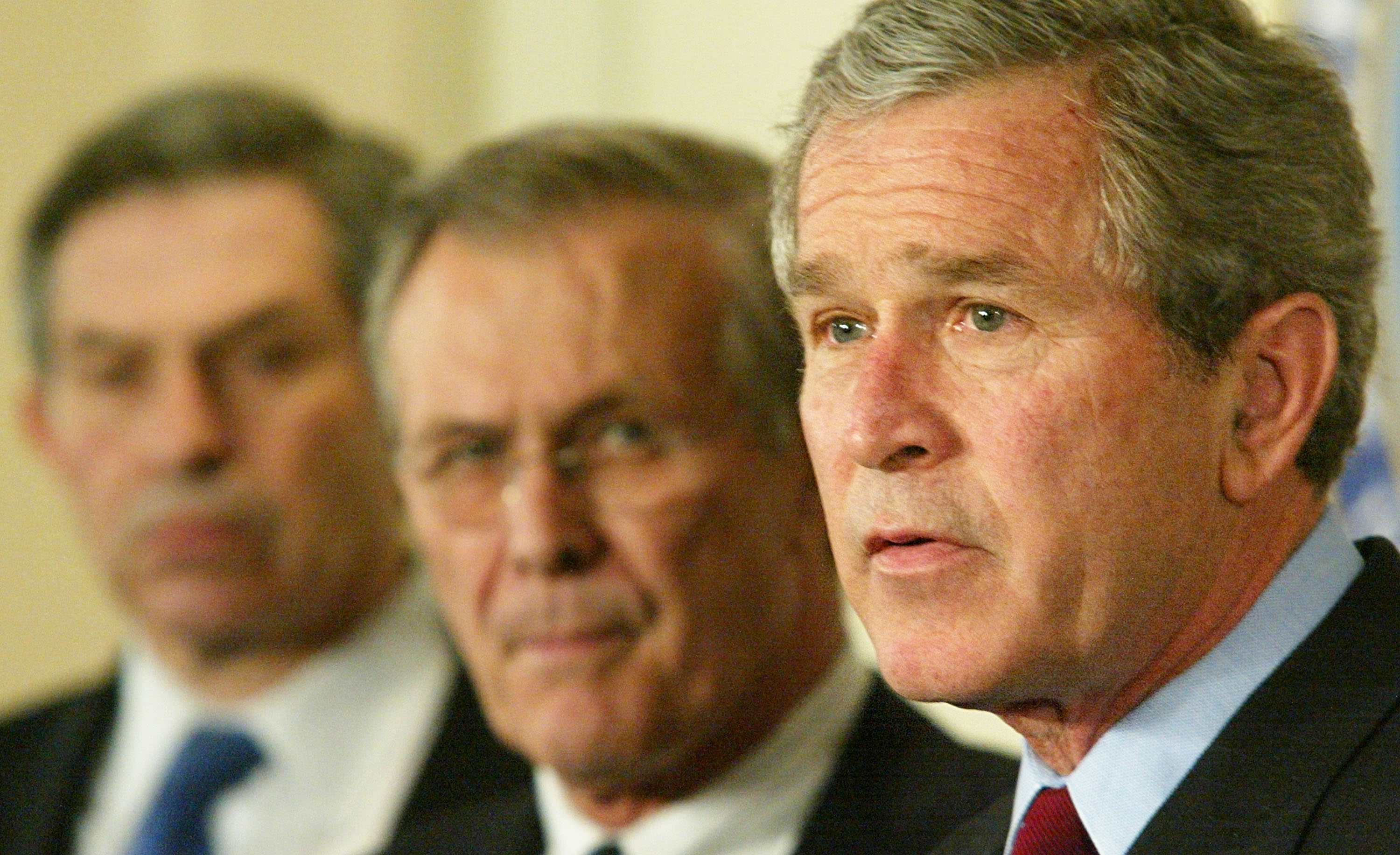
(Photo: U.S. President George W. Bush (R) speaks next to Defense Secretary Donald Rumsfeld (C) and Deputy Defense Secretary Paul Wolfowitz (L) during a visit at the Pentagon March 25, 2003 in Arlington, Virginia. Bush asked Congress for a wartime supplemental appropriations of $74.7 billion to fund needs directly arising from the war in Iraq and the global war against terror. By Alex Wong/Getty Images.)
Marching As To War?

President Obama Departs The White House

This morning, I finally watched the visual evidence of the Assad regime’s chemical attack on hundreds of children. There is a reason, these awful videos prove, behind our fear of these kinds of weapons, even if they follow over 100,000 far bloodier deaths. They kill silently in the dark. Heavier than air, poison gas can sink into the basements and cellars civilians use for protection during wartime. The crippling efficacy of such weapons, once used to propel the mass extermination of European Jews, should draw us all short. It is not that the victims of chemical attacks are any more dead or crippled than the 120,000 or so other victims of the sectarian bloodbath in Syria. It is that the use of such weapons signals that the regime is now prepared to use this final trump card, if it suits its purposes. The Alawites have always had the power to kill their sectarian foes (Hafez al Assad committed a mass murder of 10,000 civilians); but now we know they also have the will to use the most silently lethal chemicals at their disposal. There’s a reason so many millions are now fleeing. The prospect of a sectarian Holocaust from the skies is no longer a dystopian illusion. It is an historical fact.

This makes Obama’s shift explicable, whatever the debating points scored at various junctures in the Syria debate in the last few years. I don’t buy the criticism that he should have intervened much earlier in Syria (there would have been zero public support); and the principle of forbidding chemical weapons use against civilians and rebel fighters is a vital one for the future of civilization. To do or say nothing now would have given Assad a green light to exterminate more people without any cost. So the core question really emerges: what would doing something look like?

Obama has proposed doing something and nothing at the same time. And, sure, a military strike on Syria will exact a cost for Assad for his sectarian extermination program. But it is highly unlikely to bring him down or, unless I am mistaken about the situation on the ground, shift the course of the war. After the dust settles, a US strike may even give Assad more lee-way to use his poison gases against his foes, and enable him to portray himself as a victim of Western intervention. If he got away with it once, and gained ground in the war, why not again and again? And what then?

The McCain faction is obviously right about one thing: the only option that would ensure Assad’s ouster would be a full scale war and invasion conducted by some kind of alliance between the US and the rebel groups. And they are obviously wrong, it seems to me, on one thing as well: there is no way on earth that this country or its armed forces should jump into such a brutal, sectarian vortex of violence, with only the goal of deposing a dictator. Have we learned nothing from Iraq? Our core interests are not affected by the result of the Syrian civil war, and we have simply no assurance that the replacement for Assad would be less monstrous than he is. If our concern is the security of chemical weapons stockpiles – and Syria has the third most in the world – then it seems to me that our cold interests actually lie with Assad’s victory. At this point, his faltering regime is more stable than the opposition and less allied with Sunni Jihadists.

But here, it seems to me, is where we should stop, and demand more clarity and transparency from the president. The Congressional debate – in my view, a constitutionally indispensable procedure – is a great opportunity for this. We all get the gravity of chemical weapons use – and Kerry can stop embarrassing himself by calling his former dining companion another Hitler. What we don’t yet fully know is what the Obama administration has already been doing in Syria and what it hopes specifically to achieve now – by militarily joining one side in Syria’s sectarian meltdown.

I want, first up, a better explanation for this quantum leap in the use of chemical weapons by Assad. My impression is that he was winning this brutal war slowly. Why play your trump card then – with all the risks associated with it? More to the point, why do it when UN inspectors are close by? Yes, Assad is evil – but he has long been that and the Ghouta mass murder has scrambled the situation in ways that indicate reckless, even desperate, stake-raising. So, first up, what I’d want first of all is a clear statement that the US has not been engaged in a covert war in Syria that might in any way have prompted this horror. I would like a clear, emphatic and truthful refutation of the reporting in Le Figaro that implies that a new anti-Assad offensive was launched at the start of last month, as part of a covert war, headed up by the US’s covert war machine. Is this paranoid? Maybe. But I remember Iraq and, forgive me, I have learned the value of deep skepticism about various US administrations’ accounts of reality.

Second, I want a clear explanation of what the goals are of this proposed strike.

If it is merely a symbolic act, then we should understand that we are risking American lives, money and values for moral optics, with no clear goal. If it is an attempt to shift the direction of the civil war, then we should know how the US attempts to win this sectarian struggle in the Middle East, when it could not impose sectarian peace in a country it occupied with over 100,000 troops for a decade (and where the sectarian murderousness endures and thrives). If we “win”, are we sure this isn’t just another move in an eternal cycle of sectarian vengeance? Look at Libya – the other place Obama decided to intervene. Obama’s reward? The attack on the Benghazi CIA facility and a fractured non-state that has allowed al Qaeda to regroup in north Africa. You can more easily see how a rebel victory on Syria could turn into a worse nightmare. If Jihadist nutcases end up in control of the third largest chemical weapons stockpile in the world, the first step toward that result would be this war against Assad.

I’m not denying the moral atrocity. I’m not denying the gravity of this breach of international norms. But military intervention in Syria? For me, the administration hasn’t even begin to present a coherent, let alone a persuasive argument. The congressional debate is absolutely the best forum for this debate to take place – just as the House of Commons was in Britain. If the Congress votes no – which, given the current arguments, it obviously should – then the president should accede to the wishes of the American people as voiced by their representatives. If he were to do that, the kind of transformation Obama promised in America’s foreign policy would be given a huge boost. This would be a president who brought Congress back into the key decisions of war and peace as the ultimate authority on them, as the Founders intended. It would be seen by history as the first key step away from the imperial presidency and the beginning of democratic accountability for the permanent war machine.

This could, in other words, be the dawn of a new, realist and constitutional age. Or the final death-throes of an empire that won’t quit until it bankrupts us both fiscally and morally. That’s why next week’s debate is so critical. And why Obama can still come out ahead on this, even as the conventional Washington wisdom will surely be all about his humiliation in a zero-sum narrative whose attention span is the next five minutes. If he defers to Congress on a new war in the Middle East, we are definitively in a new era.

It’s called 21st Century democracy. And not a minute too soon.

(Photo by Mark Wilson/Getty Images)

The Best Of The Dish This Weekend

photo

Five must-reads: Isaac Asimov, proving our almost instinct is almost true; Francis Spufford’s guide to how to pray to the God who loves; George Orwell’s quotidian and sometimes funny private life; A.O. Scott’s definition of “strained pulp“; and the Burka-clad super-heroine!

Quote for the day: “Every angel is terror.”

The most popular posts since we went independent are “The Saddest Map In America” and “Two Popes, One Secretary” with “The GOP Calls Its Own Fiscal Bluff” and “Noonan Just Loses It,” coming up from behind. Our three biggest referrers were Google, Twitter and Facebook in that order. Over the same seven months, we sent the most Dish traffic to The Atlantic, Slate, and TPM.

I’m starting my annual fortnight August vacation tomorrow, going off-grid for a week, and then off-off-grid. I leave you in the extremely capable hands of the Dish editorial team: Patrick, Chris, Jessie, Matt, Alice, Chas, Tracy and Brendan. It’s easily the best team we’ve ever assembled in this spot – and they have more than carried this blogazine to places and topics and debates and photos and tweets and videos no single person could ever reach on his own. I’m so grateful to them, and so much better a blogger because of them.

Which means, of course, a debt of gratitude to you too, Dish readers and subscribers. This summer, for the first time, I’m taking a vacation from, er, myself and my two partners in Dish Publishing LLC, Chris and Patrick. It was by no means a sure thing. Since last August, we didn’t just produce the Dish every day, we also moved the Dish from the Beast to our new, independent platform, financed entirely by howler beaglereaders. Figuring that business model out, finding Tinypass, our meter-partner, designing a new page, with a new search function, figuring out taxes and legal stuff and health insurance and payroll … it’s been quite a learning curve for us. And easily the most exhausting as well as exhilarating year in the Dish’s life.

But looking back, it may well have been one of our best years ever. Jessie’s return has paid massive dividends every day; Alice’s poetry selection is the best on the web; Matt’s coverage of religious and cultural debates has brought the weekends new sophistication; Chas has been integral to every new technological challenge and, with Brendan, a master of Twitter. Tracy may be the best single intern we’ve ever had. Our new general manager, Brian Senecal, has been a godsend for dealing with the myriad practical things we need to get done and organized. Patrick and Chris remain, of course, the prime movers behind all of this. I couldn’t begin to name their contributions because they are so legion. Let’s just say that running a business while also producing up to 50 posts a day and dealing with me is not something for the fainthearted. But they did it – with aplomb.

The Dish now has close to 30,000 subscribers. We’ve raised revenue of $743,000 toward our year-end goal of $900,000 by next February.

None of this would have been possible without your subscriptions and support and countless communications with us every minute of the day and night. We know that our core strength is our readership – the single best readership online, IMHO. And so, before I hand over the sandbox, I just wanted to say personal thanks to all of you who placed your faith in us and subscribed. We hope to add some features this Dusty in ivyfall to enhance your subscriber experience some more. And on a personal note, the emails about Dusty were overwhelming in their tenderness and empathy. People say the web is for haters. Not here. Not in the Dish community.

And for the 11,000 of you who have used up all your meter allowances and still haven’t subscribed, [tinypass_offer text=”please do”]. If you were all to subscribe, we would have no worries for the future and could plan confidently for Year Two. The price is only $1.99 a month/$19.99 a year – or more if you want. So take a minute to ask yourselves if the work we all do each day is worth that to you. If it is, please [tinypass_offer text=”take two minutes”] to get off the fence and [tinypass_offer text=”subscribe”]. If you want online, truly independent journalism to survive, we need your help. Eschewing advertisers for now gives us a much higher signal-to-noise ratio and makes us much more independent of corporate pressure than much of online media – and enables us to push the envelope on topics most big advertisers would run from. But we cannot keep this up unless we get more new subscribers.

So help out and [tinypass_offer text=”subscribe!”] And see you in a couple of weeks.

The Other One

eddy-dusty-rocks

Today’s post on the grieving of animals truly hit home for me. Since Dusty’s death, her canine companion of seven years, Eddy, is showing what seem to me at least intimations of grief. At first: nada. Yes, she was howling when we came back to our house after putting Dusty to sleep. But that was because, we assumed, the two of us almost never leave the house with Dusty and without Eddy. She felt left out of something – and, of course, she was right.

Then she seemed almost giddy with excitement and high spirits. She could finally eat her food without having Dusty inhale her own bowl in around 30 seconds and then hover behind Eddy waiting to eat hers as well. For seven years, Eddy had to eat the food right away or guard it. Most of the time, she was forced to eat it very quickly or starve. So the day after Dusty was no longer in the house, Eddy left her food in the bowl for eddysun.jpghours. She’d take a nap or go for a little walk-around, blissfully liberated from the food stealer.

When we prepared to take her out for a walk all by herself, she would do a full body-wag even more enthusiastically than usual, jumping into the air in little spasms of joy. Trips we hadn’t made before because Dusty was too debilitated or boisterous, we now could make with Eddy by herself. So she became completely besotted with one of my best friend’s boat, running into the bay in order to jump up on it, sitting upright in it, her nose twitching with the sea breezes. For days, she seemed extremely happy.

And then, after a week or so, something changed quite suddenly.

Her demeanor shifted to sadness and quiet. She didn’t just leave her food around to eat at leisure; she stopped eating in the morning altogether. It was almost as tough as getting her to eat in the evening as well. On walks, she trailed behind, moving slowly, tugging at the end of a long leash, as if not really wanting to go anywhere. It happened after about a week – perhaps because that was when it became unmistakable that Dusty wasn’t just away for a bit – but was, in fact, never coming back.

Is this grief? We cannot ever know. But it sure feels like it. They were never that close, because Dusty was never very close with any other earthly being, including me. But the time spent together adds up – and Eddy was always a pack animal, much happier when we four were all together than when one of us went missing. Now, one part of that family is missing for good. And I’m not the only one still aching at the sight of one crate where there only recently were two.

Cameron Proves Greenwald Right

David Cameron Meets With The King Of Bahrain At Downing Street

Readers know I have been grappling for a while with the vexing question of the balance between the surveillance state and the threat of Jihadist terrorism. When the NSA leaks burst onto the scene, I was skeptical of many of the large claims made by civil libertarians and queasily sympathetic to a program that relied on meta-data alone, as long as it was transparent, had Congressional buy-in, did not accidentally expose innocent civilians to grotesque privacy loss, and was watched by a strong FISA court.

Since then, I’ve watched the debate closely and almost all the checks I supported have been proven illusory. The spying is vastly more extensive than anyone fully comprehended before; the FISA court has been revealed as toothless and crippled; and many civilians have had their privacy accidentally violated over 3000 times. The president, in defending the indefensible, has damaged himself and his core reputation for honesty and candor. These cumulative revelations have exposed this program as, at a minimum, dangerous to core liberties and vulnerable to rank abuse. I’ve found myself moving further and further to Glenn’s position.

What has kept me from embracing it entirely has been the absence of any real proof than any deliberate abuse has taken place and arguments that it has helped prevent terror attacks. This may be too forgiving a standard. If a system is ripe for abuse, history tells us the only question is not if such abuse will occur, but when. So it is a strange and awful irony that the Coalition government in Britain has today clinched the case for Glenn.

A disclosure upfront: I have met David Miranda as part of a my friendship with Glenn Greenwald. The thought of his being detained by the British police for nine hours because his partner embarrassed the American government really sickens me at a gut level. I immediately think of my husband, Aaron, being detained in connection to work I have done – something that would horrify and frighten me. We should, of course, feel this empathy with people we have never known – but the realization is all the more gob-smacking when it comes so close to home. So of course my instinct is to see this exactly as Glenn has today.

But put that instinct aside for a moment. David was detained under an anti-terrorism law:

Section 7 of the British Terrorism Act allows the authorities to detain someone for up to nine hours for questioning and to conduct a search of personal items, often without a lawyer, to determine possible ties to terrorism. More than 97 percent of people stopped under the provision are questioned for under an hour, according to the British government.

David was detained for nine hours – the maximum time under the law, to the minute. He therefore falls into the 3 percent of interviewees particularly, one assumes, likely to be linked to terrorist organizations. My obvious question is: what could possibly lead the British security services to suspect David of such ties to terror groups?

I have seen nothing anywhere that could even connect his spouse to such nefarious contacts. Unless Glenn is some kind of super-al-Qaeda mole, he has none to my knowledge and to suspect him of any is so close to unreasonable it qualifies as absurd. The idea that David may fomenting terrorism is even more ludicrous.

And yet they held him for three hours before informing his spouse and another six hours thereafter. I can see no reason for those extra six hours (or for that matter the entire nine hours) than brute psychological intimidation of the press, by attacking their families.

More to the point, although David was released, his entire digital library was confiscated – including his laptop and phone. So any journalist passing through London’s Heathrow has now been warned: do not take any documents with you. Britain is now a police state when it comes to journalists, just like Russia is.

In this respect, I can say this to David Cameron. Thank you for clearing the air on these matters of surveillance. You have now demonstrated beyond any reasonable doubt that these anti-terror provisions are capable of rank abuse. Unless some other facts emerge, there is really no difference in kind between you and Vladimir Putin. You have used police powers granted for anti-terrorism and deployed them to target and intimidate journalists deemed enemies of the state.

You have proven that these laws can be hideously abused. Which means they must be repealed. You have broken the trust that enables any such legislation to survive in a democracy. By so doing, you have attacked British democracy itself. What on earth do you have to say for yourself? And were you, in any way, encouraged by the US administration to do such a thing?

(Photo: Dan Kitwood/Getty.)

It’s Getting Worse

dish_octophant

To recap some of the latest developments. We have watched the possibility of Republican support for immigration reform rise and then dramatically fall, as Tom Edsall explains here in charting the decline in the fortunes of Marco Rubio as soon as he stood up for a path to citizenship. Christianists are seeking to end the ban on tax-exempt churches’ endorsing candidates. The recent Pew report found the following among regular Republican primary voters (in Edsall’s words):

Republicans who say that they always vote in primaries (and whose views consequently carry more weight) are much more in favor of their party’s turning in a more conservative direction. Data provided to the Times by Pew shows that 58 percent of Republicans who always vote in primaries advocate more conservative stands, while 37 percent call for moderation, a 21-point split. Republicans who do not always vote in primaries are more evenly divided, 50-44.

Insofar as support or opposition to immigration reform is a proxy for more or less positive attitudes toward Hispanics, the Pew study shows a decided tilt among Republicans. Thirty-six percent of Republican voters say that the party’s stance toward immigration is not conservative enough, compared with 17 percent who say it is too conservative. Crucially, among Republicans who always vote in primaries, the division shifts further to the right, 41-14.

In North Carolina, the state GOP has launched a brazen attempt to disenfranchise minority voters, acting more like Egypt’s Muslim Brotherhood when they came to power rather than a moderate Western political party. And in Washington, Robert Costa is reporting that the House GOP won’t force a government shutdown this fall but that they will “instead use the debt limit and sequester fights as areas for potential legislative trades.” They are going to hold America’s credit-worthiness hostage again – even though such a debt limit crisis would be far more damaging to the economy than even a shutdown, as Chait notes here. But perhaps damaging the economy is the point. The GOP has to minimize any economic growth that might redound to Obama’s benefit – in order to discredit the policies that have obviously worked for the past five years in favor of policies that have been proven failures elsewhere.

And when you look at presidential prospects, you find most of the GOP energy on the far right. And a strategy to keep it that way by ditching the whole notion of impartial debate moderators in favor of far-right talk-show hosts – Limbaugh, Levin and Hannity, for Pete’s sake – as the arbiter of primary slugfests.

We now have pretty solid evidence that the GOP will respond to Obama’s second term exactly as they did his first: total opposition to everything and anything the president supports, sabotage of the economy, and brutal gerry-mandering and voter suppression to give their white base one last chance at a majority. Actual policies? It’s hard to disagree with Newt Gingrich – and not just on healthcare.

I predicted it would get worse before it got better; what we now learn is that it will get worse before it gets worse before it gets better. And the real beneficiaries of this will likely not be the GOP – but Roger Ailes and Hillary Clinton.

(Image of Alexis Diaz‘s work via Colossal)

Why Haven’t More Muslims Won The Nobel Prize? Ctd

Sharia Law in Pakistan's Swat Valley and North-West Frontier Province

Last week, as the Dish noted, Dawkins caused an uproar by tweeting: “All the world’s Muslims have fewer Nobel Prizes than Trinity College, Cambridge. They did great things in the Middle Ages, though.” Isaac Chotiner mounts a defense of Dawkins:

[T]here is something not quite right with many of the responses to Dawkins. The point he was trying to make, I would assume, is that Islam is a religion which holds back intellectual development, and thus the Nobel Prize count is skewed towards non-Muslim countries. This might be a silly argument in point of fact, but it is perfectly acceptable to make these types of claims. Religions are man-made things. People choose to follow a particular faith. It would be one thing to say that the color of one’s skin sets back one’s intellectual development; Dawkins was (I think) trying to say that a belief system human beings choose to follow has impaired their development. Arguments like this should be not only within the bounds of reasonable debate, but are completely necessary.

I couldn’t agree more. Isaac is rightly tough on Dawkins for tweeting such a grand and foolish generalization. But it would be strange not to consider culture when analyzing any part of the world which is quite clearly lagging in economic, intellectual and social development. Just take a read of the UN reports on the Muslim Arab world and absorb their devastating conclusions about the region. Think of what the Israelis have managed to achieve in a few decades and then look at Egypt’s pathetic record. Of course, this cannot be reduced simply to Islam, which, as Dawkins noted, played a huge role in advancing human civilization a few centuries ago. But to ignore it seems perverse.

Take the simple issue of women’s equality.

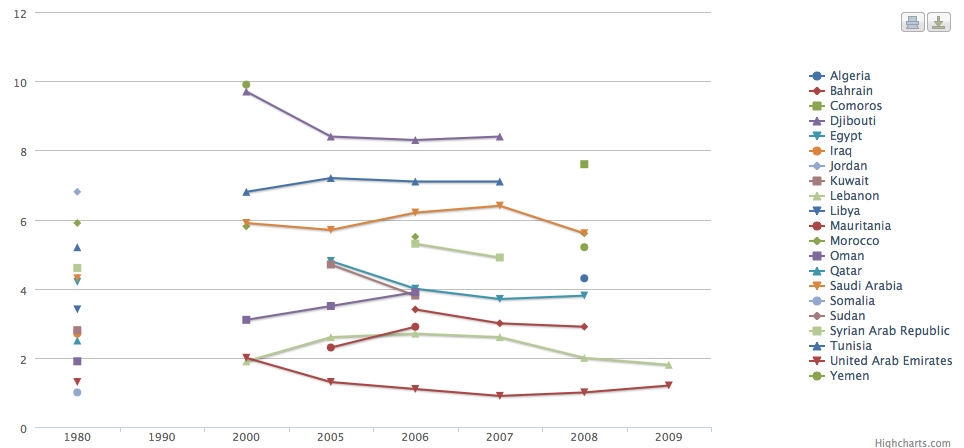
Is there any doubt that a huge amount of the West’s success in past decades has been the final unraveling of female subjugation, unleashing half of humanity’s potential in the process? The places sealed off from that shift are going to be more backward than those who pioneered it. And since Islam in Arabia is critical to sustaining this subordinate role for women, it must be seen, for that reason alone, less intellectually vibrant and economically powerful than the West. Here’s the data on education spending as a proportion of GDP:

Screen Shot 2013-08-13 at 1.53.37 PM

It’s at a low level of low GDP and not going anywhere. And the most important correlation with it is the presence of mothers in the workplace.  And is there any doubt that Islam’s often-rigid subjugation of women is connected to this?

I believe that the West is superior to the Arab Muslim world for this reason alone – as well as many others. And I believe religion has a big role to play in this. I suspect that’s what Dawkins was driving at, in his own glib, bigoted, off-hand way. I cannot stand his approach to these subjects – but I sure find more honesty in what he is saying than in the self-righteous chorus of anti-anti-Islamophobes.

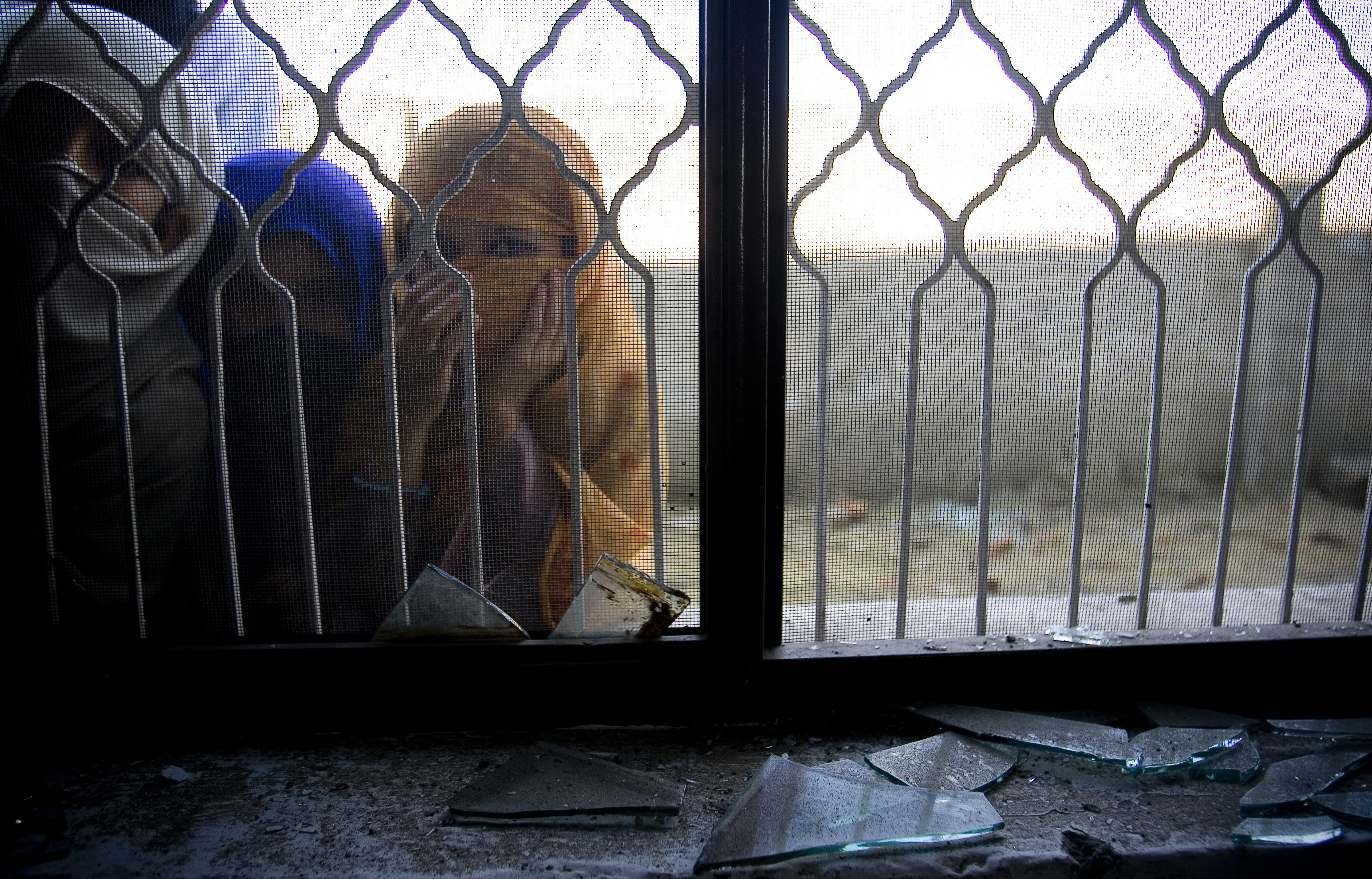
(Photo: Girl students look through the window at the damage in their classroom at Hathier High School, which was bombed on March 22, 2009 by Taliban militants opposed to female education, pictured on March 31, 2009 in Mardan, North-West Frontier Province, Pakistan. By Veronique de Viguerie/Getty Images.)

The Roots Of Rape?

There’s plenty to agree with in Frank Bruni’s column today on ameliorating the culture that leads to disparagement of and aggression toward women. In fact, I’d probably endorse most of the proposals he makes. But, unlike Frank, I don’t believe that masculinity is entirely a cultural construct. Here’s how he puts it:

There are times when I find myself darkly wondering if there’s some ineradicable predatory streak in the male subset of our species. Wrong, Chris Kilmartin told me. It’s not DNA we’re up against; it’s movies, manners and a set of mores, magnified in the worlds of the military and sports, that assign different roles and different worth to men and women. Fix that culture and we can keep women a whole lot safer.

But there is a third option between DNA and culture. It’s called testosterone. It’s a very powerful hormone that makes men men (we are all originally default female embryos) and is the sole real difference between the sexes. And it correlates very strongly with aggression, confidence, pride, and physical strength. There is nothing inherently “dark” about this. Testosterone has fueled a huge amount of human achievement and success as well as over-reach and disaster. And it makes men and women inherently different – something so obvious no one really doubted it until very recently, when the blank-slate left emerged, merging self-righteousness with empirical delusion.

This absolutely doesn’t mean acquiescence to rape or the culture that leads to rape.

That is an extreme and heinously immoral act of violence. Indeed, there’s a great deal of work to be done in creating a dialogue and culture in which the logic of testosterone is challenged constantly. But this used to be done by appealing to male pride, not by suspecting generalized male infamy. The concept of “gentle”-men or “gentlemen” was honed in the last few centuries specifically to encourage such a civilizing cultural climate. And I’d argue that approach will pay far more dividends than the well-intentioned attempts to remake human nature by cultural coercion – because it deploys one the most powerful forces in men, testosterone, against itself. It works with the grain of human nature, rather than assuming that such nature doesn’t really exist and culture is all we need to change.

A man’s self-esteem can be, in some hideous fashion, fed by acts of violence. But it can also be sustained through more open and public recognition of such virtues as courage, confidence and prudent risk-taking and through the critical institution of the family. A spouse channels testosterone to calmer waters; off-spring can bring with them a new sense of manhood if fatherhood is a truly appreciated moral activity. Virtuous institutions – such as you see in the Boy Scouts or at West Point or in the ethos instilled in the US military from George Washington on – are also vital to this. But none of this is possible if we insist on denying reality. Men are not women – and never will be.

A celebration of virtuous masculinity is impossible unless you accept the deep hormonal reality of masculinity itself. And even find much in it to admire.

Peering Into The Rotting Entrails Of The Intellectual Right

Is there a point at which a “movement” actually hits bottom? You know: like an addict? My only true experience with this was observing the British left in the 1970s and 1980s, reacting to the tectonic shift toward less state control in Britain and America. Instead of examining their own biases, challenging their own assumptions and thinking constructively about policy, they simply began talking to each other, 51yHDd+p4NL._SY346_PJlook-inside-v2,TopRight,1,0_SH20_split into factions, and, with each passing day, they got loopier and loopier. American liberalism had a less surreal intellectual collapse as well – degenerating into interest group leftism, as Reagan re-made the polity.

Reading the current conservative press (with the obvious exception of The American Conservative), it’s hard not to see the parallels. What was once Joe-Farah-style looniness is now mainstreamed; Newsmax is all over NRO; David Brooks’ idea of a revived version of early neo-conservatism is almost poignant in its level of denial. There appears to be nothing ever too far to the right, and the fervor of the true believers increasingly eclipses the worries of the doubters. Reading conservatives like Pete Wehner or David Brooks feels worthy but irrelevant. Watching conservatives like George Will and Charles Krauthammer effectively go over the cliff with the party is just dismaying. Seeing Peggy Noonan morph into Michelle Malkin may be entertaining in its incoherence, but it’s still not good for the republic.

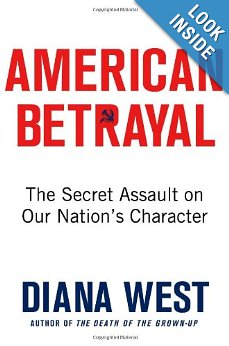
And then you get to what one might call a “whole new level”. Take a new book by Diana West about how the Soviet Union “occupied” America under FDR and dictated foreign policy to serve communist interests. Here’s how the book advertizes itself:

If the Soviet penetration of Washington, D.C., was so wide and so deep that it functioned like an occupation …

If, as a result of that occupation, American statecraft became an extension of Soviet strategy …

If the people who caught on – investigators, politicians, defectors – and tried to warn the American public were demonized, ridiculed and destroyed for the good of that occupation and to further that strategy …

And if the truth was suppressed by an increasingly complicit Uncle Sam …

Would you feel betrayed?

Probably. But why all the question marks? And then you begin to inquire further and your eyes widen a little.  A few paragraphs into reading the debate, you realize that all of this is connected with the claim of a current huge conspiracy lying in plain sight – the Muslim Brotherhood’s grip on the White House. Obama is a closet Islamist, just as FDR was a closet Stalinist. It all makes sense now!

If you’re like me and steeped in this kind of ideological stew for a few decades, you immediately check on the slightly calmer voices in the anti-Communist historical universe. The result is both a relief – not everyone has gone bonkers – which is followed by more dismay, as you realize that even the people who lived their intellectual lives as passionate, revisionist anti-Communists and anti-anti-anti-Communists are now outliers in the conservative ranks.

So do yourself a favor and get a glimpse of the insanity now dominating what was once a vibrant intellectual culture by reading Ron Radosh’s devastating review of the book. (David Horowitz gives his side of the kerfuffle here.) Front Page offered West equal space to respond but she wisely refused (see her position here). After reading Radosh, you realize why. She’s got nothing. But she still has much of the movement right on her side. Radosh:

As a historian I normally would not have agreed to review a book such as this one.  But I changed my mind after seeing the reckless endorsements of its unhinged theories by a number of conservative individuals and organizations.

These included the Heritage Foundation which has hosted her for book promotions at a lunchtime speech and a dinner; Breitbart.com which is serializing America Betrayed; PJ Media which has already run three favorable features on West; Amity Shlaes, who writes unnervingly that West’s book, “masterfully reminds us what history is for: to suggest action for the present”; and by conservative political scientist and media commentator Monica Crowley, who called West’s book “A monumental achievement.”

Shlaes, whom I recall as previously sane, even calls West (presumably without irony) the “Michelangelo of denial.” Then you think this has to be the rock-bottom of the loony right, but stupidly read the comments under Radosh’s painstakingly thorough demolition. The “best” and first comment has this throw-away line:

Incidentally, Joe McCarthy was right.

Within a few more comments, we have a Birther; then we have this, claiming that these past affairs are not worth reading into because they pale in comparison with the treason in Washington today:

How about the fact that a number of mid East advisers working in the sate department [sic] are connected with CAIR or the Moslem Brotherhood?

Mercifully, there is some sanity among some Front Page readers and it elbows its way to the front at times. But check out the Amazon reviews. Anyone with any serious understanding of history gives it one star at most. The rest? Five stars! Seriously. There is no middle ground. My favorite review:

Where West’s contribution differs from anything else, thus far available, is that in addition to assimilating all of the most important aspects of the Soviet infestation she illustrates a parallel action on the part of the Islamists today. An understanding of the current Islamic penetration into our society, government and culture alike, is vitally important, and should be readily apparent.

My second favorite:

History that I never got in school.

You can say that again.

MoDo’s Pure Washingtonism

Maureen Dowd Hosts Party For Gioia Diliberto's New Book "The Collection"

Yes, of course it’s the same column. It has a touch of Wieseltieritis:

[Obama] smoothly glided from his previously unassailable position on the matter of surveillance to his new unassailable position on the matter of surveillance.

It couldn’t possibly be that a Democratic president, always liable to be deemed “weak” on terror, waited for domestic opinion to shift before restraining the least ineffective and counter-terrorism strategy, could it? Nah. He’s just “aloof”. That’s been the story-line from long before Day One, when MoDo was giving bad conventional advice to candidate Obama, and she’s sticking to it. More Leonism:

There is no moral high ground that he does not seek to occupy. As with drones and gay marriage, he seems peeved that we were insufficiently patient with his own private study of the matter. Why won’t the country agree to entrust itself to his fine mind?

Oh, please. The first was wound down once it had achieved its primary objective and had begun to become counter-productive. The second was a politician bullshitting a little in order to expedite a civil rights revolution, by taking himself out of the front lines until the critical end-game. And if you don’t regard these political stratagems as a function of Obama’s alleged moral snootiness, but as pragmatic adjustments to shifting objectives, they look a little different, don’t they? Five years into Obama’s term and the entire Afghan al Qaeda franchise was taken out. As for his pathetic weakness on gay rights, he has presided over the end of the military ban – brilliantly maneuvered through Congress by Admiral Mullen – and federal recognition of marriages for gay couples. I’m not sure even being Tip O’Neill could have succeeded more powerfully, do you?

Then MoDo’s warning – even after 2008! – that Obama is not tough enough to counter the malign and crafty Clintons. Now I am second to none in maligning the Clintons. But what Obama grasps and MoDo doesn’t is that politics need not always be zero-sum.

It is not, for example, a threat to Obama that Hillary is already up to her neck in campaign machinations and shenanigans. This is the Clintons’ natural state of rest: machinations and shenanigans in the seeking and holding of power and money. And there is no cost to Obama if Hillary is campaigning to complete Bill’s third term. If she succeeds, then a great deal of Obama’s legacy is secure, and part of it could be the final humiliation of the GOP at his successor’s hands. If she doesn’t succeed – and she has never won a race outside the super-safe New York Senate seat she was bequeathed by her marriage – then …  the story is all about the Clintons’ failure, not Obama’s. The president’s current strategy gives him a chance of winning either way. It’s not high-minded. It’s the most nakedly political position there is.

And what, anyway, is MoDo’s alternative strategy? Win over Eric Cantor with a few Martinis? When Mitch McConnell is fighting for his electoral life because of threats from his right, does MoDo honestly believe Obama’s Capitol Hill schmoozing would help? If John Boehner cannot control the House GOP, is it really the president’s back-slapping skills that are at fault? This is 2013. We could wish the GOP were the same as it was in the 1980s but it ain’t. Then MoDo stumbles onto the truth … and leaves it lying there on the sidewalk:

His White House runs on the idea that if you are virtuous and true and honorable, people will ultimately come to you. (An ethos that sometimes collides with political success.)

That “sometimes” is a classic. It almost reminds me of the Monty Python Life of Brian skit about “what the Romans ever did for us”. Obama’s political style is useless, apart from becoming the first black president,  saving the US from another Great Depression, succeeding at getting universal healthcare, rescuing the American auto industry, presiding over a civil rights revolution, ending two failed wars, avoiding two doomed others (against Syria and Iran), bringing the deficit down while growing the economy, focusing the executive branch on climate change, and killing bin Laden. Yes his ethos “sometimes” “collides” with political success.

But no, he has never obsessed about whom the capitol is buzzing about – i.e. boomers and their Clinton obsession. Which is proof enough of his transformation of American politics. He has transformed it so much that MoDo cannot even understand how he has been so successful.

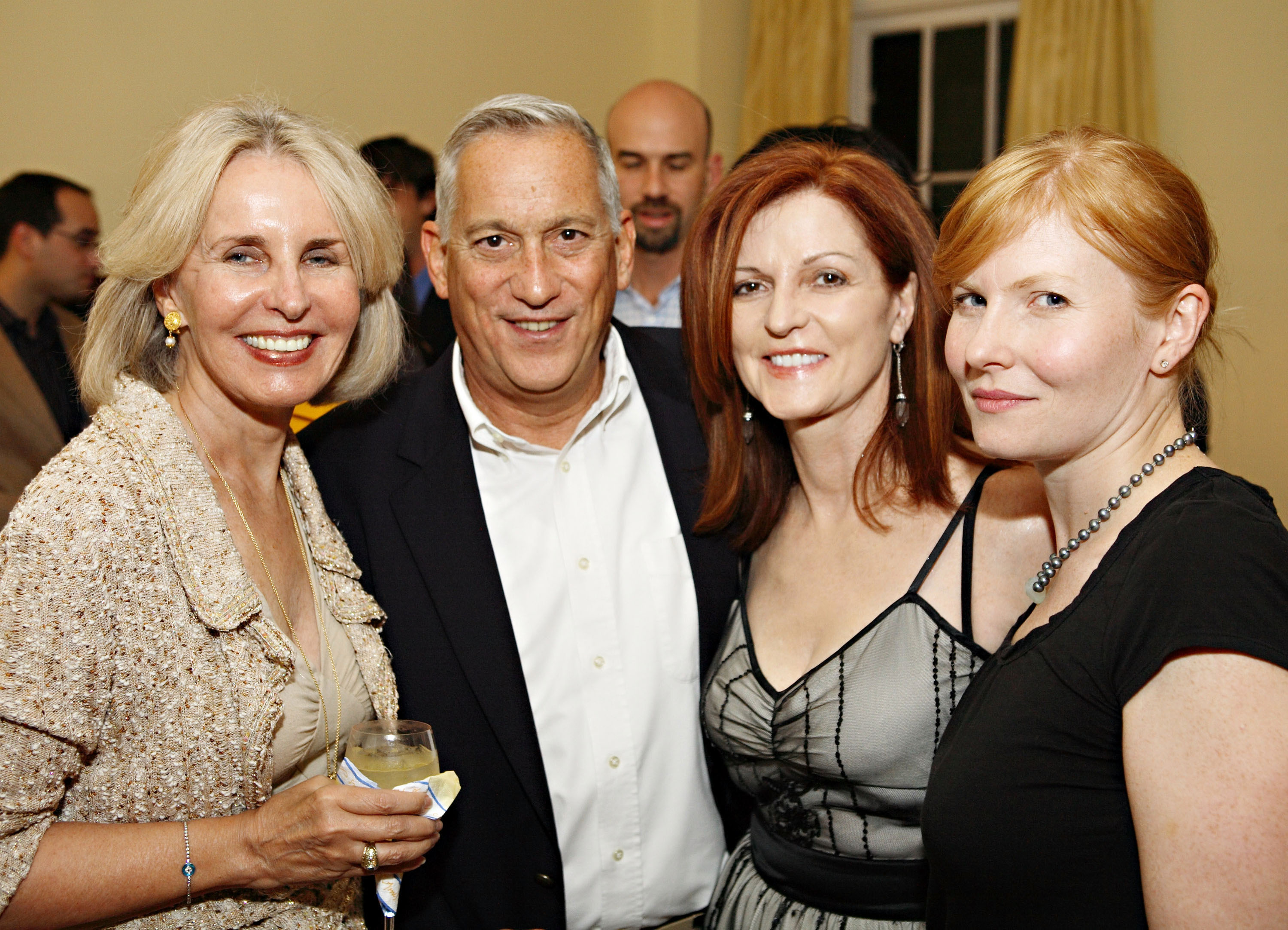
(Photo: Sally Quinn, Walter Isaacson, Maureen Dowd and Ana Marie Cox at the book-signing and reception for Gioia Diliberto’s new book ‘The Collection’ at a private residence on September 15, 2007 in Washington, DC. By Paul Morigi/Wire Image.)