“This Is Bullshit”

Straw bales, Cotswolds, Oxfordshire, UK

If you read one commentary on the meta-data gathering by the US government, do yourself a favor and read David Simon’s. The creator of “The Wire,” he is not exactly unversed in the intricacies of government power, police work and, er, surveillance. And he, even more than I, is baffled by the tsunami of self-righteous indignation:

Frankly, I’m a bit amazed that the NSA and FBI have their shit together enough to be consistently doing what they should be doing with the vast big-data stream of electronic communication. For us, now — years into this war-footing and this legal dynamic — to loudly proclaim our indignation at the maintenance of an essential and comprehensive investigative database while at the same time insisting on a proactive response to the inevitable attempts at terrorism is as childish as it is obtuse. We want cake, we want to eat it, and we want to stay skinny and never puke up a thing. Of course we do.

I, like Simon, am actually impressed by the government’s efficacy in exploring these electronic trails and patterns. I thought that was largely being done by Facebook, Google or the Obama campaign. I never thought the feds would be that competent.

And when we stumble onto a government program that is clearly legal under the Patriot Act, when not a single case of abuse can be specifically found, when it only looks for patterns and algorithms, and would have to go to a court to do any more, are you not more relieved than creeped out? Wouldn’t you prefer that this stuff be found and isolated from two steps removed? Doesn’t this new Big Data actually increase privacy compared with the pre-FISA era wire-tapping? Not for the first time, Daniel Ellsberg is wrong. It’s not that Obama is not Nixon; it is that the new program is inherently different from previous ones, because of the new nature of the technology. And its sheer scope may actually be a refuge in some ways:

When the government grabs the raw data from hundreds or thousands of phone calls, they’re probably going to examine those calls. They’re going to look to establish a pattern of behavior to justify more investigation and ultimately, if they can, elevate their surveillance to actual monitoring of conversations. Sure enough.

When the government grabs every single fucking telephone call made from the United States over a period of months and years, it is not a prelude to monitoring anything in particular. Why not? Because that is tens of billions of phone calls and for the love of god, how many agents do you think the FBI has? How many computer-runs do you think the NSA can do? When the government asks for something, it is notable to wonder what they are seeking and for what purpose. When they ask for everything, it is not for specific snooping or violations of civil rights, but rather a data base that is being maintained as an investigative tool.

Exactly. And then this point, which seems to elude Snowden and Greenwald:

There is a lot of authoritarian overreach in American society, both from the drug war and the war on terror.

But those planes really did hit those buildings. And that bomb did indeed blow up at the finish line of the Boston marathon. And we really are in a continuing, low-intensity, high-risk conflict with a diffuse, committed and ideologically-motivated enemy. And for a moment, just imagine how much bloviating would be wafting across our political spectrum if, in the wake of an incident of domestic terrorism, an American president and his administration had failed to take full advantage of the existing telephonic data to do what is possible to find those needles in the haystacks.

Just for a moment. Imagine. Now listen to Snowden.

(Photo: haystacks in Oxfordshire, England. By Tim Graham/Getty.)

Enter The Leaker

“I understand that I will be made to suffer for my actions … I will be satisfied if the federation of secret law, unequal pardon and irresistible executive powers that rule the world that I love are revealed even for an instant,” – Edward Snowden, the leaker of the NSA surveillance program. Video interview with Glenn Greenwald here.

Some helpful perspective (polling in April of this year) as to the broader impact of these revelations:

Only 20 percent of people said they believed the government had gone too far in restricting civil liberties in the fight against terrorism, while 26 percent said it had not gone far enough and 49 percent said the balance was about right. In 2011, the share of those worried about losing civil liberties (25 percent) was larger than that favoring more intrusive government approach (17 percent).

Mulling this over as the facts have come in, I remain underwhelmed. Big Data is a core tool for terror prevention and is less dangerous, it seems to me, than many other counter-terrorist programs (like occupying foreign countries, killing people with drones, etc.). Of course, you may believe that we need to end counter-terrorism altogether, because it is a hyped and over-blown threat. But say that in that case – and make the argument that we will be better off without this kind of data-gathering being allowed, and safer. Or that our freedom is worth a few terror incidents.

I’m sympathetic to the latter point of view (see Imaginationland). But then I’m not the president of a country targeted by such religious mass murderers. But what seems inescapable to me are two related things: this data is out there, and the private sector has it. It’s the first real data of its kind to be seeking computer algorithms, not necessarily content of phone conversations. It works, which is partly how Obama got re-elected. And any system of such surveillance is inherently much easier to expose than ever before. There are more Edward Snowdens out there. And they have real power – just a different and asymmetric kind. In the end, the potential for disruption is as great as the potential for knowledge.

Can This Party Be Saved? Ctd

Pascal-Emmanuel Gobry summarizes the goals of reform conservatism:

Reform conservatives believe that the GOP should put forward serious and credible policies that directly address the issue of family formation and breakdown. It will be good for the economy, good for people, A Surabaya Zoo health worker checks theand is a prerequisite to shrinking government over the long term since voters will not acquiesce to shrinking public handouts if they do not feel that they have private safety nets available, first among which is the family. Furthermore, as Jonathan V Last has pointed out, it’s good politics since family formation is a key driver of voting for the GOP.

The reform conservative blueprint, then, goes something like this: Address family formation seriously -> win elections -> make it easier to start families and have kids -> more families and more kids -> a better economy, a healthier society, less demand for big government, more GOP voters -> win more elections -> shrink government, grow the economy and civil society -> win more elections -> rinse, lather, repeat.

The alternative scenario would go something like this: Don’t address middle income voters’ day-to-day concerns seriously, don’t make family formation more affordable -> concede the field to Democrats -> increase economic and social insecurity -> increase demand for government -> lose elections -> government grows bigger -> social pathologies get worse -> keep conceding the field -> increase demand for government -> etc. 2012 was Act I of that nightmare scenario.

I need to fess up. I endorsed Ross’ and Reihan’s book, but took longer than they did to let go of my libertarian instincts in the face of yawning social inequality. It’s only been since the impact of the Great Recession sank in that I have truly come to terms with the fact that, say, flat taxes are irrelevant right now to our major problems, or that publicly subsidized private health insurance is an important response to a middle class facing an epic (if much predicted) employment and economic crisis.

I do believe, with Reihan and Ross, that supporting family formation is vital – hence my support for marriage equality (and my bafflement at Ross’ ambivalence). But my preference is for government to stop doing things that actively harm family life, rather than using money transfers to shore it up against some resilient social trends that may actually be helping marriage become more moral over time. Hence my passionate support for welfare reform in the 1990s. But there’s a core agreement: the times demand a different response than that imprinted on so many of us under Reagan-Thatcher; and encouraging self-government is the best way to keep big government at bay. If the GOP were to accept the principles of Romneycare/Obamacare, for example, they could then help reform the architecture to control costs better, empower individual choices more, and win people like me back.

Bouie makes the rather obvious but no less potent point that conservative reformers have almost no actual, you know, power:

The Republican Party is broken, and fixing it is the only way to bring long-term sanity to our politics. Unfortunately, there’s no sign of change. Last week, writers on the left and the right engaged in a debate over the conservative “reform” movement, and who counted as a “reformer.” It was a fascinating conversation with one major takeaway: Regardless of who “counts” as a reform, the obvious fact is that they have little influence over the current direction of the GOP. They lack the power necessary to challenge Republican leadership, break the party’s “fever,” and begin to reestablish it as a mainstream institution.

There is, as yet, no Tony Blair of the American right, grabbing his party by the scruff of the neck and forcing it to adapt to a new reality. And there is the persistence of the fundamentalist psyche which regards any sort of pragmatic accommodation to new political and economic realities as psychologically destabilizing. Yes, I agree with Thomas Mann and Norman Ornstein that the current nihilist extremism of the current Republican Party is “the central problem in American life.” And yet I find the chances of getting reform from within close to impossible, given how far they’ve now gone over the edge. And this is a tragedy not just for America, but for the GOP itself.

The greatest failure of the GOP is not realizing that Obama is a president they could have worked with on policy grounds, and whose relationship with them could have actually defused some of the very traits that suburban voters and most generations under 40 still find so disturbing in the GOP base.

Here, for example, was a man whose family life would make him a cult hero if he were a Republican, but who has been demonized as an alien threat to America from the get-go. Here’s a Democrat who adopted Heritage Foundation ideas for healthcare exchanges. Here’s a Democrat who has actually cut Medicare. His stimulus was one-third tax cuts. Domestic energy production has soared under Obama, even as record numbers of illegal immigrants have been deported. There were and are so many ways in which the GOP could have used Obama for their own advantage – both strategically and culturally. But they refused to, opting instead for visceral, dumb, self-defeating short-term tactical political advantage. All tactics and emotion; no strategy and reason.

And even the reformers are constrained. Have Ross or Reihan ever said that although they’d prefer a different healthcare reform, Obamacare is better than nothing? If they did, they’d be Frummed out. Or take Yuval Levin, recently tackled by Chait:

Levin may arrive at conclusions that gratify the tea party, but he does not merely rant against big government. He presents his analysis as the considered result of careful study. He harnessed himself, at least rhetorically, to a series of falsifiable claims. They are being falsified, but the restraints of his ideology give him no room to do anything but obfuscate.

I’d qualify that as the restraints that partisanship imposes on him. But they rode this tiger for so long it’s hard to feel pity as they try both to get off and not be eaten at the same time. Previous thoughts on the subject here.

Obama’s Foreign Policy Shake-Up

The above comments will mean the usual brutal attacks on Power from the usual sources. But I have written similar things, and believe passionately that acquiescence to Israel’s continued settlement policy – designed to create a permanent Greater Israel – must be challenged by the United States. The constantly expanding occupation is against our values and against our interests. We should be using all our leverage to stop it, rather than funding it, as we continue to do. But Larison argues it’s the realists rather than the neocons who should be upset:

The one major issue that distinguished Rice and Power in the first term was their support for the Libyan war, and in spite of backing that misguided intervention both of them are being promoted. That tells current and future officials that there is no penalty in supporting unwise military action, and indicates that ambitious officials should push for more aggressive policies whether they are in the national interest or not. I don’t understand the selection of Power for the U.N. unless it is simply a reward to a long-time Obama loyalist. I suppose that the position has sometimes been filled in the past to make a political or ideological statement (see Bolton, John), and appointing Power to this post might be an exercise in placating liberal hawks disaffected with Obama’s recent foreign policy record. If so, I doubt it will work, since it will just make Obama’s liberal hawkish detractors more vocal in their demands that the U.S. intervene in Syria.

I suspect it won’t. Both Rice and Power have taken an anti-interventionist position on Syria, for the usual sane reasons (even if we could do something, what would that something possibly be? Arming branches of al Qaeda?). Besides, foreign policy under this president is made in the Oval Office. I’d say the reason behind these appointments is, as my shrink will often say, multi-determined. Rice and Power have extraordinary minds, moral clarity and the kind of self-discipline that Obama rewards. (Samantha’s campaign outburst against Hillary was, I like to think, the Irish in her temporarily escaping.)

I also think their gender matters. With Kerry replacing Clinton, the need for female prominence in foreign policy is all the more politically astute. While Erick Erickson is opining that women should naturally submit to their husbands as a matter of science, and the GOP wanders off into la-la land on abortion and contraception, Obama is shrewd to balance John Kerry at State with Rice and Power at the NSA and UN. (Full disclosure: I’ve known and admired Samantha ever since I turned her down for an internship at TNR way back when, but am not that close. And yes, that was a dumb mistake in retrospect.)

And if you were a president with a conscience but also a very cold, realist approach to foreign policy, wouldn’t you do exactly what he’s done? Find those most likely to argue for liberal intervention and bring them closer into the tent rather than risk them smoldering from a distance? They act as liberal buffers to an inherently conservative foreign policy (by which I mean the antithesis of neoconservative.)

Max Fisher sees the point:

[E]ven if Power and Rice did disagree with Obama on Syria, he’s already overruled more senior and experienced officials who wanted to upgrade U.S. involvement. He shot down a 2012 plan, backed by Defense Secretary Leon E. Panetta, Secretary of State Hillary Rodham Clinton, CIA chief David H. Petraeus and Gen. Martin E. Dempsey, chairman of the Joint Chiefs of Staff, to directly arm the Syrian rebels. Even if they wanted to, it’s not clear that Power and Rice would be better positioned to change U.S. policy.

Ali Gharib expects Power to be attacked, once again, over her comments about Israel (some of the most controversial seen above):

Will re-hashing these 2008 attacks squash Power’s nomination? Probably not. But will those segments of the pro-Israel right that attacked her in 2008 have at it again in 2013? Most definitely. And if the first salvos are any indication, they’ll use the exact same playbook they did five years ago. Like Chuck Hagel’s embattled nomination as Defense Secretary, Power will survive. But she’ll take some shots and come out hesitant to say ‘boo” about Israel.

Fisher puts Power’s old comments in context:

It appears that Kreisler asked Power how she, if she were a presidential adviser and human rights atrocities broke out in Israel-Palestine, would advise the president to “put a structure in place to monitor that situation [where] at least one party or another [may] be looking like they might be moving toward genocide.”

That last part is important: the hypothetical she’s addressing is about what to do if genocide appears imminent. He’s not asking Power, hey, do you think we should invade Israel to impose a two-state solution? Still, even remembering that she was being prompted with an extreme and unlikely worst-case hypothetical, Power’s answer was not ideal.

And James Gibney previews Power’s confirmation hearings:

Even if this doesn’t end up putting U.S. boots on the ground in Syria, Power’s confirmation hearings will showcase cognitive dissonance on both sides of the bench: Power as she bobs and weaves to avoid criticizing the administration’s relative inaction to stop the slaughter in Syria, and Republican Senators John McCain and Lindsey Graham as they hammer away at a nominee whose more robust views on intervention they doubtless have great sympathy for.

Samantha can take it. As long as she doesn’t get her Irish up.

I have to say on a personal note that I’m also moved by this Irish immigrant with such brilliance and passion representing the United States. In some ways, we actual immigrants, born abroad, represent a quintessentially and uniquely American experience: we chose this country because we love it and wanted to start our lives over. And it rewards us by treating us (if not in my case for a long time because of HIV) as if we belong here. That’s uniquely American.

(Thumbnail photo by Eric Bridiers, United States Mission Geneva)

Peak Faggot?

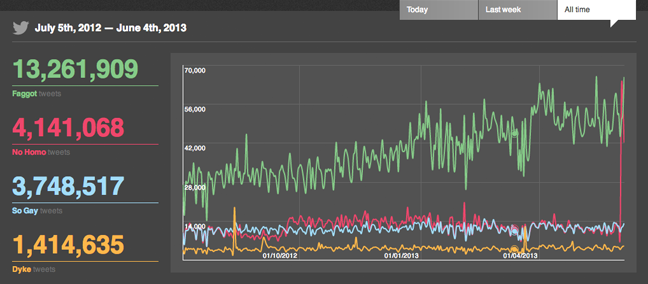
The word has been going gangbusters on Twitter lately:

alltimenohomo-grab

What’s interesting is to click on NoHomophobes.com to read the actual contemporaneous tweets that contain the phrases “so gay”, “dyke”, “NoHomo”, and “faggot.” I have to say that “so gay” does seem, from reading the tweets, to be close to meaningless in terms of active, pre-meditated homophobia. Yes, of course it is a negative term and is rooted in the premise that being homosexual is lame. But it has become so generic I’m not really outraged by it. In fact, I’m not that outraged at any of this. Twitter is full of expletives and hate-words. I wonder if the n-word and the word “bitch”, for example, are much more common.

“Faggot” is also somewhat ubiquitous, ranging from the classic hate term against gay men to a general term of abuse for straight women and straight men. But some of that abuse in context is jokey. So this post – which will be tweeted – will register as hate-speech, just as a joke between two friends in which “faggot” has been drained of any explicit homosexual meaning. But “NoHomo” is almost entirely an ugly, nasty prejudice.

I may not be personally outraged, but I’m in a very privileged position (only gay-bashed once in my life), and the general the trend is disturbing, especially when we have seen a spate of anti-gay street violence from the Castro to the West Village, a few blocks from where I now live.

It gets more disturbing still when you also have the spectacle of a Republican candidate for Lieutenant Governor in Virginia like EW Jackson. The state’s GOP has effectively affirmed the legitimacy of a man who has used not just tired cliches but what I think has to be called “eliminationist” rhetoric, as defined by Daniel Goldhagen. Take this:

“[T]he homosexual movement is a cancer attacking vital organs of faith, family & military – repositories of traditional values.”

Or this:

“The ‘homosexual religion’ is the most virulent anti-Christian bigotry & hatred I’ve ever seen.”

Now look at the actual definition of “eliminationist” rhetoric:

Eliminationism is the belief that one’s political opponents are “a cancer on the body politic that must be excised — either by separation from the public at large, through censorship or by outright extermination — in order to protect the purity of the nation.

I’m a free speech absolutist. But when we find hate terms surging on Twitter, eliminationist anti-gay rhetoric from major candidates, and a rise in attacks on gay men in neighborhoods associated with them, we should take notice. There is a range of tweeted sentiments here – from innocuous to unthinking (the NoHomophobes website has a smart slogan: “Homophobic language isn’t always meant to be hurtful, but how often do we use it without thinking?”). But when they are legitimized by rhetoric that seeks to speak of gays the way Afrikaners spoke of Africans, and extremist Sunnis speak of Shiites, we have a problem. I urge readers to check out the site and tell me what they hear and read, and what they make of it. It can get complex and I have two confirmation biases: I’m gay and am attached to a non-victimology temperament in identity politics.

But one thing I do know in this atmosphere: The GOP is dipping into some of the foulest waters here. I just hope they aren’t legitimizing a wave of hatred.

Ask Josh Barro Anything: The Recent Evolution Of Conservatism

Yesterday, Josh explained why he still had hope for the GOP. In today’s video, he gets into his own ideology, as well as surveys the past few decades of conservative policy thinking:

I would add that Burke would not have been a Burkean as Josh describes it (and he accurately details the common perception). Yes, Burke was one of the first to realize that social organisms are resistant to intellectual overhaul based on external, abstract principles – and that the sunny view of the Enlightenment needed some necessary correction.

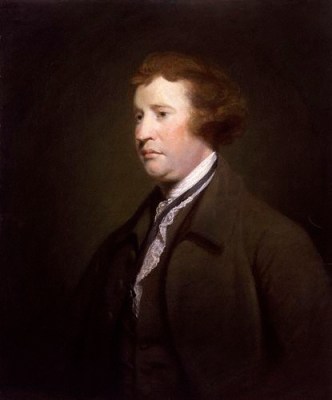
But he was more like a neo-liberal than Josh notes. Burke was not a Tory, after all, but a Whig. He supported American independence, he defended religious toleration of Catholics, and was a ferocious critic of the burgeoning occupation of India, and its concomitant abuses, an enterprise, he said, which “began ‘in commerce’ but ‘ended inempire.'” The key to Burke, it seems to me – and I recommend the new compulsively readable biography by Jesse Norman – is that he saw society as always changing, and the statesman’s role as understanding those changes, and NPG 655,Edmund Burke,studio of Sir Joshua Reynolds adjusting policy to meet them. What Josh is doing is adjusting to the realities of our time, as Burke would have.

There  are two kinds of “conservatives”at large in America today. The first, and most prominent, are those whose worldview stems essentially from the pivot of the late 1970s and those – far fewer in number – who are actually grappling with the world as it now is. We are not in an era of stagflation as we were in 1979; timidity abroad against another dangerous super-power is not our challenge; a churning multicultural society cannot be shoved back into the tiny-necked bottle of the late 1950s.

Our predicament today is one of post-depression recovery, soaring social and economic inequality, imperial over-reach, energy policies that could change – perhaps permanently – the conditions of life on this planet, and the collapse of the very economic structures that once made a prosperous middle class possible. A real Burkean would be doing exactly what Josh is doing: tackling these problems, rather than chasing abstractions down the Ailes rabbit-hole. And he would not in any way be ashamed to be called an educated man, prepared, if necessary, to tell his constituents to buzz off. When you remember all this, you see just how pseudo pseudo-conservatism really is: a cauldron of paranoia, bile, and ludicrously Manichean ideology.

So let’s call Josh what he actually is: a conservative Whig. Just like Burke. Welcome to the club. And meet the other six members.

Previous Dish on Chait’s recent profile of Barro here and here. Our Ask Anything archive is here.

What’s In A Bigot?

RUSSIA-SOCIAL-GAY-PARADE-PROTEST

A reader disagrees with me:

Andrew, you may not like calling opponents of same-sex marriage “bigots” – and doing so may not be in the best interests of gay marriage – but it doesn’t change the reality: they are bigots. If your goal is advocacy or politics or politeness, then I can understand avoiding the word, “bigot” to describe them. But if your goal is truth, then I think it is unavoidable.

They believe their relationships are better than ours – deserving of special recognition. That means they must also believe that THEY are better than us. Why? Because they have that special something that allows them to get married in the first place. We don’t, because we are gay. Once married, they are nurtured in their relationships, growing in ways that they believe are unavailable to us. We are not allowed marriage because we are lesser. Having been denied the benefits of marriage, we fall even further behind. They may not wish to admit that they hold these beliefs. We must force them to do so.

Being a bigot doesn’t make you a monster, but it does put you on the wrong side of history. You don’t have the right to imagine that you would have hid runaway slaves in 1860 or marched with Dr. King a hundred years later. That’s because you are standing with the bigots today. That’s because you are one.

I think it’s possible to be merely leery of change in such an important social institution – a small-c conservative predisposition that is not interchangeable with bigotry. But as the years go by and the actual benefits of this reform deepen and the negative impact proves to be a chimera, then you do find a residue of bigotry that is indeed bigotry. Think of the evolution of an honest, decent man like David Blankenhorn and the rigid, permanent anti-gay agenda of Robbie George. Abroad, the pure hatred is much more visible (see above).

But even then, for purely strategic reasons, I prefer not to cast out heretics with that word, and work on persuading them to be converts. I once described the goal of Virtually Normal – written at a time when marriage equality was still a joke to many – as getting past the dynamic of one side yelling perverts and the other side yelling bigots. That has some emotional satisfaction for both sides, but it achieves nothing, and closes dialogue, rather than opening it. And dialogue is what supporters of marriage equality should always want – because our arguments are so much better. Another reader backs me up:

I have a lot of sympathy for the idea that not every opponent of gay marriage is a bigot. The problem is that I don’t think there is a simple binary between good people who respect gay people and therefore accept marriage equality and evil people who wish to take away the fundamental right of a loving couple to marry.

While I don’t detect animus – a required component in my own personal definition of “bigotry” – in every argument opposing gay marriage, I do detect a certain condescension, and more often than not, an inability to understand the subject at hand. Is Maggie Gallagher a bigot for opposing gay marriage? No. I do think she has certain prejudices that prevent her from seeing the fundamental equality between male-male love, female-female love, and male-female love. Is Ben Carson a bigot for opposing gay marriage? Not necessarily for that reason. But the guy did compare homosexuality to pedophilia and bestiality in one sentence. I had no problem with Johns Hopkins disinviting him from speaking at graduation.

Of course, this says nothing of the many casual bigots, the dudes who can’t stand a fag, who also happen to support gay marriage. It was possible to think or even say the word “nigger” and still support desegregation.

People are usually much more complicated that one word “bigot” can convey.

(Photo: Unknown anti-gay activist hits Russia’s gay and LGBT rights activist Nikolai Alexeyev (C) during unauthorized gay rights activists rally in cental Moscow on May 25, 2013. Moscow city authorities on May 15 turned down demands for a gay rights rally, but Alexeyev said he would fight a ban in court. By Andrey Svitailo/AFP/Getty.)

They Died For … China?

People Pay Their Respects To The Country's War Dead At Arlington National Cemetery's Section 60

In case the Iraq war was not catastrophe enough, we now know what the trillion dollars and thousands of US casualties and injuries and tens of thousands of sectarian deaths were for. One dumb superpower went to war for one rising superpower smart enough never to get engaged at all:

“The Chinese are the biggest beneficiary of this post-Saddam oil boom in Iraq,” said Denise Natali, a Middle East expert at the National Defense University in Washington. “They need energy, and they want to get into the market.”

Before the invasion, Iraq’s oil industry was sputtering, largely walled off from world markets by international sanctions against the government of Saddam Hussein, so his overthrow always carried the promise of renewed access to the country’s immense reserves. Chinese state-owned companies seized the opportunity, pouring more than $2 billion a year and hundreds of workers into Iraq, and just as important, showing a willingness to play by the new Iraqi government’s rules and to accept lower profits to win contracts.

“We lost out,” said Michael Makovsky, a former Defense Department official in the Bush administration who worked on Iraq oil policy. “The Chinese had nothing to do with the war, but from an economic standpoint they are benefiting from it, and our Fifth Fleet and air forces are helping to assure their supply.”

Of course, this extra oil production may be a good thing. It could bribe Iraqis into not massacring each other, as they seem preternaturally eager to do (a thousand Iraqis were killed in sectarian attacks last month alone). It will almost certainly lower oil prices globally. But notice what this war for democracy and against sectarianism has achieved. We now have a Shiite authoritarian still engaged in sectarian warfare along the old Sunni-Shiite lines, and a Sunni insurgency with less and less stake in the government (sorry, general Petraeus, your surge was a brilliant Washington p.r. campaign but achieved none of its goals, except helping us get out of that hell-hole).

And now we have an authoritarian Shiite government doing huge deals with the authoritarian Chinese government, whose state-directed companies can offer terms no Western oil company, answerable to share-holders, can match. So, in the end, the war promoted the interests of authoritarianism, Iran and China.

How and when will George W Bush and Dick Cheney look the families and friends of dead service-members in the eye and tell them the truth about what their beloved sons, daughters, brothers, sisters, mothers and fathers fought and died for?

(Photo: Headstones are reflected in a photograph that is leaning against the headstone for Iraq war casualty U.S. Army Master Sgt. Tulsa Tulaga Tuliau on the 10th anniversary of the beginning of the war in Iraq at Arlington National Cemetery March 19, 2013 in Arlington, Virginia. Tuliau was killed when an improvised explosive device detonated near his Humvee during combat operations near Rustimayah, Iraq September 26, 2005. By Chip Somodevilla/Getty Images.)

Forgetting The Struggle

[Re-posted from earlier today]

Frank Rich worries that rapid advances in gay rights are obscuring the discrimination faced by the gay community in the recent past:

For younger Americans, straight and gay, the old amnesia gene, the most durable in our national DNA, has already kicked in. Larry Kramer was driven to hand out flyers at the 2011 revival of The Normal Heart, his 1986 play about the AIDS epidemic, to remind theatergoers that everything onstage actually happened. Similar handbills may soon be required for The Laramie Project, the play about the 1998 murder of the gay college student Matthew Shepard. A new Broadway drama, The Nance, excavates an even older chapter in this chronicle: Nathan Lane plays a gay burlesque comic of 1937 who is hounded and imprisoned by Fiorello La Guardia’s vice cops. Douglas Carter Beane, its 53-year-old gay author, is flabbergasted by how many young gay theatergoers have no idea “it was ever that way.”

It’s particularly remarkable given the extreme trauma of mass death that the gay world experienced as recently as a decade and a half ago. But for today’s young gays, that’s not just another country; it’s another continent.

I have to say I feel very mixed feelings about this. Having struggled a quarter of a century ago to stop marriage equality from being treated as a joke by straights and as a neo-fascist plot by gays, it’s staggering now to realize that many young gay kids take their right to marry almost for granted – even though it still isn’t granted fully anywhere in the US yet (because of no federal recognition).

So yes, it’s oddly alienating to feel that one’s entire life has now been rendered moot. But also, exhilarating. One of the key reasons I always believed marriage and marriage alone could turn the gay-straight chasm into a bridge is its generational impact. When I figured out I was only virtually normal, I was around seven. And all I really knew about sex and love was that mummy and daddy were married and I never could be. That’s a huge psychic wound in the souls of gay kids. From that wound, often nursed alone and in private, comes a panoply of pain, pathology, self-destruction, and lack of self-worth. Few can afford the kind of intensive therapy required to get past this – because the wound is so deep and inflicted so young.

But today, that seven-year-old will know, simply if he or she watches the TV, that marriage is an option for him or her. They will know in a way my generation didn’t that they have a future in the society they live in, like their siblings. There are still wounds inflicted by misguided religion or panicked families. But the ur-wound is gone. And the generations of gay kids I meet today are simply way less fucked up at their age than I was, or may ever be. In that sense, I celebrate their amnesia and look up to them. I want the struggle of the past to be flooded by the normality of the present.

But we gays are also crippled in terms of communal memory. Ethnic minorities beget ethnic minorities; and parents are able to tell the stories of their past communal struggles, whether they be Jewish or African-American or even simply immigrant stories that link us to the past. But the parents of gay kids are, by and large, straight. They never went through the gay struggle. They have no gay history to share with their kids, who are born de novo, and required eventually to go outside their own families to find out about the history of their kind.

Most don’t. And I sure wouldn’t want them indoctrinated in any way. But can you imagine Jewish grandchildren of Holocaust survivors never being told about it? Or African-American kids never knowing fully about slavery?

We have no permanent national monument to commemmorate a plague that killed five times as many young men in the same space of time as the Vietnam War. Only now are we seeing the beginnings of memory – the revival of “The Normal Heart”; the documentary “How To Survive A Plague“; or the one-night revival of David Drake’s “The Night Larry Kramer Kissed Me.” Which is not surprising, if you have studied the end of plagues. The first sentence in my own plague memoir, Love Undetectable, is the following:

First, the resistance to memory.

That is understandable at first, as Camus noted, but it is becoming increasingly unforgivable. We need as a community to honor the veterans of that war, to hold them up and keep them close, and to retrieve the unimaginable agony of those days of psychological terror and excruciating physical pain. And if that makes me sound like a bitter war veteran, please know that bitterness is the very last thing I feel.

We lived for this moment, these years when we would finally see our freedom. Many of us doubted we would ever get to this mountaintop and were fully prepared to die somewhere in the foothills. But if we do not ever look back, and see the trail of corpses along the way, and the ocean of grief and pain we overcame, we will never fully grasp the dimensions of the victory. Or its real and deeper meaning: a spiritual awakening about the dignity of all human beings; about their universal need, above all other things, for love; about how Christianity, at a key moment of testing, sided against love and lost a generation.

Telling Holder To Shove It

Holder Speaks At Naturalization Ceremony At Justice Department

It was no doubt meant as an act of reconciliation and dialogue; but it backfired, and rightly so. If my emails had been searched by the DOJ, I’d be eager to talk to the man who authorized, in the case of James Rosen, a potentially criminal warrant. But I’d want that talk to be open, clear and accountable. To try to address the question of secret government intrusion into the press in secret is like something out of a John Le Carre novel.

I’m not qualified to judge the legal dimensions of Holder’s term as attorney-general. And it does seem to my eyes that he did nothing actually illegal in the leak cases, but rather pushed the boundaries of government monitoring of the press to new, invasive levels. Some of this is about technology – emails are far easier to monitor that previous communications. Some of it is about genuine issues of national security – the outing of a mole in North Korea, for example, which any government needs to keep secret. There is a mass of gray area in there that does not easily fit into a narrative of an outrageous abuse of government power.

But politically, Holder is now and long has been a dreadful communicator, appearing both weak and yet intrusive at the same time. That’s an awful combination, only underlined by this latest example of complete tone-deafness. Let’s have the meeting. It’s important to clear the air, clarify differences, and build consensus for a new media shield law.

But let’s do it in public and on the record. I seem to recall a candidate once promising a transparent administration. So why is the current air so thick with fog?

(Photo: U.S. Attorney General Eric Holder attends a naturalization ceremony at the U.S. Department of Justice May 28, 2013 in Washington, DC. By Win McNamee/Getty Images.)