Intervene In Syria? Just Say No.

[Re-posted from earlier today]

The above video shows an Israeli airstrike in Damascus on Saturday night, reportedly targeting regime munitions bound for Hezbollah. It comes on the heels of another attack late last week, on missiles stored at Damascus airport. Assad’s regime now declares it will retaliate, and the IDF says this won’t be the end of the strikes:

Officials [in Israel] are concerned that as the Syrian state devolves into chaos, sophisticated weapons not previously available to Hizballah will make their way across the border to Lebanon, altering the military equation between Israel and the well-armed Shi‘ite militia sponsored by Iran and aided by the Syrian government.

We are told this was not an act of war. Why? Er, because Israel did it and therefore it is not an act of war. It may have killed close to 100 Syrian army soldiers, among many others; it may have been the biggest single explosion in Syria’s capital city throughout the entire conflict; it may have required entering another country’s airspace and bombing its capital city; but this is not a war. Moreover, this not-war is embraced by the US. Because Israel did it:

In a series of high-level meetings between U.S. and Israeli officials over the last year, the Israelis explained in detail the conditions that would lead them to attack targets inside Syria. Israel’s “red lines,” articulated in private and public, include the shipment from Iran of advanced anti-aircraft weapons, advanced missiles, and chemical or unconventional weapons to the Lebanese militia and political party Hezbollah, according to public reports and U.S. officials. … President Obama signaled Sunday that the U.S. had no objections to the strikes.

Which begs the obvious question:


Imagine a foreign military bombing Washington. Would we not regard that as an act of war? At what point are we going to admit that, in our view, all the rules of international law apply to every party but the US and its allies? Blake Hounshell considers the impact of the air strikes on all parties:

[W]ow, this is awkward for the Syrian opposition. The regime will seek to exploit the raids to tie the rebels to the Zionist entity, after spending two years painting them as an undifferentiated mass of “terrorist gangs.” (Syrian television is already testing out this line, according to Reuters: “The new Israeli attack is an attempt to raise the morale of the terrorist groups which have been reeling from strikes by our noble army.”)

But the propaganda can cut both ways. The rebels can point to the Israeli attacks as yet more evidence that Assad’s army is for attacking Syrians, not defending the country. It’s not clear to me which argument will carry the day.

The strikes also promise to hypercharge the debate over Syria in the United States. Advocates of  intervention will ask: If Syrian air defenses are so tough, as U.S. officials have been saying, why was Israel able to breach them so easily? Of course, a no-fly zone is a much more difficult and risky endeavor than a one-off raid, but you can expect that important distinction to get blurred.

It was, in fact, amazing to see how Israel’s complication of an already metastasizing conflict did not prompt concerns in the US about the war expanding – but immediately gave us commentary that this proves how easy war against Syria can be – and so why are we waiting? Yes, a decade after “Mission Accomplished” we are asking why not go to war in a Middle Eastern Muslim country racked by a splintering insurgency? Here’s why:

The Israeli strikes aim at specific, identifiable direct threats to vital Israeli interests and use the smallest force and lowest risk possible to eliminate those threats. The Israelis may not be able to solve the problem of potential arms transfers to Hezbollah writ large, but standoff strikes against discrete targets do not tie down Israeli forces enough to make it a distracting quagmire.

A [No-Fly-Zone], on the other hand, requires massive amounts of aircraft and munitions in both standoff and air superiority roles to even deliver the basic goal of grounding the Syrian air force. A Syrian NFZ presents an even larger operation than the Libyan air campaign, and one that is likely to be even less effective, especially if it is a pure NFZ that refrains from the additional aircraft, munitions, and ground/intelligence efforts that would be necessary to support a campaign to target the Syrian army. Syria’s mix of ground forces and paramilitary groups appear far more combat effective than their Libyan regime equivalents, and, even without air cover, would not be operating at crippling loss without their air force (Syrian aircraft appear far more competent at terror bombing than tight close-air support).

What we have here is a regional, sectarian war that has been brewing since the Iraq implosion tore the region’s fragile stability apart – and further fueled by the energies unleashed by the Arab Spring. Beneath the Iran-Israel stand-off, we also have a Shia-Sunni struggle, in which Assad and Khamenei and Hezbollah and Maliki are fighting off the hardcore Sunni Jihadists and democrats trying to depose Assad. My point is that this is emphatically not our fight, it is an intensely complex one in a fractured and splintering region, that there are no good options, but that remaining on the sidelines seems to me to be the least worst one right now.

To intervene is to help some faction directly or indirectly, which means alienating another faction directly or indirectly. It swiftly becomes a maze from which no adventurer exits. Part of this maze of confusion: the fact that the UN has now said it has found evidence that it may be the rebels, not the regime, who have used Sarin gas:

The United Nations independent commission of inquiry on Syria has not yet seen evidence of government forces having used chemical weapons, which are banned under international law, said commission member Carla Del Ponte.

“Our investigators have been in neighboring countries interviewing victims, doctors and field hospitals and, according to their report of last week which I have seen, there are strong, concrete suspicions but not yet incontrovertible proof of the use of sarin gas, from the way the victims were treated,” Del Ponte said in an interview with Swiss-Italian television. “This was use on the part of the opposition, the rebels, not by the government authorities,” she added, speaking in Italian.

So, sorry, Mr Keller, but Syria is very much like Iraq. A dictator leaving a vacuum in a half-liberated country? Check. A sectarian war we cannot understand let alone direct? Check. A Sunni insurgency increasingly allied with Jihadist elements? Check. Nebulous accusations and counter-accusations about WMDs, without hard proof of much at all? Check. A conflict swayed by interference across the region – from the Sunni monarchies to the Shi’a powers? Check.

You can argue that this could have somehow been prevented. I doubt it. You could also argue that the United States has an interest in an outcome that is neither Assad nor the al Nusra brigades. But no one can explain to me how to get from here to there. This is their regional war, not ours’. And our only reliable ally in the region seems perfectly capable of protecting itself and its own interests, without even informing us in advance.

Please, Mr President: just say no. You were elected to end this kind of hubristic, short-sighted, if well-intentioned military intervention. We did not elect you over McCain in 2008 merely to watch you follow that unreconstructed neocon’s advice, which is always to intervene first and figure out what to do once we have.

You know better. Trust your instincts. Do as little as possible.
A Couple Of Words On Niall Ferguson

Oxford Literary Festival

[Re-posted from earlier today]

What he said about Keynes’ sex life, poetry, homosexuality and caring about future generations is stupid, offensive, and absurd. He has now issued an apology:

During a recent question-and-answer session at a conference in California, I made comments about John Maynard Keynes that were as stupid as they were insensitive.

I had been asked to comment on Keynes’s famous observation “In the long run we are all dead.” The point John_Maynard_KeynesI had made in my presentation was that in the long run our children, grandchildren and great-grandchildren are alive, and will have to deal with the consequences of our economic actions.

But I should not have suggested – in an off-the-cuff response that was not part of my presentation – that Keynes was indifferent to the long run because he had no children, nor that he had no children because he was gay. This was doubly stupid. First, it is obvious that people who do not have children also care about future generations. Second, I had forgotten that Keynes’s wife Lydia miscarried.

My disagreements with Keynes’s economic philosophy have never had anything to do with his sexual orientation. It is simply false to suggest, as I did, that his approach to economic policy was inspired by any aspect of his personal life. As those who know me and my work are well aware, I detest all prejudice, sexual or otherwise.

My colleagues, students, and friends – straight and gay – have every right to be disappointed in me, as I am in myself. To them, and to everyone who heard my remarks at the conference or has read them since, I deeply and unreservedly apologize.

I am obviously an interested party to this. I’ve known Niall as a friend since we studied history together at Oxford. This has not deterred me from criticizing his public arguments on the merits, so I’m not a suck-up. But I have known the man closely for many years – even read Corinthians at his recent wedding – and have never seen or heard or felt an iota of homophobia from him. He has supported me in all aspects of my life – and embraced my husband and my marriage. He said a horribly offensive thing – yes, it profoundly offended me – but he has responded swiftly with an unqualified apology. He cannot unsay something ugly. But he has done everything short of that. I am biased, but that closes the matter for me.

And one other small thing: if he really believed gay men had no interest in future generations, why would he have asked me, a gay man with HIV, to be the godfather to one of his sons? And why would I have accepted?
Update: Readers respond here.

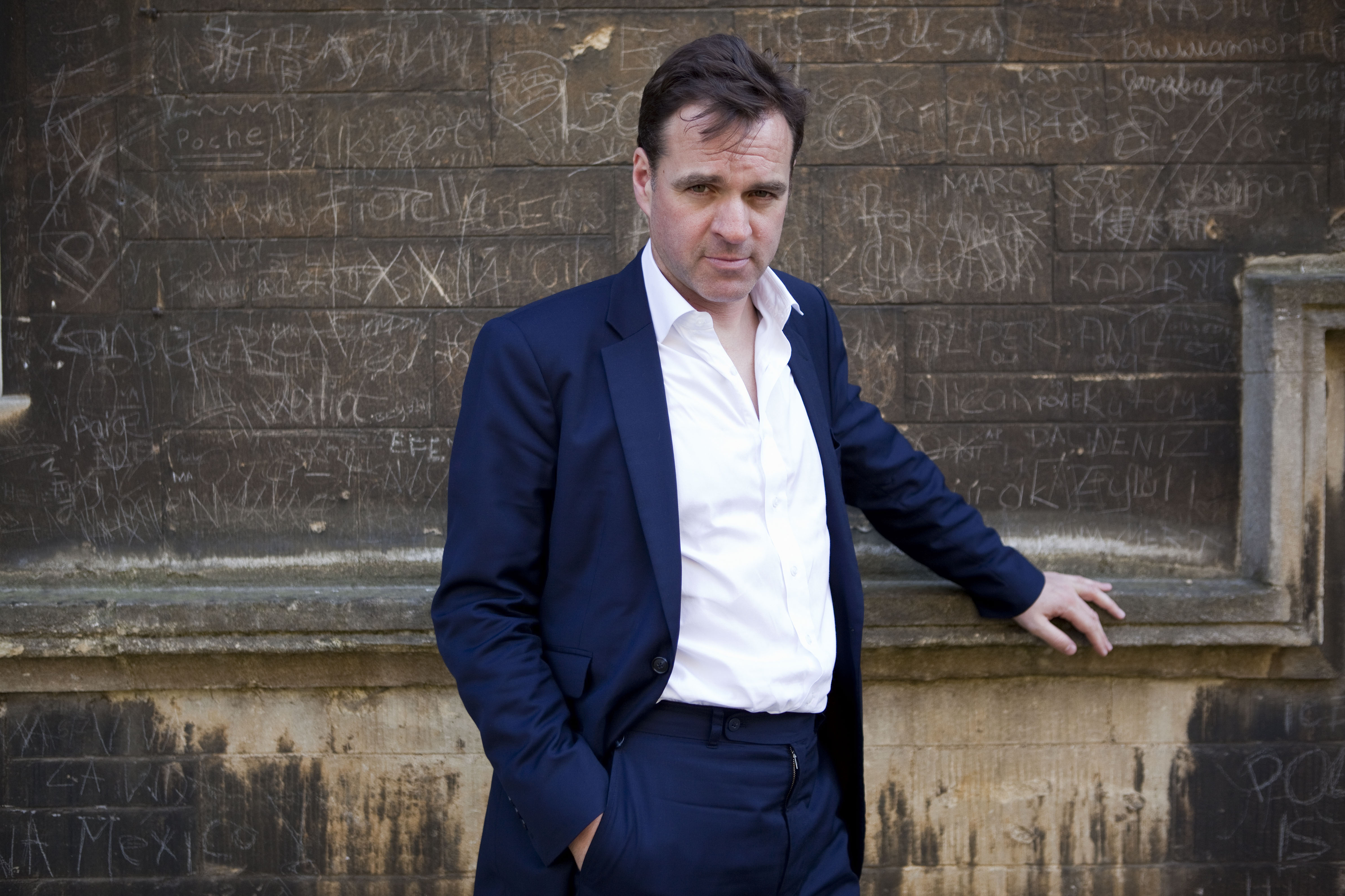
(Photo: Author/historian Niall Ferguson poses for a portrait at the Oxford Literary Festival on April 9, 2011 in Oxford, England. By David Levenson/Getty Images.)

Does Anyone Need GLAAD Any More?

That’s a good question asked by Jamie Kirchick. It’s the organization – the Gay Lesbian Alliance Against Discrimination – that polices the mass media for perceived anti-gay slights, awards those pro-gay media outlets who give it money, and occasionally engages in re-education camp rituals for people guilty of saying dumb or even – a worse sin – funny things about gays. Hence the horrifying punishment of a man like Brett Ratner being forced to atone in public – again and again and again – for a stupid joke using the word “fags” in a manner that was obviously not intentionally homophobic. Even the president of GLAAD conceded: “I believe he was never a homophobe, and I value all of his contributions and consider him a friend.” But that was after the forced confession, as part of a fundraising event. It made me physically sick.

As readers know, I cannot stand this pious policing of speech, especially when the culture has moved on so swiftly that it has made this kind of organization increasingly irrelevant. I long for the day when we can end the gay rights movement and get on with our lives, with formal equality under the law. I long for the day when HRC shuts its doors because its task is complete. And I think the last thing any journalist should do is receive an award from a special interest group – especially one that rewards a particular political stance on a divisive issue.

But the article was written by Jamie Kirchick, a young gay conservative whose core passion is the defense of Greater Israel and the stigmatization of those who disagree with him as anti-Semites. By his logic, it’s quite obvious the Anti-Defamation League should be shut down as well. American Jews are far further forward in public cultural acceptance than gays. How about it, Jamie? Tell Abraham Foxman to retire.

Obama’s Leadership: Power With, Not Power Over

US-POLITICS-OBAMA

Jon Favreau has a must-read in the Beast today. It pushes back against the infantile MoDo notion that the stalemate in Washington is a function of the president’s poor political skills, rather than a completely gerrymandered and dysfunctional Republican House, special interest group abuse of the system, and a nihilist GOP base that has basically decided to give up any thinking about policy in order to rely on opposition to anything the president does as one wing of a losing, bitter culture war struggle.

Favreau also notes the recurring rhetorical theme of this community-organizer president in Obama’s own words:

This campaign can’t only be about me. It must be about us—it must be about what we can do together. This campaign must be the occasion, the vehicle, of your hopes, and your dreams. It will take your time, your energy, and your advice—to push us forward when we’re doing right, and to let us know when we’re not.

There is another factor, I think. The president understands his role differently than his predecessor. He is not the “decider”; he is the catalyst for change that must come from below and from the other branches of government. He is not a legislator. And the Congress is the part of government that is currently failing us – not the president.

The blogger Smartypants also recognizes this:

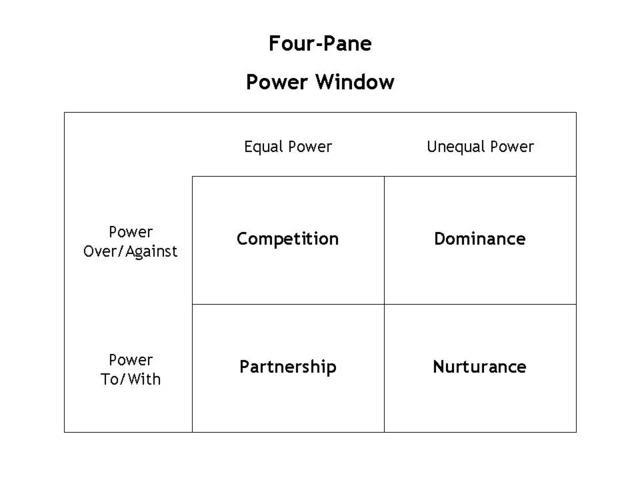
I’ve often talked about the fact that in his days as a community organizer, President Obama studied and taught about power relations. Its clear to me that he has an understanding of the power of partnership PowerWindow2and is constantly calling on us to join him in exercising that power.

Practicing leadership from a position of “power with” requires that you have an independently strong ego and don’t need to dominate in order to prop it up or feed it. And it also requires trust in the people you set out to lead. These are some of the characteristics I most admire about President Obama and ones that are often most misunderstood by his critics on the left and the right.

Its only natural that when people are so used to the power of dominance that they would dismiss the reality of the power of partnership. Its why we so often hear Obama criticized as weak and naive. But history tells us that all of the battles won by the left in this country have been based on a partnership model of power … enough people finally spoke up in ways that couldn’t be ignored. We see that in the battle for civil rights, unions, women’s suffrage, anti-war, etc.

The archetypal achievement of this president in that regard is his deployment of “power with” with respect to gay rights. The power to change came from below – but he masterfully guided it, nudged it, and helped without getting in our way. Ditto universal healthcare when he refused to impose a bill, but demanded that the Congress come up with one along similar lines.

This is the same dynamic with immigration reform. A president is not a dictator or even a decider. He presides and enables, articulates and maneuvers the entire body politic. He can screw up – Toomey and Manchin were not the most connected Senators on Capitol Hill and couldn’t deliver many votes compared with the NRA’s relentless fanaticism. Baucus wasted critical momentum for universal healthcare. But he is emphatically not a legislative dictator in our system. And real conservatives will admire this – not leap to dismiss him as a “lame duck” because of it.

The trouble right now is that a certain narrative is over. It began with the 2000 election, continued with 9/11 and a dubiously legitimate president marching the country into two deeply divisive and disastrously costly wars, trashing the country’s hard and soft power, and wrecking the government’s balance sheet before leaving his successor with the worst recession since the 1930s. Obama was elected to heal that gaping wound. And he has: one war is over, the other winding down; torture is over; alone among Western countries, the US economy is slowly, slowly returning to health – its rebound cramped by spending discipline. Obama’s re-election also cemented a deep social shift: we are now emphatically a multicultural country that celebrates that fact. Latinos and gays are part of the American spectrum. These are profound changes in five short years. And many seem ready now to relax and see his re-election as the end of the central narrative of the 21st Century so far. Hence the difficulty of leading from below today.

You want more from him? Get off your asses and make him and the Congress do it. We’re a republic, not a benevolent dictatorship. And we remain lucky to have such a sane, stable, no-drama pragmatist to marshall the forces we can muster. But without us? He is head of state and not much more.

(Photo: US President Barack Obama holds a press conference in the Brady Press Briefing Room of the White House in Washington on April 30, 2013. By Saul Loeb/AFP/Getty Images.)

S.H.O.P.P.I.N.G

ALtarinorange_SM_optimized

The striking paintings of Wal-Marts we featured this morning are not alone. Michelle Muldrow targets, among other supermarkets, Target. She calls these photographs paintings “Cathedrals of Desire.” Cathedrals used to function as a way to transcend desire into love, the worldly into the unworldly. Now these new consumer cathedrals make the worldly sacred and turn desire into a virtue.

I have to say that Target in particular engenders in me an instant version of what some hyper-lefty Germans called Konsumterrorismus: a total panic caused by the option of limitless shopping. (The definition is not undisputed). In my case, this phobia is compounded by the lighting – especially in Target. Aaron took me there once and I could not really get past the doorway. It was just horrifying. If I go to Hell, I will not have my ankles licked by fire. And I will not be lit from below. I will be subjected to giant, constant, overhead fluorescent lighting – what Michael Cunningham once called less lighting than the “banishment of all darkness.”

That gets it right, I think. All darkness must be banished to promote and encourage the purchase of things. This is what a huge amount of our culture now rests upon: the purchase of things. I guess you have to banish the literal darkness to disguise the shallow yet impenetrable darkness our shopping civilization represents.

The Deepening, Disgusting Stain Of Gitmo

dish_gitmo library

Charlie Savage has created a tumblr of detainee reading material. Dan Colman notes:

According to news reports, the library currently has 3,500 volumes on pre-approved topics. Prisoners have to order books in advance. (They can’t just wander through the stacks.) And the most popular books include Agatha Christie mysteries, the self-help manual Don’t Be Sad; The Lord of the Rings; and, of course, Harry Potter.

I’m relieved the president reiterated his support this morning for closing one of the most potent recruiters for Jihad against the US on the planet. I await his executive decision to release the innocent Yemeni prisoners to their country of origin. Or is this more bullshit/impotence? But Gitmo’s awful impact on American soft power is nothing compared to its potency as a toxin against the Constitution. Read Joe Nocera on a man captured at the age of 20, with no proof of his involvement in Jihad, and now destined to live a life sentence, if the US Congress has its way. Life-long detention without ever having committed any actual crime? That’s now the meaning of America, as represented by the Congress? Yes, it is. This is America, as recorded in a must-read diary from GTMO. In August of 2003, after days of “interrogation”, a prisoner was seized from his cell and taken out on a boat in the Caribbean:

My first thought was, they mistook me for somebody else. My second thought was to try to look around, but one of the guards was squeezing my face against the floor. I saw the dog fighting to get loose. I saw [——-] standing up, looking helpless at the guards working on me. “Blindfold the motherfucker! He’s trying to look—” One of them hit me hard across the face and quickly put goggles on my eyes, earmuffs on my ears, and a small bag over my head. They tightened the chains around my ankles and my wrists; afterward I started to bleed. All I could hear was [——-] cursing, “F-ing this and F-ing that.” I thought they were going to execute me.

The other guard dragged me out with my toes tracing the way, and threw me in a truck, which immediately took off. The beating party would last for the next three to four hours, before they turned me over to another team that would use different torture techniques. “Stop praying, motherfucker. You’re killing people,” [——-] said, and punched me hard on my mouth. My mouth and nose started to bleed, and my lips grew so big that I technically could not speak anymore. The colleague of [——-] turned out to be one of my guards; [——-] and [——-] each took one of my sides and started to punch me and smash me against the metal of the truck. One of the guys hit me so that my breath stopped and I was choking. I felt like I was breathing through my ribs. …

Inside the boat, [——-] made me drink salt water, I believe it was direct from the ocean. It was so nasty I threw it up. They put an object in my mouth and shouted, “Swallow, motherfucker!” I decided inside not to swallow the organ-damaging salt water, which choked me as they kept pouring the water in my mouth. “Swallow, you idiot!” I contemplated quickly, and decided for the nasty, damaging water rather than death.

[——-] and [——-] had been escorting me for about three hours in the high-speed boat. The goal of such trip was, first, to torture the detainee and claim that the “detainee hurt himself during transport,” and second to make the detainee believe he is being transferred to some far faraway secret prison. We detainees knew all about this; we had detainees who reported flying four hours and finding themselves in the same jail where they started.

If I had read this in my teens, I would have assumed this was a description of a Soviet Gulag or a South American fascist dictatorship. But this is America – and it tells you everything you need to know about the profound corruption in the ship of state that the man who authorized all of this was just feted by all living former presidents. As for accountability, here’s who has been held accountable: [——–].

The Death Of Blogs? Or Of Magazines?

photo-22

As part of his “eulogy for the blog”, Marc Tracy touches upon the evolution of the Dish – which he praises as “a soap opera pegged to the news cycle”:

[T]oday, Google Reader is dying, Media Decoder is dead, and Andrew Sullivan’s The Daily Dish is alive in new form. This year, Sullivan decided that he was a big enough brand, commanding enough attention and traffic, to strike out on his own. At the beginning of the last decade, the institutions didn’t need him. Today, he feels his best chance for survival is by becoming one of the institutions, complete with a staff and a variety of content. What wasn’t going to work was continuing to have, merely, a blog.

We will still have blogs, of course, if only because the word is flexible enough to encompass a very wide range of publishing platforms: Basically, anything that contains a scrollable stream of posts is a “blog.” What we are losing is the personal blog and the themed blog. Less and less do readers have the patience for a certain writer or even certain subject matter.

I wish he had some solid data to back that point up. Of course, blogs have evolved – and this one clearly has from its early days. What began as one person being mean to Maureen Dowd around 12.30 am every night is now an organism in which my colleagues and I try to construct both a personal and yet also diverse conversation in real time. But that doesn’t mean the individual blogger – small or large – is disappearing. Our entire model requires, as it did from the get-go, links to other sites and blogs – and we have not detected a shortage.

One reason we have had to grow and evolve – and this started as far back as 2003 – is that the web conversation has grown exponentially since this blog started (when Bill Clinton was president). Yes, many bloggers now get employed by more general sites, or move on to more complex forms (think of Nate Silver, a lone blogger when the Dish first championed his work and now part of an informational eco-system). But every page on the web is equally accessible as every other page. Blogs will never die – but they might form a smaller part of a much larger online eco-system of discourse.

My own view is that one particular form of journalism is actually dying because of this technological shift – and it’s magazines, not blogs. When every page in a magazine can be detached from the others, when readers rarely absorb a coherent assemblage of writers in a bound paper publication, but pick and choose whom to read online where individual stories and posts overwhelm any single collective form of content, the magazine as we have long known it is effectively over.

Without paper and staples, it doesn’t fall apart so much as explodes into many pieces hurtling into the broader web. Where these pieces come from doesn’t matter much to the reader. So what’s taking the place of magazines are blog-hubs or group-blogs with more links, bigger and bigger ambitions and lower costs. Or aggregated bloggers/writers/galley slave curators designed by “magazines” to be sold in themed chunks. That’s why the Atlantic.com began as a collection of bloggers and swiftly turned them all into chopped up advertizing-geared “channels.” That form of online magazine has nothing to do with its writing as such or its writers; it’s a way to use writers to procure money from corporations. And those channels now include direct corporate-written ad copy, designed to look as much like the actual “magazine” as modesty allows.

Adam Gopnik has a wonderful paragraph at the top of his review of National Geographic over the decades that captures the centrifugal force turning magazines into anachronistic forms of writing:

Magazines in their great age, before they were unmoored from their spines and digitally picked apart, before perpetual blogging made them permeable packages, changing mood at every hour and up all night like colicky infants—magazines were expected to be magisterial registers of the passing scene. Yet, though they were in principle temporal, a few became dateless, timeless. The proof of this condition was that they piled up, remorselessly, in garages and basements, to be read . . . later.

Or never. Alyssa likewise thinks blogs are evolving, not dying:

Obviously, it’s true that the first-mover advantage for blogging is gone, and that fewer people are coming online as individual bloggers. … The key technology now is less the publishing platforms that let people write short posts and publish them in a continuous stream, and more the ability to cross-post, so a piece can live both on an author’s individual page, or in the feed on a relevant subject or for a relevant section. …

And I think this is a situation that signals less the decline of blogs than their evolution. Readers can continue to follow the feeds of individual writers they prefer, or whole sections that they find interesting, depending on whether they’re interested in a particular perspective or a larger news feed. If blogging started out as a way to accommodate the way writers wanted to publish their work, it’s now come to serve a different end in giving readers flexibility in how they curate what they want to read, and publications the ability to accommodate them. That’s not death, precisely. It’s more like metamorphosis.

And The Truth Shall Set You Free

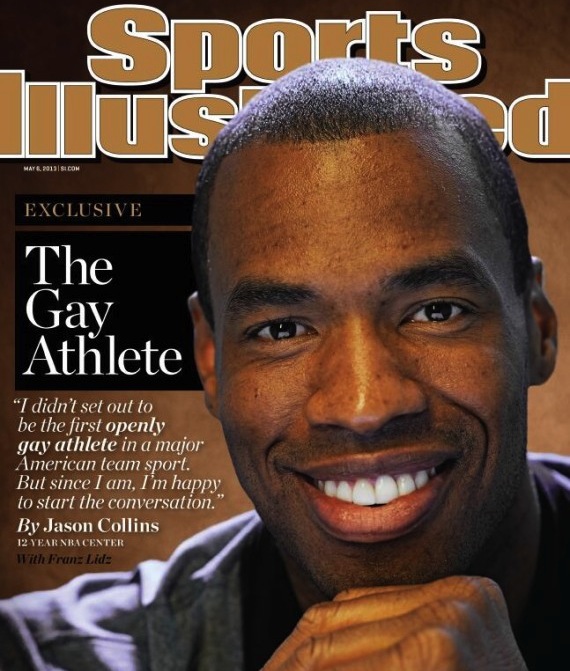
The first NBA player to come out is both African-American and a beautiful writer:

The recent Boston Marathon bombing reinforced the notion that I shouldn’t wait for the circumstances of jason-collins-openly-gay-athlete-570x758my coming out to be perfect. Things can change in an instant, so why not live truthfully? When I told Joe a few weeks ago that I was gay, he was grateful that I trusted him. He asked me to join him in 2013. We’ll be marching on June 8.

No one wants to live in fear. I’ve always been scared of saying the wrong thing. I don’t sleep well. I never have. But each time I tell another person, I feel stronger and sleep a little more soundly.

It takes an enormous amount of energy to guard such a big secret. I’ve endured years of misery and gone to enormous lengths to live a lie. I was certain that my world would fall apart if anyone knew. And yet when I acknowledged my sexuality I felt whole for the first time. I still had the same sense of humor, I still had the same mannerisms and my friends still had my back.

What I found particularly ballsy was his embrace of his Christianity:

I’m from a close-knit family. My parents instilled Christian values in me. They taught Sunday school, and I enjoyed lending a hand. I take the teachings of Jesus seriously, particularly the ones that touch on tolerance and understanding.

And his physical aggression:

I’m not afraid to take on any opponent. I love playing against the best. Though Shaquille O’Neal is a Hall of Famer, I never shirked from the challenge of trying to frustrate the heck out of him. (Note to Shaq: My flopping has nothing to do with being gay.) My mouthpiece is in, and my wrists are taped. Go ahead, take a swing — I’ll get up. I hate to say it, and I’m not proud of it, but I once fouled a player so hard that he had to leave the arena on a stretcher.

I go against the gay stereotype, which is why I think a lot of players will be shocked: That guy is gay? But I’ve always been an aggressive player, even in high school. Am I so physical to prove that being gay doesn’t make you soft? Who knows?

That may be a mind blower for some. But the gay athletes and soldiers and cops I know are some of the toughest motherfuckers out there. And not just the lesbians.

I want to salute Collins for making more space in the world for more people barred by social norms from being fully who they are. He has single-handedly increased the level of oxygen gay athletes can breathe.

We’re all mortal. We all only have now. Why not tell the truth? It’s as liberating as Jesus predicted. And as transformative as the last two decades have been – as the truth has slowly won out over ignorance and prejudice. But it only did so because it was accompanied by its most powerful partner: courage.

Sarin In Syria

Recent video claiming to show victims of a chemical weapons attack in Syria:

The Obama administration has some evidence that chemical weapons are being used in Syria. Jeffrey Goldberg – surprise! – calls for intervention:

There are no good choices — good outcomes in Syria are impossible to imagine. But if it is proved to a certainty that Assad is trying to kill his people with chemical weapons, then Obama may have no choice but to act, not only because he has put the country’s credibility on the line (Iran and North Korea are undoubtedly watching closely), but also because the alternative — allowing human beings to be murdered by a monstrous regime using the world’s most devilish weapons, when he has the power to stop it — is not a moral option for a moral man.

The US has the power to stop a lot of things with military power. That doesn’t mean it is in our national interest to do so. And that phrase – “a monstrous regime using the world’s most devilish weapons” – rings a bell, doesn’t it? Does Jeffrey really want the US directly involved on one side in a Muslim sectarian war that is now metastasizing into “Iraq”? How many more Tamerlan Tsarnaevs does he want to produce?

Alas, along with Obama’s ill-advised public disavowal of containment of an Iranian nuclear capacity, the president has only himself to blame for boxing himself in on this. But that box may be larger than McCain, Butters and the usual neocon chorus will allow, as Max Fisher explains:

The two times that Obama personally articulated his administration’s red line, he used pretty vague language on what happens if Syria uses chemical weapons. The first time, in August, he said, “That would change my calculus. That would change my equation.” The second time, in March, he said “we will not tolerate” chemical weapons use and “the world is watching, we will hold you accountable.”

So, in the first comment, Obama only said that he would change how he thought about Syria and, in the second and more recent statement, seemed to shift from talking about how the U.S. would respond to how “the world” would respond. And if “the world” means the United Nations Security Council, which authorizes any multilateral military action such as the 2011 military intervention in Libya, then that’s not much of a threat. Both Russia and China have the ability – and a demonstrated willingness – to veto any UN action on Syria. There’s little indication that either state has changed its calculus on Syria just because of the U.S.’s red line.

By all means, go to the Security Council and see if military aid of this kind can be backed by the Russians and Chinese. I am extremely wary of providing the increasingly Islamist Syrian opposition with any weapons at all. Eli Lake says there are more like me in the administration:

But it appears that, for now at least, Obama’s cabinet is divided on whether to further arm the Syrian opposition. Last week, Secretary of State John Kerry told Congress that the United States was working with other actors in the Middle East to funnel guns to members of the opposition. The same day he said that however, Gen. Martin Dempsey, the chairman of the joint chiefs of staff, said he did not have confidence the United States could identify the right people in the Syrian opposition. One element of the opposition is believed to be closely tied to al Qaeda under the banner of a group called al Nusra. In December the State Department designated al Nusra as a foreign terrorist organization.

Michael Crowley likewise finds that Obama’s options are limited:

So long as American, and possibly Israeli, national security is not directly threatened, there’s no political will for American boots on the ground. Securing Syria’s chemical weapons sites could require 100,000 troops of them. Limited airstrikes against responsible forces and commanders is a more plausible option, but would require credible information about exactly who oversaw and carried out the chemical attacks. (A direct strike on Syria’s embattled dictator, Bashar al-Assad, is almost surely out of the question.) No wonder Obama never spelled out the consequences of crossing his ‘red line.’

Allahpundit asks:

Why, exactly, did Obama announce the “red line” in the first place if he wasn’t serious about it? Ninety percent of the arguments coming from the McCains and Grahams of the world right now is that he’s obliged to intervene simply to protect U.S. credibility and show the world that when the president issues an ultimatum, he means it. If O hadn’t declared the “red line” — which he didn’t have to do formally, given the taboo that already exists for WMD — he’d have more room to maneuver now.

I wish he hadn’t said that as well. But I also know why I supported Obama against McCain in 2008. Because McCain would already have American soldiers knee-deep in Afghanistan, Iraq, Libya and Syria by now.

Why Is This Not A “Weapon Of Mass Destruction”?

Stag2wi_

One of the more striking things about the charges against Dzhokar Tsarnaev is the use of a “weapon of mass destruction.” Legally, that’s certainly valid, given the current definition in the US criminal law with respect to terrorism:

any “destructive device” defined as any explosive, incendiary, or poison gas – bomb, grenade, rocket having a propellant charge of more than four ounces, missile having an explosive or incendiary charge of more than one-quarter ounce, mine, or device similar to any of the devices described in the preceding clauses

any weapon that is designed or intended to cause death or serious bodily injury through the release, dissemination, or impact of toxic or poisonous chemicals, or their precursors

any weapon involving a biological agent, toxin, or vector any weapon that is designed to release radiation or radioactivity at a level dangerous to human life

That includes a pressure-cooker Internet-recipe bomb that killed 3 people and injured many more. But why is a version of an AR-15, as used by Adam Lanza, that killed 28 human beings, not treated the same way? Why was that act not treated as a suicide bombing would be? If something that kills three people is responsible for “mass destruction”, why not a military weapon that can kill 28 and end in suicide? The AR-15 can be adapted to have a hundred bullets in a Beta C-Mag magazine. Here’s a fantastically phallic drawing of how many bullets can be fired:

604px-Double_drum_magazine_filled.svg

You could kill dozens of people with those large, bullet-packed balls – and a terrorist could murder and maim many more human beings than were killed and injured in Boston. But it isn’t legally or technically a weapon of “mass” destruction.  In fact, having one is a constitutional right.

Is this a great country, or what?