Israel’s Accelerating Descent

Another sign of an increasingly apartheid state:

The Knesset has approved a further extension of the “temporary” order known as the ‘Citizenship Law’ (83 votes for, 17 votes against). This temporary provision prevents Palestinian spouses of Israeli citizens from attaining citizenship.

This “temporary” law is now more than a decade old. And, as you can see, the Knesset doesn’t seem likely to repeal it any time soon. I know what it’s like to be legally married to an American and yet denied citizenship because of my HIV status (a situation now mercifully over). It’s an attack on the family, a way to prevent Israeli-Palestinian understanding, and an effective second-class status for Arab spouses of Israeli citizens. It surely risks radicalizing Arab spouses, rather than helping to integrate them.

This kind of racial discrimination is also seeping into US law. Israel wants to join the 37 countries that allow travel to the US without a visa. But AIPAC wants this free visa exchange to be different than any other country’s. They want to retain an ability to discriminate against Arab-American or Muslim American citizens. Even the most loyal toadies for the Israel Lobby see this as a step too far:

“It’s stunning that you would give a green light to another country to violate the civil liberties of Americans traveling abroad,” said a staffer for one leading pro-Israel lawmaker in the U.S. House of Representatives.

Notice the anonymity of the quote. Not that they’re scared of AIPAC, of course. To say that would be “anti-Semitic.” And note the bipartisan nature of this AIPAC campaign.

It’s led by Barbara Boxer, a California liberal who would never countenance racial discrimination against US citizens – unless she’s asked to by Israel. Boxer’s bill, moreover, is backed by the American Jewish Committee as well as AIPAC. Brad Sherman, another Democrat pushing for this bill, actually says Israel is better than the US in terms of discrimination:

“There are thousands of people with Arab American backgrounds who visit Israel each year and they face far less hassle than Israeli Christians, Jews or Muslims trying to visit the United States.”

More on this from Greenwald here and Richard Silverstein here. Meanwhile, those who still believe that Israel wants a two-state solution at some point have to grapple with the latest polling of Israeli Jews in that country:

The survey, conducted by the Geocartography Institute on behalf of the Israeli university in the West Bank, found that 35 percent of respondents said the government should annex the entire West Bank, 24% said only the settlement blocs should be annexed, 20% answered that any annexation should only take place as part of an agreement with the Palestinians, and 12% said Israel doesn’t need to impose its sovereignty over any part of the West Bank. Nine percent had no answer.

Greater Israel is here to stay. The only question is whether the US will continue to support its expansion.

Technology vs Writing And Thinking

enhanced-buzz-wide-16625-1366757841-21

[Re-posted from earlier today.]

George Saunders ponders the effects of computer technology on his life and work:

I have noticed, over the last few years, the very real (what feels like) neurological effect of the computer and the iPhone and texting and so on – it feels like I’ve re-programmed myself to become discontent with whatever I’m doing faster. So I’m trying to work against this by checking emails less often, etc etc. It’s a little scary, actually, to observe oneself getting more and more skittish, attention-wise. I really don’t know if people are “deep reading” less these days in favour of a quick fix on the internet – I think this is a thing one hears a lot, but when I travel to colleges here in the US there are always people reading Joyce and DFW and debating about literary difficulty and praising William Gaddis and so on.

I do know that I started noticing a change in my own reading habits – I’d get online and look up and 40 minutes would have gone by, and my reading time for the night would have been pissed away, and all I would have learned was that, you know, a certain celebrity had lived in her car awhile, or that a cat had dialed 911. So I had to start watching that more carefully. But it’s interesting because (1) this tendency does seem to alter brain function and (2) through some demonic cause-and-effect, our technology is exactly situated to exploit the crappier angles of our nature: gossip, self-promotion, snarky curiosity. It’s almost as if totalitarianism thought better of the jackboots and decided to go another way: smoother, more flattering – and impossible to resist.

Reading this and watching this riveting Tedx talk on the impact of online porn on young male brains – essentially numbing them to actual sex with real human beings and creating an epidemic of young men with floppy dicks (I refuse to use the term “erectile dysfunction” when simpler English can do) – has woken me up a bit. Writing and editing and producing 50 posts a day – and doing something very similar almost every day since Bill Clinton was president – must be affecting my brain. It’s not as powerful as the effect on the younger, developing brain, but, yes, skittishness, dissatisfaction, and constant stress have doubtless changed my entire mindset. And I can see the point about online porn making physical sex more difficult – especially if you spent your most formative sexual adolescence under the spell of constant, dizzying varieties of sexual imagery and video. How can one woman or one man even begin to replace that cornucopia of dopamine?

Our brains were designed to be turned on. But not this often, this instantly, this pleasurably and without any consequences at all. Once again, our frontal cortex is getting way ahead of our primate DNA. And the Tower of Babel grows ever taller.

Previous Dish on Saunders here, here and here.

(Image: Outside ad of a mouse-shaped prison via Copyranter)

Bill Keller Won’t Correct An Error Of Fact

The former executive editor of the New York Times recently wrote the following sentence on his blog:

The editors (I was one at the time) argued that what constituted torture was still a matter of debate, that this issue was not just linguistic but legal and had not yet been resolved by a court, and that the word was commonly applied to such a range of practices as to be imprecise.

This is untrue. As I subsequently pointed out, there is a plethora of court cases that deal with the techniques Bush and Cheney authorized, and all of them found them to be torture. None had even the slightest equivocation about it. In fact, the one torture tactic that both former president Bush and former veep Dick Cheney have openly bragged about – waterboarding – has been ruled torture by domestic and international courts for decades. You could argue that there was a debate about some of the techniques, but not waterboarding in any way shape or form. If you were squeamish, you could have used the term “torture and other brutal interrogation techniques” in the NYT to describe the policies of the US government under Bush and Cheney. But Keller didn’t. Even that was too daring for him.

A factual untruth is still sitting on the blog of the former executive editor of the NYT. He has now written a subsequent post without any correction of the previous one, and not responded to the mountain of comments taking him to task. He appears to be compounding his cowardly refusal to use the English language when editing the paper with uncorrected factual untruth on his blog. And people wonder why journalists are held in such low regard.

If the former editor of the NYT doesn’t bother correcting the record, why should anyone else?

A Vatican Spring?

The First Signs Of Spring Are Seen At Kew Gardens

One major piece of disappointment came with Pope Francis’ endorsement of the on-going inquisition of American nuns. I’m not sure entirely what to make of it – is it an early indicator of Francis’ theological conservatism or simply acquiescing to a process already long underway? We will see by the disciplinary actions eventually taken (or not). The nuns would seem to have more in common with the Jesuit Francis, if only because he is aware of the need for outreach among religious orders – even to places and people that discomfort others. That was Jesus’ call, and Saint Francis’ and St Ignatius’. We’ll see what transpires in the end, but, obviously, I hope the Sisters can soon renew their vital work without constantly looking behind their backs.

But three other developments strike me as encouraging. The first – and least sexy – is the establishment of a global council of advisers in the governing of the church. This may seem a trivial reform. It isn’t. It restores the Second Vatican Council’s desire to place the Pope in a less dictatorial position, and to open up areas of authority within the global church as a counter-balance. And so this new governing commission – made up of highly effective cardinals in every continent – is a big shift:

More profound thinkers have read the Pope’s creation of a group of advisers as a bold new step towards fully implementing a model of ecclesial government evoked by the Second Vatican Council – one that is 418W7QTZEEL._SY380_less centralised, more collegial and based on the principles of ­subsidiarity.

“What Pope Francis has announced is the most important step in the history of the Church of the last 10 centuries and in the 50-year period of reception of Vatican II,” said the noted church historian Alberto Melloni. Writing in the Milan daily Corriere della Sera, he said the Pope had “created a synodal organ of bishops that must experiment with the exercise of the consilium”. In other words, shared governance of the Church between the Bishop of Rome and all the world’s bishops.

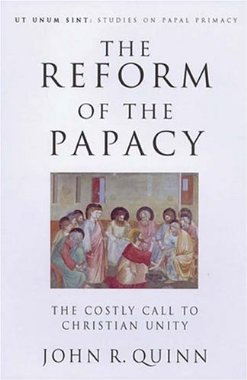
Detailed proposals for this were put forth in Archbishop Quinn’s book, [“The Reform of the Papacy“] which in 2005 appeared in Spanish. Pope Francis read that work when he was still just a cardinal in Argentina and, at around that time, he reportedly expressed his conviction that at least some of its ideas should be adopted.

More surprising is the support for civil unions for gay couples that seems to be percolating on the margins. The Pope argued for them in Argentina within the Jesuit branch he ran (it was the sole argument he lost in his years in president of the Conference), and earlier this year, some wiggle room for gay couples in civil law was mentioned by Archbishop Vincenzo Paglia, president of the Pontifical Council for the Family. This was only a defensive action against civil marriage rights for gay couples, but it was a concession to reality one cannot imagine Benedict XVI ever making. Now this:

The latest expression of support for civil recognition as an alternative to gay marriage comes from Archbishop Piero Marini, who served for 18 years as Pope John Paul II’s liturgical master of ceremonies. “There are many couples that suffer because their civil rights aren’t recognized,” Marini said.

The third indication of good news is the fact that Pope Francis has unblocked Oscar Romero’s path to beatification:

The Vatican’s Congregation for the Causes of Saints has been studying the Romero case since 1996, after the church in El Salvador formally opened the procedure in 1990. At the end of his 20-minute homily Sunday, Paglia said: “Just today, the day of the death of Don Tonino Bello, the cause of the beatification of Monsignor Romero has been unblocked.” Paglia had been received by Pope Francis on Saturday, and presumably the decision to authorize moving forward with the cause came out of that session.

Romero was shot to death while saying Mass in El Salvador on March 24, 1980. While he is seen as a hero to many because of his solidarity with the poor and his opposition to human rights abuses, his cause has also been viewed with suspicion in some quarters, partly because of Romero’s links to the controversial liberation theology movement.

Know hope.

(Photo: Crocuses in bloom. By Oli Scarff/Getty Images)

Yes, Of Course It Was Jihad

There are many nuances to the story of Tamerlan and Dzokhar Tsarnaev – and there is no doubt that, like all human beings their acts were, as my shrink often unhelpfully puts it, “multi-determined.” And there is a huge amount to learn from the stoner kid who got caught up in his brother’s religious fanaticism. But Glenn Greenwald veers into left-liberal self-parody this morning:

The overarching principle here should be that Dzhokhar Tsarnaev is entitled to a presumption of innocence until he is actually proven guilty. As so many cases have proven – from accused (but exonerated) anthrax attacker Stephen Hatfill to accused (but exonerated) Atlanta Olympic bomber Richard Jewell to dozens if not hundreds of Guantanamo detainees accused of being the “worst of the worst” but who were guilty of nothing – people who appear to be guilty based on government accusations and trials-by-media are often completely innocent. Media-presented evidence is no substitute for due process and an adversarial trial.

But beyond that issue, even those assuming the guilt of the Tsarnaev brothers seem to have no basis at all for claiming that this was an act of “terrorism” in a way that would meaningfully distinguish it from Aurora, Sandy Hook, Tuscon and Columbine. All we really know about them in this regard is that they identified as Muslim, and that the older brother allegedly watched extremist YouTube videos and was suspected by the Russian government of religious extremism (by contrast, virtually every person who knew the younger brother has emphatically said that he never evinced political or religious extremism).

Legally, the case for the presumption of innocence is absolutely right. But come on.

One reason the Miranda rights issue is not that salient is that the evidence that this dude bombed innocents, played a role in shooting a cop, shutting down a city, and terrorizing people for a week is overwhelming and on tape. And yes, of course, this decision to commit horrific crimes may be due in part to “some combination of mental illness, societal alienation, or other form of internal instability and rage that is apolitical in nature.” But to dismiss the overwhelming evidence that this was also religiously motivated – a trail that now includes a rant against his own imam for honoring Martin Luther King Jr. because he was not a Muslim – is to be blind to an almost text-book case of Jihadist radicalization, most likely in the US. Tamerlan may have been brimming with testosterone as he found boxing an outlet for his aggression, bragging to his peers of his coolness and machismo and piety, and all of that may have contributed. Who knows if the delay in his citizenship application because he was beating his wife was the proximate cause. But does Glenn wonder why Tamerlan thought it was ok to beat his wife, whom he demanded convert to Islam? Does Glenn see no religious extremism here:

The dramatic confrontation between Tamerlan and his imam began when the 26-year-old interrupted a solemn Friday prayer service three months ago. The imam had just offered up assassinated civil rights icon Martin Luther King Jr. as a fine example of a man to emulate – but this reportedly enraged Tamerlan.

‘You cannot mention this guy because he’s not a Muslim!’ Muhammad recalled Tamerlan shouting, shocking others in attendance according to the LA Times. Kicked out of the mosque for his outrageous behavior, Tamerlan did return to the prayer service after his outburst according to Muhammad.

‘He’s crazy to me,’ said Muhammad. ‘He had an anger inside.… I can’t explain what was in his mind.’

This is from the Daily Mail – which is almost as unreliable as the New York Post – but the sourced quotes from his own imam seem legit. So we see perhaps the core of what is in front of our noses: this was not about Islam or being Muslim as such. Look at Tamerlan’s family and his own imam. They all saw a young man drifting into something far more extremist, fundamentalist and bigoted. His uncle saw it:

‘I was shocked when I heard his words, his phrases, when every other word he starts sticking in words of God. I question what he’s doing for work, (and) he claimed he would just put everything in the will of God.”

We see the sexual puritanism of the neurotically fundamentalist. We have his YouTube page and the comments he made in the photography portfolio. To state today that we really still have no idea what motivated him and that rushing toward the word Jihadist is some form of Islamophobia seems completely bizarre to me.

When will some understand how dangerous religious fundamentalism truly is? And when will they grasp that a religion that does not entirely eschew violence (like the Gospels or Buddhism) will likely produce violence when its extremist loners seek meaning in a bewildering multicultural modern world? This was an act of Jihad. That does not mean we elevate it above crime; it means we understand the nature of the crime. It only makes sense in the context of immediate Paradise, combined with worldly fame. And those convinced of the glories of martyrdom – of going out with a bang – are the hardest of all to stop.

(Video: Introductory clip from the YouTube account of Tamerlan Tsarnaev)

Update from a reader:

In your recent post about the issue of religious extremism and the alleged acts of terror by the Tsarnaev brothers, you said: “But does Glenn wonder why Tamerlan thought it was ok to beat his wife, whom he demanded convert to Islam?” Just a quick fact-check query. The coverage I seemed to recall reading and hearing indicated that although the elder brother, Tamerlan, was charged in some kind of domestic violence incident, as I understand the facts, it was for something he did to a former girlfriend who is NOT his current wife. And separately, as I understand the reporting, he did in fact push and convince his current wife to convert to Islam when they married, but it appears that that was not concurrent with domestic violence against her.

Being Master Of Your Own Domain

Quitting masturbation is a trend on Reddit now, in the “NoFap” forum:

The goals for all these men, regardless of their personal lives or relationship statuses, seemed to be similar: to return to a more charged, natural self. It’s a throwback notion—virility as integral to manhood—but many of these anti-masturbators regard it as truth. “I feel like a man again” is a common refrain. One NoFapper referred to his 90 days without masturbation as “a passage into manhood.” They see masturbation as a failure of masculinity—not because it’s shameful or forever associated with adolescence, but because, on a fundamental, even chemical level, it’s draining their true potential.

The medical profession isn’t convinced. Every doctor and psychologist I spoke with informed me that “there’s no evidence” to link masturbation to sexual performance, and that it’s an over­simplification to think that frequent masturbation is the cause of delayed ejaculation.

Adam Weinstein isn’t on board:

The thing about jacking off is, it’s so personal it’s mystical: There is only you, and the feeling that arises in you. No one can judge that relationship better than you—as opposed to abstainers, who like ardent ex-smokers can judge and browbeat you, Mr. (or Ms.) Self-Abuser, as only the zealous convert can. For my part, jerking it makes me a calmer, happier, more compassionate person. I am confident in my body. I am exultant in sex and sensitive to anyone I’m lucky enough to share my sex with. And in compartmentalizing masturbation as separate from the finer pursuits of life, I feel more mindful of my surroundings, not less.

It’s worth recalling that the formal, theological case against masturbation is identical to that against contraception and gay marriage. It is sodomy, as defined in the early modern period, i.e. ejaculation outside the vagina of a married female. So, as I argued at length a decade ago, we are all sodomites now. Men, anyway. Has any priest now living not masturbated?

For the record, I could never grasp why this was so wrong. My instinctual reaction to my first teenage orgasm was total wonderment. Of course, I had been taught nothing about this strange liquid coming out of my dick. It happened while I was reading – of all things – one of the Don Camillo short stories by Giovannino Guareschi. Not the most predictable erotic trigger – but when you’re fourteen, it could be the ceiling and you’d hit yourself in the eye if you weren’t careful.

To me, having this amazing thing suddenly come alive in my body was so obviously marvelous, so instantly ecstatic, it never occurred to me that God forbade me to forsake it. Why give me this 24-hour, unlosable instrument of blind, transcendent pleasure – and then bid me not to touch it? I had never experienced anything so simply pleasurable in my whole life until then. If we’re talking natural law, all I can say is that masturbation was the single most natural thing I had ever done at the moment in my life. More natural than watching television or riding a bus. If I felt guilt, it required some excruciating effort – until I realized that the most effective thing to trigger the constantly loaded rifle was thinking of another man. Usually naked. I had no porn or access to it. So I drew the men I wanted (and they all looked scarily like my husband). It was only then that the culture began to bear down on my nature.

But as I’ve grown older, and mercifully less driven by my dick, I can see the point of self-denial. In your teens, you have a constant unstoppable production of more sperm than could ever merely reproduce (another natural refutation of natural law). By your forties (unless I’ve just had my testosterone shot), not so much. So a little self-restraint definitely increases the pleasure and intensity of the orgasm you eventually get. And no, I feel no guilt about it whatever. It’s so psychically natural, so obviously intuitive, it was the first step for me toward dismantling the strange doctrines of natural law on human sexuality, devised in the early middle ages by men who knew a lot at the time – but tiny shards of truth compared to what we know now.

Wank on, my brothers and sisters. Wank on.

Bill Keller, Still Flailing

Inside the New York Times

[Re-posted from earlier today.]

There was something almost poignant about a post yesterday by former NYT executive editor Bill Keller. It’s his way of explaining why he decided the Times could not use the plain word ‘torture’ to describe torture – when it was conducted by the Bush administration. He conflates the issue with the other t-word, terrorism, as if there were some kind of analogy. There isn’t. What happened in Benghazi was an act of terror, as Obama said the following day. What happened in Boston was an act of terror. The only circumspection about the word should be in the immediate aftermath of explosions when it seems to me prudent not to jump to conclusions. So the fire at the JFK Library Monday was not an act of terror.

The most it can take to reach the conclusion about terror is a few days. Yet the New York Times has refused to use the word ‘torture’ for years in its news pages and is still avoiding it. Keller was behind that decision. Future historians of the press will note how the most powerful single journalistic institution in the country simply caved to government and partisan pressure – even on the use of the English language.

Keller denies this. He says the avoidance of the word was because there was an ongoing debate about the legal meaning of torture, and therefore the NYT should have stayed neutral.

The editors (I was one at the time) argued that what constituted torture was still a matter of debate, that this issue was not just linguistic but legal and had not yet been resolved by a court, and that the word was commonly applied to such a range of practices as to be imprecise. We contended that the best approach was to describe the techniques as fully as possible and let readers draw their own conclusions.

Keller writes that the issue of what torture is “had not yet been resolved by a court”. Really?

Let us take, for example, a torture technique both Bush and Cheney have openly bragged about authorizing: waterboarding. Has no court adjudicated the matter? I refer Keller to page 371 of the Constitution Project report, which details countless examples of US courts finding waterboarding unequivocally to be torture:

In the early 20th century, U.S. Army Captain Elwin Glenn was court-martialed for administering the “water cure” to civilians during the combat operations in the Philippines. Japanese military personnel were convicted of war crimes by the International Military Tribunal for the Far East for using the “water treatment” method on POWs. And several lower-ranking soldiers were convicted of waterboarding, a war crime, in the years following the war.

Several state courts have decided cases involving waterboarding as well. In White v. State, the Mississippi Supreme Court threw out a 1922 murder conviction because the defendant’s confession had been obtained using the “water cure.” In that case, men held the appellant down while one stood on him and the other poured water into his nose in order to gain a confession. The court described this treatment as “barbarous” and “brutal treatment,” “causing pain and horror.”

In Cavazos v. State, the Texas Court of Criminal Appeals similarly reversed a murder conviction where officers had extracted a confession by coercive means, including the water cure. The Cavazos court found in 1942 that the trial judge had improperly admitted a confession that was “obtained by force and physical and mental torture.”

Four decades after Cavazos, four Texas law-enforcement officers who had waterboarded suspects were convicted of “violating and conspiring to violate the civil rights of prisoners in their custody.” The defendants, a sheriff and three deputies, had “draped a towel over each man’s face and pour[ed] water over it until the men gagged.” While not considering the nature of the treatment itself on appeal, the U.S. Court of Appeals for the Fifth Circuit in 1984 repeatedly described the actions of the sheriff and deputies as “torture.”

While all of the above cases were decided prior to Convention Against Torture’s ratification, U.S. courts have held that waterboarding is a form of torture after the U.S.’s ratification as well. For example, in In re Estate of Ferdinand E. Marcos Human Rights Litigation, the U.S. District Court for the District Court of Hawaii specifically listed waterboarding (or “water cure”) as one form of torture practiced by the Marcos regime, which used such techniques against political dissidents who then brought their claims in U.S. courts when seeking asylum. The U.S. Court of Appeals for the Ninth Circuit subsequently supported this finding.

The Marcos regime used waterboarding against political dissidents while it was in control of the Philippines, and it was the basis of many claims by victims in the ensuing litigation in American courts.

To repeat: Keller writes in his post that the issue of whether waterboarding was torture “had not yet been resolved by a court.” It had – and in no single case had there been any equivocation at all. Waterboarding was explicitly defined as torture by the Bush State Department and the Convention Against Torture. It is a war crime – or the law and the English language mean nothing. The same is true for a litany of other authorized abuses – which have clear, legal and regulatory status as torture. Will the former editor of the Times correct a factual error?

At any time during his position as NYT executive editor, Mr Keller could also have looked up the legal definition, which is not in dispute:

[A]n act committed by a person acting under the color of law specifically intended to inflict severe physical or mental pain or suffering (other than pain or suffering incidental to lawful sanctions) upon another person within his custody or physical control.

So allow me to remind Mr Keller of what his own newspaper, among others, reported about what was authorized by the president himself:

using dogs to terrorize prisoners; stripping detainees naked and hooding them; isolating people in windowless cells for weeks and even months on end; freezing prisoners to near-death and reviving them and repeating the hypothermia; contorting prisoners into stress positions that create unbearable pain in the muscles and joints; cramming prisoners into upright coffins in painful positions with minimal air; near-drowning, on a waterboard, of human beings—in one case 183 times—even after they have cooperated with interrogators.

And in many cases – it was many of the above combined – and several confirmed cases of being tortured to death. How can anyone not see that these techniques clearly “inflict severe physical or mental pain or suffering” on people completely under the government’s control? There is not now and never has been a debate about this.

So why Keller’s bizarre refusal to call it by its proper name? The reason is simple. Keller knew that publishing the word torture with respect to president Bush and his administration was a factual allegation of war crimes. Such an accusation would have caused all the usual suspects to deride the NYT as a left-liberal rag, with a partisan agenda. There would have been huge partisan political blowback. It might also have prevented NYT reporters from getting access to anyone in the Bush administration. Keller basically admits as much:

Now that I reside in the opinion zone, I use the word “torture” without hesitation, but I still believe that editors in the news pages should be a little slow to preempt the judgment of readers, or to use language that carries a suggestion of political posture.

Does the nonpartisan report made public today mean that what is “torture” in the Opinion pages can now be “torture” in the news pages? Has the noun shed some of its partisan freight? Watch that space.

“Language that carries a suggestion of political posture.” But what if that language is the plain truth?

Let me just say that I have a different view of the Fourth Estate than Keller does. I believe that a newspaper should report what it can in plain English, without regard to anyone else’s views on the matter, and whatever the positions of the political parties. It should publish what it deems to be true by its own methods and conclusions.

Keller, in contrast, believes a newspaper should not publish the truth if one political party has decided – arbitrarily and in accord with its own legal self-interests – that there is a “debate” about it. It’s an almost classic Fallowsian “false equivalence” moment. There is, for example, a debate about evolution. Does the NYT use a euphemism because the theory of natural selection is fiercely opposed by a large number of Americans? Does it routinely refer to “the theory of natural selection which many Americans dispute”. Of course not. They can report on polarizing issues in plain English in most cases. But not when something as profound as a president committing war crimes is concerned. Not, in other words, when you really need an independent and free press.

He also writes: “the word was commonly applied to such a range of practices as to be imprecise.” But that reveals a deep misunderstanding of the laws against torture. They are broadly drawn because that was the entire point: to rule out of bounds anything even approaching torture or cruel and inhuman conduct. In 2003, president Bush made the following statement:

I call on all governments to join with the United States and the community of law-abiding nations in prohibiting, investigating, and prosecuting all acts of torture and in undertaking to prevent other cruel and unusual punishment. I call on all nations to speak out against torture in all its forms and to make ending torture an essential part of their diplomacy.

There you have the president himself defining torture as broadly and clearly as the statute. And yet Keller was incapable of doing the same – out of fear of seeming biased.

To take another specific example of the US government taking this approach to torture, look at the asylum cases decided by the Justice Department and the immigration services under the Department of Homeland Security. You can examine the rules here. There is simply no doubt that an asylum-seeker who had evidence of being waterboarded by a foreign government would be granted asylum by the US. Because he had been tortured. Or imagine if an American soldier were captured by Iran and water-boarded. Would the New York Times refuse to say he was tortured? Seriously?

Keller knew the truth and his newspaper did sterling work in uncovering it. But he refused to tell the legal truth in plain English because he couldn’t take the political whirlwind that would ensue. He’s now searching for an excuse to decide that the issue was once vague but now clear and so we can all move along quietly please.

I’m sorry, but no. Keller needs to take responsibility for a key failure of nerve at a vital moment in the history of basic human rights. In this he is sadly like the president: against torture, except when it might mean serious political headwinds. History will condemn them both – but nothing is more damaging to the reputation of a newspaper than cowardice and equivocation in the face of such glaringly obvious facts.

(Photo: Inside the ‘page one meeting’ with New York Times Editor Bill Keller, May, 2008 in New York City. There are two daily meeting one at 10:30am and the other at 4pm to discuss what stories will be used on the front page of the paper, with the section editors and senior editors. By Jonathan Torgovnik/Edit by Getty Images.)


Yes, Of Course It Was Torture

[Re-posted from earlier today]

Until the CIA hands back its critique of the Senate Intelligence Committee’s report into the war crimes authorized by president Bush, we lack a report that carries institutional bipartisan weight on the interrogation practices in the era of Dick Cheney’s “dark side.” Until now, that is.

westpointplaqueThe Constitution Project’s non-partisan report on the facts – an exhaustive, yet gripping and lucid 575 pages – puts any lingering doubts to rest.

Some of the participants give it particular credibility: Asa Hutchinson was a key figure in impeaching president Clinton, an Arkansas congressman whose DEA nomination was backed by an overwhelming 98 – 1 in the Senate and who subsequently ran the largest division within Bush’s Department of Homeland Security.  Richard Epstein is one of the most doctrinaire libertarian conservatives you could hope to find. Thomas R Pickering was president George H W Bush’s ambassador to the UN, and American ambassador to both Russia and India. Judge William S. Sessions is the former Director of the FBI, under Reagan and Bush. They all signed off on the Constitution Project’s findings, which are inarguable, given the evidence provided in the report.

Those findings, to put it bluntly, are that for several years, the United States government systematically committed war crimes against prisoners in its custody, violating the Geneva Conventions, US domestic law, and international law. Many of these war crimes were acts of torture; many more were acts of cruel, inhuman and degrading treatment. All are federal crimes. None of those who authorized the war crimes has been prosecuted.

The report – which I urge you to read in full when you get the chance – dispassionately lays out all the possible legal definitions of torture (domestic and international) and then describes what the Bush administration authorized. The case is not a close one. Bush and Cheney are war criminals, as are all those involved in the implementation of these torture techniques. Perhaps the most powerful part of the case is an examination of what the US itself has condemned as torture when committed by other countries. Take one often lightly-dismissed torture technique – stress positions. The Bush administration’s own State Department has called these techniques torture:

The State Department criticized Jordan in its 2006 Human Rights report for subjecting detainees to “forced standing in painful positions for prolonged periods.” In its 2000, 2001 and 2002 reports on Iran, “suspension for long periods in contorted positions” is described as torture. In its 2001 and 2002 Human Rights report on Sri Lanka, “suspension by the wrists or feet in contorted positions” and remaining in “unnatural positions for extended periods” are described as “methods of torture.”

Flash forward to what the Bush administration authorized in one case:

While being held in this position [a prolonged standing stress position involving being shackled to a bar or hook in the ceiling by the detainee’s wrists, typically while naked, for a continual period of time, ranging from two to three days continuously, up to two or three months intermittently] some of the detainees were allowed to defecate in a bucket. A guard would come to release their hands from the bar or hook in the ceiling so that they could sit on the bucket. None of them, however, were allowed to clean themselves afterwards. Others were made to wear a garment that resembled a diaper. This was the case for Mr. Bin Attash in his fourth place of detention. However, he commented that on several occasions the diaper was not replaced so he had to urinate and defecate on himself while shackled in the prolonged stress standing position. When [prisoners fell] asleep held in this position, the whole weight of their bodies was effectively suspended from the shackled wrists, transmitting the strain through the arms to the shoulders.

The Bush administration is on record that this is torture. Now take one of the more famous techniques – waterboarding. Again, the Bush administration itself condemned the use of this barbarism when deployed by others and described it quite simply as torture:

In the section entitled Torture and Other Cruel, Inhuman, or Degrading Treatment or Punishment, the 2003 – 2007 Bush State Department Human Rights report on Sri Lanka described “near-drowning” as “torture and abuse.” In its Human Rights Reports for Tunisia from 1996 to 2004, “submersion of the head in water” is deemed “torture.” In the 2005 and 2006 Human Rights Reports for Tunisia, this practice is considered “torture and abuse.”

Domestic case law universally argues that waterboarding is unequivocally torture – and the report has a comprehensive set of cases to back it up. Dick Cheney has publicly admitted that he authorized this torture technique – and the report documents it occurred much more often than on the oft-cited “rare three” “high-value” prisoners. So Dick Cheney has conceded that he authorized acts which his own administration condemned as torture when committed by other countries, and which all international and domestic legal precedent defines as torture. One prisoner, as we know, was subjected to this torture technique 183 times.

I fully understand the immense difficulty any democracy has in holding its former war criminals to account. When such profound violations of human rights have occurred under the clear authority of the highest elected official in the land – who was re-elected after the torture was as plain as day – it remains very difficult to hold anyone accountable. The report assumes good faith on the part of all involved – and that the resort to torture was a function of a genuine, good faith attempt to keep Americans safe, after a uniquely horrifying act of terror on 9/11.

But none of that matters as a legal or ethical issue. What matters – and the law is crystal clear about this – is that torture and anything even close to torture be prosecuted aggressively. This is true especially when a government is claiming urgent national security in defense of its own crimes. The laws specifically rule out any defense on those grounds. So either we are a republic governed by the rule of law or we are not. Yes, there is discretion as to whether to prosecute any crime. But war crimes are the gravest on the books and have no statute of limitations. Prosecuting them is integral to adherence to Geneva, which itself is integral to the maintenance of the rule of law and of Western civilization itself. Either we set up a Truth Commission and find a way to pardon the war criminals, while establishing their guilt – which would at least give a brief nod to the rule of law. Or we have to take this report and the Senate Intelligence Committee’s findings as a basis for legal action for war crimes.

There is no way forward without this going back. And there is no way past this but through it.

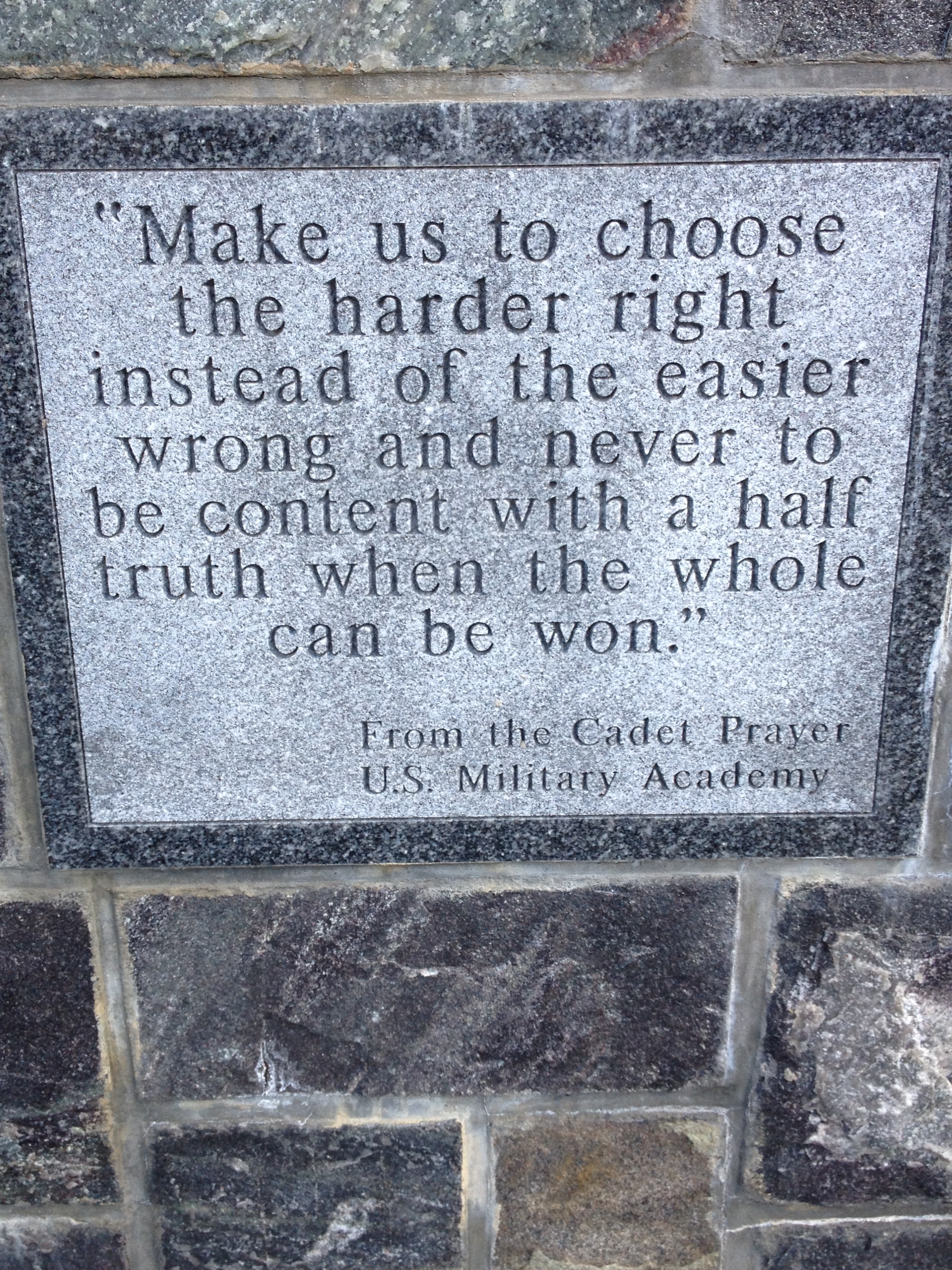
(Photo: a plaque at West Point on the integrity of America’s armed forces through history – grotesquely betrayed by the Bush administration.)

Obama’s Gitmo Disgrace

Guantanamo Military Prison Stays Open As Future Status Remains Uncertain

We all know that the Congress is fundamentally responsible for keeping the former torture camp open, by preventing the executive branch from financing the transfer of any prisoners to elsewhere in the US. We also know that some terrorists were captured but with no real proof; and that some have been transferred to other countries. Of those some have taken up arms; some have simply melted back into society.

But we also know that 86 human beings there have not been found guilty of anything and are eligible for transfer – but must remain in prison limbo for the rest of their lives. We also know that there have been prisoner deaths at Gitmo that are extremely hard to explain without a working assumption that they were accidentally tortured to death by suffocation. Now we discover that lawyers for Gitmo prisoners going before the military commissions are subject to surveillance by the government, through secret microphones in cells and extremely sensitive video recording equipment. The farce of the commissions extends to outright violation of the most basic attorney-client privilege.

Seton Hall Law School’s Center for Policy and Research has a new report: “Spying on Lawyers at GTMO? Guantanamo Bay Military Commissions and the Destruction of the Attorney-Client Relationship.” It’s a comprehensive exploration of the legal crapshoot. Take a look. Money quote:

We now know that the government has installed surveillance devices with the capacity to listen even to whispers between attorneys and clients, and to read the Screen shot 2013-04-15 at 10.45.27 PMattorneys’ own notes.
• Of all the facilities in Guantanamo Bay for attorneys to meet with their clients, the military chose Camp Echo, the former CIA interrogation facility
• Listening devices in the attorney- client meeting rooms are disguised as smoke detectors.
• The listening devices are so hypersensitive that they can detect even whispers between attorneys and their clients.
• Cameras in the attorney-client meeting rooms are so powerful that they can read attorneys’ handwritten notes and other confidential documents.
• The camera models can be operated secretly from a location outside of the room.
None of the capacities of the eavesdropping equipment would be necessary for CIA interrogations. Instead, the equipment has been implemented in a practice of multi-layered deception of defense attorneys.

Under those conditions, how can there be even a semblance of a fair trial? And if you were subjected to such a farce, and knew that you were being prevented from ever leaving a prison where you were wrongfully detained in the first place. wouldn’t you go on hunger strike? You’ve been captured by military forces with no charges, taken to a torture camp, hooded and shackled, beaten and tortured, and now – even when found innocent – kept in the same black hole of indefinite detention. Yes, I’d go on hunger strike.

Sure, Obama appended a signing statement, but the 2012 National Defense Authorization Act bars any transfer of prisoners out of Gitmo and president Obama signed it. His administration has defended the US government’s previous positions with respect to the rights of the detainees; and the military commissions are a legal farce of a kind you only find in totalitarian systems of government. And Obama is emphatically not a bystander in this.

Greenwald gets into the details:

Obama’s task force in early 2010 decreed that “48 detainees were determined to be too dangerous to transfer but not feasible for prosecution” and will thus “remain in detention”: i.e. indefinitely imprisoned with no charges. Given these facts, one cannot denounce the disgrace of Guantánamo’s indefinite detention system while pretending that Obama sought to end it, at least not cogently or honestly … In January, 2010, Obama – not Congress, but Obama – announced a moratorium on the release of any Yemeni detainees, even ones cleared for release.

The Yemeni government will take them – and is, in fact, demanding them. But Obama himself has decided he cannot risk letting innocent prisoners go to a country dealing with an Islamist insurgency itself. Many of the hunger strikers are precisely these Yemenis, and, as Greenwald notes, Obama as commander-in-chief has the power to grant a ‘national security waiver’ for the prisoners. He should use it. Is there a danger that these prisoners might turn to Jihad as a form of revenge for a decade of illegal imprisonment? Yes, there is. Is there a danger whenever an actual criminal is released from jail? Yes, there is. But the indefinite imprisonment of individuals cleared of all crimes is simply a violation of basic human rights. It cannot – must not – stand in America.

Obama did not create Gitmo and he wanted to close it. But he cannot have it every which way. By sustaining the prison and former torture camp, by keeping human beings locked up for ever for no reason but his own political fears of looking weak on terror, he is now fully responsible for the deaths that may ensue or the barbaric force-feeding that now appears to be routine. These men are not guilty. For America to imprison them indefinitely in that knowledge and not transfer them to their country of origin is simply a betrayal of core values. That the Obama administration is also spying and videoing confidential attorney-client conversations is also an outrage. Where is the Chicago Law professor when you need him?

We didn’t elect and re-elect Barack Obama to trash American values. We elected and re-elected him to restore them. As Glenn notes, this is not about his or anyone else’s legacy. It’s about the core question of whether in a free society, the government has a right to imprison people without charge, deem them innocent and eligible for release and yet keep them in prison for the rest of their lives.

For those in that haunted torture camp, there really is a fierce urgency of now. Let them go.

(Photo: A detainee stands at an interior fence inside the U.S. military prison for ‘enemy combatants’ on October 27, 2009 in Guantanamo Bay, Cuba. By John Moore/Getty, after Pentagon review.)

The Atheist’s Belief In Medicine

Seamus O’Mahony, a physician, reads Hitch’s Mortality:

I am intrigued by Mortality for one main reason, which is this: Hitchens’s beliefs about his advanced cancer and its treatment were, for a man whose fame rested on his scepticism, uncharacteristically Hospice Cares For Terminally Ill During Final Daysoptimistic. I hesitate to use the word delusional, as he admitted that he would be very lucky to survive, but he clearly steadfastly hoped, right to the end, that his particular case of advanced cancer might lie on the sparsely populated right side of the bell-shaped curve of outcome statistics.

He famously mocked religious folk for their faith in supernatural entities and survival of the soul after bodily death, yet the views expressed in Mortality are just as wishful and magical. “The oncology bargain (oncology is that branch of medicine which deals with the treatment of cancer),” writes Hitchens, “is that in return for at least the chance of a few more useful years, you agree to submit to chemotherapy and then, if you are lucky with that, to radiation or even surgery.” Years? I must now confess to a professional interest. I am a gastroenterologist in a large acute hospital, and I have diagnosed many patients with oesophageal cancer. “Years” is a word not generally used when discussing prognosis in Stage Four oesophageal cancer, “months”, in my experience, being a more useful one.

I’ve no watched two friends – an atheist and a Christian – go to extraordinary lengths to extend their lives against great odds. They were both relatively young – especially David at 34 when he found out. No one wanted them to go. But I wonder if all that medicine – which was, in fact, a form of poison – was worth it. David got ten more years, and two young children. But he also endured a disfiguring, disabling, brutal physical battering from the surgeries and chemo-sessions that tackling a tough brain tumor allow for. I say “allow for” because “required” is not the right word. What the chemo did to Christopher was beyond description – and what’s left of your body, even if the chemo works, can be extremely vulnerable to infections and diseases that can be worse than the cancer.

It seems odder to me for Christians to be as exercized by life-extension as the atheist. Put that down to the strange extremism of Ratzinger’s innovations on the question of “life”. But our culture’s gradual alienation from the fact of our deaths – our distancing ourselves even from the old and infirm in ways previous cultures didn’t and couldn’t – is not, in my view a healthy thing.

No one should seek to die or give in to a disease they can legitimately fight. God knows how many pills I take a day to keep the virus – and all its and their side-effects at bay. But I get to live healthily and meaningfully. The way some elaborate and cutting edge treatments all but kill the patient in order to save her troubles me. It’s a loss of perspective as well as immensely expensive for the entire system. Unquestionably, these sophisticated treatments are taking healthcare money away from the young, taking up more and more of our collective healthcare resources, and extending lives only be perpetuating continuous agony and nausea and pain for the patient and devastating consequences for families and friends.

We will all die. We should not seek it. But we should not flee from it for ever. I walked a 94-year old friend home last night in her wheelchair after a visit. She told me that she had worse and worse panic attacks. What are you afraid of? I asked. “Death,” she replied, with characteristic candor. I cannot blame her. And I cannot blame all of those who do everything and anything to avoid it. But at some point what seems to me to matter more is not the length of our lives but the content of them and the manner of our deaths.

At some point, medicine is a function of a social disease of modernity: the flight from our own mortality. But fleeing it does not defuse it. Only facing it does.

(Photo: John Moore/Getty.)