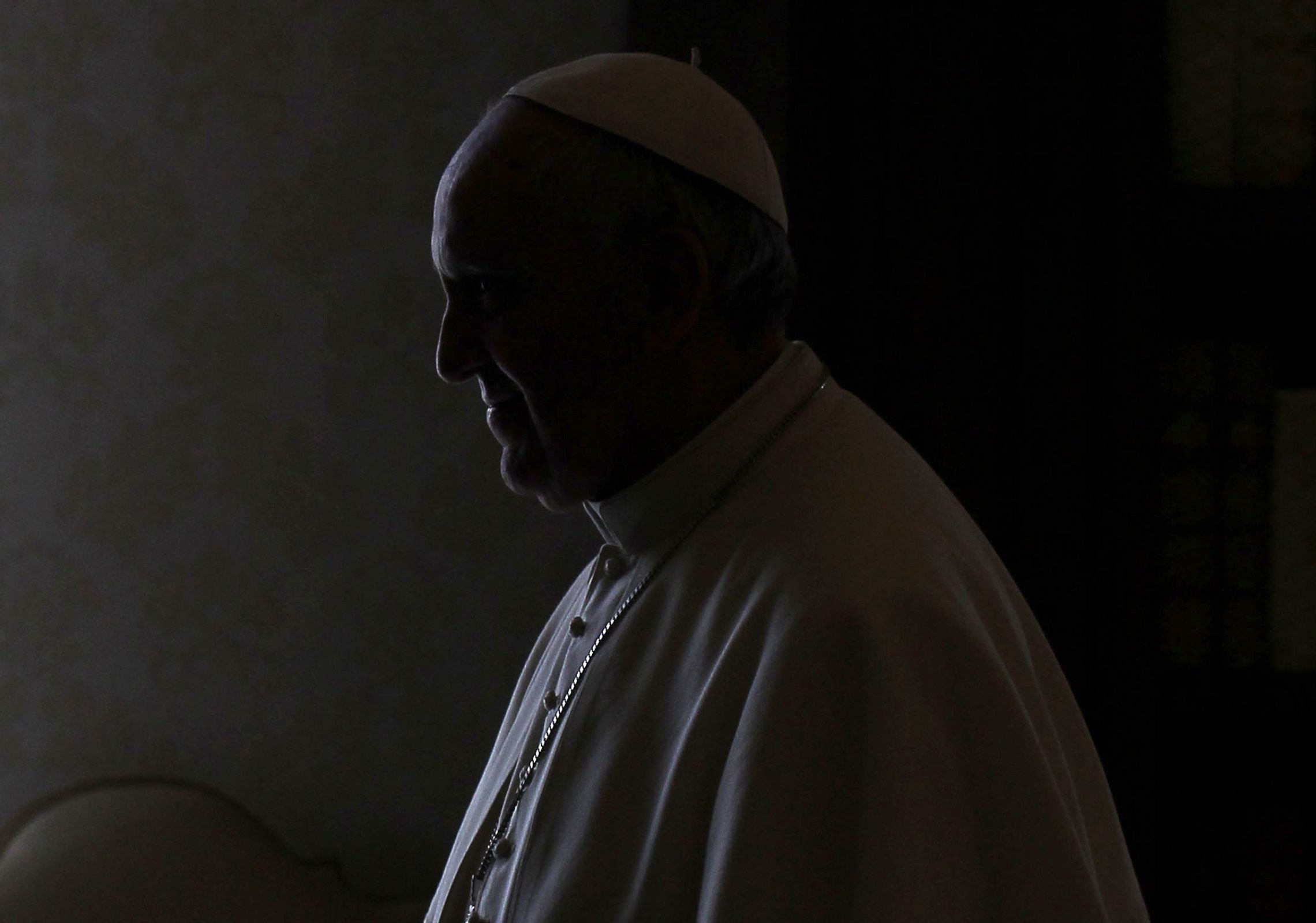
A Vatican Spring?

francisshadow

That was Hans Kung’s hope before the recent Conclave. It seemed somewhat naive to me at the time – but naivete in the face of the workings of the Holy Spirit is a good thing for Catholics to have. And we will certainly have to wait some time before we can assess whether the signs of reform become reality in any tangible fashion.

But we can say this much: almost every single action and statement from the new pontiff signals a radical departure from the past 44 years of the Wojtila-Ratzinger church. My favorite unofficial story about the new Pope was relayed to me by hearsay. But at the moment before he was to appear as the new Pope, he was allegedly presented with the papal mozzetta – the big red cape his predecessor loved to wear and an increasing must for any aspiring priest of bishop for the last decade (it had seasonal variations). He turned to the Vatican official who tried to put it on him, waved him away with one hand and said, simply, “Carnevale e finito.” The carnival is over.

Is it? That is the question. Is the Wojtila-Ratzinger era of reaction coming to an end?

You can see the theoconservative religious project from 1979 – 2013 rather as you might the neoconservative political project in the same years. After a major and arguably necessary course correction in the 1980s, by the first decade of the new millennium, the two isms had ended where isms always do: on earth. The theoconservative project ended in a collapse of the church’s moral authority inside the beadazzled Liberace outfits of its intellectual architect, Joseph Ratzinger. The neoconservative project ended in the blood and sands of Mesopotamia.

Benedict claimed he’d bring Europe back to the faith using the sublime, pristine self-evidence of a “new” natural law and the total authority of the Bishop of Rome. But after global rock-star version of the papacy under John Paul II had faded, the increasingly extremist and fastidious orthodoxy that he and Ratzinger had innovated lost altitude fast. It had been propped up by charisma, an evanescent form of authority. And when the prissy Inquisitor, Benedict XVI – with no popular appeal – inherited this mess, he gradually, gaffe after gaffe, fashion accessory after fashion accessory, disappeared beneath his meticulous vast wardrobe. He resigned for reasons we may never fully know – but after an internal dossier on church abuse – financial and sexual – had laid out his failure in stark terms. But he had ceased exercising any moral authority for most Catholics long before that.

All of that project required re-establishing the papacy as something the Second Council had explicitly disavowed: a near-dictator in theological and political and social debate. Conversations were silenced; debates ended; theologians silenced. Vatican II’s insistence on equal authority for scripture and for the laity of the church alongside the papacy were slowly downplayed, while restoring the Pope as some kind of medieval queen – down to the ermine and jewels and over-starched lace – was the objective. In his early years, John Paul II carried all before him in a sweep of drama. But he was to the papacy what Diana was to the monarchy. In the end, he was a dazzling distraction from reality, not a reinvention of it. It was under John Paul II that the rape of children became truly endemic, the cover-up the worst.

The establishment of a global council of advisers – a kind of global cabinet to counteract the Vatican bureaucracy and take the Pope down a notch or two is, in that context, a huge move:

The Italian church historian Alberto Melloni, writing in the Corriere della Sera, called it the “most important step in the history of the church for the past 10 centuries”. For the first time, a pope will be helped by a global panel of advisers who look certain to wrest power from the Roman Curia, the church’s central bureaucracy. Several of the group’s members will come to the job with a record of vigorous reform and outspoken criticism of the status quo. None has ever served in the Italian-dominated Curia in Rome and only one is an Italian: Giuseppe Bertello, the governor of the Vatican City State.

You need not have dramatic doctrinal change – and I don’t expect any on the issues that the Western laity has already moved on from. But you could have real institutional change. Here are my benchmarks: if Bergoglio closes or insists on total transparency for the Vatican Bank; if he defrocks leading bishops and cardinals who have been implicated in any way in the cover-up of child molestation, regardless of statutes of limitations; and if he allows the question of priestly celibacy to be revisited. He has chosen a collegial manner, but he is well known as a decisive man who makes up his own mind and exhibits few qualms about enforcing it.

All of this requires some patience and vigilance. But I fail to see how this new Pope could have more dramatically demonstrated that he intends to move the church away from the last forty years. Where he will lead it is anyone’s guess. But I’m merely relieved there seems to be a recognition that the Benedict path was, in many ways, a dead end. And the church must find new life again – in service to the poor, the sick, the lonely, the imprisoned and the outsider. It must get out of itself and into the world. And it’s happening.

(Photo: Pope Francis stands in the pontiff’s library on April 11, 2013 at the Vatican. By Alessandro Di Meo/AFP/Getty Images.)


Is It “Too Soon To Tell” On Iraq? Nope.

People Pay Their Respects To The Country's War Dead At Arlington National Cemetery's Section 60

Paul Wolfowitz isn’t ready to declare the Iraq War a failure:

It may be a long time before we really know the outcome of the Iraq war. To put that in perspective, consider that the Korean armistice was signed 60 years ago, but South Korea struggled for decades after that. Even after 30 years, only an extreme optimist would have predicted that South Korea today would not only have one of the world’s most successful economies but also a democratic political system that has successfully conducted six free and fair presidential elections over the last 25 years.

So too, it may be many years before we have a clear picture of the future of Iraq, but we already do know two important things. An evil dictator is gone, along with his two equally brutal sons, giving the Iraqi people a chance to build a representative government that treats its people as citizens and not as subjects. And we also know that Americans did not come to Iraq to take away its oil or to subjugate the country. To the contrary, having come to remove a threat to the United States, Americans stayed on at great sacrifice and fought alongside Iraqis in a bloody struggle against the dark forces that sought to return the country to a brutal tyranny. Iraqis rarely get enough credit for their own heroism in that struggle, but roughly 10,000 members of the Iraqi security forces are estimated to have died in that fight (twice the American total) in addition to tens of thousands of Iraqi civilians.

It’s a testament to the power of ideology and pride that Wolfowitz is actually still using the South Korea example. South Korea. How many sectarian divisions are there? Was not the war there in order to prevent Communist take-over of the entire peninsula? What possibly equivalent threat existed in sanctioned, impoverished Iraq? There is not a single sentence of personal accountability in the entire piece, not even a flicker of conscience about what his utopianism wrought. His only mention of Abu Ghraib, where torture policies authorized by his own president were exposed, destroying the entire moral case for the war, is about Abu Ghraib under Saddam. No apology for the death of a hundred thousand Iraqis because of a bungled operation. No apology for torture. No apology for sending thousands of Americans to die so that the new Shiite prime minister could actually cancel the coming elections in two critical Sunni areas: Anbar and Nineveh, as the sectarianism Wolfowitz insisted was over by 2003 still somehow consumes a country he never understood. No:

What did require a U.S. apology—which the ambassador to Iraq, Jim Jeffrey, offered in the Fall of 2011—was the failure to assist the Shia uprising in 1991, in the aftermath of Saddam’s defeat in Kuwait.

At this point, you realize you’re dealing with someone psychologically ill-equipped to reflect with even the slightest sense of responsibility on the carnage and chaos his self-righteousness wrought. He’s back to the exhausted tropes of 2002, when he last had even the faintest credibility, repeating them as if, by some magic, they will make his catastrophic error of judgment less obvious. One wonders: when exactly did Wolfowitz have his sense of shame surgically removed? Did Allan Bloom help him out? James Joyner disagrees with Wolfowitz’s view of the US’ motives:

[R]oughly 4712 Americans were killed fighting in Iraq—which is to say, 98 percent of all Americans killed fighting in Iraq—after Saddam’s regime was out of power. 94 percent of the total American KIA died after his sons were killed. 88 percent were lost after Saddam was captured, no threat to return to power, and no longer a plausible cause for the fabled “regime holdouts” to rally around. Even after Saddam was hanged, another 1548 Americans died.

From this, I would conclude that American war aims were something other than merely toppling Saddam’s regime, making sure his “equally brutal sons” did not replace him, or even assuring that Saddam was brought to justice. Because, otherwise, we could have gotten out with only 92 dead American troopers.

Larison draws a key distinction:

Wolfowitz claims that it “may be a long time before we really know the outcome of the Iraq war,” but that’s a very silly thing to say. It may be a long time before we can assess the full historical significance of the Iraq war. That’s true of any major event that happens in one’s own lifetime, to say nothing of a war. Andrew Bacevich addressed that question here, and suggested that the Iraq war might prove to be no more significant over the long term than the War of 1812 was for the later history of the United States. The Iraq war was unnecessary, appallingly destructive, and extremely stupid, but perhaps the most damning thing that will be said about it one day in the future is that it ultimately didn’t matter very much. The outcome of the Iraq war is much more straightforward: it was a costly, wasteful failure. It advanced no concrete American interests, and instead did real harm to U.S. security. Then again, that was clear to some of us over eight years ago.

And yet Wolfowitz is incapable of intellectual evolution, let alone moral responsibility. In fact he’s still blaming Shinseki for speaking the obvious: that we needed 300,000 troops to invade and retain order. Yes: all these years later and Wolfowitz is still dreaming that if only he had controlled everything … then the very fantasies he concocted would have come true. And his main point now? That the US should be more involved in the internal sectarian clusterfuck of Syria. Here’s Wolfowitz’s version of atonement:

“I realise these are consequential decisions. It’s just that they’re consequential both ways.”

The word weasel springs to mind.

(Photo: A sun-bleached flower sticker is adhered to U.S. Army Captain Russell B. Rippetoe’s headstone in Arlington Cemetery’s Section 60 on the 10th anniversary of the beginning of the war in Iraq March 19, 2013 in Arlington, Virginia. Rippetoe was killed in a suicide bombing at a checkpoint near the Hadithah Dam northwest of Baghdad, Iraq. He was the first soldier killed in Operation Iraqi Freedom to be buried at Arlington National Cemetery. By Chip Somodevilla/Getty Images)

The Other One Percent: Our Vets

Screen Shot 2013-04-09 at 10.01.28 PM

Mikey Piro, a two-time veteran of Iraq diagnosed with PTSD in 2006, has an excellent little blog called PTSD Survivor Daily through which he processes his post-war struggles. I met him at West Point and chatted late into the night. We hope to be launching a podcast soon, and Mikey will be one of my first guests. A soldier is supposed to be as courageous as this West Point grad from Long Island. But not as gob-smackingly candid about the reality of what we as a nation did to the tiny percentage of us who fought unwinnable wars, while we merely fought about them. Never in the history of human warfare has a nation demanded so much for so long from so few. From a recent post:

In combat we were always provided something to release our emotions or frustrations. Missions and free time let us discharge not only our weapons, but our pent up frustrations. Yelling, shooting, driving, crying, walking and many other releases were all at our disposal.  They were standard issue. In the staccato of combat, a rhythm existed where we could gauge and guess when we needed to pull the release valve.

However, as a civilian, life is so unpredictable by comparison that we as Veterans have a hard time adapting to a continual set of challenges at irregular and less predictable intervals. We miss the neat bookends our tours provided us to bracket the ups and downs combat threw at us. At home the issues build up and we don’t have the markers set to know when to release.

He points to an earlier post about “the pressure that builds from within our core”:

Last week, I met a woman standing in line at a Starbucks.  As I stood waiting for my coffee, I showed her one of my tweets about “#caffeination.”  We got to talking about twitter (@mikeypiro in case you didn’t know) and the conversation led to sitting and talking about our respective professions.  We pulled up a set of chairs in a quiet corner of an outdoor café.  The conversation led down many paths but we talked about the Iraq deployment, job hunting as a new civilian, and my PTSD recovery path.

As I explored the loss of my Soldiers I broke down in the court yard in front of this total stranger.  She was extremely polite and shared a story of her own as I gained my composure.  The conversation for me was very exciting in that this total stranger out of the kindness of her heart was willing to listen.  I felt I could open up to her on a number of topics, so I did not let the previous anxiety of crying get in the way.  Talk about an In Vivo exposure!  Normally, medicine helps me keep those tears in check.  Alas, I was on the tail end of my cycle and I have found that holding tears back is more exhausting than just letting them go.

You can follow his writing here, with posts including “The Myths of #PTSD recovery: A survivors’ perspective” and “Superheroes have issues too: The #Avengers and #PTSD symptoms“.  In this post, he recalls one of many traumatic moments in Iraq:

The first KIA [killed in action] was a little ways up the road.  He had bullet holes from head to toe and was in a large pool of thick red blood.

(Did I mention we didn’t have body bags?  Oh yeah, that.  We ran out a few months back and were forced to use tarps…)

The few ground troops got with the HQ guy, wrapped up the first KIA, and put him on the back of the truck.

The second KIA was a little farther up the road.  He was a big man.  Had to be two hundred and fifty pounds.  He was hunched over and also lying in his own pool of blood.

[Quick Aside]

Under the laws of the Geneva convention (I am paraphrasing here) , once you engage an enemy and they are wounded and you take their weapon, they are now an enemy combatant and subject to medical treatment and POW status.  You own them.

Back to business

We roll the giant man over to get him ready to put on the tarp only instead of being dead, he starts screaming, moaning and gurgling.

Like many times in combat, the initial report was wrong.

He was not going to live.  One third of his head was missing.  The horror is of this realism of war is still with me to this day.

I wanted nothing more than to finish him.  It would be easy, just cap him.

So there I was, new XO, with everyone looking at me.

What did I do?

I turned to the medic and said, “I don’t care if you have to scoop his brains back in his head.  Put a bandage on him; we are taking him the to the aid station.”

It was the beginning of a very long day.

In a very long war.

(Photo from Piro’s Instagram account)

Obama, The GOP And Fiscal Seriousness

Screen shot 2013-04-11 at 12.38.48 PM

A simple question given divided government and the scale of the future fiscal imbalance: which party is prepared to compromise more? The GOP is arguing that their acquiescence to a relatively minor part of the fiscally ruinous Bush tax cuts – four years after they were supposed to be sunsetted – gives them the prize. But Obama’s new budget is in a different universe. He has already kept in place a large swathe of the Bush tax regime, but now has offered some serious, tangible cuts to entitlements, including the chained CPI. On top of his previous squeeze of Medicare and the cost-control provisions in the ACA, he’s open to means-testing more for wealthier Medicare recipients.

The rough balance of his new budget is 2 – 1 spending cuts to revenue increases. The howls from the left – has the Democratic party reverted to pre-Clinton brain-deadness so swiftly – confirm the constructive moderation. One reaction from the right, it seems to me, was so cynical, toxic and foul in its hypocrisy and bad faith … well it had to have happened in Washington. Even the Club for Growth was taken aback:

“Greg Walden doesn’t seriously oppose even the most modest of reforms to social security, right?” said Club for Growth President Chris Chocola in a statement. “With nearly $100 trillion in unfunded liabilities, the last thing Republicans should attack the Democrats for is for making the most minor reforms to our entitlement programs. If anything, President Obama nibbles around the edges of entitlement reform and doesn’t do anything to put entitlements on a permanently sustainable path.”

I have been arguing for Obama to bring forward this kind of budget for a while. Maybe his caution was justified – especially given how he has been lacerated for negotiating with himself in the past and because the GOP is so riddled with purism and partisanship (even after its electoral shellacking), the compromise always seems to be in one direction.

But I think the president has realized his sagging poll numbers on the economy (see above) are directly related to his seeming inability to get even the slightest fiscal compromise in the face of unsustainable long-term debt. He’s the president, after all. In the end, he was elected to get some kind of bargain done, before the debt compounds even further. He’s now taken a clear enough step that even Bill O’Reilly may have to concede that he is serious about entitlement reform – if only to make discretionary spending in any way feasible in the near future.

What Obama needs to do soon is go everywhere and explain his compromise and demand some give in return. Perhaps if gun regulation and immigration reform really do gain traction, some kind of momentum for a deal could emerge. It is entirely to Obama’s advantage if that happens. The Democrats? They’re too smug right now. Obama’s concessionary move is in actuality a shrewd one. Inertia isn’t – if the Dems want to appeal to the center of the country on the economy and its future.

The World Of Kuo

A cherry blossom tree is pictured in the

[Re-posted from earlier today]

So there we were this morning, on a summery day, surrounding a coffin, offering prayers. David’s evangelical Christianity was omnipresent – and a cultural novelty for me, as a Catholic. First off, the coffin was never laid into the earth. It stayed there and remained there as we left. Were his very young kids the reason? I didn’t ask. But in this letting go, dirt was not shoveled or thrown over the casket, which was closed. We left it hanging. Rather, at the very end of the day’s festivities – and they were festive, not funereal – we all let go of balloons into the sky. They drifted upward, looking like little sperms, with wiggling trails of ribbon beneath them, looking for a heavenly egg.

I saw John DiIulio and his wife, Joe and Victoria Klein, along with Ralph Reed, who visited David in his final agonies, along with many of David’s uniquely eclectic posse. The service was in David’s evangelical mega-church, and infused with the surety of physical resurrection. The idea of our getting new bodies in Heaven – perfect bodies without tumors or HIV or wrinkles – has always seemed a little strange to me. If it’s true, then it must be a very different kind of existence. I remember after my friend Pat died of AIDS that I had one searing dream about him, in which he seemed extremely real, completely recognizable, yet utterly different in appearance: transfigured, but still Patrick. Perhaps that also accounts for the bewildering variety of the accounts of the risen Jesus in the New Testament. But it may also be our refusal to see the person in his or her final form: sometimes, as with AIDS, awfully deformed, or with a brutal brain tumor like David’s, wracked with pain, his face aged not just by time but by disease. We want these things not to continue. We want our dead friends and family to be remembered in the best of their prime, as if they were photo-shopped by Vogue.

I have never been to a mega-church service – which is something to be ashamed of, since I have written so often about evangelicalism’s political wing. And it was revealing. The theater was called a sanctuary – but it felt like a conference stage. There were no pews, no altar (of course), just movie-theater seats, a big complicated stage with a set, and four huge screens. It looked like a toned-down version of American Idol. I was most impressed by the lighting, its subtlety and professionalism (I’ve often wondered why the Catholic church cannot add lighting effects to choreograph the Mass). The lyrics of the religious pop songs – “hymns” doesn’t capture their Disney channel infectiousness – were displayed on the screens as well, allowing you to sing without looking down at a hymnal. Great idea. And the choir was a Christian pop band, young, hip-looking, bearded, unpretentious and excellent. Before long, I was singing and swaying and smiling with the best of them. The only thing I couldn’t do was raise my hands up in the air.

This was not, in other words, a Catholic experience. But it was clearly, unambiguously, a Christian one.

There was little sadness – and no purgative drunken wake. We were told not to wear suits and dark clothes, so the crowd was in greens and blues and whites (Joe bought a special pink plaid number just for the occasion). And the reason for this was quite obvious: almost everyone there, including myself, were completely sure that a) David was still there and b) his death was something to be celebrated if you loved him. He was certainly looking forward to it. His extraordinary wife, Kim, was effervescent and stunning in a white dress. She has been through hell and back several times in the last decade. And yet she wore that toll lightly today. The tears were for another time. The sobs for another one too.

What I guess I’m trying to say is that so many of us have come to view evangelical Christianity as threatening, and in its political incarnation, it is at times. But freed from politics, evangelical Christianity has a passion and joy and Scriptural mastery we could all learn from. The pastors were clearly of a higher caliber than most of the priests I have known – in terms of intellect and command. The work they do for the poor, the starving, and the marginalized in their own communities and across the world remains a testimony to the enduring power of Christ’s resurrection.

In some way, this was David’s last gift to me. His own unvarnished, embarrassingly frank belief helped me get over my prejudices against evangelicalism as a lived faith. His faith strengthened mine immeasurably, especially when we were among the first two to bail on the Bush administration in its first term. It was not a shock that his last day above the ground opened up more windows and doors in my mind. He doubtless hoped it would.

I feel no grief. I remain, as someone once said, surprised by joy.

(Photo: Carl Court/AFP/Getty.)

Obama’s Cultural Transformation Of America

Marijuana Crime

[Re-posted from earlier today]

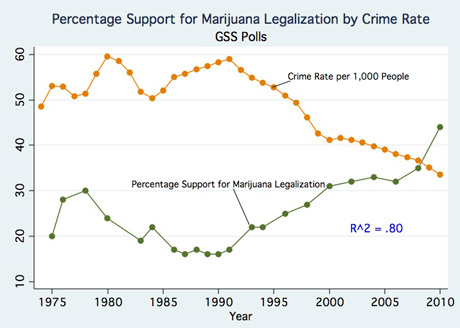
Support for marijuana legalization increases as crime goes down:

Eighty percent of the differences in support for marijuana legalization nationwide since 1975 is explained by the change in the overall crime rate through 2010 (the last year in which we have the crime rate and GSS data). Crime rates are currently at very low levels nationwide, which could explain why we saw the demonstrated upswing of marijuana legalization in all polling during the first decade of this century. If we were to see an increase in the crime rate in the future, there’s a pretty decent chance we’d see a decrease in support for marijuana.

Maybe so. But I’m still impressed by that sharp sudden uptick in the last few years. It looks a lot like the marriage equality graphs:

Screen shot 2013-04-09 at 1.21.32 PM

More and more, as the Obama re-election moves into the rear-view mirror, I think we are wrong to see the current fiscal stalemate or economic situation as the most dispositive aspects of Obama’s presidency.

I think what he may well be remembered for will not be his careful stewardship of a very sick economy back from intensive care. Given the nature of the economic collapse, he was never going to get a Reagan recovery anyway. All he needed was a recovery strong enough to get re-elected, and a winning coalition that remade America as a cultural entity. And that’s what we are now seeing. The 2012 election was a watershed for cultural change – and I suspect the sudden jump in support for marriage equality and marijuana legalization reflects a bandwagon effect in the wake of Obama’s overwhelming cultural victory.

Obama has presided over the moment when white America came to accept that it no longer has the demographic clout to ignore non-white America – a huge symbolic step in national self-understanding, literally epitomized by a multi-racial, multi-cultural president. It looks likely that his presidency will be the most significant one for gay rights in American history. He has established the principle of universal healthcare in America – another huge shift in the cultural identity of the country. He has harnessed the political power of American women to decimate the GOP’s coalition. If he presides over immigration reform, we will be a different country culturally than we were only a decade ago. And he will have ended – perhaps permanently – the entire idea of militarily occupying foreign countries to advance our geo-political goals, and, if the sequester continues, will have cut defense in ways even Clinton couldn’t dare to.

This is a cultural revolution. He did not create it. He organized it. And epitomized it. We are now looking very closely at various political, tactical moments – the budget, entitlement reform, taxes – exacerbated by the new instant and universal media. What we are missing is the strategic cultural revolution that has been occurring all the time, and that he has very carefully guided.

And he is quite happy for us to miss it. Because that stirs up less resistance. But the change goes on …

Thatcher, Liberator

[Re-posted from earlier today.]

I remember reading an article in the Washington Monthly back in the late 1980s by one of the smugger liberal British columnists, Polly Toynbee. It captured part of the true derangement that Margaret Thatcher brought out in her political foes. It was called simply: “Is Margaret Thatcher A Woman?” It’s still online. It was a vicious attack on her having any feminist credentials. It included this magnificent lie:

She has experienced nothing but advantage from her gender.

Toynbee’s case is worth hearing out, but it’s an instant classic of the worst British trait: resentment of others’ success. No culture I know of is more brutally unkind to its public figures, hateful toward anyone with a degree of success or money, or more willing to ascribe an individual’s achievements to something other than their own ability. The Britain I grew up with was, in this specific sense, profoundly leftist in the worst sense. It was cheap and greedy and yet hostile to anyone with initiative, self-esteem, and the ability to make money.

The clip below captures the left-liberal sentiment of the time perfectly. Yes: the British left would prefer to keep everyone poorer if it meant preventing a few getting richer. And the massively powerful trade union movement worked every day to ensure that mediocrity was protected, individual achievement erased, and that all decisions were made collectively, i.e. with their veto. And so – to take the archetypal example – Britain’s coal-workers fought to make sure they could work unprofitable mines for years of literally lung-destroying existence and to pass it on to their sons for yet another generation of black lung. This “right to work” was actually paid for by anyone able to make a living in a country where socialism had effectively choked off all viable avenues for prosperity. And if you suggested that the Prime Minister Margaret Thatchercoal industry needed to be shut down in large part or reshaped into something commercial, you were called, of course, a class warrior, a snob, a Tory fascist, etc. So hard-working Brits trying to make a middle class living were taxed dry to keep the life-spans of powerful mine-workers short.

To put it bluntly: The Britain I grew up in was insane. The government owned almost all major manufacturing, from coal to steel to automobiles. Owned. It employed almost every doctor and owned almost every hospital. Almost every university and elementary and high school was government-run. And in the 1970s, you could not help but realize as a young Brit, that you were living in a decaying museum – some horrifying mixture of Eastern European grimness surrounded by the sculptured bric-a-brac of statues and buildings and edifices that spoke of an empire on which the sun had once never set. Now, in contrast, we lived on the dark side of the moon and it was made up of damp, slowly degrading concrete.

I owe my entire political obsession to the one person in British politics who refused to accept this state of affairs. You can read elsewhere the weighing of her legacy – but she definitively ended a truly poisonous, envious, inert period in Britain’s history. She divided the country deeply – and still does. She divided her opponents even more deeply, which was how she kept winning elections. She made some serious mistakes – the poll tax, opposition to German unification, insisting that Nelson Mandela was a terrorist – but few doubt she altered her country permanently, re-establishing the core basics of a free society and a free economy that Britain had intellectually bequeathed to the world and yet somehow lost in its own class-ridden, envy-choked socialist detour to immiseration.

I was a teenage Thatcherite, an uber-politics nerd who loved her for her utter lack of apology for who she was. I sensed in her, as others did, a final rebuke to the collectivist, egalitarian oppression of the individual produced by socialism and the stultifying privileges and caste identities of the class system. And part of that identity – the part no one ever truly gave her credit for – was her gender. She came from a small grocer’s shop in a northern town and went on to educate herself in chemistry at Oxford, and then law. To put it mildly, those were not traditional decisions for a young woman with few means in the 1950s. She married a smart businessman, reared two children and forged a political career from scratch in the most male-dominated institution imaginable: the Tory party.

She relished this individualist feminism and wielded it – coining a new and very transitive verb, handbagging, to describe her evisceration of ill-prepared ministers or clueless interviewers. Perhaps in Toynbee’s defense, Thatcher was not a feminist in the left-liberal sense: she never truly reflected on her pioneering role as a female leader; she never appointed a single other woman to her cabinet over eleven years; she was contemptuous toward identity politics; and the only tears she ever deployed (unlike Hillary Clinton) were as she departed from office, ousted by an internal coup, undefeated in any election she had ever run in as party leader.

Indira Gandhi and Golda Meir preceded her; but Thatcher’s three election victories, the longest prime ministership since the 1820s, her alliance with the US in defeating the Soviet Union, and her liberation of the British economy place her above their achievements. What inspires me still is the thought of a young woman in a chemistry lab at Oxford daring to believe that she could one day be prime minister – and not just any prime minister, but the defining public figure in British post-war political history.

That took vision and self-confidence of a quite extraordinary degree. It was infectious. And it made Thatcher and Thatcherism a much more complicated thing than many analyses contain.

Thatcher’s economic liberalization came to culturally transform Britain. Women were empowered by new opportunities; immigrants, especially from South Asia, became engineers of growth; millions owned homes for the first time; the media broke free from union chains and fractured and multiplied in subversive and dynamic ways. Her very draconian posture provoked a punk radicalism in the popular culture that changed a generation. The seeds of today’s multicultural, global London – epitomized by that Olympic ceremony – were sown by Thatcher’s will-power.

And that was why she ultimately failed, as every politician always ultimately does. She wanted to return Britain to the tradition of her thrifty, traditional father; instead she turned it into a country for the likes of her son, a wayward, money-making opportunist. The ripple effect of new money, a new middle class, a new individualism meant that Blair’s re-branded Britain – cool Britannia, with its rave subculture, its fashionistas, its new cuisine, its gay explosion, its street-art, its pop music – was in fact something Blair inherited from Thatcher.

She was, in that sense, a liberator. She didn’t constantly (or even ever) argue for women’s equality; she just lived it. She didn’t just usher in greater economic freedom; she unwittingly brought with it cultural transformation – because there is nothing more culturally disruptive than individualism and capitalism. Her 1940s values never re-took: the Brits engaged in spending and borrowing binges long after she had left the scene, and what last vestiges of prudery were left in the dust.

Perhaps in future years, her legacy might be better seen as a last, sane defense of the nation-state as the least worst political unit in human civilization. Her deep suspicion of the European project was rooted in memories of the Blitz, but it was also prescient and wise. Without her, it is doubtful the British would have kept their currency and their independence. They would have German financiers going over the budget in Whitehall by now, as they are in Greece and Portugal and Cyprus. She did not therefore only resuscitate economic freedom in Britain, she kept Britain itself free as an independent nation. Neither achievement was inevitable; in fact, each was a function of a single woman’s will-power. To have achieved both makes her easily the greatest 20th century prime minister after Churchill.

He saved Britain from darkness; she finally saw the lights come back on. And like Churchill, it’s hard to imagine any other figure quite having the character, the will-power and the grit to have pulled it off.

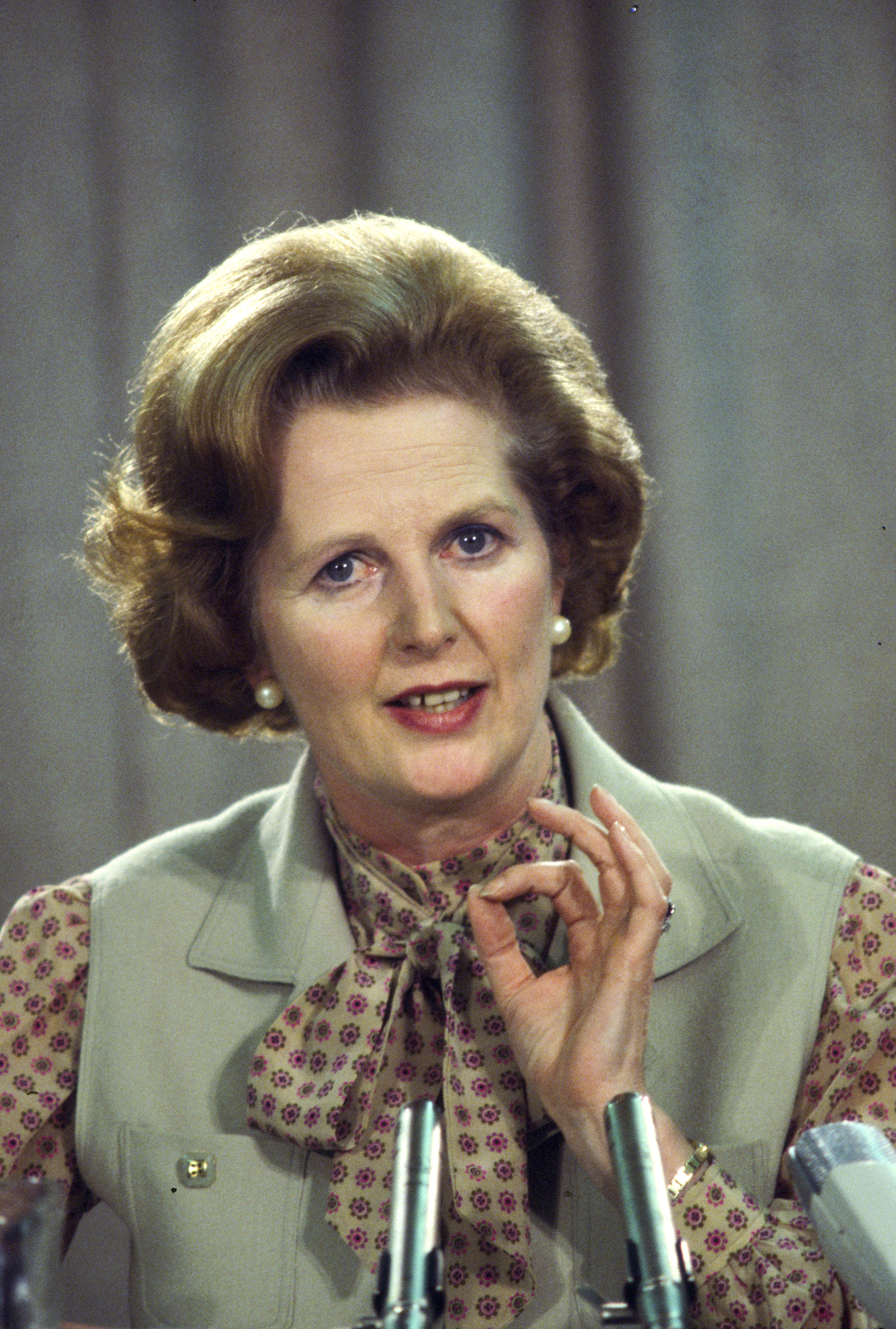
(Photo: Prime Minister Margaret Thatcher speaks at a political conference during the early 1980s in London, England. By Tim Graham/Getty Images)

At West Point

IMG_5550

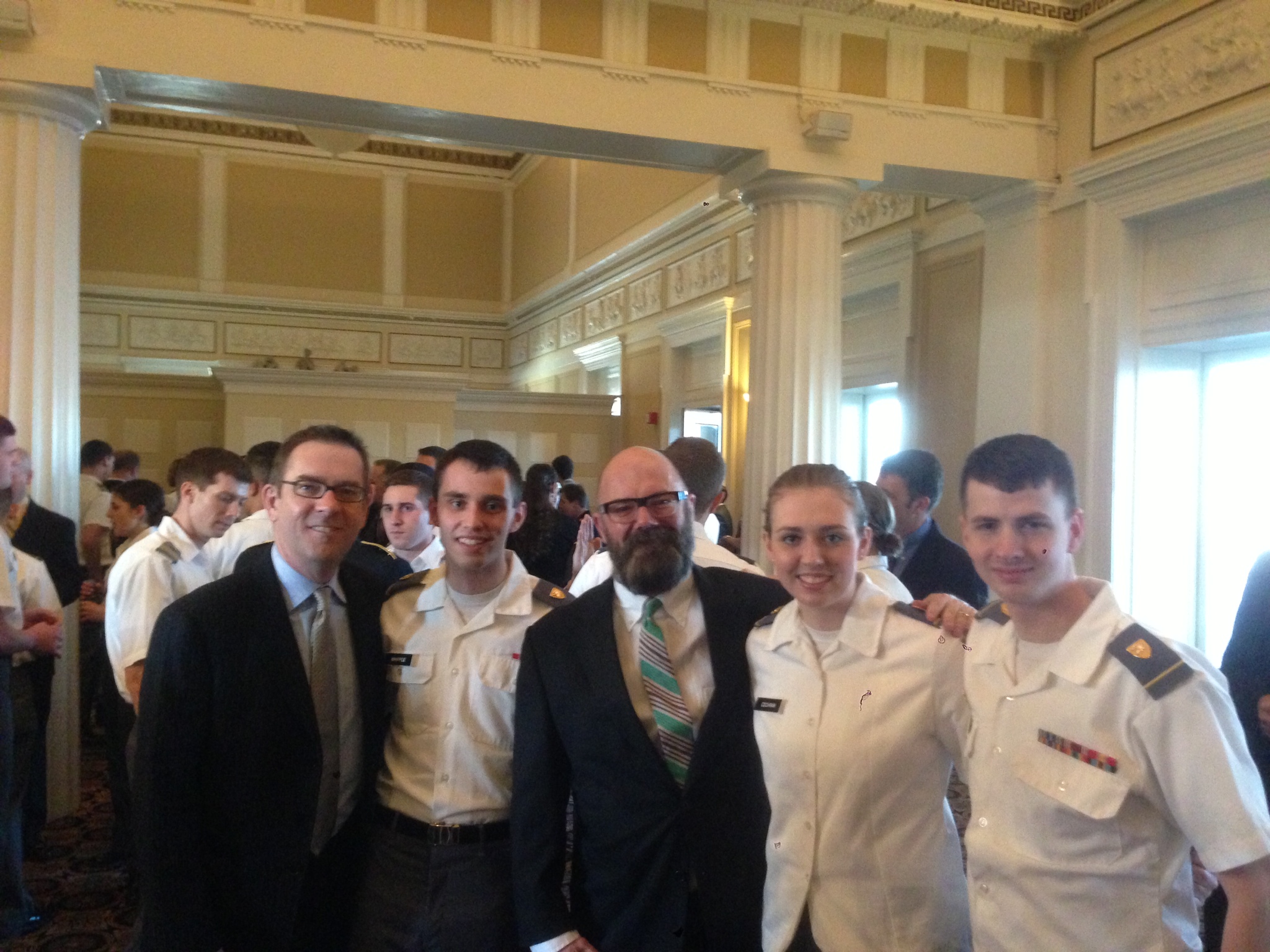
A week ago last Saturday, I was invited to West Point by a group called “Knights Out”. That’s the name for the gay-straight alliance among cadets at the oldest continuous military installation in America. This was their second annual dinner – which, like all things done twice at West Point, is now therefore a tradition. (Yes, that’s TV foodie, Ted Allen, on the far left. He was also a guest.) I thought I was just attending a dinner and making a few remarks, but they insisted on giving me an award for my work on ending the military ban on openly gay service-members. This happened the week before those critical court cases on marriage equality.

It’s taken me this long to write up the event because my bewilderment has been so disorienting – and because it was difficult to absorb the power of this moment while putting on my analyst’s hat for the court cases. But here’s part of what I managed in my paywalled Sunday column in the Times of London:

There were around 30 gay cadets present, and then plenty of old boys (and girls), and military faculty. An older general was there – with his husband. It was a formal event held in a central building. And as I tried cadetprayerto absorb the moment, it occurred to me that a little over two years ago, all of those cadets would have been expelled for merely being there. Since the beginning of the institution, gay cadets were either subject to immediate discharge or, after 1993, under the policy of “Don’t Ask, Don’t Tell”, ordered to keep their sexual orientation secret or face dismissal. They were, in other words, forced to break the core ethic of the place – “a cadet will not lie …” – in order to remain in good standing with it. And it was that ancient alleged contradiction – between military honor and homosexuality – that was being dissolved that night.

A tough Brigadier General, Tammy Smith, gave an address: “You’re military first, gay second,” she insisted, her wife sitting nearby. And these young gay men and lesbians gave her a standing ovation. They were in the military not because they were gay, but because they wanted to serve their country. One young cadet I met was following family tradition that had sent the next generation to West Point and the Army for decades. The only difference this time is that she was a woman and a lesbian. Another young cadet from the South argued with me at dinner, protesting Obamacare. He was a Republican and gay and in uniform – and saw nothing contradictory or odd about any of it.

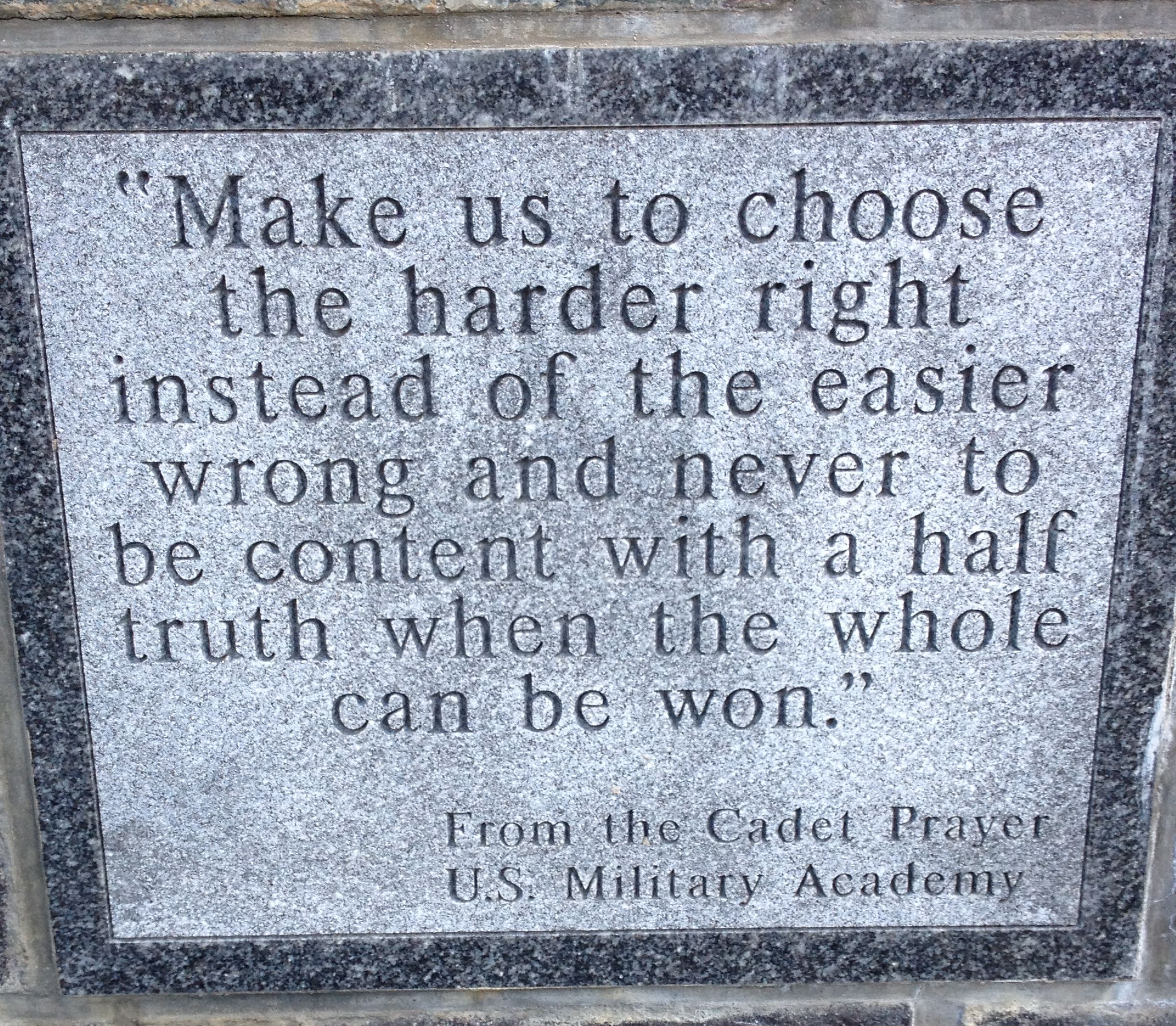
The organization as a whole has taken as its own motto a section of the Academy’s prayer: “Never to be content with the half-truth when the whole can be won.” They did not want to rebel against this institution, or to occupy some special niche. They merely wanted to be wholly, honorably part of it. And finally, they were.

In a column today, Ross Douthat urges those who have championed and almost won the argument for homosexual civil equality to adopt Churchill’s advice: “In Victory: Magnanimity,” while he opts for Churchill’s other dictum, “In Defeat: Defiance.” There was certainly no hubris or triumphalism at West Point. There was merely relief – relief that forcing gay cadets to break West Point’s honor code against lying is now mercifully left in the trashcan of history.

From the next generation, I heard nothing but the desire to serve their country without lying. This was not about the relevance of their sexual orientation but rather its irrelevance compared with this honorable vocation. There was a time when conservatives rejoiced when a balkanized minority wanted to integrate itself into the whole of society by affirming traditional goals, like serving one’s country in uniform or marrying the one you love. There was a time when identity politics was the foe of conservatism. Now, the integrators and opponents of identity politics are suddenly those at fault. And the right has resorted to the identity politics of victimology to describe its current predicament.

And what struck me about these gay soldiers – as with the many gay service-members I have been proud to know and meet in my life – was their commitment to honor. They truly found the lies they were commanded to tell about their lives to be dishonorable. And what struck me about West Point was its constant, persistent American military insistence on choosing the “harder right instead of the easier wrong.” Honor is everything there. It is a standing rebuke to the following sentence:

“You don’t want your honor to be questioned? Why would those things matter when compared to protecting America?”

Yes, the antidote to Cheney is West Point. And the cadets who found the courage to put honor first. And changed the world because of it.

The Radical Christianity Of Francis

Pope Francis Attends Easter Mass and Urbi Et Orbi Blessing in St. Peter's Square

What has struck me the most about the new Pope is his reticence. Benedict XVI was as bewilderingly bejeweled in his prose as he was in his elaborate, fastidious outfits. Francis seems to be following his name-sake, who rarely preached as such, but whose actions spoke far louder than any Latin. “Spread the Gospel everywhere – if necessary with words” was the saint’s alleged remark. It was certainly his way of life, although I doubt Pope Francis will suddenly break out into a spiritual dance or song, as Saint Francis was wont to do.

And so Francis was of few and plain words, as he emerged at first: “Bueno Sera” before urging people to go to bed soon. He has simply let the ornate and elaborate vestments of his predecessor fall from his body, as Saint Francis did in renouncing his worldly inheritance from his father. He has spoken of the need to protect Creation from the forces of pure exploitation and greed; he has reiterated Jesus’ message to visit the sick in hospital and the incarcerated in prison. He has washed the feet of a Muslim female juvie. He has refused the Papal throne and its palatial residence. And he has done all this almost instantly. No words could have said as much.

The reaction from the arch-traditionalists, especially in Liturgical matters, has been just a notch short of outright hysteria. One of the new, young priests, who came of age under the counter-revolution of Wojtila and Ratzinger, registers his bafflement at the washing of women’s feet:

I am a young, recently ordained priest. Tonight, I planned on preaching about the Eucharist and the institution of the priesthood. How can I speak about such things – the self-offering of Christ, the 12 viri selecti – when our Holy Father is witnessing to something different?

I feel like going up to the congregation and saying, “I don’t have any idea what the symbolism of the washing of the feet is. Why don’t we just all do what we want.” How hard this is for young priests.

How hard for a young priest to have to grapple with the idea that in Christ, there is “neither male nor female.” Or that some Pharisaical rules, designed to protect the powerful, are what Jesus came to disarm with the power of love, outreach, and embrace of the other. No: what matters to this priest is that those who are selecti are viri, i.e. men, that the washing of the feet is about the supremacy of the male priesthood, not the humility of a God who places the last first and the first last. There is some awkward resistance from the Ratzinger faction as a whole:

“The pope does not need anybody’s permission to make exceptions to how ecclesiastical law relates to him,” noted conservative columnist Jimmy Akin in the National Catholic Register. But Akin echoed concerns raised by canon lawyer Edward Peters, an adviser to the Vatican’s high court, that Francis was setting a “questionable example” by simply ignoring the church’s own rules.

“People naturally imitate their leader. That’s the whole point behind Jesus washing the disciples’ feet. He was explicitly and intentionally setting an example for them,” he said. “Pope Francis knows that he is setting an example.”

The inclusion of women in the rite is problematic for some because it could be seen as an opening of sorts to women’s ordination.

There is no sign that Francis will move to end that ban – although what a day for the church that would be! There are signs rather that Francis wants to break out of the zero-sum dynamic of those issues for a while and reaffirm the central truths of the faith: that the force behind all of creation is love, that Jesus revealed this in his words and in his actions, that those who believe they have everything have nothing, and that those who are marginalized, poor, alone, afraid and vulnerable are by those very facts more capable of seeing God in the world. We have to become more like them to find Jesus, and less like ourselves.

This is a Pope who follows Jesus’ example by simply showing, not telling. Francis of Assisi is the obvious precedent. But this man is a Jesuit as well, an order founded by Saint Ignatius:

St. Ignatius had been a Basque soldier, as well as something of a ladies’ man, until his conversion while convalescing after a cannonball shattered his leg. In his writings, most notably in his “Spiritual Exercises,” St. Ignatius espoused a theology based on loving deeds rather than loving thoughts or words. St. Ignatius calls us not merely to worship Christ but to imitate him.

My italics. Deeds over words; love over law. In the end, the way a human being acts is what his or her religion is. And a spiritual leader can say so much more without words, because he is describing something beyond human understanding. In the washing of a young woman’s feet – from another universe of doctrine – you are witnessing the surrender of law to love. You are witnessing Jesus’ constant resurrection in our world – every day, somewhere, in someone, opening up to the sun, like flowers in springtime.

(Photo: Daffodils in front of St. Peter’s Basilica as final preparations are made before Pope Francis delivers his first ‘Urbi et Orbi’ blessing from the balcony of the Basilica during Easter Mass on March 31, 2013 in Vatican City, Vatican. By Christopher Furlong/Getty Images)

Who Won The Argument? II

US-JUSTICE-GAY-MARRIAGE

The arguments today (pdf) were, for the first fifty minutes, way above my pay-grade, but helpfully elucidated below. But the question of the relationship between the federal government and state governments in the definition of civil marriage is a vital one. Can these two be separated? Which one defers to the other? And why?

The core argument in defense of DOMA is that the federal government needs uniformity. Where over a thousand federal laws affect civil marriage, an American citizen needs some consistency across the states. And in 1996, as Hawaii was considering marriage equality for the first time, Mr Clement argues that this was uppermost in the minds of DOMA supporters:

MR CLEMENT: Congress in 1996 at that point says, the States are about to experiment with changing this, but the one thing we know is all these Federal statutes were passed with the traditional definition in mind. And if rational basis is the test, it has to be rational for Congress then to say, well, we are going to reaffirm what this word has always meant for purposes of Federal law … when the Federal Government gets involved in the issue of marriage, it has a particularly acute interest in uniform treatment of people across State lines.

I’m sure that was exactly what Dick Morris was concerned about, aren’t you? But Justice Breyer, it seems to me, has a pretty good response:

JUSTICE BREYER: You would say it would be the same thing if the State passed a law — Congress passes a law which says, well, there’s some States -­ they all used to require 18 as the age of consent. Now, a lot of them have gone to 17. So if you’re 17 when you get married, then no tax deduction, no medical, no nothing.

And yet the Feds have no problem just accepting this lack of uniformity – and accepted it in inter-racial marriage for decades, merely deferring to the states. To put it more bluntly:

JUSTICE SOTOMAYOR: But what gives the Federal Government the right to be concerned at all at what the definition of marriage is? Sort of going in a circle. You’re saying — you’re saying, we can create this special category — men and women — because the States have an interest in traditional marriage that they’re trying to protect. How do you get the Federal Government to have the right to create categories of that type based on an interest that’s not there, but based on an interest that belongs to the States?

MR. CLEMENT: Well, at least two — two responses to that, Justice Sotomayor. First is that one interest that supports the Federal Government’s definition of this term is whatever Federal interest justifies the underlying statute in which it appears. So, in every one of these statutes that affected, by assumption, there’s some Article I Section 8 authority -­

JUSTICE SOTOMAYOR: So they can create a class they don’t like — here, homosexuals — or a class that they consider is suspect in the marriage category, and they can create that class and decide benefits on that basis when they themselves have no interest in the actual institution of marriage as married. The states control that.

Indeed they do. But it’s Kagan who scores the winning goal on this question, it seems to me:

JUSTICE KAGAN: Mr. Clement, for the most part and historically, the only uniformity that the Federal Government has pursued is that it’s uniformly recognized the marriages that are recognized by the State. So, this was a real difference in the uniformity that the Federal Government was pursuing. And it suggests that maybe something — maybe Congress had something different in mind than uniformity.

So we have a whole series of cases which suggest the following: Which suggest that when Congress targets a group that is not everybody’s favorite group in the world, that we look at those cases with some -­ even if they’re not suspect — with some rigor to say, do we really think that Congress was doing this for uniformity reasons, or do we think that Congress’s judgment was infected by dislike, by fear, by animus, and so forth? … What happened in 1996 — and I’m going to quote from the House Report here — is that “Congress decided to reflect an honor of collective moral judgment and to express moral disapproval of homosexuality.” Is that what happened in 1996?

MR. CLEMENT: Does the House Report say that? Of course, the House Report says that. And if that’s enough to invalidate the statute, then you should invalidate the statute. But that has never been your approach, especially under rational basis or even rational basis-plus, if that is what you are suggesting.

Busted. The language of the House Report declares that DOMA was explicitly about expressing moral disapproval. But deploying such moral disapproval toward homosexuals was rendered illegitimate by Lawrence vs Texas, as expressed by Scalia’s spluttering, prescient dissent. It seems to me that Kennedy is going to have a hard time repudiating his previous ruling.

But then comes an interesting question – about federal institutions or federal officials or servicemembers being treated differently from state to state:

JUSTICE ALITO: Can I take you back to the example that you began with, where a member of the military is injured. So let’s say three soldiers are injured and they are all in same-sex relationships, and in each instance the other partner in this relationship wants to visit the soldier in a hospital.

First is a spouse in a State that allows same-sex marriage, the second is a domestic partner in a State that an allows that but not same-sex marriage, the third is in an equally committed loving relationship in a State that doesn’t involve either. Now, your argument is that under Federal law the first would be admitted, should be admitted, but the other two would be kept out?

Alito asks this of solicitor general Verrilli, who resorts to an equal protection argument, rather than a federalist one. That seemed a dodge to me. What didn’t was his dismissal of the alleged interest of the federal government in uniformity across all the states:

GENERAL VERRILLI: [T]here is no uniformity advantage to Section 3 of DOMA as opposed to the traditional rule. There are no genuine administrative benefits to DOMA. If anything, Section 3 of DOMA makes Federal administration more difficult, because now the Federal Government has to look behind valid state marriage licenses and see whether they are about State marriages that are out of compliance with DOMA.

It’s easier, in other words, to retain the uniformity of recognizing any marriages a state deems valid and lawful, as was always the case before 1996. Then the kicker:

GENERAL VERRILLI: I think the House report makes this glaringly clear, is that DOMA was not enacted for any purpose of uniformity, administration, caution, pausing, any of that. It was enacted to exclude same-sex married, lawfully married couples from Federal benefit regimes based on a conclusion that was driven by moral disapproval. It is quite clear in black and white in the pages of the House report which we cite on page 38 of our brief -­ Whatever the explanation, whether it’s animus, whether it’s that — more subtle, more unthinking, more reflective kind of discrimination, Section 3 is discrimination.

In other words, you don’t have to be a bigot to discriminate. You could simply be trying, as Bill Clinton was when he signed DOMA, to get re-elected. Clinton wasn’t a bigot; he was just a callow pol. But when the House itself declares in its contemporaneous report that it is passing this to register moral disapproval toward an entire class of people, Scalia’s Lawrence dissent becomes more slaient. Yes, Lawrence did remove any constitutional basis for moral disapproval of a class of people in the law. End of story.

End of DOMA? My own impression of the arguments was that DOMA can survive this court only on the procedural grounds I don’t claim to fully understand. The best argument for it was Alito’s concern about soldiers or federal officials across state lines. But these grotesque discrepancies were allowed for in the case of race for over a century, and are still allowed for differences in age limits, consanguinity rules, etc. A unique federal definition of civil marriage both trumps the rights of states to determine this matter as they always have in this country, and was explicitly defended at the time on unconstitutional grounds of moral disapproval. What’s left?

What’s left is Edie Windsor’s lawyer and this eloquent, moving and powerful statement:

MS KAPLAN: No one has identified in this case, and I don’t think we’ve heard it in the argument from my friend, any legitimate difference between married gay couples on the one hand and straight married couples on the other that can possibly explain the sweeping, undifferentiated and categorical discrimination of DOMA, Section 3 of DOMA.

And no one has identified any legitimate Federal interest that is being served by Congress’s decision, for the first time in our nation’s history to undermine the determinations of the sovereign States with respect to eligibility for marriage. I would respectfully contend that this is because there is none…

It’s been a long, long journey, but you can see the mountaintop from here.

(Photo: A same-sex marriage supporter has her forehead painted with rainbow colors as she joins demonstration in front of the Supreme Court on March 27, 2013 in Washington, DC. By Jewel Samad/Getty.)