Live-Blogging Pope Francis: “Lowly Yet Chosen”

The Conclave Of Cardinals Have Elected A New Pope To Lead The World's Catholics

5.43 pm. He celebrated Rosh Hashana in 2007,

saying that he was there to examine his heart, “like a pilgrim, together with you, my elder brothers.” “Today, here in this synagogue, we are made newly aware of the fact that we are a people on a journey and we place ourselves in God’s presence,” the cardinal said. “We must look at him and let him look at us, to examine our heart in his presence and to ask ourselves if we are walking blamelessly…. Even if your sins are scarlet, they will become white as snow, he promises us; even if they are red like crimson, they will be like wool… In the end we are asked not to hide these, our errors, this meanness, this sin in its totality […] but to place them in front of God’s eyes — that Lord who forgives and is patient.

That’s what the church needs: humble solidarity with our fellow believers of all kinds, and a refusal to look away from our own iniquity.

5.37 pm. Stanley Hauerwas:

It’s remarkable that they’ve chosen a Jesuit. That’s even more remarkable than choosing a non-European. That he’s a Jesuit says so much about his commitment to the poor, and that he’s taken the name of Francis — in recollection of Saint Francis of Assisi — clearly gestures that the Roman Catholic Church not only serves the poor, the Roman Catholic Church is the church of the poor.

Now for a real battle within American Christianity: the “church of the poor” or the Prosperity Gospel?

5.28 pm. Assisi or Xavier? Many readers think Francis may be nodding to the co-founder of the Jesuits, Saint Francis Xavier, rather than of Assisi. I assumed Assisi because the former invariably has the Xavier attached (so many Catholic boys were once named Francis X. O’Sullivan or whatever), and because of the new Pope’s focus on poverty and humility. And Pope Francis, unlike Xavier, is not a globe-trotter or known for missionary work. But I may be wrong. We should find out soon enough.

5.24 pm. This Pope will give Paul Ryan heartburn:

Francis also seems to be an opponent of austerity, most notably during his time as spiritual leader of Argentina when the country defaulted on its debt in 2002 … When the debt crisis hit in 2002, the church called in strong terms for a debt restructuring to take place which privileged social programs above debt repayment. They argued that the true problems in the Argentinian economy were, in their words, “social exclusion, a growing gap between rich and poor, insecurity, corruption, social and family violence, serious deficiencies in the educational system and in public health, the negative consequences of globalization and the tyranny of the markets.”

5.20 pm. He has a background in chemistry. Hank Campbell cheers:

As I have noted before, we have had back-to-back Popes with solid support for science. It isn’t going to satisfy every militant who thinks every form of biology should be embraced (yet don’t complain at all that the Obama administration bans somatic cell nuclear transfer) but the Catholics have the oldest science institute in the world, Galileo was one of its first presidents, and this carries on a long tradition of advancement of science among Catholics.

Pope Francis is a humble man and that’s good, because 21st century science is humbling. The world is going to change pretty fast.

One merciful thing about Catholic Christianity: no denial of evolution.

5.16 pm. A reader writes:

“The Pope is the successor of the Apostle who was graced with faith, and still denied Christ, cowered in fear with the other male apostles in the upper room after Jesus’ death, and would have us still circumcising boys and eating kosher. Yet managed to serve God.”

We are all sinners, and the Gospels tell us that the first leader of the church was one of the greatest.

5.14 pm. I have a feeling this book is going to get translated pretty soon.

5.09 pm. Why American conservatism is so sick:

5.03 pm. Some more details on Bergoglio’s relationship with the dictatorship of the late 1970s and early 1980s:

One [case] examined the torture of two of his Jesuit priests — Orlando Yorio and Francisco Jalics — who were kidnapped in 1976 from the slums where they advocated liberation theology. Yorio accused Bergoglio of effectively handing them over to the death squads by declining to tell the regime that he endorsed their work. Jalics refused to discuss it after moving into seclusion in a German monastery.

Both men were freed after Bergoglio took extraordinary, behind-the-scenes action to save them — including persuading dictator Jorge Videla’s family priest to call in sick so that he could say Mass in the junta leader’s home, where he privately appealed for mercy. His intervention likely saved their lives, but Bergoglio never shared the details until Rubin interviewed him for the 2010 biography.

At the same time, there was a reluctance to testify, public silence about the regime’s horrors, and evasive answers, according to some human rights lawyers. He seems to have been much more outspoken about social ills under a free society than under the junta’s rule.

4.55 pm. As I often do, I find myself in agreement with Michael Potemra:

People who worry that, as a Jesuit, he might be too liberal, should relax: A very conservative Jesuit priest of my acquaintance, who is unhappy with the liberal direction of his order, has been telling me for weeks that he supports Bergoglio for pope. Bergoglio is a solid conservative on the hot-button social issues that agitate American laity, but that would have been true of just about any of the cardinals who might have been elected today. The story here is that he is an outsider who is the consensus choice to fix what’s wrong with the church administration, but all in a Franciscan spirit of love and humility, to wipe the face of the church so that its inner beauty can radiate. St. Francis was called to “rebuild the church” — Pope Francis will act in that spirit.

The word that is constantly repeated in assessments of him is “balance”. And his entire career in the church has been centered on overcoming and condemning social and economic inequality.

4.51 pm. More from Reuters on the Pope’s alleged complicity with the military junta’s purge of leftists:

The most well-known episode relates to the abduction of two Jesuits whom the military government secretly jailed for their work in poor neighborhoods. According to “The Silence,” a book written by journalist Horacio Verbitsky, Bergoglio withdrew his order’s protection of the two men after they refused to quit visiting the slums, which ultimately paved the way for their capture.

Verbitsky’s book is based on statements by Orlando Yorio, one of the kidnapped Jesuits, before he died of natural causes in 2000. Both of the abducted clergymen survived five months of imprisonment. “History condemns him. It shows him to be opposed to all innovation in the Church and above all, during the dictatorship, it shows he was very cozy with the military,” Fortunato Mallimacci, the former dean of social sciences at the Universidad de Buenos Aires, once said. Those who defend Bergoglio say there is no proof behind these claims and, on the contrary, they say the priest helped many dissidents escape during the military junta’s rule.

4.45 pm. Rod Dreher reprints a hagiography of Saint Francis as perhaps a sign of what this Pope intends to do with his time in office:

One day when Francis went out to meditate in the fields he was passing by the church of San Damiano which was threatening to collapse because of extreme age. Inspired by the Spirit, he went inside to pray.

Kneeling before an image of the Crucified, he was filled with great fervor and consolation as he prayed. While his tear-filled eyes were gazing at the Lord’s cross, he heard with his bodily ears a voice coming from the cross, telling him three times: ‘Francis, go and repair my house which, as you see, is falling into ruin.’

4.42 pm. One source of considerable hope is Pope Francis’ history of contempt for clericalism, one of the key factors behind the child-rape conspiracy:

“These are today’s hypocrites. Those who clericalize the Church. Those who separate the people of God from salvation.”

4.30 pm. Theocon Damian Thompson wants Francis to clean out the stables:

It’s a shame that Cardinal Bergoglio never had the opportunity to mingle incognito in the bars of modern Dublin, where he would have found an intensity of hatred for the Catholic Church that the Gordon rioters might have recognised. Young Irish people especially can hardly mention the Church without a curl of the lip. Older folk, meanwhile, feel miserably betrayed. It’s the same story in, say, Boston or Quebec. How telling that the siblings of Cardinal Ouellet, Prefect of the Congregation for Bishops, no longer go to Mass regularly.

I know this is a downbeat response to what, for Catholics, is a joyful and hopeful event. But savage reform to the curia is required so that Pope Francis can (should he wish) take advantage of the successful Benedictine reforms … So welcome, Holy Father, and let the sackings begin.

4.18 pm. And now the troubling parts of his background – which were aired just before the last conclave. From Hugh O’Shaughnessy of the Guardian almost two years ago:

The extent of the church’s complicity in the dark deeds [of the Argentine junta in the 1970s] was excellently set out by Horacio Verbitsky, one of Argentina’s most notable journalists, in his book El Silencio (Silence). He recounts how the Argentine navy with the connivance of Cardinal Jorge Bergoglio, now the Jesuit archbishop of Buenos Aires, hid from a visiting delegation of the Inter-American Human Rights Commission the dictatorship’s political prisoners. Bergoglio was hiding them in nothing less than his holiday home in an island called El Silencio in the River Plate. The most shaming thing for the church is that in such circumstances Bergoglio’s name was allowed to go forward in the ballot to choose the successor of John Paul II. What scandal would not have ensued if the first pope ever to be elected from the continent of America had been revealed as an accessory to murder and false imprisonment.

And the heart sinks.

4.11 pm. After Benedict’s frills and lace, we get something rather different:

When Roman Catholic Cardinal Jorge Mario Bergoglio takes the subway to work, few of his fellow commuters realize they are sharing the train with the archbishop of Buenos Aires.  The 68-year-old Jesuit eschews opulent religious garments, chauffeur-driven limousines and other perks of his position. Sometimes, he throws an old raincoat over his cassock before heading out the door. “He never dresses like a cardinal,” said Gregory James Venables, a close friend of Bergoglio’s who heads the Anglican Church in southern South America. “It’s not to be scruffy. But that’s his character. He is very, very, very humble.” …

It’s also noticeable that one of his close friends is an Anglican. He is said to be open to other faith traditions.

4.04 pm. Tweets of the hour:

4.02 pm. Quote for the hour (and perhaps suggesting why Francis’ age may not have counted against him):

One Italian writer quoted an anonymous cardinal on March 2 as saying, “Four years of Bergoglio would be enough to change things.”

3.57 pm. Chart of the hour from Yglesias:
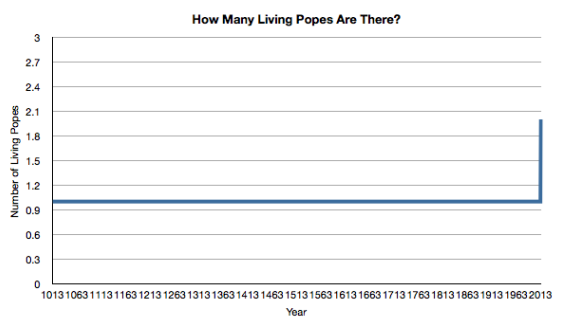
Screen shot 2013-03-13 at 3.57.24 PM

But he’s wrong. There’s only one actual Pope at a time. And his name is Francis.

3.55 pm. Why Argentina? Why not?

If you crunch the numbers, it’s astonishing that we have not yet had a Latin American pope. Today roughly 41% of all Catholics hail from Latin America. And half of all Catholics under age 40 are from Latin America.

3.48 pm. In 2001, he made an important gesture in washing the feet of people with AIDS – another sign of his association with Saint Francis, whose outreach to lepers began his great ministry. I may be reading too much into the name, but Bergoglio’s embrace of poverty and his seeming humility speak to me as a Christian in these dark ages for the faith. Rocco also notes how rare it is for a Jesuit to nod to a Franciscan:

By choosing the name of the founder of his community’s traditional rivals, the 266th Roman pontiff – the first from the American continent, home to more than half of the 1.2 billion-member church – has signaled two things: his desire to be a force of unity in a polarized fold, and his intent to “repair God’s house, which has fallen into ruin”… that is, to rebuild the church.

3.41 pm. Another Allen nugget:

In September 2012, he delivered a blistering attack on priests who refuse to baptize children born out of wedlock, calling it a form of “rigorous and hypocritical neo-clericalism.”

He seemed genuinely mild-mannered, gentle and humble too – judging from a few minutes of watching him wave rather tepidly to the crowd.

3.31 pm. Evem more than his predecessor’s, this Pope seems an unlikely fit for Paul Ryan-style Catholics:

Bergoglio has supported the social justice ethos of Latin American Catholicism, including a robust defense of the poor. “We live in the most unequal part of the world, which has grown the most yet reduced misery the least,” Bergoglio said during a gathering of Latin American bishops in 2007. “The unjust distribution of goods persists, creating a situation of social sin that cries out to Heaven and limits the possibilities of a fuller life for so many of our brothers.”

“Social sin”. I cannot imagine what he’d say about Ryan’s budget proposal.

3.28 pm. John Allen’s profile is here. Money quote:

“We have to avoid the spiritual sickness of a self-referential church,” Bergoglio said recently. “It’s true that when you get out into the street, as happens to every man and woman, there can be accidents. However, if the church remains closed in on itself, self-referential, it gets old. Between a church that suffers accidents in the street, and a church that’s sick because it’s self-referential, I have no doubts about preferring the former.”

3.24 pm. Here’s what he recently wrote about marriage equality in Argentina:

“Let’s not be naive, we’re not talking about a simple political battle; it is a destructive pretension against the plan of God. We are not talking about a mere bill, but rather a machination of the Father of Lies that seeks to confuse and deceive the children of God.”

So marriage equality is the work of Satan. Oh well.

3.20 pm. Perhaps a sign of why he chose the name Francis. From Wiki:

As Cardinal, Bergoglio became known for personal humility, doctrinal conservatism and a commitment to social justice. A simple lifestyle has contributed to his reputation for humility. He lives in a small apartment, rather than in the palatial bishop’s residence. He gave up his chauffeured limousine in favor of public transportation, and he reportedly cooks his own meals.

3.18 pm. Two obvious first thoughts. The first Jesuit Pope, named after arguably the greatest saint, Francis, and from Latin America. Those are big precedents. And they give me some hope.

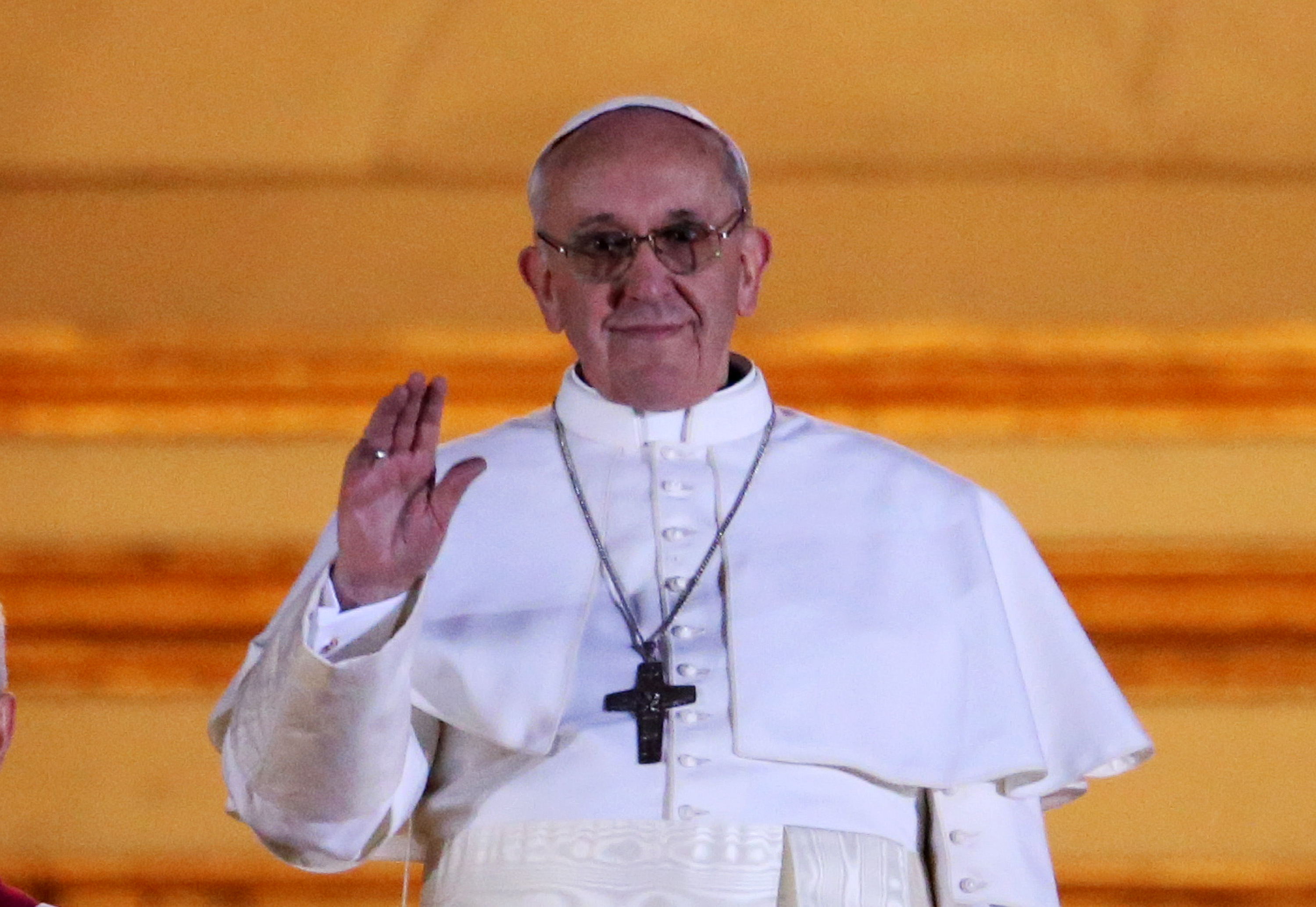
(Photo: Newly elected Pope Francis I appears on the central balcony of St Peter’s Basilica on March 13, 2013 in Vatican City, Vatican. Argentinian Cardinal Jorge Mario Bergoglio was elected as the 266th Pontiff and will lead the world’s 1.2 billion Catholics. By Peter Macdiarmid/Getty Images.)

The Climate Game-Changer

This graph seems to me to reconcile aspects of legitimate skepticism with a devastating reality. Here’s the earth’s temperatures going back 11,000 years – far further than the 2,000 years previously viewed in popular culture as the “hockey stick”. You can see that stick at the far right of the following graph:

marcott-B-MJ

So, yes, the earth has been warmer than it now is while humans inhabited it. Yes, climate has shifted over the millennia, depending on a variety of non-human factors which could also be affecting us now. Yes, in the last half a millennium, we hit what was described as a mini-ice-age, bringing temperatures down to record lows for ten millennia. In 1683, for example, the river Thames was frozen completely for two months. Here’s a painting of the river in 1677, as the Little Ice Age, as we now call it, set in:

The_Frozen_Thames_1677

I can remember a cover-story in the New Republic predicting a new ice age in the 1980s – based on the long-term chilling of the planet. So you can see why those urging against hysteria have some historical climate variety to argue that change has always been here and that humans have lived on the planet for 2000 years and adapted to similar temperature variations before. So chill out, and keep drilling.

The problem with that reassuring scenario, as Tim McDonnell points out, is that we have never before experienced this sudden rate of heating before ever – certainly not since humans developed agriculture. It’s getting close to a vertical line now, which suggests to me that the likelihood of feedback loops actually intensifying the heat has also gone up.To put it mildly, I can see no external reason why the earth’s temperature would have suddenly gone haywire in the last 500 years, without factoring in carbon, capitalism and the industrial revolution. For a while, that carbon actually warmed us up out of a millennial-long cooling. But now, it’s out of control. And if you begin to imagine the impact of every Chinese or Indian reaching the same level of prosperity as Western Europe, using the same carbon sources of energy, we are clearly putting the planet through a stress test never before imposed by its inhabitants.

To be perfectly frank, this graph shows our civilization to be unsustainable unless we dramatically alter its source of energy. Maybe we can adapt – in ways our ancestors did. But they were able to do so over much, much longer periods of time, and were not actually creating the situation.

We have become gods. And we are destroying what we inherited as a species. I do not have an answer, and suspect only a technological breakthrough in energy resources will make a difference real enough to stop this looming catastrophe. But that this isn’t the priority of every government on Earth right now (apart from Russia and Canada) is beyond me. And a carbon tax – the simplest clearest inhibitor of turning our planet into an oven – would be a start.

The Political Dead-End Of Christianism

Bluebanded_Gobies

[Re-posted from earlier today.]

Last week, as regular readers know, I went to the University of Idaho to debate whether civil marriage equality was good or bad for society as a whole. My interlocutor was and is a fundamentalist, a believer in Biblical morality, and a very hospitable and gracious host. I had dinner with his extended family – an impressive, funny, intelligent crew. His son-in-law friend, who shepherded me around, was super-smart, is obviously fully engaged in the modern world, educated and eager to chat. He also believes that the earth was created in six days six thousand years’ ago, that civil marriage should be reserved for heterosexual couples only, and that abortion should be illegal.

I just want to say I wish I met more Christianists like this more often. My hosts sincerely believe that there can be no solid separation between church and state and no basis for social order or “truth” other than Biblical morality as strained through the New Testament. And so purely pragmatic political arguments can quickly become problematic for them. Peter Leithart, who attended the debate, wrote it up on First Things and admirably homed in on the core divide:

Sullivan demanded that Wilson defend his position with secular, civil arguments, not theocratic ones, and in this demand Sullivan has the support of liberal polity. Sullivan’s is a rigid standard for public discourse that leaves biblically-grounded Christians with little to say … That leaves Christians with the option of making theologically rich, biblically founded arguments against gay marriage. But do we have the vocabulary ready to hand? And even if we do, does the vocabulary we have make any sense to the public at large?

Wilson closed the debate with a lovely sketch of the marital shape of redemptive history, from the garden to the rescue of the Bride by the divine Husband to the revelation of a bride from heaven. In order for that to carry any weight, though, people have to be convinced that social institutions should participate in and reflect some sort of cosmic order. Who believes that these days? Wilson tells a cute story, many will say, but what does it have to do with public policy?

If that’s a hard case to make, it’s even harder to make the case that homosexuals are in any way a threat to our civilization.

Rod Dreher notes:

This is the answer to the question about “cosmic” versus “moral.” Leithart is pointing out that the metaphysical ground has radically shifted under our feet. The traditional Christian moral arguments depend on a metaphysical understanding that is no longer widely shared, not even by Christians.

This is why Christianism cannot win a majority – and is fast becoming a smaller minority. If your agrument is that God says so – and your fellow citizens don’t believe in that same God – how can you even engage in secular debate? New analysis (pdf) of polling and the last election results on the gay marriage question, for example, reveal that only one major religious group now opposes marriage equality across the board: white evangelical Christians, who are pretty close to synonymous with the Tea Party. Even every other Christian population supports it! From white non-evangelical Christians to Catholics, clear majorities favor the reform.

To give one comparison: white Catholics back civil marriage equality by 53 – 43 percent. Hispanic Catholics back it by 54 – 35. But white evangelicals oppose it by a massive margin: 73 percent oppose it, 23 percent support it. The GOP’s problem is that this is their base; it cannot compromise because God’s word is inviolable; and yet it is also losing the argument badly. You either stick with this base and lose – or you fight them and lose. Which is why so many in the GOP are now just not talking about the issue.

In Idaho, the crowd was largely white and evangelical. They voted overwhelmingly against marriage equality at the start and after a debate in which my opponent conceded that his argument was ultimately rooted totally in Biblical truth and not secular consequences, and who declared the state of heterosexual marriage as in crisis. In other words, that night mirrored the last twenty years. The longer this debate has gone on, the more the opposition has Thomas_Aquinas_by_Fra_Bartolommeowithdrawn to claims of simple Biblical authority. That is not an appeal to the center of the American polity. It’s a withdrawal from it.

The theo-conservative response to this was an attempt to revive “natural law” arguments against gay marriage, derived from updating Aquinas. But deriving an “ought” from an “is” in nature has been deeply problematic since Hume. And if you were going to do that anyway, I think you’d have to concede that we now know empirically that same-sex attraction among humans and most other species is ubiquitous, and may even have some kind of evolutionary advantage. Aquinas didn’t know, for example, that humans were conceived by a woman’s egg as well as a man’s sperm. He couldn’t possibly have known what Darwin and his followers have unfolded: a vast, constantly shuffling of DNA, designed to generate diversity in order to survive the challenges of subsistence through time and environment. He couldn’t have known that the animal kingdom is full of homosexuality; or that gender can change in fishes (see the blue-banded gobies above); or that grasses have many genders; or that countless human beings are born with indeterminate gender or trans-gender.

My view is that if you take Aquinas’s core position in 2013 – and try to deduce what is right from nature itself – you’d probably have to conclude that homosexuality is itself a natural deviation from the norm, and that such deviations are not “mistakes” but, if they survive the test of scores of millennia, are actually integral to nature. Aquinas saw through a glass darkly; now we see gene to gene.

So we end up in David Bentley Hart’s words here:

If we all lived in a Platonic or Aristotelian or Christian intellectual world, in which everyone presumed some necessary moral analogy between the teleology of nature and the proper objects of the will, it would be fairly easy to connect these facts to moral prescriptions in ways that our society would find persuasive. We do not live in such a world, however.

But we still live in a democracy. Which means that this worldview cannot survive in our culture and polity without some massive Third Great Awakening that shows no sign of emergence in the developed world. The natural law Deus Ex Machina, in other words, either leads to believing that homosexual orientation is natural or collapses in the civil sphere because of previous concessions and loopholes: no fault divorce, contraception, women’s greater freedom and power, the acceptance of infertile couples and post-menopausal couples as civilly married. The only argument they have left is the nebulous idea that this will all somehow lead to polygamy. But there are very good civil and secular arguments against polygamy – the subjugation of women, the social consequences of large numbers of young men without women to marry, etc – that cannot apply to allowing gays to marry. Almost all the utilitarian, pragmatic arguments against marriage equality evaporate upon inspection. And it remains a truth that the attempt by Popes John Paul II and Benedict XVI to revive this tradition and win back the West to neo-Thomist doctrine has been a total failure.

They cannot even persuade their own flock, let alone the rest of society. We are left in the world Alasdair Macintyre brilliantly laid out many years ago. If the democratic conversation has to continue without universally shared concepts of the divine order, it must do so with pragmatic, secular and civil arguments. They may be rooted in faith, but they cannot appeal to mere divine authority to persuade.

Which is why the Christianists are losing – and so suddenly. My hope is that this failure will help many of them either to seek their own salvation and leave others be (a long evangelical tradition in America before liberal over-reach in the 1970s) or to re-learn how to engage in civil, secular argument. But that won’t be easy. And it may simply be far too late.

(Photo: blue-banded gobies from Wiki; painting of Thomas Aquinas by Fra Bartolommeo, also via Wiki.)

Can The South Be Trusted On Voting Rights Yet?

US-VOTE-RIGHTS-JUSTICE

As the Supreme Court this week heard arguments over the Voting Rights Act in Shelby County v Holder, Adam Serwer sets the scene:

Under Section 5 [of the Act], parts of the country with histories of discriminatory election practices have to ask for permission—or “preclearance,” in legal terms—from the Justice Department before making any changes to their voting rules. But [according to Bert Rein, the attorney leading the challenge to the Act,] the South, where most of the covered jurisdictions are, has changed, [and] the law, although once justified, is now unfair and unconstitutional. The five conservative justices on the Supreme Court seemed to agree. “The Marshall Plan was very good too,” argued Justice Anthony Kennedy, “but times change.” … Scalia called Section 5 the “perpetuation of a racial entitlement” that legislators would never have the courage to overturn. “In the House there are practically black districts by law now,” Scalia complained.

Scalia is an asshole, but what Kennedy is saying is not outrageous.

I have to say I am not one of those who thinks that this kind of federal oversight, essential once, must necessarily be essential for ever. And I cannot quite grasp the logic of liberals’ insistence that the bigotry of 1964 is no less a danger today. It’s obviously a much less bigoted society with respect to race than then – in part because of the very Act that liberals are rightly proud of (and that more Republicans as a proportion of their numbers voted for than Democrats). I do think there’s a day in which such supervision may not be necessary as a matter of principle and disagree with Rachel Maddow’s views expressed on last night’s Daily Show that oppression is for ever and that government control of oppression must also be for ever. Societies change. It’s crazy to take no notice of this, and wherever possible the government, in my view, should be race neutral.

But when that change has occurred seems to me to be best left to the legislature – and I thought that was the core conservative position. When last revisited, the Voting Rights Act was passed overwhelmingly. Since when were conservatives the ones asking the courts to strike down laws almost unanimously supported by the representatives of the people?

Serwer argues that SCOTUS shouldn’t even be hearing the case, because jurisdictions can in fact bail out of Section 5 provided they maintain a long-standing record of not having proposed discriminatory voting changes – something Shelby County, Alabama has not done. Jamelle Bouie’s jaw drops at the implication from Scalia and others that racism is a thing of the past. Below he responds to Roberts having asked if it was “the government’s submission that the citizens in the South are more racist than the citizens in the North?”

The answer is a qualified yes. Here is the conclusion of a 2005 study from political scientists Nicholas A. Valentino and David O. Sears:

General Social Survey and National Election Studies data from the 1970s to the present indicate that whites residing in the old Confederacy continue to display more racial antagonism and ideological conservatism than non-Southern whites. Racial conservatism has become linked more closely to presidential voting and party identification over time in the white South, while its impact has remained constant elsewhere.

But Abigail Thernstrom outlines arguments and evidence showing that black voting is vibrant in the Southern state in question:

In Alabama, the number of blacks in the state legislature is proportionate to the black population, Rein replied.  There is also very high black registration and turn-out. The point could have been put more strongly. For many years, those political participation rates have not been especially low in the Deep South. The disparity between black and white registration rates, the Chief Justice pointed out, is greatest in Massachusetts, with Mississippi, where (remarkably) the black registration rate is higher than that for whites, having the third-best rate in the country.

In addition, blacks in the covered jurisdictions have had greater success in winning public office than outside the Deep South “But think about this State that you’re representing, it’s about a quarter black, but Alabama has no black statewide elected officials,” Justice Elena Kagan argued. In reply, Rein might have pointed a finger at the Voting Rights Act.

The insistence on race-conscious districting to maximize the number of safe black legislative seats — built into the enforcement of the Voting Rights Act — is a brake on minority political aspirations.  In majority-black districts, minority candidates tend to consolidate the black vote by making the sort of overt racial appeals that are the staple of invidious identity politics. Very few have any experience building biracial coalitions; they do not acquire the skills to venture into the world of competitive politics in statewide majority-white settings. As a result, max-black districts (the ACLU’s term) seem to have worked to keep most black legislators clustered together and on the sidelines of American political life – precisely the opposite of what the statute intended.

(Photo: Activists hold a pro-voting rights placards outside of the US Supreme Court on February 27, 2013 in Washington, DC as the Court prepares to hear Shelby County vs Holder. The case centers around a key section of the 1965 Voting Rights Act which mandates federal approval for any proposed voting changes in nine states. By Mandel Ngan/AFP/Getty Images)

Obama’s Exquisite Balance On Marriage

As regular readers know, I have always been a federalist when it comes to marriage equality, and have long preferred legislative decision-making to judicial intervention on the matter. That was one of the core disagreements between me and Evan Wolfson many many years ago when we were both devoting much of our lives to the project. I did not want one state’s decision – back then it was Hawaii’s court – to apply to every other one. And indeed, as we have seen, that hasn’t happened, and wouldn’t have happened even if DOMA had remained just a gleam in the GOP’s id. It never happened for over a century of different marriage laws in America with respect to race, age and consanguinity.

And I confessed recently that if we got a gay Loving vs Virginia this June, I would certainly weep for joy. But in a country still divided 50 – 50 on the issue, I think my tears can wait. And that’s why I think the Obama DOJ has taken exactly the right approach in both joining the Supreme Court suits over Prop 8 [PDF] and DOMA [PDF] and in making the simple and modest arguments they have. They both understand and express for the first time the systemic discrimination gay Americans have lived under for centuries, and they are small-c conservative, in that they stop short of a full-scale federal equal protection argument that would mandate marriage equality across the entire country at once.

Lyle Denniston, as usual, has a superb analysis. On Prop 8, Obama has not changed his moderate ways (and we’re told he was engaged in this brief). Money quote:

The Court can resolve this case by focusing on the particular circumstances presented by California law and the recognition it gives to committed same-sex relationships, rather than addressing the equal protection issue under circumstances not present here.

I agree. Basically, the administration is arguing that if you give gay couples all the rights and responsibilities of marriage, but withhold the name, you are discriminating less rationally than those who refuse to give gay couples any rights at all. You are legislating only stigma. And on the DOMA question, the brief argues that if a state recognizes a marriage, the federal government should defer to the state, as was the case throughout American history until 1996.

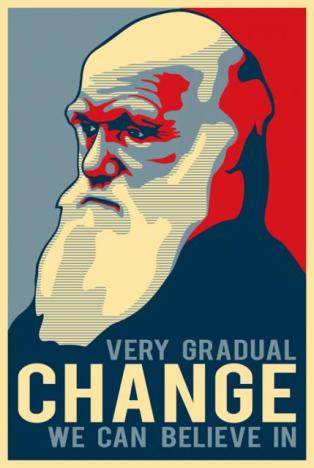
very-gradual-change

I just came from Idaho, debating a fundamentalist Christian writer and pastor, Douglas Wilson. The crowd of over 800 at the University of Idaho was full of members of his congregation, as well as students, and we debated civilly if passionately, and at the end of the debate a huge majority sided with him over me. Maybe over time, some of the points I made will resonate. Maybe they won’t. But what I do know, from my own experience, is that people can change their minds in a short period of time.

Only a short drive away from where I was speaking is Washington State, where marriage equality is legal. You can see this border – where I was instantly re-married as we drove in a pick-up truck across the border – as bizarre and incoherent (which, of course, it is), but you can also see this as something worth celebrating about such a vast and diverse country as this one. Opinion in those states differ widely – and in a democracy public opinion must count. Before Idaho, I was in Oregon, speaking on the same issue. Next year, that state looks likely to be the first one to overturn a constitutional ban on marriage equality at the ballot box. You want proof that argument and reason and time can work in a democracy? The marriage equality movement is Exhibit A: person by person, generation by generation, state by state.

Not only has federalism allowed those of us in favor of marriage equality to demonstrate that no bad consequences will come by giving gays the right to marry (Washington State’s divorce rate is lower than Idaho’s; divorce rates across the country have fallen in the decade when marriage equality became a burning issue; the first gay marriage state, Massachusetts, has the lowest divorce rate in the country); it prevents the imposition of an institution on people who do not want it or believe in it. This is what makes me a conservative, I suppose. Toleration is a two-way street. I loathe the idea of coercing anyone’s conscience, or allowing any one, central institution to enforce a one-size-fits-all solution on a diverse country, where conscience is at stake, where religious freedom matters, and where public opinion remains deeply divided.

I can see and appreciate the full liberal argument that Obama has not fully embraced. Couldn’t my gradualist, federalist, democratic argument, after all, have been made of the anti-miscegenation laws that once desecrated this country?

And the answer is yes. But mores evolve in a society; change occurs in the conscience and consciousness over time. The job of a conservative is to argue the case, when she sees fit, for change – but only when change is designed to retain the coherence of a society, not to do damage to its sense and understanding of itself. The Christian witness of Martin Luther King Jr and the simple dignity of Rosa Parks and the organizational genius of Bayard Rustin and the moral witness of so many, black and white, is what made the Voting Rights Act possible. Was America before that an unjust society? Yes. But by embracing that change, America became, in my view, more true to its founding documents, to its essential nature, than it was before. A conservative seeks to balance justice with the dispersal of power, the coherence of a culture, and the common, contingent meaning of a polity, its traditions and customs.

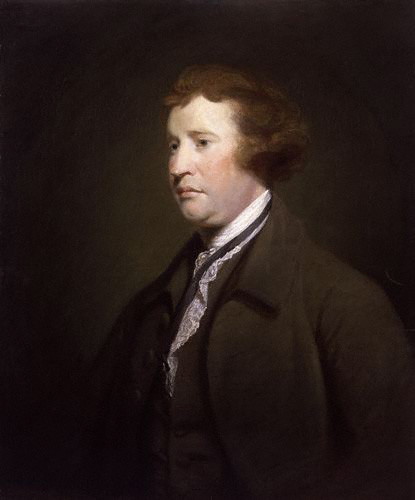
NPG 655,Edmund Burke,studio of Sir Joshua ReynoldsBut sometimes – in fact, often – you have to change an institution in order for it to stay the same. That was Burke’s insight, not Mill’s. And that’s why I have always held that marriage equality is as conservative a cause as it is a liberal one. Once gay people fully and finally owned their own equality in their own families, and their own families responded, once centuries of internalized self-hatred and oppression and criminalization gave way to self-worth and pride and freedom, keeping gay people out of their own families became, in fact, an attack on the family as it had actually evolved in this country. The humanity of gay people – intensely proven in the crucible of the plague – won out both within our own souls and the souls of others. And it was that shift in consciousness and culture that prompted legal reform. I think in a democracy, you change hearts and minds first if possible; then you change the law. And when you change it, you do so with caution, especially with a vital social institution like civil marriage.

That’s why DOMA was so pernicious. It made the federal government the sole arbiter of civil marriage when that judgment had always been left to the states. DOMA pre-empted the national debate and tried to shut it down. Mercifully, it did not prevent any states from embracing marriage equality if they wanted to; but for the first time in history, it said the federal government would not simply recognize the states’ decisions. That was wrong on conservative and federalist grounds. It was a key moment in the take-over of conservatism by religious fundamentalism. It was a declaration of war by a government on its own citizens. It was a mile-stone in the degeneracy of American conservatism.

The second argument the Obama brief makes in the Prop 8 case is neither conservative nor liberal. It assumes that if you oppose marriage equality in a democracy, you have to do so for a substantive reason, because the minority involved has been the object of such discrimination in the past. For the first time, the American government acknowledged that centuries of criminalization, stigma, cruelty and forced invisibility, and declared that “the undisputed twentieth-century discrimination has lasted long enough.”Hence the embrace of the judicial notion of “heightened scrutiny” when assessing laws that single out this minority for further discrimination by their own government.

If the reason is that the rights and responsibilities of marriage are inherently heterosexual, because of procreation, you have a very weak case, given what civil marriage now is for straights, and after the ubiquity of contraception, weddingaislebut you have a case. But if you have conceded the substance of the argument and granted gay couples all the rights and responsibilities of civil marriage – but denied them the symbolism of the the name – you are creating a separate but equal form of legal segregation that does nothing and can do nothing but express animus toward a minority or the need to segregate them from a common, binding institution. That simple segregation – without an argument – violates core civil equality. And there are eight states – California, Delaware, Hawaii, Illinois, Nevada, New Jersey, Oregon, and Rhode Island – that have laws that can only be understood as expressing the civil inferiority of gay couples. That must, in my view, end. And it can end without a resort to a sweeping federal decision across all 50 states.

What must also end is the federal government’s unconstitutional decision to distinguish between the marriage licenses in any given state where it is the law on the basis of gender. My marriage license in Massachusetts, New York and DC is indistinguishable in every respect from my heterosexual peers. The federal government has no business getting involved and creating a distinction. In fact, it has no way of actually telling from the licenses themselves which are gay and which are straight. It must infer that merely from our first names. When the feds are poring over a state’s marriage license to analyze the first names of the couple, it is way over the line. On almost any other issue, federalist conservatives would agree with that.

Which is why Obama is both advancing a liberal goal of equality with a small-c conservative concern for gradual change based on moral, empirical and spiritual evolution. He leads, like every Tory should, from behind the people he represents.

Benedict’s Farewell

Rembrandt_Christ_in_the_Storm_on_the_Lake_of_Galilee

Am I wrong to see in this an invocation of the Second Vatican Council’s insistence that the Church is not its hierarchy but the people of God?

It’s true that I receive letters from the world’s greatest figures – from the Heads of State, religious leaders, representatives of the world of culture and so on. I also receive many letters from ordinary people who write to me simply from their heart and let me feel their affection, which is born of our being together in Christ Jesus, in the Church. These people do not write me as one might write, for example, to a prince or a great figure one does not know. They write as brothers and sisters, sons and daughters, with the sense of very affectionate family ties. Here, one can touch what the Church is – not an organization, not an association for religious or humanitarian purposes, but a living body, a community of brothers and sisters in the Body of Jesus Christ, who unites us all. To experience the Church in this way and almost be able to touch with one’s hands the power of His truth and His love, is a source of joy, in a time in which many speak of its decline.

Benedict is a brilliant writer and thinker, one of the original architects, alongside Hans Kung, of the opening of the church fearlessly to the world. And it was his assumption of power, in my view, first as Rome’s doctrinal enforcer, then as its chief investigator of the ubiquitous abuse and rape of children (which must be counted, in my view, as a success in establishing new safeguards but as a terrible failure of accountability and responsibility for the past), and then as its Pope. He pledged to re-convert Europe with a newly authoritarian papacy, a rigid doctrinal discipline, and a purer, older form of Catholicism. He did not just fail; his papacy has been a rolling disaster for the Church in the West.

He lost Ireland, for Pete’s sake, if you’ll pardon the expression. His version of Catholicism entered the public square and has been overwhelmingly refuted, rejected, and spurned by not just those outside the Western church but by so many within it. And in his inability to rise to the occasion of unthinkable evil in the child-rape conspiracy – to clean house by removing every cardinal and every bishop and every priest implicated in any way with it – he has presided over the global destruction of the church’s moral authority. By his refusal to face the fact of huge hypocrisy in the church over homosexuality – indeed to double down on the stigmatization of gay people, reversing previous gradual movement toward acceptance – he has consigned the church to what might well become an institutional tragedy.

I think he knows this and knows he has not the strength to persevere through it. This passage moved me deeply:

I have felt like St. Peter with the Apostles in the boat on the Sea of Galilee: the Lord has given us many days of sunshine and gentle breeze, days in which the catch has been abundant; [then] there have been times when the seas were rough and the wind against us, as in the whole history of the Church it has ever been – and the Lord seemed to sleep. Nevertheless, I always knew that the Lord is in the barque, that the barque of the Church is not mine, not ours, but His – and He shall not let her sink.

The Lord seemed to sleep! He’s blaming the failures of his papacy on God Almighty. But notice the metaphor: the church is a sinkable ship, when left in human hands – in his hands – taking in the water of corruption, hypocrisy, denial, rigidity and above everything else, fear.

If we do not conquer that fear, if we do not rid ourselves of these corrupt old men, and their refusal to listen or converse, if we do not allow priests to know conjugal love and fatherhood, and to bring women to full and equal membership in the church – as Jesus clearly did – then I fear the ship that is the institutional church will sink.

But because we are the church, and every act of love in Jesus’ name is the church, and every sacrifice for another is the church, the actual church can never sink. It is, in his Holiness’s words a “community of brothers and sisters in the Body of Jesus Christ.” It lives on – in the lives of so many, lay and priests and sisters and brothers alike, men and women who have been betrayed by their nominal leaders, even as they witness to Jesus every day of their lives.

This church, whoever is elected Pope, will rise again. It will rise because in a world of such potential destruction, the message of non-violence and peace is more vital than at any time in the history of humankind. It will rise because the global capitalist system, while bringing so many out of poverty, is also now creating vast inequalities and straining the planet’s eco-system with a frenzy that we have an absolute duty to slow and control again. It will rise because the supreme values of the current West – money, power, fame, materialism – are spreading everywhere. And they lead us not to some future hell but to a very present one, in which the human soul becomes a means, not an end, in which human life is regarded as disposable not sacred, in which even the more enlightened countries, such as the US, legitimize the evil of torture and pre-emptive warfare.

We are the second generation of humankind capable of destroying the entire planet with weaponry. We are the first capable of destroying its very eco-system with greed. We need the Gospels more powerfully now than ever – because the stakes have become so great and humankind’s hubris so vast and expansive.

Yes, as a Catholic, I pray for a new Pope who sees this and can speak truth to the power of the world. But as a Catholic, I also know this will change nothing unless we begin that renewal from the ground-up.

(Painting: The Storm on the Sea of Galilee by Rembrandt.)

The Right And Marriage Equality: A Breakthrough

[Re-posted from earlier today]

Forgive me a moment to absorb this news. I was tipped off something was imminent, reading my email on a flight to Portland, Oregon. I’m speaking there tonight and attending a class there today – on marriage equality and conservatism respectively (if you’re a local Dishhead, the event is at 7.30 pm at the Smith Auditorium 900 State Street, Salem, Oregon. Tomorrow, I’m at the University of Idaho for a debate on the same topic hosted by Peter Hitchens. That’s at 7.30 pm at the University of Idaho’s Student Union Ballroom, in Moscow, Idaho).

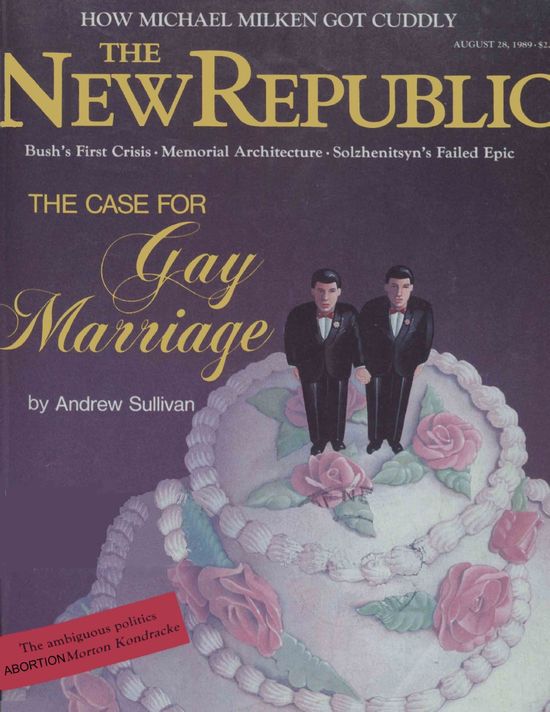
Over the years, after my 1989 conservative case for marriage equality, I must have given hundreds of these kinds of talks – in the late 1990s, it was basically all I tumblr_lni23xheku1qchhhqo1_1280did. Today, I rarely show up on TV. Then I accepted any invite on marriage. And my goal was to persuade sometimes uncomfortable audiences (I’ll never forget the events at Notre Dame and Boston College on Catholicism and homosexuality) that there really was nothing radical about integrating a previously marginalized community into the options of family and commitment and mutual responsibility, and the social status those virtues rightly acquire.

In the early 1990s, I might as well have been speaking Swahili – and was assailed, attacked, picketed, demonized and smeared to the point of personal trauma by the gay left. By the early 2000s, I was demeaned, pitied, ignored, ostracized and mocked by the Republican right. They were both, in my view, misguided and panicked – because the truth is: marriage equality is both a liberal and a conservative project. It’s liberal because of its insistence on equality; it’s conservative because of its insistence on responsibility, and because the alternatives – domestic partnerships/civil unions – are actually damaging to a critical social institution, civil marriage, by providing a marriage-lite option for all.

This conservative case was buttressed by my fellow conservative writers – learned, decent, honest intellectuals like Jon Rauch and Bruce Bawer and Dale Carpenter and John Corvino and many others. We were no Democrats. Most of us loathed the Clintons for what they did to the gay community, our rights and dignity. But we became more and weddingaislemore dismayed by our fellow conservatives, so many of whom did not simply remain on the fence but mounted a furious, passionate campaign against us. Bill Kristol’s response to this nascent movement was to bring legitimacy to the ex-gay movement; David Frum – back in the day – threatened to bring back enforcement of sodomy laws if we didn’t shut up. Republicans gleefully enshrined discrimination in many state constitutions – and bragged about it a little more loudly than Bill Clinton did the Defense of Marriage Act.

They decided, with Bill Clinton, on the most radical pushback to a fledgling movement imaginable: a Defense of Marriage Act that stripped our families of any rights under federal law, and, without Bill Clinton, a Federal Marriage Amendment that would single out gays as second-class citizens in the founding document of their own country for ever. And they used this hatred and fear of homosexuals quite openly as a way to win the 2004 election. It was crucial in Ohio that year. If Bush had lost it, Kerry would have been president. And Bush won it in large part by fear-mongering about gays.

For me, the FMA was the end of engagement and the beginning of war. You can read my reaction the day Bush endorsed it here. But I never stopped making the conservative case for marriage equality for the simple reason I believed in it. I never thought it would happen to me, but I knew it would have protected so many of my friends who didn’t have to just die agonizing deaths from AIDS but did so stigmatized and alone, their spouses treated often like dirt, their loves 400px-Aids_Quiltpublicly repudiated, their dignity grotesquely violated. This was, I believed, a matter of core humanity. It became for me the defining cause of my life.

A friend recalled visiting a man dying of AIDS at the time. A former massive bodybuilder, he had shrunk to 90 pounds. ‘Do I look big?” he asked, with mordant humor. In the next bed, surrounded by curtains, my friend heard someone singing a pop song quietly to himself. My friend joked: “Well not everyone here is depressed!” Then this from his dying, now skeletal friend: “Oh, that’s not him. He died this morning. That’s his partner. That was their song, apparently. The family took the body away, threw that guy out of the apartment he shared with his partner, and barred him from the funeral. He’s stayed there all day, singing their song. I guess it’s the last place he’ll ever see where his partner actually was. His face is pressed against the pillow. The nurses don’t have the heart to tell him to leave.”

You want to know why this became a life-long struggle? You have your answer. And I did this not despite being a Catholic, but because I am a Catholic. And I did this not despite being a conservative but because I am one.

This hideous cruelty in the midst of such shame demanded a Catholic and Christian response. This attack on people’s families, and their mutual responsibility (that man’s partner had cared for him for months, while his biological family kept their distance) was an attack on those institutions like civil marriage that are vital for a free society to keep its government in check. If that man’s husband hadn’t cared for him, the government would have had to. Why weren’t conservatives celebrating this man’s dedication rather than smearing him? Why could they not see in the gay community’s astonishing self-defense a Burkean model for social change from below – a dedication to saving our community independent of government that, if it happened in any other community, would have led the GOP to put those activists on the podium of the Republican Convention as exemplars of civil society at its best?

And that is what husband really means: to take care of someone. Why, I wondered, were conservatives actually doing all they could to prevent couples’ taking care of each other? Why would they barely tolerate it in a free society – but treat these responsible relationships as if they were threats to the very values they exemplified? Why would they want to discourage an emotional and domestic break against the huge force of testosterone that was and is bound to define a male-only community – and with a viral breakout helped wipe out 300,000 human beings in one generation? Why, for that matter, would they want to tear children from their lesbian mothers – or, even more sickeningly, recruit them to attack their own mothers, as NOM recently has?

It’s 24 years since I wrote that essay. But today, I see a phalanx of conservatives standing up for the equality of gay citizens. Here are some among the roster, which is now 75 and counting:

Meg Whitman, who supported Proposition 8 when she ran for California governor; Representatives Ileana Ros-Lehtinen of Florida and Richard Hanna of New York; Stephen J. Hadley, a Bush national security adviser; Carlos Gutierrez, a commerce secretary to Mr. Bush; James B. Comey, a top Bush Justice Department official; David A. Stockman, President Ronald Reagan’s first budget director; and Deborah Pryce, a former member of the House Republican leadership from Ohio who is retired from Congress.

Ken Mehlman, bete noir of the gay left for understandable reasons given his role in Rove’s gay-baiting 2004 campaign, was the key organizer. I’ve always believed that civil rights movements should be all about welcoming converts rather than hunting for enemies or heretics. And I think this is a huge achievement for Ken, morally, and politically. It is the right conservative thing to do. As the British Tory prime minister has put it:

I don’t support gay marriage in spite of being a conservative. I support gay marriage because I am a conservative.

Allahpundit is underwhelmed by the list. It does indeed lack, apart from Ros-Lehtinen and Hanna, current members of Congress. It lacks Dick Cheney, for example, a figure who holds this position but, as usual, does nothing about it – even when it directly affects his own family. It lacks Laura Bush – although she could still add her name. But, to her credit, Mary Cheney is there. So is my friend David Frum. The two strategists for the 2008 campaign, Steve Schmidt and Nicole Wallace are on it. Stephen Hadley and Israel Hernandez – two people very close to 43 – are there. Ken Duberstein, Alex Castellanos, Mike Murphy and Greg Mankiw are also on the list. These are not GOP lightweights. They are up there with Ted Olson.

The reason, to my mind, is quite simple. The Republican Party of Reagan who defended gay rights in the 1970s, of Bush 41 and even parts of Bush 43 is now emphatically and increasingly a party of the fanatical Christianist right, based in the South, and dedicated not to conservative politics but to dogma, theological and political. Some elements in the party may simply be wary of major change in a social institution – which is a perfectly legitimate worry. But as the statement notes:

Many of the signatories to this brief previously did not support civil marriage for same-sex couples; others did not hold a considered position on the issue. However, in the years since Massachusetts and other states have made civil marriage a reality for same-sex couples, amici, like many Americans, have observed the impact, assessed their core values and beliefs, and concluded that there is no legitimate, fact-based reason for denying same-sex couples the same recognition in law that is available to opposite-sex couples who wish to marry. Rather, we have concluded that the institution of marriage, its benefits and importance to society, and the support and stability it gives to children and families are promoted, not undercut, by providing access to civil marriage for same-sex couples.

So we now also have empirical data to reassure legitimate conservative concerns about damage to a vital institution. The first state with marriage equality continues to have the lowest divorce rate: 2.2 percent, compared with 2.5 percent before gays were allowed to marry. Compare that with the most anti-gay states: Alabama’s 4.4 percent – double Massachusetts – or anti-gay Virginia’s divorce rate of 3.7 percent, compared with marriage equality DC with 2.6 percent. More broadly, the divorce rate has come down in almost every state in the last decade – the very decade gays were allegedly going to destroy the Constitution. Stanley Kurtz was simply wrong. Gay marriage has entered our consciousness and reality as divorce rates have fallen. The linkage that Maggie Gallagher keeps talking about as a premise is a fantasy. If you can properly draw any conclusions from the data, the linkage works in the opposite way. Gay marriage has strengthened straight marriage – not the other way round.

Only prejudice and fundamentalist dogma now stand in the way. Whatever happens in the Supreme Court, exposing that matters. Showing that there is a debate among conservatives, as well as among people of faith, is a vital step forward.

I sometimes end optimistic posts with the Israeli saying, “Know hope.” But this is actually something a little different. It is knowing hope. And seeing it rise, finally and fitfully, above fear.

The full summary of the Amicus brief is below:

Amici are social and political conservatives, moderates, and libertarians from diverse religious, racial, regional, and philosophical backgrounds; many have served as elected or appointed federal and state office-holders. Many of the signatories to this brief previously did not support civil marriage for same-sex couples; others did not hold a considered position on the issue. However, in the years since Massachusetts and other states have made civil marriage a reality for same-sex couples, amici, like many Americans, have observed the impact, assessed their core values and beliefs, and concluded that there is no legitimate, fact-based reason for denying same-sex couples the same recognition in law that is available to opposite-sex couples who wish to marry. Rather, we have concluded that the institution of marriage, its benefits and importance to society, and the support and stability it gives to children and families are promoted, not undercut, by providing access to civil marriage for same-sex couples.

Amici do not denigrate the deeply held emotional, cultural, and religious beliefs that lead sincere people to take the opposite view (and, indeed, some amici themselves once held the opposite view). Whether same-sex couples should have access to civil marriage divides thoughtful, concerned citizens. Those who support and those who oppose civil marriage for same-sex couples hold abiding convictions about their respective positions. But a belief, no matter how strongly or sincerely held, cannot justify a legal distinction that is unsupported by a factual basis, especially where something as important as civil marriage is concerned. Amici take this position with the understanding that providing access to civil marriage for same-sex couples—which is the only issue raised in this case—poses no credible threat to religious freedom or to the institution of religious marriage. Given the robust constitutional protections for the free exercise of religion, amici do not believe that religious institutions should or will be compelled against their will to participate in a marriage between people of the same sex.

I. There Is No Legitimate, Fact-Based Justification For Different Legal Treatment Of Committed Relationships Between Same-Sex Couples

Laws that make distinctions between classes of people must have “reasonable support in fact.” New York State Club Ass’n, Inc. v. City of New York, 487 U.S. 1, 17 (1988). Amici do not believe that laws like Proposition 8 have a legitimate, fact-based justification for excluding same-sex couples from civil marriage. Over the past two decades, amici have seen each argument against same-sex marriage discredited by social science, rejected by courts, and undermined by their own experiences with committed same-sex couples, including those whose civil marriages have been given legal recognition in various States. Instead, the facts and evidence show that permitting civil marriage for same-sex couples will enhance the institution, protect children, and benefit society generally.

A. Marriage Promotes The Conservative Values Of Stability, Mutual Support, And Mutual Obligation

Amici start from the premise—recognized by this Court on at least fourteen occasions— that marriage is both a fundamental right protected by our Constitution and a venerable institution that confers countless benefits, both to those who marry and to society at large. … It is precisely because marriage is so important in producing and protecting strong and stable family structures that amici do not agree that the government can rationally promote the goal of strengthening families by denying civil marriage to same-sex couples.

B. Social Science Does Not Support Any Of The Putative Rationales For Proposition 8

Deinstitutionalization. No credible evidence supports the deinstitutionalization theory. … Petitioners fail to explain how extending civil marriage to same-sex couples will dilute or undermine the benefits of that institution for opposite-sex couples … or for society at large. It will instead do the opposite. Extending civil marriage to same-sex couples is a clear endorsement of the multiple benefits of marriage—stability, lifetime commitment, financial support during crisis and old age, etc.—and a reaffirmation of the social value of this institution.

Biology. There is also no biological justification for denying civil marriage to same-sex couples. Allowing same-sex couples to marry in no way undermines the importance of marriage for opposite-sex couples who enter into marriage to provide a stable family structure for their children.

Child Welfare. If there were persuasive evidence that same-sex marriage was detrimental to children, amici would give that evidence great weight. But there is not. Social scientists have resoundingly rejected the claim that children fare better when raised by opposite-sex parents than they would with same-sex parents.

C. While Laws Like Proposition 8 Are Consonant With Sincerely-Held Beliefs, That Does Not Sustain Their Constitutionality

Although amici firmly believe that society should proceed cautiously before adopting significant changes to beneficial institutions, we do not believe that society must remain indifferent to facts. This Court has not hesitated to reconsider a law’s outmoded justifications and, where appropriate, to deem them insufficient to survive an equal protection challenge. The bases on which the proponents of laws like Proposition 8 rely are the products of similar thinking that can no longer pass muster when the evidence as it now stands is viewed rationally, not through the lens of belief though sincerely held.

I. This Court Should Protect The Fundamental Right Of Civil Marriage By Ensuring That It Is Available To Same-Sex Couples

Choosing to marry is also a paradigmatic exercise of human liberty. Marriage is thus central to government’s goal of promoting the liberty of individuals and a free society. For those who choose to marry, legal recognition of that marriage serves as a bulwark against unwarranted government intervention into deeply personal concerns such as the way in which children will be raised and in medical decisions.

Amici recognize that a signal and admirable characteristic of our judiciary is the exercise of restraint. Nonetheless, this Court’s “deference in matters of policy cannot … become abdication of matters of law.” The right to marry indisputably falls within the narrow band of specially protected liberties that this Court ensures are protected from unwarranted curtailment.

Proposition 8 ran afoul of our constitutional order by submitting to popular referendum a fundamental right that there is no legitimate, fact-based reason to deny to same-sex couples. This case accordingly presents one of the rare but inescapable instances in which this Court must intervene to redress overreaching by the electorate.

Here are all the signatories so far:

—Ken Mehlman, Chairman, Republican National Committee, 2005-2007

—Tim Adams, Undersecretary of the Treasury for International Affairs, 2005-2007

—David D. Aufhauser, General Counsel, Department of Treasury, 2001-2003

—Cliff S. Asness, Businessman, Philanthropist, and Author

—John B. Bellinger III, Legal Adviser to the Department of State, 2005-2009

—Katie Biber, General Counsel, Romney for President, 2007-2008 and 2011-2012

—Mary Bono Mack, Member of Congress, 1998-2013

—William A. Burck, Deputy Staff Secretary, Special Counsel and Deputy Counsel to the
President, 2005-2009

—Alex Castellanos, Republican Media Advisor

—Paul Cellucci, Governor of Massachusetts, 1997-2001, and Ambassador to Canada,
2001-2005

—Mary Cheney, Director of Vice Presidential Operations, Bush-Cheney 2004

—Jim Cicconi, Assistant to the President & Deputy to the Chief of Staff, 1989-1990

—James B. Comey, United States Deputy Attorney General, 2003-2005

—R. Clarke Cooper, U.S. Alternative Representative, United Nations Security Council,
2007-2009

—Julie Cram, Deputy Assistant to the President and Director White House Office of
Public Liaison, 2007-2009

—Michele Davis, Assistant Secretary for Public Affairs and Director of Policy Planning,
Department of the Treasury, 2006-2009

—Kenneth M. Duberstein, White House Chief of Staff and Assistant to the President,
1981-1984 and 1987-1989

—Lew Eisenberg, Finance Chairman, Republican National Committee, 2002-2004

—Elizabeth Noyer Feld, Public Affairs Specialist, White House Office of Management and
Budget, 1984-1987

—David Frum, Special Assistant to the President, 2001-2002

—Richard Galen, Communications Director, Speaker’s Political Office, 1996-1997

—Mark Gerson, Chairman, Gerson Lehrman Group and Author of The Neoconservative
Vision: From the Cold War to the Culture Wars and In the Classroom: Dispatches from
an Inner-City School that Works

—Benjamin Ginsberg, General Counsel, Bush-Cheney 2000 & 2004

—Adrian Gray, Director of Strategy, Republican National Committee, 2005-2007

—Richard Grenell, Spokesman, U.S. Ambassadors to the United Nations, 2001-2008

—Patrick Guerriero, Mayor, Melrose Massachusetts and member of Massachusetts
House of Representatives, 1993-2001

—Carlos Gutierrez, Secretary of Commerce, 2005-2009

—Stephen Hadley, Assistant to the President and National Security Advisor, 2005-2009

—Richard Hanna, Member of Congress, 2011-Present

—Israel Hernandez, Assistant Secretary of Commerce for International Trade, 2005-2009

—Margaret Hoover, Advisor to the Deputy Secretary of Homeland Security, 2005-2006

—Michael Huffington, Member of Congress, 1993-1995

—Jon Huntsman, Governor of Utah, 2005-2009

—David A. Javdan, General Counsel, United States Small Business Administration, 2002-
2006

—Reuben Jeffery, Undersecretary of State for Economic, Energy, and Agricultural
Affairs, 2007-2009

—Greg Jenkins, Deputy Assistant to the President and Director of Presidential Advance,
2003-2004

—Coddy Johnson, National Field Director, Bush-Cheney 2004

—Gary Johnson, Governor of New Mexico, 1995-2003

—Robert Kabel, Special Assistant to the President for Legislative Affairs, 1982-1985

—Theodore W. Kassinger, Deputy Secretary of Commerce, 2004-2005

—Jonathan Kislak, Deputy Undersecretary of Agriculture for Small Community and Rural
Development, 1989-1991

—David Kochel, Senior Advisor to Mitt Romney’s Iowa Campaign, 2007-2008 and 2011-
2012

—James Kolbe, Member of Congress, 1985-2007

—Jeffrey Kupfer, Acting Deputy Secretary of Energy, 2008-2009

—Kathryn Lehman, Chief of Staff, House Republican Conference, 2003-2005

—Daniel Loeb, Businessman and Philanthropist

—Alex Lundry, Director of Data Science, Romney for President, 2012

—Greg Mankiw, Chairman, Council of Economic Advisers, 2003-2005

—Catherine Martin, Deputy Assistant to the President and Deputy Communications
Director for Policy & Planning, 2005-2007

—Kevin Martin, Chairman, Federal Communications Commission, 2005-2009

—David McCormick, Undersecretary of the Treasury for International Affairs, 2007-2009

—Mark McKinnon, Republican Media Advisor

—Bruce P. Mehlman, Assistant Secretary of Commerce, 2001-2003

—Connie Morella, Member of Congress, 1987-2003 and U.S. Ambassador to the
Organization for Economic Co-operation and Development, 2003-2007

—Michael E. Murphy, Republican Political Consultant

—Michael Napolitano, White House Office of Political Affairs, 2001-2003

—Ana Navarro, National Hispanic Co-Chair for Senator John McCain’s Presidential
Campaign, 2008

—Noam Neusner, Special Assistant to the President for Economic Speechwriting, 2002-
2005

—Nancy Pfotenhauer, Economist, Presidential Transition Team, 1988 and President’s
Council on Competitiveness, 1990

—J. Stanley Pottinger, Assistant U.S. Attorney General (Civil Rights Division), 1973-1977

—Michael Powell, Chairman, Federal Communications Commission, 2001-2005

—Deborah Pryce, Member of Congress, 1993-2009

—John Reagan, New Hampshire State Senator, 2012-Present

—Kelley Robertson, Chief of Staff, Republican National Committee, 2005-2007

—Ileana Ros-Lehtinen, Member of Congress, 1989-Present

—Harvey S. Rosen, Member and Chairman, Council of Economic Advisers, 2003-2005

—Lee Rudofsky, Deputy General Counsel, Romney for President, 2012

—Patrick Ruffini, eCampaign Director, Republican National Committee, 2005-2007

—Steve Schmidt, Deputy Assistant to the President and Counselor to the Vice President,
2004-2006

—Ken Spain, Communications Director, National Republican Congressional Committee,
2009-2010

—Robert Steel, Undersecretary of the Treasury for Domestic Finance, 2006-2008

—David Stockman, Director, Office of Management and Budget, 1981-1985

—Jane Swift, Governor of Massachusetts, 2001-2003

—Michael E. Toner, Chairman and Commissioner, Federal Election Commission, 2002-
2007

—Michael Turk, eCampaign Director for Bush-Cheney 2004

—Mark Wallace, U.S. Ambassador to the United Nations, Representative for UN
Management and Reform, 2006-2008

—Nicolle Wallace, Assistant to the President and White House Communications
Director, 2005-2008

—William F. Weld, Governor of Massachusetts, 1991-1997, and Assistant U.S. Attorney
General (Criminal Division), 1986-1988

—Christine Todd Whitman, Governor of New Jersey, 1994-2001, and Administrator of
the EPA, 2001-2003

—Meg Whitman, Republican Nominee for Governor of California, 2010

—Robert Wickers, Republican Political Consultant

—Dan Zwonitzer, Wyoming State Representative, 2005-present

Release The Assassination Memos

162132935

I think my patience broke with the revelation that the Obama administration was more willing to give Butters some bullshit info on Benghazi than to give any ground on releasing the full, complete, original memos used to justify the assassination of Americans who have joined the Jihadist enemy. The cynicism was staggering. Those of us who supported Obama need to express our disgust and anger at this – especially those of us who have defended the drone program as, within key judicial and congressional constraints, sometimes the least worst option in keeping us safe.

This cannot be regarded as somehow a state secret. It divulges no plans; it just explains to American citizens the criteria by which their own president can kill them from the sky without any due process. If the torture memos could be released by this administration, as they were, so can these. And not just to some Congressional Committee – to all of us.

Here’s a question Rand Paul has asked of John Brennan and to which the administration has never given an answer:

Do you believe that the President has the power to authorize lethal force, such as a drone strike, against a US citizen on US soil, and without trial?”

What excuse does Brennan have for not answering this? I’m with a recent stellar Greenwald post on this. Until he does, he should be kept from his nominated post at the CIA. This is a core rupture of the Constitution – as core as the rupture of executive torture. It redefines the relationship between the executive and the people he or she serves. It makes our president judge, jury and executioner of any American citizen anywhere in the world, including the US. We already know that the executive seized a US citizen without charges under Bush-Cheney and tortured him into a physical wreck of a broken soul. Torture is always illegal and evil; self-defense in a just war isn’t. But if the war is against your own citizens, then the very least that those citizens deserve is a full accounting of the rationale behind such a disturbing power-grab.

The president promised more transparency on this in his State of the Union. He has not delivered yet. Maybe he will – but I cannot say I’m optimistic with John Brennan potentially running the CIA. But what staggers me is the transition from candidate Obama to president. Many of us thought this one was different; he understood the new era of mass information and social media; he grasped the need to communicate directly to Americans in all sorts of unconventional ways; he pledged to end the abuses of executive power under Bush and he promised to be the most transparent administration in history.

And yet when it comes to how he decides whether to kill you sitting in your living room, he won’t let you know the legal basis for it, or allow a check from another branch of government that is not just a rubber stamp. It’s unacceptable. And this much I know: the CIA has long held presidents hostage and after they literally got away with war crimes, the current CIA appears to be unaccountable to anyone. War criminals who destroyed the evidence of their own crimes, like Jose Rodriguez, strut on the national stage as if they are inviolable, utterly above the law and beyond the public’s scrutiny. Because they are.

It’s time for the president to remind them who pays their salaries. We do. And when the deepest constitutional protections created by the Founding Fathers against the temptation of tyranny are cast casually and arrogantly aside with a “trust us” piece of bullshit, it’s time to get angrier.

(Photo: U.S. President Barack Obama waves after speaking at an event at the Eisenhower Executive Office Building February 19, 2013 in Washington, DC. By Win McNamee/Getty Images)

The GOP vs The Pentagon?

First some overdue business. On the authorship and meaning of the sequester, I think Ezra Klein basically cleaned Bob Woodward’s clock last week. Yes, the sequester appears to have been first suggested by Jack Lew, as a throwback to the 1980s, as a desperate last minute way to avoid a credit downgrade. But it was heartily endorsed 481px-Dwight_D._Eisenhower,_official_photo_portrait,_May_29,_1959by the GOP at the time as a way out of a horrible impasse and as a down-payment on triggered, automatic spending cuts. The pressure on the GOP was entirely because of possible defense cuts; the pressure on the Dems was because of automatic entitlement cuts. The goal was to make both sides so queasy they’d come up with a Grand Bargain of tax hikes, tax reform and entitlement cuts that would clear the air, end uncertainty and help us move on.

The committee failed; the elections loomed. Ezra’s right, I think, to see the elections as an endorsement of a mixed approach: raise revenues, reform taxes, and cut entitlements. Now some revenues have been raised – but only because without some modest concessions from the GOP, even more revenues would have been raised, tipping the economy into recession. But the implemented tax hikes, as the GOP has consistently and rightly argued, are nowhere near enough to tackle the debt. So we still do need real spending cuts in the medium and long run, especially in Medicare, and we do need defense cuts, to reduce a military-industrial complex now costing twice as much as it did a decade ago; and we desperately need tax reform and simplification. In that last option – tax reform and simplification – lies the least damaging way to raise essential revenues.

The GOP’s recent position, in contrast, was that all the cuts should come from the needy and entitlements, that none of them should come from defense, and that no increase in revenues is permissible at all – and that the sequester is horrible and all Obama’s fault. Perhaps sensing the total incoherence and unpopularity of this position, their response may be changing somewhat – and in a good way. More and more Republicans are prepared to see the military cut rather than raise taxes. That’s a BFD, if it pans out, a real shift in the balance of ideology within the Republican coalition. There’s a reason Bill Kristol is worried. This Kristol post is such an amazing bath in hathos I found myself reading it twice, letting the panicked, ponderous, pseudo-Churchillian prose roll joyfully around in the frontal cortex. It even has a shout out to Leo Strauss. Sit back and enjoy:

The plain is darkling. The world grows more dangerous. Yet we heedlessly slash our military preparedness. Iran hastens toward a nuclear weapon, which would pose an existential threat to Israel and signal a nuclear arms race in the Middle East. Yet the president nominates for secretary of defense a man who is patently unqualified for the position, who despises Israel, and who has a record of being exceedingly solicitous of Iran. We win in Iraq and make progress in Afghanistan, thanks to the valor and sacrifice of our troops, and the president puts these accomplishments at great risk because he chooses to pander to public war weariness rather than attend to America’s national interests.

There is more complete delusion, absurd hysteria and outright deception in that hysterical passage than in Sarah Palin’s autobiography. (We won in Iraq! Won! No WMDs found, no sectarianism overcome, tens of thousands of bodies, the collapse of America’s moral standing, and a strengthened Iran … and we won! One wonders what losing would have looked like.)

But back to the sequester. The president’s position, as I understand it, is here (hat tip: Chait).

The core fact to me, and, I suspect, many others who remain very concerned about financing the long-term debt indefinitely, is that the president has already cut $1.4 trillion in spending, while getting $600 billion in new revenues: more than 2:1, or roughly the balance of the British Tories. Going forward, if I understand this correctly, the president proposes $930 billion in new spending cuts, of which only $100 billion could come from defense. He’s also committed to cutting Medicare over the next ten years by the same amount proposed by Bowles-Simpson. If I were a Republican (and, of course, my brand of conservatism would make that currently quixotic), I’d jump at that deal.

Instead, the GOP is insisting on absolutely no new revenues, and recently insisted that all the cuts come from entitlements. I just don’t see how they win this argument, especially if they protect the Pentagon. And that may be why many of them are resigned to the sequester taking effect – and taking credit for it, including the big defense cuts. I have to say I’m fine with that. The spending reductions are not enough to fully sink the economy this year, although they will almost certainly drag us all down. I’d prefer a Grand Bargain, or a sane set of cuts (rather than the crude ones we now have), but if this is the only way we will ever be able to cut defense spending, I can live with it – especially if defense cuts implicitly get a GOP blessing. That’s a huge step forward toward some fiscal sanity on the right.

The trouble is: whichever of these positions the GOP takes will hurt them.  The president’s proposals for debt reduction are simply much more reasonable and pragmatic and doable than the GOP’s – and he has far higher favorable ratings than the Congressional Republicans. Obama’s approach is also much more popular. He just won re-election on those priorities – against a ticket that included Paul Ryan, whose cuts-only approach was front and center. A cuts-only, protect-the-wealthy approach would be hard enough even if Ryan and Romney and the Republicans had won the last election. A cuts-only, including-the-Pentagon, approach won’t be much more popular, but it also presents the possibility of a serious split in the GOP between fiscal conservatives and the spendthrift neocons.

Yeah, it’s a meep-meep. But a depressing one. The only positive aspect is that finally, the Pentagon might be reined in a little, because the GOP wouldn’t stop it. About fucking time.

(Photo: The official photograph of President Dwight Eisenhower, the best Republican president of the 20th Century, war hero and champion of keeping the Pentagon’s spending and political power under control.)

Guess Which Buzzfeed Piece Is An Ad

Since I’m going to be discussing forms of new media revenue with Friend of the Dish, Ben Smith, later today, I though it might be worth noting some aspects of Buzzfeed’s innovative model, i.e. “sponsored content” or “native advertizing”. I should start by saying I’m not trying to criticize anyone who’s trying to make new media work financially. We don’t know what works and there are various options. But Buzzfeed’s model is a hot topic – as was the Atlantic‘s resort to “native advertizing” in the Scientology fuck-up.

So let’s take a specific example which caught my eye the other day. Here is Buzzfeed”s post on Sony’s Playstation 4 posted yesterday at 8.07 pm. Despite being billed as “The Only Post You Need To Read About The PlayStation 4,” it was actually preceded by this post on Buzzfeed the day before about the same event, titled “11 Things You Didn’t Know About PlayStation”. The difference is that the February 19 post was “sponsored” by PlayStation and the February 20 one was written by two staffers with by-lines. Go check them both out and see the differences (an off-white background and acknowledgment of the sponsor) and the similarities (in form, structure and tone, basically identical).

To my eye, the two are so similar in form and content, I have a few questions to ask of Ben later today: were the people who wrote the first Sony-sponsored post employed by Buzzfeed or Sony? Or was it a team effort? If it was a team effort, why no Buzzfeed by-lines? Or did the same people write both the promotional copy and the journalistic copy?

Now go a little deeper on the sponsored page about the PlayStation 4. Here’s a screen shot of what you see on the side:

Screen shot 2013-02-21 at 12.04.18 PM

Were these sponsored or real?

The second post was put up on the same day as the first Sony-sponsored post, with the classic Buzzfeed headline: “10 Awesome Downloadable Games You May Have Missed”. But all of the posts in the sidebar above were sponsored by Sony, even though, as you can see, they are not distinguished as such. Once you slip into the advertorial vortex at Buzzfeed, everything that is advertizing appears as non-advertizing. Just keep clicking. When you’re on Buzzfeed proper (if that’s the right term), the sponsored posts are delineated, ethically, as I noted above, by an off-white color background that subtly makes them different and an acknowledgment of the sponsor.

So I don’t see an ethical line being definitively crossed here – just deliberately left very fuzzy. Maybe I’m old-fashioned but one core ethical rule I thought we had to follow in journalism was the church-state divide between editorial and advertizing. But as journalism has gotten much more desperate for any kind of revenue and since banner ads have faded, this divide has narrowed and narrowed. The “sponsored content” model is designed to obscure the old line as much as possible (while staying thisclose to the right side of the ethical boundary). It’s more like product placement in a movie – except movies are not journalism.

So my core worry is: who writes and composes these sponsored posts? Are they done in collaboration with Sony? Or does Sony do it all? Are any of the sponsored post writers also writing regular posts? If they are, what credibility does Buzzfeed have when actually reviewing PlayStation 4? By the way, here’s the end of their review:

Screen shot 2013-02-21 at 1.29.54 PM

And so we get a tease for what might well be a future Sony-sponsored post. I have nothing but admiration for innovation in advertizing and creative revenue-generation online. Without it, journalism will die. But if advertorials become effectively indistinguishable from editorial, aren’t we in danger of destroying the village in order to save it?

Update: To read the rest of the posts in this thread, go here.