Obama 1; Netanyahu 0

Peter Beinart explains what the Israeli election results may mean for the US:

A weaker Israeli government does Obama little good right away. For the past four years, Israel has boasted a prime minister strong enough to move boldly toward a two-state deal, but uninterested in doing so. Now it has a prime minister who lacks not only the ideological desire, but perhaps also the political strength. But Netanyahu’s weakness also means he’ll be less able to fend Obama off if the White House unveils a peace initiative. To the contrary, the more actively engaged Obama’s new foreign policy team becomes on the Palestinian issue, the shorter Netanyahu’s political life span will be. Right-leaning commentators sometimes claim that public disagreements between America and Israel stiffen Israeli spines and push them to the right. But in truth, such intervention helped topple Yitzhak Shamir in 1992 and Netanyahu himself in 1999. And while it’s unlikely it was the key factor, Obama’s recent dissing of Netanyahu probably played some role in his last minute drop in support.

The results do make Remnick look a little excitable and by inference, me too. But the story is complicated. It’s not that the hard right did not do well. Jewish Home got eleven seats, just shy of Labor’s. What trumped that was a new party, “There Is A Future” (which Goldblog drily notes is “such a Jewish name … Optimistic, but threaded with melancholy”). It focused on domestic bread-and-butter issues, and widespread resentment of the fecund but largely molly-coddled haredim. Goldblog – surprise! – doubts much progress will be made on the peace process or the settlements:

A Netanyahu-Bennett-Lapid coalition would be far more likely to take bold action against another of Israel’s threats, the rise of the ultra-Orthodox, than to take on the peace process. Thousands of ultra-Orthodox Haredi men don’t serve in the army and are on the public dole so that they can pursue full-time religious studies. And Haredi political parties are becoming more radical (ayatollah-like, in some ways), demanding sex segregation on public buses and generally trying to erase the line dividing synagogue from state. Lapid’s popularity is derived in large part from his stalwart stance against the privileges accrued by the ultra-Orthodox.

Remnick agrees that there are still many roadblocks to peace:

In the end, these election results suggest that there is greater fight in the center-left than any of the pre-election polls and journalism—my own included—suggested. Which is good news—but limited good news. Netanyahu, barring some freak of coalition infighting, will still be Prime Minister; the majority in the Knesset will still be conservative, including members of the annexationist far right; and the calculus standing in the way of a secure and decent end to occupation persists.

Michael Koplow examines the prime minister’s predicament:

Nobody should underestimate just how much pressure Netanyahu is now under from his own side, let alone from the parties on the left of the spectrum that would like nothing more than to bring him down. Netanyahu is in a very difficult spot, and while I am relatively sure he will be able to form a coalition and serve as prime minister, don’t expect it to last very long.

But Zvika Krieger adds:

The problem is that the parties as they stand now have little chance of presenting a viable alternative to Netanyahu. Lapid and Shelly Yachimovich (the Labor party leader, also a former journalist) are not seen as realistic candidates to be prime minister; in this election, they largely coasted off of issues related to the 2011 economic protests in Israel, but had little, if anything, to say on broader issues of peace and security. “A TV anchor can’t be prime minister; it just doesn’t work in Israel,” said Natan Sachs, a fellow at the Saban Center for Middle East Policy in Washington.

Brian Ulrich frames things differently:

Netanyahu’s bloc failed to meet expectations and the new government will probably last for only a couple of years, but this is far from the near-defeat for the incumbent prime minister some are presenting.

That sounds judicious to me, but I am not an expert. And when even the Washington Post announces that Netanyahu has been weakened substantially, it does seem to me to suggest that the Israeli public is not as obsessed as Bibi is about the allegedly existential threat of Iran. If it really were that existential, wouldn’t it have dominated the entire election? Ditto, alas, the settlements. By all accounts, they weren’t much of an issue. But for Netanyahu, in his relationship with the US, they are a huge issue. So on both his over-riding ambitions – war against Iran and permanent control of the West Bank through ethnic social engineering – Netanyahu is now much weaker vis-a-vis Obama.

Over the last four years, Netanyahu has won almost every single tactical victory over the American president. But strategically, Obama now has the upper hand, especially after his recent statement that Israel was not doing what is in its best interests did not backfire in Israel and may even have helped undermine Netanyahu.

Bibi is still highly likely to be prime minister for a while, but also as decapitalized by his re-election as Obama was recapitalized by his. That leaves an opening. In my view, the president and next secretary of state should now lay out a detailed, mapped, two-state division that the US supports and present it to both Fatah and Jerusalem. If Jerusalem balks, the US should switch its vote at the UN to abstain on Palestinian statehood. If the PA balks, we’ll discover something important about them: their willingness to sacrifice for a state alongside and at peace with a Jewish one. Hamas? Leave them out of it for a while, or open up a back-channel. But as Obama’s power waxes and Netanyahu’s wanes, it would be crazy not to seize the moment.

And that moment is defined by a core fact: the Israeli public is clearly not on the same page as America’s neoconservatives right now, not as fixated on the same things they are, and more concerned about their own core well-being than geopolitics or apocalyptic family psychodramas. What the American electorate just told the GOP, the Israeli electorate just told its own far-right government: moderate or get out of the way. Which could be put more simply.

Meep meep.


Lancing Lance

lancingLance

Like many others, I was transfixed last night. The first thing to say is that Oprah Winfrey is one hell of an interviewer. As an exercize in journalism, in an extremely fraught interaction, she was focused, clear, calm and relentless. Not since Martha Raddatz …

As for Armstrong, I’m afraid I cannot muster much anger about the actual use of what he correctly calls “performance enhancers”. If everyone is cheating, in some ways, no one is. And the ubiquity of performance enhancers in the sport when he was at its helm means he was competing against chemically-enhanced equals. He still won. Those drugs take human performance to new levels, but they do not abolish core and real athletic prowess, focus, and psychological grit. I’ve long believed in ending prohibition in sports on performance enhancers – because they are everywhere and unstoppable. We should rather have tests that ensure equality of enhancement. We could also have drug-free football, for example, alongside the steroidal monstrosities of the NFL. Fans might even prefer to watch human beings play the game again, rather than herds of steroidal human cattle, slowly turning their brains to mush.

My point is that we are all pharmaceutically-compromised now. From SSRIs to Adderall, from Xanax to taurine and caffeine energy drinks, it’s harder and harder to draw very clear lines between lance_hulkwhat chemicals are illicit and what chemicals aren’t. We don’t begrudge injured athletes drugs that alleviate pain and speed recovery. And the distinctions between preventing pain and improving performance will become harder to maintain.

I can see a day when human growth hormone is almost universally used among male retirees, just as testosterone is now being prescribed routinely to those facing the decline of age. I have a bias here. Without pharmaceuticals of extreme sophistication, I’d be dead. Without testosterone replacement therapy, I’d probably be terminally depressed and sick. Without Xanax, insomnia would destroy my productivity. But I hope that bias does not negate the fact that the human mind has made the human body qualitatively different than it was only a couple of decades ago. We don’t just live longer because of drugs. We live immensely better lives. This is a fact that will affect every aspect of our lives, and sports, of course, will be part of that. The money involved, the sheer power of the drugs, the availability of them … we can continue to deny this and get outraged every time it emerges, or we can begin to have a calmer, saner conversation about it.

No, to my mind, what’s disgusting about Armstrong was not his drug-use; it was his unconscionably vicious assaults on the truth-tellers.

He went so aggressively on the offense against far weaker human beings who were simply telling the truth. He used his fortune to bully, abuse and destroy them. He trashed their reputations, while celebrating his own. He lied and betrayed others every single step of the way. What he called so many of them is simply beyond belief. He never had to do any of that. And Winfrey brilliantly exposed the monster he became. What she unpeeled is what living a lie will do to anyone’s integrity. It isn’t a one-off event. It is a slow-burning destruction of the human soul.

And, of course, even if performance enhancers didn’t give him an unfair advantage over his rivals, who were also pharmaceutical experiments on wheels, they were nonetheless clearly banned in his sport, he knew it, and the rules matter. Real sportsmen follow rules; they don’t find elaborate, conspiratorial means to foil them. And the use of cancer-survival as a device to keep the truth at bay is simply despicable.

Look: I’m a libertarian in most things and a Christian. I believe in forgiveness – which must start, of course, with Armstrong and those he wronged. But what I see in Armstrong is extraordinary intelligence, peerless will-power, and staggering athleticism – all destroyed by pride and deceit. He is living proof that greatness and evil are often intertwined in the self-destructive longings of the lost soul.

We know this already. And we are all human. Not many of us can say we have never lied. But I just want to say how impressed I was by how skillfully Oprah Winfrey laid that truth out in front of us, like a patient etherized upon a table. She is a broadcaster without equal.

(Photos: American Lance Armstrong with team RadioShack rides in a breakaway during stage 16 of the Tour de France on July 20, 2010 in Pau, France. By Spencer Platt/Getty Images; a young fan holds a sign in support of Lance Armstrong as watches stage six of the USA Pro Challenge from Golden to Boulder on August 25, 2012 in Boulder County, Colorado. By Doug Pensinger/Getty Images.)

Israel’s Fundamentalist Temptation

“I would say that today Israeli democracy has one central mission, and that is to disappear. Israeli democracy has finished its historical role, and it must be dismantled and bow before Judaism,” – Benny Katzover, a leader in the settlement of Elon Moreh in Greater Israel, cited in a new must-read by David Remnick.

The entire report from Israel is as excellent as you’d expect from Remnick. Which is why it is also terrifying. As I argued in my post-9/11 essay, “This Is A Religious War,” and in my book The Conservative Soul, my own view is that the core dynamic in the world today is between fundamentalism and liberalism. By liberalism, I mean an acceptance of ideological and cultural diversity, a limited government, and a clear separation between church and state. This does not Israel_118mean an obliteration of religion; in fact, liberal democracy has, in America, helped religion flourish and evolve in constantly surprising ways, by no means all fundamentalist. By fundamentalism, I mean the attempt to enshrine certain scriptural or religious doctrines into literal reality for ever and to fuse them with politics and national identity.

Of course this is a grand simplification of a world beset by many other subcurrents. But the core battle between Western democracy and theo-political fundamentalism is as real as it is vital. In the US, thanks in large part to Obama and the younger generation, fundamentalism is losing the battle for hearts and minds for the time being, but remains dangerously irrational in its deep, panicked and bewildered hostility to modernity. In the Muslim world, it is waxing turbulently – from Pakistan to Egypt – and has killed thousands in its murderous wake. But it is also true that Greater Israel is, alas, an increasingly fundamentalist project, built on the most dangerous fusion there is: land and monotheism. All religions have the fundamentalist temptation, and Christianity has historically been one of the worst, but the point is not to single out any specific faith tradition, but to note this danger in all of them, and the distinction between a confident live-and-let-live faith and the neurotic need to enforce religious doctrine through civil law on others – a temptation that Jesus warned so often against.

Next week’s Israeli election will almost certainly mean the end of even the illusion of any two-state solution ever happening – and of a secular country able to make peace with its neighbors, let alone relent in its aggressive re-population of the occupied territories. It looks as if it will empower the fundamentalist, racist far right in ways we have not yet seen. Which is to say: If you fear a nuclear-armed theocracy emerging in the Middle East, Iran should not be your only worry. The slick and truly modern theo-fascism of a man like Naftali Bennett bears all the hallmarks of modern fundamentalism. Including its tendency toward violence when challenged.

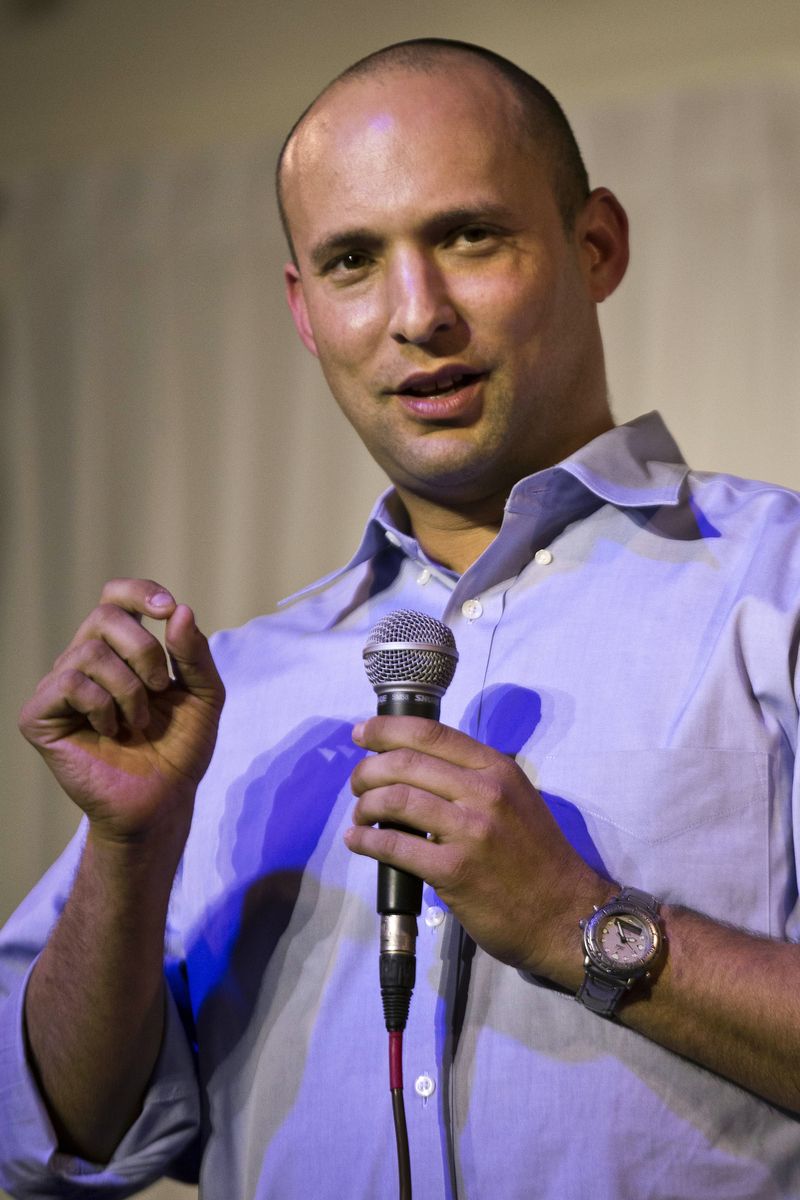
(Photo: Naftali Bennett, leader of the HaBayit HaYehudi (Jewish Home), delivers a speech during a meeting at the Tel Aviv International Salon on December 23, 2012. A former high-tech entrepreneur, the 40-year-old is a former protege of Prime Minister Benjamin Netanyahu and is expected to lead his party to one of their best results ever in the upcoming election. By Jack Guez/AFP/Getty Images.)

How Mainstream Is Pot?

noted that roughly ten percent of Americans admit to using marijuana in the last year and approximately a third of Americans admit to having tried it at some point. Dreher is underwhelmed by these numbers:

I have no doubt marijuana use is far more ubiquitous in cultural-liberal circles (which includes libertarians) than it is among cultural conservatives, and I also would point out that the kind of people who work in media (news and entertainment) are far more likely to be cultural liberals. This stands to distort their view of what’s mainstream and normative, as we’ve seen on other issues (e.g., religion and politics). I’m skeptical that marijuana is as accepted by the mainstream as legalization proponents say it is. I could be wrong, but this seems to me along the lines of the apocryphal epistemic-closure statement attributed to Pauline Kael, which could be restated: “I don’t know why marijuana remains illegal; I don’t know a single person who doesn’t smoke pot.”

Actually, I think Rod is the Pauline Kael in this respect. His own readers – who surely skew toward the culturally conservative – agree with me: “When we talked about this before on the blog, a number of you said I’m living in a bubble, that pot use is everywhere.” But one thing that unites red and blue America is their pot. CBS did a survey of states where cannabis is most used. In ascending order, the 18 states with the highest pot use are: Delaware, Hawaii, Michigan, Montana, Connecticut, New York, Washington, California, Maine, DC, Rhode Island, Oregon, Massachusetts, New Hampshire, Colorado, Vermont, and Alaska. Yes: Alaska is the biggest stoner state in the nation! And they are not miles apart: 11.9 percent of Delaware residents smoke pot, while 16.3 percent of Alaskans do. Among the states with decriminalized or medical marijuana laws are Montana, Alaska, Mississippi, North Carolina, Nebraska, and Arizona. I never thought of Mississippi and Nebraska as bastions of cultural elites. Does Willie Nelson strike you as a cultural liberal elitist? And you simply cannot get 50 percent support for legalization without widespread national awareness of pot use. May I recommend to Rod a quick perusal of the Dish’s little book, “The Cannabis Closet“, to see the full range of regional and cultural acceptance of marijuana.

Frum, on the other hand, fears that marijuana is becoming more and more mainstream:

I do not think marijuana is America’s #1 public health problem. That bad distinction goes to firearms – access to which I am also in favor of restricting and tightening. I don’t claim that marijuana is even the #1 drug problem. Tobacco is more deadly, alcohol blights more lives.

But here’s where marijuana is different from other drugs. With every other drug, attitudes today are less permissive today than they were a generation ago. Public opinion is tougher on booze, tougher on pills, tougher on tobacco. With marijuana, and marijuana alone, we are moving in the wrong direction: toward more acceptance, and even more promotion.

With every social problem, we start from where we are. We already have a tobacco industry. Over the past 15 years, that industry’s troubling marketing practices have been exposed. The question for today is: shall we create another such industry to market marijuana?

But has it occurred to David that the reason disapproval of other drugs has gone up and disapproval of marijuana has gone down is because people understand the difference. They know from their own experience that marijuana is harmless, compared with other legal drugs like alcohol, and certainly harmless compared with prescription drugs (20,000 deaths a year) or other street drugs. You can’t overdose on it; and it doesn’t lead to anti-social behavior, as long as you don’t count snoozing as anti-social. Meanwhile, arrests for marijuana have sky-rocketed in recent years, to 800,000. When social tolerance for something increases based on reality, and the government reacts by intensifying enforcement, you have what can only be called Prohibition. It was insane with alcohol; it is even more insane with marijuana.

What David is fighting is a social change based on empirical reality. Which is why I believe his position on this is not a conservative, but authoritarian and even liberal in its condescension toward the decisions of ordinary people living their own lives. He needs to trust the American people more.  I think of the marriage movement. Once people realized the fact that gay people are just like them, with the same emotional and psychological needs and family backgrounds, they saw no reason to deny them full inclusion in marriage. Similarly, once a critical number of sane adults understand that pot-use is of trivial concern, minimal harm and considerable pleasure, they have rightly placed it in a different category than, say cocaine or meth. Meanwhile, the government remains in la-la land.

So here’s a question for David: do you believe the government should alter its Schedule 1 classification of cannabis as having no medical use at all and in the same class as heroin? David is a believer in empiricism and rational public policy. Does he believe that pot has “no currently accepted medical use”? Does he believe that there is “a lack of accepted safety for use of the drug or other substance under medical supervision”?

If you want a sane drug policy, you cannot have a literally insane government classification of cannabis. And it is insane, David, isn’t it?

“Enhanced Advertorial Techniques”

I have to confess that the term “native ads” was new to me as I read the Atlantic’s spokesperson, Natalie Raab, explain the magazine’s propaganda page for Scientology – right next to journalists of the highest integrity, from TNC to Fallows. You might be too. Here’s what I found out about them from one man who played a part in coining the term last year:

“a form of media that’s built into the actual visual design and where the ads are part of the content.”

A little more Googling and I found this:

Launched three years ago, Native Solutions creates ad programs that have the look and feel of The Atlantic’s content. The goal: help brands create and distribute engaging content by making the ads linkable, sharable and discoverable. For example, take a look at the work it did with Porsche on the image-heavy sponsored post, “Where Design Meets Technology,” which was shared 139 times on Facebook and 80 times on Twitter. The Native Solutions programs has been so successful that it now accounts for half of digital ad revenue, which is up over 50 percent so far this year.

So you can see how letting advertizers drive content is lucrative and expanding. The Atlantic isn’t alone. Buzzfeed, Gawker, Forbes and HuffPo are all in the game – because online banner ads really are dead. But I can’t help but feel troubled by this development:

Like BuzzFeed, [Jay] Lauf has a 15-person creative team that helps brands create content and develop distribution strategies… Fidelity Investments is working with The Atlantic to find what Fidelity’s best assets are to tell its story. Fidelity, which uses its own in-house creative services team to create content, has a couple of campaigns on The Atlantic — one’s a video and accompanying infographic, the other is a series of pictures. Each is a branding mechanism, tying back to the financial company’s “Thinking Big” campaign.

Jay Lauf, again, is a great guy and a business genius. But when a magazine is actively working with an advertizer to “create content” that has “the look and feel of The Atlantic’s content” … well, all I can say is that if that is the future of online journalism, we should all be alarmed.

Which Side Is Now Pauline Kael?*

155570907

Noonan feels things:

There is no denying the Republicans have the passion now, the enthusiasm. The Democrats do not. Independents are breaking for Romney. And there’s the thing about the yard signs. In Florida a few weeks ago I saw Romney signs, not Obama ones. From Ohio I hear the same. From tony Northwest Washington, D.C., I hear the same.

Is it possible this whole thing is playing out before our eyes and we’re not really noticing because we’re too busy looking at data on paper instead of what’s in front of us? Maybe that’s the real distortion of the polls this year: They left us discounting the world around us.

Look: I don't know, and I don't, oddly, have a feeling at all right now. I leave that to the Log Cabin Republicans. But I do try to check my feelings against data, as opposed to anecdotes from friends about yard signs. I agree with John O'Sullivan, however, that it is vital not to believe that predictive data – even the best polling data – are reality. The reality is behind the curtain – subject to any number of utterly unknowable micro-factors. John has a classic English conservative, empirical attitude about this: he's fascinated to find out. Me too. But his American colleagues who all seem to be expecting a Romney landslide. Utterly convinced of it. Tomasky notes:

Wingers seem to know, or think they know. Of course they don't know, and deep down they know that they don't know, which must be a kind of psychological torture to them, and so they compensate for having to endure that torture by putting up that front of absolute certainty, which in turn brings its own rewards whatever the result. Their guy wins, they get to say, "Ha! I knew it all along." Their guy loses, they get to be outraged and blame the blacks, the media, the pollsters, Nate Silver. In a weird sort of way I suspect many of them prefer the latter outcome.

"That front of real certainty." It's a good phrase for what I have long called the "fundamentalist psyche."

Fundamentalism is not about belief; it's about the rigidity required because of faltering belief. It's not faith; it's neurosis. And it's at the heart of the GOP problem; it's why they cannot look at things empirically, refuse to acknowledge nuance, and cannot trust anyone who might be in touch with the reality fundamentalists secretly fear may be true.

In some ways, if this election does end in an Obama victory and a solid Democratic gain or hold in the Senate and minor GOP losses in the House (as now seems the more probable polling conclusion), then the cognitive dissonance might break. Even they will have a hard time arguing that Romney, who picked Ryan, has not been "conservative" enough. They've got Sandy to blame, but I'm unconvinced. Then they'll blame minorities, whose votes they will eventually conclude they need. It's a process.

I long argued it would get worse before it got better on the right. It did get worse. But if Obama wins, it just might get a little better. If the GOP greeted 2008 with denial about the Bush legacy and denial about Obama's potential, they then ran, Kubler-Ross-style,  into the 2010 elections with anger; then they bargained their way toward a debt ceiling fiasco (whose terms of resolution are about to bite them in the ass); then they got depressed – and then they went right back to Stage One after that first debate, and went right back into denial again.

Then there is the stage of acceptance, which may already be happening among some:

Republican Governors Chris Christie and Bob McDonnell, by praising President Obama, and New York's formerly Republican Mayor Michael Bloomberg, by endorsing him, are not leading their supporters to Obama; they are following them to protect their own political futures because they believe Obama will win. Bloomberg wants to preserve his centrist credentials, and there is no easier way to separate from Romney then by emphasizing the urgency of dealing with climate change. Christie governs a state in which the president is popular; his sudden admiration of Obama benefits both of them at the expense of Romney, who will have no way of paying Christie back if he loses. McDonnell was an early supporter of the Ryan budget, but now is backing away from the devilish details in that budget – like slashing FEMA.

As I said, I don't know. But if reality is what the state polls are overwhelmingly indicating, then we are going to get a psychic break on the right later this week and year. And that, if it occurs, will be extremely healthy. And long overdue.

* The most likely actual quote from Ms Kael was as follows: ""I live in a rather special world. I only know one person who voted for Nixon. Where they are I don't know. They're outside my ken. But sometimes when I'm in a theater I can feel them." See? She feels things too, just like Peggy Noonan.

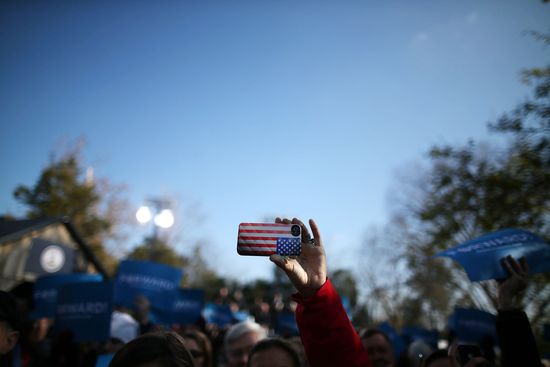
(Photo: A cell phone with an American flag cover is held up as U.S. Vice President Joe Biden speaks during a campaign rally at the Heritage Farm Museum, on November 5, 2012 in Sterling, Virginia. By Mark Wilson/Getty Images.)

The Reality Check Election

JEZ COULSON captainamericaromney

Yesterday, I tried not to think about the election for a day. The off-grid-because-no-grid experience helped me see there was little use at this point in obsessing about the tiniest of details that will be washed away by whatever reality flushes out on Tuesday or thereafter.

But that flush will be instructive. The narrative in the GOP blogosphere is of imminent triumph, even landslide. All the independents are surging toward Romney, the swing states are trending Romney, and the total failure of Obama's four years is so obvious you have to be a liar to believe that deficits have slightly declined on his watch, despite a collapse in revenues caused by the Great Recession. And so state after state is falling to Romney even as I type. Hinderaker – who still believes that George W Bush was a great president – sees one outlier poll in Pennsylvania as something that will be "sending chills down David Axelrod’s spine". It's one poll – and the only one that doesn't give Obama a clear edge. The poll of polls puts Pennsylvania as 50 percent Obama, 45 percent Romney, and it's been very stable. Minnesota? That's also got Hinderaker atwitter: he thinks both Minnesota and Pennsylvania could both "very possibly end up in the red column." All the polling suggests otherwise – but I guess they're all rigged.

Then there's Michael Barone's rather amazing forecast. Michael knows every inch of every district in a way few others do; he's deeply knowledgeable about the electoral process, and, his latest column predicts a Romney landslide:

Bottom line: Romney 315, Obama 223.

He gives Ohio to Romney on the following grounds:

Many polls anticipate a more Democratic electorate than in 2008. Early voting tells another story, and so does the registration decline in Cleveland's Cuyahoga County. In 2004, intensity among rural, small -town and evangelical voters, undetected by political reporters who don't mix in such circles, produced a narrow Bush victory. I see that happening again. Romney.

Does Michael remember a cynically placed gay marriage amendment in Ohio in 2004 that brought out the fundamentalists in droves? He also gives Pennsylvania, Virginia, Wisconsin and Iowa to Romney – which must mean a sudden enormous change in the polling is happening as we speak. 'Tis possible. I deeply respect Michael's expertise and integrity (unlike the rabid propagandist Hinderaker), so this is really a fascinating test case. I suspect it will be very tight nationally, and I try not to give predictions. But if Romney gets a landslide in the electoral college, many of us will have to reassess our entire understanding of America, politics and polls. And if Obama wins, Michael will presumably acknowledge where and how he was so, so wrong. There might even be a crack in the cognitive dissonance and epistemic closure across the right. I mean: the central issue in this campaign is Benghazi, remember?

The great thing about reality is that eventually you hit it. We are about to.

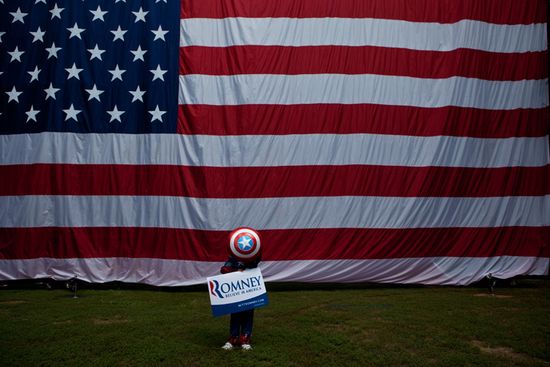
(Photo: Captain America comes to Romney's rescue on Halloween. By Jez Coulson, whose full portfolio of Americana can be found here.)

The Case For Mitt Romney

Frum tries to make it:

The country's most pressing economic problem IS the break-down of the old middle-class economy. Wages are stagnating at the middle, class lines are hardening, and more and more of the benefits of growth are claimed by the very wealthiest. President Obama delivered his answer to this problem in his important speech in Osawatomie, Kansas, a year ago: more direct government employment (at higher wages), more government contracting (to enforce higher wages), and more government aid to college students (in hope that expanding the number of degree holders will raise their average wage).

Obama is following a path explored by the British Labor governments of 1997-2010, when the majority of the net new jobs created in northern and western England, Scotland, and Wales were created in the public sector. That approach pushed Britain into fiscal crisis, when the recession abruptly cut the flow of funds from south-eastern England to pay everybody else's government salary. 

So far, under Obama, private sector job growth has vastly outpaced the public sector. And the big public unions, like the teachers', have been directly challenged. They're losing in the states. And in so far as inequality is driven by globalization, public investment in education has to be a key part of the answer. I agree with David on the benefits of a carbon tax, but which party is likelier to enforce that? I agree with him on the need for a balanced Grand Bargain – but I don't believe Obama wants to end the Bush tax cuts on those earning more than $250,000 because he wants more government. He's proposing that to help balance the budget over time.

But my real objections to David's endorsement are the following. The premise of his argument is that Romney is a liar of massive proportions whose campaign David accurately describes as "one long appeasement of the most selfish and stupid elements of the Republican coalition," but who actually, in private, doesn't believe a word of it. So not to worry. The "real" Romney will emerge – compassionate, moderate, practical and data-driven, as in Massachusetts – the day after he is elected.

Some questions. First off, he worked in Massachusetts with an 85 percent Democratic legislature. That's a guide to how he'd run the entire country with a Republican Congress? Not buying it. But secondly, if Frum is right, then Romney does not have the character to be president of the US. Someone who lies his way to the top will have no credibility with the American people and no mandate from his party. I do not believe we should elect a fathomless cynic to the White House. David's argument for Romney is even worse than David Brooks': Brooks predicts that circumstances will force Romney into pragmatism. Frum simply says that nary a jot of what Romney said in the primaries is what he actually believes.

To wit:

I don't want to see Obamacare repealed. I don't believe it will be, not even if the Republicans retake the Senate, which I don't expect either.

And yet Romney has said it will be his first priority on Day One to end the program despised by every element of his far right party. He says this almost every day. David thinks Romney is cynical enough to make that clear, binding pledge day after day, ad after ad, and then instantly renege on it, even with a Republican majority in both Houses. Again, if David's right, Romney lacks the character to be president. If he's wrong, he's voting for the wrong presidential candidate.

The question of what would better help get the GOP back to sanity and concern with solving the actual problems we face is a real one. David thinks that Romney would help. Given that he has surrendered at every single point in this campaign to the furthest right in his party – all the way from firing Ric Grenell to endorsing Richard Mourdock – I fail to see the logic. He Etch-A-Sketched as late as October because of this, which reveals his weakness with respect to his own party. (Compare his father's courage and candor to Mitt's cravenness and salesmanship.)

My own view is that the only way to rehinge an unhinged party is for it to lose badly. And because Romney put Ryan on the ticket, and endorsed the entire Tea Party shebang, it will be hard for the wingnuts to blame defeat on running a moderate. I think the likeliest combination for a Grand Bargain is Obama, a Democratic House and a Republican Senate. That won't happen. But the second likeliest is Obama, a Democratic Senate and a GOP House with a smaller majority. I cannot see Romney compromising on revenues at all if he is president, with a GOP House, which kills the chance for a deal. When Jim DeMint says that an Obama victory would force a GOP retreat on their no-revenue-increase-ever theology, I believe him.And when the left starts fretting that Obama really will cut a Grand Bargain that tackles entitlements, I think they have every reason to.

As for war, there is a clear difference between a candidate advocating pre-emptive war on a country for merely having the technological capability of having a nuclear bomb, and one advocating war as a last resort if a nuclear bomb is actually made and able to reach outside the borders of the country. One is a violation of just war theory and would make the West the aggressor in a global religious conflict. The other is the least worst option, given the power of the Greater Israel Lobby and US public opinion. The other difference is that Romney would launch a trade war with China at a very precarious moment in the global economy, and whose election would be greeted with dismay by every ally, except Israel's. Why? Because Romney will put the settlement policy on steroids and permanently end the chance for a two-state solution in Israel-Palestine. Romney will also bring back torture as an instrument of government policy in America. That's a huge moral difference.

There are many common areas between my views of where we are, and David's. And I too want a more vibrant and sane conservatism that can indeed reform Obamacare, scour government for waste, tackle Medicare's costs, radically reform taxes, and focus on inequality as a scourge of democracy. But that conservatism no longer exists in the GOP. And, in my view, only a thorough thumping of the extremists at the polls can bring it back.

Dear Barry Goldwater, From George Romney

Screen shot 2012-11-01 at 1.33.58 PM

[Map of Electoral College States in the presidential election of 1976. Blue is Democrat, Red Republican.]

There have been many moments during this campaign when I wondered what the late George Romney would have thought. No doubt whom he'd vote for, but the GOP his son now leads? Romney Sr refused to campaign for Barry Goldwater, and the bitterness lasted long after. The following are some things said by George Romney to Barry Goldwater about the direction of the party and the Southern strategy that now looks as if it could bear final fruit in Romney's Dixie firewall.

Screen shot 2012-11-01 at 1.37.18 PM

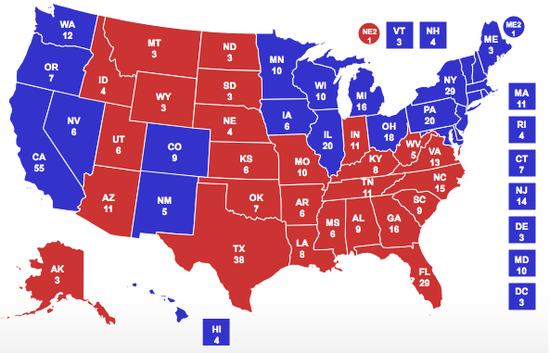
[Current RCP Electoral College map with no toss-ups.]

It's a fascinating letter and well worth reading if you are a moderate or independent thinking of voting for the Ailes-Atwater-Rove GOP that Mitt Romney panders endlessly to. Its warnings about the Southern strategy just emerging in Goldwater's opposition to the Civil Rights Act of 1964 are perhaps best illustrated by the maps above, where you can see how in three decades or more, the parties have switched positions geographically. In 1976, the Democrats under Carter won the whole South and lost the entire West and large swathes of the Northeast. By today, the GOP is the inheritor of the Confederacy geographically, and the West and Northeast – previous GOP strongholds – are now the Democratic base.

With that context, check out George Romney's disdain for the idea of ideological parties of the European kind:

First, as to your remarks in Jamaica concerning the possible realignment of the Republican and Democratic parties into “conservative” and "liberal" parties. Whatever the circumstances of the statement, you have indicated that you believe that might be "a happy thing." I disagree.

We need only look at the experience of some ideologically oriented parties in Europe to realize that chaos can result. Dogmatic ideological parties tend to splinter the political and social fabric of a nation, lead to governmental crises and deadlock, and stymie the compromises so often necessary to preserve freedom and achieve progress. A broad based two party structure produces a degree of political stability and viability not otherwise attainable.

Tell that to Hugh Hewitt. Romney then complained to Goldwater about the 1964 GOP Convention platform and had wanted to meet Goldwater in person to convey his concerns. The meeting didn't happen. Back to Romney:

Let me interject that that time the need for such a meeting had become all the more important. You were just about to take a position the 1964 Civil Rights Act contrary to that of most elected Republicans in and out of Congress, and there were disturbing indications that your strategists proposed to make an all-out push for the Southern white segregationist vote and to attempt to exploit the so-called "white backlash" in the North.

The delegates' mail was beginning to contain much of what I'm sure you would regard as "extremist," "hate” literature, backing you. A clear understanding of your position was needed, and I persisted.

It didn't satisfy Romney, who wrote Goldwater further:

A platform whose basic emphasis was on state, local and individual rights and responsibilities but which failed to pledge state, local and individual action in the civil rights field was clearly vulnerable to charges of inconsistency, and more important, of bowing to the segregationists in the South. With respect to the extremism amendment, as I said at the time:

"Experience shouts the differences between success and failure are small. I do not believe our country will survive present perils unless the Republican party provides the program and the leadership that will recapture the interest, respect and support of a majority of voting Americans.”

"With extremists of the right and left preaching and practicing hate, and bearing false witness on the basis of guilt by association and circumstantial rationalization and with such extremists rising to official positions of leadership in the Republican party, we cannot recapture the respect of the nation and lead it to its necessary spiritual, moral, and political rebirth if we hide our heads in the sand and decline to even recognize in our platform that the nation is again beset by modern 'know nothings.’"

Sounds like David Frum, no? The peroration:

The real challenge for us lies in the expansion of voter support for the Republican party in all parts of the country, urban or rural, North or South, colored or white. Without common dedication to this fundamental, our rehash of 1964 positions may become of interest only to the historians of defunct political institutions.

Below the fold is the full, prescient letter, Dec. 21, 1964 and published on November 29, 1966, in the New York Times. The shift from the father's Republican principles to the party the son leads is, well, striking.

Dear Barry:

Thank you for your letter of December 8. My apologies for not having answered sooner.

You have requested "an explanation" from me with respect to certain matters raised in your letter. I will try to cover them as frankly and fully as I can.

First, as to your remarks in Jamaica concerning the possible realignment of the Republican and Democratic parties into “conservative” and "liberal" parties. Whatever the circumstances of the statement, you have indicated that you believe that might be "a happy thing." I disagree.

We need only look at the experience of some ideologically oriented parties in Europe to realize that chaos can result. Dogmatic ideological parties tend to splinter the political and social fabric of a nation, lead to governmental crises and deadlock, and stymie the compromises so often necessary to preserve freedom and achieve progress. A broad based two party structure produces a degree of political stability and viability not otherwise attainable.

I believe, therefore, that we should exert every effort to broaden and strengthen our Republican party, as a means of preserving a strong
two-party system, which is an essential element of a free country.

Next, you state that you are "confused" about the language of the Denver statement that "we need to become inclusive rather than exclusive." It seems to me that the arithmetic of the election should make this unmistakably clear.

A political party which drops from 35,000.000 votes in 1960 to 27,000,000 votes in 1964 has certainly narrowed its orientation and support. The party's need to become more broadly inclusive and attractive should be obvious
to anyone.

Then, and I suppose this is the point which really prompted your letter, you repeatedly indicate that I was at fault for not "backing," "supporting'' and "cooperating 100 per cent with" the top of the national ticket. I suppose I could give you a short and summary answer to this but, to try to resolve misunderstanding, I will cover the point in some detail.

Cites Michigan Vote

First, let me point out that, based upon careful analysis, I'm satisfied that, without changes in your campaign, an endorsement from me would not have made any significant difference in the results of your election.

In Michigan, it would have shifted the state campaign from our Republican record of state progress to the national issues and candidates. Your 33% of the total Michigan vote included about 70% of the Republicans, 30% of
the independents and .5% of the Democrats. Reliable polls show that these percentages remained relatively constant from well before the San Francisco convention all the way through to the election.

The figures appear to have become fixed without regard to any comments or positions of mine. The Presidential campaign dominated Michigan's political consciousness, as I'm sure it did elsewhere. People made up their minds based upon your public positions and your campaign.

I don't make this point to duck responsibility. It's just a fact that should be recognized and you appear to recognize it when you say that "I don't claim for one moment that had you (and others) supported me I would have won."

Second, I believe I made every reasonable effort to bring about circumstances under which I could have "backed" and supported the national ticket. Long before San Francisco–going back to the fall of 1963, I expressed concern about my lack of understanding of your views on several matters which I regarded as vitally important.

In September of 1963 I requested, through your representatives, an opportunity to meet with you to discuss these matters privately and in depth.

(You refer in your letter to the meeting we had at my request much earlier in 1963 in your office in Washington. That discussion was largely limited to three points: (1) The fact that I had a commitment to the people of Michigan that I would not be a candidate for national office in 1964; (2) my invitation to you, as to other candidates, to appear in Michigan; and (3) my concern that your campaign in Michigan avoid, if possible, the involvement of individuals who might make it difficult to preserve party unity and harmony.

At that time I was inclined to support your possible candidacy because the issues that subsequently became of grave concern to me were not then particularly apparent. As a result, I didn't even mention them and discussed a few other matters only incidentally in that meeting.)

At any rate, the meeting I requested in September of 1963 did not occur.

No Meeting Arranged

During the winter of this year, after my earlier requests had been repeatedly renewed, your Mr. Clifton White did tell me he had had talked with you and that you would meet with me after the California primary. However, the meeting did not materialize.

Instead, at the Cleveland Governors' Conference, shortly after the California primary, where I had hoped to be able to meet with you, Paul Fannin handed me a copy of a statement of your positions on some issues, printed for use in the California primary.

In the newspapers I read that when you were questioned about our getting together for what by this time was my well-publicized desire for a discussion in depth, you said you had sent me a printed statement of your positions, and if I didn't understand it, I could get in touch with you.

Let me interject that that time the need for such a meeting had become all the more important. You were just about to take a position the 1964 Civil Rights Act contrary to that of most elected Republicans in and out of Congress, and there were disturbing indications that your strategists proposed to make an all-out push for the Southern white segregationist vote and to attempt to exploit the so-called "white backlash" in the North.

The delegates' mail was beginning to contain much of what I'm sure you would regard as "extremist," "hate” literature, backing you. A clear understanding of your position was needed, and I persisted.

I invited you to Lansing to meet with the Michigan delegates. You accepted. I then telephoned, inviting you through Mrs. Coerver because you were attending a meeting, to come early enough for dinner at my home and a thorough private discussion.

This was first accepted by telephone and then canceled because I was told "the boy said" you could not leave Chicago in time. I then indicated, in writing, my willingness to come to Chicago and fly back with you, so that we could visit on the plane. This was rejected and several days later reproposed by you but unfortunately, only after I had made other unbreakable commitments.

Phone Call Promised

You will then recall our chance meeting at the Washington Butler Airport on June 29. You indicated you could come to Lansing earlier than expected on the following day and that you would call me when you left Chicago.

The next day I not only received no call but you arrived half an hour late for your meeting with our delegation. We talked pleasantries with others present riding in from the airport and briefly in your suite before the meeting of the delegation. I conducted the meeting on the basis of written questions previously prepared by the delegation and used in a similar meeting with Governor Scranton. In my personal view some of your comments in response to delegates' inquiries particularly on civil right and extremists, raised more questions than they resolved. However, I did not regard that relatively open meeting as an appropriate place for me to express to you my concerns. The meeting ended and without saying anything about your failure to arrive on time or of our long sought “discussion in depth," you left.

Following this all-out effort at such a discussion, I decided it was futile to try further before San Francisco.

Sound Platform Sought

However, my efforts to bring about circumstances under which I could support the ticket continued. In my public statements and actions, I placed heavy emphasis on the vital importance of a sound platform.

In a memorandum submitted to Congressman Laird at his request a week before the convention, I spelled out some recommendations of my own, and some offered on behalf of the Republican Governors. This memorandum dealt importantly with positive steps to avoid centralization in Government, emphasizing state, local and individual responsibilities. It also included the points on civil rights and extremism which were later to be the basis for my proposed amendments to the platform.

I presented this memorandum in person and in writing to the entire platform committee on July 8th in San Francisco. My testimony specifically urged, among other rights, that the platform pledge Federal, state, local and individual action to promote the civil rights of all Americans. I also urged the repudiation of extremists who might attach themselves to the party or its candidates. My proposals were subsequently presented in written form to the Platform Committee in debate and were rejected.

Contrary to your statement, my amendment on extremists was offered to the Platform Committee by Richard Van Dusen, the delegate from Michigan and was rejected. Both amendments were next presented, and before the convention consideration of the platform, to your Platform Committee representative, Congressman Rhodes, and he rejected them. I personally discussed the importance of such amendments, briefly and separately, before their being offered on the floor with Congressman Rhodes, Paul Fannin and Richard Kliendienst.

These were not amendments which called for any compromise of your principles, if in fact you find no quarrel with the Denver statements on civil rights and extremism. But they were essential if the party was to be soundly positioned for the campaign on the basis of principles I am convinced are essential to the future of freedom in America and around the world.

Further a platform whose basic emphasis was on state, local and individual rights and responsibilities but which failed to pledge state, local and individual action in the civil rights field was clearly vulnerable to charges of inconsistency, and more important, of bowing to the segregationists in the South. With respect to the extremism amendment, as I said at the time:

"Experience shouts the differences between success and failure are small. I do not believe our country will survive present perils unless the Republican party provides the program and the leadership that will recapture the interest, respect and support of a majority of voting Americans.”

"With extremists of the right and left preaching and practicing hate, and bearing false witness on the basis of guilt by association and circumstantial rationalization and with such extremists rising to official positions of leadership in the Republican party, we cannot recapture the respect of the nation and lead it to its necessary spiritual, moral, and political rebirth if we hide our heads in the sand and decline to even recognize in our platform that the nation is again beset by modern 'know nothings.’"

Private Discussion

The failure of your representatives to accept these concepts left the party in an exposed and vulnerable position. A leading Southern delegate in a private discussion with me, opposing my civil rights amendment after it was introduced but before it was offered, made it clear that there had been a platform deal that was a surrender to the Southern segregationists, contrary to the entire tradition of the party. And it appeared that there was a willingness to accept, perhaps even welcome the support of irresponsible extremists such as those you clearly reject in the Dec. 21, 1964, U.S News interview.

Serious as this weakness was, you could still have corrected it by speaking out clearly and unequivocally. Unfortunately, your acceptance speech moved in precisely the opposite direction, seeming to approve the platform as adopted and to throw down the gauntlet to those who had dared to suggest it could be improved. Then the replacements made on the national committee executive committee by your appointee, Dean Burch, added to the evident intention to restrict direction of the campaign and the party to those who had supported you before the convention. The very ones needed to give the campaign broad and inclusive direction were replaced.

Despite these developments, I still keep the door open for an endorsement of you. On July 15, 1964, as the convention ended, I said:

"As the national campaign progresses in a . . . responsible manner free of hate-peddling and fear spreading and devoted to the issues of the day, I will be happy to support it."

Reviewed Amendments

Just ahead of the Hershey conference, you invited me to Washington for the type of "discussion in depth" I persistently sought for most of the nine months before San Francisco. At that meeting I reviewed the reasons behind the proposed platform amendments on civil rights and extremism, only to be told by you that you had only read a few sections of the platform and didn't know what amendments were being offered.

On that occasion I told you of a leading Southern delegate's revelation that a deal had been made on the platform's civil rights language which our Michigan amendments violated. I also urged you to recognize the need to overcome the effect of Governor Wallace's withdrawal and some Ku Klux Klan endorsement.

You cited your personal dedication and action to eliminate discrimination and human injustice as you did many times before and during the campaign—a personal attitude I do not question now and did not question then or at any time. However, I did my best to point out the inconsistency between your personal record and public record including the arbitrary rejection of my San Francisco amendment which was offered separately from the Rockefeller-Scranton amendment because it dealt only with principle and was not related to the candidacy fight.

While this made no apparent impression on you, at the end of our conference, which also included a shorter discussion of the extremism issue, you asked me to let you have any suggestions before the Hershey conference. This I did in writing, urging a public statement by you at Hershey that would include this key language:

"The enduring solution must be a personal solution in the hearts and minds of individuals. That is why we must encourage civil rights actions by individuals, in families, in neighborhoods, and at the community and state levels of government.”

"The rights of some must not be enjoyed by denying the rights of others. Neither can we permit states' rights at the expense of human rights. The basic principles of individual rights and states' rights are indivisible from individual responsibilities and states' responsibilities."

Extremism Suggestion

My extremism suggestion recommended this statement on your part:

"Extremism in defense of liberty is not a vice but I denounce political extremism, of the left or the right, based on duplicity, falsehood, fear, violence, and threats when they endanger liberty."

"A political extremist in my view is one who advocates overthrow of our Government through either peaceful or violent means; one who uses threats or violence or unlawful or immoral means to achieve political ends; or one who believes that the political end justifies the use of any means, regardless of the effect on others."

"Such political extremism destroys liberty, and is a vice."

"With one or two exceptions, I cannot condemn groups as groups. Guilt by association is contrary to American principles of justice."

In the subsequent inadequate opportunity for discussion at Hershey it was apparent you were not planning to make such strong clarifying statements. As a result, three times in the group meeting I tried to point out your need to recognize and correct the conflict between your personal and public record, My final plea was voiced in essentially these words:

Barry, in essence what I'm urging is that you urge others to do in the field of civil rights what you say you have done at the private, local and state levels. To advocate it with such conviction that everyone will know you mean exactly that.

Notes Campaign Actions

In one response, you said that I was questioning your honesty.

As far as the campaign itself was concerned, I ran as a Republican on a record of state progress built with the assistance of Republican legislators. I endorsed statewide and local Republican candidates and appeared with hundreds of them. I instructed the G.O.P. State Central Committee to extend full support based on Republican accomplishments. I ran as a Republican and I won as a Republican.

Despite our landslide losses in local and state offices, we have stopped the progressive membership shrinkage of the Republican party in Michigan and have started to broaden its base. We are now in the process of taking steps in Michigan similar to those recommended in the Denver Governors' statement designed to broaden and strengthen the party nationally. To the extent I can, I want to help in this effort.

I cannot accept the blame for the divisiveness in the party when you, your representatives, and your campaign strategy refused to encompass those of us who had reservations based on basic American and Republican principles. My reservations I voiced privately to your representatives and publicly on many occasions for some months before the San Francisco convention. Dick Nixon, since you draw the analogy, was astute enough to reach understandings with you and Governor Rockefeller in 1960.

At no time before or during or immediately following the convention did you move effectively to restore the unity of the party. You certainly knew the Hershey conference had failed to do so. Points of principle raised in discussion were not resolved nor did the conference have any apparent influence on the campaign.

Acceptance Speech Cited

Many in the party detected intransigence in your attitudes before, during and after the 1964 convention, culminating in your acceptance speech which, among other things, said:

"Any who join us in all sincerity, we welcome. Those who do not care for our cause we do not expect to enter our ranks in any case."

Indeed, the conduct of the campaign and the Nov. 3 election results demonstrated that your campaign never effectively deviated from the Southern-rural-white orientation. Preconvention discussion and postelection discussions with some who were active in your campaign brought to my attention distressing evidence that this was part of the strategy.

Now, Barry, I do not assert you were aware of this strategy or the author of it. I frankly can't believe you shaped it. You didn't read the platform adopted in San Francisco and you didn't know what amendments were being offered on the floor so you were obviously leaving many vital things almost entirely up to others, vital things about which you were not personally informed. This may account for your inability to see the inconsistencies I tried so hard to help you recognize.

However, for these philosophical, moral and strategic reasons, I was never able to endorse you during the campaign. Of course, millions did because they believed your leadership would inspire a rebirth of Americanism and a strengthening of constitutional government.

I, too, am one dedicated to these objectives, but I know they cannot be realized if foundation principles of American freedom are compromised. The chief cornerstone of our freedom is divinely endowed citizenship for all equally regardless of pigmentation, creed or race.

Unwilling to Compromise

It is true I said on the "Face the Nation" television interview that I did not endorse you because I was not willing to compromise one iota the principles I fought for in San Francisco. But this did not make it "rather clear that you expected me and others to compromise theirs" as you assert. I have never suggested that to you or anyone else.

One reason I was so anxious to talk with you in depth before the convention was because I felt sure we would be in agreement in principle on the above issues and others, providing there was adequate opportunity to discuss them, but I was denied this opportunity until it was too late.

Now, I realize that our busy schedules contributed to the problem, but I sincerely tried over a nine-month period to arrange a discussion. Our relatively public meetings were hardly appropriate "to bury our differences " as you put it. So, if our positions were really closer than it appeared, all I can say is that I made my position known on many occasions and did my best to discuss them with you personally and in depth.

As to the governmental centralization, we do share a common apprehension and concern. But, then you ask me, "Where were you, George, when the chips were down and the going was hard?" Well, Barry, for a long time I've been right on the firing line.

All Republicans (and, I believe, most Americans) are increasingly concerned about constant centralization, but many of us believe we must have a positive rather than negative approach to this increased Federal control.

At San Francisco, I offered a detailed program for stronger state and local government cooperation and activity, plus recommendations that could result in a recovery of certain functions from Federal control. On behalf of the Republican Governors' Association, I urged the Resolutions Committee to adopt these proposals. For the most part the recommendations were ignored by the committee and in your campaign.

In Michigan, I entered public life to help modernize Michigan state and local government as an essential step in slowing and reversing the constant flow of responsibility to Washington. It is futile to talk about stopping centralization and the eventual nullification of our constitution without removing the antiquated obstacles at the state and local level that prevent meeting the needs of the people effectively in the right place.

Urges ‘Sound Solutions’

I do not believe we can prevent unsound solutions to current problems by sheer opposition. My experience convinces me we must present sound solutions based on applying our proven principles to current problems in the development of specific, positive programs.

Only in this way can we stop the adoption of unsound national programs to fill personal, private, local, state and national vacuums. For instance, talk about states' rights will not be an adequate substitute for state responsibility. We are beginning to prove in Michigan, and in some other states, what it takes to deal with centralism.

In light of your recent public statements joining me with Nelson Rockefeller, may I point out that at no time did I publicly or privately say or do anything to create "the bomb scare or Social Security scare." I never discussed them. Nor was I part of any stop-Goldwater effort before or at the convention.

Finally, this has been a difficult letter to write. It is all too apparent that we have differing interpretations of the events of this hectic year. What I have tried to do is to answer your questions about the past. Having done so, I—as I believe you are—am much more concerned with the party's future than its past.

Early Meeting Favored

Just as I believed in full and frank discussion of intraparty differences (and agreements) before the election, I believe in it now. The sooner we can get together and discuss the recovery of the G.O.P., the better. The sooner we can get together with others, as well, the better.

Your agreement with the statement of principles and unifying recommendations adopted by the Republican Governors' Association bodes well for productive future conversations. I urge your early direct public endorsement of it.

I also urge you to take the initiative in calling the leadership planning group meeting that is recommended instead of fighting the implementation of that hopeful aggreement. This would be constructive and a big step in the right direction.

The real challenge for us lies in the expansion of voter support for the Republican party in all parts of the country, urban or rural, North or South, colored or white. Without common dedication to this fundamental, our rehash of 1964 positions may become of interest only to the historians of defunct political institutions.

Intraparty Talks Urged

I believe an intraparty leadership conference representing all elements of the party is essential to unifying and strengthening it. Based on our experience at the Denver Governors' Conference, I know it will take a schedule that provides adequate time for the frank, sincere, searching discussion that is essential in resolving misunderstanding and hammering out agreement on principles and programs.

The Denver conference is the only one in which I have participated involving representative party leadership from any party segment where such a procedure was used and such a result achieved.

It was a significant accomplishment to arrive at unanimous agreement in a group representing the diversity in viewpoint of a Paul Fannin and Nelson Rockefeller.

It was also significant that a preponderant majority exercised restraint and did not force their position into the approved statement contrary to the views of a significant minority.

I hope you will actively support the Denver recommendations designed to achieve needed national leadership agreement and understanding. I regret such a leadership conference could not be convened ahead of the Chicago meeting of the National Committee. This I advocated but reluctantly abandoned as being impossible considering the time problem.

You may be sure I am prepared at any time to meet with you or other party leaders to increase our effectiveness in strengthening our party for the essential task it faces of arousing the nation to the developing national crisis and providing the programs that will get us back on the road to realizing America's divine destiny.

Barry, from a personal standpoint as well as party standpoint, I wish the past year had turned out differently so I could have followed my personal attitude toward you as a friend and endorsed you.

Lenore joins me in wishing the new year will be one of health and happiness for you and Peggy and your loved ones.

Sincerely, ?GEORGE ROMNEY

The GOP’s Geography And The Confederacy

I made a point on ABC News' This Week this morning that George Will described as "empirically false." Here's the clip:

This embed is invalid

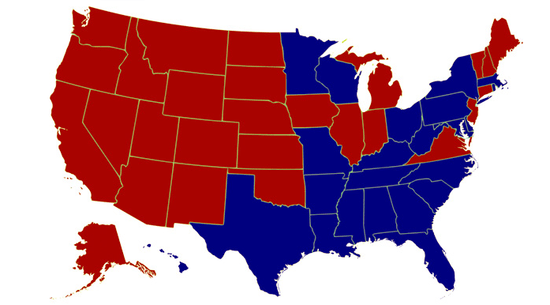
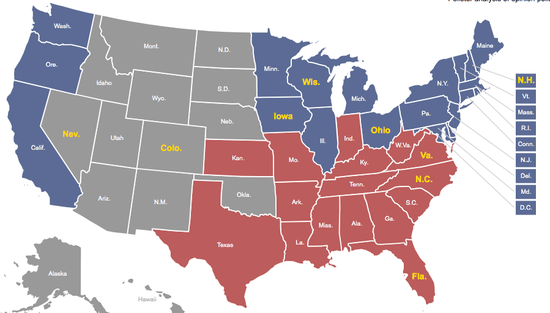
I made the following claim: that if Virginia and Florida and North Carolina flip back to the GOP from Obama this November, as now looks likely, Romney will have won every state in the Confederacy. And if you look at the current electoral map without toss-up states, and only the states that were in existence in 1861, you get this comparison:

Screen shot 2012-10-28 at 3.36.50 PM

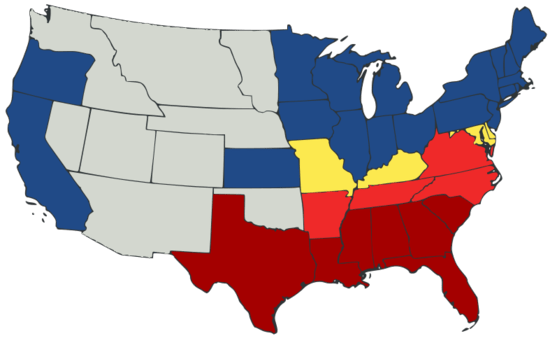
Here's the map of the states in 1861, colored for their position on slavery:

US_Secession_map_1861

Are you not struck by the similarities? (The yellow states were not part of the Confederacy but backed slavery. Kansas is an exception, and Maryland and Delaware along the border too). I am not saying (and in the conversation it's a little garbled and I can see why Heroge might have interpreted me as saying) that that the only states that will switch from Obama to Romney this year were Confederate states. Indiana is the exception. I was saying that if Obama loses North Carolina, Virginia and Florida – which I suspect he will – then the 2012 map will more closely resemble the civil war map than 2008, when the same pattern was striking.

I think America is currently in a Cold Civil War. The parties, of course, have switched sides since the 1964 Civil Rights Act. The party of the Union and Lincoln is now the Democratic party. The party of the Confederacy is now the GOP. And racial polarization is at record levels, with whites entirely responsible for reversing Obama's 2008 inroads into the old Confederacy in three Southern states. You only have to look at the electoral map in 1992 and 1996, when Clinton won, to see how the consolidation of a Confederacy-based GOP and a Union-based Democratic party has intensified – and now even more under a black president from, ahem, Illinois.

I find it troubling – and interesting.