Emanuel And Menino: Liberal Bullies

I haven't commented on the Chick-Fil-A issue because, well I was too busy enjoying Mitt in London. Which is another reason to celebrate the existence of Glenn Greenwald. Here's a classic Greenwald post – full of OCD updates, relentlessly researched, thoroughly linked, addressing every single counter-argument. Let me just add one word: amen.

Intimidating a business because its chairman expresses his perfectly legitimate – if to me, misguided – views, should have absolutely nothing to do with a civil rights movement. Civil rights movements are about expanding freedom, including for those with whom we disagree. The impulse by some well-meaning heterosexual allies to ban or shut down or somehow use the power of the state to police thought in this way is simply anathema to what we ought to stand for. There is no contradiction between marriage equality and a robust defense of the rights of those who oppose marriage equality – including maximal religious freedom and maximal free speech. In fact, it is vital that we eschew such tactics, as they distract from a positive argument that has been solidly winning converts for two decades.

The point is that we all have to live together even while we passionately disagree. That toleration is the challenge of our time, and it goes both ways.

If we gays now try to suppress others' rights, we have become nothing less than what we have opposed for so long. And there's a worrying tendency – more pronounced on the right than left, but still potent on the far left – not simply to oppose the arguments of the other side in a cultural debate, but to delegitimize them as people of equal standing. But calling a bunch of good-faith people bigots and leveraging government power against them is, in my mind, no morally different than calling a bunch of people perverts and leveraging government power against them.

No hate crimes laws; no restriction of the free speech of our opponents; no infringement on religious freedom; no delegitimization of the perfectly legitimate (if, to my mind, deeply flawed) argument that civil marriage be reserved exclusively for heterosexuals. Just equality. And freedom. If Emanuel and Menino want to know how a straight ally acts, look at Jeff Bezos. You can support civil rights by enlarging speech, not restricting it.

Obama’s Biggest Blunder Yet

I know full well that the full context of the “You didn’t build that” quote largely exonerates Barack Obama from the absurd charge that he somehow dislikes or loathes individual achievement, entrepreneurship, and business. But for the second time in this campaign, Romney’s most powerful weapon against Obama is Obama’s words themselves. In this extremely close election, Obama cannot afford unforced errors. And yet this is his second. His statement that “the private sector is doing fine” – while also perfectly innocuous in its description of the relative state of the public and private economy – was political malpractice by an experienced pro like him. The first gaffe was completely unnecessary: Obama called a press conference to shove his foot in his mouth. The second was, so far as I can tell, an off-the-cuff reprise of this Elizabeth Warren schtick:

I don’t find the argument that offensive. It’s pretty obviously true. But what was wrong about it, I realize upon reflection, was the tone. It was condescending; it was rhetorically hostile to an imaginary entrepreneur complaining about class warfare. And that rhetorical aggression effectively – and unnecessarily – alienates anyone who has ever built a business or made a success of herself. I doubt Obama would have used those words in a composed speech – the speechwriters and the president himself would have red-flagged the construction.

And look: my own view is that, sure, government helps the individual in a market economy. Without a strong government, there is no effective market economy. Unlike some contemporary conservatives, apparently, I have read Adam Smith. I had a government-paid education through college that was among the best in the world. My healthcare as a kid was socialized. The fact that I have managed to make a living through writing was undoubtedly helped, nourished and sustained by public sector investment – not least of which was the Internet itself, made possible by defense spending.

But whatever success I have had is also due to my own efforts. I was the first in my family to go to college and became a classic American immigrant – arriving with a scholarship and now living my own small version of the American Dream. Six other people now have jobs because I spent six years blogging for nothing. Producing the kind of output on the Dish for twelve years is something you have to be devoted to. It takes real elbow grease. I’m ok with paying half my income to various levels of government as the price of having this opportunity, but I’d rather not be told I’m lucky not to pay much more. Or that I somehow owe much of it to someone else I don’t know.

That quote, in other words, is going to be used and used and used to foment a story-line that is as dangerous to Obama as Romney’s massive tax-sheltering is to him. It adds a personal connection to a larger argument, being made on Fox News every other minute, that Obama is an alien to the “Anglo-Saxon” American way of life. And the chief architect of that propaganda campaign is, alas, the president himself and a lapse of self-discipline.

America’s First Woman In Space Was A Lesbian

1343134774932.cached

That wasn't too hard, was it?

But it takes a long time into the NYT obit of Sally Ride for readers to realize that the first American woman in space was a lesbian, and, even then, you have to be alert. Maybe this could have tipped them off:

Dr. Ride was known for guarding her privacy. She rejected most offers for product endorsements, memoirs and movies, and her reticence lasted to the end. At her request, NASA kept her illness secret. In 1983, writing in The Washington Post, Susan Okie, a journalist and longtime friend, described Dr. Ride as elusive and enigmatic, protective of her emotions. “During college and graduate school,” Dr. Okie wrote, “I had to interrogate her to find out what was happening in her personal life.”

Now talk about a buried lede! The only thing preventing the NYT from writing an honest obit is homophobia. They may not realize it; they may not mean it; but it is absolutely clear from the obit that Ride's sexual orientation was obviously central to her life. And her "partner" (ghastly word) and their relationship is recorded only perfunctorily. The NYT does not routinely only mention someone's spouse in the survivors section. When you have lived with someone for 27 years, some account of that relationship is surely central to that person's life. To excise it completely is an act of obliteration. I'm afraid the Beast's tribute is worse. Lynn Sherr manages to write an appreciation which essentially treats Ride as a heterosexual. When Sherr writes this …

In technological terms, NASA was pushing ahead toward the 21st century. But in human terms, it had finally entered the 20th. And it could not have picked a better pioneer.

… she is referring to Ride's gender, not her sexual orientation. And one often over-looked aspect of this is the long-standing discomfort of some in the feminist movement with lesbians in their midst. Feminists often "inned" lesbian pioneers, or the lesbians closeted themselves. This was not because they were in a reactionary movement; it was because they were in a progressive movement that did not want to be "tarred" with the lesbian image. (Think of Bayard Rustin for a gay male equivalent). Now, of course, Ride chose the closet throughout her life. Given who she was, how independent and brilliant, brave and cool, this is surely testament to how deep homophobia ran in American life. But it may also, as one reader suggests, be part of a welcome shift:

We only know O'Shaugnessy is a female from that vague abstraction – "partner" – and from a parenthetical statement that Ms. O'Shaugnessy was the CEO of the late Ride's company. I have no idea if Ride was out to her friends or out to the public. But this could be another replication of the Anderson Cooper phenomenon – a movement towards a gay equality where people can come out on their own terms, without making what they perceive to be a big deal out of it. Hopefully we're getting to the point where being gay is an utterly unremarkable fact in a great American life.

Another:

I don't always keep up with the latest on who has come out openly, but this certainly came as a surprise to me.

I guess putting this information at the end of the obit is in line with the Times's treatment of sexuality; they certainly would not go out of their way to identify someone as heterosexual other than in listing survivors. That alone shows how far we've come. But are we really in a world where the fact that one of the most respected and pioneering women of the past quarter century was a lesbian is not worthy of mentioning more prominently?

According to the obit, Ride was very concerned with promoting women's opportunities in the sciences. She apparently was not as interested in promoting opportunities, or visibility at least, for gays and lesbians (at least, no such efforts are mentioned), which is a shame.

But assuming that she was not out before her death, I don't think we can judge this as a failing. We all do what we can, and play the role we are most comfortable with. Now that the information is in the open, the LGBT community has another heroine to claim as our own and celebrate posthumously.

I'm not so understanding. We can judge this decision in the context of Ride's life. Her achievements as a woman and as a scientist and as an astronaut and as a brilliant, principled investigator of NASA's screw-ups will always stand, and vastly outshine any flaws. But the truth remains: she had a chance to expand people's horizons and young lesbians' hope and self-esteem, and she chose not to.

She was the absent heroine.

(Photo: Sally Ride in June 1983, on the shuttle "Columbia." NASA / AP Photo)

Why Obama Is Right (And Reagan Was Too)

Kudos to Fareed for getting to the crux of our current debate. It is not what the GOP wants it to be about: some kind of ideological, abstract debate about government and freedom. It's a practical question about whether the US needs a correction from thirty years of center-right (yes, I include Clinton in that consensus) and then hard-right governance. That practical question requires engagement with the specifics of America's needs at this present moment. It is not un-American to favor private enterprise and small government, as Romney presents his own views. Far from it. Equally, it is emphatically not un-American to stress the parallel importance of collective infrastructure, institutions and public goods which are essential to free enterprise's flourishing. If you don't believe me, go read Adam Smith. Small government doesn't mean no government.

Remember Ronald Reagan's much misquoted Inaugural address. The money quote:

In this present crisis, government is not the solution to our problem. Government is the problem.

It's important to note what today's conservatives won't: the statement was qualified. It was about the crisis of governance in the 1970s – the culmination of years of liberal over-reach. When people ask me how I can remain proud of supporting Ronald Reagan in 1980 and also proud of supporting Barack Obama in 2012, I can simply say: there is no contradiction. Reagan was right for his time; Obama is right for his. Both conservatism and liberalism have a role to play in guiding America toward balance and success. They exists as traditions that help correct each other's excesses. And that is why the Republicans' current insistence that liberalism is inherently un-American is so un-conservative. It is without the context Reagan provided; it has no time and place to measure itself by; it is pretty close to theology, rather than politics.

And it seems to me that the problem of 2012 is not excessive government (although there are plenty of ways in which government could and should be leaner and more efficient, a project Obama has been engaged on). The problem is weak government when it came to regulating the financial sector; insolvent government because of a refusal to raise taxes even as spending has soared and revenues have collapsed; and hubristic government that tried to being freedom to every person on the planet through military occupation. And the answer is not doubling down on theology, but restoring limited but effective government in areas where only government can work.

Here's why we need it, in this present crisis, to coin a phrase:

America is worse off than it was 30 years ago — in infrastructure, education and research. The country spends much less on infrastructure as a percentage of gross domestic product (GDP). By 2009, federal funding for research and development was half the share of GDP that it was in 1960. Even spending on education and training is lower as a percentage of the federal budget than it was during the 1980s … In 2001, the World Economic Forum ranked U.S. infrastructure second in the world. In its latest report we were 24th. The United States spends only 2.4 percent of GDP on infrastructure, the Congressional Budget Office noted in 2010. Europe spends 5 percent; China, 9 percent.

As for economic freedom, America remains the fifth most competitive country in the world and the most competitive of major countries.

Reagan was right in 1980. Obama is right in 2012. And there is no contradiction between those two statements.

Romney’s Deeper And Deeper Hole

Grimromney

If today is the Romney campaign's idea of how to get out of the box Romney is in, they're even less ready for prime time than I thought. This is, well, amazing:

"There may have been a thought at the time that it could be part time, but it was not part time," [Romney spokesman Ed] Gillespie said. "He took a leave of absence and in fact he ended up not going back at all, and retired retroactively to 1999 as a result," he added.

He ended up not going back at all? So I presume since he retroactively retired, he also paid back the salary he earned during that period. But apart from that, how does the Romney campaign explain the following claims made under oath by Romney and his lawyer testifying about his Massachusetts residence to qualify for the race for governor:

Romney testified that “there were a number of social trips and business trips that brought [him] back to Massachusetts, board meetings” while he was running the Olympics. He added that he remained on the boards of several companies, including the Lifelike Co., in which Bain Capital held a stake until 2001… 

“He succeeded in that three-year period in restoring confidence in the Olympic Games, closing that disastrous deficit and staging one of the most successful Olympic Games ever to occur on US soil,” said Peter L. Ebb from Ropes & Gray, [his lawyer at the 2002 hearing].

“Now while all that was going on, very much in the public eye, what happened to his private and public ties to the Commonwealth of Massachusetts? And the answer is they continued unabated just as they had.”

So either Ed Gillespie and Romney are lying now, or Romney and his lawyer were lying then. Which is it? They were and are obviously trying to have it every which way to suit whatever purpose at the moment. But legally, CEOs are responsible for their companies, whether they are managing them full time, part time or even retroactively retiring while managing them. Period. The buck stops with the CEO, just as much as it stops with a president. As a Bain partner at the time said today:

“Mitt’s names were on the documents as the chief executive and sole owner of the company,” Ed Conard, who served as a partner at Bain Capital from 1993 to 2007, said in an exclusive interview with Up w/ Chris Hayes. Asked again if Romney was chief executive officer of Bain Capital from 1999 to 2002, Conard said, “Legally, on documents, I suppose, yes.”

Despite Romney's statements that he left in 1999, Conard's new remarks suggest that, in fact, Romney's continued ownership of the firm enabled him to negotiate a better exit deal. "We had to negotiate with Mitt because he was an owner of the firm," Conard said.

Romney, in other words, doesn't have a leg to stand on. He has been running a campaign against the "Obama economy" insisting that the president own every single month he has been in office in order to condemn his economic management all the more – despite at least a first year in which Obama cannot really be held responsible for the fallout of an economic collapse he inherited. So Romney insists on maximal responsibility for Obama and the economy.

But responsibility for Bain? Think about it. No one disputes that Romney co-founded Bain, hired most of its staff, and honed its methods and strategies from 1984 to 2002. No one can dispute that he was paid at least $100,000 from 1999 to 2002 for being CEO. There is no massive difference between the kind of strategies Bain pursued from 1984 to 1999 when Romney was managing full-time and from 1999 to 2002, when he was managing part-time and by his own lawyer's assertion that his Bain activities "continued unabated just as they had." Is Romney saying that nothing that happened at Bain after 1999 is his responsibility but that everything that happened after January 2009 is all Barack Obama's fault?

Yep, that's what he's saying. It's a pathetic double standard argument from a suddenly pathetic and panicking campaign. The only way he can dig out of this hole – yes, Bill Kristol is right – is to release 12 years of tax returns just as his father did. Until he does, the Obama campaign has every right to double and triple their insistent criticism of Romney's Bain record. And there will be more and more blood in the water.

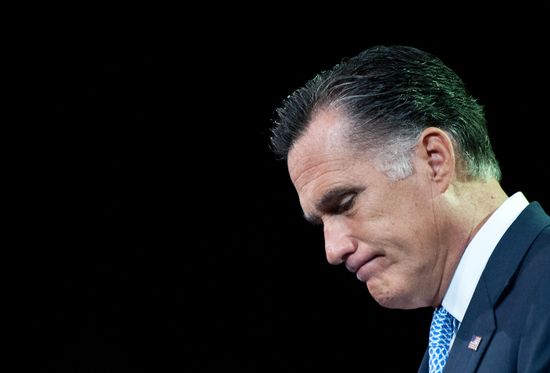
(Photo: Getty.)

Romney’s Got Nothing

The gist of his big media interviews today is explained thus:

Mitt Romney on Friday night demanded an apology from President Obama for making what he called “reckless” and “absurd” allegations about his record while repeating his insistence that he left Bain Capital in 1999 to run the Olympics.

He then attacked the president personally:

“What kind of a president would have a campaign that says something like that about the nominee of another party?” Mr. Romney asked during a brief interview with CBS News. Earlier, on CNN, Mr. Romney called the accusation of criminal behavior — which came on Thursday from Mr. Obama’s deputy campaign manager — “disgusting” and “demeaning” and said it was destructive to the political process.

“It’s something that I think the president should take responsibility for and stop it,” Mr. Romney said.

This is another lurch downward for Romney in this cycle, I'd say. For a simple reason. We have documentary proof that Romney told the SEC he was CEO of Bain through 2002, and that he drew a salary of more than $100,000 for doing that job. So was he telling the truth on television today when he insisted that “I left any responsibility whatsoever, any effort, any involvement whatsoever in the management of Bain Capital after February of 1999” – or when the company he solely owned filed with the SEC, and when Bain itself called him the CEO in July 1999, and when he testified under oath in 2002 that he was involved in many business and board meetings of Bain companies in the period in question?

To put it more succinctly: how does this statement

[T]here were a number of social trips and business trips that brought me back to Massachusetts, board meetings, Thanksgiving and so forth… [I] remained on the board of the Staples Corporation and Marriott International, the LifeLike Corporation [all Bain companies]

and this excerpt from a press release from Bain in July 1999:

Bain Capital CEO W. Mitt Romney, currently on a part-time leave of absence to head the Salt Lake City Olympic Committee for the 2002 Games said …

jibe with this one today:

“I left any responsibility whatsoever, any effort, any involvement whatsoever in the management of Bain Capital after February of 1999 … I went on to run the Olympics for three years I was there full time after that I came back and ran in Massachusetts for governor. I had no role with regards to Bain Capital after February 1999.

and this recent statement from Bain itself, declaring Romney had:

"absolutely no involvement with the management or investment activities of the firm or with any of its portfolio companies."

My italics. He had "no role with regards to" Bain Capital after February 1999 (a very broad statement) – except for being the CEO, and repeatedly returning to Massachusetts for board meetings of Bain-owned companies, which he "attended by telephone if I could not return".

A false SEC filing is a serious offense; to say so is not disgusting. So is potential perjury in 2002 when Romney detailed his continued involvement in Bain-owned enterprises in the period he retained the CEO title and now says he had nothing whatsoever to do with Bain. The SEC filing rules apply to everyone – except, it seems, to Romney, and his well-paid legal and accounting team. They may have so internalized this immunity from any accountability that Romney may indeed genuinely feel disgusted by being called to follow the normal rules, or called out on logical inconsistencies.

I'm getting the feeling that Romney thinks he is above the level of accountability required in a presidential candidate or even in an average ethical businessman. He seems genuinely offended to be directly challenged with facts – which he still won't address or rebut in detail. So he simply huffs and puffs and uses words like "disgusting" for a perfectly valid charge in the big boy world of presidential politics.

This does not seem to me to be like a candidate ready for prime time.

Bain: He’s Drowning Not Waving

148153991

This morning, we still have no explanation for why Mitt Romney was paid a six figure salary for three years while he "had absolutely no involvement with the management or investment activities of the firm or with any of its portfolio companies" in Bain's words in their statement yesterday. We also have no explanation of why telling the SEC in 2001 that he remained the "sole stockholder, chairman of the board, chief executive officer, and president," while he was nothing of the kind. Yes, we have been told that his departure was dramatic, and that it took time to restructure a complicated business partnership, but for a company to declare a false CEO to the SEC for three years is either the mark of spectacular incompetence – and a potential felony – or a lie.

I think it's telling that the Romney campaign has not yet addressed these two core questions. But even its own line of response – to reiterate that even though Romney remained the formal CEO, he was completely AWOL – is now looking more tenuous with new data from HuffPo. In trying to fend off questions about his Massachusetts residency for the gubernatorial campaign, Romney stated that while he was running the Olympics,

[T]here were a number of social trips and business trips that brought me back to Massachusetts, board meetings, Thanksgiving and so forth.

My italics. That statement was under oath. So was this about the period in question:

[I] remained on the board of the Staples Corporation and Marriott International, the LifeLike Corporation.

Lifelike and Staples were Bain acquisitions. To repeat: Romney said he attended board meetings of Bain companies in a period in which Bain says he had "absolutely no involvement with the management or investment activities of the firm or with any of its portfolio companies." And this was under oath:

I returned for most of those meetings. Others I attended by telephone if I could not return.

So now the story is the following: Romney legally declared himself the "sole stockholder, chairman of the board, chief executive officer, and president" in a period when his company says he had "absolutely no involvement with the management or investment activities of the firm or with any of its portfolio companies." But during that period, he attended board meetings of Bain companies and made several business trips back to Boston.

So did Romney lie under oath or is Bain lying today? I'd say Romney's best bet is to stick with his under-oath testimony and to his SEC filing and admit that he was responsible for what Bain did – legally and practically – in the period in question, even if he was part-time. Otherwise, he could have committed a crime. The only problem with conceding this is that it opens up a whole can of worms about investments and decisions by Bain in those years – and possible inquiries into conflicts of interest as he drummed up dollars for Salt Lake City's Games.

Which leads us to the following conclusions: yes, former Senator Santorum, your nominee was the "sole stockholder, chairman of the board, chief executive officer, and president" of a private equity firm that invested in a post-abortion fetus disposal enterprise. Maybe if you'd known that, you could have brought it up in the primaries.

(Photo: Nicholas Kamm/Getty)

Where’s The Line Between A Religion And A Cult? Ctd

D.T. Bell and Ryan Bell, authors of MormonAmerican.com, were offended by my exploration of Mormonism’s cultish qualities. They argue that “calling a religion a cult is a cowardly act, because the vagueness of the word provides plausible deniability to any who use it”:

Sullivan’s argument is illustrative, as it follows the approach of so many others who have pushed the “cult” line of attack. These attacks inevitably abandon any definitional rigor and load the dice to reach the desired result. Thus, Sullivan adopts a handful of suspiciously on-the-nose criteria for cultishness— secret places sealed off from outsiders, pressure not to leave, and effective “enforcement” of tithing. In other words, Sullivan looked at some elements in the Mormon tradition that he finds unsettling, exaggerated them for effect, and decided that those are the characteristics of a cult. It’s an easy game to play. Here is another reasonable-sounding list of cultish characteristics: belief in the infallibility of a supreme leader, a system prohibiting clergy from normal family life, and a network of the especially devout who vow to totally remove themselves from society. No one believes Sullivan’s own Catholic Church—a global faith that has inspired some of the world’s greatest art, thought, and philanthropy — is a cult. But using Sullivan’s tactics, it isn’t hard to cast it in a dark, suspicious light.

And those aspects of Catholicism should indeed be cast in a dark, suspicious light. The very deference and obedience required in an authoritarian structure with no external accountability is a real cultish danger: and in the Catholic church it led to the rape of thousands of innocents and a cover-up that went right to the top of the church. The same goes for the opaque finances of the Vatican. I also favor ending mandatory celibacy for priests because, again, it creates a separate caste that can easily be corrupted by its own self-interest. I also favor women priests to air out the fetid closet of the Catholic hierarchy. As to the “network of the especially devout who vow to totally 52remove themselves from society”, I’m not sure what they mean, but if they are referring to Opus Dei, they are indeed right. That is a cult – and like all such cults, it led to abuse. If they mean religious orders, I see no reasonable objection. I can see why Mormons would regard the vita contemplativa as somehow spiritually suspect, because their ethic is one of being “deseret” – or capitalist like a honeybee. But Christians have always revered monastic spirituality. Christianity is, as Oakeshott put it, the “religion of unachievement.” Nothing could be further from Mormonism.

There are cultish aspects to all religions, including my own. I specified some criteria and began a discussion. Reader pushback on the question can be found herehere, and here. But there is no mandatory tithing in Catholicism for full access to the sacraments; there is no mysterious new text like the Book Of Mormon, created by what was quite obviously a scam operation and written in excruciating faux King James Bible English; there are no cathedrals where non-believers are excluded and believers have to open their bank accounts to enter. There is no extreme social pressure against apostasy. In many ways, the current Pontiff appears to want many Catholics to leave the church, because we openly disagree on some aspects of moral teaching. Mormonism, in contrast, is always seeking expansion, converts and new missions and if these new markets for their religion reject some aspects of it, the doctrines are changed in a process of continued revelation. Hence the evaporation of the racial doctrines as the LDS church was expanding into South America and Africa.

On the broader point, I am not going to be intimidated by accusations of “prejudice” into not exploring aspects of Mormon doctrine and practice when debating a presidential candidate whose entire identity has been forged by the LDS church and is one of the most prominent former church officials ever to run for president. This is a legitimate question about the identity and character and beliefs of a man running for the highest office in the land. Everything has to be on the table – for both him and Obama. And if Fox could run a loop of Jeremiah Wright endlessly against Obama, I sure can explore and question a candidate whose religious life is far more central to his identity.

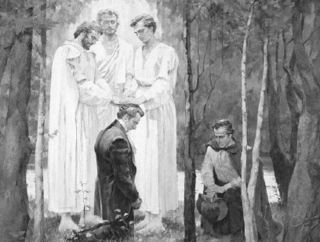
(Painting: Saint Peter, Saint James and Saint John the Baptist bestow on Joseph Smith the apostolic succession of the Melchizedek priesthood. Full context here.)

“The Lethal Presidency”

Article-1382859-0BE03DE700000578-150_964x642

Tom Junod sees the drone war as central to Obama's presidency:

You are not the first president with the power to kill individuals. You are, however, the first president to exercise it on a mass scale. You inherited the power from George W. Bush as one of several responses to terrorism. You will pass it on to your successor as the only response, as well as an exemplar of principle. Your administration has devoted far more time and energy to telling the story of targeted killing than it has to telling the story of any of your domestic policies, including health care. It is as though you realize that more than any of your policies, the Lethal Presidency will be your legacy.

The essay, as with everything from Junod, is well worth reading – a fair but powerful case against drones and the targeted killing of enemy combatants. This strikes me as its nub:

The danger of the Lethal Presidency is that the precedent you establish is hardly ever the precedent you think you are establishing, and whenever you seem to be describing a program that is limited and temporary, you are really describing a program that is expansive and permanent.

Jonathan Last asks why more liberals haven't turned on Obama over this:

There were plenty of Republican types whom Bush drove out of the party. (Andrew Sullivan, Kathleen Parker, Andy Bacevich, Jim Webb, etc.–the list is actually pretty long.) Why haven’t any lefty Dems done the same? 

Sonny Bunch spots a double standard:

What conservatives have a problem with is the way in which liberals treated incredibly difficult issues of national security—Gitmo, GWOT, drones, waterboarding, etc.—as little more than a political cudgel with which to bash someone they didn’t like and then, when their guy was in office, ceased giving a shit.

But I have to say that this line of attack on Obama seems remarkably off-base to me – even in Junod's nuanced reflection. The conflation of the issues above – Gitmo, GWOT, drones, waterboarding, etc – is part of the problem. Obama tried to close Gitmo but the Congress wouldn't let him. He never proposed or even hinted that he would end the war on Jihadist terror; in fact, one of his defining moments as a candidate was to defend war as necessary at times in countering evil. He gave a Nobel Peace Prize speech which was centered on Christian realism, not pacifism, as a basis for deciding issues of war and peace. Liberals who had a problem with this presumably still have a problem, but Obama has done nothing that he didn't explicitly say he'd do.

The difference between him and Bush, moreover, is stark. First and foremost, there is an end to the torture program. For many of us, that was the first non-negotiable deal-breaker from the Bush administration. To bungle two wars, as Bush and Cheney did, is one thing. To throw away the invaluable tradition of decency in wartime was unforgivable. Torture is not, as Bunch would have it, a "difficult issue". It is an easy one. We don't do it or condone it and we bring to justice anyone caught doing it. Obama's failing is in the latter part – but it pales in comparison with Cheney's lawless barbarism. And the end of torture has immensely improved intelligence and brought some moral credibility back to the West. Are some terror suspects being treated horribly in allied countries? There's much evidence that this is true. And the Obama administration should be extremely careful not to exploit or use any intelligence garnered from torture or abuse. But there is an obvious difference between the injustices perpetrated by regimes in developing countries and the standards we set for ourselves.

As to the drone war, what would Junod have Obama do? The alternatives are either long-term occupation of Jihadist-spawning countries, or a decision to end all military responses to Jihadist terror, or a more focused drone campaign that can minimize civilian casualties while taking out key enemies planning to kill Western and Muslim civilians. I harbor severe worries about the unintended consequences of the drone war, and deeply regret civilian casualties. But there were around 100,000 civilian casualties caused by the Iraq occupation. Obama's record is simply not comparable with the widespread destruction and immorality of the Bush-Cheney era.

So Obama has waged the war he promised (against al Qaeda) with minimalist but lethal means (drones). He has been far more successful in killing Jihadists before they kill us than Bush, with Osama the most conspicuous example. He has ended torture; he has withdrawn every soldier from Iraq; and is winding down the Afghanistan campaign. If you are a utopian liberal who projected onto Obama peacenik pretensions he never claimed himself, you can, I guess, be outraged. And the danger of precedent and blowback is real and deserves airing. But the idea that a more moral, more lethal and less casualty-laden fight against al Qaeda is some kind of betrayal of Obama's promise just baffles me.

It is not a betrayal. It is a promise kept.

The Closet And The Status Quo I

There's a point that few make when talking about the whole "coming out" issue. When gays are, say, around 3 percent of the population, it is not unreasonable to assume they are straight, until told otherwise. Odds are: a random person will be straight. And so it is simply a fact of homosexual life that you have a double standard when it comes to public acknowledgment of one's orientation. To get to neutrality, gays have to say something, while straights need only swim in the current of the majority. No straight person needs to come out. Every gay person, who doesn't want basic facts about him or her misunderstood, has little choice.

Silence-equals-death-poster-294-040110But when you get to the level of Anderson Cooper in terms of exposure, you have to come out again and again and again. I was lucky in my own fecklessness two decades ago. I was 26, suddenly named acting editor of The New Republic, then editor itself, and I was out to everyone in the office and my life. What to do? I had a long interview with Mike Duffy of Time magazine, where we talked about everything I wanted to do at the magazine, blah blah blah, and then his final question was: "And you're gay, right?" "Sure am," I answered, with all the blithe assurance of a twentysomething. I got it over with all at once – like my HIV diagnosis.

I may have stumbled into total openness, but I simply couldn't lie. And as an opinion writer on gay issues, I felt it was unethical not to let the readers know that I have a stake in this question, a deeply personal one. But I also believed that precisely because of the tininess of the gay minority and the reasonableness of assuming that a random person is straight, every gay had a responsibility to be as open with as many people as he or she can be. It was the only way to stop silence reinforcing the discriminatory and prejudiced status quo, which was built on the invisibility and subjugation of homosexuals. I still believe there is no substitute, and that most of our progress comes from these small and large acts of honesty. David Link has some reflections on this question as well. Money quote:

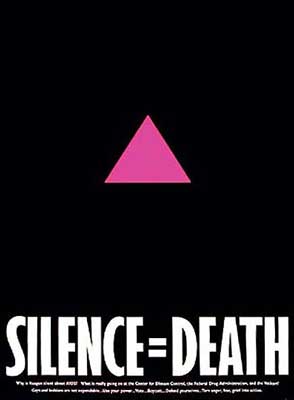
Our silence, their silence, anyone’s silence is a vote for the National Organization for Marriage, is a vote for the bias and prejudice that are woven into the fabric of current law.

In this politicized environment, privacy equals silence, and silence equals — well, not death anymore, but certainly some spiritual damage.  That was the unholy balance that Cooper upset.

Neutrality is a primary virtue of the journalistic profession, but when “neutrality” means “the status quo,” and if the status quo is, itself, biased, then neutrality is not neutral. Anderson Cooper’s coming out helps expose that truth.