Mulling over the Supreme Court ruling in favor of Obamacare this weekend, it occurred to me why this remains a BFD. It's not that we now have a reprieve for the idea of universal healthcare in the US. Or even that we have an interpretation of the Commerce Clause that could eventually mean some non-trivial ratcheting back of the federal government's powers vis-a-vis the states. It is that a creature of the conservative movement, one of its youngest and most intelligent stars, saw the radicalism of the four dissenters … and balked.
He balked, it appears, because of his attachment to the court as an institution, because he was unwilling to trash its reputation by embroiling it in a deep and bitter partisan grudge-match in the middle of a presidential campaign – when there was a plausible way out. He was also applying the logic of judicial restraint with respect to legislative wishes, interpreting the law to be as constitutional as it could possibly be deemed (i.e.in this case, viewing the mandate as part of the Congress's tax power). In these two ways, Roberts upheld a form of conservatism that is not synonymous with the interests of the Republican party at any given moment. Which is so unusual these days one wants (pathetically) to stand up and cheer.
One of the most strikingly anti-conservative aspects of today's allegedly conservative movement, after all, is its contempt for institutions, especially elite institutions that in any way limit the scope of fundamentalist ideology. And so Newt Gingrich's crucial innovation was throwing out the politeness and manners and decorum and rules and traditions of the House of Representatives in order to gain power by populist demagoguery. You can see his legacy in Tom DeLay's implementation of the Medicare D entitlement under Bush, an essentially lawless and rule-free process that made a mockery of parliamentary procedure. You saw this contempt for the rule of law, if it got in the way of desired policy, in the torture policy under Bush, cynically making the patently illegal "legal" through cynicism and double-speak.
Similarly, McConnell's use of the filibuster is essentially a display of contempt for the American constitutional system, rigging the system to nullify legislative majorities and to conduct politics as a zero-sum war for power, rather than as a means to debate, discuss and implement necessary changes in an evolving society. The give-and-take of American constitutionalism has been essentially reduced by the GOP in the last two decades to take-and-take-some-more. They impeached one successful president, in an act so disproportionate to the offense (and the offense was real; Clinton was a shameless perjurer) that it helped gut any bipartisan functioning of an institution designed for deal-making across the aisles or within them. They treated the 2000 election, when Bush lost the popular vote, as a landslide mandate election – again with no deference to the other side or sense of governing as one nation.
After Bush vs Gore and then Citizens United, I think Roberts saw the full political and constitutional consequences of a radical Court vote to gut the key legislative achievement of a duly elected president and Congress. In other words, he put the institutions of American government before the demands of partisan power-mongering. And he deftly nudged the issue back into the democratic process, where it more comfortably belongs.
I cannot say this is the moment the fever broke. The "movement right" is still furious at Roberts, pushing Romney as the principle-free instrument of their next round of institution-smashing (Medicare). But that a conservative placed the country's institutional stability before ideological fervor is so rare at this point it deserves some kind of praise. It's a start. If the GOP is beaten this fall, it may even be seen as the moment the tide began to turn, and conservatism began to reach back toward its less feral traditions and ideas. But I know I'm getting way ahead of myself here.
But at some point, conservatism must re-emerge, if only because we so desperately need it. Conservatism is, after all, a philosophy that tends to argue that less equals more, that restraint is sometimes more powerful than action, that delay is often wiser than headlong revolution. It reveres traditional rules and existing institutions, especially endangered elite institutions that the Founders designed to check and cool the popular will. Roberts took a small step toward resuscitating that tradition last week.
It's the first seagull spotted after a decade or two on the open seas.
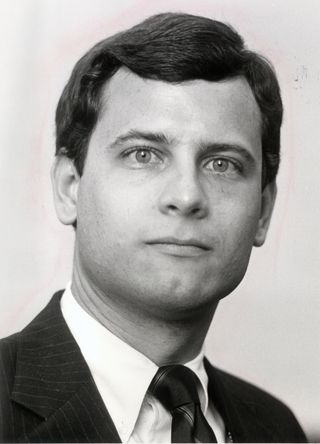
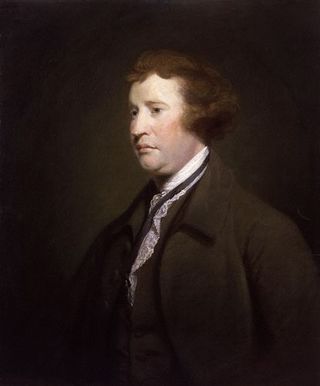
(Photo: John Roberts at the age of 29, associate counsel at Fielding and Co, by Harry Naltchayan/The Washington Post via Getty Images. And Edmund Burke.)
Last week, Entertainment Weeklyran a story on an emerging trend: gay people in public life who come out in a much more restrained and matter-of-fact way than in the past. In many ways, it’s a great development: we’re evolved enough not to be gob-smacked when we find out someone’s gay. But it does matter nonetheless, it seems to me, that this is on the record. We still have pastors calling for the death of gay people, bullying incidents and suicides among gay kids, and one major political party dedicated to ending the basic civil right to marry the person you love. So these “non-events” are still also events of a kind; and they matter. The visibility of gay people is one of the core means for our equality.
All of which is a prelude to my saying that I’ve known Anderson Cooper as a friend for more than two decades. I asked him for his feedback on this subject, for reasons that are probably obvious to most. Here’s his email in response which he has given me permission to post here:
Andrew, as you know, the issue you raise is one that I’ve thought about for years. Even though my job puts me in the public eye, I have tried to maintain some level of privacy in my life. Part of that has been for purely personal reasons. I think most people want some privacy for themselves and the people they are close to.
But I’ve also wanted to retain some privacy for professional reasons. Since I started as a reporter in war zones 20 years ago, I’ve often found myself in some very dangerous places. For my safety and the safety of those I work with, I try to blend in as much as possible, and prefer to stick to my job of telling other people’s stories, and not my own. I have found that sometimes the less an interview subject knows about me, the better I can safely and effectively do my job as a journalist.
I’ve always believed that who a reporter votes for, what religion they are, who they love, should not be something they have to discuss publicly. As long as a journalist shows fairness and honesty in his or her work, their private life shouldn’t matter. I’ve stuck to those principles for my entire professional career, even when I’ve been directly asked “the gay question,” which happens occasionally. I did not address my sexual orientation in the memoir I wrote several years ago because it was a book focused on war, disasters, loss and survival. I didn’t set out to write about other aspects of my life.
Recently, however, I’ve begun to consider whether the unintended outcomes of maintaining my privacy outweigh personal and professional principle. It’s become clear to me that by remaining silent on certain aspects of my personal life for so long, I have given some the mistaken impression that I am trying to hide something – something that makes me uncomfortable, ashamed or even afraid. This is distressing because it is simply not true.
I’ve also been reminded recently that while as a society we are moving toward greater inclusion and equality for all people, the tide of history only advances when people make themselves fully visible. There continue to be far too many incidences of bullying of young people, as well as discrimination and violence against people of all ages, based on their sexual orientation, and I believe there is value in making clear where I stand.
The fact is, I’m gay, always have been, always will be, and I couldn’t be any more happy, comfortable with myself, and proud.
I have always been very open and honest about this part of my life with my friends, my family, and my colleagues. In a perfect world, I don’t think it’s anyone else’s business, but I do think there is value in standing up and being counted. I’m not an activist, but I am a human being and I don’t give that up by being a journalist.
Since my early days as a reporter, I have worked hard to accurately and fairly portray gay and lesbian people in the media – and to fairly and accurately portray those who for whatever reason disapprove of them. It is not part of my job to push an agenda, but rather to be relentlessly honest in everything I see, say and do. I’ve never wanted to be any kind of reporter other than a good one, and I do not desire to promote any cause other than the truth.
Being a journalist, traveling to remote places, trying to understand people from all walks of life, telling their stories, has been the greatest joy of my professional career, and I hope to continue doing it for a long time to come. But while I feel very blessed to have had so many opportunities as a journalist, I am also blessed far beyond having a great career.
I love, and I am loved.
In my opinion, the ability to love another person is one of God’s greatest gifts, and I thank God every day for enabling me to give and share love with the people in my life. I appreciate your asking me to weigh in on this, and I would be happy for you to share my thoughts with your readers. I still consider myself a reserved person and I hope this doesn’t mean an end to a small amount of personal space. But I do think visibility is important, more important than preserving my reporter’s shield of privacy.
Me too.
Update: The Beast created a video tribute to Anderson’s work – watch it here.
[Re-posted from earlier today. Extensive coverage after the jump.]
1.12 pm. Normal blogging will resume shortly. My take on this morning's drama: for millions of people, this will mean one thing. They will have an opportunity to purchase healthcare that would otherwise be denied them because of a pre-existing condition or simply lack of means to buy it. This has been done through the private health insurance sector along lines many Republicans were proud of until very recently. And this is a good thing.
The fact that there is no constitutional issue in doing this federally, as opposed to by the states, also removes Mitt Romney's only argument in defense of his own almost identical law in Massachusetts. And so the GOP candidate will be running against his own record in his own state on no rational grounds whatever. And against a Chief Justice appointed by George W. Bush.
But that matters less to me than that someone in America who once had to suffer in silence may now get some help to tackle her health issues. For me, that's a moral principle. Much more needs to be done, specifically in restraining healthcare costs and reforming Medicare. But the core beginning of this process will be getting everyone in the same boat. That now seems unstoppable. So Obama's first term remains historic. And his re-election to cement this change essential.
1.11 pm. NRO's commenters on Romney's pledge to repeal the law one Day One are priceless.
1.07 pm. Take a bow, Will Wilkinson, who wrote this yesterday:
Roberts, writing for the majority, will offer a hyper-casuistical decision that discovers in standing commerce clause precedent principled grounds for ruling in an insurance mandate while ruling out congress' power to mandate purchase of any goods and services that don't begin with an "i" and end with an "e", and aren't ice or iodine. To brighten the dashed hopes of conservatives, the "Why there can never be a broccoli mandate" section of Roberts' decision will on the whole narrow Congress' commerce-clause regulatory powers. However, in their very great relief, and schadenfreude over bitter conservative disappointment, liberals will largely miss the minor revolution contained in Roberts' sly scholasticism.
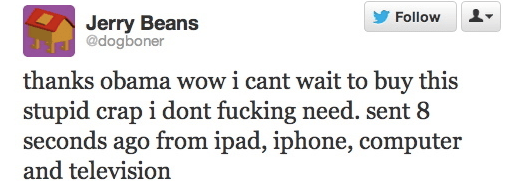
ObamaCare was a gigantic tax increase! The Supreme Court says so! I just heard Marco Rubio on Fox, and he managed to use the word “tax” about four times in every sentence.
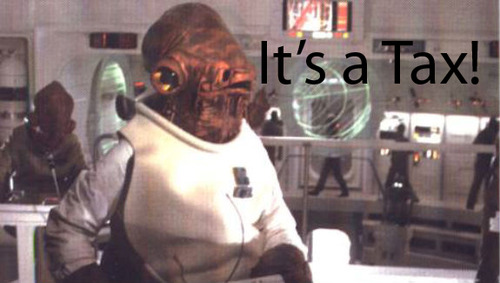
The individual mandate is constitutional because despite the name because it’s not really a mandate. Congress called it a mandate, to be sure, but in practice it’s really just a small tax. And the enforcement mechanism is pretty light. So you really don’t have to get health insurance: You just have to pay the smallish penalty if you decide you don’t want it. So Congress lacks the power to say that you go to jail if you don’t buy health insurance.
But Congress does have the power to encourage you to get health insurance by imposing a tax if you don’t, as long as the tax isn’t so coercive that it’s really more than just a tax… willful failure to pay the tax (that is, knowing you have to but intentionally refusing to pay your tax bill) can be a crime. But you can pay the tax and not get health insurance if that’s what you want. So the “mandate” is just a tax, and it is therefore constitutional.
“Fucking humiliating. We had a chance to cover it right. And some people in here don’t get what a big deal getting it wrong is. Morons.
12.50 pm. This strikes me as a sober and judicious assessment:
It’s questionable to me, formally, whether the mandate survived as a mandate. It’s not exactly a mandate, any more than a tax on cigarettes is a mandate to cease purchasing cigarettes. Effectively, however, the function the mandate was meant to serve did survive. The “mandate” was intended to fund coverage for those who would be a net loss on the health care system. If you are a young and healthy individual who does not particularly need health insurance, you can fund the system either by signing up for health insurance or by paying the tax that helps to fund the system.
12.46 pm. Will this revive the Tea Party? Tobin hopes so (as does Fred Barnes). This will be a talking point going forward, it seems to me:
Mitt Romney and the rest of the Republicans can argue that while the Court ruled it constitutional, its passage was the result of a deception, and the net result is a tax hike for the entire country as well as granting the government an unprecedented expansion of power. The health care debate now switches from speculation about what the Court would do to one about whether the voters are prepared to re-elect a president who has snuck through a massive tax on the middle class on a technicality.
My italics.
12.42 pm. Good one, Nancy (who's wearing the same purple pumps today that she wore when Obamacare passed):
Pelosi: What a great victory!
Congressman George Miller: You bet your ass [it is].
12.35 pm. More radical in its implications than we might have thought? Lawrence Solum:
There is an alternative gestalt concerning the New Deal Settlement. For many years, some legal scholars had advanced an alternative reading of the key cases uphold New Deal legislation. On this alternative reading, the New Deal decisions were seen as representing the high water mark of federal power. Although the New Deal represented a massive expansion of the role of the federal government, it actually left a huge amount of legislative power to the states. On the alternative gestalt, the power of the federal government is limited to the enumerated powers in Section Eight of Article One, plus the New Deal additions. These are huge, but not plenary and unlimited.
Today, it became clear that four of the Supreme Court's nine justices reject the academic consensus… And because Justice Roberts believes that the mandate is not a valid exercise of the commerce clause (but is valid if interpreted as a tax), he has left open the possibility that there is a fifth justice who endorses the alternative gestalt.
12.26 pm. A round-up of reader reax from the in-tray. A lawyer writes:
Actually, broccoli doesn't win. As I’m sure other readers are pointing out, Justice Roberts’ opinion argues that if the Commerce Clause meant what the government argued it did, then “Congress could…[order] everyone to buy vegetables…That is not the country the Framers of our Constitution envisioned.” (See page 23 of the opinion.) Sorry, broccoli.
Another lawyer:
It is remarkable that, at the end of the day, the 5-4 vote upholding the ACA turned on a simple, well established rule of statutory construction, the “constitutional avoidance” doctrine. When a court is faced with a statute that is fairly susceptible of more than one meaning, and one interpretation renders the law unconstitutional while the other interpretation affirms its constitutionality, a judge is required to adopt the later interpretation. That’s what Chief Justice Roberts did. He said that the individual mandate could be read as a tax, even though that was not the most obvious interpretation. Thus, because Congress has the authority to impose a tax, the invalidity of the mandate under the Commerce Clause was not determinative.
Another:
What I think a lot of people are missing in this case is its connection to that foundational Supreme Court case, Marbury v. Madison (to which the Chief Justice cites several times). Marbury is an interesting study; essentially it was a political battle between Jefferson and the Federalists. John Marshall, presiding Chief Justice, most definitely held with the latter. In deciding the case, Marshall pulled an impressive feat of judicial jujitsu; he found for Jefferson's side, but announced the principal of Judicial Review, something with which Jefferson would have disagreed. But Jefferson could hardly caterwaul about a case he had 'won.' Jefferson won in the short term, Marshall, arguably, in the long term. Thence to Roberts' opinion.
He did uphold the mandate as a tax, but specifically said it was beyond the Commerce Clause power. Much of the opinion is dedicated to explicating why this is so (and adopting the anti-ACA arguments for such). I think Roberts has taken a lesson from his famed predecessor. By upholding the mandate as a tax, but deciding the Commerce Clause issue against what would seem to be the weight of precedent, he may be hoping to hand conservatives the long-term win.
If Wickard v. Fillburn (generally seen as the broadest Commerce Clause case) is one day overturned, as seems likely, much of the language will be taken from the Chief Justice's opinion.
Another:
A prediction: public opinion will swing toward a favorable view of Obamacare because of today's ruling. Remember, most Americans have no idea what this does; they've just been told it's either a terrible, awful, horrible scheme to allow the government to form death panels to kill them or it's a terrible, awful, horrible illegal power grab by that socialist/Communist/Kenyan anti-colonalist in the White House. Well, the second part turns out to be false. And it's hard to build a suitable conspiracy theory to explain away today's ruling when John Roberts is the decider on this.
Another:
You wrote: " We may see attempted nullification of the law by Tea Party types refusing to get insurance in order to destabilize the system." Tea Party types already have health insurance. They are overwhelmingly white and middle class, and the retiree set amongst them already has government healthcare. I cannot see the system being destablized by the abstention of the five or so Tea Partiers who aren't already covered.
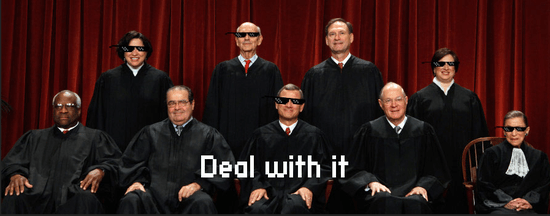
Roberts peered into the abyss of a world in which he and his colleagues are little more than Senators with lifetime appointments, and he recoiled. The long-term war over the shape of the state goes on, but the crisis of legitimacy has been averted. I have rarely felt so relieved.
12.22 pm. Yglesias Award nominee – Jeff Toobin live on CNN:
"This is a day for Don Verrilli to take an enormous amount of credit, and for me to eat a bit of crow – because he won, and everyone should know that that argument was a winning argument, whatever you thought on it."
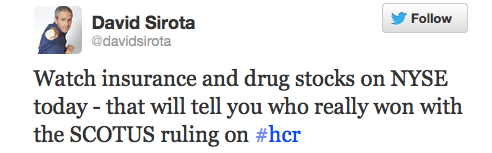
Stocks are reacting very much as analysts predicted in the event that the law was upheld. Hospital stocks such as HCA (up 8%) and LifePoint (up 4%) are rising because the law is likely to result in increases in volume for their businesses without added costs. Insurers such as Wellpoint and Cigna (down 4% and 5% respectively) are dropping because the law is likely to crimp their profit margins.
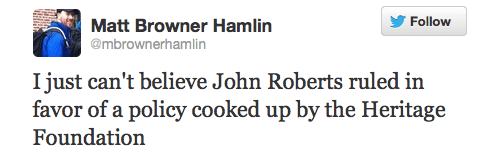
12.15 pm. Tweet of the hour:
12.14 pm. Yglesias also ponders the implications of the Medicaid issue:
Chief Justice Roberts joined with the other conservatives on the court to argue that this penalty—withdrawing of existing federal money unless states kicked in new money of their own—overstepped the constitutional bounds of the spending power. So now states have the carrot to expand Medicaid but not the stick.
Since your state's citizens have to pay taxes to the federal government one way or the other, you'd have to be pretty crazy to refuse the carrot if you ask me. But ideological zeal may well lead some states to turn it down. In that case, substantially more people than the law's authors expected might find themselves eligible for either hardship waivers from the mandate or subsidies to buy insurance on exchanges. How much of each of those things happened will depend on exactly what states do, and figuring out the budgetary implications of the whole thing is going to require some hard work by the little modeling gnomes at the Congressional Budget Office.
The Court’s decision on the constitutionality of the Medicaid expansion is divided and complicated. The bottom line is that: (1) Congress acted constitutionally in offering states funds to expand coverage to millions of new individuals; (2) So states can agree to expand coverage in exchange for those new funds; (3) If the state accepts the expansion funds, it must obey by the new rules and expand coverage; (4) but a state can refuse to participate in the expansion without losing all of its Medicaid funds; instead the state will have the option of continue the its current, unexpanded plan as is.
12.11 pm. Cable News FAIL:
This embed is invalid
12.06 pm. An interesting piece of speculation from David Bernstein:
Scalia’s dissent, at least on first quick perusal, reads like it was originally written as a majority opinion. Back in May, there were rumors floating around relevant legal circles that a key vote was taking place, and that Roberts was feeling tremendous pressure from unidentified circles to vote to uphold the mandate. Did Roberts originally vote to invalidate the mandate on commerce clause grounds, and to invalidate the Medicaid expansion, and then decide later to accept the tax argument and essentially rewrite the Medicaid expansion (which, as I noted, citing Jonathan Cohn, was the sleeper issue in this case) to preserve it?
If so, was he responding to the heat from President Obama and others, preemptively threatening to delegitimize the Court if it invalidated the ACA? The dissent, along with the surprising way that Roberts chose to uphold both the mandate and the Medicaid expansion, will inevitably feed the rumor mill.
12.04 pm. Echoing Dish readers' concerns below, Jon Adler writes:
Holding that it would be unconstitutional to terminate existing Medicaid funds to states that refuse to go along with the Medicaid expansion is quite significant, particularly as seven justices joined this result. While the holding here may not go beyond the limits articulated in South Dakota v. Dole, the Supreme Court has not limited the exercise of the spending power to impose conditions on states since the New Deal and, again, seven justices endorsed this result. Going forward, I expect this portion of the opinion to have the greatest practical impact. In fact, I can think of some federal laws, including portions of the Clean Air Act, that are likely to be challenged on these grounds.
11.59 am. Now the chatter begins to turn to the challenges of this ruling for Obama. Some liberal readers are nervous. One writes:
This decision is a massive political problem for Obama. For starters it will rally conservatives and allow Romney to further consolidate his base. A loss for Obamacare would have done the same for Obama's base which would have been helpful in November. Second, and more importantly, SCOTUS' finding that this is a "tax" opens Obama to an entire new line of attack. Not only has he "raised taxes" on "hard-working middle class people" but he has done it in a non-transparent, nefarious way. It feeds directly into the Right's existing themes on Obama. Obama is going to have to come out swinging and, I think, finally defend the merits of Obamacare (i.e. explain to people what they are getting for this "tax").
Well, we'll see soon enough. Another:
I think Jeffrey Toobin was more right than wrong. Ok, I can't actually justify that by what he said but I do think this ruling was a disaster for the left. Advocates of federal power lost everything except the headline. This looks like a stealth overturning of Wickard v. Filburn. The commerce clause expansion that has fueled everything from the New Deal to federal highways to the Great Society to the War on Drugs just took a huge hit.
Furthermore, Congress's power to attach new strings to existing pipelines of federal money just got clipped. This power is used so pervasively that I can't even describe it. Here are a few examples of strings tied to federal buckets of money that were enacted long after the original funding: Title IX (education funds), national drinking age (highway funds), and same sex partner hospital visitation rights (Medicare funds).
11.54 am. It seems to me that Romney is stuck with a call to repeal the entire law, and will probably now tout it as a big tax increase. Ed Morrissey advises fortitude:
So what now? Mitt Romney and Republicans can now run on repeal as a big issue in the campaign. They should emphasize the tax argument when they do, because this tax hits everyone. The ruling may alleviate some of the bad polling the ACA has received, but probably not by much. It’s going to remain deeply unpopular for the next few months.
That may be, but now the law is deemed constitutional by John Roberts, it will be harder to portray it as the end of America, or whatever today's unhinged right believe. And since there's no actual "replace" in Romney's proposals, Obama can and should talk about Romney's attempt to strip those with pre-existing conditions of protection, throw twentysomethings off their parents' policy, etc etc. Obama is gonna speak at 12.15 pm, apparently. We'll keep live-blogging.
11.51 am. It's important to remember what, beneath all the legal wrangling and political posturing, this decision will mean for millions of Americans. Ezra weighs in:
The individual mandate, by bringing healthy people into the insurance market and lowering premiums, means health insurance for between 12.5 million and 24 million more Americans than if the mandate was struck down. And as Kennedy said in his dissent that the conservatives on the Court believed the entire law should have been invalidated, it means health insurance for 33 million more Americans than if Kennedy and the conservatives had their way.
[W]e may learn that President Obama sacrificed his presidency to push through this piece of legislation — the Dems already lost Congress over it. But presidencies are for doing important things not just for getting elected to second terms in office. And I strongly suspect that even if Mitt Romney wins and gets a Republican Congress, they still won’t be able to get rid of this law.
That counts. That matters.
11.49 am. Tweet of the hour:
11.46 am. An angle that looks at the ruling from a woman's perspective:
Women are big financial winners in this decision … The first is the elimination of gender rating, or charging women more because they’re women, pure and simple. The National Women’s Law Center recently found that in states that haven’t banned the practice, over 90% of the best selling plans charge women more than men, even though only 3% of them cover maternity services. In fact, even when maternity care is excluded, almost a third of plans charge women at least 30% more than men for the same coverage. One plan even charges 25-year-old women 85% more than men. All told, the practice costs women about $1 billion a year.
That will now become illegal in 2014, after the ACA is fully implemented.
11.43 am. Cable news needs to shut itself down. They failed high school newspaper tests this morning. There's no excuse whatsoever. They really ought to be ashamed. Covering live events is all they're really good for any more, if you are not partial to screeching propaganda or pure CNN tedium. And they even fuck that up – in a way many pajama-clad amateurs didn't.
11.40 am. To me, the most fascinating part of this is that John Roberts has revealed himself as an institutional conservative rather than a radical reactionary (as his party has now become). Matt Cooper notes:
He saved the individual mandate, choosing to see it as a tax hike and not a mandate, and thus legal. It's like that moment in the Cuban Missile Crisis when President Kennedy got two letters from the Soviets, one accommodating and one bellicose. He chose the one he wanted. Sure, we don't know how John Roberts will evolve in the years ahead. Justices change. But he's shown a deference to federal authority in this case — and in the Arizona case — an aversion to being like the "nine old men" who tortured Franklin Roosevelt, throwing out key elements of the New Deal. As a former DOJ lawyer, as well as longtime veteran of the firm Hogan & Hartson, he seemed to have a deference to arguments and not ideology.
It's good to see conservatism survive somewhere.
11.35 am. Is this the "best public relations news Obamacare has ever gotten?" From Peter Spiliakos in First Things:
The argument against Obamacare from constitutional norms has been fatally wounded to the extent of winning over persuadables… It also damages Romney in other ways. He can no longer distinguish Romneycare from Obamacare on the grounds that one is a legitimate use of state power and the other is is an unconstitutional use of federal power. Thanks to the Supreme Court, both Romneycare and Obamacare are now constitutional schemes of coverage mandates + individual purchase mandates + guaranteed issue + community rating. Romney can try to explain why what he thinks is good for Massachusetts isn’t good for America. Not impossible, but not easy, and I would guess probably beyond Romney’s power.
Yep. This was a triumph for a federal version of Romneycare. Which puts Mitt in the excruciating position of declaring John Roberts a leftist and explaining why Obamacare raises constitutional issues that Romneycare doesn't.
11.31 am. My view on the politics if this is that it will sharpen the debate this fall – and probably rally the GOP base. We may see attempted nullification of the law by Tea Party types refusing to get insurance in order to destabilize the system. But the interpretation of the mandate as a form of taxation is giving Erick Erickson other ideas:
The President and Democrats did, according to the Court, impose a tax increase. Because it is a taxation issue, the GOP now, should it take back the Senate, have even more grounds to deal with the matter under reconciliation, bypassing the 60 vote filibuster threshold.
My view: not gonna happen. But this will take time to shake out.
In issuing this ruling, the Court has not only validated the Affordable Care Act. It has also validated its own reputation. The vast majority of legal experts have said, all along, that the law is constitutional under any reasonable reading of past decisions. The only way to overturn the law would have been to rewrite decades of constitutional law, if not more—and to overturn in economic regulatory legislation in a way the Court has not done in nearly a century. Instead, five justices demonstrated that judges should act with caution and humility, overturning major federal legislation only in cases where such legislation represents clear violations of the Constitution. The Affordable Care Act does not qualify, the justices said.
Liberals for judicial restraint!
11.26 am. When all else fails, read the ruling (PDF). Legal reader comments particularly welcome.
“The president’s health care law is hurting our economy by driving up health costs and making it harder for small businesses to hire. Today’s ruling underscores the urgency of repealing this harmful law in its entirety. What Americans want is a common-sense, step-by-step approach to health care reform that will protect Americans’ access to the care they need, from the doctor they choose, at a lower cost. Republicans stand ready to work with a president who will listen to the people and will not repeat the mistakes that gave our country ObamaCare.”
“I got a call from Speaker Boehner last Friday,” said Rush Limbaugh on his radio show Wednesday. “He called a lot of people and he was telling us what the Republican plan is. And it was repeal, repeal, repeal. Regardless of what happens. … He made it clear that repeal — and not repeal and replace, but repeal — was going to be the focal point for the House Republicans.”
11.16 am. Maybe the president owes the Supreme Court Chief Justice an apology:
I want to take Judge Roberts at his word that he doesn't like bullies and he sees the law and the court as a means of evening the playing field between the strong and the weak. But given the gravity of the position to which he will undoubtedly ascend and the gravity of the decisions in which he will undoubtedly participate during his tenure on the court, I ultimately have to give more weight to his deeds and the overarching political philosophy that he appears to have shared with those in power than to the assuring words that he provided me in our meeting. The bottom line is this: I will be voting against John Roberts' nomination.
11.14 am. I apologize for running all this deranged hysteria from the far right (which is now the center of the GOP), but it's revealing of how loony the right now is:
11.12 am. And now for a comment from some obscure reality show nutcase:
11.03 am. Why do some people hate America? From NRO:
I honestly cannot believe this many Americans are retarded and think this way. As if one law will make premiums go through the roof. God damn I'm ashamed to say I'm American. Selfish assholes, all of you.
In July of 1798, Congress passed – and President John Adams signed – “An Act for the Relief of Sick and Disabled Seamen.” The law authorized the creation of a government operated marine hospital service and mandated that privately employed sailors be required to purchase health care insurance.
10.58 am. Today marks the end of cable news as news, don't you think? I mean, bloggers did much better than the MSM.
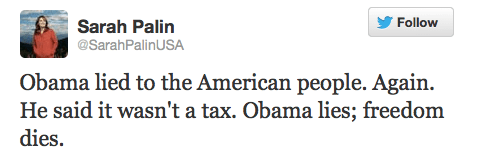
10.56 am. An immediate favorite to win the year's Malkin Award nomination – and it's only June:
Nah. No exaggeration at all. Upholding slavery vs giving more people basic healthcare – no contest for the moral enormity of our current moment.
"This was a train wreck for the Obama administration. This law looks like it’s going to be struck down. I’m telling you, all of the predictions including mine that the justices would not have a problem with this law were wrong… if I had to bet today I would bet that this court is going to strike down the individual mandate."
10.50 am. Romney backs the decision with enthusiasm because it reflects the "ultimate conservatism" of the individual mandate:
Oh, wait, that was in 2007. Sometimes, it's hard to keep up with a human weathervane.
10.48 am. Remind me why we're surprised again:
10. 45 am. The movement right is just getting its dander up. Ross Kaminsky at the American Spectator understates:
This is nothing short of a disaster for the nation, and a huge black mark on John Roberts' legacy. In speaking with others, I noted that Roberts was the Court member who worried me most; more than Kennedy. Still, I am fairly stunned by this outcome and can't help but feel that the soul of our nation has just been lost.
Yes, America's soul is lost because many more poor people will be able to get basic healthcare. Do these people hear themselves? Do they have any idea what it is to have a pre-existing condition? Or to live without any healthcare at all?
In Plain English: The Affordable Care Act, including its individual mandate that virtually all Americans buy health insurance, is constitutional. There were not five votes to uphold it on the ground that Congress could use its power to regulate commerce between the states to require everyone to buy health insurance. However, five Justices agreed that the penalty that someone must pay if he refuses to buy insurance is a kind of tax that Congress can impose using its taxing power. That is all that matters.
Because the mandate survives, the Court did not need to decide what other parts of the statute were constitutional, except for a provision that required states to comply with new eligibility requirements for Medicaid or risk losing their funding. On that question, the Court held that the provision is constitutional as long as states would only lose new funds if they didn't comply with the new requirements, rather than all of their funding.
10.40 am. By the way, the Dish basically called this one back in March. Money quote:
In an American Bar Association survey of legal experts, 69% determined that the most likely conservative to uphold the ACA is not Anthony Kennedy, but Chief Justice John Roberts … Conn Carroll … expects that Republicans will never forgive Bush if his appointee joins the liberal majority:
If Roberts does end up being the fifth and deciding vote to uphold Obamacare, Bush's Supreme Court legacy will be regarded as a failure too. His reputation among conservatives will never recover.
10.38 am. Now that the court has defined the mandate as a tax, this video is making the rounds:
But in a weird way, this brings Obama back to his position in the primaries, when he opposed a mandate and Clinton supported one.
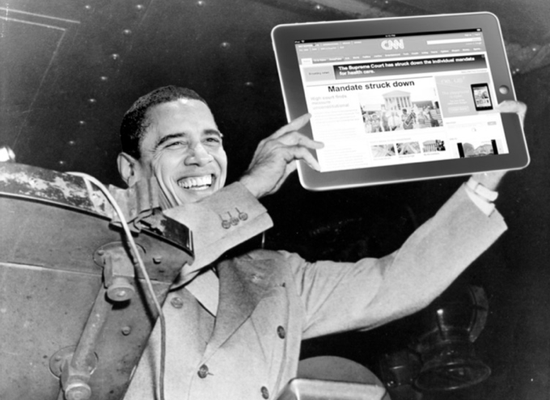
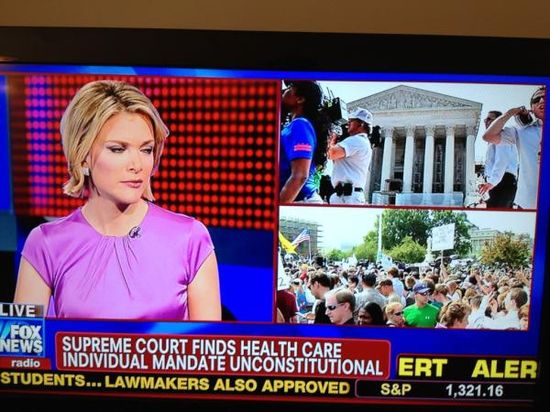
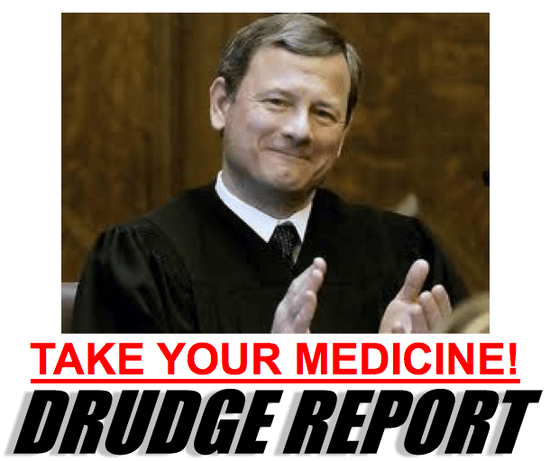
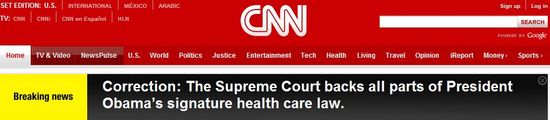
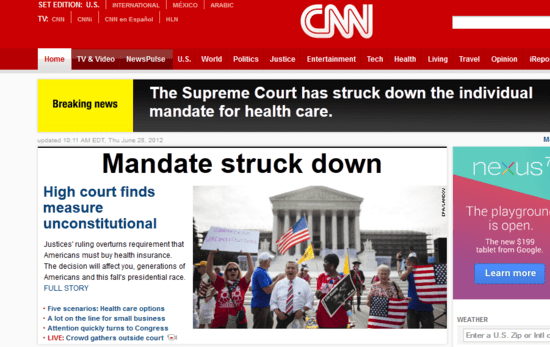
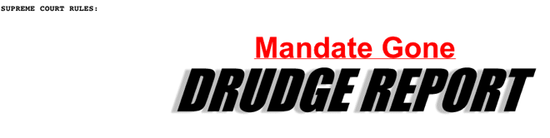
10.36 am. One wonders who at CNN authorized the excruciatingly premature headline below. This is now the correction of the year:
Drudge did not run a correction.
10.32 am. Tweets of the day:
10.29 am. Some confusion in the media:
CNN has now refreshed the page to read:
The Supreme Court backs all parts of President Obama's signature health care law.
Roberts is going to turn out to be another in the long list of GWB mistakes. Complete squish.
Another beaut:
This is what happens when conservatives ignore liberty principles (which they often do) and put someone like Roberts on the Court? He has been deferential to government power in many areas of the law. He is a conservative, not a libertarian. Deference to tradition and we've had a 100 years of tradition in the law that is deferential to government power.
10.25 am. Premature ejaculation:
10.19 am. Tom at ScotusBlog:
The bottom line: the entire ACA is upheld, with the exception that the federal government's power to terminate states' Medicaid funds is narrowly read.
That's a huge victory for Obama, it seems to me. His core domestic achievement was salvaged by … John Roberts.
10.16 am. Roberts defends Obamacare. And a thousand pundits swoon.
10.15 am. The mandate survives! As a tax, apparently. But: "It's very complicated, so we're still figuring it out."
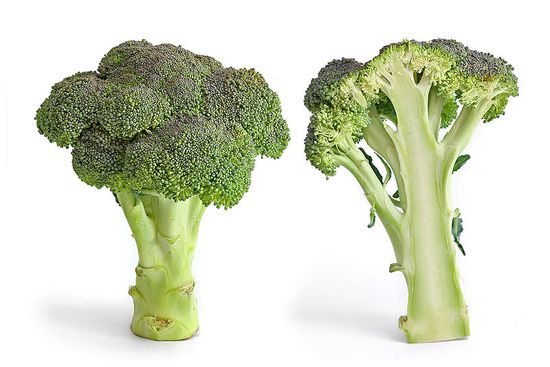
(Broccoli photo by "Fir0002/Flagstaffotos" via Wiki)
Fallows fears that the GOP, in alliance with a GOP-packed Supreme Court, is subverting democracy:
[W]hen you look at the sequence from Bush v. Gore, through Citizens United, to what seems to be coming on the health-care front; and you combine it with ongoing efforts in Florida and elsewhere to prevent voting from presumably Democratic blocs; and add that to the simply unprecedented abuse of the filibuster in the years since the Democrats won control of the Senate and then took the White House, you have what we'd identify as a kind of long-term coup if we saw it happening anywhere else.
He follows up here. I agree that the Supreme Court – after Bush vs Gore, its modernist interpretation of the Second Amendment and then the coup de grace of Citizens United – is in one of its more aggressively political modes. It's also become trashier: Justice Scalia's dissents are perfectly at home on the Rush Limbaugh show at this point. And all this will not help the Court if it strikes down the Affordable Care Act with a similar partisan rhetorical flourish, or on flimsy, clearly partisan grounds.
Wilkinson quips that this "looks to me more like a list of things Mr Fallows finds upsetting than the slow-motion demise of American democracy." Jonathan Adler also counters Fallows:
The problem with these characterizations of the court is that if by “judicial activism” one means a willingness to overturn precedents and invalidate federal laws, the Roberts Court is the least activist court of the post-war period. As a recent NYT analysis showed, thus far the Roberts Court has overturned prior precedents and invalidates federal at a significantly lower rate than its predecessors.
And when you look back at how the Court tried to sabotage the New Deal under Roosevelt – under far more desperate economic circumstances – you see that naked politics has never, alas, been absent from the Court. What's different now is a reversal of roles in which the president is acting according to the old norms and the court is actively reactionary. Under Roosevelt, the Justices were being conservative, trying to preserve the old order under radically changed circumstances. Under Obama, they are reactionary, seeking to undo a century of precedent for federal power. If the ACA is struck down on these radical new grounds, the stakes will be very clear. If the Tea Party keeps control of the GOP and the GOP wins another presidential election under Romney, the next appointees are likely to be more radical still. If there's one thing Romney will aggressively pander on (is there anything he won't aggressively pander on?) it's the Court.
So this is not a coup. It's just the system at work, when one side has gone rogue. When that happens, the answer is not to call the refs but to win the presidency and win back the Congress and reshape the court through the constitutionally appropriate way: by appointing new Justices. After his disastrous attempt at Court-packing, that's what FDR did. It's what Obama has to do. He's in that rare position of being a president whose entire legacy depends upon being re-elected. And as each day passes, the historical importance of that re-election becomes clearer.
"I have a few non-doctrinal yardsticks to think about the question of how legitimate a religion is. 1. Does it have secret, sacred places that are sealed off from outsiders? 2. Is there some kind of esoteric teaching involved known only to those high up in the faith? 3. Is it easy to leave the church, i.e. is apostasy without serious consequences? 4. Does it enforce tithing effectively?"
You came as close as you ever have to questioning Mormonism’s legitimacy as a religion that's truly parallel to "established" ones. It's for the reasons you listed, which were clearly meant to be descriptive of Mormonism, and NOT because of magic plates in Missouri, that I believe we need to seriously raise this question: are we about to elect a man who just belongs to a fringe religion, or are we placing in power a man who closely follows the tenets of a secret society disguised as a legitimate religion?
John F. Kennedy famously stated that secret societies were anathema to America’s principles: "The very word 'secrecy' is repugnant in a free and open society; and we are as a people inherently and historically opposed to secret societies, to secret oaths and to secret proceedings." I want a president who’s an open book, not one who revels in secrecy and exclusivity. You are the person to ask this question, as you have other unpopular ones, and it’s time to do so explicitly.
I do think the question of the cultish qualities of Mormonism are worth exploring. Why cannot non-Mormons come and go in Mormon Temples as they can in Cathedrals and mosques and synagogues? Why is it so hard for some to leave the LDS Church without social ostracism and peer pressure? How much money would taxpayers be automatically giving the LDS church by paying the president his salary? How much control does the LDS hierarchy have over its members? Why is missionary work compulsory? Why were Ann Romney's non-Mormon parents barred from attending her own Temple sealing?
Why did Romney go to Salt Lake City to consult with the big machers in the church before running as a pro-choice candidate in Massachusetts? What transpired at that meeting? (Can you imagine John Kerry going to the Vatican to inform the Pope that he was going to run as a pro-choice candidate – and getting the Pope's silence as a result?) The only explanation that makes sense to me is that they believed that getting a Mormon into the governor's office was more important than adhering to church teaching, which, given the church's absolute stricture against abortion, is revealing about a church's understanding of truth's relationship to power. The LDS church is not the only religion that has these tendencies. But in other faiths, the institutions that most resemble it – like, say, Opus Dei or the Legion of Christ – are more cults within churches than churches themselves.
The doctrines of Mormonism strike me as no more strange than those of most other mainstream religions, but more obviously odd simply because they are so recent. I cannot criticize the absurd and unsubstantiated notion that there were lots of strange tribes occupying America two thousand years ago when Jesus dropped by to say hi, when my own church insists as a matter of infallible teaching that the mother of Jesus was sucked up into the sky rather than dying a natural death. You cannot note that Joseph Smith was a convicted con man whose scam is retroactively obvious without noting the unsavory aspects of Muhammed's biography or the rank anti-Semitism of, say, Martin Luther.
But one can examine the structure of the religion and its practices, to see if they are easily compatible with open government and transparency, or if they rely on intimidation, isolation and cultic practices. Perhaps this can be ignored with lesser offices. But a president is different. If he has been part of a church hierarchy, has had secret meetings with them, has a social life revolving almost entirely around fellow Mormons, and practices his faith in places that no one can see or talk about … then we have some questions. If a candidate's best friends say that Mormonism is at the very core of who Romney is, then his refusal to answer any questions about it or discuss it at all is already disturbing.
I’ve seen and read and written a lot about the AIDS plague in America, fifteen years of mass sickness and death that killed five times as many young Americans as the Vietnam War in roughly the same period of time. I was a volunteer “buddy” to a man dying from AIDS before I tested HIV-positive myself. I lost my dearest friend, who found out he had AIDS at the very moment I found out I was HIV-positive, and countless others as well. I was scared shitless for years. I remember one night talking on the phone to an old boyfriend who was in the same mess as I was: “One thing we need to remember, if we survive this,” I said. “We must never forget how fucking terrified we are.”
I channeled that fear into my books, Virtually Normal and Love Undetectable. I wrote the first because I didn’t expect to live to write the second. The date on the preface is the day I was diagnosed. I wrote the bleakest essay of my life in 1990 for TNR: “Gay Life, Gay Death.” I went to ACT-UP meetings in New York City to absorb the scene and to Harlem’s projects to see a dying gay man whose main worry was that a white guy like me on his doorstep would out him in front of his entire community. I watched young, vibrant men in their twenties turn into skeletons in a matter of weeks. I wandered through the great horizontal cathedral of the AIDS quilt on Washington’s Mall, and saw a wave of grief that reduced the entire scene to an eerie silence.
People forget that HIV decimated the immune system – but people actually died from the opportunistic infections. These “OI”s were something out of Dante’s Hell. So many drowned to death from pneumocystis. Or they would develop hideous KS lesions, or extremely painful neuropathy (my “buddy” screamed once when I brushed a bedsheet against the tip of his toes), or CMV where a friend of mine had to inject himself in the eyeball to prevent going blind, or toxoplasmosis, a brain degenerative disease where people wake up one day to find they can’t tie their shoe-laces, and their memories are falling apart. Within the gay community, 300,000 deaths amounted to a plague of medieval dimensions. Once you knew your T-cells were below a certain level, it was like being in a dark forest where, at any moment, some hideous viral or bacterial creature could emerge and kill you. And for fifteen years there was nothing to take that worked, just the agonizing helplessness of waiting to die, and watching others get assaulted by one terrifying disease after another.
In this immense catastrophe, you had an almost epic tale: no sooner had a critical mass of gay men actually come out, established themselves in urban ghettoes, and finally celebrated their humanity and sexuality than they were struck down in droves. But the next part of the story is the most amazing. We could so easily have given up in shame or self-hatred or exhaustion. But somehow, we found the internal resources to fight back. We knew that the federal government would refuse to react as they would have had this disease occurred anywhere but among homosexuals. And so we were almost a model of self-help, activism and empowerment. We had nothing to lose any more – and that unleashed a kind of gay power that is the most powerful reason, in my view, for why we have made so much progress so quickly since.
ACT-UP had its problems. It would alienate people unnecessarily; it would polarize; it would disrupt religious services; it could be a parody of p.c. claptrap (some meetings were interminable victim-fests), and tiresomely accuse almost anyone not in ACT-UP of being a murderer (yes, I was busted more than once). And yet all of this was a function of rage and will that was and is inextricable from defeating the plague.
“How To Survive A Plague” is the first documentary that I have seen that does justice to this story of a civil rights movement rising from the ashes of our dead.
It gets the chronology just right – with the false hopes and then the real progress and then the crushing news of bad drug trials. The worst years were 1992 – 1995. That was when the deaths were always at your door, when our local gay paper, the Washington Blade, had up to a dozen pages a week just for obituaries, and when I lost my friends who just missed the miracle of cocktail therapy. 1996 was a real nail-biter. Everything was a race against time; some won that race; some fell before the finish. “I just got out from under the barbed wire,” said one friend who lived just long enough to get the treatment. But he left many behind who had been hanging from the same length of string.
ACT-UP begat the research citadel went on to help guide and revolutionize it. The whole concept of being a patient was turned from being a passive recipient of authoritative men in white coats to being an aggressive interrogator with any medical doctor who didn’t know his shit. Almost all of us were certain we’d die of it. And almost all of us mastered the science because we didn’t trust anyone else to help us.
The film gets this; it shows us what today’s generation never saw: the extreme suffering of agonizing and terrifying deaths, compounded at times by ostracism, shame and family betrayal . It shows the women who helped lead the movement – Ann Northrop and Garance Franke-Ruta (now an Atlantic blogger) among many others; and it beautifully captures the manic passion of Mark Harrington and the sharpened lead at the end of the activist pencil, my old friend Peter Staley. There’s one moment in it when you forget and forgive all of Larry Kramer’s occasional excesses because of the look in his eyes. The look was determination to live. And he lived.
If you want to understand the gay civil rights movement in the last twenty years, you need to see this film. None of it would have happened as it did, if we had not been radicalized by mass death, stripped of fear by imminent death, and determined to bring meaning to the corpses of our loved ones by fighting for the basic rights every heterosexual has taken for granted since birth. No spouse was ever going to be turned away from his husband’s deathbed again, as far as I was concerned. Never. Again. For me, marriage equality is not an abstract concept. It has always been my attempt to make my friends’ deaths mean something more than tragedy. And it is non-negotiable.
I was there in Ptown at the film festival with some of my generation of survivors – Peter Staley, Kevin Jennings, David France, Tim McCarthy, whose videos of throwing the ashes of loved ones over the White House gate cannot leave my mind. We hugged afterward, my face blurred red with sobbing. It felt a little like a veterans’ get-together, we older men remembering our salad days of terror and combat. We are not free of health issues as older HIV-positive men. But they are nothing compared with the past. In that sense, we are all children of the plague, forged by it, tempered by it, and, in the words of Mark Helprin, I doubt we will ever be anything else …
… for soldiers who have been blooded are soldiers forever… That they cannot forget, that they do not forget, that they will never allow themselves to heal completely, is their way of expressing their love for friends who have perished. And they will not change because they have become what they have become to keep the fallen alive.
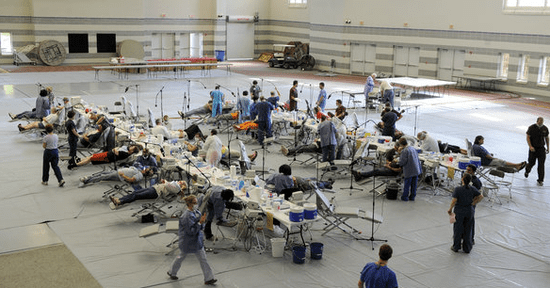
That scene is a free, makeshift dental clinic for the uninsured. It was mobbed – as it would be in a developing country. Except it's right here in Tennessee, where many of the working poor are uninsured, and where the state is perfectly happy to keep it that way. For these strapped, working-class folk, Obama's demonized healthcare reform is a godsend. Pity almost none of them in this part of deepest red America have heard of what it could do for them:
It was hard to find visitors to the clinic who would not benefit directly from the law. Barbara Hickey, 54, is a diabetic who lost her insurance five years ago when her husband was injured at his job making fiberglass pipes. She gets discounted diabetic medication from a charity, but came to the clinic to ask a doctor about blood in her urine.
Under the law, she would qualify for Medicaid. Her eyebrows shot up as the law was described to her. "If they put that law into effect, a lot of people won't need disability," she said. "A lot of people go onto disability because they can't afford health insurance."
Tom Boughan, 58, came to the clinic for glasses and dental work, with a sci-fi novel to pass the time. He's been without coverage since being laid off from his industrial painting job last year, which means he's paying $400 every few months for blood work for a thyroid problem.
This piece was supposed to run on the front page of the Washington Post. They turned it down went cool on it on the grounds that it was too long and too supportive of Obamacare. It's worth remembering before we all go into a Beltway frenzy about SCOTUS and the ACA – that this issue affects people's lives in the most graphic and direct way imaginable. It becomes the difference between living with chronic illnesses or being healthy. It can be the difference between a short life and a long one.
I've evolved on this issue. In general, I find a huge amount to admire in America's private healthcare system and wouldn't want to alter its essential private structure. But its simply staggering inefficiencies, massive costs, and failure to provide health to the working poor persuaded me of the need for reform. And at some deep level, when I consult my conscience, I find denying people healthcare different than denying them a job or a mortgage or a car or an iPhone, or any other material goods. Without your health, you can enjoy none of this.
I remember my instant, sustained reaction when my friends became sick and died for so many grueling years. It was inconceivable for me then that these people should be left to suffer and die in a country as wealthy as we are. If that's true of my friends, it must also be true of those I have never known, whose bodies are no different than mine, whose pain is no less acute, whose lives are no less sacred. You can call this the Golden Rule if you want. Or Christian principles.
(Photo: by Jim Myers/AP/KHN as part of a slideshow of the poor and the sick in Tennessee you can watch here.)
The falsehood is that he has been serious about cutting government spending. The fallacy is that this election will be some sort of referendum that will break the logjam in Washington.
I agree with Dana that Obama made a huge error in not immediately grasping the Bowles-Simpson commission as his own. I decision is that private negotiation was better than taking a public stance that would immediately make compromise impossible. If Obama had endorsed Simpson-Bowles, the GOP would have denounced it. But that would simply have given Obama a clear and brutal chance to call the GOP out on their phony fiscal policy. And when push really came to shove, he put politics above “Yes We Can”. Sure, he had partisan base pressure: Bowles-Simpson would slash Medicare more potently than the Democratic party would like, especially in an election year. But what he needs and needed is simplicity and clarity. In that case, his caution was foolish. He’s been living with the consequences ever since. But it remains true that discretionary spending has been modest in this presidency – far more modest than the last one. And Dana is unfair in not pointing out the serious pilot schemes in the ACA to curtail out-of-control healthcare spending. These try to tackle the problem from the source. They cannot replace higher premiums, or means-testing, or Paul Ryan’s more aggressive attempt to restrict what seniors can buy by limiting their vouchers’ value over time. But they are an integral part of the long-term solution, if there is one. Again, the tragedy of our current situation is that both sides have decent ideas to tackle this debt, but polarization has turned the best of both parties’ ideas into the worst of all worlds. As for Dana’s second point, does he not see he is blaming the victim? He does, actually, and rightly places the blame on the GOP:
Obama alleged, correctly, that Republicans’ refusal to countenance tax increases scuttled the Bowles-Simpson plan and the Senate’s Gang of Six plan. He argued, also correctly, that Republicans’ refusal to budge on taxes is “the biggest source of gridlock in Washington today.” He’s on solid ground, too, in saying Republicans would end Medicare as we know it. But none of that is going to help Obama, because he hasn’t come up with a viable alternative.
But his alternative is pretty clear: more investment and stimulus in the short-term and a Grand Bargain with the GOP in the next Congress. He’s betting that his re-election would allow for a better chance at a real deal with Boehner. I have no doubt Obama would love to cut a huge, legacy-making budget deal that would restore long-term confidence, even if it were to alienate part of his base. And his unspoken message is that in a second term, he could make exactly those kinds of deals – because he has just earned a vote of confidence from the people, because he will not be running again, and because the fiscal crisis is now. Taxmageddon will see to that. Dana is wrong to see the logjam as eternal. It simply cannot be without real pain to both parties, or a real fiscal crisis, which was how Obama set up the final negotiation in the last debt ceiling deal.
So in a sense, Obama’s message is what it can only be: we all want to tackle the debt seriously. Within the next six months, let alone four years, we will have to make key decisions or lose control of our fiscal destiny. The question is how will we do it? Would you rather thave those decisions with me at the bargaining table – or leave it entirely to the current Republican party?
When framed like that, I remain convinced that this is a cogent case. And he put it well. He can hone it some more – and should. But the actual choice we now face is either a draconian exercize in budget cutting entirely on the backs of the middle class and poor, exempting the wealthy, or a deal with Obama for a more balanced, less ideological and more inclusive collective sacrifice. Maybe this choice argument will be swamped by pure GOP hazing, mockery and taunting in a terrible economy that could suddenly get worse. But the choice argument is all Obama has. He should not be berated for making it.
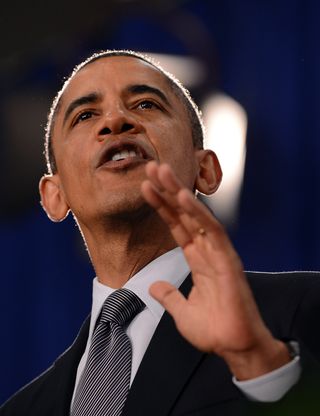
(Photo: the president yesterday in Cleveland, Ohio. By Jewel Samad/Getty.)
3.05 pm. My bottom line? A home run. Simply constructed, carefully reframed, aggressive while positive: the Obamaites have been listening to critics and are responding. If this is his message, and if he is able to keep articulating it this clearly, he will win. And in my view, the experience of the last thirty years is that he should win. If I have to choose between a governing philosophy espoused by Bill Clinton or one espoused by George W. Bush, it's a no-brainer. And I can't stand Bill Clinton.
3.03 pm. Finally a vote of confidence in the American future. He says he sees even in deep economic distress "a stubborn hope and a fierce pride and a determination to overcome whatever challenges we face." It's a stem-winding patriotic ender – and a call for unity against the allure of cynicism. We have gone from "change you can believe in" to "change we need right now."
2.58 pm. He redirects the attacks on him. "That may be a way to win an election. It is not a way to grow the economy." I love the phrase "the scary voice in the commercials." His position is that he wants a real debate about these two visions, a defining moment between 1980s conservatism or 1990s liberalism as the way forward. We're watching a fusion of Obama and Clinton here in his case for a second term. And there is the inevitable unstated pairing of Romney and Bush.
Then the return to the 2008 election: "I will work with anyone in any party who believes we are in this together."
2.57 pm. "The only people who can break the stalemate is you."
2.56 pm. He insists that the only reason we have not made a Grand Bargain is the GOP insistence on protecting the very rich from any tax increases: "the biggest source of gridlock in Washington today."
2.50 pm. Now the deficit and a withering attack on those who only care about the deficit when the other party is in office, but not when they are. "If you really want to do something about it …" then the tax code has to ask the wealthiest Americans to contribute. Then he's essentially running on Clinton's record of raising taxes on the rich and precipitating a jobs and millionaire boom.
Brilliant line: "We don't have a choice to bring down our deficit. We have a choice about how we bring down our deficit." I like the adjective about deficit reduction: "honest" and "balanced". And then he actually says that cutting the deficit should not be done by giving Mitt Romney a new tax cut while rendering sick seniors insecure. Brutal. Effective. The argument is there. And he's beginning to put it together.
2.47 pm. There's an interesting emphasis on science and innovation in this speech. "Why would we reverse this commitment right now when it's so important?" Someone should count the number of times he has said "science."
Then a line straight from Ron Paul: "Instead of paying for war, let's do some nation-building right at home!" This is an aggressive confident speech that is all but begging the GOP to oppose him on these grounds. And it's all forward-looking – exactly the approach he needs.
2.45 pm. "We're producing more oil than at any time in a decade." He's boosting natural gas and cleaner coal, and renewable energy. The all-of-the-above approach. "Let's double down on a clean energy industry." He's making the choice starker and starker. And he does not seem afraid.
2.43 pm. Now he's stressing education as the last thing we should cut if we want to have a middle class economy in the future. And then a dig at Romney: "I want to hire more teachers." Ouch. Then a pitch to young immigrants with education: "we won't deport them." Another direct tackle.
2.40 pm. Now he's invoking Lincoln and Eisenhower and even Nixon and Reagan on the need for common projects for the common good – from the interstate highway to the EPA and reforming social security. He's giving a speech to a highly partisan crowd, but this is a speech delivered to all those centrists and independents who backed him in 2008. And given the cogency of his case, it's a powerful message. Because it engages the facts of the last two decades and gets concrete on what he, compared with Romney, wants to do in the next four years.
2.36 pm. Now we have a passage declaring that he is not a big government liberal; he wants to cut and streamline regulations, cut unnecessary taxes, reduce the government's size and inefficiency. He's touting a $2 trillion deficit reduction. "I do not believe the government is the answer to all our problems. I do not believe that we should be in the business of helping people who will not help themselves." Then he invokes Lincoln as his mentor – doing things together we cannot do alone.
2.34 pm. His pitch is basically a "balanced" approach to deficit reduction (i.e. not balancing the budget entirely on the backs of the middle class and the poor). Then serious investment in education and infrastructure. But he's framing this in a very Clintonian way – touting his own tax cuts, decent private sector job growth. and deficit plans. He is, in my view, nailing it.
2.30 pm. "We tried this." It didn't work. The speech began with a statement of a clear choice, then pivots to a brutal attack on Romney's return to the past, and then a peroration on his "different vision." Let's see how persuasive it is.
2.27 pm. Now he's arguing that the tax reform Romney proposes would effectively be a big tax increase on the middle class. Money quote: "This is nothing new. It's what Bill Clinton described as old ideas on steroids." And if you want to return to big tax cuts, huge spending cuts and the agenda of the Bush years, then vote for Romney! That's a great line: he's telling people who miss the policies of George W Bush to vote for Romney. Awesome line. Except he can't quite say the word "Bush."
2.23 pm. Now he outlines Romneyism as an extension of Bush's tax cut policy – but with the legacy of even greater debt. It's a story of massive gains for the very rich and a brutal attack on core government functions. He's strongest here on cuts in science and medical research. But he's very clear that the cuts would be greater and deeper than any in modern times. And he calls their Medicare plan a "voucher system" eventually "ending Medicare as we know it".
2.22 pm. The debate is not about the state of the economy; we all agree it sucks. The debate Obama wants is "about how we grow faster and how we get more jobs and how we pay down our debt". So far, this is about as good a summary of the case as those of us who support him could have expected.
2.19 pm. Now he's telling a rather convincing story about the failure of tax cuts in 2001 to give us growth in the last decade – and explaining how the current recession is not a normal one, how it usually takes a decade to recover from that kind of financial crisis. Then a pivot to the European nations unable to get any growth at all, compared with America's resilient private sector. Then the record of private sector jobs – more in the last two years than in the seven years before the crisis.
He has yet, however, to mention the word Bush.
2.12 pm. The election is about ending the "stalemate in Washington." Making a final choice about where we go from here. And now he starts to tell the story of middle class stress for the past three decades. "You know that. You lived it."
2.11 pm. So far, it's all about choices for the future, which he is portraying as a defining moment for the survival of the middle class.
2.10 pm. Within a few minutes, he is saying that this election is about the economy and a clear choice about how to tackle it.
2.09 pm. He jokes about his "unique contribution" to the press and media frenzy last week. But he's telling his supporters not to get too jumpy about short term ups and downs.
2.07 pm. The intro was by a mother who spoke about her daughter. They're going to cling to their gender gap as tightly as they can.
Here's a question: if Barack Obama had to go through a brutal process of defending the doctrines, sermons and ideology of a church he merely attended, why is Mitt Romney exempted from explaining the doctrines and statements and ideology of a church he was an actual leading official in? I've been doing my best to read up on Romney's life and career and the more you read, the more you agree with one of his fellow worshippers who told the New York Times that Mormonism is
at the center of who he really is, if you scrape everything else off.
You could argue, as I do, that politics and religion are separate spheres and that a candidate's faith should not be a major issue for anyone. But Romney is running as the leader of a party whose modern incarnation is defined by an insistence that religion and politics are inseparable, and Romney's runner-up memorably described president Kennedy's strict affirmation of political secularism as puke-worthy. So there really is no solid defense against an examination of Romney's faith and how it formed him – or questioning some of his faith's stranger doctrines. The media thus far have trod gingerly around the subject for good reason. Anti-Mormon bigotry, like racism, has been part of this country for a long while and in many ways, an election between a black man and a Mormon is a stupendous achievement for toleration in America.
And yet. There must be a way to tell a story about Romney's Mormonism that is illustrative and helpful in understanding a man we could put in the Oval Office rather than bigoted. In my view, this should be a priority for Romney, and he should soon give a speech, like Obama's bright shining moment after the Jeremiah Wright onslaught. But I fear he won't, because any day he is talking aout Mormonism rather than the economy is a lost day. But if Romney thinks Mormonism will somehow not be a factor in this election, he's deluding himself. A new paper suggests a surge in anti-Mormon sentiment in the past few years, and a very stable and resilient anti-Mormon bias among evangelicals – who didn't give Romney a single majority in any of the primary states. Money quote from Buzzfeed's summary:
According to the paper, concern about Mormonism has remained relatively stable among Evangelicals, with 36 percent expressing aversion to an LDS candidate in 2007 and 33 percent doing so in 2012. But among non-religious voters, that number shot up 20 points in the past five years, from 21 percent in 2007 to 41 percent in February. There were also substantial increases in Mormon-averse voters among liberals — 28 percent in 2007 and 43 percent in 2012 — as well as moderates, who went from 22 percent in 2007 to 32 percent this year…
The new study argues that the single most accurate predictor of how a voter views Romney is how he views Mormons — whether or not they are Christian, patriotic, hard-working, and friendly. Strikingly, the correlation between attitudes about Mormonism and support for Romney is even stronger than political ideology or party identification.
Perhaps most potentially distressing to Romney's campaign is the study's finding that conservatives who said they were less likely to vote for a Mormon were much more likely to say they were undecided or would not vote at all in a contest between Obama and Romney.
My italics. One caveat may be that the study was conducted before Romney clinched the nomination – so partisanship may help assuage conservative jitters. But if Karl Rove were running the Obama campaign, we wouldn't be discussing if this would emerge as an issue but how. I don't believe that the Obama campaign, in contrast, can or should touch it. But what I expect is that at some point the sheer enormous new prestige and legitimacy that winning the American presidency would give to the Mormon church will give conservative evangelicals the willies. That won't matter in the South – but it could factor in in Pennsylvania or Colorado or Ohio. And there may be some secular independents who really distrust the LDS Church.
Unless race trumps everything. And unless these very evangelicals also think the dude running against the Mormon is a Muslim. Is this a great country, or what?
 middle of a presidential campaign – when there was a plausible way out. He was also applying the logic of judicial restraint with respect to legislative wishes, interpreting the law to be as constitutional as it could possibly be deemed (i.e.in this case, viewing the mandate as part of the Congress's tax power). In these two ways, Roberts upheld a form of conservatism that is not synonymous with the interests of the Republican party at any given moment. Which is so unusual these days one wants (pathetically) to stand up and cheer.
 election, when Bush lost the popular vote, as a landslide mandate election – again with no deference to the other side or sense of governing as one nation.


 decision is that private negotiation was better than taking a public stance that would immediately make compromise impossible. If Obama had endorsed Simpson-Bowles, the GOP would have denounced it. But that would simply have given Obama a clear and brutal chance to call the GOP out on their phony fiscal policy. And when push really came to shove, he put politics above “Yes We Can”. Sure, he had partisan base pressure: Bowles-Simpson would slash Medicare more potently than the Democratic party would like, especially in an election year. But what he needs and needed is simplicity and clarity. In that case, his caution was foolish. He’s been living with the consequences ever since. But it remains true that discretionary spending has been modest in this presidency – far more modest than the last one. And Dana is unfair in not pointing out the serious pilot schemes in the ACA to curtail out-of-control healthcare spending. These try to tackle the problem from the source. They cannot replace higher premiums, or means-testing, or Paul Ryan’s more aggressive attempt to restrict what seniors can buy by limiting their vouchers’ value over time. But they are an integral part of the long-term solution, if there is one. Again, the tragedy of our current situation is that both sides have decent ideas to tackle this debt, but polarization has turned the best of both parties’ ideas into the worst of all worlds. As for Dana’s second point, does he not see he is blaming the victim? He does, actually, and rightly places the blame on the GOP: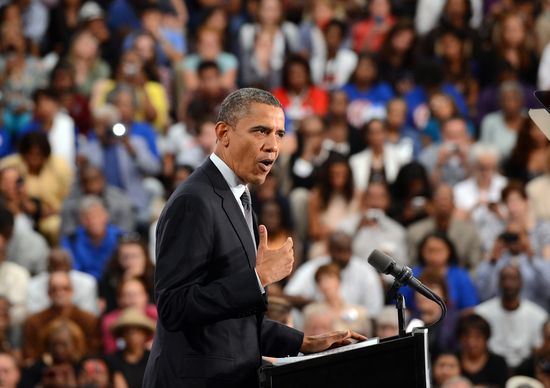
 should not be a major issue for anyone. But Romney is running as the leader of a party whose modern incarnation is defined by an insistence that religion and politics are inseparable, and Romney's runner-up memorably described president Kennedy's strict affirmation of political secularism as puke-worthy. So there really is no solid defense against an examination of Romney's faith and how it formed him – or questioning some of his faith's stranger doctrines. The media thus far have trod gingerly around the subject for good reason. Anti-Mormon bigotry, like racism, has been part of this country for a long while and in many ways, an election between a black man and a Mormon is a stupendous achievement for toleration in America.
 The Dish
