Are Drones Defensible?

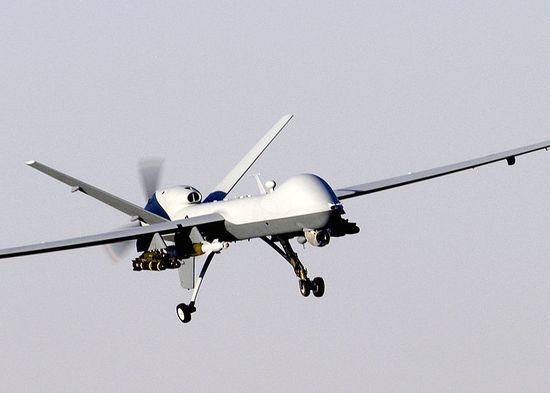
800px-MQ-9_Reaper_in_flight_(2007)

Friedersdorf believes that my posts on drones are at odds:

Sullivan is … celebrating Obama's drone kills and suggesting that they're part of why he deserves reelection. And yet, in more considered moments, he asserts that the drone campaign (a) violates the constitutional imperative to get Congressional permission for war; (b) constitutes the use of a technology that inclines us to blowback and permanent war; (c) effectively ends the Founders' vision; (d) empowers an unaccountable and untrustworthy agency; and (e) kills lots of innocent children.

Hold on. (a) The war against al Qaeda in Afghanistan and Pakistan was explicitly authorized by the Congress back in 2001. (b) recent research suggests blowback is not inevitable in all cases (although I certainly agree it is a major drawback) and the attacks themselves are extremely effective in what they are trying to do:

On the basis of comprehensive analyses of data on multiple terrorist and insurgent organizations, [two new] studies conclude that killing or capturing terrorist leaders can reduce the effectiveness of terrorist groups or even cause terrorist organizations to disintegrate … [R]eligious terrorist groups were almost five times more likely to end than nationalist groups after having their leaders killed.

(c) What ends the Founders' vision is religious terrorists from mountains in Middle Asia successfully invading and terrorizing major cities in the US and killing thousands. What frustrates me about Conor's position – and Greenwald's as well – is that it kind of assumes 9/11 didn't happen or couldn't happen again, and dismisses far too glibly the president's actual responsibility as commander-in-chief to counter these acts of mass terror. If you accept that presidential responsibility, and you also realize that the blowback from trying to occupy whole Muslim countries will be more intense, then what is a president supposed to do? I think the recourse to drone warfare is about as reasonable and as effective a strategy as we can find. It plays to our strengths – technology, air-power, zero US casualties, rather than to our weaknesses: occupying countries we don't understand with utopian counter-insurgency plans that end up empowering enemies Moqtada al Sadr and crooks like Hamid Karzai, and turn deeply unpopular at home. Given our country's fiscal crisis, massive expensive counter-insurgency is no longer a viable option.

Not that blowback isn't a real worry; not that all of Conor's concerns shouldn't be part of the equation. It's possible, for example, that wiping out the entire mid and top leadership of al Qaeda could make things worse:

What is coming next is a generation whose ideological positions are more virulent and who owing to the removal of older figures with clout, are less likely to be amenable to restraining their actions. And contrary to popular belief, actions have been restrained. Attacks have thus far been used strategically rather than indiscriminately. Just take a look at AQ’s history and its documents and this is blatantly clear.

But as Will McCants explains:

Al-Qaeda Central’s senior leaders seek to kill as many citizens as possible in the non-Muslim majority countries they don’t like, particularly the United States and its Western allies … It is hard to imagine a more virulent current in the jihadi movement than that of al-Qaeda Central’s senior leaders. Anyone with a desire or capability of moderating that organization was pushed out long ago.

Daveed Gartenstein-Ross and Clint Watts side with McCants. Bill Roggio returns to basics:

Nine years into the drone program, it is now clear that while drones are useful in keeping al Qaeda and its affiliates off-balance, the assassination of operatives by unmanned aircraft has not led to the demise of the organization or its virulent ideology. During both the Bush and Obama administrations, US officials have been quick to declare al Qaeda defeated or "on the ropes" after killing off top leaders, only to learn later that the terror group has refused to die. Instead of being defeated, al Qaeda has metastasized beyond the Afghan-Pakistan border areas, and has cropped up in Yemen, Somalia, North Africa (including in Mali), and even in the Egyptian Sinai.

And there does seem a danger, especially in Yemen, that drones may be focusing the Islamists' attention away from their own government and onto ours. Which is why this program needs to be very carefully monitored, excruciatingly reviewed, constantly questioned. So yes, I'm with Conor on the need for more accountability and transparency on this.

But if you'd asked me – or anyone – in 2001 whether it would be better to invade and occupy Afghanistan and Iraq to defeat al Qaeda, or to use the most advanced technology to take out the worst Jihadists with zero US casualties, would anyone have dissented? And remember the scale of civilian casualties caused by the Iraq war and catastrophic occupation: tens of thousands of innocents killed under American responsibility for security. The awful truth of war is that innocents will die. Our goal must be to minimize that. Compared with the alternatives, drones kill fewer innocents.

Of course, we need to be incredibly careful to limit civilian casualties even further. Counting every military-age man in the vicinity of a Jihadist as a terrorist is a total cop-out. We should see the real casualty numbers and adjust accordingly. But we also have to stop the Jihadist threat. It is real. And a president does not have the luxury of pretending it isn't.

(Photo: A MQ-9 Reaper unmanned aerial vehicle prepares to land after a mission in support of Operation Enduring Freedom in Afghanistan. The Reaper has the ability to carry both precision-guided bombs and air-to-ground missiles.)
Obama And The Future

145960124

The good news of the terrible news of the last couple of weeks is that there's a lot more realism about the forces at work in this election. Incumbent presidents always have a tricky re-election campaign, because they have to balance a defense of their record with a set of proposals for the next term. Often, the mandate is vague – and you won't find a better summary of the risks and opportunities involved than Ryan Lizza's superb new piece in The New Yorker.

What the Obama campaign has to do is relatively simple: stop being defensive about their record, connect the politics of the past two years to the GOP's fierce resistance to change and then ask for help in completing it. I made a brief case along these lines last Friday. Tomasky piths it up:

The story, in a nutshell, is this: we inherited a total disaster, things are getting better, and Romney will bring us back to disaster.

The problem is that the GOP looks likely to remain a powerful force in the second term, barring some miracle in November. In fact, I'd argue Romney's best case is that with a Republican Congress, he will be able to end the gridlock and move the country forward. The trouble with this, of course, is that a total GOP government would be a toxic brew of Paul Ryan's economics with Dick Cheney's diplomacy and Bryan Fischer's open mind. But if you're a low-information swing voter and associate gridlock with recession, you can see the appeal of at least some movement somewhere.

So what Obama has to do – what he can only do – is focus on the specifics of what must happen before the end of the year. He should remind us that without some compromise, we will have what's been called Taxmageddon: all the Bush tax cuts will be sunsetted, unemployment benefits for 3 million Americans will end, payroll taxes will rise two percent for employees, and sequestration will start being enforced. Even Romney has said that that combination would plunge us and the world back into recession, so he won't go there. So if both candidates say this is unacceptable, the most obvious choice we currently face in this election is: which solution to this looming crisis is the most effective?

This where Obama has the edge in the arguments, it seems to me: he says that the Bush tax cuts should only be sunsetted for those earning over $250,000, unemployment benefits should continue, the payroll tax should be kept where it is (to prevent a slide into a double dip), but sequestration should proceed. But he should also say he'd throw all this up in the air if the GOP were willing to raise serious new revenues via elimination of tax deductions, along with further cuts in defense, in return for real entitlement reform. In other words, he must put front and center his view of debt reduction: entitlement cuts, defense cuts and revenue increases via tax reform. Essentially a more Democratic version of Bowles-Simpson. Then he has to just call Romney out on refusing to raise any taxes on the very wealthy. If it's framed this way, Obama wins.When you're grappling with debt and one sides insists on only tackling spending and not revenues, it's being perverse.

Running simply against austerity, as if the debt did not exist, is not, I think, a realistic option. Obama should run rather on the most equitable way to cut the long-term debt, and then insist on some short-term easing on the imminent austerity. And he has to combine this with one signature and clear second-term commitment. 

My view is that it should be immigration reform, along Bush's lines (as Lizza discusses). This is something even the most recalcitrant Republicans would be leery of demonizing, especially if 6a00d83451c45669e20163065f2971970d-320wiRomney lost the election because of the Latino vote. Those whites who are incensed by illegal immigration are voting for Romney anyway. More to the point, the sane people left in the Congressional GOP know that it splits their party and opposition to it could kill their future. If Obama invokes the legacy of Bush for the reform, it could be brutal for them.

Tomasky's critique of this is that the Republicans will be just as crazy after the election as now, and so all of this is academic. I don't agree. We live in a polity where one party has essentially stopped treating the other party as in any way legitimate representatives of the American people. There is no willingness to compromise. The question is not whether this fever will break; the question is how does a country function unless it breaks? One soft spot where it could be tackled is immigration. It's one area where the GOP is rightly alarmed about its own future. If it is front and center in this election campaign, alongside a balanced approach to long-term debt and short-term stimulus, you can begin to see why many would want to back Obama.

So far, the Obama campaign has seemed to me overly negative and tactical, as opposed to positive and strategic. I'm not saying the Bain ads should be pulled; they're legit and they appear to be working. I'm not saying that Romney's extreme wealth and privilege should not be highlighted. But I am saying that Obama's core strength must stay what it was last time: sane, centrist, profound reform. He can say in his first two years, he made a massive downpayment but has been stymied ever since. This election is about empowering him to finish what he began. And to have voted for him in 2008 and not vote for him now makes no sense at all.

We all knew there would be brutal resistance to real change. So are we really going to bail when resistance makes its strongest counter-attack? Or will we push the president to keep his promises while mobilizing to ensure he can recapitalize in this election and finish the job? I know where I am on this. Do you?

(Photos: Mandel Ngan, Brendan Smialowski/Getty)

Obama’s Brutal Week

After the jobs numbers and the Wisconsin recall, we get a royal verbal screw-up from POTUS and Romney drives the knife further in:

I'm with Weigel on this one. This is a big black eye for the president – not because what he said is in context that outrageous. It's a black eye purely because what he said is outrageous out of context and not in a self-evidently false way. So it's a pure political gift to his opponents – and the GOP will clip the quote to make it as damning as they can. They will try to identify a president whose administration inherited and was consumed by  the worst recession since the 1930s as a man who has no idea there is a recession at all. And with low-information swing voters, it will be horrible.

Of course, I do not believe for a second that Romney actually believes that Obama believes the private sector is doing fine. He knows, as we do, that what Obama was trying ineptly to say is that compared with the public sector, the private sector is doing fine, which is not the same as great, right now. But watch Mitt up there, all shocked and stunned. He's just incredulous that Barack Obama genuinely believes that the private sector is doing fine. Amazed. Staggered. I mean: gee willikers, can you believe it?

Now watch Obama's expression as he swiftly tries to correct himself:

This embed is invalid

Yes, that's a smile. Of amused desperation. He knows the damage. He knows that the result is that some will successfully persuade others that he truly believes the exact opposite of what he actually believes. He knows that the elaboration above will get one millionth of the views of the original fuck-up.

All I hope is that it doesn't get into his head. Or our collective head.

There are some real choices in this election: how to work off a recession created by a financial crisis, a housing bubble, and a debt overhang? Whether to tackle the debt with spending cuts alone or whether to include tax increases in the mix? War with Iran or not? More stimulus or more austerity? And none of them can usefully be engaged in by any reference as to whether the president actually believes that the private sector is booming. He doesn't. It's obvious he doesn't. It came out wrong. If we cannot make the distinction between those kinds of arguments – real ones or phony ones – then we will get the government we deserve.

As for Obama, he's been hazed before; he will be hazed again. This election campaign is going to turn him into a pinata of projection and distortion and blame. It will be like the battle with Clinton only far, far more brutal. His only option is to do what he did then: relentlessly counter distortions with truth. He needs to tell the story of the last three years clearly and honestly, and to make the case for what he will do in the future, without being distracted by the 24 hour nonstop chatter that now convulses the attentive body politic. He has a strong case on the content of his record and on what he plans to do going forward and how it all fits together. He has to make it. Again and again. With ever more clarity and concision.

To be more precise, he must make it plainer that, in this country's politics, he is still the change agent. If he weren't, why would they have done so much to stop him? And why are they so desperate to prevent a second term? What Obama needs to do is to connect the opposition he now faces to the campaign he ran in 2008. He did what he said he'd do. But he needs another term to get it to stick. They know that. He knows that. But do his 2008 supporters see it yet?

It's going to be hard. And it's not always going to be fair. But the stakes now are as large as they were in 2008. And the wind, rather than being at his back like last time, is blowing with increasingly irrational ferocity in his face. I feel no pity for him. When you take up the mantle he has, you accept that you will alternately be blessed and cursed by fate as well as your own judgments. And he's had plenty of his own luck in getting to the White House. He's going to have to earn every inch of it to stay there.

This is where we see, of course, if he really has got it in him – and if those of us who saw him as a change agent have the stamina in us as well. Few have achieved so much in the presidency so tenuously. But that was always the risk of the long game.

In that long game, as they say on cable news, the critical period starts now.

“Microinsurance” vs HIV

Tina Rosenberg assesses the impact of a private sector enterprise – microinsurance – that seems to be genuinely extending the lives and self-care of people living with HIV:

Ross Beerman, AllLife’s managing director, says that clients average a 15 percent improvement in their CD4 count — an immune system marker — six months after buying insurance, whether or not they are taking antiretrovirals (the majority of clients have not yet reached that stage). That improvement may partly be the psychology of seeing their disease in a different way: “If you think you have a terminal disease, you don’t care how you eat and exercise,” said Beerman. AllLife helps patients to be more adherent. Doctors are busy and do many things. AllLife does only one thing, and sometimes catches a problem before a doctor can. “If necessary we’ll give the doctor a call,” said Beerman.

Felix Salmon adds his two cents. I can certainly attest to the fact that psychology plays a part in defeating sickness. I credit my own survival to believing from the get-go that I could be part of the first generation that survives this. And I was. Talking to smart researchers (Jerry Groopman was my intellectual rock), doing research into new treatments, closely monitoring your own health, better diet and exercize: all these make it likelier you will do better. It’s not dispositive. Everyone is different. But confidence in the future makes a huge difference.

On the TMI front, my latest HIV news is pretty good. Still no viral load detectable by the usual tests; CD4 counts within the lower portion of the normal range. The one thing that resiliently affects my life is the HIV-related collapse of testosterone and the side-effects of the drugs. My body has all but stopped producing testosterone on its own; and when I had to inject myself every two weeks, I often HIV-budding-Colordelayed it (who wants to stick a needle in their rump if they don’t have to?). By this spring, I realized I had effectively reduced my dosage of testosterone by more than half simply by non-adherence to the regimen (which I am punctilious about when it comes to swallowing handfuls of pills). No wonder I found myself struggling against exhaustion and depression.
This week, I got a new implant that will deliver testosterone evenly in my body over four months. It still hurts a bit when I sit down, but that will pass. Even after three days, I feel a lot better. This small, incremental change will doubtless be another life-saver. But my own failure to stay on top of my health with respect to testosterone is a reminder that illness can lead to depression which can easily lead to hopelessness which can become self-fulfilling.

It’s not that I haven’t succumbed to depression or despair at times. I did this spring. It’s just that I have realized I have a very strong survival instinct; and I have learned that survival with a chronic disease is a process, not an event. It requires life-long vigilance and will. And that’s often harder than it seems. Anything – even small things – that can help you stay vigilant and in charge of your health is a good thing. From micro-insurance to testosterone implants to single-pill drug combos to preventative use of Truvada, it all adds up.

Which is a very roundabout way of saying: for me, as for anyone with a chronic disease, it’s always a challenge, but, through it all, I’m so grateful to be alive. If you forget that fact, and we all do, it’s good to remind yourself from time to time. I regard HIV in this way as a kind of blessing.

By figuring out how I might die, I learned how to live.

(Photo: Scanning electron micrograph of HIV-1 (in green) budding from cultured lymphocyte. Multiple round bumps on cell surface represent sites of assembly and budding of virions.)

Wisconsin – And The Rest Of Us

145722729

Readers know the Dish hasn't exactly been fixated on the epic partisan struggle in Wisconsin over public sector union rights. The reason? I'm not that interested in raw purely partisan mudfights, and while I don't see the harm in allowing public sector unions to retain some collective bargaining rights, especially in an era when unions can be seen as institutions putting a break on soaring economic inequality, I also believe there's a difference between public sector and private sector unions, and that curtailing the massive collective costs that public union benefits place on the public is a perfectly legitimate way to cut spending. It may be vital if we are to regain some fiscal balance. But when all is said and done, my bottom line is that I believe in democratic elections, and granting legitimacy to your opponents when they win.

Leaving aside the issues being fought over, Scott Walker won an election, and absent some grotesque abuse of power, he deserved to serve his term out. I don't think turning out to be even more radical than the platform you ran on is a grotesque abuse of power. It is precisely the kind of over-reach that is best left to the voters at the next election, rather than creating a massive, disruptive, premature political storm that can only deepen partisan deadlock and mistrust. What Wisconsin means in microcosm is not so much a portent of the future November election (though it may be that), or a decisive turn toward fiscal retrenchment (thought it certainly seems that way), but a case study in the complete breakdown of our political system, and of public trust.

The Democrats refused to allow Walker to serve his full term and then seek the judgment of the voters. They acted throughout as if he were somehow illegitimate. They refused the give-and-take of democratic politics, using emergency measures for non-emergency reasons. And in this, they are, it seems to me, a state-based mirror-image of the GOP in Washington. Just as Walker was quite clearly a far right candidate and implemented an agenda that was predictable from the spirit if not the letter of his campaign, so Obama ran precisely on what he has done in office, despite the crushing emergency he was handed on becoming president. His healthcare reform was not suddenly revealed in a bait-and-switch operation. It was exhaustively debated in the primaries and the fall campaign; ditto the stimulus, a no-brainer for any president looking into a deflationary abyss; ditto ending the war in Iraq; and focusing on al Qaeda in counter-terrorism, rather than social engineering of quixotic proportions in counter-insurgency.

He has done what he said he'd do. And yet he has been treated as illegitimate and utterly unworthy of any cooperation or compromise by the congressional and media GOP. I worry that Ross's prediction of zero-sum scorched earth politics in an era of spiraling austerity is accurate. I worry that the polarization that Obama tried to overcome has now been innoculated by the virus of victory.

(Photo: A sign supporting Wisconsin Governor Scott Walker stands outside a home June 4, 2012 in Clinton, Wisconsin. By Scott Olson/Getty Images.)

They Are Both Keynesians Now

Gov-spending-00

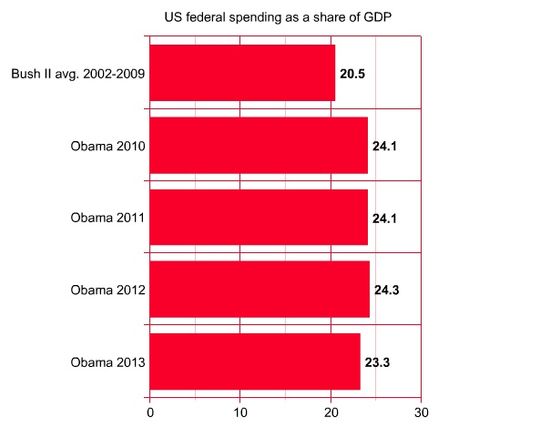
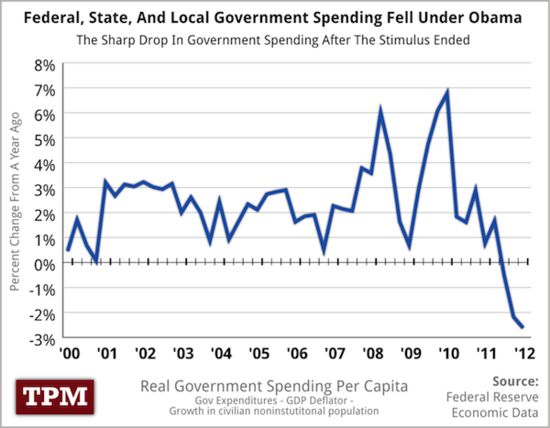
Ezra Klein anticipates the Romney debt balloon:

There will almost certainly be deep spending cuts if Romney is president, but both the Romney and Ryan proposals include trillions of dollars in unpaid-for tax cuts and defense spending. If Republicans decide to assume that deep tax cuts will lead, through supply-side magic, to larger revenues, their deficit-reduction plans might well end up increasing the deficit over the next few years, even if it does so in a regressive way. Remember, wrote Business Insider’s Joe Weisenthal, “Republicans were pro-deficit, and pro-entitlement expansion under Bush and Reagan. Deficit cutting only became part of the party’s ideology under Obama.” Compared to anything Obama is likely to get from a Republican House, that is, at least in the short term, a much more expansionary, Keynesian approach. But it’s also an awful precedent. In a sense, Republicans are holding a gun to the economy’s head and saying, “vote for us or the recovery gets it.”

The graph showing government retrenchment is via TPM. Allahpundit wonders how plausible this is:

[Romney is] not going to do something which he thinks will force a major economic contraction; does he try to build congressional majorities to delay deep cuts by replacing recalcitrant tea partiers with Democrats, knowing that the optics of that might only increase his headaches? If he thinks that conservatives will grant him a honeymoon period after he’s sworn in on issues as critical as the size of the federal budget and the speed with which meaningful cuts are made, I think he’s kidding himself. But maybe Klein’s right that this can be finessed by signing Paul Ryan’s budget — and getting to work on entitlement reform, assuming that Romney has the nerve to do so.

If you assume that the sanest, most feasible approach is stimulus-now-retrenchment-later (because sunsetting Bush's tax cuts and the sequestration process would mean an almost certain double dip recession), then the practical immediate question in this election is: what brand of stimulus-now-austerity-later admixture do you prefer?

In that choice, it seems to me we have two options on the table. The first is Romney's: huge defense spending increases and lower tax revenues than the Bush regime, accompanied by turning Medicare into a voluntary voucher scheme, where you will henceforth be guaranteed only the healthcare your voucher affords. The second is Obama's: sunsetting the Bush tax cuts on those earning over $250,000, more infrastructure investment, cutting defense spending (though they're getting way too squishy on that), and more serious cost controls in Obamacare and Medicare (higher premiums for the wealthy, an end to fee-for-service, rationing at some point) to slow spending in the long run.

To put it bluntly, Romney favors more tax cuts, more defense spending and decimating Medicare. I don't think much of this is popular, especially the latter. Ponnuru is onto something:

Most people believe the [entitlement] programs need reform. But in a Pew poll in 2011, Americans favored preserving benefits to reducing deficits by almost 2-to-1. By 56 percent to 33 percent, they worried more about Social Security benefit cuts than about tax increases. In a March 2012 poll, just 26 percent of the public favored the Republican idea of changing Medicare so that beneficiaries pick a health plan and get a “fixed sum of money” to meet the costs.

That's your attack. You also point out, in the final stretch, that voters risk handing over the entire government to the most radical Republican party in decades if they elect Romney alongside a GOP House and Senate. Obama can be framed as the indispensable negotiator for half the country in the coming fiscal showdown.

Here's your positive message: Obama inherited an economy in free-fall and the most obstructionist opposition in decades. He prevented a second Great Depression, achieved a halting recovery, passed universal healthcare and won as solid a victory against al Qaeda as is conceivable. What he needs to argue is that this is just the beginning of a national renewal, a downpayment on the rest  – by insisting that long-term debt reduction can be done now, that immigration reform must be achieved for the next generation of Americans, and that the insane tax code can be rescued from the special interests.

Obama will not win by playing safe, it seems to me, or defensively, so that external events determine his fate, and Romney can crudely but mercilessly try to blame all our woes on the incumbent. Obama's brand is inextricable from reform, and his campaign must be designed to break the Republicans' resistance to such reform. You don't need a new slogan. "Yes We Can" needs just some tinkering.

"Yes We Must" is more 2012.

DOMA On Life Support

Here’s the critical passage from the First Circuit Appeals Court’s ruling:

[M]any Americans believe that marriage is the union of a man and a woman, and most Americans live in states where that is the law today. One virtue of federalism is that it permits this diversity of governance based on local choice, but this applies as well to the states that have chosen to legalize same-sex marriage. Under current Supreme Court authority, Congress’ denial of federal benefits to same-sex couples lawfully married in Massachusetts has not been adequately supported by any permissible federal interest.

It strikes me as completely obvious. If you believe in states’ rights, as Republicans claim to, then the federal government has no business deciding to recognize most of the civil marriage licenses in one state, but not all of them. The state itself makes no such distinction. My civil marriage license in Massachusetts is indistinguishable in every way from all the heterosexual civil marriage licenses in Massachusetts. And yet the feds choose not to recognize mine, but to recognize the others. They have no right to trample on the freedom of states to arrange their marriage laws as they see fit – whether by outlawing gay marriage or allowing it. During the long period of miscegenation bans, for example, the federal government recognized such bans in those states where they existed, but also recognized miscegenated marriages in those states which had non-racist marital laws.

If you believe in federalism, DOMA must go. But the GOP only believes in federalism when it allows for reactionary states to do as they will against minorities, not for conservative ones, seeking to encourage responsibility among all its citizens.

How Obama Can Win

145247279

It's clear enough by now that this election will be a nail-bitingly close one; and that any early triumphalism among the Obamaites is preposterous. Of course he can lose. In that context, John Heilemann's deeply-reported piece on Obama re-election efforts is worth reading in full. Big picture:

[The 2012 campaign] will bear about as much resemblance to 2008 as Romney does to Nicki Minaj. In the campaign prior, any mention of Wright caused a collective coronary in Chicago; this time, it provokes high-fives. In the campaign prior, Team Obama boldly bid to expand the map; this time, it is playing defense. In the campaign prior, the candidate himself sought support from the widest possible universe of voters; this time, instead of trying to broaden his coalition, he is laboring to deepen it. Indeed, 2012 is shaping up to be an election that looks more like 2004 than 2008: a race propelled by the mobilization of party fundamentalists rather than the courtship of the center.

The question to me becomes: does the electoral strategy shift the positive message and the unifying brand? I can see the governing logic: if Obama gets a solid re-election, he is in a much stronger position to negotiate a grand bargain on debt, taxes and spending with the GOP on Bowles-Simpson lines. A clear victory for him would sober up the GOP. It would recapitalize the president to negotiate our way out of debt and sluggish growth. But if that's the case, it seems to me that that should be the message.

Here's how I'd summarize the argument I think works best for Obama:

"I inherited a financial and economic disaster and two wars that did not end in victory. I have prevented a second Great Depression, restored job growth, saved our auto industry, restored financial stability, ended one war and wound down another, but we need more. We need investments in infrastructure, reform of immigration, and continuation of my education reforms. And we need a sensible approach to debt elimination. My policy is to cut entitlements, cut defense and slash tax loopholes and deductions so we can get higher revenues from those who have done extremely well these past three decades. My opponent refuses to tax the extremely wealthy at the same rates as ordinary folk, and wants to cut the debt solely by cutting entitlements for the old and sick, while increasing defense spending and cutting taxes even further. We all know we are going to have to retrench. Would you rather do it with me guarding the core of the welfare state or with Romney-Ryan who want to end it with a solution that Newt Gingrich called 'right wing social engineering'"?

I think you have to have this positive contrast to balance the brutal attacks on Romney in advertizing, or risk losing that critical ingredient that made Obama Obama: a sane reminder of the actual policy choices we face, and a reasoned centrist approach to solving them. Alas, after the heat of a brutal partisan pushback from the GOP from Day One, that positive vision is not so present this time around. It needs to be brought back.

On the back of an envelope, I'd jot three key arguments a la Carville:

Would you rather cut the debt by slashing entitlements alone – or do you favor a balanced approach, with increased taxes on the wealthy, retrenchment of defense and reform of entitlements?

Would you rather a president who wants to launch a war against Iran or a president who will do all he can to avoid it?

Do you want repeal of a healthcare law that guarantees available private insurance even to those with pre-existing conditions? If you are under 26, and on your parents' health insurance, do you want to lose it?

If those questions dominate the campaign, Obama will win. Waiting for better economic numbers and pummeling Romney's favorables is not, in my view, a superior strategy.

(Supporters listen to US President Barack Obama speaking during a campaign event at the Paul R. Knapp Animal Learning Center in Des Moines, Iowa, on May 24, 2012. By Jewel Samad/AFP/GettyImages.)

Did Jesus Foresee The US Constitution?

Ww-9

Mormons believe so – and so, presumably, would a future president Romney. Here's an extract from a 1987 statement by the then-Mormon president, Ezra Taft Benson. It's worth reading the whole thing, but these passages stood out to me:

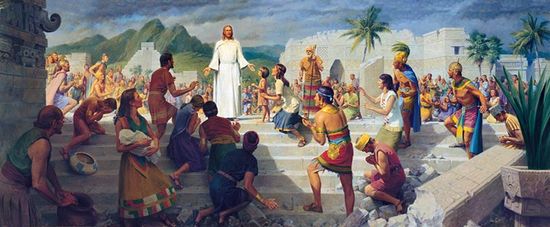
Our Father in Heaven planned the coming forth of the Founding Fathers and their form of government as the necessary great prologue leading to the restoration of the gospel. Recall what our Savior Jesus Christ said nearly two thousand years ago when He visited this promised land: “For it is wisdom in the Father that they should be established in this land, and be set up as a free people by the power of the Father, that these things might come forth” (3 Ne. 21:4). America, the land of liberty, was to be the Lord’s latter-day base of operations for His restored church…. For behold, this is a land which is choice above all other lands; wherefore he that doth possess it shall serve God or shall be swept off; for it is the everlasting decree of God. And it is not until the fulness of iniquity among the children of the land, that they are swept off…

I reverence the Constitution of the United States as a sacred document. To me its words are akin to the revelations of God, for God has placed His stamp of approval upon it. I testify that the God of heaven sent some of His choicest spirits to lay the foundation of this government, and He has now sent other choice spirits to help preserve it.

We, the blessed beneficiaries of the Constitution, face difficult days in America, “a land which is choice above all other lands” (Ether 2:10).

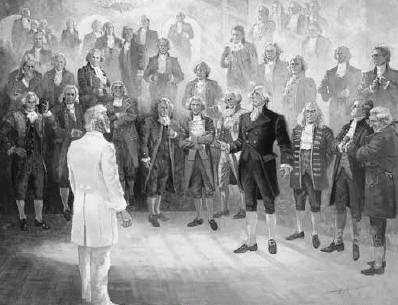
My italics. For Mormons, the Constitution was a necessary great prologue for the real endeavor: the restoration of the Gospel, i.e. the triumph of Mormonism over other forms of Christianity. The same president of the LDS church confirmed the Mormon belief that the Founding Fathers appeared as spirits in Utah's Saint George Temple to a previous president, Wilford Woodruff in 1877, and stayed for two days and nights in order to be properly saved by a Mormon baptism. Woodruff wrote of this experience:

The spirits of the dead gathered around me, wanting to know why we did not redeem them. Said they, "You have had the use of the Endowment House for a number of years, and yet nothing has ever been done for us. We laid the foundation of the government you now enjoy, and we never apostatized from it, but we remained true to it and were faithful to God." These were the signers of the Declaration of Independence, and they waited on me for two days and two nights. I thought it very singular, that notwithstanding so much work had been done, and yet nothing had been done for them … I straightway went into the baptismal font and called upon brother McCallister [sic] to baptize me for the signers of the Declaration of Independence, and fifty other eminent men, making one hundred in all, including John Wesley, Columbus, and others…

George Washington was posthumously named a high priest in the LDS church, alongside John Wesley, Benjamin Franklin, and Christopher Columbus. Yes: Ben Franklin is a Mormon High Priest now, according to Romney's faith. More significant to me is that all these figures in American history were asking to be baptized since they now knew that Mormonism was true and they needed saving. 

In some ways, Mormonism is the perfect form of Christianity for Christianist nationalist politics. It is the only form of Christianity that believes Jesus visited America; that the Garden of Eden was somewhere in Missouri; and the only one that, as a theological proposition, sees the US Constitution as an integral part of the divine order, and one that Jesus personally foresaw in his appearances in America two millennia ago, and blessed.

I raise this because such an understanding of America's unique and divine status among nations has profound foreign policy implications. It means that America alone has divine permission to do what it wants in the wider world, that America is subject to different standards than everyone else (because we alone are divinely blessed), and that geopolitics is about the global supremacy of the modern world's first divine nation (even if Iran and Israel might differ on which country is divinely blessed).

Jesus-christ-in-america

There's a reason, in other words, that Romney's foreign policy does not have a moderate, realist strain to it; that it is wedded to zero-sum conflict as the only way to engage the world (he regards Russia as America's number one geopolitical foe and wants a trade war with China); that its opposition to Jihadism gets perilously close to opposition to Islam as a whole; and that its core principle is that America is always, by definition, right.

I wish we had a Mormon candidate in a party that adheres to a separation of church and state and of politics and religion (like Reid or Huntsman in a different universe). Then we could regard that faith as utterly irrelevant to a candidate's capacity for running the country. But when the GOP affirmatively declares that there is no such thing as a secular decision, that there is no place and no decision and no policy which is not subject to religious and theological influence … it seems to me that we have to examine how a candidate's faith affects their politics – by the GOP's own reasoning.

Does Romney believe that America is uniquely divine among nations? How would that affect his decisions as president? Does he believe that the Constitution is also divine and a "necessary prologue" for the triumph of the LDS Church in America and across the world? Would he therefore appoint Justices who share that view? Or if the original Constitution is divine, and the Amendments are not, as Garry Wills asks, what status do the Amendments have in a Mormon president's eyes?

(Painting: the Founding Fathers appear to Mormon President Wilford Woodruff in the St George Temple in Utah in 1877. A painting rendering the Mormon view of Jesus' appearance to the Nephites in the Americas after his resurrection. )

If You Want Another Debt And Spending Binge, Vote GOP, Ctd

James Pethokoukis counters this graphic on Obama's spending record with one of his own:

Obama_Spending

Pethokoukis insists that Obama is responsible for his deficits:

Only by establishing 2009 as the new baseline, something Republican budget hawks like Paul Ryan feared would happen, does Obama come off looking like a tightwad. Obama has turned a one-off surge in spending due to the Great Recession into his permanent New Normal through 2016 and beyond.  It’s as if one of my teenagers crashed our family minivan, and I had to buy a new one. And then, since I liked that new car smell so much, I decided to buy a new van every year for the rest of my life. I would indeed be a reckless spender.

Suderman agrees. They're both full of it. Kilgore explains why:

I hardly think refusing to cut automatic stabilizer spending (the main areas of domestic spending increase since 2009), particularly for safety net programs where increased spending is a matter of higher enrollments by people in need rather than higher benefits, is analogous to buying a new car every year. … Pethokoukos also doesn’t mention that a recession depresses GDP, making spending (which is affected both by population growth and by higher demand for public services) a higher percentage even if nothing else happens.

That last massive lie is at the core of Romney's political strategy. By removing that context (which is like talking about the sinking of the Titanic without mentionng the iceberg), Romney is knowingly arguing that the spending and debt levels of the last three years were some kind of choice by a president who just loves to strangle the US economy by spending much more money than we have. But the only president who made that choice was George W. Bush – by crippling revenues, even as he fought wars with no budgets and new entitlements with no end (Medicare D), rendering us bankrupt even as we desperately needed a rainy day surplus to fight the depression.

Obama did not have a serious choice; he had a fate. That fate was to pick up the pieces of the most catastrophic presidency in modern times. The final bouquet – after emptying the public coffers with no serious boost to employment, profits or growth – was the financial collapse, which both shrunk the economy, decimated revenues to 50 year lows, and automatically increased spending for the unemployed and poor in desperate need of help. Once you account for that – and the Nutting graph indeed shows that this was baked in the cake by the time Obama was elected – Obama has been, like most modern Democrats, far more fiscally conservative than any modern Republican.

Now you could argue that Obama should have let the auto industry go fully bankrupt, allow the economy to head into deflation and depression without any fiscal stimulus to counter, cut the unemployed off at the knees – and we would be Greece today, underwater in a deepening and self-reinforcing depression. Can you imagine what Romney would have said about Obama's record then?

And yes, as Suderman notes, the real criticism should be focused on the absence of any long-term deal on entitlements, defense, taxes and spending – a deal that would do a huge amount for business confidence. But seriously: if one side simply refuses to put any serious revenue increases on the table at all, who's really preventing that effort?

There are legitimate issues to debate with respect to the future in this election. But the caricature of the last three years, the knowing lies that interweave with this false narrative, the attempt to describe a pragmatic, sane and successful president as somehow unqualified to tackle this mess – when the US economy has fared better in this period than much of the West – are deceptions, exploiting pain. I'm sick of them, and the cynicism they represent.