Unlike the United States, some democracies take the international and domestic rule of law seriously. That's especially true of countries that once suffered under totalitarianism of various sorts, like communism in Poland. And so we are beginning to see glimmers of legal accountability from Europe for the war crimes perpetrated by George W. Bush and Dick Cheney. The EU long ago reported the existence of torture sites in Poland and Romania, and one of the EU investigators of these war crimes was former Solidarity member, Józef Pinior. He insists he saw something important:
Pinior has always claimed that, during his investigations, he was told about a document signed by Leszek Miller, Poland’s Prime Minister at the time the CIA prison was in operation, providing information regulating the operations of the prison – in a military intelligence training base in Stare Kiejkuty in north eastern Poland – including information about how, if necessary, to deal with corpses inside the facility.
My italics (but this isn't the only formal recognition of deaths in the torture archipelago). We know, because even the Pentagon has confirmed, that several prisoners held under the Bush-Cheney administration were tortured to death. That those running the program knew that the techniques were brutal enough to risk occasional deaths of the victims adds one extra layer of criminality and evil to the process. The case in Poland appears to have been slowed but not halted by the prosecutors, aware of where it might lead. But one nugget will surely strike home in Poland, as told by Adam Krzykowski, a journalist for Polish public TV, and the first reporter to provide proof of the landing in Poland of a specific rendition plane:
Off the record, Wojciech Czuchnowski and I also obtained information about the location where people suspected of terrorism and kidnapped by the CIA were detained, on the premises of the so-called spy school in Stare Kiejkuty in the Mazury region, about 20 km from the airport in Szymany, where planes landed which were used by the CIA. We were also informed about the existence of another relevant building, a two-storey villa — once named as “Marcus Wolf Villa” in honour of the founder of the East German intelligence service — which appeared to have been used as a back office, and may have included housing for the interrogators. It seems that both the villa and the presumed prison building were located in a specific section of the grounds occupied by the spy school, which was separate from the rest and even more heavily guarded.
Isn't there something grotesquely appropriate in that Bush and Cheney, in importing into the US the torture techniques of totalitarian regimes, used one building named in honor of the founder of the East German Stasi? They remain war criminals, and the rule of law in America remains unenforced by the Obama administration on the core issue of torture. But not all politicians are as craven as Obama on this. Here's the current conservative prime minister of Poland, Donald Tusk:
“Poland will not be a country anymore where politicians will arrange something under the table and it will not come to light, even if they do it hand-in-hand with the biggest empire in the world,” and “those in power must be able very effectively to safeguard the dignity of the Polish state; in other words, they must act only in accordance with their conscience, Polish law and international law.”
Good for Poland. There is far more accountability in that new democracy than is allowed to exist in this one.
(Photo: the exterior of the Polish spy school in Stare Kiejkuty, where prisoners were tortured under the order of president George W. Bush.)
Returning from my breather, the reality set in. It's Romney vs Obama and no amount of my Santorum scenarios, Palin panics, Gingrich giggles or Paul swoons can now disguise the fact. The dread I feel is partly knowing that Romney is not even excruciating enough to be amusing. We cling to Seamus as tightly as he clung to his car roof penthouse. Even the Togg, Tagg and Tigg sons, or whatever bland all-American name is affixed to each, cannot compete with Alaskan wonder of Tripp and Trig and Levi. And on top of this, a very boring man is nonetheless prepared to tell outrageous lies, repeat them proudly, and intensify the polarization of the country even further. So we have another red-blue war, led on one side by a total cynic.
And so the promise of Obama – an end to this pattern – was delusional, not so much because he didn't try or have the ability, but because the other side immediately decided that this epochal moment for the country, the first black president, was not a time to compromise and resolve some deep long-standing issues, specifically on taxation and spending. What might have been an integrating, reforming moment evaporated with zero Republican House votes on a desperately needed stimulus in the worst recession since the 1930s.
And so my heart sinks as I see Obama drifting to the left, offering the silly Buffett Rule instead of serious tax reform, and Romney tacks to the W-Cheney right, promising tax cuts, defense increases and drastic debt reduction, without providing any clue as to how this can be afforded.
So we are left with Hilary Rosen versus Ann Romney, on which MoDo has the best summary.
The NYT Jonathan Rosen review of The Crisis of Zionism attained a kind of Platonic ideal of the response of the American Jewish Establishment. The first and most important principle of that Establishment is that the settlements are not to be discussed, mentioned, debated or wrangled over at any length. I cannot count the number of friends who over the years have quickly conceded that they do not support the settlements, and then move briskly on to another distraction. Rosen follows this party line exactly – even when reviewing a book focused precisely on such settlements, and even as half a million settlers now sit on illegally occupied land. Peter makes the obvious counter-point:
Most fundamentally of all, Rosen ignores my contention that by holding millions of West Bank Palestinians as non-citizens, and building settlements that eat away at the possibility of a viable Palestinian state, Israel is imperiling its democratic character. That simple, and unoriginal, fear lies at heart of The Crisis of Zionism. Does Rosen share it? He never lets on because in addition to persistently ignoring the specific factual claims in my book, he ignores the book’s central argument.
And then lards up the review with smears, untruths and a complete absence of any quotations. The notion that Beinart ignores the standard and fair criticisms of past Palestinian leaders is simply wrong, as any reader will see. Yes, he presses the case that the Israelis and their American patrons have recently led the Jewish state into a dead end – but his book is an argument, not a history. He lacerates one side – persuasively, I might add – but doesn't excuse the other.
I have to say it was great to have a break from all of this for a few days. Because when you step back a little from the fray, you see, I think, how pointless it is close to becoming. I simply cannot see a two-state solution any longer, given what we have learned about where Israeli and US politics are heading. Obama was the last train from the station. He may push again if he gets a second term, but he knows he cannot win. The Christianists, neocons and Democratic Israel fanatics are far stronger than any president. Romney, for his part, would put the settlements on steroids, and re-open a hot religious global war by attacking Iran. The real shift in US policy toward Israel has been the embrace of the settlements by the Christianist base of the GOP over the last decade and their continuing power. The real development is the fusion of Jewish and Christian fundamentalism around the cause of Greater Israel.
Which means to say that a democratic Israel is living on borrowed time. And Peter's book will one day be seen as one lone protest, a marker that not everyone acquiesced in Israel's degeneration, not everyone put blinders on. Just most.
Like David Brooks, I feel whip-sawed a lot of the time. The gamble of Obama's re-election message seems so far to be a mix of personal popularity and tax fairness. I can see the logic of this. Obama is hated by a resilient part of the population, but pretty well liked as a human being by many. As the CNN poll yesterday showed, he has real strengths but one obvious weakness:
Obama has double-digit leads over Romney on likeability, honesty, confidence, values, leadership and almost every other characteristic tested, with one important exception."Obama and Romney are essentially tied on who is more likely to get the economy moving again, and that may provide Romney an opening to chip away at Obama's current overall lead," says Holland.
And my view is that worries about the economy may not be assuaged by tepid, sustained growth this year alone. Obama hasn't gotten into my head yet how he plans to stabilize the debt or reform taxes. And yet both those issues seem to me to be crucial to seeing where Obama wants to take us. Here's what David Brooks has learned:
During Obama’s presidency, domestic spending topped out at 4 percent of G.D.P. But, in the Obama budget, over the next 10 years, that spending would fall to 2.2 percent, much lower than anything Reagan achieved … Annual federal deficits, which are at about 8 percent now, would come down to around 3 percent between 2015 and 2022. The total federal debt is now at about 74 percent of G.D.P. Under Obama’s plan, it would rise to 78.4 percent of G.D.P. in 2014 and then stabilize at about 76.5 percent from 2018 to 2022.
Basically, what we’re looking at is a period of stability, administration officials say, which would soothe credit markets and give us time to make further adjustments. This, they conclude, is responsible prudence.
There is indeed responsible prudence in this, as there was prudence in avoiding the debt trap that premature and excessive austerity has brought to Europe. But to present a budget proposal that never sees a balanced budget over a decade means the debt will grow and grow, unless it is inflated away. And at this moment in US history, we are facing a huge fiscal drain from the baby boom retirement. If anything, we should be running surpluses now.
The gap between Obama's plans and this reality unsettles me. I look at Romney and see much, much more debt – because of his massive defense increases, even further tax cutting, and refusal to specify which deductions will be ended to pay for it, and the political implausibility of the massive cuts to Medicare and Medicaid that he needs to keep the debt from spiraling.
But that shouldn't let Obama off the hook.
The president says he wants tax reform and debt reduction but is still playing politics in pushing the GOP out front on the issues. He may regret it. If he cannot show how he will cut the debt, not just slow its exponential growth, and if he cannot embrace a simpler, clearer tax system, he is ceding two central issues to the GOP. He may get away with it. But he once offered something more.
I think it’s an open question whether a political party should prefer to control Congress or control the presidency. And if we’re talking about filibuster-proof control of Congress, I’m not even sure it’s close.
There is a huge amount that will not change, because of the deadlocked and polarized Congress. But there is obviously a significant policy implication. If Romney is elected, we will lose the possibility of universal healthcare, we will accelerate income inequality even further, we will double down on carbon energy, and we may see a Supreme Court more radical than in a century. Fiscally, austerity is coming, whoever wins. But the balance of that austerity will shift. Under Obama it will be borne more by the wealthy; under Romney, the budget will be balanced, as someone once said about a much milder proposal, "on the backs of the poor." I'm encouraged by Romney's hints that he will go after deductions for the wealthy, and am open to a serious plan for deficit reduction that does not tip us all into a precipitous double-dip. But the refusal to contemplate increases in revenue does not bode well for any kind of agreement, before the debt forces action on its own timetable.
But for me, this is first and foremost a foreign policy election. If Romney is elected, and if no deal with Iran is accomplished before then, we will go to war in a third Muslim country, and possibly escalate again in Afghanistan. The rebooting of the global religious war would be instant. The US will almost certainly become the guarantor of all of Greater Israel, rendering us cut off from the entire Arab and Muslim world, as well as increasingly isolated from Europe. Russia, Romney tells us, is the number one "threat". Torture could well return.
It is the return to global polarization, confrontation and war that concerns me above everything else. The calming of international relations, the slow reintegration of the US with the global community, the slow strategy with Iran, the quiet rebuilding of alliances in the Pacific: all these are now white noise. But if they collapse, war and terror will return as the polarizing norm.
We know what those things did to the world in the last decade. And we know what they did to the US. Much more and we may not be able to recognize ourselves at all.
[Re-posted from earlier today.] Rod Dreher takes issue with my Newsweekessay. Guess what his main focus is:
Jesus condemns lust. What is lust? How would Andrew Sullivan define lust? Jesus believes that “sexual immorality” is so serious that it’s the only legitimate reason for divorce. What could Jesus have meant by “sexual immorality” Clearly, unambiguously, Jesus believes in a right way of sexual conduct, and a wrong way — and condemns the wrong way in serious terms. It is completely untenable to say that Jesus was indifferent to sexual conduct. If we want to know more explicitly what kind of sexual conduct Jesus found to be trayf, we should consult his tradition’s teachings, found in the Hebrew Bible. Or you could trust the rabbi Paul, who was a contemporary of Jesus’s. If you really don’t want to know, because to know is to be responsible, and to be responsible is to have to change your life and die to yourself in ways you prefer not to, well, then you are fooling yourself. It’s as if the Rich Young Ruler went away from Jesus sorrowful, and then wrote an essay later saying that if we really knew Jesus, we would know that he really didn’t mean that one would have to sell all one’s possessions if one wants to have eternal life.
It’s revealing that for Rod, sex is the first thing that comes to mind after reading my essay. Which kinda proves my point- which is that in the grand scheme of Jesus’ teaching, sex is an extremely minor theme, while the current Catholic and evangelical leadership regards it as a central defining issue. But the notion that Jesus was a free love kinda guy is also preposterous, and I never wrote otherwise. His sexual radicalism is as extreme as his property radicalism (give away everything, including your home). Take the part of the Gospels Rod cites:
“You have heard that it was said, ‘You shall not commit adultery.’ But I tell you that anyone who looks at a woman lustfully has already committed adultery with her in his heart. If your right eye causes you to stumble, gouge it out and throw it away. It is better for you to lose one part of your body than for your whole body to be thrown into hell. And if your right hand causes you to stumble, cut it off and throw it away. It is better for you to lose one part of your body than for your whole body to go into hell. “It has been said, ‘Anyone who divorces his wife must give her a certificate of divorce.’. But I tell you that anyone who divorces his wife, except for sexual immorality, makes her the victim of adultery, and anyone who marries a divorced woman commits adultery.
This is a remarkably radical passage – requiring us, if we take it literally, to dismember our bodies because they constantly present a temptation to forget God. My interpretation is that Jesus is warning against believing that because you obey certain religious rules, you are somehow holy. Inside you are probably not. Lust, greed, racism, fear, and tribalism – to take a few aspects of fallen human nature – are innate; and his call is for a total, deep renunication of all of them, not just obeying formal rules like a “certificate of divorce.” This is of a piece with Jesus’ insistence on interior, personal transformation – not just obedience to religious law. But in so far as this passage is about sex, it is a total impossibility. Not to feel involuntary sexual attraction is not to be human. The standard is impossible. I mean: try it. Try to have no sexual desires, feelings or moments of attraction. Not try to resist acting on them; but resist even thinking them. That’s Jesus’ standard. We all fail that standard. We are all therefore adulterers to different degrees. Any man who has ever had a chubby for someone not his wife is an adulterer. Every celibate priest is an adulterer. The Pope is an adulterer. Every Christian who has ever lived is an adulterer. This is Jesus’ radicalism at work, and it points, in my view, not to using government to police and repress sexual desire (as you see in large swathes of the Muslim world). And it does not point to church authorities using the repression of sex as a tool for real power over their flocks (which they then sometimes use for sexual abuse). It points to achieving a level of grace that leaves sexual desire behind entirely – a standard also familiar to other religious or philosophical traditions, like Buddhism. And recall Jesus’ response to an actual condemnation of an adulterer. She is about to be stoned. Does Jesus uphold the law he came to fulfill against the woman? No. He demands that those without sin cast the first stones. And he forgives the woman – while insisting she not sin again. Actually, he does more than forgive. He says:
Neither do I condemn thee: go, and sin no more.
This is the Christian model of sexual morality, it seems to me, as it is of morality in general. Jesus poses an impossible standard and then refuses to condemn an actual tangible human being who fails to reach it. Since we are all completely ridden with sin, we equally have no right to condemn anyone else, even if we are living the most upright lives according to the law. Forgive us our trespasses, as we forgive those who trespass against us. And in this classic scene in which religious authorities stand ready to deploy their power to punish sin, Jesus does something strange. He physically defuses the dynamic. She is cowering; they are threatening; they demand he uphold the law. What does he do? He sits on the ground and doodles in the dust. He is neither condemned nor condemner. He breaks that circle. He does not condemn. He forgives. So I am a sinner. So is Rod. We should leave the stones on the ground. But this debate is not about me and Rod anyway. It is about reclaiming the core message of Jesus against the distortions that every age imposes on it. And in so far as I am offering any argument as to how to live one’s life when the standard Jesus offered is literally impossible, it is merely to say it is hard, and would be cruel were it not for forgiveness. I have had good moments in this struggle and terrible, lasting failures. This Lent has forced me to consider my constant failures more than my intermittent moments of grace. That I confess. As a practical matter, I have not had the strength to live as Saint Francis, without possessions, without a home, without sex, without anything but a subsistence diet, reliant entirely on physical labor and begging on the streets as a last resort. I find the secular world fascinating, funny, engaging, enraging, joyful. And I have made compromises in my faith-life – just as our laws make compromises for the crooked timber we make up. That made writing this piece hard; and responding to it difficult. Because I am unworthy to deliver such a message. But if no broken being can speak to the truths he cannot always live up to and has often strayed from, then we would have a great deal of silence. We should not be comfortable with the compromises our fallen lives compound. But we have to live with them, and keep each one in proper perspective:
Nothing that is worth doing can be achieved in a lifetime; therefore we must be saved by hope.
Nothing which is true or beautiful or good makes complete sense in any immediate context of history; therefore we must be saved by faith.
Nothing we do, however virtuous, could be accomplished alone; therefore we must be saved by love.
No virtuous act is quite as virtuous from the stand point of our friend or foe as it is from our own standpoint; therefore we must be saved by the final form of love, which is forgiveness.
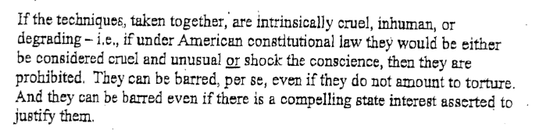
Finally, Spencer Ackerman gets his document. It's Philip Zelikow's 2006 State Department memo arguing that the interrogation techniques already authorized by Bush were clearly illegal – and way outside the bounds of American precedent:
Zelikow knew that this torture violated core values in American history:
“We are unaware of any precedent in World War II, the Korean War, the Vietnam War, or any subsequent conflict for authorized, systematic interrogation practices similar to those in question here,” Zelikow wrote, “even where the prisoners were presumed to be unlawful combatants.”
Other “advanced governments that face potentially catastrophic terrorist dangers” have “abandoned several of the techniques in question here,” Zelikow’s memo writes. The State Department blacked out a section of text that apparently listed those governments.
“Coercive” interrogation methods “least likely to be sustained” by judges were “the waterboard, walling, dousing, stress positions, and cramped confinement,” Zelikow advised, “especially [when] viewed cumulatively.” (Most CIA torture regimens made use of multiple torture techniques.) “Those most likely to be sustained are the basic detention conditions and, in context, the corrective techniques, such as slaps.”
(I presume "advanced governments" refers in part to Israel whose Supreme Court struck down the torture the Israelis once inflicted on Palestinian terror suspects.) But what's crucial here is that while I think there's no doubt that what was authorized was torture, the legal bar against cruel, inhuman, and degrading interrogation techniques which also "shock the conscience" is and was much broader. The Reagan-signed Convention Against Torture is not pulling a Yoo, trying to parse legitimate forms of torture from the illegitimate. It is insisting on the broadest definition possible. Here is a passage from Reagan's signing statement:
The United States participated actively and effectively in the negotiation of the Convention. It marks a significant step in the development during this century of international measures against torture and other inhuman treatment or punishment.
My italics. Note that the law is very clear that no national emergency can trump this prohibition – precisely because torture is invariably defended as an emergency. Zelikow clearly understood this. As presumably did Condi Rice. And let me repeat what was actually done to the prisoners in plain English:
using dogs to terrorize prisoners; stripping detainees naked and hooding them; isolating people in windowless cells for weeks and even months on end; freezing prisoners to near-death and reviving them and repeating the hypothermia; contorting prisoners into stress positions that create unbearable pain in the muscles and joints; cramming prisoners into upright coffins in painful positions with minimal air; near-drowning, on a waterboard, of human beings—in one case 183 times—even after they have cooperated with interrogators.
The gut test: if an American were subjected to these techniques in an Iranian prison, would we regard it as torture? It's not really close, is it?
(Photo: a Khmer Rouge waterboard, preserved in Cambodia's Genocide Museum.)
Some readers may know that my own legal marriage in Massachusetts five years ago made no difference whatever to my ability to become a permanent resident, because of my HIV status. The HIV ban is now history (thanks to Bush and Obama). But it's worth recalling that if I had married a woman instead of a man, my marriage license would have trumped the HIV ban immediately, granting me an automatic waiver for permanent residence. When Jesse Helms and then Bill Clinton put the HIV ban into law, they exempted the married and heterosexual. The reasoning was the same as it is for general US immigration policy: family trumps everything. The US government does all it can not to split up immediate families in immigration law. But when it comes to gays and lesbians, we have no recognized family under federal law since DOMA, and therefore bi-national couples are literally strangers to one another in the law.
Readers may recall my time in London fundraising for Immigration Equality earlier this year (I am on the board). At one meeting that was filled with same-sex couples doomed to divorce by deportation, or joint emigration, I looked out at a sea of eyes. The intensity of the pain was a little too much to bear, because I remembered it so well. To fall deeper in love, knowing there is no security for the future at all; to put down deeper roots in the knowledge that one day, they may have to be uprooted; to see your relationship have an expiration date on a visa; to have HIV actually stamped in code in my passport as a final stigma; to stand in separate lines if we re-entered the US, since gay couples were deemed a particular immigration risk, since the USCIS understandably assume that couples in love might be tempted to overstay visas.
Yesterday was the first legal step to ending this injustice. Glenn Greenwald highlights a new lawsuit (pdf):
[T]housands of U.S. citizens are barred from living in their own country with their same-sex spouse. The “luckiest” among them are able to move to their spouse’s country, but that’s a choice available to only a small percentage: for that to work, the foreign spouse’s nation must grant immigration rights to same-sex couples (only a minority of countries do) and the American partner must be able to find work while living outside the U.S.
(I’ve written and spokenpreviously about how this discriminatory framework forces me to live in Brazil with my Brazilian partner, who cannot obtain immigration rights to live, work and/or study in the U.S.). But the vast majority of same-sex couples in this situation do not have even that limited option: instead, they are faced with the horrifying choice of (a) having the foreign partner live illegally in the U.S. (which means they face the constant threat of deportation, cannot legally work or study, and cannot ever leave the country to visit their family back home), or, worse, (b) living thousands of miles apart — continents away — from the person with whom they want to share their life.
Glenn downplays his own strain. But what does it say about a country that one of its brightest intellectual stars has to live thousands of miles away from his own country, because he is committed to another man for life? As Western countries increasingly allow for these immigration rights, a diaspora of gay Americans and their spouses is growing around the world. For the rest, the agonies of separation and family destruction endure.
Why is the US government actively attacking family life in this country? And doing so by some of the cruelest punishments imaginable – the choice of divorce from the person you love and exile from the country you were born in?
(Photo: Tens of thousands of same-sex couples in the United States live under the threat of separation because federal law prohibits immigration authorities from treating them the same as married opposite-sex couples. Joy Hayes, right, and Lujza Nehrebeczky were married in Connecticut last year. On the advice of an attorney, Nehrebeczky won't attempt to travel to Hungary to see her mother, who has cancer. She fears her student visa might not be renewed. By Mark Cornelison/Lexington Herald-Leader/MCT via Getty Images.)
It has long befuddled me – the way so many on the right view him not with disagreement or discernment, but with contempt. Contempt is a strong word; and it is built on some notion of his illegitimacy as president. They called Clinton illegitimate as well, of course, because of his plurality victory in 1992 (he never quite made it to 50 percent of the vote in 1996 either). But Obama? A clear electoral victory by a black candidate after one of the most brilliant underdog campaigns in our lifetimes. I suppose the right's view that racism no longer exists in America defuses the racial barrier. But it's telling, is it not, that very, very few Republicans have hailed the election of a bi-racial man as president, if only to celebrate the progress this country has made.
Why not fear of Obama's charm? Or suspicion of his cunning? Why not coopt this oh-so-willing-to-be-coopted figure to move his policies to the right (as if the individual mandate, extension of Bush tax cuts, and escalation of the war in Afghanistan could get further right)?
No. Instead we have contempt. A president who can be shouted at during a State of the Union address; a president whose birth certificate, readily available, is still questioned; a president who is regarded by an unthinkable chunk of Republicans as a Muslim; a president who allegedly cannot speak a full sentence without a TelePrompter; or, in Glenn Reynolds' immortal words, "a racist hatemonger."
Every now and again, they tip their hand in further weirdness. One of the more Kinsley-esque moments in contemporary Washington is the spectacle of every liberal in the town now bemoaning judicial activism, and every conservative celebrating the courts as a vital part of our constitutional system. Why, it's enough to make someone a little jaded. In that vein, comes one Michael Walsh who just had a conniption about the president's attack on the Supreme Court yesterday. It speaks to the right's view of this president:
Obama’s only tough contest came in the 2008 primaries, when he ambushed the fat and complacent Clintons by rabbit-punching Hillary and hanging on in the face of her furious counter-attack to eke out a split-decision victory. Of the general election that year, the less said the better. As the gangster, Johnny Caspar, says in Miller’s Crossing, “If you can’t trust a fix, what can you trust?”
But there inevitably comes the time when the fix isn’t in, when the opponent didn’t get the memo to take the dive, or when the mob simply tires of a champion who’s outlived his usefulness and seeks another tomato can.
Walsh is clearly implying that the election of 2008 was "fixed" or "rigged." And when you think about it, this has to be the case, or else their contempt for Obama would have to be leavened by at least some respect for one of the most brilliant underdog presidential campaigns in modern times. But not even that. Not even in the killing of Osama bin Laden could they give him any credit.
Is this rank racism, pure partisanship, class resentment, or some toxic combination of them all?
I assume it's an April Fool's, right? It couldn't be that NBC is so desperate for ratings it has to find an unhinged, delusional, inarticulate know-nothing to guest-host its show just to leverage red America against blue? They didn't do it just to make a point about Katie Couric's lonely interview with the woman who wanted to know where "North Africa" was? They haven't just picked an active partisan fanatic who could still play a role in the current election season as a sign that they are a news organization, have they?
I mean: NBC News isn't just a total whore with no pretensions to actual journalism, right?


 trespass against us. And in this classic scene in which religious authorities stand ready to deploy their power to punish sin, Jesus does something strange. He physically defuses the dynamic. She is cowering; they are threatening; they demand he uphold the law. What does he do? He sits on the ground and doodles in the dust. He is neither condemned nor condemner. He breaks that circle. He does not condemn. He forgives. So I am a sinner. So is Rod. We should leave the stones on the ground. But this debate is not about me and Rod anyway. It is about reclaiming the core message of Jesus against the distortions that every age imposes on it. And in so far as I am offering any argument as to how to live one’s life when the standard Jesus offered is literally impossible, it is merely to say it is hard, and would be cruel were it not for forgiveness. I have had good moments in this struggle and terrible, lasting failures. This Lent has forced me to consider my constant failures more than my intermittent moments of grace. That I confess. As a practical matter, I have not had the strength to live as Saint Francis, without possessions, without a home, without sex, without anything but a subsistence diet, reliant entirely on physical labor and begging on the streets as a last resort. I find the secular world fascinating, funny, engaging, enraging, joyful. And I have made compromises in my faith-life – just as our laws make compromises for the crooked timber we make up. That made writing this piece hard; and responding to it difficult. Because I am unworthy to deliver such a message. But if no broken being can speak to the truths he cannot always live up to and has often strayed from, then we would have a great deal of silence. We should not be comfortable with the compromises our fallen lives compound. But we have to live with them, and keep each one in

 The Dish