The Politicization Of Catholicism

BENEDICTHANDS2JoeKlamar:AFP:Getty

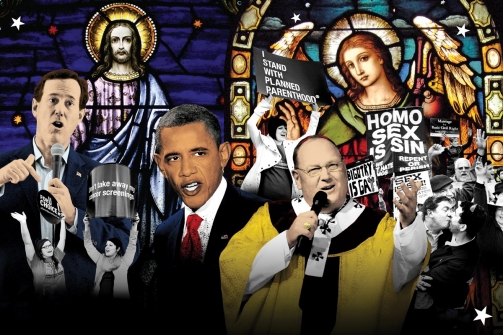
The legacy of Pope John Paul II and the current pontiff is increasingly felt. In rejecting the separation of church and state, and by focusing primarily on sexual issues, the hierarchy in many countries is beginning to fuse with parties of the social right. And the politics is now Santorum-esque. Listen to Cardinal Dolan of New York embracing the culture war:

“We are called to be very active, very informed and very involved in politics."

There's more:

“It is a freedom of religion battle,” he said. “It is not about contraception. It is not about women’s health.” He added: “We’re talking about an unwarranted, unprecedented, radical intrusion” into “a church’s ability to teach, serve and sanctify on its own.”

The cardinal mocked a secular culture that “seems to discover new rights every day.” “I don’t recall a right to marriage,” he said, describing marriage, instead, as a “call.”

“Now we hear there’s a right to sterilization, abortion and chemical contraceptives. I suppose there might be a doctor who would say to a man who’s suffering some type of sexual dysfunction, ‘You ought to visit a prostitute to help you.’ ”

The rhetoric is creeping toward Limbaughism. The Second Council's notion that all Catholics are the church is dismissed:

At a news conference after Saturday’s speech, Cardinal Dolan said, “We kind of got our Irish up when leaders in government seemed to be assigning an authoritative voice to Catholic groups that are not the bishops.” He added: “If you want an authoritative voice, go to the bishops. They’re the ones that speak for the truths of the faith.”

Yes, they did a great job ensuring that thousands of children were left at the mercies of child predators for decades, didn't they? Just trust them. Don't listen to the majority of Catholics who dissent, or those brave souls who exposed the network of pedophiles and pederasts. Then the leader of an institution which refuses to allow women equality, boasts of using women as p.r. elements of a political campaign:

He told a story about bishops hiring an “attractive, articulate, intelligent” laywoman to speak against abortion and said it was “the best thing we ever did.”

And in Britain, Cardinal Keith O'Brien has now likened allowing gay citizens to have civil marriage to "madness" and the legalization of slavery:

Disingenuously, the Government has suggested that same-sex marriage wouldn’t be compulsory and churches could choose to opt out. This is staggeringly arrogant. No Government has the moral authority to dismantle the universally understood meaning of marriage. Imagine for a moment that the Government had decided to legalise slavery but assured us that “no one will be forced to keep a slave”.

It's in this context that you have to understand the recent cruel withholding of communion to a lesbian daughter at her mother's funeral, or the abrupt firing of a gifted music teacher because he sought to marry the man he loves. As modern society shifts, and as its own flock shifts with it, the Church hierarchy has decided to double-down on its sexual absolutism. The cruelty comes with it.

The Culture War Tide Is Turning

1328977951442

Rush Limbaugh – are you sitting down? – apologizes:

For over 20 years, I have illustrated the absurd with absurdity, three hours a day, five days a week.  In this instance, I chose the wrong words in my analogy of the situation. I did not mean a personal attack on Ms. Fluke … My choice of words was not the best, and in the attempt to be humorous, I created a national stir. I sincerely apologize to Ms. Fluke for the insulting word choices.

I note that Limbaugh hasn't apologized yet on the air in the same context as he called another human being a "slut" he wanted to make a sex tape he could masturbate to. I note also that uses the same terminology as Santorum did when referring to this: "absurdity." Hmmm. This is the "I was only kidding – I'm an entertainer" defense. He is an entertainer except when he isn't, of course. But the apology to Fluke should be taken as genuine, and also as a sign of something deeper.

In the culture wars, the right increasingly has more to lose than to win, as I recently noted. Listen to Limbaugh:

In my monologue, I posited that it is not our business whatsoever to know what is going on in anyone's bedroom nor do I think it is a topic that should reach a Presidential level.

Santorum seems to realize he has over-reached as well. Krauthammer notes exactly what I did in the live-blog of last Tuesday night:

Remember that odd riff with which he began his Michigan concession/victory speech? About three generations of Santorum women — mother, wife, daughter — being professional, strong, independent, i.e., modern? That was an unsubtle attempt to update his gender-relations image by a few decades.

In the last debate, Santorum scuttled away from a subject, contraception, he was only recently willing to say he would talk about during his presidency. Krauthammer cautions:

The less said about contraception the better, a lesson Santorum refused to learn. It’s a settled question. The country has no real desire for cringe-inducing admonitions from politicians about libertinism and procreative (vs. pleasurable) sex.

Which is to say that Andrew Breitbart's legacy, summed up by Sister Toldjah as "Apologize For WHAT?" lasted a few days.

And Limbaugh, of all people, ended it.

Breitbart – And Us

112771411

Two small thoughts that came to me today, as I absorbed the news some more. This is how Andrew spent his last hours – a two hour argument in a bar with a total stranger. It wasn't heated, apparently, just lively, even fun. But it shows how utterly absorbed Breitbart seemed to be in the game. This nugget leapt out:

"He wasn’t drinking excessively," Sando recalls. "He was on his BlackBerry a lot."

Ah, yes, the Blackberry. Limbaugh notes:

Over the years, the whole thing he was involved in seemed to lose some of the fun factor as the intensity and the seriousness of it picked up. And this loops back to the notion that we all only have one life. I hope that that didn't have anything to do with it. I mean, he was very intense. He was profoundly intense, and at times he'd get very mad, very angry — as we all do — and very frustrated. Everybody wants to matter. Everybody wants to be effective. He was far more effective than he probably ever dreamed, but probably wanted to be even more so.

Toby Harnden adds to the picture:

Andrew also said [one] night that he had recently gone to the hospital emergency room with a tightness in his chest. When a nurse had "freaked out" at how high his blood pressure was, he had responded: "Don't tell me that – you'll make it even higher."

Breitbart had looked overweight and stressed that night. I and the others with us told him he needed to ease up on his insane travel schedule and he talked about trying to exercise more, taking downtime with his family and getting a personal assistant to take charge of his diary. But he always seemed to be on Twitter, on TV, on the phone or on a plane – and sometimes seemingly two or three of these at once.

In the new 24/7 mediaverse, in a brutal, unending culture war, with the web unleashed and news and opinion flashing every few seconds, you can very easily lose yourself, and forget how and why you got here in the first place. There have been times writing and editing this blog on that kind of insane schedule for more than a decade when I have wondered who this new frantic way of life would kill first. I do not doubt that Andrew tried to keep a balance, and stay healthy, but like the rest of us, became consumed with and overwhelmed by this twittering, unending bloghorreic chatter. It takes a much bigger physical, emotional and spiritual toll than most realize, and I've spent some time over the years worrying it could destroy me. Here I am, after all, at 9.30 pm, still blogging, having just filed another column, and checking the traffic stats, and glancing feverishly at every new item at Memeorandum.

Human beings were not created for that kind of constant unending stress, and the one thing you can say about Andrew is that he had fewer boundaries than others. He took it all so seriously, almost manically, in the end. The fight was everything. He felt. His anger was not feigned. He wanted to bleed and show the world the wounds. He wanted to scream. And he often did. And when you are on that much, and angry to that extent, and absorbed with that kind of constant mania, and obviously needing more and more validation, and on the online and real stage all the time, day and night, weekends and weekdays … well, it's a frightening and dangerous way to live in the end.

He is in that sense our first new-media culture-war fatality. I fear he won't be the last.

(Photo: Brendan Smialowski/Getty Images.)

Winning By Losing

As New Hampshire's GOP attempts to undo marriage equality, popular support in California has leapt since Prop 8 succeeded:

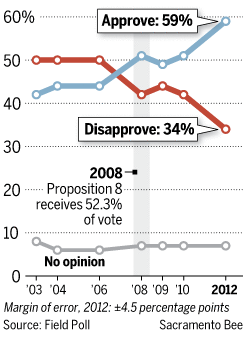
Golden State registered voters now favor same-sex unions by 59 percent to 34 percent, a 25-point gap that is the largest margin of support for the issue in the three-plus decades the Field Poll has been asking the question.

The new Field survey shows support has leapt markedly in the three and a half years since California voters approved Proposition 8, which banned gay marriage, 52.3 percent to 47.7 percent.Screen shot 2012-02-29 at 11.13.14 AM

The poll showed increases in support virtually across the board – among voters under 64, non-white voters, Catholics, Republicans and nonpartisans.

Poll Director Mark DiCamillo said the move to a 25-point gap goes beyond the gradual increase in support that has been expected as young voters age and "replace" older voters in the electorate. "This is now showing that opinions are changing irrespective of generational replacement," DiCamillo said. "This is real change."

The generational change is most marked among boomers, not seniors. In two years, in the 40 – 64 bracket, support for marriage has jumped from 46 to 59 percent. What you also see is how this issue has isolated Republicans from the center. 69 percent of Democrats favor marriage equality, indistinguishable in this poll from the 67 percent of Independents/Others. The GOPers remain at 39 percent support – up from a mere 26 percent support two years ago, but still stranded on a shrinking cultural island.

Polls are not votes – and I suspect that resistance to marriage equality is still real. But there is little doubt any more that it's fading. More to the point, as previous civil rights movements have shown, steps forward are always accompanied by steps back. And in many cases, watching a minority being crushed by majority power makes the minority's position more appealing to fair-minded observers. We win when we win. We win even after we lose.

Which makes the GOP's over-reach in New Hampshire all the more notable. A big majority (59 percent) of New Hampshirites are fine with leaving marriage equality in place – while the GOP is trying to get a veto-proof majority to rebuke them. The GOP leaders do not believe the poll. That's their problem, not New Hampshire's.

The Messy Pursuit Of What Might Be Happiness

At my doctor's the other day, I asked, as I sometimes do, about what he's seeing with gay men and the crystal meth epidemic. His practice has a lot of sexually active young homos, and although they're not scientific, I take his anecdotes seriously. He told me there has been a big drop in usage in the lives of his patients. A much more empirically robust New York study came to the same conclusion.

Why? I ask this because it suggests that changes in social behavior – for good and bad – are not always easily explicable; and we should avoid easy or ideologically loaded explanations. My subjective interpretation is that the horrifying effect of meth on so many men's lives and health persuaded many others (and themselves) that the costs vastly outweighed the benefits. Stigmas emerged; lost lives stung; jail sentences began to impinge on the white middle class; watching young men age overnight must also have been a factor. The cool dudes stopped using it; it became uncool; it declined. If I were feeling ambitious, I might also suggest that the marriage movement might have subtly shifted social signals among gay men, and those looking to couple up may see more of a future for themselves, may be less damaged than previous generations (including my own), and therefore are better able to postpone instant gratification for longer-term contentment. Or it could have been just fashion – drugs rise and fall all the time in their varying popularity.

I raise this because the blogosphere had a great recent debate between Douthat and Yglesias that tried to answer two further social whys. Why are more women having children alone? And why are there fewer men in the workplace? Are these good or bad things and what can we do about them anyway?

Matt argues that fewer women need men to bring up children because of the vast new workplace opportunities for women compared with the past. In other words, for the first time, they can really afford to. He also suggests there are fewer men working – a long-term trend – because basically men are, at heart, bums, and being able to enjoy life with fewer resources and more distractions (hello, YouTube and Xbox) is a trade-off worth making. Mooching off parents or working wives or partners sounds like a pretty good deal to many.

Ross responds on Charles Murray lines by blaming the social mores of elites whose libertine example has led to social decay. His argument is not far from what Julian Sanchez has called Straussian social conservatism, in its emphasis on elite influence on the masses. He sees single-motherhood as draining for the woman and worse for the kids (as most studies show). And fewer responsible working men exacerbate the problem.

My terrifically constructive suggestion is that all of this may be correct, that the reasons behind these shifts are massively over-determined and largely beyond our full understanding.

In these trends, we may be seeing some good things – more choices for women, less stress and more sexual opportunities for men – along with some bad ones – worse environments for child-rearing, exhausted women, less fulfilled men. Some of this is obviously a function of spontaneous adaptation to a new, more-female economy; some may be attributed to top-down social messaging on Murray-esque lines; some may be genuine gains in happiness. It's a mess in a messy society, figuring out costs and benefits.

The evidence also suggests that the elites have begun to figure out a new balance: later and longer marriages. Men get to screw around for longer than they used to; women get to advance further in their careers; their own generational memories of parental divorce may have led them to be more leery of marriage and more committed when they go for it. Better still, feminism may have helped kill the notion that one gender has some kind of default position on bread-winning.

And could this trickle down to the less well off, the way some positive trends have spread spontaneously among gay men?

We don't know. But I think we should be leery of believing that the poor somehow cannot adapt and change to the same costs and benefits as elites. I guess that's long been one of my main issues with Straussianism. (The crack epidemic among urban blacks, for example, ended as suddenly as the meth epidemic among gays, for similarly over-determined reasons.) And now the elites are also sending subtly different signals about what is socially good – not a return to the 1950s, but a much more hybrid and nudging social conservatism – that non-elites might follow. Maybe the economics of the globalized economy will make it much harder for the poorer. But I wouldn't bet on it. If women hold more economic power, men may seek to latch on to some of it – this time with women in the drivers' seat.  

I guess what I'm saying is that libertarianism – defined as an instinct to trust people to figure their own collective problems out by trial and error – is not incompatible with social conservatism from the top down and, more importantly, from the bottom up. In fact, if you believe that the truths of social conservatism endure, you should be more confident that digressions away from them will eventually return to the mean.

There's a phrase for these complex eddies and currents in social behavior: the pursuit of happiness. Only freedom allows us to enjoy it. And its end result, if left alone, may well be more conservative than many conservatives today are able to acknowledge.

Santorum Exposes The Real Republican Party

140078500

[Re-posted from earlier today.]

What's fascinating to me about Santorum's outburst yesterday was not its content, but its candor. In fact, one of Santorum's advantages in this race, especially against Romney, is that we can see exactly where he stands. There can be no absolute separation of church and state, let alone a desire to keep it so; and in their necessary interactions, the church must always prevail, or it is a violation of the First Amendment, and an attack on religious freedom. The church's teachings are also, according to theoconservatism, integral to the founding of the United States. Since constitutional rights are endowed from the Creator, and the Creator is the Judeo-Christian one, the notion of a neutral public square, embraced by liberals and those once called conservatives, is an attack on America. America is a special nation because of this unique founding on the Judeo-Christian God. It must therefore always be guided by God's will, and that will is self-evident to anyone, Catholic or Protestant, atheist or Mormon, Jew or Muslim, from natural law.

Hence the notion that America could countenance Tcs2abortion or same-sex marriage is anathema to Santorum and to theoconservatism. It can only be explained as the work of Satan, so alien is it to the principles of Judeo-Christian America. Hence the resort to constitutional amendments to ban both: total resolutions of these issues for ever must reflect what theocons believe was in the Founders' hearts and minds.
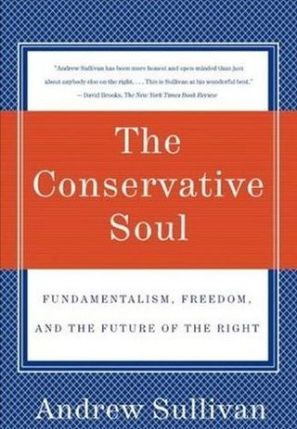
This has long been the theocon argument; it was the crux of what I identified as the core Republican problem in "The Conservative Soul". It is not social conservatism, as lazy pundits call it. It is a radical theocratically-based attack on modern liberal democracy; and on modernity as a whole. It would conserve nothing. It would require massive social upheaval, for example, to criminalize all abortion or keep all gay couples from having any publicly acknowledged rights or status. Then think of trying to get women back out of the workplace or contraception banned – natural, logical steps from this way of thinking. This massive change is radical, not conservative. It regards the evolution of American society these past few decades as literally the work of the Father of Lies, not the aggregate reflection of a changing society. It is at its essence a neo-Francoite version of America, an America that was not the pinnacle of Enlightenment thought, but an America designed to destroy what the theocons regard as the catastrophe of the Enlightenment.

PM Carpenter is right to note below that "Kennedy was emphasizing an institutional separation; he never denied that his conscience was influenced by his faith." But to say that Santorum is attacking a chimera is unfair to both men. Yes, of course, Kennedy's conscience was informed by his faith; how could it not be? But what Kennedy asserted was that his public pronouncements would be defended by non-sectarian reason, devoid of explicit religious content. Moral content – yes. Religious content – no. Which is why I have long found Obama's occasional digression into defending, say, universal healthcare by invoking Jesus as depressingly part of the problem. Money Kennedy quote:

I believe in an America that is officially neither Catholic, Protestant nor Jewish–where no public official either requests or accepts instructions on public policy from the Pope, the National Council of Churches or any other ecclesiastical source–where no religious body seeks to impose its will directly or indirectly upon the general populace or the public acts of its officials–and where religious liberty is so indivisible that an act against one church is treated as an act against all.

This is an explicit public denial that this country is a Christian nation. It is a reaffirmation that "the Government of the United States of America is not, in any sense, founded on the Christian religion." The most important feature of today's GOP – and the fundamental reason I have long abandoned it – stands foursquare against that idea. Moreover, in its fusion of explicit religion and explicit politics, it is itself, in my view, an attack on America – and the possibility of a civil republic. Its religious absolutism is the core underpinning of this country's polarization – because when religion becomes politics, negotiation and compromise become impossible. Bring God into it, and a political conversation must become a culture war.

Note this too from Kennedy:

I believe in a President whose religious views are his own private affair, neither imposed by him upon the nation or imposed by the nation upon him as a condition to holding that office.

This is a defense of private conscience as the core bulwark of religious life – emanating from the Second Vatican Council. And that too is what today's radical GOP is attacking.

For Santorum, as for Ratzinger, if your conscience says one thing, and the Pope says another, you obey the Pope, not your conscience. And for the Christianists, if your conscience or intelligence says one thing, and the Bible says another, you obey the Bible, not your conscience, and certainly not your intelligence. Because beneath Christianism is a deep fear of the human mind – as if they actually believe that reason is stronger than religion and therefore must be restrained. As if the human mind can will God out of existence.

This is Santorum's fear-laden vision. Which is why he is not a man of questioning, sincere faith and should not be flattered as such. He is a man of the kind of fear that leads to fundamentalist faith, a faith without doubt and in complete subservience to external authority. There is a reason he doesn't want many kids to go to college. I mean: when we already know the truth, why bother to keep seeking it? And if we already know the truth, why are we not enforcing it as a matter of law in a country founded on Christian principles? It is not religious oppression if it is "the way things are supposed to be", by natural law. In fact, a neutral public square, in his mind, is itself religious oppression. 

We can also see here the collision of the Second Vatican Council and the current hierarchy. Kennedy was a Catholic of another era, unafraid of modernity, interested in other paths to God, publicly humble and cheerful, privately devout and deeply connected to others of all faiths and none. Santorum is of a different kind: authoritarian, deeply suspicious of freedom when it leads to disobedience of the Papacy's diktats, and publicly embracing a religious identity as his core political one.

I am relieved he is at least candid. For now we can see in plain view the religious fanaticism that has destroyed one of the major parties in this country, a destruction that is perilous for any workable politics. It must be defeated – and not by electing a plastic liar and panderer like Romney. But by nominating Santorum and defeating him by such a margin that this theo-political Frankenstein, which threatens both genuine faith and civil politics, is dispatched once and for all.

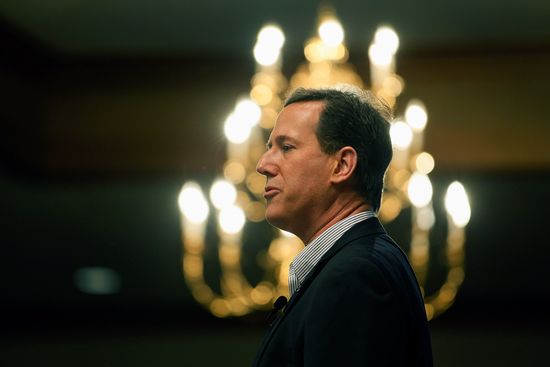
(Photo: Republican presidential candidate, former U.S. Sen. Rick Santorum speaks during a campaign stop at the St. Mary's Cultural & Banquet Center on February 27, 2012 in Livonia, Michigan. By Joe Raedle/Getty Images.)

What Kind Of Catholic Is Santorum?

GT_SANTORUMRALLY_120221

James Wood dissects his theology:

[W]hen Santorum says that we must be good stewards of the earth, there is religious zealotry behind the sweet words. He is proposing, in effect, that the earth is dispensable but that our souls are not; that we will all outlive the earth, whether in heaven or hell. The point is not that he is elevating man above the earth; it is that he is separating man and earth.

If President Obama really does elevate earth over man (accepting Santorum’s absurd premise for a moment), then at least he believes in keeping man and earth together. Santorum’s brand of elevation involves severing man from man’s earthly existence, which is why it is coherent only within a theological eschatology (a theology of the last days). And he may well believe that man cannot actually destroy the earth through such violence as global warming, for the perfectly orthodox theological reason that the earth will come to an end (or be renewed) only when Christ comes again to judge the living and the dead. In other words, global warming can’t exist because it is not in God’s providential plan: the Lord will decide when the earth expires. 

It is also profoundly immune to Darwin's truths. Two core beliefs of Christian fundamentalism is both man's dominion over woman but also humankind's dominion over the earth. And for true fundamentalists, humankind must be seen as radically separate from the rest of creation – because of our capacity for self-consciousness or because of our souls – just as the difference between man and woman must be emphasized to insist on the primacy and hegemony of one over the other.

Yet we now know that all life – all of it – came from the same original goo; we know now how connected we are to the entire planet, as Saint Francis intuited, and as so many, once much more tied to the land than we are, understood in their bones. So dominion for a non-fundamentalist Christian is both care for the planet and thereby self-care. It blurs the distinction between man and beast, in humility not nihilism or denial of human specialness. In contrast, it seems to me, the rigid separation between humans and earth and the total hegemony of humans in the Christianist vision leads to a vision in which earth is to be used and exploited, rather than conserved or stewarded.

Hence, I think, the lack of even passing concern for the environmental consequences of, say, fracking, or even an acknowledgment of the damage our multi-national capitalism is doing to something far more morally vital: our divine planetary inheritance. Santorum, it must be said, is to the right of the Pope on this. Here's Pope Benedict's much more nuanced 2009 statement:

There exists a certain reciprocity: as we care for creation, we realize that God, through creation, cares for us. On the other hand, a correct understanding of the relationship between man and the environment will not end by absolutizing nature or by considering it more important than the human person.

Of course. That would be a false God. But man – if given free rein to do with the earth as he pleases – is a false God as well. Larison adds:

Santorum doesn’t understand the concept of stewardship very well. After all, the purpose of Christian stewardship isn’t simply to serve human needs (much less desires), but to preside over the natural world as God’s viceregents and to rule it in a manner pleasing to God, all of which is directed towards giving God glory and thanksgiving for the blessings He has bestowed upon us. We are to see creation as something entrusted to us by God, and as something that we are responsible for preserving and keeping as part of our obedience to Him. That necessarily involves limiting and restraining our desires so as not to exhaust or waste what has been entrusted to us. 

More Catholic pushback against Santorum's enviro-radicalism here. He is best seen, it seems to me, as the articulate uber-Catholic veneer for an intellectually bereft evangelicalism. He provides the most reactionary Catholic arguments for their evangelical convictions. He gives their panic at modernity the balm of a 13th century natural law.

(Photo: Republican presidential candidate Rick Santorum speaks at a news conference on February 17, 2012 in Columbus, Ohio. By Jay LaPrete/Getty Images)

Why On Earth Am I Sympathizing With Santorum?

Heaven knows how utterly opposed I am to his foreign policy of reckless belligerence and domestic policy of relentless interference. And yet I’m pretty sure I know what he believes – and it is exactly what Romney says he believes too. The difference is that Santorum means it, and says it, and defends it in public … and will probably implement it – so far as he can – when he gets into office. Romney is, in contrast, impossible to decipher.

Jon Stewart and John Oliver have a brilliant skit in this respect:

George Will recently sighed: “Romney is not attracting people who want rationality leavened by romance. Santorum is repelling people who want politics unmediated by theology.” That’s about right. But for the past decade, the Republican elites and base have precisely insisted on a politics that is mediated by theology.

They are the ones who have insisted that religious argument has an integral role in public discourse; that there is a “war on Christmas” and now all religion; they are the ones who have campaigned against gay marriage as un-Biblical or in violation of a “natural law” barely updated from the 13th century; they are the ones raging against a two-state solution in Israel-Palestine because God bequeathed it all to the Jewish people; they are those who directed the federal government to involve itself in an end-of-life decision already resolved by state law; they are those who have made criminalization of abortion a litmus test for Republican candidates for a generation, and who want to give women an invasive ultrasound before allowing them to exercize what has now been a constitutional right for decades.

And when an intelligent, sincere candidate emerges who has actually walked the walk on these issues, and refused to back down on them, and overcomes a massive financial and organizational disadvantage to become the national leader in the polls, he’s suddenly far too extreme.

Is Santorum unelectable in a general election? Yep. The current polling says Rick loses to Obama by 6.3 percent. But Mitt loses to him by 5.1 percent. How big an argument do you want over 1.2 percent?

I despise what the GOP has become. But it is what it is. And Santorum is its logical leader. Let this party stand up and be counted. Romney would shroud it in bullshit and blather – while not deviating from it a scintilla. If he won the nomination and lost the general campaign, the GOP would simply blame it on his lack of “real conservatism”. And we’d be back where we started. With Santorum, we’d finally get to test whether that “real conservatism” is indeed the future of the GOP or what I think it is – a reactionary form of madness.

And, by the way, those Washington pundits now huffing and puffing about Santorum’s extremism? They should have spoken up a long time ago. Or tell us now what substantive differences there are between Santorum’s apocalyptic war-mongering and Romney’s; or between Santorum’s belief in erasing the difference between politics and religion and Romney’s. Or simply acknowledge they have no principles but defeating Democrats by whatever means necessary.

But that would be honest, wouldn’t it? Like the candidate they now oppose.

Online Lent

HuffPo is live-blogging the season of repentance: 

Right now, the Lent blog is leading with a quote from Flannery O'Connor and a piece of scripture. Farther down the page, items include "Learning to Suffer? Or Learning to Love?" and "The Pope Will Be Tweeting Lent!" The content also includes user-generated posts and guest posts.

As readers know, I believe this is the way religion should be in public life. Instead of using political power to direct the lives of others through law, Christians should embrace true secularism as a neutral stage on which to explore and explain and witness to their actual faith. No law Rick Santorum will ever pass will be as powerful in people's hearts and minds than his and his wife's decision to have little Bella and take care of her, with love and discretion and privacy. In this act, he has shown Christianity. In his politics, he has shown how the freedom of Jesus and the coercion of the government are in contradiction. 

This is my objection to Christianism, as it is to Islamism. Because it obscures the true message: Jesus led by example and non-violence, not by the coercive power of the state. And the message of the Gospels and of the lives of the saints is exactly this: witness, don't control. Let go of such an impulse. Live the truths, and you will find people coming to you. And if the truths are lies, only freedom will allow you to see past them to deeper truths.

Each Sunday, we've tried here to provide a platform for public discussion of things beyond our full understanding – not as a way to proselytize (although I am, of course, openly Christian) – but as a way to explore in a neutral and safe space the great questions worth asking every day. I'm delighted HuffPo has started something not dissimilar, and any live-blog that has Henri Nouwen and Flannery O'Connor on it is a blessing.

One small quibble: that lovely Saint Francis prayer was never spoken by Saint Francis. It dates to a small French journal, La Clochette, in 1912 and has no known author. (The real thing is in the video above.) But this Nouwen nugget is truly his and truly Lenten:

There is so much in me that needs to die: false attachments, greed and anger, impatience and stinginess … I see clearly now how little I have died with you, really gone your way and been faithful to it.

What great power Christianity of this sort should have in the culture of our time. How many false attachments are we addicted to – celebrity, money, possessions, news, the web. How much greed we see and how much anger we feel. Jesus liberates us from these things that cloud our culture and soil our souls. How tragic that in politicizing this message at this moment we are obscuring its timeless promise of freedom?

The Moral Scandal Of Rick Santorum And “Enhanced Interrogation Techniques”

Capt4

Here's Rich Lowry, defending Santorum yesterday:

Although his critics will never credit him for it, Santorum’s social conservatism brings with it an unstinting devotion to human dignity, a touchstone for the former senator. The latest position for which he’s taking incoming is his opposition to a government mandate for insurance coverage of prenatal testing often used to identify handicapped babies who are subsequently aborted.

Here are the torture techniques Santorum aggressively defends and told Senator John McCain he didn't understand:

Using dogs to terrorize prisoners; stripping detainees naked and hooding them; isolating people in windowless cells for weeks and even months on end; freezing prisoners to near-death and reviving them and repeating the hypothermia; contorting prisoners into stress positions that create unbearable pain in the muscles and joints; cramming prisoners into upright coffins in painful positions with minimal air; near-drowning, on a waterboard, of human beings—in one case 183 times—even after they have cooperated with interrogators.

Here is a specific case conducted at Camp Nama directly under the authority of Stanley McChrystal:

[One prisoner] was stripped naked, put in the mud and sprayed with the hose, with very cold hoses, in February. At night it was very cold. They sprayed the cold hose and he was completely naked in the mud, you know, and everything. [Then] he was taken out of the mud and put next to an air conditioner. It was extremely cold, freezing, and he was put back in the mud and sprayed. This happened all night. Everybody knew about it. People walked in, the sergeant major and so forth, everybody knew what was going on, and I was just one of them, kind of walking back and forth seeing [that] this is how they do things.

It seems to me that no politician who has aggressively defended these core violations of human dignity can be described as someone for whom human dignity is a "touchstone" of his worldview. The effrontery is not that of the media; the effrontery is from Santorum when he lectured John McCain that McCain

doesn’t understand how enhanced interrogation works. I mean, you break somebody, and after they’re broken, they become cooperative.

In that very defense – in Santorum's own description of what he is defending – he is defending the "breaking" of a human person, made in the image of God. He is defending a core, absolute evil. Let us concede for the sake of argument that these are "enhanced interrogation techniques" and not "torture", as Santorum insists. There is no meaningful difference between the two whatsoever from a Catholic perspective, and Santorum's public positioning as an avowedly Catholic politician, while defending and promoting an absolute evil, is a true and immense moral scandal – in the Church's sense of the word. No one should be giving the impression that the Catholic church defends "enhanced interrogation techniques". This is from the Catechism: 

Torture which uses physical or moral violence to extract confessions, punish the guilty, frighten opponents, or satisfy hatred is contrary to respect for the person and for human dignity…

Non-combatants, wounded soldiers, and prisoners must be respected and treated humanely. Actions deliberately contrary to the law of nations and to its universal principles are crimes, as are the orders that command such actions. 

Notice there is a bar even on "moral violence" on or "frightening" prisoners. Santorum's own moral distinction between "breaking" human beings by EITs and "torture" does not exist in international law or Catholic doctrine.

I conscientiously dissent from the Magisterium on marriage equality, contraception, and women and married priests. But I publicly acknowledge that I am dissenting and this is not the hierarchy's view and that I am not representing the Magisterium. Santorum, it seems to me, needs to be just as explicit in his statement that he dissents from his own church on the question of the inviolable dignity of the human person. He is advocating crimes "deliberately contrary to the law of nations and to its universal principles". He is proposing to "break" a human person, without even due process. He is standing as the publicly Catholic foe of human dignity.

And notice that, unlike, say, allowing contraception or gay marriage in a free society, the government that Santorum proposes to lead is directly involved in such activities. A lawmaker who allows free contraception in health insurance can only be accused of indirectly causing sin to occur; but a president who authorizes the abuse and torture of human beings is directly, intimately involved with that decision and bears full moral responsibility for it. 

It seems to me that Santorum can and should be free to defend this evil as he sees fit. But his defense of torture is far, far more scandalous to the Catholic church than any liberal Catholic politician's views on, say, same-sex marriage or contraception. It is he who has made his faith integral to his public life. Yet he defends the equivalent of crucifixion for prisoners under his potential command.

When, one wonders, will Catholics hear a letter from the pulpit on the vital question of torture – and the support for it from a leading Catholic candidate for the presidency?