I happened to meet Peter Tatchell, the legendary and vocal international gay rights activist, last week in London. In the 1990s, he had publicly challenged my book, "Virtually Normal," and its advocacy of marriage equality, from the vantage point of the gay left. A decade and a half later, we are on the same page. But he was always an "outer" and I wasn't; and that kept us somewhat at odds. But just as you cannot libel the dead, I don't think you can out them either. And Peter's reminiscence of younger Whitney's closest friend, Robyn Crawford, is a touching one, and I see no reason to disbelieve it:
When I met them, it was obvious they were madly in love. Their intimacy and affection was so sweet and romantic. They held hands in the back of the car like teenage sweethearts. Clearly more than just friends, they were a gorgeous couple and so happy together. To see their love was infectious and uplifting.
Whitney was happiest and at the peak of her career when she was with Robyn. Sadly, she suffered family and church pressure to end her greatest love of all. She was fearful of the effects that lesbian rumours might have on her family, reputation and career. Eventually she succumbed.
The sudden and horribly self-destructive marriage to Bobby Brown surprised many. But until reading Peter's piece, I did not realize that Brown had himself said that Whitney married him in part to put behind rumors of her love for Robyn, to whom she dedicated her albums. He wrote that the marriage was
"doomed from the very beginning. I think we got married for all the wrong reasons. Now, I realize Whitney had a different agenda than I did when we got married. I believe her agenda was to clean up her image, while mine was to be loved and have children. The media was accusing her of having a bisexual relationship with her assistant, Robin [sic] Crawford. Since she was the American Sweetheart and all, that didn’t go too well with her image. In Whitney’s situation, the only solution was to get married and have kids. That would kill all speculation, whether it was true or not."
Robyn wrote a moving tribute after Houston's death, reflecting on its happening around Valentine's Day. These paragraphs leapt out at me:
People thought they had to protect her. She hated that. And that’s what people don’t understand: She was always the one doing the driving … She was working hard to keep herself together, and I think she felt that if she admitted any feeling of sadness or weakness she would crumble. One time, back when we were young, we were out, we were partying, and I said, "Listen, I have to go. I’m tired. I can’t make it." And she looked at me with her eyes wide and said, “I’ve got to make it.”
And that was Whitney. She could not pick up the phone, and that meant it was too painful. I have never spoken about her until now. And she knew I wouldn’t. She was a loyal friend, and she knew I was never going to be disloyal to her. I was never going to betray her. Now I can’t believe that I’m never going to hug her or hear her laughter again.
We can never know what's in someone's heart. I hope for her sake that Houston wasn't gay and didn't suffer because she couldn't face it – for religious or professional or social reasons, or for reasons within her even she could not understand. Robyn, her assistant, describes a love that could just as well have been profound intimate friendship, rather than full intimacy. But these barriers are more porous for women than many men, and if she was at heart a naturally lesbian woman – as her ex-husband claims – it makes her suffering so much deeper and more important to understand. It reveals the deep toll of suppressing your core emotional identity for the sake of "making it" or simply because of social pressure and shame. Many men and women caught in this vise suffer for it, sometimes unconsciously seek punishment for it, or try to numb it with the pursuit of professional perfection, or rigid religious fundamentalism, or alcohol, or drugs, or pure, unrelenting, soul-punishing denial. It's a horrible way to live – enough, at some level, to make you want to die.
Deep down, I think this was the core tragedy of Michael Jackson. He never felt the validation of unconditional love as a child, as is the case with so many gay kids (whether he was gay or not). I hope Whitney didn't endure the same agony – or worse, once did experience unconditional love and then ran away to punish herself for it for life. Both Jackson and Houston were musical geniuses. But what came through their voices, to me at least, was not just those near-divine moments of joy, but the sincerity of the visceral pain that laced every note.
I pray their pain is over now; and that their wounded souls are being healed by their Father's unconditional love for ever.
 of the marijuana itself. All other normal costs of doing business – including employee salaries and benefits, rent, equipment, electricity and water – have been denied.
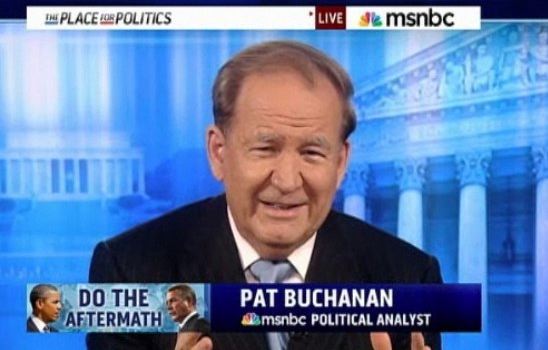 There is so much I disagree with Pat Buchanan on – from World War II to marriage equality to immigration to my love of a multi-racial and multi-cultural society – that I could write a book in it. But let me say something in his defense: however repellent some of his views, he is intellectually honest. Yes, publicly bigoted, sometimes outrageous, a flame-thrower, a reactionary who flirted at times with what only can be called neo-fascism. But here’s another thing he has always been: true to his own ideas and a gifted writer. He truly believes what he says and has read and researched a huge amount and has thought carefully about his extreme out-of-the-mainstream views. He is a serious figure in that respect. Compared with Al Sharpton or Ed Schultz, he is a paragon of intellectual integrity. He is not a propagandist. He is a passionate writer who loves nothing more than a good argument with a worthy opponent – and he has a serious sense of humor to boot. That his ideas are often repelling should precisely be why he should stay on MSNBC and defend his views against the smartest critiques that can be found. We should stop silencing people and keep debating them. The idea that he was not the target of much subterranean leftist outrage and pressure to fire him, as my colleague Howie Kurtz


 women, preferably about inane things like where Lisa Vanderpump will hold her daughter’s bachelorette party in Las Vegas. The second feature is classic Depression era porn: such fantastic obscene luxury and wealth paraded like a 1930s movie set in aristocratic New York apartments with massive sweeping staircases and near-mandatory black tie.
 The Dish