How Scared Is Fox?

This embed is invalid

Fox News is now waging war on the essay. I'm not surprised. Megyn Kelly has declared that I am "not a real journalist." She has also just said that I have written that Trig is not Sarah Palin's child. As longtime readers well know, I took great pains never to state that and merely to ask Palin, given her insane story about the birth of her child, to provide some evidence for it, which she said she would but never did. The Beast has asked for a correction. Real journalists do not tell untruths on air without correcting them.

What I want to know is why they cannot invite the author of an essay to debate it, rather than two random individuals (including Rich "Starbursts" Lowry) to discuss. Surely that's only fair – unless, of course, I am on a blacklist.

So this is an open challenge to Fox News. If you want to trash my work, have me on to defend it. Any time, Megyn. Any time. What are you afraid of?

Apart from the truth, that is. 

Why Ron Paul Is Right And Barack Obama Is Wrong About Iran

One of the key things that Ron Paul has contributed to our discourse is the notion that we should try and look at conflict from the point of view of our foe. You'd think this would be obvious if we are attempting to influence, say, Iran's behavior, to understand their fears, their baseline interests and their ideology. So far, all we hear about is their ideology. But let's broaden our moral imagination in ways not allowed in the Washington Post.

Imagine that three scientists working on the US nuclear arsenal were assassinated in the streets of Chicago or Washington or Los Angeles by agents of Iran. Now imagine that an explosion took place at one of our nuclear facilities – also engineered by Iran. Also imagine that Iran was capable of blockading US ports to cripple the US economy. Imagine the dollar collapsing because of this and a new depression initiated. What do you think Mitt Romney would be saying? I suspect he would be saying that Iran has already declared war on the US.

But all these things have happened in Iran, probably by the hands of Israeli intelligence, perhaps by the US, or some combo of the two. Is it surprising that the Iranians are throwing rhetoric around, even if much of it is empty? Of course not. Vali Nasr argues that Iran is already on a war-footing because of this:

Iran has interpreted sanctions that hurt its oil exports, which account for about half of government revenue, as acts of war.

Who alone among the presidential candidates gets this? Only Ron Paul. Bob Wright has a must-read on the potential president's lonely sanity on this question. Jon Rauch also notes that the debate we're having about Iran is very very similar to the debate we once had about China's nuclear capacity:

Fifty years ago, [China] was the Iran of its day, a rising regional power that was radical, ideological, boldly antagonistic. It fought the U.S. in Korea, attacked India and Taiwan, supported violent insurgencies and more. Its leader, Mao Zedong, mused that killing half of mankind might be a price worth paying to make the world socialist. Understandably alarmed, some of President Eisenhower’s advisers urged a pre-emptive nuclear attack. (Ike wisely forbore.) President Kennedy said a nuclear China would dominate Southeast Asia and "so upset the world political scene" as to be "intolerable."

Notice the classic Kennedy recklessness in foreign policy (he was George W Bush avant la lettre), and the characteristic Eisenhower sanity. Now look at the history. Since China's adoption of nuclear status, it has actually behaved more responsibly abroad, not less. Jon makes a very persuasive case that nuclear weapons really don't give countries much of an edge, and, if anything, tend to calm them down, especially if they are in a region where they have foes who do have such weapons.

The Obama administration has foolishly decreed that it will never allow a nuclear-armed Iran. It's foolish because at some point, Iran will get one, and the US will therefore have to go to war either to stop it or to punish Iran for it. The obvious option – containment – is foregone.

Obama also argues that he opposes Iran's nukes because of proliferation in the region. At which point one must loudly cough "Ahem." Only one country in the region has illegally, in defiance of internatinal law and the NPT and US policy, has nuclear weapons and it's Israel, not any Arab state. More absurdly, the US government has a formal policy of never acknowledging this fact. At one point in the not-so-distant past, the US government was committed to the view that Iraq had nukes but Israel didn't.

When will the US evolve a sane policy in the Middle East? One that advances our interests, avoids a catastrophic global religious war, and bases it judgment on history and statecraft rather than religion and a US-Israel alliance that, since the end of the Cold War, has become increasingly unhealthy to both parties? Less Kennedy, more Eisenhower, please.

Arguments vs Associations

Paul

The Ron Paul candidacy has proven a very fertile event on both right and left. It has shown that there is some real disquiet among conservatives about retaining the 20th Century vision of American military global hegemony. And it has shown that the left is ultimately more concerned with the hunt for damning ideological associations, than with the ideas that Paul has promoted – even when those ideas are closer to some of candidate Obama’s than president Obama’s.

In a deliberately provocative must-read, Glenn Greenwald spells out the left’s priorities in demonizing Ron Paul:

Whatever else one wants to say, it is indisputably true that Ron Paul is the only political figure with any sort of a national platform — certainly the only major presidential candidate in either party — who advocates policy views on issues that liberals and progressives have long flamboyantly claimed are both compelling and crucial. The converse is equally true: the candidate supported by liberals and progressives and for whom most will vote — Barack Obama — advocates views on these issues (indeed, has taken action on these issues) that liberals and progressives have long claimed to find repellent, even evil.

As Matt Stoller argued in a genuinely brilliant essay on the history of progressivism and the Democratic Party which I cannot recommend highly enough: “the anger [Paul] inspires comes not from his positions, but from the tensions that modern American liberals bear within their own worldview.” Ron Paul’s candidacy is a mirror held up in front of the face of America’s Democratic Party and its progressive wing, and the image that is reflected is an ugly one; more to the point, it’s one they do not want to see because it so violently conflicts with their desired self-perception.

And so they spend enormous energy persuading themselves that Paul is actually a paranoid, anti-Semitic, racist bigot, and so need not be engaged seriously. And the neocons are only thrilled to help out (since Paul remains the one candidate in either party who will not launch their longed-for war on Iran). I find in this much that was ascendant on the left in the 1990s: an identity politics purism in which the entirety of moral discourse is distilled to exposing variously illicit prejudices or associations toward various groups of people. Sometimes, this verges on total parody. Check out PowerLine’s attempts to discredit Keynes because he was an anti-Semite at the age of 17! Too funny, if it weren’t half-serious. And then this surprising piece of pure McCarthyism from David Frum:

A politician isn’t answerable for the antics of every one of his supporters. But there’s surely a reason, isn’t there, that racists, anti-Semites, 9/11 Truthers, and Holocaust deniers are so strongly attracted to the Paul campaign. They hear something. They continue to hear it too, no matter how firmly Ron Paul’s more mainstream supporters clamp their hands over their own ears.

Notice how pure the smear is, enabled and not diminished by the first sentence. Notice the key concept of Beltway ideological policemen: there is a mainstream and a non-mainstream. Dabble with the latter at your peril. Since David has perished by the cult of the “mainstream”, it’s odd he should deploy it against others. But to throw in “Holocaust denial” and 9/11 Truthers for good measure! Really.

This embed is invalid

And notice how particularly cheap and easy it is to use such tactics against a libertarian. The traditional left is often based on collective associations, building a movement out of oppressed groups and their grievances, whether it be class or race or even sexual orientation. Libertarianism is the opposite. It’s about disassociating. When you listen to Paul saying he will not turn anyone away from supporting his platform regardless of their motives or beliefs, you are hearing a reflection of his libertarianism, not his bigotry. He will accept support from any quarter and compared with the corporate money flowing into the other candidates’ coffers, he is about as independent as a presidential candidate can be. Because he is a radical individualist, he doesn’t even understand why he should somehow explain the belief of others, or justify their support. You should ask them, not him.

This kind of gotcha-association game is particularly easy because libertarians favor liberty above all, and that will necessarily mean liberty for bigots as well as others. A principled belief in states’ rights will doubtless lead to more racist and homophobic policies in many states – but also, of course, more enlightened and successful inclusive states like Oregon or New York or Massachusetts or California. A rejection of statism might lead to more discrimination in the private sector. But it doesn’t mandate it. And it need not encourage it. A non-interventionist foreign policy will allow evil to triumph elsewhere in the world, because it believes it’s none of our business or too riddled with unintended consequences to try extirpating. That may be right or wrong, but it is not an approval of the evil of Assad or Ahmedinejad or the North Korean junta. And again, it is actually much deeper an American tradition than permanent warfare. But if you can trot out David Duke or Ayatollah Khamenei as potential Paul supporters, you have a very easy, cheap and essentially McCarthyite target. It saddens me that this kind of tactic works.

I still believe that the newsletters, because they were in Paul’s name, require a clearer explanation from Paul than the muddled ones he has given. He should not be left off the hook. And his proposals deserve a thorough vetting and discussion.

But there is something awry when a candidate is assessed not on his arguments and proposals but on the shadiness and ugliness of some of his fringe supporters. And his arguments are serious, even vital, ones for this moment: that the construct of American global hegemony is too costly, too dated and too counter-productive to work in this country’s interests abroad any longer; that the welfare state cannot be sustained at its present level with our looming demographics and massive debt; that problems are often best solved closest to the ground where they occur; that dividing Americans into identity groups and pandering to each is inimical to a free individualist society, and so on. These are fresher ideas on the right than the exhausted re-microwaved Reaganism of the others.

Which is why, whatever happens to his candidacy, Paul has already achieved something important: the broadening of debate, the scrambling of right and left, and the appearance on our toxic public stage of a man who seems to say what he thinks without much calculation or guile.

The Ides Of 2011

It was a dreadful year in many ways: the embarrassment of the debt ceiling clusterfuck, Europe’s lurching inability to manage its own currency, mass slaughter in Syria, civil war in Libya, the Japanese nuclear disaster, and the GOP primary circus. But it also felt to me, with my nose pressed up against history’s fleeting present, as a deeply transformative and actually positive year, in which underlying tectonic plates in world politics and culture shifted – for the better.

What we had seen in 2008 and 2009, as the new media powered both Obama’s unprecedented campaign and then the Green Revolution, turned out to be prescient, not a fluke. The increasingly connected global consciousness, the awareness of how others live in the same moment as you subsist, the globalization of thought and interaction, the power of peer-to-peer communication: all these led to a shift in power from the top to the bottom. Hence the miracle of Tunisia’s revolution, the continuing struggle of Egypt’s, the emergence of post-totalitarian Libya and the astonishing resilience of Syria’s people. Hence too, in the West, the sudden bubble of the Occupy movement, as a negative image of the Tea Party. And the rises and falls of various insurgent candidacies in the GOP that wanted to shake the status quo, and the great restlessness on the center-left with Obama’s incremental, conservative liberalism.

We do not know where this will lead, except that democracy really does seem “on the march” at last. And not a forced march, with US bayonets prodding from the rear, as in Iraq. But a genuine popular movement in many places, reacting spontaneously to a fast-shifting global economy and polity. This cannot be managed by the US, it seems to me, using the tools of the Cold War. It cannot be handled without a vast amount of muddling through, mistakes, misjudgments, restraint and observation. In fact, it should be managed lightly, if at all. These are epochal changes – happening in their own time, not on America’s quadrennial presidential schedule. If we haven’t learned already that we cannot control this, that we should not try to, but should protect our interests as pragmatically as we can, and advance our values as humbly as we ought to, then we never will.

The wars, moreover, are done. In 2011, Obama got us out of Iraq on the schedule dictated by George W. Bush and Nouri al-Maliki. We have also done about as much damage as we can to al Qaeda in Pakistan and Afghanistan without active Pakistani support. We’re outta there in two years anyway. A clear majority of Americans, moreover – 53 to 36 percent – believe that the current decade-long war is not worth fighting any more. The brilliant capture and killing of Osama bin Laden by Seal Team Six closed an open wound. If we can reach back and remember why so many backed Obama in 2007, this really is the change we believed in.

On two issues the Dish cares passionately about – the freedom to marry for all and the end of the military gay ban  – 2011 was also a watershed. For the first time, polls consistently showed a majority of Americans favoring marriage equality; in New York State, a Republican Senate brought marriage rights to one of the biggest states in the Union, effectively entrenching what was once a pipedream into a permanent part of the American landscape. For good measure, the ban on openly gay servicemembers was finally lifted, and the non-consequences were deafening. There remains much work to be done. But we broke the back of the anti-gay opposition this year, and cemented our huge majority in the next generation.

This revolution was built from below as well: largely by gay people and their families and friends in daily acts of courage and candor and conversation. It was powered by the Internet. It became global, as change in places as backward as sub-Saharan Africa on gay rights brought new conflict and BouaziziStampterror. And the Obama administration put America’s weight behind the advancement of gay dignity and equality worldwide.

And in this new world, Obama’s critical contribution is indeed “leading from behind” because in this new world, leading self-righteously from the front, commanding other nations to behave as we wish, unilaterally intervening at will, and generally continuing the role that America played in the last century is an ineffective anachronism. The Bush-Cheney years proved this, when America’s international isolation led to a long, costly disaster in Iraq, where China and Iran benefited more than the US. The rise of the new powers of Brazil and India and Indonesia and China mean that American hegemony in the 1990s sense is over; and if we do not understand that and adjust, we will be caught in the worst trap of declining empires. This does not mean the abandonment of military power and reach, but a much subtler, lighter and more collaborative force.

The man of the year, in my mind, is Mohamed Bouazizi, even though he died a few weeks before the year began. His self-immolation on Decmber 17, 2010, was an act of civil disobedience that became the spark for the democratic wave in the place we never expected it: the Arab Middle East. He was one man, with no power but his own conviction. But, in the words, of RFK:

It is from numberless diverse acts of courage and belief that human history is shaped. Each time a man stands up for an ideal, or acts to improve the lot of other, or strikes out against injustice, he send forth a tiny ripple of hope, and crossing each other from a million different centers of energy and daring those ripples build a current which can sweep down the mightiest walls of oppression and resistance.

Through the recession and deaths of 2011, this truth emerged. There are dark clouds around – specifically the vile regime in Tehran, the dangerously radical government in Jerusalem, the Egyptian military’s fear, the chance of a lingering depression. But if we allow these to overwhelm the real news of this year, we are missing the screen for the pixels.

This was an inspiring year for human dignity and freedom. Know hope.

Re-Thinking The Paul Endorsement

I sat down and re-read some of the Ron Paul newsletters last night. I don't think he wrote them; I don't think they represent who he is; I do not believe the man is a racist, although seeing into men's souls is not something any of us is very good at. But you have railed and railed and railed at me these past few days – and it's my duty to sit down and re-think. It's happened before and will happen again. I write and think in real time.

In my view, my friend Joe Klein goes too far:

The newsletters went out under his name. They are replete with hateful filth. They disqualify him from the presidency. The idea that someone else wrote them and Paul didn’t read them is utter nonsense–even if true, it would be a devastating commentary on Paul’s executive abilities. How could he hire whomever wrote this crap? And so, when I called Ron Paul honorable yesterday, I was wrong. He is not.

This is too much (I think it's perfectly possible, rather than 'nonsense', that Paul used these newsletters as fundraising tools without full oversight). But it is not nothing. A fringe protest candidate need not fully address issues two decades ago that do not in any way reflect the campaign he has run or the issues on which he has made an appeal. But a man who could win the Iowa caucuses and is now third in national polls has to have a plausible answer for this. It's what happens when you hit the big leagues. Obama did it with Jeremiah Wright, openly grappling with the past toxic association, owning it, explaining it. Paul has not had the wherewithal or presence of mind to do that. Indeed, he has not even named the association, the first step to disowning it. And unlike Obama with Wright, Paul got money from these newsletters.

It seems to me that even though I don't believe these old screeds reflect Paul's own beliefs, his new level of prominence demands a new level of accountablity, even on issues this old. If Paul did not write these newsletters, then he has an obligation to say if he knew who did, or conduct an investigation. He has had years to do this, and hasn't. And here's what you've persuaded me of in the last few days: a person who has that kind of bigotry directly printed under his name without a clear empirical explanation of why he is innocent cannot be an honorable president of the United States. The hatred of groups of people in those letters – however gussied up by shards of legitimate arguments – is too deep and vile to be attached to a leader of the entire country. It is far too divisive. The appearance of things matters; and until Paul explains why this appears so horrible, he cannot shrug off the burden of proof.

My endorsement was complicated and I'd like to ask hostile readers to do me the favor of re-reading it before they get all worked up again. It's a very delicate maneuver between Huntsman and Paul. But there was an illogic in it that I now understand:

There are times when [Paul] is rightly described as a crank. He has had associations in the past that are creepy when not downright ugly. But all this is why a conservative like me is for Obama. What we are talking about here is who to support in a primary dominated by extremes, resentment, absence of ideas and Obama-hatred.

This works as an argument if you endorse Paul, as I did, as the best medicine for the GOP, not the best president. But I'm not sure, in retrospect, that I can have that cake and eat it too. An endorsement should not be entirely instrumental. I'm not trying to spoil the GOP race; I am trying to support the one guy who has resisted both perpetual offensive warfare and out-of-control spending in the years Republicans embraced both. And so I have to accept that I am endorsing him as a candidate for the presidency, not just as a protest vote against the last decade, and think that through fully.

And I just cannot see how he can be such a president without explaining away the newsletters convincingly. Until he does, I have to say that the balance of the endorsement must now go to Huntsman. Oddly, I think that Paul's courage in challenging the neocon establishment has made a Huntsman candidacy possible. And I tend to prefer the brave to the lucky. And I stand by all the things I wrote about Paul's views, his refreshing candor, his happy temperament, his support for minorities, and his vital work to undo the war on drugs and the military-industrial complex. I don't think he's a racist; in fact, I think he's one of the least racially aware politicians I've come across in a long while.

But the words and sentiments in those newsletters cannot attach themselves – even by mere appearance – to a potential president of this country. I see that now. Maybe my admiration for Paul's courage and his extraordinary resistance to the authoritarianism and intolerance in his own party blinded me to this. But you can't be both the solution and the problem. And so, until Paul fully explains this incident, in the kind of way Michael Tomasky recommends, I have to say there is an alternative, as I described at length in the endorsement: Jon Huntsman. He's what my super-ego tells me is the right choice. My id remains with Ron. But I write with the rational part of my brain, or at least I try to.

Mitt Romney Is A Big Fat Liar

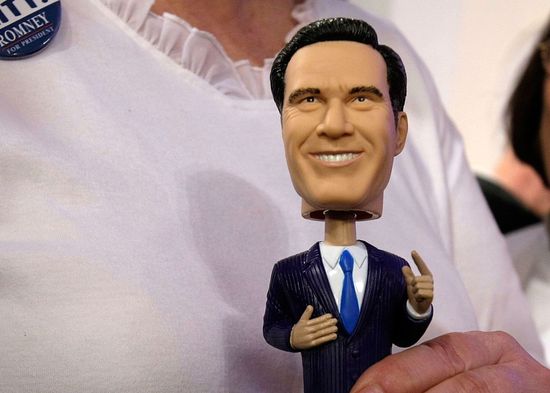
BOBBLEMITTAlexWong:Getty

One of the advantages of having put your soul on eBay is that it frees you up. You can say anything to anyone, and feel no consequences. You can go from promising to be more pro-gay than Ted Kennedy to backing an amendment to the Constitution permanently putting gays into second class status. You can go from calling yourself "progressive" to "the most conservative candidate in this race." And you also can repeat in increasingly crude terms the notion that this president is some kind of anti-American, far-left ideologue determined to turn 21st Century America into Eastern Europe c. 1978 … and pretend that this is the actual debate we are having and that this is the universe we are living in. Given the alternative galaxies proferred by Roger Ailes, any other narrative might prove confusing for the true believers, I suppose. But if you want to read a long list of the whoppers that Romney has been touting, check out Sargent.

This is a lie:

Roosevelt believed that government should level the playing field to create equal opportunities. President Obama believes that government should create equal outcomes.

I hereby challenge Romney to cite a single case or action in which president Obama has said he believes that government should enforce equal outcomes in the workplace or the economy or anywhere else. His signature policy in education is called "Race To The Top", for Pete's sake. He chose to extend the Bush tax cuts. He has actually cut Medicare and taxes on a majority of Americans. The idea that at a time when the debt is soaring the wealthy might be asked to contribute their fair share to balancing the buget is not Marxist. It's something the most right-wing economic government in the West, Britain's Conservative Party, has insisted upon.

One other little contrast to reveal the extent of Romney's deception. Here's a recent debate riff:

This is a president who fundamentally believes that the next century is the post-American century. Perhaps it will be the Chinese century. He is wrong.

Again, I hereby demand from the Romney campaign direct evidence that the president has ever said or done something that can back up this ludicrous assertion of backing a foreign country over one's own. It's a lie. And, by the way, here is the president in this year's State of the Union:

You see, Washington has been telling us to wait for decades, even as the problems have grown worse. Meanwhile, China is not waiting to revamp its economy. Germany is not waiting. India is not waiting. These nations — they're not standing still. These nations aren't playing for second place. They're putting more emphasis on math and science. They're rebuilding their infrastructure. They're making serious investments in clean energy because they want those jobs. Well, I do not accept second place for the United States of America.

Ron Paul And The Republican Future

116775490

“I would be a different kind of president. I wouldn’t be looking for more power. Everybody wants to be a powerful executive and run things. I, as a president, wouldn’t want to run the world,” – Ron Paul, December 15.

It's so heartening to see a candidate who's been ignored, condescended to and caricatured by both the liberal media and the Fox Propaganda machine emerge as a viable candidate to win the Iowa caucuses. He did it the best way possible: by a long, consistent message and the spade-work of previous campaigns; by old-school ground-organization; by generating enthusiasm among the grass roots and by bringing in many more people into the GOP fold. And look at the people he's attracting:

Among voters under 45 [in Iowa] he’s at 33% to 16% for Romney and 11% for Gingrich.  He’s really going to need that younger than normal electorate because with seniors Romney’s blowing him out 31-15 with Gingrich coming in 2nd at 18%. Paul is also cleaning up 35-14 with the 24% of voters who identify as either Democrats or independents. Romney is actually ahead 22-19 with GOP voters.  Young people and non-Republicans are an unusual coalition to hang your hat on in Iowa, and it will be interesting to see if Paul can actually pull it off.

If any other candidate were to win the Republican Iowa caucuses with a demographic that could go head-to-head with Obama's base in the fall, we'd be having newsweekly cover-stories and round-the-clock cable coverage. Instead we have the usual silence from liberals who cannot take domestic libertarianism seriously and from neocons desperate to keep the Military Industrial Complex humming at Cold War velocity. But Paul is a demographic dream for the GOP. What the party desperately needs is an outreach to the Millennials and, to a lesser extent, the Gen-Ys and Gen-X's, if it is to be saved from dying out in the near future. Alone among the candidates, Ron Paul, at 78 76 years' old, is able to attract them to the GOP.

And the generation gap is growing hugely. Since the Carter era, the young and the old have been separated by at most 7 percent in the gap between Democrats and Republicans, and sometimes as little as 1 percent (when Reagan beat Carter). But in the last decade the gap has widened to a staggering 20 percent difference, as the recent Pew survey found.

Paul's other great strength is in understanding, in a way neither the current Democrats or Republicans do, that the imperial apparatus inherited from the war against the Soviet Union has to be wound down. Romney sees this as defeat, because his worldview is still so 20th Century. Obama understands the need for re-calibration, but is actually far more Niebuhrian than Paul's "friends-with-countries" approach to foreign policy. Only Paul makes the big leap into the multi-polar future.

There is no way over the long term that Americans will be or should be prepared to endure greater relative poverty in a free trading world when they also have to pay almost the entire cost of global order and stability required to uphold it. There comes a point at which the Western Man's burden becomes being taken for a ride. For the US to deny its seniors medical care, to sleight its infrastructure renewal, and depress investment in the economy in order to keep the global economy militarily stable for China and India and Europe … well, Paul is right. It makes no sense. We have to move back from a Department of Offense and Empire to a Department of Defense and Security. We need to let go of paranoia. The cycle of fear has already done immeasurable damage to the constitution, the economy and regional stability and security (watch Iraq and Afghanistan implode in the next few years).

The young get this. They were not brought up under the Cold War and mercifully have not absorbed its toxic fumes as children. Their formative war is neither WWII nor Vietnam, but Iraq. They want an America that is not bankrupting itself either by too expensive a welfare state at home or too unwieldy a war-machine abroad. And amid all the pandering and positioning and 1980s rhetoric, Paul has made this case as clearly as he can – with enormous courage and aplomb.

We were told one thing after his extensive riff last week on the paranoia around Iran's nuclear weapons, his defense of blowback theory in our encounters with Jihadist terrorism, and his open denunciation of the greatest mistake of his own party in the last decade, the Iraq war (where every other candidate is silent). We were told this ended his candidacy, that there was no constituency for this in the current GOP, that he was throwing it all away, that he has, as the Ailes memo clearly has it, zero chance of getting the nomination.

Well: now he's ahead in Iowa. And, yes, it remains a long, long, long shot. But you know what?

Yes he can.

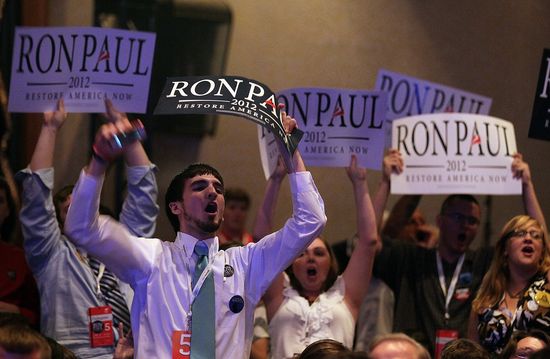
(Photo: Supporters of Republican presidential candidate U.S. Rep. Ron Paul cheer as he speaks during the 2011 Republican Leadership Conference on June 17, 2011 in New Orleans, Louisiana. By Justin Sullivan/Getty Images. )

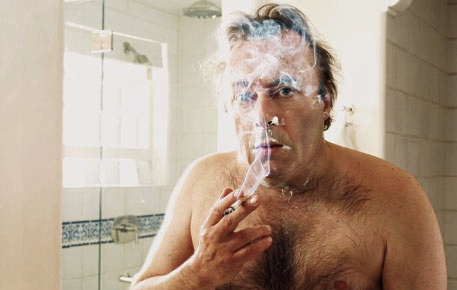
Hitch RIP

4661507396_2771a58363

I could sense it coming. But I couldn't write anything beforehand and I cannot write anything worthy of him now. So I just sat down an hour ago when I heard the news – Aaron told me as he clicked on Gawker – and sat a while and got up to write and then blubbered a bit and, staring at the screen, read through some emails from him.

I'd asked him last year to write a letter to the Immigration Services sponsoring me to finally become a permanent resident of the United States. Who better than my fellow Englishman immigrant of the last twenty-five years? A while later, he emailed:

Safely in the US mail. I managed to say that your faith had allowed you to extend a warm hand to so many of your fellow men, and then remolded that bit to make it sound a touch less close to the heart's desire.    

Brunch? Sunday? Smooch Hitch

I responded,

lol. many many many thanks. an honor. brunch sounds great. we tend not to be conscious till around noon, tho. xx a 

He replied:

Dearest Andrew I always think of Sunday lunch as beginning at about 2.30 ("a lavish and ruminative feast", as Waugh says about elevenses). Want to come here?

Yes, I do, Hitch. Yes, I do.

Ron Paul For The GOP Nomination

121093014

[Re-posted from earlier today.]

The Dish goes through the process of endorsing candidates in a primary season, not because I'm under any illusions that my endorsement counts. It probably hurts an insignificant amount, if anything. I try to make a decision – because it's easy to pontificate, debate, counter and riff off the various eddies in the campaign, but in the end, it comes to a choice for all voters in the booth. Why should a blogger avoid that responsibility? And I should be clear. This endorsement is mine and mine alone.

For a long time, I thought Huntsman would be my ideal candidate. And indeed, his tax reform proposals – modeled on Bowles-Simpson – are dead-on. Removing every single deduction in one heave would do more to empower market-based decisions in the economy and to throw lobbyists out of work than any other single measure. It's the most important, simple, productive move we can make right now and Obama has been a coward and a fool for not embracing it. Alas, the rates Huntsman favors are, to my mind, far too low, given the desperate need for revenues, if we are to tackle the debt seriously. But we are not electing a dictator. We are electing one branch of three that govern us. Huntsman is not the kind of Republican who couldn't compromise with Democrats. The Grand Bargain may become possible again.

On foreign policy, Huntsman also favors a more realist correction to neocon excess, and would build on Obama's remarkable successes, without invoking some of Obama's more worrying bleeding heart tendencies. His longstanding ties to America's most important global partner, China, make him uniquely qualified to take that relationship to a new level. Unlike Romney, he is not for starting a trade war. And his sanity on climate change – certainty that it is man-made but real skepticism about how to tackle it – is, in my view, the conservative position. And, almost alone among the Republicans, he acknowledges that gay people exist and that our committed relationships merit recognition in the law.

So why not Huntsman? The sad truth is: he simply hasn't connected with the voters, generates little enthusiasm, and has run a mediocre campaign. He started timidly, and failed from the get-go to make a clear distinction between him and Romney. He isn't even campaigning in Iowa; and remains behind in New Hampshire. Nationally, he is at a sad 3.2 percent, a number that has barely budged since the summer. For all intents and purposes, he is a one-state candidate. I welcome his participation but view it as a marker for 2016, if the GOP crashes and burns next year, as they well might with Newt Romney. With such a defeat (and one would hope it is decisive), there will be an opportunity to rebuild a reality-based conservatism. And Huntsman may well be the man to lead it. I sure hope so.

Which brings me to Ron Paul. Let me immediately say I do not support many of his nuttier policy proposals. I am not a doctrinaire libertarian. Paul's campaign for greater oversight of the Fed is 135306910great, but abolition of it is utopian and dangerous. A veto of anything but an immediately balanced budget would tip the US and the world into a serious downturn (a process to get there in one or two terms makes much more sense). Cutting taxes as he wants to is also fiscally irresponsible without spending cuts first. He adds deductions to the tax code rather than abolish them. His energy policy would intensify our reliance on carbon, not decrease it. He has no policy for the uninsured. There are times when he is rightly described as a crank. He has had associations in the past that are creepy when not downright ugly.

But all this is why a conservative like me is for Obama. What we are talking about here is who to support in a primary dominated by extremes, resentment, absence of ideas and Obama-hatred.

And I see in Paul none of the resentment that burns in Gingrich or the fakeness that defines Romney or the fascistic strains in Perry's buffoonery. He has yet to show the Obama-derangement of his peers, even though he differs with him. He has now gone through two primary elections without compromising an inch of his character or his philosophy. This kind of rigidity has its flaws, but, in the context of the Newt Romney blur, it is refreshing. He would never take $1.8 million from Freddie Mac. He would never disown Reagan, as Romney once did. He would never speak of lynching Bernanke, as Perry threatened. When he answers a question, you can see that he is genuinely listening to it and responding – rather than searching, Bachmann-like, for the one-liner to rouse the base. He is, in other words, a decent fellow, and that's an adjective I don't use lightly. We need more decency among Republicans.

And on some core issues, he is right. He is right that spending – especially on entitlements and defense – is way out of control. Unlike his peers, he had the balls to say so when Bush and Cheney were wrecking the country's finances, and rendering us close to helpless when the Great Recession came bearing down. Alas, he lacks the kind of skills at compromise, moderation and restraint that once defined conservatism and now seems entirely reserved for liberals. But who else in this field would? Romney would have to prove his base cred for his entire presidency. Gingrich is a radical utopian and supremely nasty fantasist.

I don't believe Romney or Gingrich would cut entitlements as drastically as Paul. But most important, I don't believe that any of the other candidates, except perhaps Huntsman, would cut the military-industrial complex as deeply as it needs to be cut. What Paul understands – and it's why he has so much young support – is that the world has changed. Seeking global hegemony in a world of growing regional powers among developing nations is a fool's game, destined to provoke as much backlash as lash, and financially disastrous as every failed empire in history has shown.

We do not need tens of thousands of troops in Europe. We do not need to prevent China's rise, but to accommodate it as prudently as possible. We do need to get out of the Middle East to the maximum extent and return our relationship with Israel to one between individual nations, with different interests and common ideals, not some divine compact between two Zions. We do need a lighter, more focused, more lethal war against Jihadism – but this cannot ever again mean occupying countries we do not understand and cannot control. I suspect every other Republican would launch a war against Iran. Paul wouldn't. That alone makes a vote for him worthwhile.

Breaking the grip of neoconservative belligerence on conservative thought and the Republican party could make space again for more reasoned and seasoned managers of foreign policy. Embracing the diversity of a multi-cultural, multi-faith America is incompatible with Christianism and the ugly anti-illegal immigrant fervor among the Republican base. But it is perfectly compatible with a modest, humble libertarianism that allows a society to find its own way, without constant meddling 133051306and intervention in people's lives. Just as vitally, no other Republican (or Democrat) would end the war on drugs, one of the most counter-productive, authoritarian campaigns against individual liberty this country has known since Prohibition.
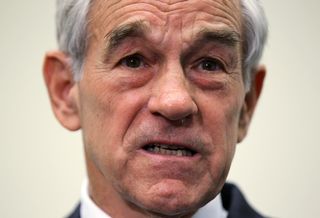
He could also begin to unwind the imperial presidency. We would no longer go to war without a full Congressional vote and approval. Torture would not return under Paul, making it more likely that we can contain that virus to the criminal regime of Cheney and Bush. Politics would be marked more by what wasn't done, rather than what was – a truly conservative move and in stark contrast with the man who really would have made a good Marxist, Newt Gingrich.

The constant refrain on Fox News that this man has "zero chance" of being the nominee is a propagandistic lie. Nationally, Paul is third in the polls at 9.7 percent. In Iowa, he may win. In New Hampshire, it is Paul, not Gingrich, who is rising this week as Romney drifts down. He's at 19 percent, compared with Gingrich's 24. He is the third option for the GOP. And I believe an Obama-Paul campaign would do us all a service. We would have a principled advocate for a radically reduced role for government, and a principled advocate for a more activist role. If Republicans want a real debate about government and its role, they have no better spokesman. He is the intellectual of the field, not Gingrich.

I am, like many others these days, politically homeless. A moderate, restrained limited government conservatism that seeks to amend, not to revolt, to reform, not to revolutionize, is unavailable. I'm a Tory who has come to see universal healthcare as a moral necessity that requires some minimal government support, who wants government support for a flailing recovery now, but serious austerity once we recover. I favor massive private and public investment in non-carbon energy, because I am a conservative who does not believe our materialism trumps the need for conserving our divine inheritance. I back marriage equality and marijuana legalization as Burkean adjustments to a changing society. I see a role for government where Paul doesn't.

But Paul's libertarianism may be the next best thing available in the GOP. It would ensure real pressure to make real cuts in entitlements and defense; it would extricate America from the religious wars of the Middle East, where we do not belong. It would challenge the statist, liberal and progressive delusion that for every problem there is a solution, let alone a solution devised by government. As part of offering the world a decent, tolerant conservatism, these instincts are welcome. As an antidote – and a very strong one – to the fiscal recklessness and lawless belligerence of Bush-Cheney, it is hard to beat. The Tea Party, for all their flaws, are right about spending and the crony capitalism it foments. So is Paul.

I regard this primary campaign as the beginning of a process to save conservatism from itself. In this difficult endeavor, Paul has kept his cool, his good will, his charm, his honesty and his passion. His scorn is for ideas, not people, but he knows how to play legitimate political hardball. Look at his ads – the best of the season so far. His worldview is too extreme for my tastes, but it is more honestly achieved than most of his competitors, and joined to a temperament that has worn well as time has gone by.

I feel the same way about him on the right in 2012 as I did about Obama in 2008. Both were regarded as having zero chance of being elected. And around now, people decided: Why not? And a movement was born. He is the "Change You Can Believe In" on the right. If you are an Independent and can vote in a GOP primary, vote Paul. If you are a Republican concerned about the degeneracy of the GOP, vote Paul. If you are a citizen who wants more decency and honesty in our politics, vote Paul. If you want someone in the White House who has spent decades in Washington and never been corrupted, vote Paul.

Oh, and fuck you, Roger Ailes.

(Photos: Tom Williams/Roll Call; Alex Wong, Kevork Djansezian/Getty.)

The Evangelicals’ Catholic

Newt is many things, but his hostility to secularism is one of the more recent and impassioned of his convictions. And it's this drive to found the United States on explicitly religious grounds that has won him the support of so many Christianists. The checkered marital past is not as important as Gingrich's new faith, and his new faith is less important than his defense of "Judeo-Christianity" in both America and around the world. There's been some internal debate among evangelicals over whether to forgive Newt his past – and the consensus seems to be yes. Note why:

On the same e-mail chain, which CNN obtained from a conservative activist, prominent Atlanta preacher Richard Lee said the nation’s evangelicals needed to support Gingrich. Lee called Gingrich “the only forceful Christian candidate who can at this point be elected and cleanse the White House next November.”

Don't you love that word "cleanse"? The current president is a devoted family man, devoid of any personal scandal, and a committed Christian, as his speeches and books testify to. And this must be "cleansed"? The reason is that Obama represents a more liberal and live-and-let-live version of Christianity, and believes in the separation of church and state. That's what needs to be cleansed (assuming we are not talking bald-faced racism here).

What Newt represents is the tip of the spear of the Christianist attempt to wipe separation of church and state out of the constitution. And in this struggle, the denominational differences do not count as much as the secular enemy. Gingrich is also not an old-style Catholic – in the Kennedy or Cuomo or Biden manner. He is an ideological Benedict XVI Catholic, bent on public and political Christianity as a means of saving what's left of civilization after the great Electro-Magnetic Pulse.

The main danger here is not, to my mind, domestic. The real danger is what Gingrich would do in the wider world. With Bolton as his secretary of state, gripped of the conviction that we should launch two more pre-emptive wars against North Korea and Iran, paranoid of existential threats to an extent that would out-Cheney Cheney, determined to fuse America's foreign policy with Israel's in a religious war between Judeo-Christian fundamentalists and Jihadists … it would be hard to come up with a more alarming prospect than Newt with a capacity to wage war, under the unilateral parameters set up by George W. Bush and tragically reasserted and legitimized by Obama in Libya. There is not a global conflict Gingrich would not further inflame; not a diplomatic relationship he wouldn't occasionally blow up (apart from Israel, which would effectively be seen as indistinguishable from the United States itself).

Every day, it seems, the tectonic plates of our world shift. And what I see in Gingrich is the relentless rise of fundamentalism as the overwhelming threat to liberal democracy and world peace.