Live-Blogging The ABC News Debate

10.54 pm. Tapper is playing up the $10,000 Romney bet – and I suspect he’s right to. It leapt out at me, along with the “Newt Romney” line from Bachmann. Other than that, Newt wins; Romney loses; Paul rises. Have yourself a shot. I sure will.

10.50 pm. So this is the end? Or not the end? Does Sawyer get to talk some more? That last round was congenial, like a group hug on American Idol. I think both Gingrich and Paul emerged the strongest frm this debate, while Romney failed to do or say anything to change the dynamic of his listless campaign. So … Gingrich could well win Iowa. I don’t see the trajectory changing any tonight.

10.48 pm. Newt: “If we do survive …” Wow. Does Gingrich really believe that the US faces an existential threat from Iran? Or is he running for the Likud party?

10.43 pm. Politifact has judged Newt Gingrich’s statement that he has never supported cap and trade as a lie. Meanwhile, I loved this tweet:

Sometimes I think Rick Perry gets halfway through an answer and sees a Frisbee.

10.38 pm. A reader writes:

What it must feel like to be a lifelong Republican at this point? My girlfriend’s grandma is watching, and you know what she keeps saying? “You go, Newt! Tell the truth! Someone needs to!” with the utmost excitement.

Another writes:

I’ve been laid off since 2009, but luckily my wife is gainfully employed as a university librarian. We have 2 kids and have had to scrape by, figuring out how to feed them the last week of each month. It’s clear to me, more than ever, these candidates are very out of touch with the economic pain put here. They haven’t had to feel any pain or sacrifice.

And, we’re the lucky ones. We have a house. These clowns have no idea what it’s like to feel the white-hot shame of selling family heirlooms or borrowing from friends. I have no real representation, and don’t really see it coming.

10.34 pm. Sawyer tells us she has a cold and what she did today. Ron Paul runs with it. A great digression that will send a thrill up the libertarian leg – and firm up his support among the young, where the oldest candidate is strongest. Perry seems looser and more relaxed, if just as clueless.

10.31 pm. Back to healthcare mandates, and Newt Romney’s longtime support for them. Romney does okay, but his position is still excruciating. Newt ducks, then we get a classic: we need to “fundamentally re-think the entire health system.”

10.23 pm. Which of these candidates are struggling in the recession? Seriously? Perry scores with a truthful account of his modest upbringing. Romney tackles a no-win question rather well. Ron Paul charms as usual, at least he does me. Then we get another Fed riff.

10.21 pm. A reader writes:

Maybe it’s just that I’m waxing sentimental because I made my drinking game every time Sawyer speaks (and she won’t shut up so I’m about 5 minutes from a crying jag. I kid I kid.) but can you imagine what it must feel like to be a Republican – a seriously life long and earnest Republican – right now? Watching this.

This is it. That is it. That’s all that showed up.

Merry Christmas GOP.

10.17 pm. This has so far been a feisty debate and I’m pretty sure Diane Sawyer is hoping for a lift in Iowa. I mean she is running, isn’t she? It feels like she’s spoken more than most of the candidates.

10.13 pm. Santorum backs Romney: truth with “prudence.” Then he says we didn’t have allies against the Soviet Union! Then Santorum says that the entire West Bank is Israeli. Perry now accuses the president of treason, and responsible for all the woes in the Middle East. The crowd roars. Yes, the one abiding, unifying passion: contempt for the president.

10.05 pm. Ron Paul sums Gingrich up: “stirring up trouble.” Gingrich doubles down with the full AIPAC, and seems utterly indifferent to diplomacy. Stephanopoulos doesn’t note how Gingrich’s one-state solution differs from every single administration since 1967. But his total identification with Israel against Palestinians will work very well with the Christianists – even if it wrecks US diplomacy. Romney presses Gingrich on being a bomb-thrower. Newt invokes Reagan’s Evil Empire. This is a win for Gingrich. But it reminds us how terrifying it would be to have Gingrich with his finger on the button.

10.04 pm. Nothing interesting on immigration, despite Sawyer’s endless blather.

10.01 pm. Sawyer is making Charlie Rose seem brusque.

9.57 pm. Newt, for a change, doesn’t get pissy, and just all but pleads forgiveness. Now Sawyer is droning on and on again, the verbal diarrhea now piling up and up. She’s still talking? That was a 3 minute question.

9.55 pm. Josh Romney has those dilated Puss In Boots eyes as he looks at his dad.

9.53 pm. Ron Paul says character doesn’t have to be talked about. It should show through anybody’s life. I love the guy. Then he pivots to the salient oath: the oath of office. A great little Ron Paul riff.

9.51 pm. Perry says he made a vow to God when he married. He’s up-Godding Newt. It’s really on now. Perry: “If you would cheat on your wife, why wouldn’t you cheat on anybody else?” Ouch. Santorum says “trust is everything” and doesn’t have to look at Newt Romney.

9.49 pm. Some reader notes. One writes:

Since when did Mormons become cool with gambling?

Another:

Rick Santorum: “I believe in bottom up.” Quoted without comment.

Another:

Is Diane Sawyer high?

9.46 pm. So far, I’m surprised by Gingrich’s aggression – being the front-runner seems to make him less restrained; by Bachmann’s very smart “Newt Romney” line; by Newt’s ad hominem about Romney’s career out of public office; and Romney offering a $10,000 bet over a small debating point. Now we’re getting instant replays!

9.45 pm. Can someone tell Sawyer we are not in the slightest bit interested in her pointless, droning blather?

9.41 pm. Newt Romney just slapped Bachmann down rather hilariously, if ineffectively. The dynamic is Santorum, Bachmann and Perry versus Newt Romney. And Ron Paul is, well, Ron Paul.

9.39 pm. Romney offers a $10,000 bet to Perry. I wonder how many voters in Iowa have a spare $10,000 to settle an argument. That from a man who only has $100 bills in his pocket. That was a big booboo.

9.38 pm. Newt rightly reminds us that Obama’s healthcare proposal is considerably to the right of Clintoncare in the 1990s.

9.35 pm. Romney intends to go after Obama for cutting Medicare. Yep: the GOP is complaining at the tiniest cut in Medicare from Obama, but favors the Ryan plan. Perry and Bachmann focus on the individual mandate.

9.32 pm. Gingrich gets a little pissy once Bachmann exposes his long-held support for an individual mandate. And Bachmann comes back against “Newt Romney” again. From her position in the polls, this is exactly the right tactic. A litle desperate. But effective.

9.31 pm. Bachmann targets Newt-Romney as one liberal blob. Very effective riff, I’d say. The best parry I’ve ever heard from her.

9.27 pm. Ron Paul plays the Freddie Mac card hard against Gingrich. Accuses Newt of indirectly taking tax payer’s money! Gingrich now says he offered “strategic advice” to Freddie Mac. He’s no longer a “historian”. Bachmann calls Newt a K Street insider. He sure is.

9.24 pm. Newt kills off Mitt with one swipe: telling him that the only reason he hasn’t been a career politician is because he lost to Ted Kennedy.  Maybe he’s been reading the Dish. Gingrich goes after Romney with the passion and energy of an underdog, not a front-runner. He’s on fire. I think the dig about Newt’s trip to the moon probably set him off.

9.21 pm. Ron Paul contrasts the cost of the Baghdad embassy with the payroll tax cut. Then Romney accuses Barack Obama of wanting to kill off the opportunity society – and almost has a Perry moment when asked to say where he differed with Newt Gingrich.

9.19 pm. Bad Romney joke. Same Romney blah.

9.17 pm. Bachmann opposes the payroll tax cut in the first place and its extension now, as well.

9.16 pm. Sorry to keep hammering on this, but why does Diane Sawyer talk so much and treat us and the candidates as if we were eight years old?

9.07 pm. Gingrich argues for more tax cutting and not regulating the private sector as his distinctive policy for cutting unemployment. Surprise! What will they shock us with next? Mitt has seven – count them, seven – ways. I have forgotten them already. Ron Paul argues for shock therapy: cutting $1 trillion in a year. We’ve heard all this before. Their prescriptions are the same ones we had under George W Bush for eight years. Sawyer is deeply irritating; is there something abou network news that turns people into pious condescenders and pablum peddlers? Bachmann’s spiel is pretty close to her Bad Lip Reading special. Santorum argues for a manufacturing industrial policy. As to the regulations argument, go read David Brooks.

9.05 pm. When will Diane Sawyer shut up?

9.02 pm. Another reality show intro. But some things don’t change: it’s snowing in Iowa.

(Photo: Kevork Djansezian/Getty Images)

Cameron’s Inevitable “Veto”

135278383

Anglophobia is on the march in Europe today after Britain "vetoed" a full EU treaty change that would require all member states to submit their budgets to Brussels for approval. I don't quite understand the fuss. Britain is mercifully not in the euro – thanks to Thatcher, Major and Brown. Why would Britain give up basic sovereignty for a safer future for a currency it doesn't share – especially when the new treaty would also hobble London's financial sector? In any case, a deal that is not a full-scale treaty change will be easier to implement quickly. So the Frogs and the Germans get their "solution", forge ahead more speedily on the Titanic, and start to create a new EU centered on Paris-Berlin and maybe Warsaw. Good luck to them. They're going to need a lot of it.

It's also worth noting that Cameron is still prime minister of an actual democracy. A big majority of the voting public back him in his refusal to join in. His own party would have split in two if he had caved to Merkozy. And his Coalition partners, the Liberal Democrats, have said that Cameron's requested exemptions on the financial sector were modest and reasonable. Sarko has used the crisis to bolster his own cred at home with the usual perfidious Albion crap. He's desperate to get re-elected.

And the result, anyway, is deeply underwhelming. The austerity pact, some gamely hope, is the precondition for the ECB to print money to keep the whole enterprise afloat in the short and medium term. But the ECB seems adamant that this won't happen. So what we've got is a plan for serious austerity, enforced by Brussels and destined to pummel the economies of the peripheral countries even further. So forget the British veto, the real threat to the EU is that, at some point, the peripheral countries risk becoming less autonomous within the EU than the individual states are within the US, during what could become the worst depression since the 1930s. If you don't see future strife built into that formula, you are a more optimistic reader of history than I am.

We already have Germans dictating government fiscal policy in Athens and, to a lesser extent, Italy. Neither country has a democratically elected government. And so we see that Europe risks degenerating into a Franco-German bully zone, and in an era where democracy is resurgent in the Middle East, it is retreating in Europe. Does anyone think this is feasible in the long run? That the publics in countries whose economies are being effectively run by Berlin won't buckle at some point – especially if the core problem of an imminent new depression remains likely.

My sense is that if the continent's incipient depression deepens under German command, resistance among the publics of Italy, Greece, Spain and others could create echoes of the very World War the EU was designed to swipe from the collective memory banks.

It would not be the first time that a well-meant utopian project collapsed under its own unreasonable assumptions, and actually worsened the problem it was designed to solve. But for the European Union to promote European dissolution and dictatorship is one for the ages.

(Photo: Carl Court/AFP/Getty.)

Live-Blogging The Huckabee Forum

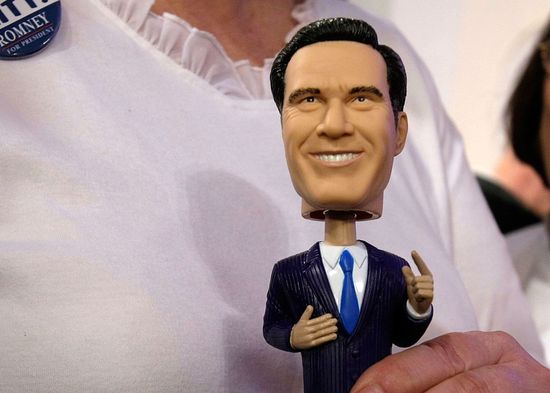
BOBBLEMITTAlexWong:Getty

9.59 pm. Bottom line: creepy ideological litmus test grilling. Huntsman was very smart not to fall for this. Gingrich knew his elderly audience very well – from starting with George Washington and ending with the Alinskyite that is deliberately destroying Washington's achievement. It's deranged, of course. But it may work – to Newt's advantage at first and then surely to Obama's.

9.55 pm. Santorum focuses mainly on America as a moral enterprise and "we are sick from the inside." He cites abortion and marriage under attack. He will not surrender.

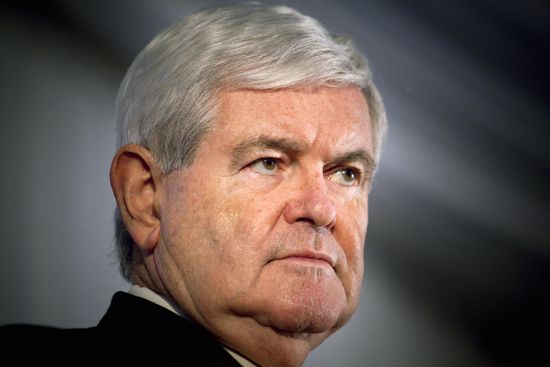
9.53 pm. Gingrich focuses entirely on Obama hatred. He focuses on Obama for eight years as a disaster and then tries to soften himself by asking people not to support him but to be with him. He knocked Romney out of the park. Because he has such an intimate, effortless grasp of what turns the base voter on. They will be roused by one thing: hatred of this president, and the marshalling of any evidence of any problems in America as a way to defeat him.

9.52 pm. Ron Paul pitches states' rights as his final message – and reinstating nullification.

9.51 pm. Rick Perry rambles on about forcing the US Congress to be part-time, and then claims he has a purpose-driven life.

9.50 pm. Romney says that America is at risk of being a country governed by the government. Not exactly red meat to cite David Brooks in his first sentence.

9.47 pm. What Wiki says is in Bastiat's La Loi, Ron Paul's favorite book:

In The Law, Bastiat states that "each of us has a natural right — from God — to defend his person, his liberty, and his property". The State is a "substitution of a common force for individual forces" to defend this right. The law becomes perverted when it punishes one's right to self-defense in favor of another's acquired right to plunder.

Bastiat defines two forms of plunder: "stupid greed and false philanthropy". Stupid greed is "protective tariffs, subsidies, guaranteed profits" and false philanthropy is "guaranteed jobs, relief and welfare schemes, public education, progressive taxation, free credit, and public works". Monopolism and Socialism are legalized plunder which Bastiat emphasizes is legal but not legitimate.

9.44 pm. No, he would not get rid of all federal labor laws! A dangerous wobble, as Cuccinelli frowns. I don't think he helped himself with this performance; while Newt did fine. Which means that Romney's slow fade and Gingrich's sudden rise seem fated to continue for a bit. If anyone is watching this.

9.43 pm. Yes, he is orange. Like Gore in that infamous second debate with Bush.

9.39 pm. Romney defends a federal role in education as a way to counter federal teachers' unions. Unlike all the others, he stands by No Child Left Behind. He's coming off more liberal than the others – which may be a liability in this context. Then he clumsily ducks the question over a federal role over school lunches.

9.36 pm. Romney says he looks forward to being challenged by Obama on the similarities between his healthcare proposal and Obamacare. Coming after Paul, you suddenly get a blast of complete phoniness.

9.33 pm. It's Stepford Man! First up, he cites the EPA as a means to crush the free enterprise system! I mean" seriously. He's claiming that Obama officials are gathered behind closed doors to plotting how to destroy the private sector economy! It's not just that this is an unfortunate by-product of environmental regulation; it is designed to destroy the private sector.

133051307

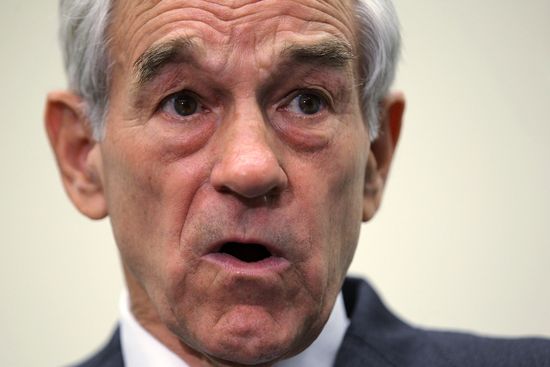
9.30 pm. Ron Paul, asked to name a book Americans should read, cites "The Law" by Frederic Bastiat. Wow. He's different from the others because he rally does seem like a human being, thinking in real time sincerely, offering answers that no focus group would ever provide or even know about. I remain a big fan. And he has done more to improve the GOP's foreign policy and civil liberties debate than anyone else on the planet.

9.28 pm. Ron Paul cites Prohibition as the worst constitutional amendment. Great call.

9.25 pm. How to get rid of Medicare? And the Federal Reserve, of course – with transitional programs. Yes, there's a reason he cannot get off the ground. And then he wants a one-year spending cut of $1 trillion, which would effectively initiate a global depression. Sigh.

9.23 pm. A reader writes:

So, Perry seems to want term limits for justices, assuming we do not abolish the judicial branch altogether, plus tons of amendments to the Constitution, but he does not want the Constitution changed?  Am I that drunk already?

I wish I were. But I always enjoy me some Ron Paul.

9.20 pm. Ron Paul insists again that the US's meddling in the Middle East is the root cause of 9/11. I simply don't understand how abolishing the EPA and soft enforcement of environmental laws will not lead to dirtier water and dirtier air. And it is a fact that the Republican proposals on healthcare do leave millions of Americans uninsured, compared with Obamacare. That's not an outrageous statement. It's just a fact. If you want everyone to have access to affordable healthcare, the GOP has nothing for you.

9.18 pm. Terrorism is a crime! Finally we come to life. You can imagine how much this dooms him with a large section of the authoritarian Christianist base. And yet he seems neither defensive nor rattled … just sincere.

9.16 pm. Ron Paul favors the federal government enforcing the Bill of Rights. And he basically argues that the Patriot Act was an effective repeal of the Fourth Amendment.

9.15 pm. Good call, governor Huntsman. This is really grueling. But Ron Paul is up! Yay!

9.12 pm. It's fascinating that these Republicans vie with each other to prove their federalist credentials and yet all agree that on matters they really care about – abortion an marriage – there should be one federal answer for the entire country enforced through a constitutional amendment.

9.11 pm. Bachmann goes for the Kelo decision as the worst in the past fifty years. Good call. At least she knew of one.

9.07 pm. Abolishing the Department of Education will not be enough! Getting rid of the Bush legacy and the Race To The Top are somehow integral to educational reform. Bachmann is arguing that we can do without the EPA, even when states' environmental policies conflict. But she's completely dumbstruck by the consequences of abolishing the EPA. She clearly hasn't thought this through for more than a couple of minutes.

9.04 pm. I'm struck by the anal retentive constitutionalism of the questioners, and their insistence on vetting each of the candidates on these Tenth Amendment issues alone. Maybe that's what the base is interested in. But it's going to sound rather abstruse to others. Ron Paul has indeed made an impact – before he has even appeared.

9.02 pm. Bachmann! I'm getting a little blurry but I think we have an argument that Obamacare includes – gasp – available contraception; and that the country should spend over $130 billion to round up illegal immigrants and send them home.

133333422

8.54 pm. Perry explains that the Constitution's meaning is self-evident. There is no need for any interpretation. Just like the Bible. Then a goofy, adolescent gesture with his lapel mic. Next!

8.51 pm. Another Constitutional Amendment – to ensure that liberal judges can be thrown out and the federal judiciary is even more thoroughly politicized.

8.48 pm. More grilling on the Tenth Amendment. Now it's education – and Perry backs ending federal support for school meals or the GI bill. He'd also abolish the Department of Education.

8.43 pm. Perry actually does a pretty god job in defending states' rights. The consensus here seems to be that the federal government really shouldn't exist in large swathes of its current authority.

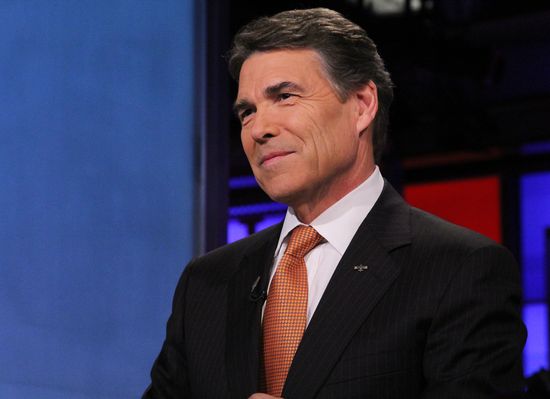
8.39 pm. Now we've got Perry. He looks better sitting down and the hair is perfectly dyed. But he still cannot answer how he, as the executive, can render a Congressional law null and void. He can't. Cuccinelli points out just how implausible this week.

8.36 pm. It's a little odd that Huckabee himself is doing nothing in this forum. He asks no questions at all, presumably because it would put him in the position of being a partisan, depending on the nature and force of his questions. And so we have this kind of Star Chamber format, in which the most hardcore Christianists and anti-government fanatics grill candidates on their political correctness. Which means the Romney section is going to be fun.

8.34 pm. A lie: Obama is enforcing DOMA; he is just not defending the law in court. Which Santorum is fine with. If the courts find DOMA unconstitutional, he'd come up with another version. He asserts that the judiciary is not the final arbiter of the Constitution.

8.31 pm. Now we have a question the premise of which it is outrageous for the federal government to enforce environmental laws and protection. Jeez. Santorum pledges not to enforce regulations when environmental laws are not automatically re-authorized. It's been a while since I saw a political party so brazenly hostile to environmental protection.

8.29 pm. Santorum backs a federal constitutional amendment to ban marriage. He wants the Constitution to be a guide to moral principles: hence his support to amend it to ban marriage equality and all abortion.

8.27 pm. Santorum is whiffing on how to encourage the family through the politics. His welfare point seems dated to me, after welfare reform. Then we just get blather about "promoting marriage". No laws, just preaching about marriage and fidelity. 

8.25 pm. We were not apparently dealing with terrorism before 9/11, according to Santorum. Really? Santorum criticized the suspension of habeas corpus under Lincoln but not under George W. Bush.

134709308

8.20 pm. Another attempt to understand his ad with Pelosi. He seems to be saying that it was a mistake because Pelosi's radioactivity obscured his conservative environmental argument. Then a daring, provocative embrace of George Washington.

8.18 pm. It's anti-American to back separation of church and state in public high schools. Anti-American. Why can't the Republican party move past its McCarthyite instincts?

8.16 pm. Ok. A shot every time we hear the words "Washington bureaucrat". This is getting like a Politburo meeting in which various party members are required to prove their adherence to the party platform.

8.09 pm. The far right anti-gay Virginia AG Cuccinelli finally puts the boot in. Newt on healthcare says he backed the individual mandate to prevent Hillarycare. Huh? And he still has no defense of his embrace of Nancy Pelosi on climate change. Against all these sane heresies, Gingrich puts out there his conservative credentials.

Now Cuccinelli wants to know how Gingrich will be able to enforce hard right ideological purity in his administration. Gingrich blathers.

8.05 pm. Now we're getting a propaganda message from three hardline Republicans. I love the fact that these people are now guardians of the Constitution. None of them said a word during the Bush administration's truly radical expansion of executive power, including the suspension of habeas corpus and the insitution of torture, even against US citizens on American soil.

8.03 pm. Oh shit. This is going to be two hours and no one is allowed even to mention other candidates. The hardball questioners include Republican state attorneys general. No journalists allowed. In fact, is this the first ever presidential debate in which not a single journalist is present? It's kind of a seminal moment in the cooptation of the GOP by FNC.

The Mark Of Cain

What legacy does this motivational speaker and former restaurant lobbyist leave in the GOP? At one level, it is great that a conservative black man made it so far in the Republican race – and did so on the basis of one compelling idea: tax simplification. Those two things – along with his surreally great ads – make his candidacy worthwhile, even as performance art.

But, sadly, one feels that his race helped primarily because it could be a contrast with Obama (Cain was really black and a businessman to boot), and rebut allegations of racism in the GOP. So, although Cain for the most part refrained from playing the race card, race was at the center of a campaign that appealed primarily to older white people.

He was also emblematic of contemporary conservatism’s degeneracy into an extension of an entertainment franchise. Whatever else can be said of Cain, he sure was entertaining. That’s how he makes a living, and, increasingly, it’s how most national Republicans make a living. That’s the Ailes effect – and one can sense how FNC now wants Gingrich, if only for the ratings, and endless drama. Palin was about ratings too, according to Ailes himself.

Nonetheless, Cain’s character eventually came out: megalomaniacal, cocooned, a creature of that place where corporate lobbying meets politics, and your life is lived in hotel rooms, radio stations and convention centers. I see no reason to disbelieve the many women who claim he harassed and in one case assaulted them; nor do I disbelieve Ms White about her long affair with Cain. And what was truly gob-smacking is that he never owned these incidents and was capable of and fully prepared to offer the Full Metal Denial. I don’t trust a man who can lie that brazenly. A reader notes:

Watching Herman Cain’s address on C-Span, my lawyer senses tingled when I heard him refer to the “false and unproved” allegations against him. He used the same construction several times. Phrased that way, Cain could later claim that he was distinguishing between allegations that were “false” and those merely “unproved” – should evidence emerge that would make such a distinction necessary.

Another notes:

His wife, Gloria, stood up there with the grinning philanderer and political stunt-artist as he invoked everything from family, to God, to Pokemon. As a woman, I can’t tell you how unbelievably depressing I find that.

Newt’s Appeal

A reader writes:

I spent Thanksgiving with my family of formerly-sensible moderates and conservatives. Every one of them has morphed into a Gingrich fan. As much as the commentariat likes to talk about electability, the just-regular-folks I spent the holidays with talked only about how Newt would "hammer" the President during debates. "Can you imagine," my sister said, her eyes as lit-up as a child's on Christmas morning. "When Obama starts that smartest-guy-in-the-room shit, Newt'll shut him up." No one talked about policy or even politics. This is a mob storming the Bastille, cheering the guillotine, and Gingrich is their most likely Robespierre.

Is that feeling widespread enough to get a loon like Gingrich elected? I hope not, and don't think so. But it's enough to get him nominated, and anyone who doubts that needs to get out more. There's a big slice of the electorate that has lost all perspective. The only thing they're interested in is the visceral joy of watching someone destroy and humiliate "that damned Obama." They're convinced that Gingrich is just the guy to administer the rough justice they crave, and whether he's electable or would even be good for the country simply doesn't enter into their thinking.

Dear Ta-Nehisi

Dreher weighs in on the popular IQ and race thread:

Sullivan understands that just because the Nazis made bad use of this stuff doesn’t make it untrue, or unimportant. I get that. But I keep coming back to a point that seems to be the one TNC is making: of what use is this field of study, anyway? Where do we propose to go with it? Andrew’s view is that it’s worth knowing for the reason all truth is worth knowing, and pursuing. In an abstract world, that makes sense. But we don’t live in a world of pure disinterestedness. If I were a geneticist, I doubt I would want to work in this field, only because the experience of the 20th century, especially the Holocaust, makes me deeply mistrustful of what human beings will do with the scientific knowledge that this race is intellectually inferior to that race, and we can prove it genetically.

The only possible good I can see coming out of it is to knock down affirmative action programs as unjust — but you don’t need genetics to do that. The possible evils coming out of it? Legion.

TNC's final thoughts on the subject, which are difficult to excerpt and should be read in full, are here. They deserve a final response from me.

Let me first suggest he is conflating two separate issues. The question of whether the taboo against research on intelligence between racial groups has hampered research into intelligence in general does not rely on any position about the validity of the racial research. It's an empirical claim. My first stab was an over-reach. Sometimes that happens when you respond as a blogger to a story. But I've walked back that empirical claim (run, I might add, on a hyper-lefty site), and run several posts explaining why, and fail to see how that claim in particular is offensive. What is offensive to some is my refusal to assume that research into racial differences in IQ is inherently racist. Sorry, but I don't. I regard it as an empirical question, as I do for many human differences.

But Ta-Nehisi points to a deeper question and it is one I have wrestled with. How do I live with the knowledge that writing about such things as merely empirical matters, when they are freighted with profound historical evil, will deeply hurt many, and could help legitimize hateful abusers of information? What responsibility does a writer have for the consequences, good and bad, of good-faith pieces he writes? Is merely citing the massive amount of data showing clearly different racial distribution for IQ an offensive, cruel and racist provocation? Is raising this subject worth anything anyway?

This is not the only time I have encountered this moral problem as a writer. Was I wrong to take reparative therapy seriously as an argument and accord some respect to its claims as to the origin of homosexuality, as I did in Love Undetectable? Was I aggravating sexism by writing my essay on testosterone for the NYT Magazine? Am I encouraging anti-Semitism by writing what I think is the truth about the influence of the pro-Israel lobby in hobbling US interests in the Middle East? Did I encourage unsafe sex by writing "When Plagues End," in 1996, or undercut funding for AIDS research by revealing the breakthrough in treatment? Have I exacerbated the polarization I decry by calling those who approved or imposed "enhanced interrogation techniques" war criminals? Is "Christianist" too offensive a term even if it can be defended as a legitimate way to contrast it with live-and-let-live Christianity?

My core position is that a writer's core loyalty must be to the truth as best as he can discern it.

That's especially true in considered essays or books. On blogs, where sudden real time judgment can lead you to occasional overstatements or errors, it is important to ensure that corrections, adjustments or clarifications follow, and that dissent is open. (In publishing an extract from The Bell Curve in TNR, I also insisted in the same issue on publishing 19 separate dissents.) The point is the truth. I believe that part of the role of the public writer is not to self-censor for fear of social or cultural stigma. And that's one reason I took to the blogosphere before many others: because it was a place where I felt the limits on total freedom of speech were the least powerful. It was a place where taboos were weakest.

In my mind, I regard my work as a writer as existing in a different mode than my everyday living. I am writing not with respect to any individual but for the general public – which I envision stripped of its particular racial, gender, religious or whatever identities. If the truth hurts, so be it. In my role as a truth-seeker – and it is a role not my being – compassion and empathy are irrelevant.

Except they aren't.

The abstraction of the disinterested writer in pursuit of truth is an abstraction. And as a human being, I do not live in an abstract world. That I have wounded someone – like Ta-Nehisi – whom I revere as a writer and care about as a human being distresses me greatly. The friends I've lost from my recent Israel posts also grieve me. The friends I lost during the AIDS crisis – when I wrote things that violated the gay p.c. consensus – hurt me even more deeply. And to tell you the truth, I wonder whether my Christian faith is, in fact, compatible with the work I do. My compulsion to get to the bottom of highly contentious issues and my fixation on subjects where others smartly conclude the costs outweigh the gains ensure that I will continue to hurt people's feelings.

At one level, I wonder if this gift of freedom is not poisoned by my attraction to controversy rather than truth. I mean: questioning a woman's own pregnancy is an act of profound hurt. My defense in that case is that the person in question was a potential president and therefore merits more scrutiny than others. Nonetheless, it must have been deeply hurtful to Palin's family and herself even to raise the subject if there was nothing to it. In my conscience, I concluded that what drove me was my simple inability to believe the story on the surface, and that a possible president of the US who might have done such a thing was inconceivable. Similarly, I never believed that gender is entirely a social construction. Or that homosexual orientation is entirely genetic. My curiosity gets the better of me often.

I just know that it is hard for me to be a writer any other way. It seems to be in my nature – a querulous, insistent curiosity that sometimes relishes the hostility it often provokes. What I remain committed to is a constant re-evaluation of these arguments and complete openness to new data. But the hurt remains.

One justification is that the truth counts, and that even if we are able to ignore it for a while, it won't become less true. What I fear about liberal democracy is that if it rests itself on untrue notions of substantive human equality – both individually and in groups – it will one day fail. Covering up resilient inequality merely kicks this can down the road. And at the rate neuroscience is going, the empirical research – using far more powerful techniques than IQ testing – could up-end a lot of assumptions. Liberal democracy is better defended if it rests on formal civic moral equality, and not substantive, skills-based human equality. So, for example, it's a great argument for gay equality that homosexuality is 100 percent genetic. But I have never used that argument because the evidence isn't there for it. I think one should be careful about resting arguments on wobbly truth-claims.

One resolution to this conflict is to quit the public arena for areas of life where general truths are not so central; to find another way to make a living, and live it without the danger of hurting so many feelings. Throughout my life, I have considered doing this, for spiritual, moral and religious reasons. I fear there are too many times when I hurt more than heal, even though I don't intend to hurt. I fear that insisting on finding out reality at the expense of charity and empathy is not something a Christian should do lightly, if at all.

And so I ask TNC for forgiveness; not as a writer, where good faith and honesty alone matter; but as a friend and human being, where empathy counts.

The Exception Ends The Rule

Jose_padilla_goggles300

“Sovereign is he who controls the state of exception,” – Carl Schmitt.

"Dynamism, I believe, will some day be recognized as the most destructive and 'radical' revolution of modern times. It strikes at the root. Its modern rival, Marxism, retains at least the traditional respect for reason. The basis of the western world is the disciplining of life's energies and instincts by the supremacy of rational and ethical Law. Here our Christianity combines and conserves the legalistic heritage of the Jews and of the Greco-Roman Empire. In contrast, dynamism glories in the revolt of expansive Life-force against Law's 'dead shackles.' Transferred from individual to nation, such dynamism becomes lynch law: the 'healthy' and natural mob instincts of what Nazis call 'the Volk' and Reds call 'the masses,'" – Peter Viereck.

"What’s wrong with indefinite detention is not a matter of the logistics of national security or military resources. What’s wrong with indefinite detention is that it is an eradication of a fundamental right upon which American democracy has stood from its founding days — namely, the right not to be incarcerated without evidence, the right not to be summarily "disappeared" on the say-so of one person or agency, the right not to be denied justice.

If the President himself is not willing to embrace as sacred the right to due process for Americans, if he is not willing to risk everything to protect that fundamental constitutional guarantee, if he really believes you can compromise on this basic value, then why should we be surprised that the nation itself is floundering?" – Karen Greenberg, New York Daily News.

The president has mercifully agreed to veto the bill that would allow the US military to seize and detain without any due process anyone, including American citizens, who are suspected of terrorism, even in the US itself. A future Republican president might throw torture in with this toxic brew.

The veto is a relief. But the US Senate has thrown its weight behind gutting the core, most basic freedom upon which all others follow: habeas corpus. It has endorsed the notion that the government can do whatever it likes to any citizen it merely suspects of being involved of terrorism. It is a hole through which the entire framework of the constitution could disappear. One more terror attack, and we would have authorized soldiers to break into citizens' homes at will, round up any citizens the government deems suspicious, and deny them any recourse.

Let us assume that this power is exercized judiciously by the government – an assumption none of this country's Founders would have tolerated for a second. What happens when someone – a future Cheney or Addington – seized with the righteousness of their cause, abuses that power? I find it staggering that the current GOP, with all its suspicion of overweening government, nonetheless backs total trust of that government in these crucial constitutional areas.

A healthcare mandate is an outrage; gutting habeas corpus is just fine. Go figure.

(Photo: US citizen Jose Padilla, detained without charge and tortured by the US government for four years. He was then tried and convicted on a fraction of the allegations made against him. The current bill would remove from a future US his right to a trial entirely.)

The Example Of Viereck

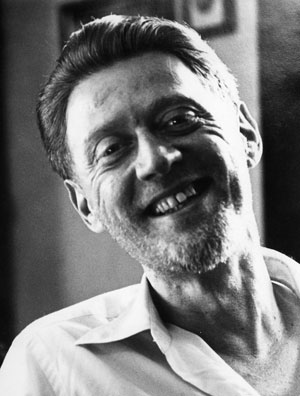
It's a matter of shame to me that I never really engaged the political and philosophical arguments of 14647748_125924620444Sullivan, Bartlett, Frum et al.) What Viereck reveals is that in some ways, the new leftist critiques of conservatism (like Corey Robin's stimulating, if uneven, series of essays) have a point.

The conservative criticism of today's GOP that I and others have engaged in is not new. It was there at the beginning of the "movement" in the post-war period and has never really left. In other words, there is a distinctive conservative strain of non-violence, pragmatism, restraint and limited government that is at peace with the New Deal. How else to expain Eisenhower or the first Bush or Reagan in some moods?

Equally, there has been a long tradition of the kind of conservatism that is ascendant today: relishing violence and war, ideological, revanchist and in favor of limiting government but not of limiting other forces inimical to liberty, like rentier classes, or a fusion of corporate interests and legislation. Here's Viereck calling out the American right for its lack of conservatism in 1949:

"Most ["conservatives"] are so muddled they don't even know when they are being 19th-century liberal individualists (in economics) and when they are being 20th-century semi-fascist thought-controllers (in politics). Logically, these two qualities are contradictory. Psychologically, they unite to make America's typical pseudo-conservative rightist …

[Russell Kirk] and perhaps half of the new conservatives are bankrupt … How can one attribute bankruptcy to a growing concern? Indeed, this new American right seems a very successful concern. On every TV station, on every mass-circulation editorial page, the word "conservatism" in the 1960s has acquired a fame, or at least notoriety, that it never possessed before … Which is it, triumph or bankruptcy, when the empty shell of a name gets acclaim while serving as a chrysalis for its opposite?

The historic content of conservatism stands, above all, for two things: organic unity and rooted liberty. Today the shell of the "conservative" label has become a chrysalis for the opposite of these two things: at best for atomistic Manchester liberalism, opposite of organic unity; at worst for thought-controlling nationalism, uprooting the traditional liberties (including the 5th Amendment) planted by America's founders."

Sound familiar? What better description of neoconservatism at its worst than "thought-controlling nationalism". There's a great profile of Viereck in The New Yorker, from 2005. And here is his first essay on conservatism, written for The Atlantic when he was only 23. The New Yorker profile prompted a riposte from John J Miller at National Review. In it, in the immortal words of Frank Meyer, the right line on Viereck was established early on:

"Viereck is not the first, nor will he be the last, to succeed in passing off his unexceptionably Liberal sentiments as conservatism."

Again: sound familiar? Then this point, made by Viereck in 1949:

‘Religion’ is a house with many mansions, finding room not only for literal but for symbolic interpretations of church dogma.

The key difference between Viereck and his immediate successor, William F Buckley Jr was also a fascinating one. Viereck did not want to uproot the New Deal and despised McCarthyism. Buckley was his opposite in both respects. This is what Viereck said of McCarthy:

He corrupted the ethics of American conservatives, and that corruption leads to the situation we have now. It gave the conservatives the habit of appeasing the forces of the hysterical right and to looking to these forces — and appeasing them knowingly, expediently. I think that was the original sin of the conservative movement, and we are all suffering from it.

We still are. In our end is our beginning, as another actual conservative once put it.

“The Deadliness Of Doing”

IMG_5591

That's the phrase Oakeshott used to describe our usual, rational, self-interested selves – engaged constantly in wanting, getting, wanting, not getting, and wanting some more. Hobbes put it thus:

I put for the general inclination of all mankind, a perpetual and restless desire of power after power, that ceaseth only in death.

The futility and unhappiness of all this is what exercized Oakeshott, and that led him to a Taoist form of conservatism, about as alienated from the American "Drill, Baby, Drill!" conservatism of today as one could imagine. But I couldn't help thinking of it when reading Jim Holt's superb review of a clearly ground-breaking book, Thinking, Fast and Slow, by Daniel Kahneman.

What Oakeshott was trying to recover was a way of doing things which was as unself-conscious as possible. And so a wheelwright is not rewarded by the number or even quality of the wheels he makes, let alone the money he might acquire. He is rewarded solely by the experience of making a wheel, of feeling the doing-of-it in his hands, arms and feet, of achieving craft that transcends usefulness. It is in these moments that we are fully human in the world we live in, for we have left the experiencing self for the experience itself, or some transcendence of one into the arms of the other. Here's how the point is made in Zen And The Art Of Motorcycle Maintenance:

It can be at a level as simple as sharpening a knife or sewing a dress or mending a broken chair. The underlying problems are the same. In each case there's a beautiful way of doing it and an ugly way of doing it, and in arriving at the high-quality, beautiful way of doing it, both an ability to see what "looks good" and an ability to understand the underlying methods to arrive at that "good" are needed. Both classic and romantic understandings of Quality must be combined.

And they must be combined effortlessly, which requires great effort and repetition until it takes off, and we are free. As Eckhart Tolle, in a particularly Taoist mood, has put it,

All true artists, whether they know it or not, create from a place of no-mind, from inner stillness.

And all human beings who are at peace in this vale of tears come from the same place, the "still small voice of calm," as the hymn has it. Is this notion of a more authentic, natural, less self-conscious and therefore less troubled self hovering alongside our rational self connected to Kahneman's schematic – the notion of two minds within us, the subrational one and the rational one? There are some parallels:

Kahneman cites research showing, for example, that a college student’s decision whether or not to repeat a spring-break vacation is determined by the peak-end rule applied to the previous vacation, not by how fun (or miserable) it actually was moment by moment. The remembering self exercises a sort of “tyranny” over the voiceless experiencing self. “Odd as it may seem,” Kahneman writes, “I am my remembering self, and the experiencing self, who does my living, is like a stranger to me.”

Kahneman’s conclusion, radical as it sounds, may not go far enough. There may be no experiencing self at all. Brain-scanning experiments by Rafael Malach and his colleagues at the Weizmann Institute in Israel, for instance, have shown that when subjects are absorbed in an experience, like watching the “The Good, the Bad, and the Ugly,” the parts of the brain associated with self-consciousness are not merely quiet, they’re actually shut down (“inhibited”) by the rest of the brain. The self seems simply to disappear.

One sentence keeps ringing: "The experiencing self is like a stranger to me." And when you try to think your way through life, rather than allowing oneself to experience it, you will become unhappy, confused, even angry. And that particular unhappiness is a good, working definition of alienation or sin: "I do what I hate", as the oldest son says, like Augustine, in "Tree of Life."

At some point in our civilization, we will have to stop doing what we hate.

We will have to relearn how to live.

The Era Of Corporate Profit

1126-biz-CHARTSweb2

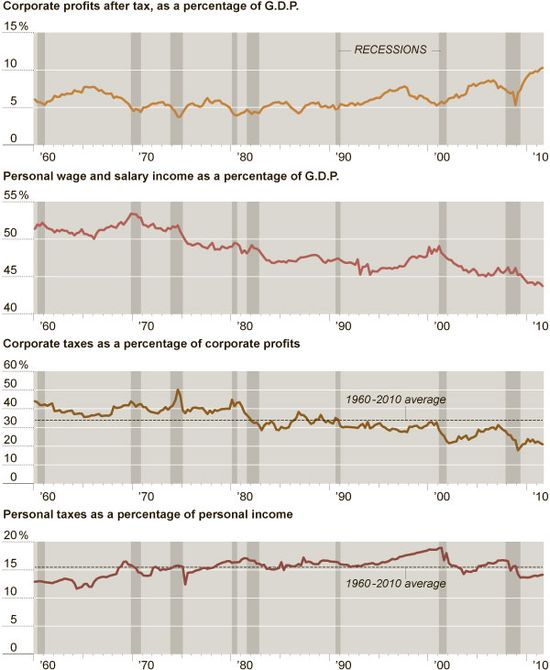
The graphs above need no more elaboration. What they show is that, at a time of soaring public debt, corporate and personal taxes are at historic lows, while wages are in the toilet but corporate profits, after tax, have never been as healthy as they currently are, as a share of the economy. Money quote from Floyd Norris:

Corporate profits after taxes were estimated to be $1.56 trillion, at an annual rate, during the quarter, or 10.3 percent of the size of the economy, up from 10.1 percent in the second quarter. Until 2010, the government had never reported even a single quarter in which the corporate share was as high as 9 percent, as can be seen in the accompanying charts.

The government began calculating the quarterly figures on corporate profits in 1947, but it has annual figures back to 1929. Until last year, the record annual share was 8.98 percent, set in 1929. For all of 2010, the figure was 9.56 percent.

Does this seem to you to be an era in which the president knows nothing about business and needs to get out of the way of the great American job-making machine by, er, cutting taxes even further? Or does it seem an era in which global corporations can make serious global money even when domestic workers are suffering, and where the obvious primary worry for any government would be the collapse of demand and risk of deflation at home?

I don't particularly like this set of facts; but what my ideology tells me should be put aside at all times by an engagement with reality. That reality suggests a country veering fast into two countries, and one party, the GOP, proposing to accelerate the shift. I'd lean on the rudder right now somewhat toward getting revenues from those currently enjoying a boom, while the rest try slowly to recover from excessive debt. Not because I hate the successful, or despise the wealthy. But because that's the obvious way to stabilize the polity and economy. 

And, you know, I'm a conservative in part because I like political stability. Pity today's Republicans have never seen a stable politics they didn't want to smash up.