Can The EU Survive?

Phil Levy runs through five scenarios for the immediate future, none of which seem likely to succeed. His bottom line:

[T]here are options like the implausible “hold tight and hope for growth” or the dubious “join together in a political and fiscal union.” Or European leaders could face up to the underlying structural problems of the euro and step back from the current level of integration. Not that such a move would be easy. It would be not so much “rip the Band-Aid off” as “sever the gangrenous limb.” It’s not hard to see why they are approaching such a decision tentatively and looking askance at those who urge them to Just Do It.

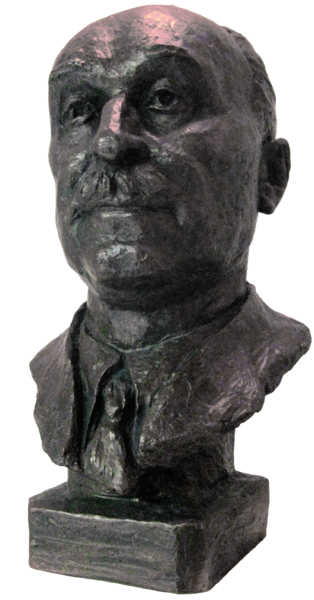
The European Union over-reached with the euro. And I very much doubt that Europe’s elites – as distinct from their populations – will relinquish it easily. An entire generation of German and French leaders have invested their entire lives and political careers in the project born from the 314px-Jean_Monnet_bust_in_the_Peace_Palaceashes of the Second World War. To see it unravel would unearth so many ghosts, raise so many questions, re-set history to reality, not abstraction, and consign their beloved “Europe” to a has-been hodge-podge of post-industrial, demographically declining nation states. At least that’s how they see things. I, for one, have no problem with good old nation-states, with their own currencies, freely trading and traveling.
The EU was a fantastic and thoroughly noble concept designed somehow as a proportionate response to the European suicide of 1914 – 1945. In that sense, it lingers as a Burkean cautionary tale. Even when a political project is noble and well-intentioned, even when it attempts to right past wrongs, it has to be grafted onto the existing cultures and deep histories of its actual human environment. Europe simply does not have the common political culture that a single federal state, like the US, has. There was a collective experience of devastation which gave the illusion of a common political culture in the later 1940s, but the depth of each country’s culture and history could not be simply defined away. And such an artificial, unitary behemoth cannot provide a genuine and meaningful federal legislature or executive (although some judicial functions can operate alongside national norms). To give it a common currency was to pile one last straw onto this already utopian dream. You could see it in the euro notes/bills themselves. There are only abstract architectural designs on them – no European patriots every European could champion: no Shakespeare or Michelangelo, no Mozart or Einstein. Just pillars.

This isn’t obvious just in retrospect; it was argued at the time; and Britain’s pragmatic refusal to be coopted was one of my native land’s smartest calls in recent times (though it too was close). Sometimes the more moral and noble the cause the more doomed the project.

To which allow me to add a provocative parallel. The other political construct designed in a noble experiment to right the wrongs of the past, and specifically the hideous wrongs of the Second World War, was the state of Israel. Grafting an entirely new concept onto a land even more steeped in history than Europe was, in retrospect, as inspiring as it was based on denial. And like the EU, the project seemed possible for a while – even a smashing success. But also like the EU, Israel over-reached in pursuit of a more perfect union. The annexation of the West Bank is, in some respects, like the adoption of the euro. It made the concept purer at the expense of making it implode. But Israel, unlike the EU, was far more tenuous. From the beginning to now, it can only sustain itself through massive military superiority. It has far less legitimacy in its neighborhood than the EU, for all its profound flaws, has in its.

Which, one wonders, will survive the longest? The EU or Israel?

(Bust: Jean Monnet, chief intellectual and political architect of European Union.)

Whatever Happened To Hell? Ctd

A reader writes:

There’s a problem with Rob Bell’s critique of Christianity, in particular, this:

This is why lots of people want nothing to do with the Christian faith. They see it as an endless list of absurdities and inconsistencies; and they say: “Why would I ever want to be part of that?”

Not quite. The problem for most people is not the “endless list of absurdities and inconsistencies.” Life is full of those. The problem is the abuse – the horrific emotional and spiritual abuse embodied in the dark twisted theology that says “God is going to send you to hell, unless…” – and all the guilt, shame and fear that comes after. That’s why lots of people want nothing to do with the Christian faith. That‘s why they say: “Why would I ever want to be part of that?”

That seems dead-on to me. Christianity is a contradiction – life through death, getting through giving without wanting to get – that peerlessly, to my mind, makes sense of the inherently contradictory human condition. And the doctrine of hell became a terrible temptation for those with authority in the church to abuse their momentous power over others’ minds and souls.

But here is a confession. I still believe in hell, not as eternal punishment but as a temporal, phenomenological reality. The human soul can indeed enter dark places and find it impossible to return without grace; evil is real; the banishment of God perfectly possible. The terrible loneliness of depression, of lovelessness, of self-hatred is a kind of hell while it lasts (and we can make it last a lifetime). To banish this spiritual despair from theology would be to put on blinders to our predicament. As a child, I found the idea that this despair could be eternal as beyond horrifying. But if “eternal” means we cannot see out of it, then it makes a kind of sense. If we create a hell in our own souls, we may eventually have nowhere else to live. And then we die. That’s the terror. I feel it. But I do not let others use such truths as means to power over me.

The point of Christianity is not that Hell does not exist, but that grace does too. Grace is the awareness that the force behind the universe loves us, redeems us, transforms us. I have felt it at times break into my life and the lives of those I love. It cannot be explained. It can merely be accepted and marveled at.

I should add at this point that I have rarely been as overwhelmed by an aesthetic rendering of grace as I was transfixed the other night by Terrence Malick’s recent film, “The Tree of Life.” It managed both to examine us humans in our microscopic dignity and insignificance and yet connect us to literally everything in existence, and to the good. It did so without hiding from tragedy or grief, which are at the heart of our lives, but relating them to the miracle of grace – mostly beyond words.

It seems to me that the holiest people are far more riveted by Heaven than interested in using Hell for their own purposes. It seems to me that God’s unconditional love cannot end at death. Because we will know then as we are known. And these former things, including the hell we construct for ourselves, will pass away.

Ask Me Anything: What’s Obama’s Biggest Mistake?

brightcove.createExperiences();

Question? askandrew@thedailybeast.com

This, of course, brings to mind David Brooks’ column this morning, bemoaning Obama’s decision to abandon attempts to get Republican support for preventing a double-dip and to go it alone out there as a populist outsider. Strategically, I think David is right that Obama’s strengths do not lie in polarization. In my ideal world, the conciliatory, reasonable Obama would have reached some accords with a reasonable, chastened GOP and then fought an election on the future direction of the country. In the actual world, it seems clear that this GOP has shown itself dedicated to the destruction of this presidency and any promise it offered to the country – as well as doubling down in its heart on a repeal of much of the New Deal. The refusal to address any revenues at all as part of a bipartisan fiscal Grand Bargain made that perfectly clear.

David concedes that:

Republicans weren’t willing to meet him halfway — or even 10 percent of the way.

But he then argues that Obama should have stuck to his position nonetheless, even though the GOP seems actively intent on increasing the chances of a double-dip in order to pursue their path back to power. He twists the knife a little comparing Obama’s strategy to Netanyahu’s. Yes, that will get their attention.

The flaw in the case, however, seems to me that, after a while, Obama’s conciliatory response to a bunch of ideological thugs – especially after they tried to send the country into default – made him look weak and impotent. You can’t win an election that way. You can neither rally your base nor look strong to Independents. And you risk looking weak as the economy tanks for lack of demand – as the GOP is clearly hoping for.

My own view is that the dichotomy David draws is too stark. The Grand Bargain is completely compatible with a populist message, as long as it includes the kind of tax reform and simplification along the lines of the Bowles-Simpson plan. And populist measures, like a tax on millionaires, if they are cast as a means to restrain debt rather than to punish success, can be popular among liberals and independents. And without knowing the super-committee’s results, it’s hard to see what Obama can do in the meantime. A national tour highlighting the GOP’s desire to enrich the wealthiest even now seems to me a perfectly worthwhile exercize for this moment. Obama can and should shift if the super-committee somehow succeeds, and I agree with David that the Grand Bargain is almost perfect Obama policy.

But Obama wasn’t entirely about restoring reason and civility to the discourse. He was also about changing the country’s direction away from the debt and recklessness of the Bush years. He was concerned about the poorest. He was worried about inequality all along. He was a moderately liberal insurgent.

I see no reason why, as next year takes shape, he cannot repeat that formula, sharpened by the impact of the Great Recession. Not easy. But the GOP’s dickishness made anything else extremely hard.

Kristol: War Is Like Lemonade

Mitt Romney's embrace of the dusted-off nostrums of the Iraq war architects as his foreign policy – more defense spending! more! where's Max Boot? which Kagan are you? – is a sign of how tenacious neoconservatism is. Just as none of the leading neocon figures have suffered an iota of prestige-loss in Washington because they concocted a foreign policy disaster that cost tens of thousands of lives to no serious effect, so they have, almost to a man, refused to cop to a single error in the process. Their partisan discipline is only matched by their unchanging Stalinist ideology. So what if the Iraq war was a disaster? It's time for a new war with Iran!

If you think I'm exaggerating the chutzpah, check out the Bill Kristol piece that woke Les Gelb up. It's a carbon copy of the memo to invade Iraq. Worse, actually:

[Iran] is a brutal dictatorship. And it’s seeking nuclear weapons while denying it’s doing so. It’s long since been time for the United States to speak to this regime in the language it understands—force. And now we have an engraved invitation to do so. The plot to kill the Saudi ambassador was a lemon. Statesmanship involves turning lemons into lemonade.

Let us pause to note that for Kristol, war is like lemonade. It's a good thing: delicious, refreshing, innocent. One wonders whether he has, for a millisecond, paused to think of the tens of thousands of 463px-Lemonade_with_strawsinnocents who died during his beloved occupation of Iraq, or the thousands of permanently maimed veterans who fought and died in Kristol's war only to empower Iran and bankrupt America. You can be wrong in good faith, as I think Kristol was – and yet also take responsibility for the consequences of your good faith decisions. But neoconservatism is about the abdication of any intellectual responsibility and the promotion of those not proven right, but proven relentless in the promotion of an agenda. It is now, as it has always been, about power, not freedom.
And this must be a core debate in the next election. Are we going to return to a foreign policy that bankrupted the Treasury, destroyed America's moral standing, eviscerated the US military's reputation for competence (a huge loss of deterrence), and empowered our enemies? Or are we going to continue the pragmatism that has since ended torture, decimated al Qaeda, and removed more despots from power in two years than Bush tried to in eight?

Repeat after me: Romney = Cheney's return. And if your purism demands staying home next year, do not complain when a global religious war breaks out. They've told us quite plainly that's what they want. Like a cold, sparkling drink on a hot summer day. War as a cocktail.

(Photo: Arria Belli via Wiki.)

The Untold Story Of The Actual Obama Record

129663017

[Re-posted from earlier today.]

I can't put it better than this longtime Dish reader:

Personally, I am praying that Obama's messaging improves drastically. (It has failed on multiple occasions – not the least of which was during August/September of 2008.)

The truth is that this President has done a good job in what has been one of the most difficult periods of modern history. He saved the economy from ruin (until the Tea Party took over Congress) with a stimulus that was as large as possible given the political realities, presided over a stock market that fairly quickly recouped many of its losses, presided over almost consecutive monthly increases in private sector job growth (unfortunately balanced by monthly decreases in public sector jobs which I attribute to the GOP further starving government), enacted the only meaningful healthcare reform ever in our history, passed financial reform (no matter what the Left says, he did this), saved the auto industry (which Romney is on record opposing), fired the first salvo of the Arab Spring with his address in Cairo no less, drawn down our footprint in Iraq in a responsible way (and headed toward almost total withdrawal), stopped numerous terrorist attacks in this country, stopped torture as policy, repealed DADT, joined the international community in a measured and responsible way to bring down an odious tyrant in Qaddafi, and killed a whole generation of al Qaeda leaders. And taking out Osama bin Laden the way he did will go down as one of the bravest military actions in American history.

I know this President is not popular, and it is very unpopular to defend him in such a way. I don't care. For this country to dump him for anyone on the other side would be a terrible thing. Progress is slow and painful, but we are doing it. Is that fashionable to say? No. Again, I don't care.

Amen. And the way in which the ADD media simply jumps to the next cycle of spinmanship only furthers the amnesia. But the Obama administration also shares some of the blame.

Many of them have been too focused on governing to explain what the fuck they're doing. There's a technocratic arrogance to them at times that is too blind to winning and sustaining arguments and narratives. And this is kinda mind-blowing because the record is so remarkable in retrospect.

If you'd told me in January 2009 that the banks would pay us back the entire bailout and then some, that the auto companies would actually turn around with government help and be a major engine of recovery, that there would be continuous job growth since 2009, however insufficient, after the worst demand collapse since the 1930s, that bin Laden would be dead, Egypt transitioning to democracy, al Qaeda all but decimated as a global threat, and civil rights for gays expanding more rapidly than at any time in history … well I would be expecting a triumphant re-election campaign.

But we are where we are – and the economic pain is real and the president must take his lumps. The good news for those of us who still back Obama and hope for his re-election is that even with all this positive record essentially dismissed and little of it capitalized on politically, Obama is still neck and neck with any likely opponent. And he is his own best messager.

At some point, he needs to shuck off the restraint, and tell the actual story of the last three years – against the fantastic and self-serving lies and delusions we keep hearing in Republican debates and Beltway chatter. If he does it with panache, he won't need a jumpsuit onto an aircraft carrier. And many of his missions may even be accomplished.

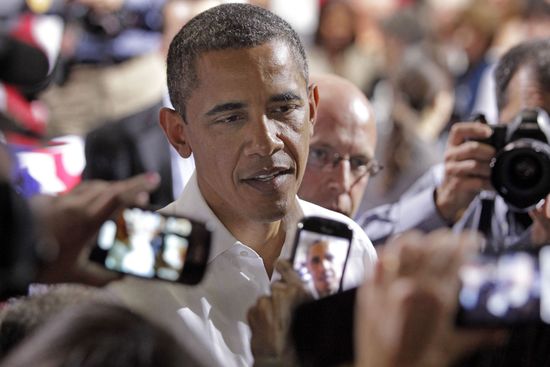
(Photo: U.S. President Barack Obama speaks with people at a fire station October 19, 2011 in Chesterfield County, Virginia. Obama was on the final day of his three-day bus tour through North Carolina and Virginia to push for his Jobs Bill. By Jay Paul/Getty Images.)

Occupy The World

After this weekend, it is impossible to deny that something is going on out there – something that spans different cultures, countries and polities. From the "Indignants" of Madrid to the pierced peons of Times Square to the thousands in Berlin and Frankfurt and London: this is a chord being struck. The question, to my mind, is: which chord exactly?

The demos remind me a little of ACT-UP in its heyday, when AIDS activists got into the faces of the powerful and the masses and demanded they not be forgotten or ignored. There was the same ghastly p.c. crap, in which all that matters is the conversation and pure democracy and not specific leadership, which is swiftly problematized as patriarchal. But ACT-UP had an obvious set of goals: speed up HIV research, force drug companies to lower prices, give the FDA a kick up the ass, lobby for ADAP, etc. What does the Occupy movement actually want?

I see the signs urging us to "smash capitalism" and remain unmoved. Capitalism has – even over the Tumblr_lsvtjmRROW1r25y9yo1_500last decade – brought more people out of poverty than ever before in history. I see personal hatred aimed at people working in the financial services industry, which again leaves me unmoved and not a little nauseated.
But what I do see is – finally – a powerful cultural protest against the corruption of capitalism in the last decade, the crony-ridden political system that even now is trying to stall or gut Dodd-Frank, and against the staggering inequalities that now exist in this country and threaten to change its core democratic nature. And this is a good thing. It's a good thing because it provides essential balance to the Tea Party's case against government as a whole. Only one entity can restore some equity to the system and it's government. Disempowering government at a time when the current system is consigning millions to decades of unemployment while rewarding a fraction of that with simply unimaginable rewards … that's a recipe for social unrest.

In other words, this street movement is emerging to demand some accountability from the bankers who helped destroy this economy, from the politicians who used our money to save them, from the GOP even now balking at basic regulations on Wall Street to help prevent another crash, and from Obama whose conciliatory style so many now regard as betrayal.

Some of this is self-serving. I don't believe the debt binge – private and public – was conducted without the eager participation of large numbers of Americans, trying to get something for nothing. I don't think you can leave government off the hook either, given its disastrous role in Freddie and Fannie. I think blaming Obama for all of it is absurd, when he is trying very hard in a deeply constrained Washington to enact core reforms. But reminding Wall Street and multinational corporations that they inhabit a polity, not a planet, is a good thing. Their fate is connected with ours, and until we return to a government that can balance its books, and to a banking system that seeks merely to make good loans, we are all in trouble.

My instinct is not to worry about those inequalities that reflect different talent or luck. Equally, though, when inequalities persist that are structural, that are rigged by one economic sector dominating others, and when the global trends point to even greater polarization, I think we should worry. This inequality will not hold over another decade of mass unemployment. Globalization is beginning to find millions of middle class victims in the West. This, in some respects, is the middle class's 1968.

The question hanging in the air will be the president's response to the movement. So far, he's been as vague as the movement itself. But if Obama can reframe his political future as harnessing this street power to hold the powerful accountable, if he can leverage it into passage of the American Jobs Act, and if he can cite this inequality as a reason for major tax reform with entitlement cuts and revenue increases, then Romney suddenly looks like a defensive plutocrat.

It's a question of movement and mood. The anger was first directed at Obama from the right (and largely redirected away from Bush and Cheney). Now it is being directed at those who were rescued after staggering recklessness. Each mood creates a different climate. And this one, I'd wager, benefits the populist left.

The Pioneer

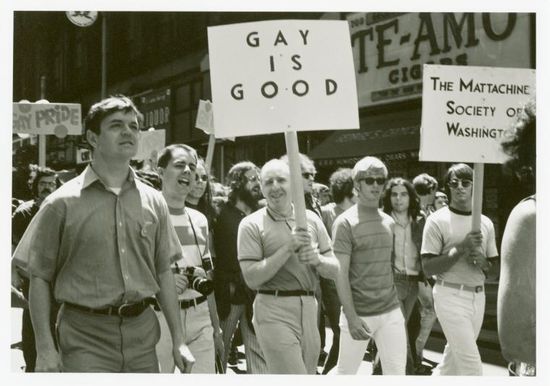
Frank-kameny-and-mattachine-society-of-washington-members-marching-1970

The great, perhaps greatest ever, campaigner for gay equality, Frank Kameny, died last night. MW has a good summary of his life's work. Wiki's profile is here. For all you atheist readers, a good summary of his strongly Hitch-avant-la-lettre position on religion is here. But picketing the White House in 1962 in a tie for homosexual equality tells you much that you need to know. That he never gave up, that he insistently engaged even his fiercest opponents for decades with unremitting conviction and self-worth, that he was firing off clarifying emails to his last days … this was a giant of a man. Without him, the movement to remove homosexuality as an impediment to security clearance in federal work would never have gotten off the ground. Ditto sodomy law repeal. Ditto the removal of homosexuality from the list of psychological disorders by the American Psychiatric Association board in 1973.

But what I treasure about Frank was his refusal to write anyone off. The most ferocious bigots he wrote polite but stern letters to. Here is an extract from one that was sent to the raging bigot, Joseph Farah, of WorldNetDaily. And they published it. Classic Kameny quote:

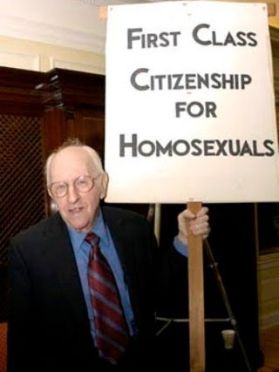
I am a long-time gay activist, considered by many to be one of the remaining Founding Fathers of the gay movement. I initiated gay activism and militancy in 1961 and Kameny, first class citizenship signcoined the slogan "Gay is Good" in 1968. It is!
I am a gay veteran of front-line combat in Europe in World War II. I did not fight that war to return to second-class citizenship or back-of-the-bus status (or off the bus altogether) for me and my fellow gays…

We gays know that our homosexuality is a divinely inspired gift and blessing, given to us by our true God to be enjoyed to its fullest, exultantly, exuberantly and joyously.

We seek not "special rights and privileges" as you term them, but precise equality of rights and privileges in what is our America, for us explicitly as gay Americans (not merely "American Americans" so to speak) fully – fully – as much as it is your America as non-gay Americans.

To repeat: For us, as gay Americans, this is our America, fully as much as it is yours, and you are not going to be allowed to steal it from us, try as you may – and you are certainly trying very hard.

And they are our White House and our president, fully as much as they are yours.

Any time one's nerve faltered, or when the price of being a bit in the drill of a civil rights movement seemed too high, Frank's enthusiastic embrace of the goodness of gayness always cheered me up. There was not the slightest trace of defensiveness about him or his arguments. He believed, as I do, that gayness is not a disorder but an objective wonder, a way of being human that has its own unique patterns and staggering achievements through the centuries of our civilization and others.

The tragedy is not that gays are discriminated against because of who we love. That is an absurdity. The tragedy is that the goodness of gayness is barely grasped by many gays, beaten down as they have been by social and cultural pressure, and only recently grasped by large numbers of straights.

Frank Kameny believed in the goodness of gayness with all his mind, heart and soul in 1957. And he lived a long life, and died a peaceful death at home. His thought and his life made "gay tragedy" finally an oxymoron. He was a gay triumph.

(Photos: a march by the Washington Mattachine Society in 1970, with Frank holding his trademarked sign, and Frank with a placard from 1962 I was honored to carry in the 2009 Equality March.)

A New Reality

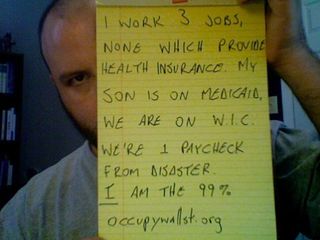
Occupy_wall_street bulls..._thumb

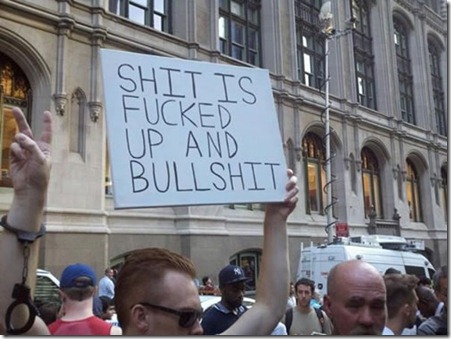
Yes, at one level this is Cartman-bait. On another level it's surely true. It's dawning on people that this recession really is different. It's a classic post-financial crisis recession – slow, uneven, uncertain. But it's also a recession lacking any new industry to power new growth and accompanied by a technological revolution that is making human beings less relevant to labor than ever before. Think factory automation; or the jobs lost in, say, the music or journalism industries. The only growth sectors are those where you need people near other people to perform key tasks, like healthcare. And on top of all this, this is the first recession that the US has exited, or tried to exit, with two billion new people integrated into the global economy, from India, China, Brazil and elsewhere. Information technology also makes distance less problematic – and so outsourcing continues apace, in white collar jobs up and up the food chain.

Shit is fucked up and bullshit all right. Except that this isn't a conspiracy. It's a function of choices we made as a democracy: to defeat Soviet and Chinese communism; to ramp up private and public debt in good times rather than tackle deeper problems in education and infrastructure; to enlarge the global economy; to foster innovation. We are, in this sense, a victim of our own success.

So what now? The GOP response is to cut spending drastically and cut taxes and regulations even more drastically. The trouble with this approach is that this is not 1983. Three decades of low tax rates have not produced record-breaking growth (au contraire, alas) and have made the US close to bankrupt under any normal measurement. Only by printing money, and relying on being the investment of last global resort, are we able to stay afloat. I don't, however, believe we can simply wish the debt away as we concentrate on jobs. The two, to my mind, are connected. Confidence swooned after the failure of the Obama-Boehner Grand Bargain; and long-term constraints on Medicare spending are essential – above and beyond the cost controls in the ACA – if we are to regain any sense of optimism about our future. This healthcare drain is a huge burden on private business and a major disincentive to hire new employees – which is why it's odd, if predictable that the GOP never mentions it. They have to believe in totally private medicine as the best option, despite its rank failure to be anywhere close to as efficient as socialist schemes elsewhere. This is the kind of dogma conservatism has to abandon in favor of empirical analysis.

The president should not, in my view, abandon his Jobs Act – but neither should he tout it as some sort of solution. It isn't – and neither was the last stimulus. They are negative acts designed to prevent a spiraling economy from plunging into a self-sustaining abyss. And Obama is not going to get re-elected on damage limitation.

He should, instead, back a big, serious program of infrastructure spending, of the kind laid out in "The Way Forward," presaged by Joe Nocera today. Bottom line:

A sustained infrastructure program, lasting from five to seven years, to create jobs and demand. “Labor costs will never be lower,” says Hockett. “Equipment costs will never be lower. The cost of capital will never be lower. Why wait?” Their plan calls for $1.2 trillion in spending — not all by the government, but all overseen by government — that would add 5.2 million jobs each year of the program. Alpert says that current ideas, like tax cuts, meant to stimulate the economy indirectly, just won’t work for a problem as big the one we are facing. Indeed, so far, they haven’t.

Their second solution involves restructuring the mortgage debt that is crushing so many Americans. It is a complex proposal that involves, for some homeowners, a bridge loan, for others, a reduction in mortgage principal, and, for others still, a plan that allows them to rent the homes they live in with the prospect of buying them back one day.

I'm not expert enough to judge the details here. But this notion of thinking big does seem to me to be good political and economic advice. We don't want to look like Japan in a few years' time. Americans, moreover, won't tolerate it. And a serious infrastructure program was something Romney backed in 2008. A second stimulus that focused entirely on this kind of infrastructure upgrade – roads, high speed rail, broadband, high schools – could capture the imagination and also tackle the actual deep-seated problems that can be engaged, as opposed to monthly jobless figures which once can merely fiddle with for years.

Am I now an apostate from conservative economics? In some respects, many on the right would say so. But my core belief is that this is not 1979. We do not have sky-high taxes and rocketing inflation. We have lower revenues than at any time since the 1940s and a constant risk of deflation. The rest of the world is not coming to our aid – and Europe could be facing its darkest days since the 1940s. Protectionism is no solution. And the bond markets are signaling that they'd be fine with more spending in the US.

This time, in other words, it's different. And in my view, the core task of the conservative mind is to be open to the present moment, clear-eyed in trying to understand it, and flexible on solutions. Government must play a role in this. In my judgment, Obama can easily say that he tried to advance bipartisan solutions to the debt problem but failed because of Republican intransigence on revenues. He can then say he has no choice but to advance proposals on his own, to be carried out after the next election if politics prevents it beforehand. It would be a turn to the left – but in order to save the capitalist system, and its credibility with most Americans.

For this is the deeper danger. If we continue as we are, fighting over a shrinking pie, and if those who have made vast fortunes over the past three decades refuse to contribute their share to solving it, and if ordinary Americans believe that these people have bought the Congress, then we're talking serious social unrest. Occupy Wall Street is a puppet show compared with what could be coming. Americans aren't Japanese. They do not take decline and depression stoically – and if such decline is seen as one that exempts the global moneyed elite, watch out. Leveraging that instinct for radical reform – I'd favor both a big infrastructure package with full-scale tax reform to raise revenues and reduce rates – will be critical to America's endurance as the world's richest and most innovative nation.

Can Obama pivot in this way convincingly? That's his challenge. Can we rally behind him if he does? That's ours.

Why Steve Jobs Matters

The reason he strikes such a huge chord with an entire generation lies, it seems to me, beyond his immense technical and business and design skills. It was because he became the bridge between the 1960s and the 1980s, the counter-culture and the counter-counter-culture. He was the hippie capitalist. He was the fusion of two great American forces – personal actualization and a free market. Listening to his Stanford Commencement speech above is a revelation, isn't it? He was a baby turned over for adoption by his biological parents. He dropped out of school. He was fired at the age of 30 by the very company he had founded. And in the face of early humbling, he focused on his own vision and his own passion – an individualist creed forged in the crucible of a sure knowledge of his own mortality, of his own death.

This passage resonates very deeply with me:

Death is very likely the single best invention of Life. It is Life's change agent. It clears out the old to make way for the new. Right now the new is you, but someday not too long from now, you will gradually become the old and be cleared away. Sorry to be so dramatic, but it is quite true. Your time is limited, so don't waste it living someone else's life. Don't be trapped by dogma — which is living with the results of other people's thinking. Don't let the noise of others' opinions drown out your own inner voice. And most important, have the courage to follow your heart and intuition. They somehow already know what you truly want to become. Everything else is secondary.

These are the words of a man with great spiritual insight, and the courage to live it (because true spirituality requires extreme courage). His worldview was forged by an eery prescience of his own mortality. He got there long before his cancer diagnosis, which, perhaps, was why he transcended it with six of the most spectacularly creative and successful years of his life. And this fusion of counter-cultural courage with capitalist genius is what defines our time – as well as the fear-ridden reaction against it.

Jobs simply defied convention at every stage in his life. He saw how the arts could deeply inform the sciences in revolutionizing human life and interaction. He dropped out of college in order to intensify his learning. And that learning came from many sources:

After dropping out of Reed College, a stronghold of liberal thought in Portland, Ore., in 1972, Mr. Jobs led a countercultural lifestyle himself. He told a reporter that taking LSD was one of the two or three most important things he had done in his life. He said there were things about him that people who had not tried psychedelics — even people who knew him well, including his wife — could never understand.

Decades later he flew around the world in his own corporate jet, but he maintained emotional ties to the period in which he grew up. He often felt like an outsider in the corporate world, he said. When discussing the Silicon Valley’s lasting contributions to humanity, he mentioned in the same breath the invention of the microchip and “The Whole Earth Catalog,” a 1960s counterculture publication.

This is the fusion that has made the best in our modern world – and those who reflexively mock the counterculture miss its spiritual genius because they are incapable of the courage needed to understand it better. Think of Pixar. I remember during the darkest days after 9/11 feeling bleaker about the future than ever before in my life. And I went to see a Pixar movie. For some reason, I came out feeling better about the world and its prospects. If a civilization could produce that kind of genius conflation of the left and right sides of the brain, if it could also turn that into exquisite beauty and laughter and even sadness, then this civilization was a formidable force against its nihilist fundamentalist enemies at home and abroad. No politician – save Obama at his best – ever reassured in quite that comprehensive a way. And what was reassuring was that this had been rooted in a vision from an individual who took no-one else's lead and had the courage to realize it, to his own exacting standards of perfection. That's America at its best.

Steve Jobs' approach to life is terrifying for most of us, because it demands firstly the hardest thing – facing death – and then its necessary, scary corollary – living your own life, and no one else's. These are difficult things, the bequests of a modernity we were born into, and perhaps beyond most human beings. Hence the enduring nihilist appeal of fundamentalism in all its forms – a fundamentalist approach to religion, in which fallible words are turned into literalist gods; a fundamentalist approach to politics, in which every problem is defined by a dogma and every solution found in a catechism; and a fundamentalist approach to life, which is rooted in obedience and rules and the false comfort of Manicheanism, rather than freedom and love and terrifying, liberating existential doubt.

You cannot teach these things in a book. But you can see them in a life. And every life lived without fear is a life that can sustain and nourish others. And Jobs truly lived without fear – which enabled him to create beyond the measure of most mortals. That he had, in the end, everything to fear – a rare pancreatic cancer slowly moving toward him – only makes his energy and spirit more vibrant.

He was alive when he died.

How many of us live as if we were already dead?

No More Trig Blogging?

Palin-email-trig-august

I wrote that, now that we know Palin isn't running, "we can stop worrying about the threat she posed to this country." Pejman crosses this fingers:

So that means no more obsessive Palin-blogging? That means Sullivan will hang it up and call it a career as an Internet gynecologist and obstetrician?

This meme on the right – simply equating genuine, real, empirical questions about the insane stories made up by Palin about her last pregnancy with some kind of creepy fascination with vaginas – is one more dodge from the Palin partisans. Trust me: I am the last man on the Internet with an interest in gynecology. I am, however, duty bound, as I see it, to say when a leading politician is saying something obviously nuts or, at the very least, wildly implausible, and asking for empirical proof. That used to be called journalism, until "deference" became the norm.

There are many individuals in the world nutty enough to make up stories about pregnancies, and this blog covers none of them. Indeed, I couldn't care less if someone capable of such a thing walks around in a free country. All I ever cared about was that someone who was incapable of understanding reality, who was, in my view, clinically disturbed, intellectually incapable and emotionally crippled, should not be foisted on the world as a potential US president because John McCain had a temper tantrum.

The record shows I had an open mind in the first blissfully data-free minutes I absorbed her candidacy. I had no desire to spend hours on a story out of a movie-of-the-week. But as a blogger, I owe my readers honesty. I could not disguise the fact that I did not believe her on Trig, and that if the worst were true, we had a fullscale nutjob potentially in line for global power. What was I supposed to do? I took a day off when it dawned on me I shouldn't lie, and yet knew I would be pilloried for airing the question. That day off was entirely my own choice, and I used it to try and think skeptically about what was in my head and to pray for the right response. The obloquy and ridicule from my fellow hacks was close to universal, and I put awful strains on my colleagues at the Dish. The only reason I did this was that I simply didn't believe her. None of it made sense to me. I regard it as a sacred rule of this blog that I will not bullshit you. So I didn't. Fuck the consequences.

Birth_of_trig

If her loss of power leads to some kind of resolution to some of the mysteries, the Dish will cover it. And in so far as a child with Down Syndrome may have been tossed into the scarring chaos of Palin life, one should simply pray for him. But that's it. At some point, history will have its say. Or we will never know (one reason, I suspect, she quit while she was ahead). But there's no need any more to even think, let alone blog, about her. I did what I could to expose her and the corrupt system – in politics and the media – that made her possible. And she's over. Mission, as they say, accomplished.

Cue the music from "Jaws".

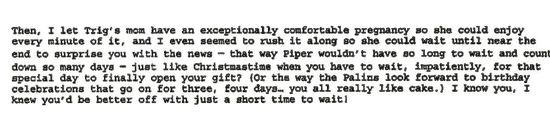
(Images: an email from Palin trying to get paid for the two days she allegedly spent in hospital having a premature child with Down Syndrome; an extract from Palin's own letter to her family and friends, in the voice of the Almighty, miraculously predicting a premature birth she would subsequently describe as a total shock – "It's far too early.")