DADT Is Dead

The video above tells you all you need to know. Burroway reflects:

[W]e can’t marry in most states, it is still legal for employers to fire someone solely because of his or her sexuality, and LGBT couples face various other enormous tax and other financial inequalities under the law. But these are consequences of legal indifference, not the products of active and hostile pursuit.

… by the government. What made DADT so horrifying was not just that it was irrationally discriminatory against patriots and heroes, but that the government supposed to protect these citizens from discrimination was the main force doing so. The Pentagon fired countless servicemembers explicitly and solely because they were gay – which sends a very powerful signal to the private sector that it's legit to do the same. It always struck me as bizarre for a government to endorse a law banning private sector discrimination, while reserving for itself the power to fire any gay person at will. And when you see the reality of gay servicemembers – like the polite professional above – and the sheer relief of not having to lie to everyone in your life, you begin to realize what liberation this is, and wonder why it took so long.

One day, a gay spouse will receive at a military funeral the flag on behalf of his husband who died in battle. On that awful day, dignity will attach to gay Americans. And decency too. I remain intensely grateful for the Obama administration in getting this done and for the military itself which was far more mature about this than so many posturing politicians. This is truly a new day – one so many of us dreamed of but which has now come to pass.

Know hope.

What The GOP Has Done To David Brooks

He's venting at Obama today for finally absorbing the ineluctable fact that the current GOP will never, ever support increasing government revenues, and thereby cannot get to the Grand Bargain so many of us want. But look: Obama has put Medicare on the table before and got nothing for it. He has even cut Medicare and been pilloried by the GOP for it. He has been open to major tax reform: they are uninterested until they regain the White House. He compromised on the extension of the Bush tax cuts … only to be ambushed by the debt ceiling fiasco, which seriously hurt him.

I agree with David that Obamaism matters; but I don't think Obama has treated us all like saps for proposing a second stimulus now and less radical ($3 trillion) debt reduction later. Yes, it's not Bowles-Simpson. Yes, its tax proposals will not radically simplify the system (which is what we need) and are geared for political purposes … but at this point, what's he seriously supposed to do?

The only way forward to a Grand Bargain is by calling the GOP bluff on taxes and going to the country on it. Once the Tea Party seized the House, this was always the likeliest scenario. Obama tried extremely hard to avoid it – which is what precipitated the last year of humiliations – which have taken a toll on his ratings and, far more dangerously, wounded his authority as president. And so, he has been forced into political contrast. To blame Obama for this seems absurd to me – and is only in the column because David is leerier of saying what needs to be said: that the current Republican party is a radical, extremist, reckless force that is far more concerned with defeating this president than in reforming the country on bipartisan lines.

And the political logic of the shift, even if it is a Plan B, is compelling. If Perry is the candidate, the choice in 2012 will be between an incrementalist like Obama who is prepared to put entitlement cuts and tax hikes on the table, and a radical who has called social security a "monstrous lie", and wants all the fiscal sacrifice to come from the middle class and poor.

I wish it hadn't come to this. But Obama, to my mind, has successfully demonstrated he has been willing to compromise, and the GOP has successfully demonstrated they cannot. I think most Americans get that. I think they get that if there has been a sap in all this, it isn't David Brooks for hoping for bipartisan reform, but Obama for hoping for sanity from today's GOP.

“He Made It Worse”?

United-states-gdp-growth-rate
There’s no question that we are in a post-financial crisis recovery, long and puny. There’s also no question that Obama will take major lumps for it. But for the Republicans to make a case for his specific failure, they have to come up with a plausible scenario for how they would have handled this period in American history differently. From that comes a plausible account of how they’d take us forward from here. So far, we’ve had little but rhetoric, but James Pethokoukis takes a stab in Commentary. I’m not trained in economics, so I’ll leave some of the claims to others to discuss. But here’s the core case:

Instead of saving us from a Greater Depression, the Obama stimulus (together with his health-care plan and financial reforms) was a two-year waste of precious time and money that may actually have impeded economic growth.

That’s a provocative thesis, to say the least. The evidence?

White House economists predicted the stimulus would prevent the unemployment rate from hitting 8 percent. But the rate actually rose as high as 10.1 percent, has settled in above 9 percent now, and even Obama’s own team currently hopes for a rate of, at best, 8.25 percent by the end of 2012—if nothing else goes wrong.

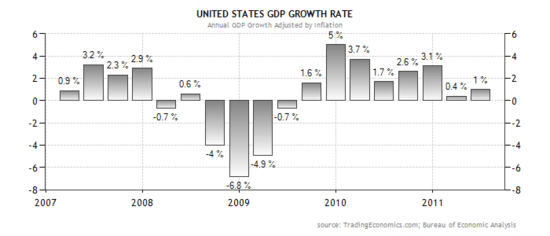
Well, that’s because they were predicting employment based on contemporaneous estimates that the US GDP was contracting at around 3 percent in the fourth quarter of 2008. As you can see from the above corrected data, that estimate was off by a half. The recession was much steeper than anyone realized at the time. Blaming economists for projecting off inaccurate data is not the same as indicting them for having a stimulus in the first place. And, yes, the stimulus – put together in a frantic rush – merely stabilized demand, and did not reverse it. The Krugman thesis – that we should have put through a far larger stimulus – was, given the assumptions of the time, an impossible sell. And the paucity of real shovel-ready projects was a problem. The same goes for the next stimulus: it will probably help us avoid a double-dip, but not much more. Much of the tax cut money in the past was saved, not spent. And that problem applies to the GOP’s and Obama’s prescription as well: tax cuts are not always the best way to stimulate the kind of economy we are now in. (Although increased rates of private saving will, in the long run, surely help stimulate demand. It just takes time). But what if we had done nothing? Or slashed spending instead? Pethokoukis admirably notes that this is a thought experiment – Bush began the bailouts and the stimulus, and it’s hard to see how any president, with the risk of the entire global economy going down the tubes, could have done otherwise. But he argues that such a hands-off approach would have facilitated a faster recovery and we would not be stagnant as we now are.

This is a counter-factual that cannot be proven, but it strikes me that without the stimulus, there was a real chance of a spiral downward in growth of historic proportions, and that the unemployment rate today would be much, much higher than 9 percent. And you think Peggy Noonan would he heralding that as a success?

You also have to factor in how this recession accelerated trends in automation in manufacturing, in outsourcing, and in the loss of well-paid skilled work for the middle classes. Again, none of this is new, but it has come to a head. This recession ended only to have Americans greet a highly competitive global economy, where America’s former advantages have been equaled or beaten by competitors, especially in Asia.

The truth is also, as Pethokoukis notes, that we are at the end of a long spasm of government binging – on discretionary spending, entitlement growth, wars and tax cuts, that began under Bush and Cheney. Keynes himself was leery of big stimuli if the economy was already leveraged to the hilt. He believed in running surpluses in ordinary times of economic growth. Given all this, I find Obama’s stimulus to be the least-worst option feasibly available to policy makers given the horrifying legacy he was bequeathed. It wasn’t so small it had no impact; it wasn’t so large it made our debt crisis even worse. The mistake – if there was one – was to raise expectations for recovery beyond what the new globalized world will allow.

We are, after all, not alone in this. Europe looks headed to a stalled economy next year; Japan’s recovery from a similar financial crisis took a decade. When you have private and public debt at the levels we have, the idea that we can turn an economy around in a year or so is ludicrously overblown. Obama did what any responsible president would have. It wasn’t enough. And so we grind pragmatically on. And if that were the tenor and substance of the debate: how we build on the stimulus to steer the economy to more employment more quickly, we’d all be better off.

Indecent

The moment from last night that keeps haunting me:

Look: in some ways the honesty is refreshing. Yes, failing to get your own health insurance creates an obvious free-rider problem, and this is at the heart of the health insurance debate. We need to deal with that, and this was one of the more admirably candid moments in the entire years-long debate.

Look: I've long been a skeptic of government-provided healthcare, but I do have a core (maybe Catholic?) belief in helping the sick. Even the foolish sick. And certainly the poor and sick. In my personal life, I have found it morally impossible not to want to help someone stricken with illness, in whatever way I can. I'm sure my own health struggles have impacted this view, as my experience alongside a generation in a health crisis. Do I think we should have done nothing while hundreds of thousands died of AIDS? Of course not. Ditto cancer and all the ailments that flesh is heir to. America, moreover, has a law on the books that makes it a crime not to treat and try to save a human being who walks into an emergency room. So we have already made that collective decision and if the GOP wants to revisit it, they can.

Here's how: offer an honest proposal from the GOP to repeal the emergency room care law. Why not? If you are going to repeal universal health insurance, then make your libertarian principles coherent. And make the case that people unable or unwilling to buy health insurance deserve the consequences. That makes sense. And the question of why Perry or Ryan or Bachmann support this free-rider loophole in contradiction to their principles is one worth asking again and again.

Of course, even if such libertarian purity does make sense, that cannot excuse the emotional response to the issue in the crowd last night. Maybe a tragedy like the death of a feckless twentysomething is inevitable if we are to restrain healthcare costs. But it is still a tragedy. It is not something a decent person cheers. Similarly the execution of hundreds, while perhaps defensible politically and even morally (although I differ), is nonetheless a brutal, awful business. You don't delight in it. And the same is true of torture. Even if you want to defend its use in limited circumstances, it remains an absolute evil, no humane person would want to do it, and no civilized person would brag of it or dismiss any moral issue with it at all. And yet that is what Dick Cheney and Liz Cheney have repeatedly done. They are positively proud of their torture record.

The fish rotted from the head down. Last night, we got a whiff of the smell.

Republicanism As Religion

120493355

The Dish covered the remarkable web essay of Mike Lofgren, but I didn’t comment myself because it so closely follows my own argument in “The Conservative Soul” and on this blog, that it felt somewhat superfluous. But I want to draw attention to the crux of the piece, because if we are to understand how the right became so unmoored from prudence, moderation and tradition and became so infatuated with recklessness, extremism and revolution, we need to understand how it happened.

It is, of course, as my shrink never fails to point out, multi-determined. But here is Lofgren’s attempt at a Rosebud:

How did the whole toxic stew of GOP beliefs – economic royalism, militarism and culture wars cum fundamentalism – come completely to displace an erstwhile civilized Eisenhower Republicanism?

It is my view that the rise of politicized religious fundamentalism (which is a subset of the decline of rational problem solving in America) may have been the key ingredient of the takeover of the Republican Party. For politicized religion provides a substrate of beliefs that rationalizes – at least in the minds of followers – all three of the GOP’s main tenets.

That too is my view: that the GOP, deep down, is behaving as a religious movement, not as a political party, and a radical religious movement at that. Lofgren sees the “Prosperity Gospel” as a divine blessing for personal enrichment and minimal taxation (yes, that kind of Gospel is compatible with Rand, just not compatible with the actual Gospels); for military power (with a major emphasis on the punitive, interventionist God of the Old Testament); and for radical change and contempt for existing institutions (as a product of End-Times thinking, intensified after 9/11).

Lofgren argues that supply-side economics attaches to the fundamentalist worldview purely by coalition necessity. The fundamentalists are not that interested in debt or economics (they sure didn’t give a damn as spending exploded under Bush) but if their coalition partners insist on a certain economic doctrine, they’ll easily go along with it, as long as it is never compromised. If it’s presented as eternal dogma, they can handle it – and defend it with gusto. If it also means that Obama is wrong, so much the better. Most theo-political movements need an anti-Christ of some sort; and Obama – even though he is the most demonstrably Christian president since Carter – fills the role.

And so this political deadlock conceals a religious war at its heart. Why after all should one abandon or compromise sacred truths? And for those whose Christianity can only be sustained by denial of modern complexity, of scientific knowledge, and of what scholarly studies of the Bible’s Rick_Perry-Bush origins have revealed, this fusion of political and spiritual lives into one seamless sensibility and culture, is irresistible. And public reminders of modernity – that, say, many Americans do not celebrate Christmas, that gay people have human needs, that America will soon be a majority-minority country and China will overtake the US in GDP by mid-century – are terribly threatening.

But all these nuances do not therefore vanish. The gays don’t disappear. China keeps growing. The population becomes browner and browner. Women’s lives increasingly become individual choices not social fates. And this enrages and terrifies the fundamentalist even more. Hence the occasional physical lashing out – think Breivik or McVeigh – but more profoundly, the constant endless insatiable cultural lashing out at the “elites” who have left fundamentalism behind, and have, on many core issues, science on their side. So within this religious core, and fundamentalist mindset, you also have the steely solder of ressentiment, intensified even further by a period of white middle and working class decline and economic crisis.

That’s how I explain the current GOP. It can only think in doctrines, because the alternative is living in a complicated, global, modern world they both do not understand and also despise. Taxes are therefore always bad. Government is never good. Foreign enemies must be pre-emptively attacked. Islam is not a religion. Climate change is an elite conspiracy to impoverish America. Terror suspects are terrorists. When Americans torture, it is not torture. When Christians murder, they are not Christians. And if you change your mind on any of these issues, you are a liberal, an apostate, and will be attacked.

If your view of conservatism is one rooted in an instinctual, but agile, defense of tradition, in a belief in practical wisdom that alters constantly with circumstance, in moderation and the defense of the TEAPARTIERChipSomodevilla:Getty middle class as the stabilizing ballast of democracy, in limited but strong government … then the GOP is no longer your party (or mine).

Religion has replaced all of this, reordered it, and imbued the entire political-economic-religious package with zeal. And the zealous never compromise. They don’t even listen.

Think of Michele Bachmann’s wide-eyed, Stepford stare as she waits for a questioner to finish before providing another pre-cooked doctrinal nugget. My fear – and it has building for a decade and a half, because I’ve seen this movement up-close from within and also on the front lines of the marriage wars – is that once one party becomes a church with unchangeable doctrines, and once it has supplanted respect for institutions and civility with the radical pursuit of timeless doctrines and hatred of governing institutions, then our democracy is in grave danger.

If you ask why I remain such a strong Obama supporter, it is because I see him as that rare individual able to withstand the zeal without becoming a zealot in response, and to overcome the recklessness of pure religious ideology with pragmatism, civility and reason. That’s why they fear and loathe him. Not because his policies are not theirs’. But because his temperament is their nemesis. If he defeats them next year, they will break, because their beliefs are so brittle, but will then reform, along Huntsman-style lines. If they defeat him, I fear we will no longer be participating in a civil conversation, however fraught, but in a civil war.

(Photo: Lucy West of Kileen, TX, participates in the opening worship ceremony during the non-denominational prayer and fasting event, entitled ‘The Response’ at Reliant Stadium August 6, 2011 in Houston, Texas. Thousands attended the event organized by Gov. Rick Perry in order to pray for God to help save ‘a nation in crisis’ referring to America. By Brandon Thibodeaux/Getty Images. Also: Tea Partier by Chip Somodevilla/Getty.)

The UN And US Should Recognize A Palestinian State

124110380

Larison says I've misunderstood the politics of the situation:

U.N. recognition of Palestine as an independent and full member state would not create a two-state solution in any meaningful sense. Even if recognition had U.S. support, it would be rejected out of hand by the one party whose agreement is essential to making a two-state solution work, and it could mark the end of any hope for a negotiated settlement. The reason why Palestinian leaders have been contemplating this risky move is that they have reached the conclusion that negotiations leading to a lasting two-state solution are not going to happen. A bid for recognition would be a desperate gamble that would almost certainly backfire on the Palestinians, and it would provide the Netanyahu government with a pretext for taking provocative actions that it might not risk taking otherwise.

The pragmatic consequences of UN recognition may well backfire, given the radical, religious nature of Israel's government. But the Palestinians know that the Israelis have no intention, whatever blather they give us in public, of creating a genuine two-state solution anyway. And that goes for AIPAC as well. So why is this move worse than the hopeless status quo in which Israel has all the cards? The Israeli government is immune to positive pressure from Washington (in fact, treats the US with contempt, as Bob Gates has noted); and any real sanctions are ruled out by a Congress far more sensitive to Jerusalem's perspective than the general public (with the exception of the Christianist right). So one tends to sympathize with one of Larison's commenters:

I don’t know if they play 11-dimensional chess in the PNA offices, but here’s a theory:

1.The Palestinians have given up on a two-state solution. They know that Israel will never give them a real state, and they don’t want the pathetic bantustans that the non-lunatic-fringe of the Israeli right is prepared to one day, maybe, concede. They have doubts that they’d ever get even that much, anyway.

2. They can never say this publicly. So the UN bid is designed to produce the next-best thing: provoke the Israelis to abrogate the Oslo process themselves and, as you suggest, annex the West Bank.

3. At this point, the Israel = South Africa narrative becomes undeniable. Israel has to either give the Palestinians full citizenship, or expel them.

4. The PNA believes that the American government, and American Jews, will never tolerate outright, naked ethnic cleansing on the part of Israel.

I think that's a fair strategy. The point of the resolution is to accelerate Israel's encounter with reality: if they want to continue the Greater Israel project, it needs to be laid bare for the world to see. It needs to be seen as a land-grab and a clear policy of occupation that leads inexorably to apartheid and brutality. Since no other pressure can be placed on Israel, given the intransigence of Netanyahu on continued ethnic engineering in occupied land, it makes sense as a form of Hail Mary. Washington is so coopted – proven definitively by Obama's perpetual humiliation at the hands of a putative ally, the UN is the only option.

The US and its allies should support the resolution. And impose sanctions if Israel then formally annexes its land of conquest. They will, of course, do neither. But I do not blame the Palestinians for using the only real leverage they have: international condemnation of the settlement policy. Netanyahu had a chance to make a deal. Now he should see the consequences of intransigence.

(Photo: An Israeli boy lies on a hammock at a coffee shop next to a part of Israel's separation barrier on September 08, 2011, near the West Bank Jewish settlement of Beit Horon. The United States is to send a diplomat to visit the West Bank in a last-ditch attempt to dissuade the Palestinians from going to the UN to try to and become a full member state with the US saying it would veto the move at the UN security council. By Uriel Sinai/Getty Images.)

Obama’s Moment Of Truth

OBAMARAINRoslanRahman:Getty

It comes tonight, in the midst of by far the worst reviews of his presidency and the real chance of a double-dip recession ending it after one term. The left is livid; Dowd keeps reiterating her Obambi mockery; and he's apparently lost the Hamptons! (yes, that was a joke.) I don't think anyone can deny the gravity of the crisis he inherited on many fronts, foreign and domestic, or the things he cannot control (tsunamis in Japan, debt crises in Europe, an opposition defined by hatred of him) but that doesn't mean he will or should be excused for another economic after-shock after the 2007 – 2009 Great Recession.

I find much of the criticism overblown. Partly that's because I have yet to hear an account of what he should have done by his conservative critics. They seem to suggest he should have passed no stimulus, bailed out no banks or auto-companies, and let the economy heal itself over time. It's an interesting thesis, I suppose, if you can wipe your memory banks of 2008/2009. At the time, there was a sense of total emergency as the entire global financial system looked as if it could go under. It didn't. Nor did the US economy enter a very frightening downward spiral. To dismiss Obama's stabilization of a plane headed toward crashing seems terribly unfair to me.

But let's say Rick Perry had been president: no stimulus, no auto bailout, no payroll tax cut, no extension of unemployment benefits. Does anyone think that unemployment would be lower today than it is? Surely it would have been much much worse, even if you take a dim view of the content of the 2009 – 2010 stimulus. Does anyone think that any president, Democrat or Republican, would have risked a second Great Depression when offered ways to mitigate it?

But what's accurate about the criticism is that Obama has not (yet) told a story of the last three years that resonates. Instead the rightwing noise machine has drowned out reality with an alternate set of non-facts. The sheer fantasies and lies about Obama's record on display last night really do shock the conscience. Romney was among them [NYT]:

“We are an energy-rich nation and we’re living like an energy-poor nation,” [Romney] said, asserting that Mr. Obama had halted offshore drilling, blocked construction of new coal plants, slowed development of nuclear plants and failed to develop natural gas trapped in shale formations.

But those claims are largely untrue. While Mr. Obama declared a moratorium on deep-water drilling in the Gulf of Mexico after the BP spill in 2010, the government began granting permits again earlier this year and activity is approaching pre-spill levels. The administration recently announced a major lease sale in the western Gulf of Mexico and gave provisional approval to a Shell project in the Arctic off the coast of Alaska. And while a number of utilities have canceled plans to build new coal plants, that is largely because demand for electricity has slowed, not because of new federal regulations.

But when did you last hear an Obama official touting that? I was watching Hannity the other night (they pay me) and he said that when the president offered a tax cut to help the economy, he'd back him 100 percent. Really? One third of the hated stimulus was tax cuts. Obama is now proposing an extension of the payroll tax cut. Tax revenues are at their lowest in fifty years and tax rates are lower than under Reagan. Obama even agreed to extend the Bush tax cuts for two more years. If tax cuts are the solution, why aren't we booming?

And yet somehow the Fox Propaganda Machine has just continued to portray Obama as the only candidate they know how to run against: a crazy big government liberal, taxing the country to death. Joe Klein regards this as a political failing on Obama's part:

If he were [a top-drawer politician], we’d be talking about the Obama tax cuts–there have been two big ones–instead of the “failed” Obama stimulus package; the Obama Senior Citizen prescription drug benefit (he closed the donut hole), universal health coverage that you can never lose instead of death panels; the Detroit auto boom as a path to a revival of manufacturing. Most important, we’d be talking about jobs instead of deficits. We would never have played the Republican deficit follies these past nine months. He would be defining the political arena. Instead, the Republicans are.

But the deficit and debt do matter if only because they are undermining any confidence in the long term stability of the American polity and economy. I don't think Obama was wrong to tackle it, just too cautious in not nailing himself to the Bowles-Simpson mast while offering concrete proposals to help jobs now. As to the rest, Joe is right. The gap between what has actually happened and the narrative the right has been able to propagate about it is dangerously wide.

But that gap means one thing: if an accurate, compelling counter-narrative emerges, a real revival is possible. And one thing I have long observed about Obama is his willingness to stay on the ropes longer than seems wise or possible. That's the pattern, obscured by his meteoric political success. But then, time after time, he has often managed to pull out of it with a speech that returns the country to reality, an argument that is very hard to counter, and a set of proposals that are often commonsensical. Recall his healthcare address after the Tea Party revolt in the summer of 2009. Recall where it led: passage of national universal health insurance.

This time, it's much harder. The deeper economic forces are bleak for any incumbent anywhere in the West; the rubric of change ends when you have been in office for almost three years. The lack of a strong recovery has understandably unnerved people. But I believe Americans are a fair bunch and will give him a hearing (they still like him a lot, despite the approval ratings slide). What he needs to do is not just offer proposals that would be suicidal for the GOP to oppose, but to give us a narrative of where we've come and where we are going. He has one – and put the right way, it's compelling.

This, after all, is a president who has ended the war in Iraq, killed Osama bin Laden, passed universal health insurance, rescued Detroit, stabilized an economy in free-fall, dispatched Qaddafi, deftly presided over a democratic transformation in the Middle East, and guided the political system toward a far more honest assessment of our fiscal crisis. He has quite a story to tell. He just needs the audacity to tell it.

Well, tonight we'll see the first attempt. What ultimately forges a presidency is how it responds to the moment when it is getting pummeled. Good luck, Mr President. This time, you'll need it.

The Origin Of Sin, Not Species

Tubal_Pregnancy_with_embryo

This is really another post-script to our series on Adam and Eve and Darwin. My own view is that there can be no conflict between eternal truth and empirical facts, because God is without error. And so the Genesis story is not disproven by Darwin; Darwin actually helps us understand its deeper spiritual, metaphorical truth.

That truth is that at some point in human history, as homo sapiens emerged, a human mind and soul struggled sporadically into existence. The first homo sapiens who saw a bison, as this terrific post from Michael O'Flynn notes, and thought of "bison" as an idea to represent the collective reality of bison, might have been a lonely fellow. But he and those women like him would eventually find each other and civilization as we know it will have begun its epic and tortuous journey:

Adam is different.  Having a rational human form in addition to his sensitive animal form, he is capable of knowing the good. As Paul writes in Romans 2;12-16,  the law is written in the heart. God being the author of natures is, in the Christian view, the author of human nature in particular; hence the law "written in the heart" was written there by God.  But for Adam to know the good means that Adam is now capable of turning away from the good.  Thus, when Adam wills some act that is contrary to what his intellect tells him is good, he is acting in disobedience to "God's commands written in his heart."  A turning away from the good is called "sin" and, since no one had ever been capable of doing so before, it was the original sin.

This is what Genesis is about: how homo sapiens came to know what it was to know, to think, to reflect, to be aware, above all, of impending death, to rise above mere instinct and feeling into the "thinking reed" that Pascal so beautifully limned. And in this world-historical shift, the terrible responsibility of moral reasoning, existential dread, and thrill of life emerged from the goop.

And what Genesis is really about is the danger of human pride in this transition. It is a warning against the notion that because evolution gave us these extraordinary gifts, we are masters of the universe. (The same can be said of that other myth, "The Tower Of Babel"). But we are not masters of the universe. We are ni ange ni bete. We are in between heaven and earth, the first creatures to imagine a higher conciousness still, and find ourselves longing for it, while running away from it because of our weakness and pride:

Whilst this Deity glows at the heart, and by his unlimited presentiments gives me all Power, I know that to-morrow will be as this day, I am a dwarf, and I remain a dwarf. That is to say, I believe in Fate. As long as I am weak, I shall talk of Fate; whenever the God fills me with his fullness, I shall see the disappearance of Fate. I am defeated all the time; yet to Victory I am born.

"To Victory I am born" is what Jesus taught us was possible. "I am defeated all the time" is what Genesis is trying to remind us, to warn against hubris and a man-centered world. All of this isn't just compatible with modern science, it is made more explicable, more profound, more wondrous given what we know about how we came to be.

One day, Christianity will see science as the wondrous gift it is, rather than as a threat to a cultural neurosis masquerading as faith.

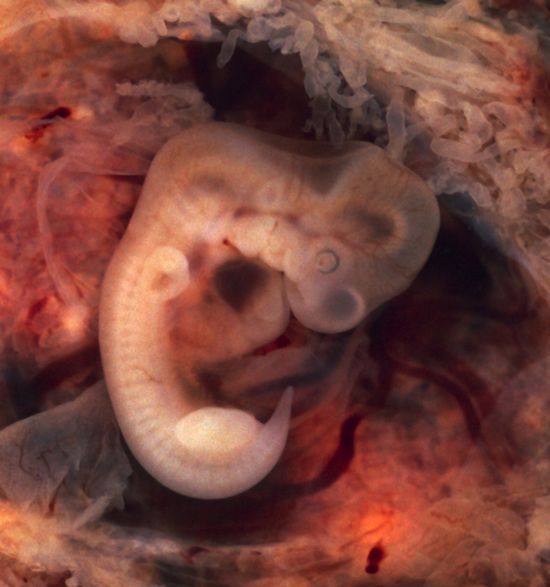
(Photo: Human Embryo, 7th week of pregnancy.)

Christianism – And Its Defenders

Francis_schaeffer-1

One of the more engaging discourses I read while I was sick was the exchange between Ryan Lizza and Ross Douthat on exactly how radical the Christianist writer Francis Schaeffer is. Schaeffer had a huge influence on Michele Bachmann, and his work is clearly part of the thriving Christianist/GOP subculture. Ross's first post in defense of this radical is here. Ryan's riposte is here. Ross concludes here.

The core question is whether Schaeffer advocated revolutionary violence against a government so corrupted by liberal elitism and "humanism" that it had ceased to command legitimate authority. The theocon journal, First Things, when edited by Richard John Neuhaus, stirred up a huge fuss a few years back with a symposium on the very same topic. And this is not peripheral to Christianist ideology. Christianists believe that anything other then Biblical principle as a guide to law and politics is literally Satanic – and so a post-Roe and post-Lawrence America is a clear example of a society commanding legal protections for intrinsic and grave evil, i.e. abortion and homosexuality. What does a faithful citizen do in a country where this is becoming a permanent regime, when Roe remains intact decades after passage and has been upheld by many Republican-appointed Justices? What does she do when gay citizens, instead of being ashamed or seeking a cure for their depravity, actually demand – and achieve by majorities in legislatures! – civil equality in the key area of civil marriage?

Ross argues that all that Schaeffer is calling for is civil disobedience, the honorable non-violent resistance to unjust laws as a means to change the hearts and minds of the democratic majority. And the evidence shows that Schaeffer was indeed devoted to civil disobedience – protesting outside abortion clinics, marching, politicking – in a manner that should trouble no one in a free society.

But the key point becomes: is there a point at which, for Schaeffer, civil disobedience is not enough?

Ross argues that it is when civil disobedience is literally made illegal, when the First Amendment is abolished. But if that were the case, it would not just be Christianists overthrowing the government, it would be a whole lot of us. And, of course, we have no evidence of such a thing coming to pass in America (unless, of course, you happen to be an Islamist sympathizer). What we do have is federal, judicially imposed abortion, secular public schools and gay marriage – all seemingly entrenching themselves deeper and deeper into the broader culture. In the book whose lecture series influenced Bachmann so much, How Should We Then Live?, we are told that

[Schaeffer] further warns that this government will not be obvious like the fascist regimes of the 20th century but will be based on manipulation and subtle forms of information control, psychology, and genetics.

Ah, yes, the paranoid Beckian twist. And it is in that context that Schaeffer takes some pains to insist on a bottom line for armed revolt:

"When any office commands that which is contrary to the Word of God, those who hold that office abrogate their authority and they are not to be obeyed. And that includes the state … Rutherford offered suggestions concerning illegitimate acts of the state. A ruler, he wrote, should not be deposed merely because he commits a single breach of the compact he has with the people. Only when the magistrate acts in such a way that the governing structure of the country is being destroyed—that is, when he is attacking the fundamental structure of society—is he to be relieved of his power and authority.

That is exactly what we are facing today. The whole structure of our society is being attacked and destroyed. It is being given an entirely opposite base which gives exactly opposite results. The reversal is much more total and destructive than that which Rutherford or any of the Reformers faced in their day."

This seems to me to hand the debate entirely to Lizza. Schaeffer says that the humanist liberal elites are "attacking the fundamental structure of society" today. By that he meant the 1980s. How much more undermined is the "fundamental structure" of society in 2011? How many more millions of abortions have taken place? How many more millions of incidents of contracepted sex or sodomy have occurred since then? And note that, for Schaeffer, the 1980s were worse with respect to anti-Christian tyranny than that which justified violent overthrow of governments during the Reformation. Necessarily embedded in his argument, it seems to me, is that the current American regime, because it is based on secular pluralism and not Christianism, is illegitimate and must be overthrown.

And this is the core point: Schaeffer is deeply illiberal, profoundly opposed to the Enlightenment on which the US Constitution rests and determined to replace Enlightenment thought with a Biblically based regime. The choice is pretty clear. Either you base your conception of politics on the Constitution, framed along Enlightenment principles with a Deist architect floating ethereally behind it, or you believe that religious doctrine is and must be the core basis for our society, and that a long-standing government that continuously permits and encourages absolute evil must be resisted, eventually with force.

Yes, Schaeffer is careful with his words. But not that careful. The truth is: Ross's party is defined by a radical theological politics that a New York Times columnist has to to diminish or whitewash in order to defend. The question I ask myself is: at what point do these fanatics lose legitimacy in Douthat's eyes? Or will he keep finding excuses for their illiberalism for ever?

(Photo: Francis Schaeffer via the Institute for the Study of American Evangelicals.)

After The Breather

IMG_0266

For me, it's not an unfamiliar pattern. A few days before my scheduled vacation, my lymph nodes started to pop out like golfballs and the night after I went off-grid, I got violent chills, fevers and aches that lasted until a couple of days ago. I'm still creaking a bit. Loads of tests; nothing conclusive, except for a summer flu. Bummer. But it was a change, if not a holiday, and I'm glad to be back, and grateful for the Dish team for a superb job while I was indisposed.

Two rough observations as I dipped into the news from my iPad – observations which sometimes require a few steps back from the cult of contemporaneity we live in. One profound thing has happened this year. It has become clear that the 2007 recession was much, much more severe than we realized at the time; and that the employment recovery is likely to be stalled for as long as it takes for Americans to pay down more debt. This is not that surprising. We knew this was a bad one; and we also knew that recoveries after financial crashes tend to last longer. But politically, it has up-ended the core strategy of Obama's re-election. The bet was that recovery would be visible enough by 2012 for voters to remember who got us into this mess and be patient with those trying to get us out of it.

For the most part, it seems to me that the bet has failed. The stimulus was not perfect, but it definitely put a floor under the pain. But we've been bouncing along that floor ever since – and, in my view, are far too indebted to risk another huge bout of borrowing to try and kickstart the engine again. Worse, the Republican brinksmanship over the debt ceiling and the subsequent downgrade seriously hurt the president's image of competence. Yes, the Tea Party was hurt much more. But they have dragged Obama down with them, and helped create a narrative of a weak, flailing executive. I don't think the president who enacted universal healthcare, rescued Detroit successfully and killed Osama bin Laden and much of al Qaeda's leadership can be described as weak. But the Christianist right's passionate hatred of the man has taken a toll; and the refusal of the left to defend the administration's substantive achievements has led to Obama once again on the ropes.

Yes, he has been there before. Many times. But this is the most serious in terms of approval ratings. His job now is to keep insisting on a balanced debt reduction package and an aggressive attempt to do the limited things he can to help employment rebound. Once this dynamic kicks in, as it will this Thursday, I think the core GOP obstructionist case against anything this president wants gets politically riskier. We will segue into the phase of a choice, not a referendum. And as yet, the GOP has not mustered a credible or persuasive plan to cut the debt and get the economy moving again. Until they can explain what they would have done differently in the last two years and link that argument to a case for economic revival ahead, I think they're far too cocky right now.

The second observation is that Qaddafi is now out of power. I opposed the war and worried it would become a long and civil one. I remain unconvinced that we did the right thing, and concerned that the consequences of this will still be ugly, or less damaging to human lives than non-interventionism would have been. Nonetheless: Obama asked for patience, defended his new "lead-from-behind" strategy with the allies, and the NATO campaign has succeeded in its core task. I read a column like this by Nick Kristof and I get a lump in my realist throat. I'll remain suspicious of what lies ahead and dismayed by the imperial manner in which this war was launched. But credit where it's due.

Since Obama's speech in Cairo, Tehran has been rocked to the core by a popular revolt, Mubarak and Ben Ali are gone, Qaddafi has been deposed and Assad looks weaker by the day. For good measure, al Qaeda in Afghanistan and Pakistan has been decimated and bin Laden captured and killed. Like George H W Bush through the last years of the Soviet Empire, Obama has been castigated throughout for caution, nuance, restraint. But like GHW Bush, his foreign policy legacy is shaping up to be transformational.