Beth Haile takes issue with my definition of Christianism:
For Catholics, the “live and let live” attitude that Sullivan endorses is simply not a viable option when there are clear affronts to human dignity and rights at work in the world.
Christianity, especially in the way Catholics see it, is imminently public and political. It demands that Christians attend closely to the "signs of the times" and seek to change those laws, practices, and structures which violate the tenets of the faith, especially when it comes to affirming and protecting the dignity of all human beings, attending to the needs of the poor, affirming the family as the fundamental unit of society, and working for the protection of all of God’s creation. … While Sullivan is clearly frustrated with the religious right’s efforts to ban gay marriage or make abortion illegal, these actions too are part of the Church making an effort to act out her social mission, just as much as it is the Church making an effort to act out her social mission that led Catholics to criticize the Iraq war, to advocate for the protection of the poor and elderly in budget cut debates, and to lobby for universal health care (a position Sullivan himself supports).
Bearing witness to what are regarded as social evils is one thing, and my libertarian Christianity would fully embrace the power of words to persuade, inspire and evangelize. And I never saw Jesus advocating against "live and let live" as a political matter. Yes, Christians should challenge evil and evangelize, they can and should wield the power of nonviolent protest as well. But using the power of one party to criminalize, i.e. use the coercive power of the state, to combat those evils is a dance with worldly power that is inherently dangerous to both faith and politics.
I think bearing witness and deploying persuasion is the Christian way; taking over a political party to impose a religious agenda is not (and in this, Beth and I are not, actually, that far apart). Kyle R. Cupp also notes a critical difference:
I'm a Christianist if my only basis for opposing torture and working to outlaw it is my Christianity. However, if I also have a non-religious moral basis in support of my attempts to outlaw torture, then I am not acting as a Christianist.
Exactly. Translating religious convictions into secular arguments is essential if we are to have any common weal at all in the modern world. Take my defense of marriage equality or condemnation of torture. Both are rooted in my Catholic faith. But I take extreme pains to present the case as neutrally as possible. Because my job is not to persuade Catholics, but to persuade anyone.



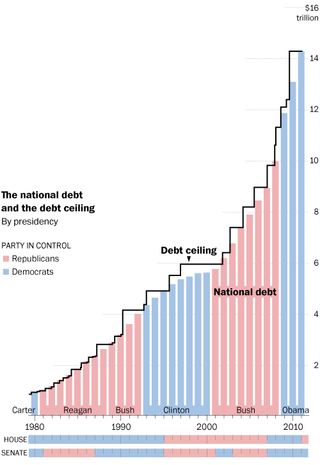 What then? I think the Grand Bargain is the final step of this thirty year debt dance, (along with serious cost controls in the healthcare sector, pencilled into Obamacare). The Grand Bargain is a big entitlement-and-defense cut package balanced by higher taxes on those who have done so well during the last thirty years. Much of this, in the view of many economists, could be done alongside tax reform to minimize the impact of more revenue on marginal rates of income tax. Last fall, we had a chance to do this, with the Simpson-Bowles commission. But the bipartisan Congressional will to act on it was weaker than the desire of both parties to play politics with entitlements and taxes. And Obama decided to lead from behind on this one, and ended up following. So where does that leave us? It leaves us with more time without a real solution to the deepest problems. That’s a huge defect in the current stop-gap deal. But it really is just a stop-gap deal. It points pretty quickly to a Grand Bargain in the super-committee, and for the first time has attached real incentives for both sides for it to work. What has just happened is, to my mind, therefore the following: 1. The Republicans used the debt ceiling as blackmail for a big cut in discretionary spending. This was a step too far, in my view, and redolent of a truly reckless attitude toward government and the American economy. On the other hand, this was not just “another raise” in the debt ceiling as some have argued. It’s a debt ceiling of over $14 trillion. And it’s a debt ceiling that in every single poll, a majority of Americans did not want to raise, without the equivalent or more of cuts being imposed. In retrospect, it’s not a huge surprise that Obama, especially because he is actually a responsible character, surrendered. 2. But the terms of surrender are to Obama’s advantage. He has taken the nuclear weapon of the debt ceiling off the table till after the election, neutralizing his opponents’ main weapon against him. He has revealed a split in the GOP between those who are fixated on no revenue increases and those who want continued Cold War level defense spending. He has also made his preferred Grand Bargain more likely to happen with the terms for the super-committee. And he is now free – better late than never – to throw caution aside and campaign around the country for a balanced solution of tax hikes and spending cuts that can resolve our future debt decisively.
 The Dish