This is one of those stories where narrative simply cannot be beat. But I should say this kind of ghastliness does not surprise me. Nothing to do with eros much surprises me. Powerful men who become sexual predators with impunity are not going to stop because it's in their political interests. Think of Bill Clinton's second term. And the propensity for this behavior is not something fully within the person's control. So, yes, it's irrational; but it is also driven by the unconscious that makes us human. I take these moments to remind myself of that. Of a previous hideous sexual assault, Strauss-Kahn himself remarked
“I don’t know what happened, I went crazy.”
What is hopeful here is the immensely fair way in which the hotel officials and the police responded to the trauma of the raped house maid. One can imagine many other cities around the world in which such a person would be afraid to complain, and if she did, denied credibility or ignored in favor of the powerful. But this woman did exactly the right thing and was backed up in exactly the right way:
At the Sofitel New York, a maid, who refused to give her name, described the woman as friendly. “In the world, she is a good person,” she said. The maid added that her superiors had asked other hotel employees not to question the woman about what happened. “The office said, ‘Don’t ask too much because she is sad,’ ” the maid said. “Just give her a hug when she comes back.”
Ross Douthat goes point-by-point through my criticisms of his column. Ross insists that “the Bush-Cheney vision of America’s role in the world” endures “in good ways and bad, deep into a presidency that promised to repudiate it”:
[W]here the Libyan war is concerned the Obama White House has displayed both continuities and discontinuities with Bush-era interventionism. On the one hand, our North African campaign has been justified by the same broad worldview and the same kind of arguments that gave us the Iraq invasion. On the other hand, it’s implementation has owed more to Clintonian liberal internationalism than to the neoconservative foreign policy vision. On the other other hand, if you look at military commitments rather than U.N. resolutions, the Libyan campaign is arguably less multilateral than the war in Iraq — and it’s a more striking manifestation of the imperial presidency, in a sense, because we’re fighting it with barely a nod to the need for congressional approval.
Ross’s Libya points are well-taken, especially on the imperial presidency, where we couldn’t agree more. On multilateralism, I would argue that merely counting the number of allies in any mission is not as salient as which allies. If the Arab League had backed the Iraq war, along with France, Russia and China, I could see Ross’s point. He’s also right to see military continuities from 2006 – 2011. But what we understand as the core dynamic of the Bush-Cheney approach was from 2001 – 2006. Those were the years when the deepest holes were dug.
The other important point is that Obama inherited these wars and their apparatus (including the torture bureaucracy). You cannot practically abolish an entire government machine built up over two terms overnight. If Obama puts the torture era behind us, gets us out of Iraq and accelerates the departure from Afghanistan (via a temporary build-up), then I think we will see starker differences than Ross does.
As for the impact of Obama on the Iranian revolution and the Arab Spring, I agree it’s too facile to draw a direct linkage. History and perspective will again help. But the Cairo speech – defending democracy in the heart of the Arab world – was a breakthrough. Bush could never have done it.
The closest he could get was London. But the Obama campaign’s leverage of social media and the call for change was echoed in Tehran and then in Cairo. The fact that a man with Hussein as a middle name killed bin Laden is also pivotal for shifting the propaganda war in our favor.
Yes, the potential for Obama in re-branding the US was partly foiled by the pro-Israel lobby. And that remains the acid test for many Arabs and Muslims. But his election and possible re-election will undoubtedly affect the promise of reform in the region in part because America has finally had the good sense to get out of the way and to speak more quietly and subtly. A return to the crude rhetoric of a Bolton or Romney would help no one.
Yes, the Libya adventure is the drastic exception that proves the rule. Like Ross, I wish we hadn’t done it, especially cutting the Congress out of any substantive role. But its outcome is also unclear. In the middle of deep historical change, we see continuities and discontinuities. I believe the discontinuities between now and then are now much greater than Ross holds. But history in the end will judge both of our assessments with its usual lack of mercy.
Joe McGinniss asks if the Atlantic could have picked a more flattering painting of Sarah Palin. Maybe a slightly more obvious halo?
Josh's piece, while perfectly accurate and fair in describing her big tax increase on the oil companies, seems to me to make a massive amount of inferences about that achievement, and fails to grasp – because establishment Washington cannot really cop to its own recklessness – that Palin is not and never was driven by policy but by resentment. It reads like a piece from the Weekly Standard in 2007.
That oil tax was a way to get back at the Republicans she hated (and who had humiliated her), and to win power by a populist appeal, backed up by a virulent Christianism – hostile to the moneyed elites of the GOP and unmentioned by Josh. It was a massive new windfall for Alaskans, already accustomed to a socialist state, and doesn't hinge on good government reform arguments to make political sense. Which ambitious politician wouldn't see a tax on oil companies as worth trying for? And she wasn't stupid. Sending much fatter checks to Alaskans boosted her ratings into the stratosphere, and created that brief bubble when she was attractive to national Republicans. Yes, she allied with Democrats to get back at the Murkowskis. But does Josh really think there was a unifying, bipartisan, pragmatic reformer underneath? Does he think she was and is a Republican Barack Obama? That Matthew Scully wrote a speech Palin really didn't want to give? Does he think her entire behavior since her insane selection by McCain has been foisted upon her when she'd really rather be discussing healthcare policy at the New America Foundation? I mean, seriously.
I guess it's counter-intuitive to argue that Palin, deep down, is a bipartisan progressive reformer, foiled by a cynical McCain campaign, trying to galvanize the base. But it's also – from every single thing we know about her – untrue. The only consistent thing about her is not bipartisan reformism, but a will to power, fueled by resentment of whomever foiled her last. More paranoid and vengeful than Nixon, more divisive than Buchanan, more deceptive than Clinton, more delusional than George W. Bush, more psychologically unhinged than any candidate for the vice-presidency in modern times, she is what she always has been. And Josh's attempt to resuscitate her reputation is about as persuasive as the soft-lens, North Korean-style portrait attached to the story.
What are the odds that they will consider denying him communion for backing the torture of terror suspects? They have weighed that question with politicians over abortion rights – and yet no presidential candidate I know of has personally approved of an abortion or declared him or herself prepared to carry one out. But with torture, a presidential candidate is essentially saying that he would personally authorize this evil. And so the endorsement of something that is "contrary to respect for the person and for human dignity" is far more direct.
Will the Bishops move? Let's just say I am not holding my breath.
Ross reacts to the killing of bin Laden with another attempt to conflate the war legacies of Bush and Obama. PM Carpenter enjoys fisking Ross's column. I'd say there are several differences Ross elides.
The first is competence. Think of the fiasco of the Iraq occupation – which remained unfixed for years while tens of thousands died. Now think of the superlative, careful management of the killing of bin Laden, a man Bush had said he'd stopped thinking about.
The second is torture. For the United States to have more success without torture than with it marks a turning point in history's assessment of the war crimes committed by Bush, Cheney, Rumsfeld, et al.
The third is multilateralism. It is inconceivable that Bush would have ceded the initiative on Libya to Britain, France and the Arab League. That humility – which Bush promised in 2000 – was only realized after he had left office. (Ross acknowledged this not so long ago.)
The fourth is a limited executive branch. There is no longer any claim of total supremacy over the laws of the land and the other branches of government in warfare. Yes, classic executive actions – like the killing of OBL – remain in the president's unique authoritah. But elsewhere, the administration has gone to some lengths in vesting its war powers in all three branches of government.
The fifth is a transformation in the propaganda war.
Bush's unilateralism, false pretenses for the Iraq war and embrace of torture gave us one teetering, blood-stained chaotic and still fragile transition to democracy in Iraq. Obama's multilateralism, outreach to the Muslim world, and distance from indigenous movements have given us democratic revolutions from below in Egypt, Tunisia, Syria, Iran, Bahrain and Libya. Only the first two have succeeded. But the shift in what's possible, while by no means primarily due to Obama, has certainly been marked since the cowboy left the Oval Office.
Yes, Ross is right in urging vigilance of the war machine directed by the president. But he is not right in trying to rescue the failure of the Bush-Cheney years from the historical dustbin they deserve.
It's maddening to me – but entirely predictable – that Obama's successful coup in finding and killing Osama bin Laden should be turned by the GOP into a defense of torture. It is almost as if they cannot explain how on their watch, when torture was widespread in every branch of the services and authorized by the White House, they were unable to get bin Laden, indeed unable to make any serious progress either in the terror war, where they let Osama get away in Tora Bora, or in the democratization of the Middle East.
There is being tortured, thereby leaving open the question of whether the shred of information he provided could have been gotten by non-barbaric methods; and two denied any knowledge of the courier under the torture technique called "waterboarding." So in order to defend torture, Cheney has to say that it's a success when the tortured tell lies. Heads he wins, tails we lose. Moreover, in the last two years or so, torture has been forbidden – although its legacy remains with war criminals protected by the US government, in violation of Geneva – and it was after those two years of a return to decency that bin Laden was found and killed. As for the Bush administration's over-arching goal – democratization of the Middle East – it was only under Obama that we got the Green Revolution in Iran, the successful revolutions in Egypt and Tunisia, and the power-struggles now happening in Syria and Libya.
When these Bush administration fanatics are presented with clear evidence that Obama has been far more successful against terror and its causes than they ever were, they return to their precious, their torture program, and claim ludicrously that, without it, bin Laden would not have been captured. Rumsfeld joined in the chorus of mass distraction this weekend on the same basis. All this really tells you is that these people realize that if their torture regime is definitively found to have been counter-productive in their lifetimes, if bin Laden was caught two years after the torture program was ended and with no evidence it helped, then their barbaric policy will be exposed once again as unnecessary, un-American, unproductive, and a violation of core human values.
Cheney calls investigations into war crimes that went beyond the authorized torture techniques "an outrage." Well, he would, wouldn't he? He knows where the war crimes trail ends up – in his office. And he knows where he should be if we were governed by the rule of law: in jail. The real outrage is that he is still walking free – and doing all he can to entrench torture in the American way of war.
(Photograph: the corpse of a detainee at Abu Ghraib who died under Bush-authorized torture techniques.)
To say I am embarrassed to be defending Tony Kushner is an understatement. I was one of very few gay men with HIV who found Angels in America to be pretentious, boring propaganda, and like most propaganda, endless and laden with stereotypes and cartoon figures. In the internecine fights in the gay movement in the 1990s, we were on opposite sides. I'd rather have pins stuck in my eyes than attend his new play, ominously titled "The Intelligent Homosexual's Guide to Capitalism and Socialism With a Key to the Scriptures," which like other Important Plays, clocks in at four hours. His sad attempt to exonerate traitors like the Rosenbergs was once perverse; now it just seems at odds with reality. I have no beef with him personally, I should add, although after writing all that, he may feel somewhat differently toward me.
Nonetheless, I really despise the way he has been used by an extremist who has no business being on any board at CUNY. It's only about an honorary degree, and Kushner must be able to wallpaper his living room with them by now. But it's also about a mindset and an argument that truly need to be debunked and tackled and refuted.
The argument is that any criticism of Israel is extremist and a function of anti-Semitism if you are a goy and self-hatred if you are Jewish.
Given the growing religious radicalism in Israel, its corrupting refusal to give up land conquered in war, its insistence on populating that land with its own people, and its brutal bombardment of Gaza two and a half years ago … how on earth can criticism of these actions and policies be self-evidently motivated by anti-Semitism or extremism?
And yet they are if you subscribe to Mr Wiesenfeld's worldview. This is a critical part of it, relayed in a conversation with the NYT's Jim Dwyer:
I tried to ask a question about the damage done by a short, one-sided discussion of vigorously debated aspects of Middle East politics, like the survival of Israel and the rights of the Palestinians, and which side was more callous toward human life, and who was most protective of it. But Mr. Wiesenfeld interrupted and said the question was offensive because “the comparison sets up a moral equivalence.”
Equivalence between what and what? “Between the Palestinians and Israelis,” he said. “People who worship death for their children are not human.” Did he mean the Palestinians were not human? “They have developed a culture which is unprecedented in human history,” he said.
Until you grasp the fundamental belief of some pro-Israel extremists that Palestinians are collectively sub-human, or cockroaches, as Yitzhak Shamir once called them, you never fully understand the mindset that is pushing Israel into an existential crisis. I mean: how can you negotiate with subhumans? Then notice this astonishing hyperbole:
They have developed a culture which is unprecedented in human history.
You mean they are worse than the Boers or the Nazis or the Communists or the Hutus and Tutsis or the Mayans? Or any population in human history? Only once you grasp that worldview can you see how the killing of hundreds of women and children in dense urban areas, as Israel did in Gaza, can be justified. The deaths of Palestinians are not to be mourned, because the Palestinians aren't fully human.
Wiesenfeld is not alone in this viewpoint. Here is Yitzhak Shamir in 1988:
'Anybody who wants to damage this fortress and other fortresses we are establishing will have his head smashed against the boulders and walls.'' … In remarks aimed at Arab rioters, the Prime Minister said: ''We say to them from the heights of this mountain and from the perspective of thousands of years of history that they are like grasshoppers compared to us.''*
Here is Raphael Eitan, Chief of Staff of the Israeli Defence Forces, in 1983:
"When we have settled the land, all the Arabs will be able to do about it will be to scurry around like drugged cockroaches in a bottle."
Here are some popular military t-shirts at the time of the Gaza war:
The t-shirt on the right celebrates killing a pregnant woman because two Palestinians are killed at once.
All of this is a deliberate and sustained dehumanization of an entire people. It's important to see its full context – the cultural PTSD and understandable paranoia of Israelis, and the traumatizing psychological impact of the Holocaust, even now. And I am not saying that this kind of thing isn't also common throughout the Arab and Muslim world with respect to Jews, who are demonized, dehumanized and lied about on a regular basis. It is extremely common; it is far more prevalent than its opposite; and the hideous history of anti-Semitism in the twentieth century makes eliminationist language about the Jewish people and their absolute right to a homeleand repellent in every way. But we would not allow such anti-Semites to sit on university boards judging the work of writers, based on their politics, would we?
So why is Wiesenfeld not just on such a board but capable of commanding instant assent from his peers? How has American public discourse on this question been so thoroughly distorted by the unhinged tribalism of a few maniacs? And when will we begin to stand up to these bullies?
* This quote has been corrected from the first version, which was a tuncation.
Chris Geidner goes back fifteen years to this week in 1996, when DOMA was introduced into the House of Representatives. But he does something much more valuable at the same time. He revisits the struggle within the gay community to get the campaign for marriage rights off the ground. At times in the early days, it felt like just two of us – Evan Wolfson and yours truly – who pushed against the understandable incrementalism of the gay establishment, men and women who, with some notable exceptions (like Tom Stoddard), who really did not want to tackle marriage rights when we did.
It shocks the current generation to be told that marriage equality was fiercely opposed by the right and the left when it emerged as a serious issue in the early 1990s. Here is leftist Michael Warner as recently as 2000:
''At a time when the largest gay organizations are pushing for same-sex marriage, I argue that this strategy is a mistake and represents a widespread loss of vision in the movement.''
My book tour with Virtually Normal, my fully fleshed out case for marriage rights – was picketed in some places – by the Lesbian Avengers. My backing of marriage equality was also the pretext for outing my sex life by leftists who regarded anyone supporting marriage rights having sex when single as some sort of hypocrisy! I was heckled in London – by my fellow gays. HRC was, at best, condescendingly tolerant and, at worst, actively hostile to marriage equality and very defensive on behalf of their Democratic party patrons:
Of HRC's approach at the time … Sullivan is characteristically blunt.
''They were like, 'No, we want to get ENDA. … We know that has higher polling, we can do it.' And my position was, 'Screw ENDA. First, this is a more fundamental issue about the government discriminating against us as opposed to our fellow citizens, and, secondly, if we win this, the argument that we make on this will so change the debate that ENDA will become easy.' And their view was totally understandable — I'm not saying it wasn't.''
But, as Sullivan says he told people at the time, ''It's coming anyway. The courts are going to have to make these decisions.''
And so it came. What has frustrated me these past few years is not the success of the movement, which is simply thrilling, but how that success has in some ways blurred the real and fraught history of this cause both within the gay movement and outside it. Geidner's piece is an excellent first step toward recovering the actual history, with its large share of tensions, setbacks, internal arguments and the battle against and within the Clinton administration.
Nothing is easy; and nothing is inevitable. This was a struggle against both ideological sides toward a sane, humane resolution of a pressing problem. It is not over yet. But its success does cast light on the limits of ideology, if confronted relentlessly with logic and passion and argument.
"Former government lawyer John Yoo taking credit on behalf of the Bush administration for Sunday's strike against Osama bin Laden is like Edward John Smith, the captain of the Titanic, taking credit for the results of the 1998 Academy Awards," – Andrew Cohen.
Not only do these war criminals and shoddy lawyers refuse to take accountability for their crimes, they tell clear untruths about how the capture of bin Laden was achieved and distort history.
So let us be very clear. The war criminal Dick Cheney presided over the worst lapse in national security since Pearl Harbor, resulting in the deaths of more than 3,000 people. This rank incompetent failed to get bin Laden at Tora Bora, and then dragged the US on false pretenses into a war in Iraq, empowering Iran's dictatorship, and killing another 5,000 more Americans on a wild goose chase. He presided over the deaths of more than 8,000 Americans, and tens of thousands of Iraqis during his criminally incompetent years in office.
On the other hand, the man who abolished torture as soon as he took office, Barack Obama, captured and killed Osama bin Laden, and captured a massive trove of intelligence, more than two years later. No Americans died in the operation.
What on earth are we debating? How have these delusional maniacs managed to even get us onto this turf? Because they have to. Because when the full truth of these past years are fully in focus, they will be revealed as some of the greatest criminals ever to have wielded power in America.
Kevin Drum makes the case for releasing the photos of Osama's corpse:
These are public records of a very public operation against public enemy #1, and like it or not the public should have access to them. The only reason to withhold them would be for reasons of operational security, and I don't think that applies here.
What really galls me is the arrogant position permeating this debate that American’s need to be shielded from the gruesome truth for their own good. In my humble opinion, if we don’t have the fortitude to see what they’ve done, then they probably had no business doing it.
I'm conflicted here but think the president's position is, in the end, motivated by exactly the right reasons:
"That’s not who we are. We don’t trot out this stuff as trophies."
We celebrate not the death of an individual as such but the blow to his wicked organization, and some closure and justice after his multiple mass murders. To put his head on a digital spike and display his mangled head is, indeed, not the Western way. We are better than that.
How do I square this with my usual unsparing policy of airing all and every image of war? Because this is a named individual and a victim of the war he waged, and we do not display these things like scalps on a wall. Seeing his face does not bring home to us anything we don't already know. It offers no insight into the horrors of war and violates some core Geneva notions of the dignity of captives and corpses.
This is a special case, it seems to me, for restraint as the flipside of a just war. We don't torture and we respect the human dignity of even our worst enemies. This is partly what we fought for – to reverse the barbarism of al Qaeda, not reflect it. We failed for years. We are now beginning to succeed. The right way.

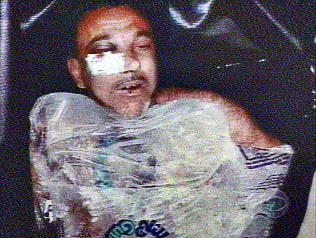 being tortured, thereby leaving open the question of whether the shred of information he provided could have been gotten by non-barbaric methods; and two denied any knowledge of the courier under the torture technique called "waterboarding." So in order to defend torture, Cheney has to say that it's a success when the tortured tell lies. Heads he wins, tails we lose. Moreover, in the last two years or so, torture has been forbidden – although its legacy remains with war criminals protected by the US government, in violation of Geneva – and it was after those two years of a return to decency that bin Laden was found and killed. As for the Bush administration's over-arching goal – democratization of the Middle East – it was only under Obama that we got the Green Revolution in Iran, the successful revolutions in Egypt and Tunisia, and the power-struggles now happening in Syria and Libya.
 The Dish