The Big Lie: Torture Got Bin Laden

113434996

Dave Weigel predicts Republican spin:

Expect to hear more about this report that the information that led to the tailing of bin Laden's courier, and eventually to his death, was acquired in interrogations that Obama ended once he took office. It may not be Republican candidates pointing this out. They don't need to. George W. Bush has a considerable amen chorus in the press, with former staffers like Marc Thiessen, Michael Gerson, and John Yoo writing regular columns about how the 43rd president was right.

Predict it? It's already become a meme. Last night, O'Reilly simply said "What about the waterboarding?" before moving on to other issues. A military reader writes how Fox is leading with the torture lie:

Driving right now – flipped on Fox News Channel out of curiosity on Sirius.  Since 07h30, they have been openly encouraging waterboarding and have at least 6 times that I've noticed said that the reason we got OBL is directly attributable to what had been revealed during waterboarding sessions.  I am, in two words, fucking disgusted.

Here's Andrew Malcolm:

That previous president authorized enhanced interrogation techniques which convinced folks like Khalid Shaikh Mohammed to give up, among many other things, the name of their top-secret courier, now deceased.

Leave aside the horrifying fact that Republicans, seeking to score some ownership of this triumph, would look to torture as their contribution. Why not the beefed up on-the-ground intelligence from 2005 on? That's Bush's legacy that Obama built on. Besides, there is no evidence that it played any part whatsoever. From the NYT:

Prisoners in American custody told stories of a trusted courier. When the Americans ran the man’s pseudonym past two top-level detainees — the chief planner of the Sept. 11 attacks, Khalid Shaikh Mohammed; and Al Qaeda’s operational chief, Abu Faraj al-Libi — the men claimed never to have heard his name. That raised suspicions among interrogators that the two detainees were lying and that the courier probably was an important figure.

My italics. So in torturing these two men, interrogators got nothing of substance. In fact, it was only by assuming that these men were lying under torture that the investigation continued. It was subsequently, during normal interrogations that KSM gave us a central clue:

Mohammed did not reveal the names while being subjected to the simulated drowning technique known as waterboarding, former officials said. He identified them many months later under standard interrogation, they said, leaving it once again up for debate as to whether the harsh technique was a valuable tool or an unnecessarily violent tactic.

To repeat: in the one instance we now clearly know about, the CIA is telling us that torture gave them lies. Which they were. Only when traditional interrogation was used did we get the actual names of the couriers. Marcy Wheeler looks at the current data set:

We can conclude that either KSM shielded the courier’s identity entirely until close to 2007, or he told his interrogators that there was a courier who might be protecting bin Laden early in his detention but they were never able to force him to give the courier’s true name or his location, at least not until three or four years after the waterboarding of KSM ended. That’s either a sign of the rank incompetence of KSM’s interrogators (that is, that they missed the significance of a courier protecting OBL), or a sign he was able to withstand whatever treatment they used with him.

Follow up here. Jane Mayer's thoughts. Brian Beutler focuses on the flaws in the AP story torture apologists latched onto. Meanwhile, Rumsfeld himself has denied that torture played any role in finding bin Laden:

“It is true that some information that came from normal interrogation approaches at Guantanamo did lead to information that was beneficial in this instance. But it was not harsh treatment and it was not waterboarding.”

What really broke the case? From the NYT:

Operation Cannonball, a [2005] bureaucratic reshuffling … placed more C.I.A. case officers on the ground in Pakistan and Afghanistan. With more agents in the field, the C.I.A. finally got the courier’s family name. With that, they turned to one of their greatest investigative tools — the National Security Agency began intercepting telephone calls and e-mail messages between the man’s family and anyone inside Pakistan. From there they got his full name. Last July, Pakistani agents working for the C.I.A. spotted him driving his vehicle near Peshawar.

Old-fashioned, painstaking, labor-intensive intelligence work. The American way. We never needed to stoop to bin Laden's standards to get bin Laden. We needed merely to follow our long-tested humane procedures.

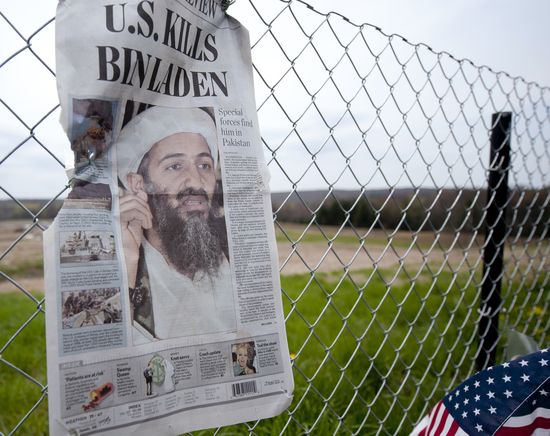
(Photo: Newspapers left by visitors grace the fence overlooking the crash site of Flight 93 in Shanksville, Pennsylvania on May 2, 2011 following the announcement that Osama Bin Laden had been killed in Pakistan. Nearly 10 years after September 11, 2001, construction is underway to erect a formal memorial at the crash site.  By Jeff Swensen/Getty Images)
Presidential Bumps, Past And Future, Ctd

GT_NOTFORGET_05012011

I trust polling and political science … up to a point. But seriously, the idea that this event does not transform the arc of the Obama presidency is to miss the moment.

Obama avoided a plunge into the second Great Depression. He saved the auto industry. His bank bailout may make a profit. He has withdrawn most troops from Iraq. He has ended the ban on openly gay servicemembers. He has appointed two women to the Supreme Court. He muscled universal healthcare through the Congress into law. He ended torture as the law of the land.

Abroad, since his Cairo speech, democratic revolution after revolution has occurred. From Tehran to Tunisia to Egypt, Bahrain, Syria and Yemen, the march of freedom George W Bush imagined has actually swept the region under his successor. Where Obama has failed – Israel/Palestine – he may still prevail.

But the capture and killing of bin Laden eclipses these. It does two things instantly: it tells us that an American named Barack Hussein Obama ordered the operation that killed Osama bin Laden. A man who symbolizes an integrative, tolerant, multicultural future defeated the symbol of a twisted, dark, fundamentalist past. A man who represents the human continuum of the developing and developed worlds defeated a man who seeks only one world and Shariah rule over all of it. And it also tells those who have been bombarded with lies and rumors and disgusting smears that this president, whatever they have been told, is no weakling, no terror-lover, no alien. He is as American as every new passport holder and every ancient Southern or Yankee family.

He found and killed the man Red and Blue America equally wanted found and captured or killed. And in that specific fact, a certain narrative – the narrative the degenerate right has been trying to fix to him for years – must now die. And it must die in the heart of the red states as well as in the mind of the blue ones.

Far from being somehow un-American, this president is only conceivable in America. Which makes this moment so rich with meaning and justice and, yes, hope.

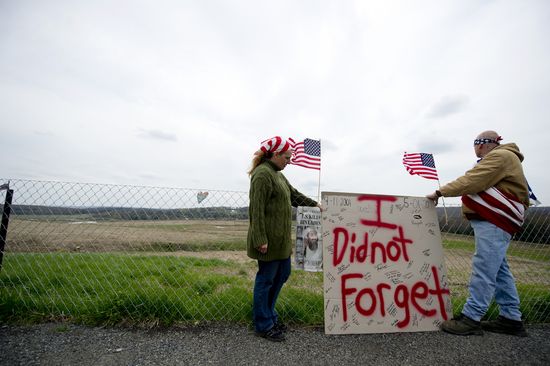
(Photo: Jeff Ray and his wife, Barbara, of Shanksville, Pa look over the crash site of Flight 93 following the announcement that Osama Bin Laden had been killed in Pakistan May 2, 2011 in Shanksville, Pennsylvania. By Jeff Swensen/Getty Images.)

Those We Celebrate For

I understand those who feel that joy is not an appropriate or civilized thing to feel right now. As a Christian I am asked to pray for the soul of Osama bin Laden, not to celebrate his death. And this prayer I have spoken as I am bound to. But this is also true: the joy will not leave me either and I am not ashamed in the slightest.

In fact, the only sane thing to feel right now, I think, is both great sorrow and great joy.

The reason for the sorrow is obvious: that this one figure was capable of inflicting so much pain on so many people, that he distorted so many minds and souls, that he killed so many human beings. And that he did it all in the name of God.

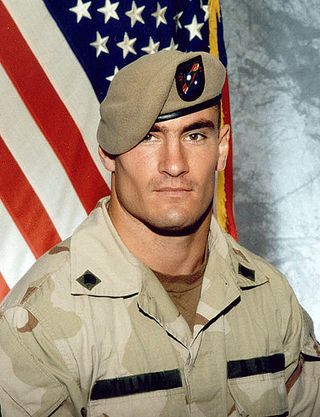
The reason for the joy is actually less obvious. It is, at its best, I think, not vengeance or relief -  although they are within us all, at various levels of suppression. The joy comes because somewhere 460px-Corporal_Patrick_Tillman we feel for the first time in so long that this hideous, bungled, tortuous, torture-filled decade of war and mass murder might, after all, have some smidgen of emotional closure, some sliver of justice in its long arc, some core thread leading to something we can call victory.
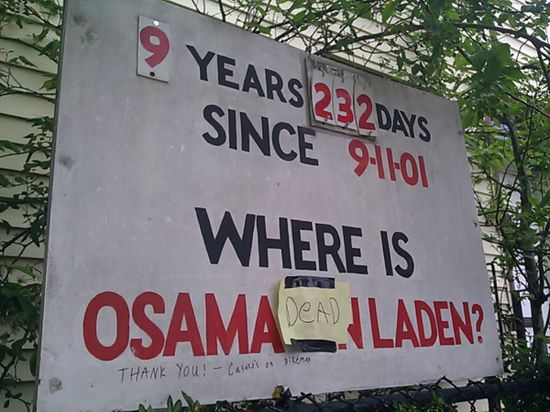
I think especially of all those young Americans who, on September 12 2001, woke up and decided to serve their country in her hour of need. I think of all those who signed up for war because of 9/11. And let's face it. They did not sign up because they wanted to re-shape the Middle East, or bring democracy to Iraq, or to bribe Hamid Karzai.

They signed up to find, capture, or kill Osama bin Laden.

They signed up to attack everything he represents.

It gives bin Laden too much credit to say he made them soldiers. But they became soldiers because of his crime and what he had done to the country they loved.

Many of them were cheering last night. But many were not alive to do so. I think particularly of those men and women now. They died in battle not knowing that America would eventually, finally find this murderer, and bring him to justice. Imagine telling them now, as if they were still alive, "We got him! We got bin Laden!" Imagine the look on their faces. Imagine what you see in their eyes.

And then look at their faces as you also tell them that it was done by Navy SEALS, in a gun-battle, where bin Laden was given the option of surrender, and refused. And then we ensured that his funeral was a dignified one, in accordance with the protocols of Islam.

Which is to say to our heroes: You did not die in vain. And your comrades finished the job.

And who can not feel joy at that?

(Photo: Cpl Patrick Tillman, a former Arizona Cardinals linebacker. November 6, 1976 – April 22, 2004.)

Obama’s Greatest Accomplishment?

289494384

Mr Kurtz says what "happened Sunday will probably rank as Obama’s greatest achievement." Mickey demurs:

[I]f a significant part of the Democratic health care plan survives, that will “probably” easily outrank yesterday’s bin Laden success. Obama will have done something a series of popular Democratic presidents had failed to accomplish in more than half a century.  … And it’s easy to overestimate the significance of Osama’s demise: Remember when we thought finding Saddam would turn the tide in Iraq?

C'mon. Does Mickey think bin Laden is the same as Saddam in the American psyche? OBL attacked ths country; Saddam didn't. Osama began this hideously divisive bait of a war. Saddam just couldn't cop to not having any WMDs. (By the way, Mickey had similar prescience (ahem) after 9/11, when he predicted we would have moved on by Thanksgiving.)

In my view, the president who found and killed Osama bin Laden will be very hard not to re-elect. Now the association between his name and his enemy's will be an asset: Obama killed Osama. A few tea-party fanatics will have their heads explode. And the Big Lie that Obama is somehow not a strong president is debunked – because strength doesn't actually mean being inflammatory on Fox News, it means exercizing patience, quiet and resolve to get what you want. That Obama also helped prevent a Great Depression – with zero Republican votes – and brought universal health insurance to America? All we need now is a debt deal. And the only way that's possible before the election is if Obama looks highly likely to win it. That likelihood just increased today.

So it's good potential news all round. And since this incident reveals that we are really at war with Pakistan, not Afghanistan, I suspect Obama will have the leverage to shift strategy drastically in the coming year. Without bin Laden and with Pakistan working against us, the logic for withdrawal just got a lot stronger. Which is why, I suspect, the hegemonists are busy reminding us this war is not over. Because for them, it's never over.

But your average American? We did what we went there to do after 9/11. And after ten years, it is time to leave. With our heads high. And justice done.

(Photo by Tina Fallon via Mackey)

God Save The Monarchy

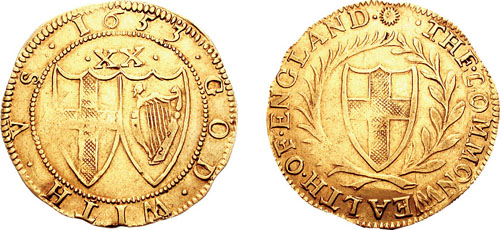
Commonwealth_Unite_1653_692157

Mark Vernon makes a case for the royals:

I remember being persuaded that a monarchy has the upper hand when, after 9/11, it became almost impossible to criticize Bush without being taken as criticizing America too, because the political leader and the head of state were embodied in the same person. Similarly, a list of values will run into trouble when they conflict – as liberty and equality clearly do. A symbolic figure seems better able to hold together inevitable contradictions because they're symbolic not explicit.

Amen. And Walter Bagehot is smiling somewhere.

A huge part of me is anti-monarchical. One reason I fell in love with America was its resistance to these kinds of inherited hierarchies. But like the allure of abolishing organized religion, you don't know what you've lost till it's gone. America shows, for example, that if you do not have the allure of royalty, you tend to create stranger, more politicized versions of it: from the Adamses and Roosevelts to the Kennedys and the Bushes. In the search of unifying cultural symbols, given a politicized head of state, you get idolatry of the flag or the Constitution. Nations need neutral cultural threads to give them meaning and coherence over generations.

And of course, Americans often forget that Britain had an experience of the republican model long ago. King Charles I was executed long before Louis XVIII, and Britain was a commonwealth for  eleven years in the seventeenth century, much of which under the "protectorate" of Oliver Cromwell. The rationale for the monarchy was graphically illustrated by the abuse of power by the genocidal Cromwell, proving Joni Mitchell right.

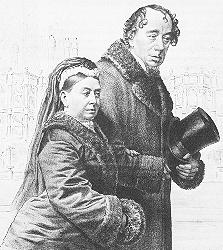
But I think the appeal of the monarchy is more mysterious than its practical advantages. England was governed by kings for a very long time; and its Anglo-Saxon monarchy was far more sophisticated and had farOld_disraeli more reach over the land than many rival monarchies abroad. This is in the DNA of the island nation, and something impossible to change without rupturing the country's identity altogether. It may be much harder for the monarchy to retain the mystery that helps it survive in the modern media age – especially when you hear taped telephone conversations wherein prince Charles expresses a wish to be Camilla's tampon – but you can get past that if you want to. In the eighteenth century, far more scurrilous rumors and stories abounded. And, ironically, that sometimes helps the royals. There's something about their human failings that bonds them to the rest of us.

And when Britain is in crisis, or divided against itself, the monarchy does act as a unifier. Today, as in 1981, the country is economically beset by a deep conflict over resources. But tomorrow, that will not be in the forefront of many minds. Ditto in wartime, a mediocre King and a brilliantly emotionally intelligent queen profoundly helped Churchill rally the country. Their very human frailty made them stronger as symbols.

This is a national lodestar that goes through human generations and exhibits human trials. My rational modern mind cannot really defend it. But my emotional intelligence grasps the reason for its longevity. And hopes it survives for ever.

(Photo: A "Unite" coin from 1653, depicting the union of England, Scotland and Ireland, with no mention of the monarchy, under the Commonwealth. Drawing: the most beguilingly monarchist Prime Minister, Benjamin Disraeli, and Queen Victoria whom he named Empress of India.)

Why Did Obama Wait So Long?

So he had the power to get this into the public eye and yet resisted until the country's polity was almost paralyzed with distraction. I know this was an ethically legitimate position after releasing the short-form document proving that he was indeed born in the US. I know it was politically savvy because, by the rules of jujitsu, Obama allowed the nutty right (is there any other variety with influence now?) to make fools of themselves.

Nonetheless, I think this should have been done long ago.

Because a president has to put his public responsibilities before his pride and his privacy. That's the price of the job – to defuse or debunk conspiracy theorists or just skeptics with all the relevant information you have.

It's also the job of the media always to press for more information, not less. But so many spent their energy arguing that Obama need do no more and piling on the Birthers. They still seem to think they are gatekeepers, possessors of the power to decide what is or is not legitimate for citizens to ask of their public officials.

Get over yourselves, MSM. And do your job – not defending the right of people in power to protect themselves, but scrutinizing them relentlessly, with every fact and document you can get. You don't defuse conspiracy theories or end legitimate doubts by telling public officials they need not provide clear and available evidence to rebut them. Yes, some will still suspect. But many will walk away. That's worth doing.

Do you know what I am saying?

“Doctors” At Gitmo

6a00d83451c45669e2012876eb40a0970c-500wi

Steel yourself. If you were a doctor and had a patient showing up with symptoms like this, what would you do?

contusions (2), bone fractures (3), lacerations (2), peripheral nerve damage (1), and sciatica (2).

I'd ask how these occurred, wouldn't you? But the Gitmo doctors were remarkably incurious. These injuries just "happened." Ditto the following psychological symptoms in prisoners with no previous record of mental or psychological illness:

nightmares (5), suicidal ideation (4), depression (2), audiovisual hallucinations (3), suicide attempts (2), anxiety/claustrophobia (2), memory and concentration difficulties (1), and dissociative states (2).

The doctors never asked why prisoners were showing up bruised and with bone fractures or exhibiting classic symptoms of PTSD. One was actually told

‘‘[You]…need to relax when guards are being more aggressive.’’

The report is sickening. Just one incident:

At one point, the detainee was observed by an interrogator to be having auditory hallucinations in response to extreme sleep deprivation and other abuses. Case documents indicate that a BSCT psychologist was informed of the hallucinations and did nothing to mitigate obvious and profound psychological harm that he/she was made aware of.

Because the psychologists were part of the torture. What did the prisoners say was done to them, prompting these symptoms? You know the answer:

The detainees reported being exposed to an average of eight different forms of EITs (range: five to 11 forms of abuse) including sleep deprivation, temperature extremes, serious threats, forced positions, beating, and forced nudity. In addition to the use of authorized EITs, each of the nine detainees reported being subjected to ‘‘unauthorized’’ acts or torture including: severe beatings, often associated with loss of consciousness and or bone fractures, sexual assault and/or the threat of rape, mock execution, mock disappearance, and near asphyxiation from water (i.e., hose forced into the detainee’s mouth) or being choked.

Other allegations included forcing the detainee’s head into the toilet, being used as a human sponge to wipe the floor, and desecration of the Quran (e.g., writing profane words in the Quran, stepping on the Quran, and placing it on the floor near the trash). Five of the detainees reported loss of consciousness during interrogation.

I believe the prisoners. I also believe that the evidence Scott Horton has assembled – in an essay nominated for a National Magazine Award – strongly indicates that some alleged "suicides" at Gitmo were actually brutal torture sessions gone wrong. When five out of nine prisoners in this report testify to loss of consciousness as they were brutally tortured, how much of a stretch is it to think that some might have accidentally been killed? The Pentagon has already conceded that some prisoners in the war on terror "died during interrogation", a nice term for "tortured to death."

Notice also that none of this comes anywhere near the ticking time bomb exception that allowed torture to become the rule. These prisoners were destroyed – physically, psychologically, mentally – over a period of years. The report asks president Obama to set up a bipartisan blue-ribbon commission to investigate this evil, and to invite the UN rapporteur on torture to visit Gitmo freely to assemble the facts.

I'm sorry to say I think that has a snowball's chance in hell – to the eternal shame of this president. But I believe with every bone in my body that those who did this, cooperated with it and authorized it should be prosecuted and jailed.

Either there is a rule of law or there isn't. Either we are a civilized country or we are not.

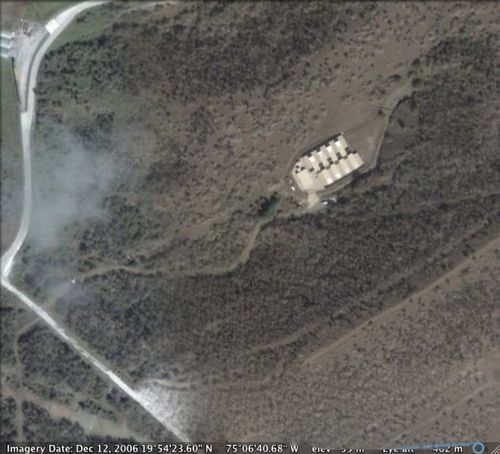
(Photo: a mysterious building in the Gitmo compound.)

Which Birth Certificate?

Ben Smith thinks I’ve glossed over a major difference between Obama’s birth certificate and Trig’s:

The Obama conspiracy theory had bearing on his eligibility for the White House. Palin, by contrast, isn’t running for anything, and if she were, the constitutional requirement bears on your own birth, not your kids’. If Obama hadn’t released his birth certificate, it wouldn’t have been unreasonable to ask for it. Indeed, reporters are supposed to ask obnoxious questions. But Trig Palin isn’t running for president, and that makes this fixation a bit harder for me to get exercised about.

 Justin Elliott’s response to me makes the same point:

[I]n the case of Obama, his place of birth presented a potentially urgent constitutional problem. If Obama had been born abroad, there would have been questions about his eligibility to be president, hinging on the murky definition of the phrase “natural-born citizen.” Absurd as it all seemed, there was a reason in 2008 for a reporter to ask the Obama campaign for a copy of the birth certificate. (And remember: Obama wasn’t the only ’08 candidate who faced questions from the press about the circumstances of his birth.)

The parentage of Trig Palin presents no similarly urgent issue.

Agreed. But if the only basis for asking for documentary evidence of various biographical facts in a politician’s campaign is that they pertain to core legal eligibility for public office, then there would be no journalism at all. On what grounds did reporters uncover that Richard Blumenthal had lied about his war record? Surely not that it would have legally disbarred him from office. The man is still in office. But Blumenthal’s war record was only a minor theme in his biography and his mis-statements were few and far between. They were not an integral part of his campaign’s message or a central part of his appeal to his base. And there was no obvious reason to doubt him. The story was even ginned up by his political opponent in a campaign. And yet the New York Times rightly had no qualms about running a big story refuting his occasional untrue statements with empirical data. And Politico rightly had no qualms doing its own investigation. How does Justin defend this, given his current refusal to get on the phone and ask Palin for proof? Or talk to more than other journalists?

Palin, moreover, unlike Blumenthal, has reiterated her birth and pregnancy stories many many times. She has written a book detailing it all. She has been obsessed with rebutting it since it first emerged months before she hit the national spotlight – and yet has consistently refused to do so by what Frank Bailey called the “simple solution”. She held up her newborn child at the Republican national convention. She ran for vice-president of the US – not even the Senate. Her local newspaper tried to clear all this up – only to be stonewalled by Palin. Her doctor refused to take calls from the New York Times which ran a puff-piece on the whole thing. But Salon is uninterested. And Politico won’t go there.

The question before us is: why? Are they scared? Or squeamish? No journalist has any business being either. And simply stating the following is a cop-out:

We’re prepared to do that right here and now: Sarah Palin, we’d be happy to see and publish your medical records. But the point of our package is that Palin simply doesn’t need to do this — there is no credible evidence to suggest that anyone other than Sarah Palin is the mother of Trig.

Has Salon ever aired the countless questions so many have had about this bizarre pregnancy? Or the persistent disbelief around it? About the wild ride? By not even acknowledging the natural skepticism of people toward these strange narratives, by arguing there is nothing fishy here at all without even going into what people have found fishy, is also a cop-out. It’s basically an insult to the many people who remain genuinely puzzled by all this.

This blog, moreover, has diligently offered up evidence on both sides. Salon will not publish anything that might counter their a priori position. I mean: how many politicians in history have claimed that they gave a political speech while experiencing contractions? If that isn’t de facto curious and remarkable enough to be worth asking about, what is? And yet no one – even those supportive of her – will go near that question. Why on earth not? Here’s what counts for journalism today:

“She went into labor and got an airplane to go back to Alaska — that’s pretty cool!”

If that’s your standard of skepticism in today’s press corps, you get to host Meet The Press.

There is also the matter of consistency. When a politician has publicly claimed she has produced a birth certificate and hasn’t, is it illegitimate for the press to ask why she simply lied about this? Can any sane person misremember such a thing? And if she’s claimed she has released it, what on earth is the ethical reason for not asking her to do it along with medical records? When she publicly derides skeptics in speech after speech, is it not the press’s duty to see if her derision has empirical validity? Or are we skeptics supposed to just sit back and be mocked by a pathological liar putting her own credibility against ours?

We all have cognitive biases. I have one – profound skepticism of anything Palin says – and may be judging evidence in ways that others wouldn’t. But so do Justin and Ben and Weigel who have an interest in dismissing the possibility that they may have missed uncovering the biggest hoax in American political history. That same cognitive bias question applies to Loy and Quinn. It does not mean they they may not be right. It just means that their cognitive bias is as real as my own.

It seems to me that when some simple, readily available medical records could end this excruciating debate in one easy swoop – and could have more than two years ago – it is professional negligence that the MSM won’t even ask for such proof, and devote far more energy to defending their own past than the facts at hand.

Trig Wars

I'm going to respond to Justin Elliott's alleged "definitive debunking" of the questions surrounding Sarah Palin's maternity of Trig in due course. It deserves more than an instant reaction – and adds two new sources to the dozens that have now emerged to shed partial light on the story. In the end, there are two stories here: the actual story and the meta-media-story. I'm interested in both equally. And the visceral contempt and dimissal for me personally is sadly a part of the latter.

One aspect of the meta-media-story is media intimidation – from within and without. MSM reporters tackling anything to do with the Palin pregnancy have to overcome what they know will be Img-article---ries-wonkette-trig-palin_201153649802 the spin from the Palinite right: that they are just liberal maniacs bent on destroying this real and talented hope for conservatism, precisely because she is such a hope for conservatism. This dynamic is one MSM reporters have internalized, making what would be routine questions and investigations of a public figure in, say, reality TV or national politics into exceptional and career-risking gambles.
Imagine a huge media backlash and internal restraint about, say, Lindsey Lohan's drug use or Britney Spears' romantic and pharmaceutical forays. No, I can't imagine it. But when politics and tabloid truth combine – think of the John Edwards story – the MSM can suddenly find itself mute. Part of this is genuine: the desire not to pour salt onto the wounds of Elizabeth Edwards or to make the life of a new-born kid with Down Syndrome any more challenging than it might already be. Part of it is simply discomfort. Wouldn't it be less fraught to cover the budget negotiations? Part of it is about status: all of this is beneath me, and hurts my reputation as a Serious Journalist, respected by my peers.

But then there's this. What Wonkette published about a completely innocent little boy was, as I said as soon as I absorbed it, despicable. Whatever may be the truth behind all the Palin pregnancy stories, even if the zaniest theory is true, Sarah Palin is taking care of a child with Down Syndrome who deserves respect and privacy even if his own mother refuses to give them to him. To mock him, the most defenseless figure in this whole saga, is just foul. I've made my position on this question very very clear from the beginning. The only person who truly deserves protection from this media mayhem is Trig himself. I'll go further and repeat what I have written from the very start. I deeply admire and respect Palin for doing what she has done in giving this child a home and a life. It is more of a sacrifice than I will ever know. And more of a joy than I will ever know. We can be journalists but we can also be humane toward children and see the good that someone has done as well as the bad.

But the blowback has not just been rhetorical. It has been to bring the entire site to its knees. The  buycott of Wonkette's advertizers has led to almost all of them fleeing immediately:

Starting with Papa John’s Pizza, the companies began to run. It grew from there. As of Friday afternoon, the list was 30-some strong, and includes brands like Huggies, Vanguard Group, Nordstrom, Bob Evans, and StarKist Charlie—the tuna mascot. [See the list of Wonkette’s remaining advertisers.]

I feel as queasy about this flexing of Palinite muscle as I do about the original, disgusting, asinine story. In some ways, I see a legitimate come-uppance for a tacky site that published a simply inexcusable piece of mean-spirited dreck using a child who cannot defend himself, treating him as if he were subhuman, which he most definitely isn't. But I also recoil from mob action like this, for the impact it has on fearless free speech and the chilling effect it will have on an already cowed and defensive MSM when covering the truly tough stuff about Palin.

A “Rigorous” Theology

[Re-printed from earlier today]

David Brooks is at his customary acute in reviewing The Book Of Mormon. But he misses, in my view, a critical step. Here's his bottom line on religion:

The only problem with “The Book of Mormon” (you realize when thinking about it later) is that its theme is not quite true. Vague, uplifting, nondoctrinal religiosity doesn’t actually last. The religions that grow, succor and motivate people to perform heroic acts of service are usually theologically rigorous, arduous in practice and definite in their convictions about what is True and False.

That’s because people are not gods. No matter how special some individuals may think they are, they don’t have the ability to understand the world on their own, establish rules of good conduct on their own, impose the highest standards of conduct on their own, or avoid the temptations of laziness on their own.

The religions that thrive have exactly what “The Book of Mormon” ridicules: communal theologies, doctrines and codes of conduct rooted in claims of absolute truth.

So David uses the limits of human reason and self-restraint to make a pragmatic case for fundamentalism. And this is, indeed, a core problem – perhaps the core problem – for organized religion in modernity. Mark Lilla pursues this theme in his under-appreciated book, The Still-Born God, which, in a gripping narrative, exposes the failure of liberal Christianity in modern Germany – a failure that led, in part, to Nazism. Since the godless totalisms of the 20th Century have now collapsed under the weight of their own lies, new totalisms – literal, fundamentalist, anti-enlightenment versions of religion – have taken their place.

And this is in part the argument of The Book Of Mormon, which was written and composed by atheists. It is that religion, even if obviously based on a massive scam, is nonetheless useful and even admirable in its encouragement of moral life. That's what I meant by describing the musical's message as "religion is both insane and necessary."

But the ultimate test of religion for a non-atheist is not: is this or that religion useful? Or even: is it necessary?

It is, rather: is it true?

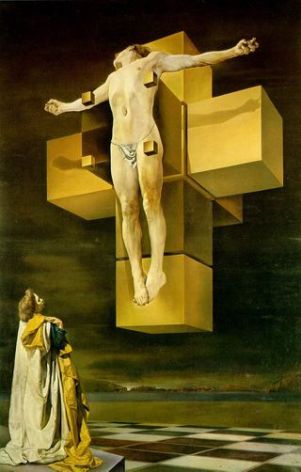
And The Book Of Mormon rather deftly shows that, by any rational perspective, the literal Dali_Crucifixion_hypercube doctrines of Mormonism are manifestly untrue – perhaps because they are more easily exposed because they are so recently concocted. And that's why, to my mind, it is insufficient or condescending to argue that the literal truth claims of fundamentalist religion are irrelevant, as long as they reliably lead to happiness of morality. On this, I side with the new atheists who do literalist believers a service by taking them at their word.
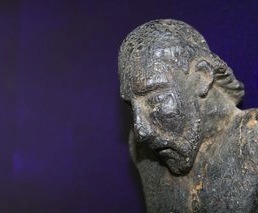
My own view is that if Christianity is a useful lie then it should be abandoned by thinking people. If being a Christian requires one to believe literally that the world was created de novo 6,000 years ago, or that our species literally emerged one day from an actual garden of Eden, then I am not a Christian. It's my view that if something is not true, it cannot be countermanded by a God who is Truth itself. And so a sincere modern believer has no choice but to make distinctions between kinds of truths – metaphorical, spiritual ones and empirical, literal ones.

We cannot deny Darwin without also denying God, to put it provocatively, since God cannot be in contravention of Truth. And sincere Christianity is a faith, it seems to me, that can embrace the deepest truths about human existence and salvation as revealed by Jesus without also embracing every empirical nugget in the flawed, mis-copied, mis-written, second generation oral accounts of the life of Jesus, let alone the even older myths and stories the Jewish people told about themselves through the millennia.

And so, on Good Friday, we cannot know what actually happened in those last minutes on the Cross. Did Jesus cry out in despair, "My God, my God, why have you forsaken me"? Or did he utter in completion the words "It is accomplished"? This is the literal choice we have between the Gospels of Matthew and John. They cannot both be empirically right. And they are not signs merely of the confusion that often comes from individuals' last words and moments. They indicate radically different ideas of Jesus' moment of truth: was he so human that even then, he still did not know for sure that his self-sacrifice was for something – or so divine he knew in advance the itinerary he tried not to choose in Gethsemane?

To my mind, the truth is both at a deeper spiritual level; even if both is literally an impossible position to take on Rt-picempirical grounds. Ditto the Resurrection. Was it a literal, take my shroud off and walk out experience? Or was it something more mysterious? Again the Bible tells us all sorts of contradictory things: Jesus is tangibly physically resurrected; he is strangely altered; those close to him can see him after his death and yet not recognize him at all on the road to Emmaus. These cannot all be literally true and yet they all point to a mystery at the core of our faith: He is risen.

My difference with David, I think, is that I still believe; and I refuse to believe in something that has been disproven, however socially useful or salutary or admirable its social or personal effects may be. Fundamentalism, in this sense, is not a rigorous theology. It is rigid resistance to a rigorous theology. It's a form of denial and despair. It is rigorous only within a theological structure that does not account for the growth and expansion of human knowledge. It is therefore, to my mind, an expression of a lack of faith rather than an excess of it. And the use of fundamentalism by those who do not even believe in it – for whatever purposes, good, bad or indifferent – is the real blasphemy.

Does a force exist that is behind everything we are and see and know? Is that force benign? Does that force love us? Was the only way that truth could be revealed was by God becoming man and sacrificing himself to show us the only way to save ourselves? Today, in the darkness of the Cross, I say yes to these questions, which go to depths that literal parsing of parables or Gospels misses entirely. Which is why Scorsese's version of the Passion is so much deeper and truer than Gibson's.

Perhaps this is too much for us. We are not gods, as David says. But in the face of this difficult task of faith, we have God to fall back on. Precisely because we are human. And we were given reason for a reason.

In the beginning was reason. And reason was with God. And reason was God.

This beginning of John's Gospel – I'm translating logos as reason – is my faith. And it is why fundamentalism is not my faith. You cannot set truth aside, even if you cannot fully see it. And you must not use truth, as if its truth did not finally matter; it must stand alone. As we must. Till the hour of our death as well.