
I’m Now Joseph Farah?

Palin32608k

Salon's Justin Elliott says he has definitively resolved all conceivable doubts about Sarah Palin's biological maternity of Trig. I have to say my first instinct is to thank and congratulate him for doing what should have been done a long, long time ago. Before I go into the details, let me first, however, address the following canard:

Sullivan's refrain on this issue is that he does not endorse any conspiracy theory, he is merely asking questions. He simply wants Palin "to debunk this for once and for all, with simple, readily available medical records." He has proposed, for example, the release of "amniocentesis results with Sarah Palin's name on them."

It's worth noting that this posture is identical to the rhetoric used by Obama birthers (for instance, WorldNetDaily Birther czar Joseph Farah employs the "just asking for definitive piece of proof x" line here).

This is absurd. Obama has produced the most relevant, clear, unimpeachable, if humiliating, piece of empirical evidence that he is indeed a native-born US citizen. In fact, he produced it a long time ago. (I think he was right to do so, and the press was easily within bounds to ask. That's how these things should work.)

And there is a huge difference between someone asking for exactly that kind of proof, however distasteful, and someone continuing to ask for it after that proof has already been produced.

To equate my simple request for proof – a request first made in September 2008 – with a request for evidence even after it has been produced is not "worth noting." It's a smear.

And I have not shifted this position since the very beginning. In my view, a journalist doesn't have to engage in any consipracy theories in order to ask a public figure to verify a story that they tell as a core plank of their political candidacy – especially when verifying it should be easy. When the figure has publicly said she has already released the birth certificate – and she hasn't – and when she demands further digging into the Obama birth certificate after it has been produced, and when she once demanded that her opponent for the mayoralty of Wasilla provide his actual marriage license to prove his wife was his wife (and he did), I see no reason whatever to apologize or regret asking her to put her medical records where her mouth is. She still hasn't.

Did Elliott ask Palin to do so himself? If you want an end to this, that is what you would do. It appears he hasn't. He has asked fellow journalists what they saw and believed. I'm not sure why a reporter decides to ask fellow reporters for eye-witness accounts when he could simply ask Palin for proof. Well, I do see why – which I'll tackle in a forthcoming post.

(Photo: Sarah Palin on March 26, 2008, three weeks before giving birth to a six-pound baby).
“Culturally, He Isn’t”

A blogger occasionally 24Cover-popup majority of Americans don't qualify either. Obviously, I don't consider this a negative. Obama is also bi-racial, instantly putting him in a relatively (if decreasingly) rare cultural position. And I think it's overly defensive to insist that Obama is in no way different than most Americans. He is. His formative years were spent shuttling between Indonesia and Hawaii, missing his Kenyan father. You cannot read "Dreams From My Father" without intuiting a very distinctive man in the history of the American presidency. I think it's a big advantage especially in foreign policy. And I think it's a transformative moment in the evolution of America – a multicultural, multiracial experiment in democracy that has a president that reflects its future.


And then you read a beautifully crafted piece like Janny Scott's profile of Obama's mother, Ann Dunham, and you see again how Obama is a human kaleidoscope. Look at him from a variety of angles, and it's almost as much a Rorschach test for you as for Obama himself. Here's one take on the president's extraordinary composure while being subjected to some of the more enraging racial (and often racist) scrutiny one can imagine. I know at some point, in a similar situation, I would have snapped. He never has. How has he done this? Well, this helps:

After lunch, the group took a walk, with [nine-year-old] Barry running ahead. A flock of Indonesian children began lobbing rocks in his direction. They ducked behind a wall and shouted racial epithets. He seemed unfazed, dancing around as though playing dodge ball “with unseen players,” [American ex-pat Elizabeth] Bryant said. Ann did not react. Assuming she must not have understood the words, Bryant offered to intervene. “No, he’s O.K.,” Ann said. “He’s used to it.”

And Roger Ailes thought he could race-bait him by running round-the-clock videos of a snippet from Jeremiah Wright! Then this:

“We were floored that she’d bring a half-black child to Indonesia, knowing the disrespect they have for blacks,” Bryant said. At the same time, she admired Ann for teaching her boy to be fearless. A child in Indonesia needed to be raised that way — for self-preservation, Bryant decided. Ann also seemed to be teaching Barry respect. He had all the politeness that Indonesian children displayed toward their parents. He seemed to be learning Indonesian ways.

“I think this is one reason he’s so halus,” Bryant said of the pres­ident, using the Indonesian adjective that means “polite, refined, or courteous,” referring to qualities some see as distinctively Javanese. “He has the manners of Asians and the ways of Americans — being halus, being patient, calm, a good listener. If you’re not a good listener in Indonesia, you’d better leave.”

I understand him a little better. This context matters in assessing this president. Especially when you see it as an asset rather than a marker of otherness.

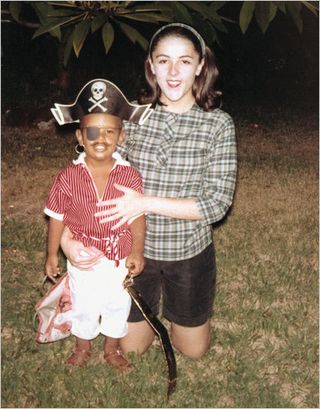
(Photo: from the NYT courtesy of Ann Dunham's friends and family.)

A Modest Proposal On Healthcare Costs

This popped into my mind last night, after reading Gregg Easterbrook's somewhat glib piece about why wealthy liberals should just voluntarily pay more to the government than the law requires them to. The more you try to figure out ways to square the healthcare costs circle – fiscally and morally – the harder it gets. But this option is easily grasped and needs no government action.

If everyone aged 40 or over simply made sure we appointed someone to be our power-of-attorney and instructed that person not to prolong our lives by extraordinary measures if we lost consciousness in a long, fatal illness or simply old age, then we'd immediately make a dent in some way on future healthcare costs. A remarkable proportion of healthcare costs go to the very last days or hours of our lives.

This seems to me particularly apposite for the boomers who, even if Paul Ryan got his way, would still be grandfathered into the most generous combination of personal prosperity and government support of any generation in history. Wouldn't a few fewer unconscious hours or days be a sacrifice worth making?

Of course, this would be entirely voluntary – and not even nudged (although, frankly, I see no reason why the government shouldn't nudge you to make arrangements ahead of time given that others will be forced to pay the costs). "Death panels!" Christianists would scream, revealing exactly how un-Christian they are. Christians, of all people, it seems to me, have nothing to fear from death, and a great deal to gain from giving a few of their own unconscious final days to make it feasible for others to have a few more conscious and healthy ones.

How about an easily reached website that makes such a legal process easier to accomplish?

How Change Really Happens

Pamela S. Karlan uses the example of Loving v. Virginia, on interracial marriage, to argue that marriage equality won't necessarily be decided in the Supreme Court:

Loving was the end point of a sustained assault on racial discrimination, and most of the troops in that campaign were not Supreme Court justices. … By the time the Court decided Loving, the vast majority of states had already repealed laws forbidding interracial marriage. Loving was decided a generation after the California Supreme Court, in Perez v. Sharpe, had used the Fourteenth Amendment to strike down California’s ban on interracial marriage. (In contrast to the California Court, the U.S. Supreme Court disingenuously dodged the marriage issue for a decade, apparently because it feared that a decision striking down bans on interracial marriage would imperil support for Brown.)

Rather than anticipating progressive social change, the Supreme Court most often reflects it.

This seems to me particularly true when the premise of certain arrangements genuinely shifts in the public consciousness. Once homosexuals became defined as people with a certain core identity rather than as people with a propensity for certain acts, a whole series of logical steps followed. My own view is that the law has largely followed this shift in underlying attitudes, and these attitudes have primarily changed simply because more straight people know more gay people. And unlike racial minorities, many of these gay people were those already known and embedded in existing families, communities and churches. How, one wonders, do fundamentalists really keep insisting that gay kids in their own churches and colleges are less aware of who they actually are than their preachers and politicians?

In one of the most tragic ironies in recent social history, this greater knowledge of gay people was accelerated by the AIDS epidemic. Our deaths remade our lives. I wonder if, without such a catastrophe – three times as many young Americans died of AIDS than died in Vietnam over a similar period of time – we would still be decades behind where we are.

When Reporters Die

SWEATChrisHindros:Getty

The Dish is reeling today from the news of the untimely deaths of two extraordinary journalists – killed in Misurata by Qaddafi's forces (Beast homage here). Tim Hetherington's Restrepo is easily the finest film on the US intervention in Afghanistan. If you haven't seen it, stream it, rent it, Netflix it. It was far too good to win an Oscar. And its magnificence comes from its directorial restraint. Somehow, Hetherington and Sebastian Junger managed to take themselves out of the picture altogether, and allowed the events, the faces, the human beings to tell their own story with the cumulative power that actual reality television or film-making requires. There's a good interview with Hetherington here, and a book of photographs, Infidel, available here. Chris Hondros's work has been a staple of Dish coverage for the past few years. The great privilege of a blog like this one is being able to scour the output of photo-agencies and find images that cannot fit into a daily newspaper, but which sear into one's consciousnessness.

Some believe that the role of old-fashioned being-there reporters is antiquated with the emergence of citizen-journalism, YouTube, Twitter, and blogging in general. I certainly think these new media and ways of bringing the truth about the world to light are amazing. That's why I do what I do. But I have never believed there is a replacement for on-hand reporting. Citizen journalists witness and broadcast. Men and women like Hetherington and Hondros do that but with professional skill, the eye of an outsider, and the capacity to edit. And they exhibit in some ways more courage than those in the midst of their own lives and conflicts because they do not have to be there. They choose to be there, and to bear witness to the struggles of others. A human being is a human being and journalists' live are not more worthy than anyone else's. But when men like these perish, there is a special darkness in our hearts. Because we know less, can care less, and can turn away from less because these men are gone.

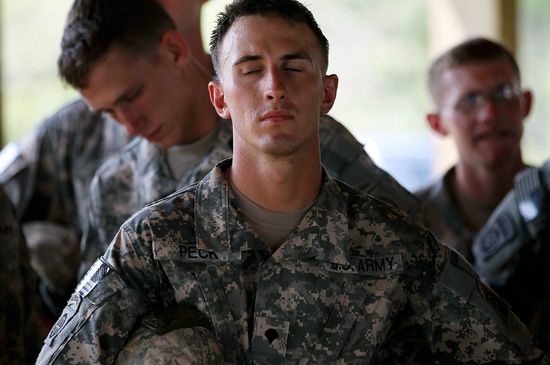
(Photo: A paratrooper in the First Brigade of the US Army's 82nd Airborne Division stands in summer heat after a parachute training jump August 6, 2010 at Camp Mackall, a training ground of Fort Bragg, North Carolina. The First Brigade, which just returned from a year-long tour in Iraq, were required to take the parachute jump as part the 82nd Airborne regulations in keeping all paratroopers' jump training current. By Chris Hondros/Getty Images.)

The Church And The State

Over the last couple of weeks, readers may have noticed that I'm wrestling with more than even my usual conflicts over the budget. The conflict is actually pretty simple. I believe the federal budget crisis is real and must be tackled by a radical reform of tax and spending soon. I also find it morally hard to deny vulnerable people healthcare that is available and far more effective than ever before in human history.

Hence my mixed response to the Ryan and Obama plans. I agree with Ross that the Ryan plan was indeed brave (perhaps insanely so) as well as deeply flawed (it seems absurd to me to rule out any net increase in tax revenues when the debt is this damaging, and loopy to insist still on supply-side fantasy when it comes to future growth). I agree with Ezra that the Obama plan is preferable in terms of suppressing healthcare inefficiency, but still doubt it's radical enough to save us from mounting debt without centralized and politicized rationing on a scale we've never seen before.

But the Catholic Church is pretty clearly in favor of Obama's vision rather than Ryan's. I don't need this April 13 statement to know that, but it is clarifying:

"The moral measure of this budget debate is not which party wins or which powerful interests prevail, but rather how those who are jobless, hungry, homeless or poor are treated. Their voices are too often missing in these debates, but they have the most compelling moral claim on our consciences and our common resources. A just framework for future budgets cannot rely on disproportionate cuts in essential services to poor persons. It requires shared sacrifice by all, including raising adequate revenues, eliminating unnecessary military and other spending, and addressing the long-term costs of health insurance and retirement programs fairly."

This you won't find at NRO – because it sounds a lot like Obama's speech on Wednesday.

Now I don't believe Catholics should have their policy decisions made for them by the USCCB; that would be Christianism. But a humane concern for the poor, sick and elderly is integral to the Gospel message and spirit. And my own gut-unease about withholding available healthcare – perhaps more than any other good – from the needy is rooted, I think, in this Catholic admonition.

The Bishops are often cited by men such as Newt Gingrich as unquestionable authorities when it comes to questions of abortion, marriage and euthanasia. So it is perfectly fair to confront Newt with the stark distinction between his views on the budget and the Vatican's and the American Bishops'. Does he agree with the Bishops of his new Church? And was the social teaching of the Church one reason for his conversion? Or was it an issue he just agreed to disagree on?

FWIW, here's a blog-spat between a liberal Catholic and a priest in my own archdiocese of Washington. The latest foray is here. It's not as simple as the liberal Catholic makes it out to be – isn't debt reduction part of the common good? – but it's very hard to see how the Ryan plan (with no revenue increases and no cuts in defense) can pass muster even for the most conservative Catholic.

The WWII Model

Newcollege_wall-hall-chapel_oxondude

Rick Hertzberg compares how the US handled prisoners of war during WWII to Guantanamo today:

[B]y the tens of thousands, German soldiers were loaded aboard Liberty Ships, which had carried American troops across the Atlantic. Eventually, some five hundred P.O.W. camps, scattered across forty-five of the forty-eight United States, housed some four hundred thousand men. In every one of those camps, the Geneva conventions were adhered to so scrupulously that, after the war, not a few of the inmates decided to stick around and become Americans themselves. That was extraordinary rendition, Greatest Generation style.

And it makes one weep to see what we have now come to. In the Republican policy riders to the budget deal – one of the more jaw-dropping documents I have read in a while – there was an absolute insistence on not funding the closure of Gitmo. It was that important – to retain something that the entire world sees as a black mark on America and the West.

All war is unspeakable – but there is a civilized as well as a barbaric approach to it. In a civilized culture, you respect how the enemy, however we have to demonize them to kill them, is still human. And so there are limits to what will be done to them if they come into our custody. And there are laws of war to manage this. And then there are those moments, like those German POWs becoming American, when a gesture takes on a grander scale and actually heals.

It would be hard to think of a bloodier war than World War I. Its psychic scars are still profound in Europe. You'll find a war memorial in most English towns, somewhere, and even today, everyone wears a paper poppy in their lapel in November, to honor the fallen in Flanders. And if you go to New College Oxford chapel, you'll also find a war memorial: an etched list of names in stone of those students who died in combat. And in one section, you will see a list of German names, for those German transfer students from New College who went to war to fight against England.

They are still remembered and honored, not as Germans or as Englishmen, but simply as members of New College. I recall the moment I first saw that, and absorbed the values it upheld. It taught me something about what it was to be English, just as the memory of decent American soldiers conveyed what it meant to be an American. 

We need to find that sentiment again. It's still there, but buried in fear.

Home And Dry

Trees

There are days in your life you always remember, days when some great burden is lifted or some grave news changes everything.

This is one of those days.

I remember the moment when I found out I had somehow gotten into Oxford University. My family had never had anyone go to college before, and the day the letter came, I felt my whole world move into a different orbit. I remember my first day in America, and the sense of something truly new and liberating in my 21 years of life. I remember my first kiss with a man, when the world that had previously been black and white suddenly burst into color. I remember the day when I found out I was HIV-positive, and the sky and my heart broke in two. I remember the day one of my dearest friends died in his mother's arms of the same disease. I remember the moment I first saw my first nephew, and simultaneously wondered if I would ever live to see him go to high school. I remember the day I got married, a strange, wonderful, totally integrating moment in my public and private life.

In my in-tray today was a simple email from my immigration lawyer with the content line saying simply "Congrats." I am still a little numb, reeling, unable to really think much, rapidly dialing my family and friends, listening to my husband open the letter over the phone and reading the words "Welcome to the United States." The "green card" was approved.

It has been a journey of 18 years – the promise of a new life and a new start for a jejune, precocious kid from England somehow always coming with an asterisk, the shame of my illness conflated with this crushing fear that I still did not belong and would probably never belong to the country I had fallen in love with.

Nothing scared me as much; nothing was able to get into my heart and soul with this level of anxiety and fear. Not HIV. This was deeper than HIV. It was a threat to the home from where I could fight the HIV.

Nothing in my future could confidently be planned; everything was a gamble that one day,  I could actually, simply, finally be secure in my own home with my own husband in a life that would have been so hard to rebuild from scratch somewhere else. That fear hanging over my head never left me from June 23 1993 to a few hours ago.

How do I explain it? So few understood, and so much had to be kept confidential. How do you express living a life rendered so provisional to friends or strangers who see you as totally secure and have no way to analogize the otherness that followed me around? How do you live somewhere for a majority of your existence and still not know if you could remain for another year, another month, as each visa was sent for adjudication and each trip abroad became full of foreboding. And as the time went by, as the stakes grew, as I put down deeper and deeper roots of work, of friends and of family, the fear actually intensified. How much more traumatic would the uprooting be, when I had reached so deep into the ground?

And then it lifts. And I do not know right now what to do or say. Except to express my love and gratitude for my family and friends and husband who lived through this with me; and to those who helped lift the HIV ban; and to my lawyer who was simply magnificent; and to those who did what they could – and they know who they are – to keep this show on the road.

But I do know this. America remains the great dream, the great promise. For all its dysfunction, it remains an ideal, a place where the restlessness of the human mind and soul comes to rest in a place it constantly reinvents and forever re-imagines. I know this in my bones, perhaps more than many who take this amazing mess of a country for granted. But for the first time in my life, I do not feel somewhere in my psyche that I am displaced, unwelcome, an impostor.

I have indefinite leave to remain.

Why The Healthcare Question Is Insoluble

One very, er, healthy aspect of the debate about Paul Ryan’s proposals for Medicare (and the entire budget for that matter) is that it has stimulated a long-needed reality-based debate about the role of government. It has shaken some of us out of lazy ideology into more pragmatic choices. For the moment, though, let me take a stab at the Big Picture and work back from there. In 2011 we live in a world even our parents could barely dream of. We have the medical capacity to bring Gabby Giffords back to life even after a bullet has gone straight through her brain; we have the scientific ability to model a retrovirus on computers and get to real world treatments in years rather than 418px-Tree_of_Knowledge decades; we are able to give wounded soldiers new limbs and tell cancer patients that hope is real and not be lying. We can map the human genome and devise revolutionary new treatments for previously fatal conditions; and we can extend life beyond any previous human generation’s imagination. Remember all those old black and white movies where you saw scenes in which the father of a sick child simply says “we don’t have the money for the operation.” And little Johnny dies. How far away that passive stoicism now seems. Within a few decades, what was once taken as fate is now rejected as a moral obscenity. Because, given what we have achieved in those decades,  it is a moral obscenity. We are all physical beings and we are never as equal as when we face sickness and mortality. Because we have so feasted on the tree of knowledge, it becomes morally intolerable to prevent its fruit from being given to all. At the same time, as a matter of economics and mathematics, we also know at the back of our minds that we simply cannot give it to all – because these breakthroughs involve huge investment, highly trained experts, and inherently expensive technology. And as the options for health grow, we are forced to make choices that were previously out of our grasp, and those choices make us, in some way, gods. We collectively decide who can live for how long and who can die – because for the first time in human history we really have that choice. In fact, we have no escape from that choice. Healthcare is no longer triage, where sickness and death is the norm; it is an open-ended, blurry range of positive choices, where wellness is the expectation. At some point, then, we have to ration. You see this in socialized systems as well as hybrid ones. In Britain, the National Health Service confronts medical opportunities unknown when it was set up sixty years ago. And so, as the years went by, you saw more waiting lists and more de facto rationing – or a spending splurge under Blair and Brown that was simply unsustainable, and ended in piles of debt. Nonetheless, Cameron is refusing to cut from the NHS – which makes the cuts elsewhere all the more draconian. Why? Because he is a decent chap who has seen family illness upfront, and cannot really deny his fellow human beings the ability to rescue their infant from early death or cure a loved mother or keep someone with HIV or Parkinson’s as healthy as possible. In the US, you see the same process – but where no single entity gets to dictate the outcome. The result? Each agent passes the buck to everyone else – from insurance companies to doctors and hospitals to patients and back to government and then back again. And so instead of rationing by government, we have soaring healthcare costs as the least worst option. We can try to find efficiencies to make these god-like choices less onerous, but it often feels like running down an up escalator. We’re lucky if we merely stay in the same place. In fact, we have long since been going backward – hence the alarming projections of healthcare spending essentially crowding out every other economic or government activity in a few years’ time. We can try to increase efficiencies – and the ACA has not been fully credited with the many good ideas and experiments buried inside it. Or we can do what Ryan proposes, which is essentially severing the whole idea of an entitlement to good health, and turn it into a simple lump sum for seniors, after which they have to pay for themselves or have less health or longevity. Ezra Klein is right to remind us of the distinction here.
Only the ACA is really trying to deliver more efficiency; the Ryan plan simply shifts the responsibility for someone’s health after a given point from government to individuals.

Both proposals therefore make some sense to me. But Obama’s is both more humane and less ambitious in its attempt to solve the basic dilemma. My fear is that the ACA’s admirable experiments in cost control, even if they work, simply will not save enough money to alter the basic reality. And so we can either tackle the widening discrepancy between our expectations and our means politically through a government appointed rationing board or economically through the market. The market feels more manageable and at the same time more callous to me – because to make these choices consciously through the political process turns politics into a citizenry’s version of Sophie’s Choice. Yes: at some point, if you really wanted to hyperbolize and demonize such proposals, you could call these decisions “death panels” for those without great wealth. But the alternative is really hidden death panels, where the market makes the cut, and not the government.

My fiscally conservative mind sees some variation of the Ryan option as the only long-term viable one. You just, at some point, choke off the supply and force human beings to go without. And that’s where my Christian-informed conscience rears its benign head. As a human being, I find it extremely hard to deny another human being the ability and means to cure their sickness, if it is available. Health, one recognizes, is not like other goods; it is the precondition for all such goods. Going without chemotherapy is not like going without an iPad 2, or a car. There is, in other words, an inherent tragedy here. Accepting that tragedy is the first step to trying to ameliorate it. Because we can ony ameliorate this dilemma; we cannot resolve it.

We are humans; but we have no choice now but to play God. And people wonder why in Genesis, partaking of the tree of knowledge is regarded as a fall. This is our fate as truly modern humans.

I don’t really think it’s a fate we can ultimately handle.

(Painting: The Tree of Knowledge by Lucas Cranach.)

Rationing One Way Or Another

GT_DYING_04082011

Here’s one way of looking at the crisis in Medicare and, indeed, private health insurance. The diagnostic advances, pharmaceutical innovations, and bio-technology now available for doctors have transformed the very meaning of what constitutes health. Instead of being a limited number of options for a limited number of diseases, the sky is now the limit. This, of course, is a wonderful thing (without it, I would be dead by now) but it also means higher costs as health shifts from rescuing people from a few diseases to offering people any number of treatments to prevent illness, extend life and promote health. I can’t see any way around this cost. If we want to reduce this giant suck from the rest of the working economy, there are two options: have a government body decide which treatments can be afforded and which cannot; or have patients ration themselves by price. That is one core difference between the Democratic approach and the Republican one. CATO’s Michael Tanner puts it simply enough: “Rationing is going to go on within the Medicare system. It’s a fact of life” given financial constraints, he said. “The question’s going to be, is that decision going to be made by government and imposed top down under the current system? Ryan wants to shift that responsibility to individuals and from the bottom up.” Case in point: The Medicare subsidies proposed by Ryan would barely meet elementary health needs of seniors, and they would have to supplement them with their own savings if they wanted better care. The alternative would be not unlike what happens in Britain, where rationing occurs by waiting lists. My own view is that central government diktat on these things is more likely to provoke anger and even more heated debates and paralysis than now.

Every politician seeking to rein in costs will be called a callous accessory to murder (just take some time to see how the British parliament spends hours debating abstruse medical procedures and expenditures best left to doctors and patients). It will make “death panels” and “death traps” key parts of the political discourse.

But it also seems to me that empowering patients to choose from a variety of health plans should also include empowering them to make end-of-life decisions ahead of time. So much healthcare expenditure occurs by keeping people alive for a few more final days in an ICU. If only a fraction of Medicare recipients were asked – just asked – to consider a living will, and made one, we could move those huge and, in some cases, needless expenditures toward preventive care or better options for all seniors. But Paul Ryan will have none of that. And by abolishing Obamacare, he would also kill off several important cost-control pilot schemes. There’s a lot of good in his proposal, but also a lot of partisan posturing and bullshit math.

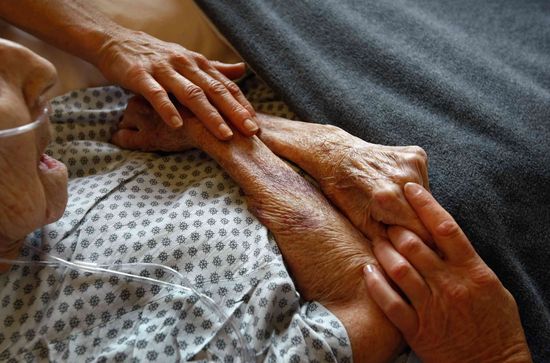
(Photo: Hospice volunteers caress the hands of terminally ill patient Annabelle Martin, 92, as her health quickly declined at the Hospice of Saint John on September 1, 2009 in Lakewood, Colorado. The non-profit hospice, which serves on average 200 people at a time, is the second oldest hospice in the United States. The hospice accepts patients regardless of their ability to pay, although most are covered by Medicare or Medicaid. End of life care has become a contentious issue in the current national debate on health care reform. By John Moore/Getty Images.)