Back To The Bush Years … ?

Bush Asks Congress For $74.7 Billion In War Aid

My own dismay (even bewilderment) at the current mood in America may well be because I was largely off-grid in August. But it’s still a truly remarkable shift. In a month, the entire political landscape has reverted to Bush-Cheneyism again. I honestly thought that would never happen, that the grisly experience of two failed, endless wars had shifted Americans’ understanding of what is possible in the world, that the panic and terror that flooded our frontal cortexes from 9/12 onward would not be able to come back with such a vengeance. I was clearly wrong. Terrorism does not seem to have lost any of its capacity to promote total panic among Americans. The trauma bin Laden inflicted is still overwhelming rationality. It would be harder to imagine a more stunning success for such a foul mass murder.

The party that was primarily responsible for the years of grinding, bankrupting war, a descent into torture, and an evisceration of many core liberties is now regarded as superior to the man originally tasked with trying to recover from that experience. The political winds unleashed by a few disgusting videos and a blitzkrieg in the desert have swept all before them. And we now hear rhetoric from Democratic party leaders that sounds close to indistinguishable from Bush or Cheney.

Is it merely panic? I doubt it. I think what’s also coursing through the collective psyche is the thought that Obama told us we were finally out of Iraq – and events have shown that assurance to be shaky at best. A core part of his legacy has had the bottom fall out of it. I don’t think most people – outside the Tea Party – really believe that all would be well if we’d just kept more troops in country the last couple of years. But the resurgence of the Sunni insurgency – now tinged with the most fanatical of theocratic barbarisms – is nonetheless blamed on Obama. Maybe it could have been contained without the beheadings. But they touched so many visceral chords that the Jacksonian temperament, always twitching beneath the surface of American life, simply bulldozed away every conceivable objection and doubt.

But will this last? I have my doubts. The Republicans are actually ambivalent about this war – largely because Obama is the president. For a while, they’ll bash him for not being “tough” enough – as if toughness has been shown to be the critical virtue in the fight against Jihadist terrorism. But when and if it actually comes to ground troops, my guess is that they’ll get cold feet. Apart from the unhinged McCain and Butters, few of them are so delusional to think we should re-occupy the place indefinitely. Maybe ISIS can  do the neocons a favor and engage in some domestic terrorism to ratchet up the global stakes once again – in which case, we will very much be back where we started, our collective memory erased like those lab rats we covered earlier today.

My point is this: when they actually have to choose to go back to Bush-Cheneyism, and an endless, global civilizational war, Americans will not be as gung-ho as they now appear to be, in the wake of ISIS’ propaganda coups and the Beltway’s hysteria.

If the air-strikes do manage to contain the threat, and they don’t provoke another terror attack, Obama’s anti-terror minimalism might even appear the least worst option over time, and his caution admirable in retrospect. My worry, of course, is that the demonization of the president by the Fox News echo-chamber has rendered any sober judgment about his anti-terror policies moot. You can see the deep currents at work here: paranoia about border security, a bigoted belief that Obama actually favors Islamism, and the memes of racism, otherness and barbarism that ISIS both triggers and, in part, is designed to trigger. It doesn’t help that he is at the moment in a two term presidency when we are looking past him to the future, when discontent is inevitable, and in a time when the economy continues to pummel the working poor and the middle class.

Like me, Peter Beinart is alarmed by the change in the national mood:

The GOP’s advantage on “dealing with foreign policy,” which was seven points last September, is now 18. And the shift toward Republicans has been strongest among women. In August, women were 14 points more likely to support Obama’s foreign policy than men, according to a Wall Street Journal poll. Now the gap is down to two points. In August, white women favored a Democratic Congress by four points. Now they favor a Republican Congress by eight. As in 2002, Democrats are responding by becoming more hawkish. In October 2002, most Democrats in competitive Senate races voted to authorize the Iraq War. Last week, Obama announced a multi-year air campaign against ISIS.

But it doesn’t work. Almost all the imperiled Democrats in 2002 lost anyway. And there’s no evidence that Obama’s new hawkishness is helping him politically either.

The great error was Obama’s effective endorsement of the panic. Maybe if he hadn’t done so, the Democrats would be wiped out this fall. Maybe any president would have had to appear to do something as Americans are beheaded in a desert and the images flood the web. But maybe a determined stoicism and refusal to panic might have undergirded Obama’s core appeal, shored up his base, and in time, seemed far more responsible than Butters’ vapors.

No one said it’s an easy job. But I fear Obama’s pragmatism may have just made it even harder.

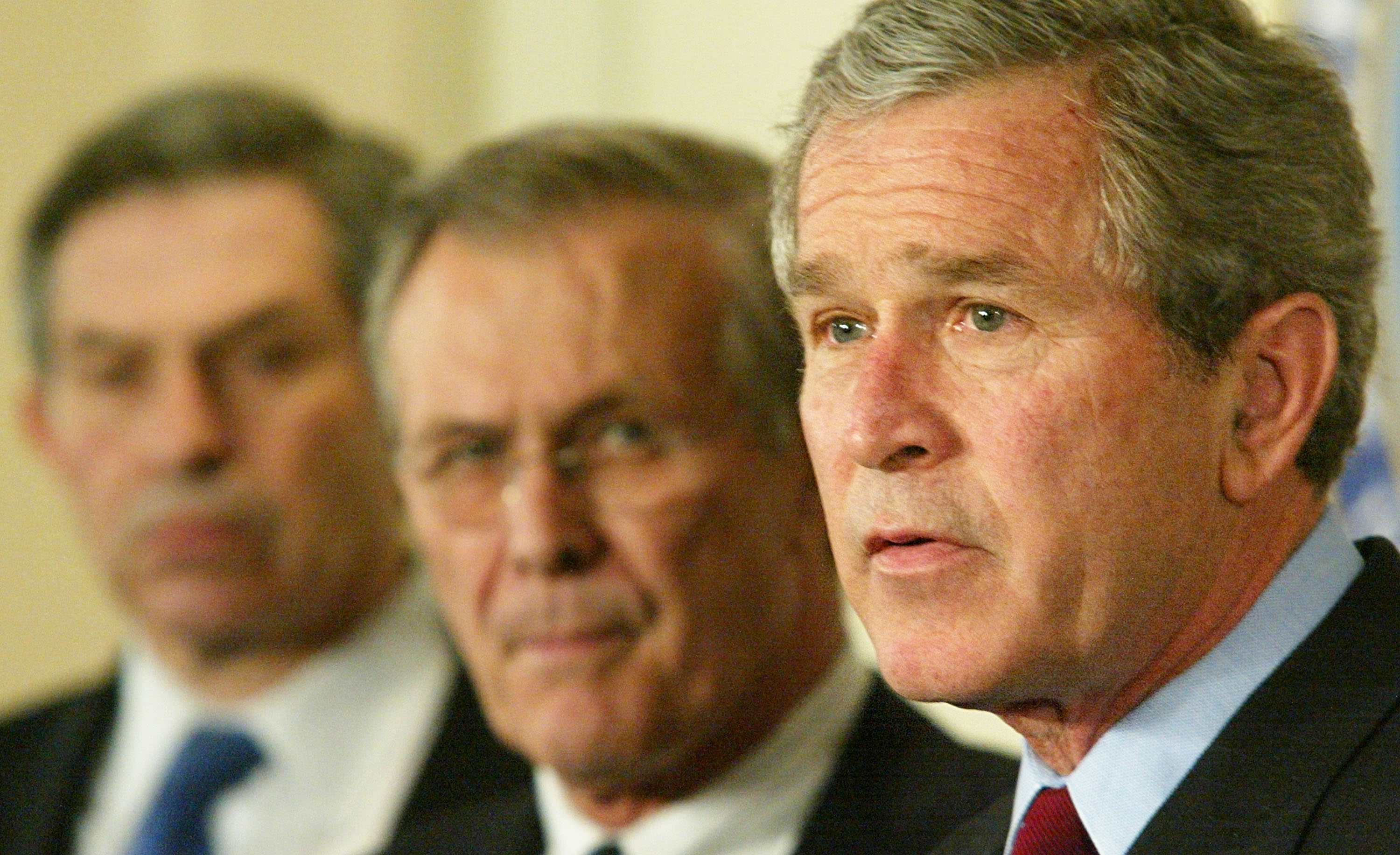
(Photo: U.S. President George W. Bush speaks next to Defense Secretary Donald Rumsfeld and Deputy Defense Secretary Paul Wolfowitz during a visit at the Pentagon on March 25, 2003. Bush asked Congress for a wartime supplemental appropriations of $74.7 billion to fund needs directly arising from the war in Iraq and the global war against terror.  By Alex Wong/Getty Images.)

The Great “Unraveling”?

[Re-posted from earlier today.]

I’m a huge admirer of Roger Cohen’s writing – and can appreciate many of the thoughts percolating in his latest column on what he sees as a disintegration of the world order. He manages to cite Scottish independence, the rise of ISIS, and the devolved powers to Eastern Ukraine – and even Ebola! – as part of a trend toward dissolution and anarchy.

But when I look at all the developments he is citing, I don’t really see anything that new. Take Iraq – please. What we are witnessing is the second major Sunni revolt since they were summarily deposed from power by the United States in 2003. How is this new? The Sunnis have long since believed in their bones that Iraq is theirs by right to govern. They despise the Shiites now running the show. The entire construct Syria_and_Iraq_2014-onward_War_mapof Iraq in the first place was designed on the premise of permanent Sunni rule over the majority. That rule necessarily had to be despotic – as all attempts to permanently deny rights to a majority in the country must be.

So we removed the despot – as we did in Libya – and we have an ongoing power-struggle that is a continuation of the same power struggle Iraq has been hosting since time immemorial. I mean look at that map on the right, from Wiki on the current division of power and land in Iraq. Does it look familiar? It looks like every map of Iraq’s sectarian divide since time immemorial. And we think we will change that by air-strikes?

My fear is that the catastrophic error of 2003 will never lead to a stable state, because the Sunnis will never tolerate or trust majority Shiite rule. Yes, we bribed them enough to switch sides temporarily in the “surge”. But they knew we’d leave; and they knew what they had to do when we did. The only conceivable way to avoid such a scenario would be to stay in Iraq indefinitely – but that too is untenable, for both the Iraqis and for us.

The Beltway nonetheless decided – against all the evidence – that the surge had worked, that sectarian passions had subsided, and that a multi-sectarian government would be able to overcome the profound rifts in Iraqi society that have always been embedded in its DNA. We were sold a bill of goods – by Petraeus and McCain and the other benign imperialists. They have spun a narrative that Iraq was “solved” in 2009 – and that the absence of US troops led to subsequent failure. But they flatter themselves. We never had any real reason to believe these sectarian divides had been overcome – and after a decade of brutal and traumatizing mutual slaughter, why on earth would they be?

Iraq was unraveled in 2003; in my view, it has thereby become the battle-ground for the simmering, wider Sunni-Shiite civil conflict that has also been a long-running strain in the region. Our own solipsistic focus on ISIS as another al Qaeda against us – again the narrative of the utterly unreconstructed neocon right and the pious interventionist left – misses this simple fact. We cannot see the forest for our own narcissistic tree.

When you look at Russia and Ukraine from the same historical perspective, the unraveling meme also seems unpersuasive. Russia is a proud and ornery and mysterious country. It has gone from global super-power to regional neo-fascist state in a matter of decades. Its sphere of influence has retreated from the edge of Berlin to the boundaries of Ukraine, which it simply controlled for an extremely long time.

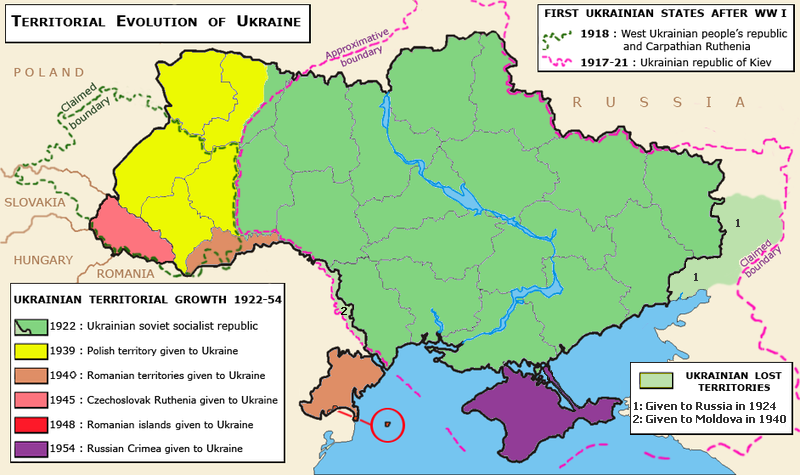
Ukraine has never existed as an independent country for very long; as you can see from another Wiki map on the left, it is itself a cobbled together mix of land lost to Russia, gained from Poland and Czechoslovakia and Romania. It was “given” the Crimea by the Soviets only in 1954. And throughout, Russia has obviously been its big brother, with a deep belief in its right to dick around with its near-abroad (a similar historic belief to the Sunnis faith in their own right to rule).

Ukraine-growthAnd what is sometimes lost in all this is that the last pro-Russian leader of the country was democratically elected and then deposed by a revolution from the European-centered populations of the West of the country. Russia did not start this; it reacted to a sudden, revolutionary loss of a pliant neighbor. Anyone with any inkling of Russian history would know what would happen next. I’m not defending Putin’s military and pseudo-military aggression. I am saying that the resolution reached this week – with significant autonomy for the Eastern, Russian-speaking provinces together with a new trade pact with the EU is a perfectly logical way to resolve this. And if Scotland demands outright independence, who could deny the East Ukrainians for wanting more autonomy?

Then Scotland. I don’t know what will happen – and, yes, the term “unraveling” is the most apposite in this case. But what the campaign has shown is that the unraveling has already taken place, that the desire for self-government and the disdain for the Westminster elites have combined to make the current arrangement anachronistic. But that kind of change – conducted democratically and peacefully – is not the same thing as an undoing. It is an adjustment to an emergent, new reality. And it increases democracy in the UK, rather than diminishing it.

What I’m saying is that America is in great danger of over-reacting to all these things, and blundering into new errors because of a generalized anxiety about declining relative US power, and PTSD from 9/11 in which every Jihadist in a hummer with a knife and a social media presence is imminently going to come over here and slit our collective throats. So my “hysteria” about this new, unknowable, fast-escalating rush to war is actually the opposite. It’s really a call to calm down, to breathe deeply, to stop reacting to the news cycle like neurotic lab-rats and to remember history – ours and theirs.  And to carry on.

I thought Obama was the man to sell this message. But he has been overwhelmed by the collective freak-out. Maybe he’ll regain his composure, keep this war limited and contain these loons for others, with much more at stake, to fight. Or maybe American amnesia will take hold again – and the Jacksonian impulse will once again trump every rational attempt at a foreign policy that isn’t always doomed to repeat the errors of the past. From the way things are going, it’s America’s own history of Jacksonian violence against outsiders that will prevail. We believe we are immune from history – that it can be erased, that what matters is just the latest news cycle and the political spin that can be applied to it. But history will have – and is having – the last word.

The Offense Industry On The Offense

In a really terrific post during my vacation, Freddie DeBoer nailed something to the cross:

It seems to me now that the public face of social liberalism has ceased to seem positive, joyful, human, and freeing. I now mostly associate that public face with danger, with an endless list of things that you can’t do or say or think, and with the constant threat of being called an existentially bad person if you say the wrong thing, or if someone decides to misrepresent what you said as saying the wrong thing. There are so many ways to step on a landmine now, so many terms that have become forbidden, so many attitudes that will get you cast out if you even appear to hold them.

Freddie’s concern was with online hazing of the politically incorrect. Writers are not just condemned any more for being wrong or dumb or rigid. They are condemned as sexist, racist, homophobic, anti-Semitic, blah blah blah – almost as a reflex in trying to discredit their work. That’s particularly true when it comes to fascinating issues like race or gender or sexual orientation, where liberalism today seems to insist that there are absolutely no aggregate differences between genders, races, ethnicities, or sexual orientations, except those created by oppression and discrimination and bigotry. Anyone even daring to bring up these topics is subjected to intense pressure, profound disapproval and ostracism. This illiberal liberalism is not new, of course. But it’s still depressingly common.

Sam Harris is one of its latest victims. There sure is plenty to disagree with Sam about – and we have had several such arguments and debates. But the idea that he is a sexist – and now forced to defend himself at length from the charge after a book-signing discussion – is really pathetic. His account of the episode is well worth-reading for the insight it gives into the Puritanical wing of the left. Michelle Boornstein decided to play the sexist card after a contentious interview, and then tweet it out thus:

Here’s what she was referring to (in her words):

I also asked Harris at the event why the vast majority of atheists—and many of those who buy his books—are male, a topic which has prompted some to raise questions of sexism in the atheist community. Harris’ answer was both silly and then provocative. It can only be attributed to my “overwhelming lack of sex appeal,” he said to huge laughter.

“I think it may have to do with my person[al] slant as an author, being very critical of bad ideas. This can sound very angry to people… People just don’t like to have their ideas criticized. There’s something about that critical posture that is to some degree intrinsically male and more attractive to guys than to women,” he said. “The atheist variable just has this—it doesn’t obviously have this nurturing, coherence-building extra estrogen vibe that you would want by default if you wanted to attract as many women as men.”

This is impermissibly sexist because it assumes that there are some essential biological and psychological differences between men and women, and for a certain kind of leftist, this is an intolerable heresy. If that truth cannot be suppressed or rebutted in a free society, its adherents must be stigmatized as bigots. It’s a lazy form of non-argument – and may have been payback from Boorstein after Harris and she differed quite strongly on the power of fundamentalism in American culture.

But Boorstein’s premise – that because many more men than women seem to buy and read his books, there must be some sexism at work – is preposterous.

Anyone can buy a book on Amazon. There are no gender barriers whatever. The free flow of ideas will often lead to different audiences for different authors. That some books by white Americans are read disproportionately by whites doesn’t mean they’re racist. And, yes, style of writing – especially the combative, testosteroned debates that occur online or typify the slash-and-burn atheist conversation – can lead to a disproportionately male-skewed audience for that kind of thing. But all that is a function of free choice in a free market of ideas – not some kind of institutional sexism – let alone personal sexism. Why we cannot revel in these differences and embrace them as part of what makes being human so fascinating and variable is beyond me. But clearly it threatens people. Reality can.

Then Sam was subjected to a public dressing down by a person in the book-signing line:

She: What you said about women in the atheist community was totally denigrating to women and irresponsible. Women can think just as critically as men. And men can be just as nurturing as women.

Me: Of course they can! But if you think there are no differences, in the aggregate, between people who have Y chromosomes and people who don’t; if you think testosterone has no psychological effects on human minds in general; if you think we can’t say anything about the differences between two bell curves that describe whole populations of men and women, whether these differences come from biology or from culture, we’re not going to get very far in this conversation.

But the conversation is not the point. Even an individual writer’s personality and style is not the point. The point is the enforcement of an ideology by the weapon of stigma and social ostracism. Some favorite lines from the p.c. war:

You should just know that what you said was incredibly sexist and very damaging, and you should apologize … You’re just totally unaware of how sexist you are.

It’s that last line that really gives the game away. It means essentially that a writer cannot win. Or rather: that a writer somehow has to represent all of humanity or risk being regarded and demonized as hostile to whole sections of it. This should be called out for what it is: a full-scale assault on the integrity and freedom of writers in the name of social liberalism. Writers need to stand up to this cant – and not capitulate to it.

For more on the subject of women and atheism, check out the Dish discussion thread, “Where Are All The Female Atheists?” One of those readers brought to our attention the work of the brilliant female atheist Jennifer Michael Hecht, whom we subsequently invited to join our Ask Anything feature to discuss the subject of suicide, explored in her book Stay: A History of Suicide and the Philosophies Against It.

Obama’s New War: Dumb Dumb Dumb Dumb Dumb

President Obama Addresses The Nation To Outline Strategy On ISIS

As you are by all accounts aware, the US now faces its deadliest foe, its most terrifying enemy – the likes of which we have never seen – in the deserts of Iraq. If we do not send ground troops into that country again, we will all die at home, says Butters. 90 percent of the country think we are directly threatened by the new Caliphate. And far from calming the hysteria, our leaders have fanned it.

Very few people in political leadership have laid out what this group is actually capable of, what the limits of its potential are, or examined the contingent reasons behind its recent sudden advance. It has been framed as an abstract but vital fight against “pure evil” – a rubric the originator of the phrase “axis of evil” knows more about than most. Here’s a must-read on reality:

Despite its territorial gains and mastery of propaganda, the Islamic State’s fundamentals are weak, and it does not have a sustainable endgame. In short, we’re giving it too much credit.

Consider the fall of Mosul, which catapulted the impression that the group is a formidable force able to engage on multiple fronts simultaneously and overpower a U.S.-trained army that dwarfs its size. In reality, it was able to gain such vast territory because it faced an impotent opponent and had the help of the broader Sunni insurgency. The Iraqi army, lacking professionalism and insufficiently motivated to fight and die for Sunni-dominated Mosul, self-destructed and deserted. The militants can be credited with fearlessness and offensive mobility, but they can hardly be said to have defeated the Iraqi army in combat. At the time, Islamic State militants represented less than 10 percent of the overall Sunni insurgency. Many other Sunni groups helped to hold territory and fight off Iraq’s Shiite government and Iranian-backed militia forces …

The Islamic State’s capture of Sinjar in the northern province of Nineveh further added to perceptions of its dominance and helped precipitate Washington’s decision to carry out airstrikes in Iraq. But that episode was also misinterpreted. Kurdish forces were not only taken by surprise, but since they had only recently filled the vacuum in Sinjar left by Iraq’s fleeing army, they were stretched too thin and poorly equipped to sustain a battle outside their home territory. Lacking ammunition and other supplies, they conceded the territorial outpost and retreated within their borders in Iraqi Kurdistan.

Read the whole thing. IS is already over-stretched, and the regional powers who are actually threatened by it, have been slowly mobilizing against it. All of that was happening before Obama decided to Americanize the conflict. Immediately, there is less incentive for the regional actors to do the work themselves, and IS now has a global legitimacy – the US president is now its chief enemy! – it can leverage for further recruits.

Those Sunni recruits are likely to come from the region, especially if Shiite forces from Baghdad, Tehran and Damascus are its foes. But more importantly, this titanic global struggle will create and foster indigenous, Jihadist terror in the US in response to the war. The only terror attacks we have suffered since 9/11 have been these kinds of attacks. And we just incentivized them.

Let me be clear. I have no illusions about Jihadism or the evil of ISIS. I passionately oppose everything they stand for in every single respect. I abhor their brutality, their twisted version of religion, their pathetic neuroses disguised as faith, their inability to cope with the modern world, and their foul theocracy. But everywhere this kind of extremism has flourished in the Middle East – think of al Qaeda’s failed attempt to turn Jordan – has collapsed because the vast majority of Muslims – like anyone anywhere – do not want to be governed by these murderous loons. That’s why al Qaeda distanced itself. Zawahiri knows that the Caliphate’s path is self-defeating in the end.

So we had a chance to allow that process to take place, to see regional actors be forced to confront it, to allow natural alliances – temporary and durable – form in that region. But a couple of videos and we lost our shit. I am not a pacifist. I do not oppose all wars. What I am opposed to is a dumb war. What I am opposed to is a rash war. A war based not on reason but on passion, not on principle but on politics.

If that sounds familiar, you’re not wrong. But that was a different person at a different time. And we will all live with the consequences of his capitulation to panic.

(Photo: U.S. President Barack Obama delivers a prime time address from the Cross Hall of the White House on September 10, 2014.  By Saul Loeb-Pool/Getty Images.)

Am I Over-Reacting?

Obama Meets With Iraqi Prime Minister Nouri al-Maliki At White House

Well, it wouldn’t be the first time. Ambers, whose views I deeply respect, urges all of us to take a chill pill. He thinks this is simply part of the global police operation that we allegedly consented to in 2001 and that it’s vastly better and different than Bush’s “Global War On Terror”:

I don’t actually think, in his heart of hearts, Obama believes that the U.S. is going to “war” with anyone. Counterterrorism campaigns do not neatly fit into our black-and-white descriptions of the way conventional wars begin and end. There will never be “victory” in the sense that terrorists will stop trying to attack the United States. What there will be, instead, is managed risk. A constant effort to detect and degrade the threat. A balance of measures — political, military, legal, and otherwise — focusing on the capacity of terrorists to create havoc outside their geographical boundaries. Preventing them from obtaining or developing weapons of mass destruction.

But it seems to me that this ignores one critical lesson we have learned (or I thought we had learned) from the war on terror from 2001 onward. That simple lesson is as follows: American military force to pummel Jihadists from the skies can create as much terror as it foils. Our intervention can actually backfire and make us all less safe. How many Jihadists, for example, did the Iraq War create? Our intervention gave al Qaeda a foothold in Iraq and then, by creating a majority Shi’a state for the first time, helped spawn Sunni support for the Caliphate. If the Iraq War was designed to counter terrorism, it failed. It may well be that any Shi’a majority state in Iraq will always be at war with its Sunnis. Expecting this new government to be any different is mere window dressing for the immense and powerful centrifugal forces beneath.

If the impact of military force were that simple, we could wipe out Jihadism from the face of the earth. But force is never that simple, it’s especially complex in the countervailing myriad of factions and nations and sects of the Middle East, and it wins no friends, and merely makes more enemies. What Ambers is talking about is a global version of Israel’s policies toward the Palestinians. We are “mowing the lawn” with this kind of action, which spawns more hatred of the US, does not lead to a political settlement, and in fact makes such a settlement less likely, and therefore future “police actions” inevitable. It’s a cycle of violence breeding violence, in which we enable and empower Jihadism, rather than insisting that this is a problem first and foremost for the Muslim and Arab world, not us.

So Yemen is no longer producing Jihadists? And Somalia? We’ve turned them into perpetual, low-level Jihadist factories, churning them out as we continue to decimate them.

And our wars in other people’s countries are inevitably unpopular – would you like some distant super-power suddenly striking your town or village? – and so immediately undermine a huge amount of what they are trying to achieve. This is truer now than ever – after the US has been revealed as an incompetent occupier, an inveterate meddler and a practitioner of torture. We are the biggest recruitment tool that Jihadism has ever had.

All of that seems to have been wiped from our collective memory banks in a single month. We do not seem to understand that because there is a problem, we are not necessarily the solution. We may even unwittingly be part of the problem! Now, of course, if terror groups are plotting attacks on the US, I’m glad and grateful that we have a police operation to monitor and take them out when we are in danger. But that is emphatically not the case in Iraq and Syria. ISIS – even the war machine tells us – posed no threat to the homeland – until we intervened. We have created a new and vital narrative that all but encourages loser-wannabes in the West to launch terror attacks because the US is attacking Muslims again. Of course, this isn’t fair to the good intentions of the president, but the Middle East is never fair. We actually begin this war with what we usually end a war with: reluctant allies, pitiful military support, and a commitment from the Arab world that is – how shall I put it? – somewhat typically restrained and two-faced. As for all those arms we have been plying all those countries with? Well, it appears only American arms are really capable of doing anything. Remind me again why we have bankrupted ourselves for this?

A reader captures my mood. I asked my reader if he was as depressed about this whole reversion to the one percent doctrine as I was. He replied:

Yes. Totally and utterly depressed. As in: I give up. It’s as if America (and, more depressingly still, Obama) hasn’t learned a single thing about what feeds jihadism. And they seem to have forgotten totally about the threat of homegrown terrorism (the only form of terrorism that’s actually been successful in America since 9/11), and what feeds that.

And the sheer hysteria from Hagel, Kerry, etc. about the ISIS threat. The job of the president at times like this should be to fight the hysteria, not feed it. Things are so bad that when I think about the Scotland vote I think:  Hey, maybe Vermont will secede and I could move there and not be part of all this. So, in a word: Yes.

And if I could sum up my response to this act of folly and amnesia, in a word, it would be: No.

(Photo: Iraqi Prime Minister Nouri Al-Maliki (L) shakes hands with U.S. President Barack Obama in the Oval Office at the White House November 1, 2013 in Washington, DC.  By Olivier Douliery-Pool/Getty Images.)

The CIA’s Contempt For Our Democracy

I’d argue that one of Barack Obama’s core weaknesses these past six years has been his appeasement of the CIA. It’s an agency that has come to believe that it is above the law, outside any constitutional accountability, and empowered to fight countless little wars – undeclared, covert, and with no democratic checks – and to spy and torture and become what is in effect a paramilitary adjunct to our constitutional armed CIA Director John Brennan Speaks At The Council On Foreign Relationsforces. With that kind of untrammeled power, as well as the capacity to hide itself under the vast cloak of government secrecy, it is not surprising that its chiefs dictate to presidents rather than the other way round.

And so, in its concerted and passionate attempt to conceal its war crimes under Bush and Cheney, it has done all it can to stymie and delay and censor the Senate Intelligence Committee’s inquiry into the torture years. It has tried to turn this vital act of accountability and truth into a partisan affair, in league with Republicans who see nothing wrong with torture anyway and are committed to bringing it back. It actually spied on the Senate Committee itself, an act that is not so much remarkable for its illegality (the law is for others, not the CIA), as indicative of its conviction that it can get away with anything.

The CIA chief, John Brennan, initially denied any such thing – either a transparent, bald-faced lie or a sign that even he doesn’t control the agency he runs. The CIA is, in fact, now so out of control that one of its key defenders and enablers for years, Senator Feinstein, has finally seen it as the threat to our democracy that it is. And yet we still haven’t seen the Senate report, because the CIA so censored it to render it unintelligible, and the bare-knuckled Beltway brawl to bring it to light is still underway. The CIA top brass are not just content with their legal impunity for some of the foulest war crimes, but they want the record erased, obliterated and classified. That way, they set a precedent for future wars and war crimes over which the American people and the American president have little or no control.

The contempt for our democracy continued last week, as McClatchy reported:

Tensions between the CIA and its congressional overseers erupted anew this week when CIA Director John Brennan refused to tell lawmakers who authorized intrusions into computers used by the Senate Intelligence Committee to compile a damning report on the spy agency’s interrogation program …

After the meeting, several senators were so incensed at Brennan that they confirmed the row and all but accused the nation’s top spy of defying Congress. “I’m concerned there’s disrespect towards the Congress,” Sen. Carl Levin, D-Mich., who also serves as chairman of the Senate Armed Services Committee, told McClatchy. “I think it’s arrogant, I think it’s unacceptable.”

“I continue to be incredibly frustrated with this director,” said Sen. Martin Heinrich, D-N.M. “He does not respect the role of the committee in providing oversight, and he continues to stonewall us on basic information, and it’s very frustrating. And it certainly doesn’t serve the agency well.” Sen. Mark Udall, D-Colo., said he was “renewing my call” for Brennan’s resignation.

The person missing here is the president.

John Brennan has been exposed as the head of an agency that clearly broke the law and precipitated a constitutional crisis by spying on its own Congressional overseers, as a bald-faced liar or know-nothing when asked about it, and as someone who continues to refuse to answer basic questions from those whom he is supposed to defer to. The CIA’s explanation for this contempt for Congress is that someone else at the agency should answer the questions:

Levin dismissed Brennan’s defense that CIA Inspector General David Buckley was the appropriate person to answer Feinstein’s questions. “It may or may not be appropriate for the (CIA) IG to answer, but it’s not appropriate for Brennan to refuse to answer. If he doesn’t know the answers, he can say so,” said Levin. Levin continued, “He either knows the information or he doesn’t. If he doesn’t know the answers, OK, tell us. It’d be kind of stunning if he didn’t know the answers to those questions, but if that’s what he wants to say, he should tell us.”

Of course he should. But the ultimate responsibility for Brennan’s misconduct, lies and contempt for his Congressional over-seers belongs to the president who appointed him. And he has backed Brennan to the hilt throughout. It’s past time we blamed Brennan for the rogue CIA now at large. This is the president’s doing. And the president’s policy. And the president’s legacy.

(Photo: Getty Images.)

Why Obama Launched Another War

President Obama Marks Anniversary Of September 11th Attacks At The Pentagon

I wish I could say that my fears have abated somewhat since returning from vacation and finding the country in a bout of total hysteria over ISIS. No, I know I have no legs to stand on when it comes to hysteria, and may be over-reacting to Obama as badly as the country seems to have over-reacted to ISIS.

But consider the following facts as they have emerged this week. The key element of any intervention – as argued by the president – is that we have clear regional allies on the ground. We don’t. The Turks are AWOL; the Saudis claim they will train some Sunni forces to fight ISIS (drawing Iran into bolstering its balancing Shiite force); the European allies are not joining the military air campaign; and the Arab world is deeply suspicious – even when faced with a movement almost every government there despises. Even Jordan refuses to say publicly it is in the fight – and Jordan may be one of the most vulnerable Sunni dictatorships out there.

So let’s be clear: we have waded into a war alone. We seem to regard the ISIS problem far more seriously than anyone in the actual region. We are therefore Americanizing this war almost as soon as it begins, which means that almost everyone in the region will be hoping for our defeat. The hatred for America is deeper than the fear of ISIS:

Even in Baghdad and across Syria, where the threat from ISIS is immediate, reactions were mixed. Members of Iraq’s Shiite majority cheered the prospect of American help. But many Sunni Muslims were cynical about battling an organization that evolved from jihadist groups fighting American occupation. “This is all a play,” said Abu Amer, 38, a government employee, who withheld his family name for his safety. “It is applying American political plans.”

So this is almost a text-book example of the dumb war Obama was elected to avoid. It vitiates everything he has said through his candidacy and presidency. Its potential consequences are utterly opaque and we have no exit plan in the wake of our defeat. And yes – there is no war in the Middle East that leads to victory. It is always some kind of version of defeat.

So you have to ask yourself why. This is a calm and smart president who has just launched a war with no provision for its cost, no end-date, no Congressional authorization, no troops on the ground who can really do the work, and no reliable allies. The worst possible reason is an emotional response to the beheadings and enormous political pressure before the mid-terms. If that’s why he acted, he deserves our contempt. But there is another reason that deserves to be taken seriously. Jeffrey Goldberg puts it this way:

The only possible way to slow ISIS’s progress, and to possibly reverse it in some more-than-negligible way, is to provide air cover and intelligence and logistics support to our hapless allies on the ground. A second reason: President Obama was careful not to speak of an imminent or specific ISIS threat to Americans, because none currently exists. But it is not implausible to argue that a Qaeda-inspired group of limitless cruelty and formidable financial resources, one that has an omnibus loathing for “infidels,” and one that has thousands of members who hold passports from countries that participate in the U.S. visa waiver program, poses a non-trivial threat to American civilians.

The first objective – containing it in Iraq – was underway before this new and open-ended war. It had modest success – although it also precipitated the bait of the beheadings, which gave us this new wave of war. See how things evolve? So the second one is the most plausible. Obama is scared that minimalism won’t be enough, that ISIS could grow in strength, that a new Caliphate could be the final result of a war to bring secular democracy to the Middle East.

So he is acting out of fear. He believes that if you hit ISIS more comprehensively now, you can perhaps keep it at bay. No such threat can be left to fester. If you’ve heard of this kind of mindset before, you’re not wrong. It’s Dick Cheney’s one percent doctrine all over again. In abandoning what he said just last year about unwinding the war machine, Obama holds that the United States must be constantly at war, bombing and drone-striking other sovereign nations in order to prevent terrorist enclaves from becoming more dangerous over time – even when they have made no direct threat to the US, even though they are consumed by their own regional conflicts. But even Cheney was forced to go to the Congress to get authorization. Obama will have no truck with that. This new emperor assesses the threat himself, makes decisions later, and informs us that, whatever we believe, we are now at war again. If no-drama Obama has caved to this kind of hysteria and over-reaction, then what future president will ever be able to stand firm and unwind the cycle? If the un-Cheney Obama has just endorsed a Cheney-like idea of what the executive branch can do on its own, he has all but assured us that a future Republican or Clinton will have a solid precedent to conduct war as if they were emperors.

I can’t believe I have to say this in the Obama era:

the only way the blight of this modern-medieval bloodlust can be turned back is if the Muslim world does it. If we do it, it comes back again more potently, fueled by hatred of the distant empire. If we do it, it gains strength. We may bomb it into some kind of submission, but it will only come back, like a virus, mutated and stronger. Why on earth do you think we are confronting ISIS anyway? It’s because we destroyed the country of Iraq, allowed al Qaeda a foothold, and ISIS exploited the shift to Shiite power in Iraq by becoming al Qaeda’s more brutal successor.

In fact, by intervening, we make a possible regional resolution of these centrifugal forces less likely. By meddling, we could postpone a potential resolution of this long, difficult struggle as the Arab Muslim world tries to come to terms with the modern world. We are actually forestalling a possible Arab future by conflating it with a fight against American intervention.

I’m trying not to despair. I know plenty of you will mock me for over-reacting. And maybe I am and this lack-luster, transparently pointless move is just a gesture to reassure a nervous public and Obama will prevent this whole thing from metastasizing. I sure hope so. I sure hope that by some miracle, this will have some effect. I hope that the Iraqis put behind their sectarian hatred and unite against these fanatics. I hope the people subjected to this new Caliphate rebel against its insanity and evil. I hope this new front doesn’t lead to a wider Shiite-Sunni war or to the collapse of the critical nuclear negotiations with Iran. I hope the president hasn’t just put out a sign to ISIS that says: “You want a war? Come and Fight America.”

But this blog was transformed on 9/11, and has been a searching, grueling attempt to find a way out of that terror and out of the huge errors we made thereafter. Obama, for me, was the only man able to get us there. And he has folded – and you can see he knows it by the wan, listless look on his face. His presidency may well now be consumed by this new war and be judged by it – just like his predecessor’s. And all because when Americans are faced with even the slightest possibility of future terror, they shit their pants and run to daddy.

You know a country gets the future it deserves. And ours may have just gotten a lot darker.

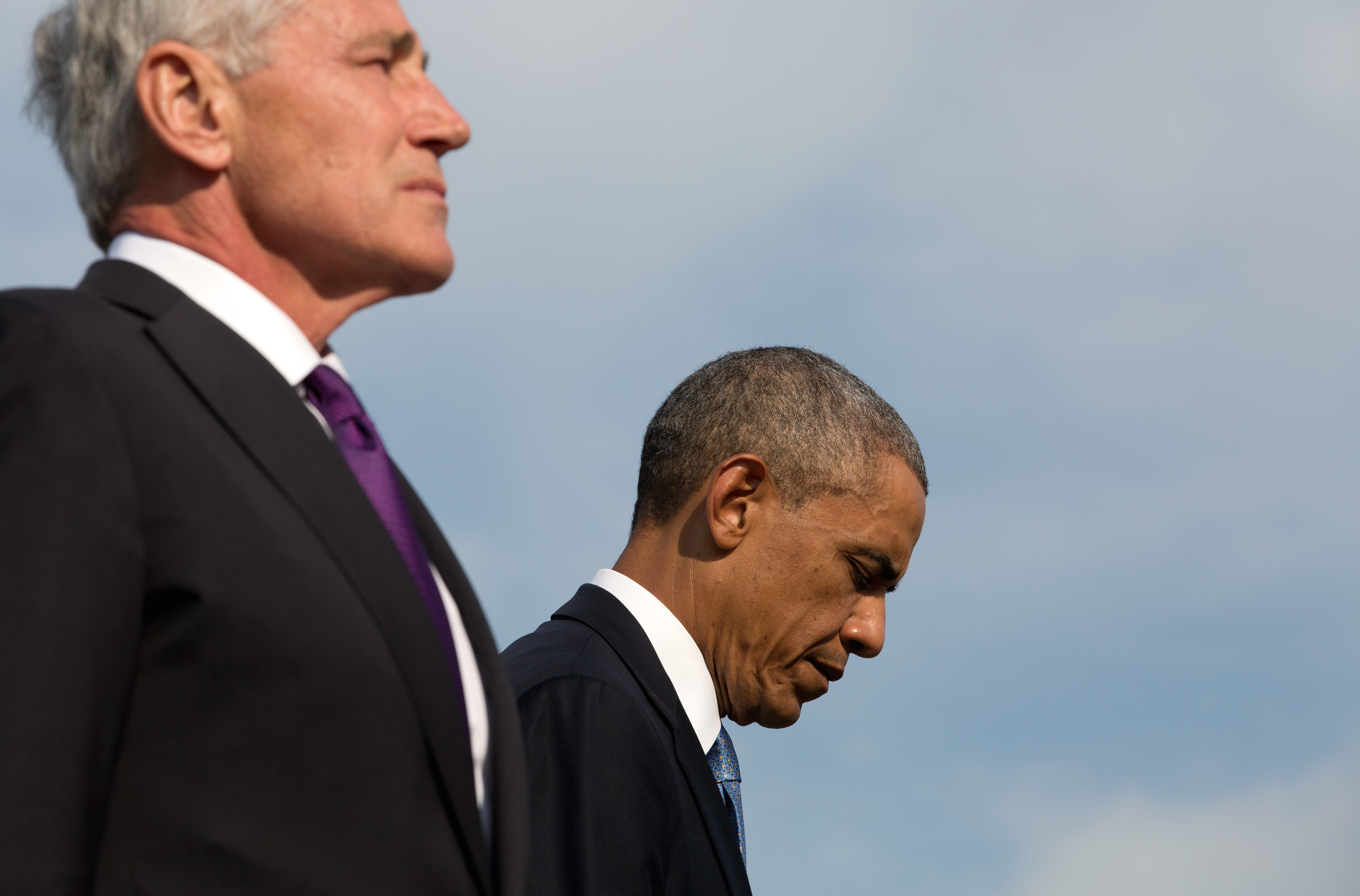
(Photo: U.S. President Barack Obama bows his head, as Defence Secretary Chuck Hagel looks on, during a ceremony to mark the 13th anniversary of the 9/11 terrorists attacks at the Pentagon Memorial on September 11, 2014. By Martin H. Simon-Pool/Getty Images)

A Pragmatism Too Far?

It’s extremely hard to reconcile the events of the past month or so with the rationale of the Obama presidency. And that’s what makes this capitulation to hysteria so profoundly depressing. I can see the simple pragmatism behind it: the president under-estimated the strength and tenacity of these maniacs, and feared they could make further gains, plunging the region into a new turmoil. The media and the elites all jumped into full metal panic mode and created a powerful momentum for action. In fact, the elite consensus in favor of attacking ISIS was, until last night, at least, eerily reminiscent of the elite consensus in favor of going to war in Iraq in 2003 – without the year or so of debate. If US-ATTACKS-9/11-ANNIVERSARY-OBAMAyou’re Obama, you do not believe you can really solve this problem, but you need to do something, both to stave off possible disaster, to guard against potential ISIS expansion, and to try and rescue the Iraqi “state” one more time. So you rely on air-power, you corral the Saudis to help train and fund Sunni opposition to ISIS, you funnel some arms to the “moderate” Syrian rebels … and hope for the best.

What this misses in its flexibility is that it comes at the cost of profound incoherence. Presidencies need a grand narrative if they are to succeed. Obama’s was a simple one: to slowly rescue the US from the economic and foreign policy nadir that Bush-Cheney bequeathed us. We would slowly climb back out of the hole of fiscal recklessness and financial corruption into a saner, calmer period of slow but steady growth. We would slowly de-leverage from counter-productive over-reach in the war on Islamist terrorism. We would end two wars. We would begin nation-building at home – in the form of universal health insurance and badly needed infrastructure improvement. Above all, we would not be jerked back and forth by Islamist fanatics abroad, seeking to chart a course of steady strategic retrenchment.

Now, of course, this was never going to be a linear path. I feared back in 2009 that withdrawing from Iraq might look a lot like withdrawal from Vietnam. That it took place without a bloodbath or national humiliation was a triumph of optics and luck and bribery. But I was never under any illusion that the “surge” had succeeded in its own terms. We had no guarantee that Iraq would not return almost instantly to the sectarian distrust, hatred and violence that have been integral to its existence for decades. Kurdistan could work – but the rest remains ungovernable, except by tyranny and terror. And so yet another spasm of Shi’a-Sunni violence seemed inevitable to me. But at least, we would no longer be sitting in the middle.

I don’t buy for a second the lame idea that if the US had kept a residual force there – despite Baghdad’s express wishes – we would have avoided the current turmoil. We couldn’t control or end it with a hundred thousand of the best-trained troops in the world. What chance would 10,000 advisers have to counter the weight of history and the cycle of revenge? So there would come a point at which Iraq would implode again and the US might be tempted to intervene. I naïvely thought no sane American, after the Iraq War, would ever support that. I foolishly believed we would not be able to instantly erase – like an Etch-A-Sketch – all that we so painfully learned in that catastrophe.

What I under-estimated was the media’s ability to generate mass panic and hysteria and the Beltway elite’s instant recourse to the language of war. I believed that Obama was stronger than this, that he could actually resist this kind of emotional spasm and speak to us like grown-ups about what we can and cannot do about a long, religious war in the Middle East, that doesn’t threaten us directly. But he spoke to us like children last night, assuming the mantle of the protective daddy we had sought in Bush and Cheney, evoking the rhetoric he was elected to dispel.

What the president doesn’t seem to understand is that this dramatic U-turn isn’t just foolish on its own national security terms; it is devastating to him politically. He is now playing on Cheney’s turf, not his own. His core supporters, like yours truly, regarded our evolution from that Cheney mindset one of Obama’s key achievements – and he tossed it away last night almost casually. He committed himself and us to a victory we cannot achieve in two countries we cannot control with the aid of allies we cannot trust. And, worse, he has done so by evading the key Constitutional requirement that a declaration of war be made by the Congress. He is actually relying on the post-9/11 authorization of military force against al Qaeda in Afghanistan to wage war in Syria (in violation of international law) and in Iraq.

This is not just a betrayal of a core principle of his presidency – a restoration of normality – it is a rebuke to his own statements. This is what the president said last year:

We cannot use force everywhere that a radical ideology takes root; and in the absence of a strategy that reduces the wellspring of extremism, a perpetual war — through drones or Special Forces or troop deployments — will prove self-defeating, and alter our country in troubling ways.

His speech last night was an argument for doing exactly what he said we should not do a year ago. He has made no attempt to explain why he has completely changed his mind – except to react emotionally to a vile off-shoot of another Sunni insurgency in Iraq. This does not only mean his administration no longer has a coherent narrative, it also means he is utterly hostage to forces abroad he cannot control. His refusal to go to Congress for a prolonged open-ended campaign in Syria is also utterly inconsistent with his decision a year ago to go to Congress before even considering punitive air-strikes in response to Assad’s use of chemical weapons.

If he believed he needed to go to Congress for that limited engagement, how on earth can he argue with a straight face that he does not need to now? It makes no sense – and no one in the administration has been able to make a persuasive case for this walking contradiction.

That seems to me to leave us with a small chance to nip this in the bud. I believe that the administration needs to get direct authorization from the Congress to re-enter the Iraqi theater and enter the Syrian one by October 7 – 60 days since the first air-strike. Again, this is completely consistent with Obama’s previous positions. We have to break the war machine’s ability to do what it will without any constitutional checks upon it. We need to demand a full debate and a serious declaration of war. We are, after all, planning at least a three-year campaign in Syria, without the Syrian government’s approval, and in violation of international law. How can we do that without direct Congressional authority – especially when the administration has declared that ISIS is not a threat to the homeland?

Maybe there are enough Democratic and Republican skeptics in the Senate to force a vote. Even if they lose, such a vote would at least force these cowards to own a war they are acquiescing in, to share the full responsibility and face the voters, and to be subsequently accountable for its failures or modest success. And if an open-ended war against an entity that has not attacked the US or plans to do so is not something that the Congress should approve, then we really are an empire, and not a republic.  We are an empire with an executive branch that controls war and peace, that launches covert and overt wars, that keeps the US on permanent offense across the globe, creating as much terror as it prevents, and entangling us in one more sectarian vortex of fickle friends and mortal foes.

I refuse to cave into depressed acquiescence to this machine, even as it has now captured the one president who promised to restrain it. The only way to do this is to build a strong campaign – not least among Obama supporters – that no war be continued past October 7 without full Congressional debate and formal authorization.

Are we able to prevent the US from entering another nightmarish engagement in a part of the world that rewards no one?

Repeat after me: Yes. We. Can.

(Photo: US President Barack Obama stands at the Pentagon in Washington, DC, September 11, 2014, for a moment of silence marking the 13th anniversary of the 9/11 attacks on the United States. By Jim Watson/AFP/Getty Images.)

Live-Blogging The Case For War

9.51 pm. Here’s the best rationale I can think of for what the president has just announced. If we simply left ISIS alone, there’s a real danger that it could begin to organize in such a way as to threaten the US. That in itself reveals the craven dependency that the regional powers still have with respect to this kind of Salafist fanaticism – but it remains a fact. We can do a few things from the air to make ISIS’s life a lot harder, and hope to God that yet more American bombs in Iraq won’t go astray or provoke an even more intense reaction. Maybe the non-Salafist Syrian opposition can get its act together, but maybe it can’t. At best, the strategy is simply to try to contain ISIS with airpower. And that’s basically it. Another Sunni Awakening? That’s the hope. But at this point it’s surely just a hope.

So this is really a police action which does not end crime, cannot apprehend the criminals but can keep the criminals from getting a firmer footing for a while. As long as we are cognizant of that, we can judge its relative success or failure. But it contains no inkling of what the unintended consequences will be, leaves Obama open to even more pressure to send ground troops in if things go South, and allows the Congress to shirk any responsibility to declare war. Apart from all that, it’s brilliant.

9.42 pm. Notice a few salient things: the utter vagueness of the end-game; the refusal to go to Congress for a new war; not even a gesture toward telling us how we actually pay for this amorphous thing (with the Republicans suddenly losing any interest in the debt); no real sense of whether the Iraqi and Syrian forces can really fight ISIS, with or without US air support; and the grand coalition of Sunni Arab states … well, it looks like the Saudis may be rattled enough to help – but you don’t hear a peep from the Gulf states or Jordan.

This is an almost text-book case for not starting a war. I have come to the conclusion that the administration saw a kind of tipping point on the ground with ISIS, has no real solution, and improvised this strategy on the fly. And as far as the model in Yemen and Somalia, well …

And:

And the beat goes on …

9.37 pm. Hard to disagree:

Now, Obama has never denied he is prepared to wage a long war of attrition against Islamist terrorism. So it is not exactly a U-turn to target ISIS the way we targeted al Qaeda in Af-Pak. But if you do not buy the idea that mere force works against Islamist terror – because in a terror war, force can actually embitter and create as much terrorism as it prevents – then this is a grueling conclusion. It means a state of permanent warfare. It sets a precedent that the US can be baited into this kind of action by any two-bit Jihadist with a social media account and a few scary videos.

Do we think American bombs raining down on Iraq again will win us friends? Apparently we do.

9.36 pm. Tweet of the night:

9.30 pm. So here we are. The strategy is not to defeat a direct threat to the United States, because there is no such threat at present. The strategy is to contain ISIS through US airpower, the Kurds, the Iraqi “Army”, and by trying to get the Saudis to work the tribes to turn a critical mass of Iraqi and Syrian Sunnis against the Salafists and toward Baghdad. I presume air-strikes in Syria will be designed to cut off ISIS’ supply lines across the now non-existent border. I don’t doubt there will be special forces on the ground.

There will also be old-school American service-members on the ground in Iraq to help train the Kurds and the central government forces. Somehow, along (one presumes) with massive bribes as during the first “Awakening”, this will turn the tide.

That we have already spent enormous sums training the Iraqi army – and that they fled at the first sign of a black ISIS flag – goes unmentioned. But we should have no illusions about their ability to do anything meaningful to push back the Islamic State. The Kurds have had limited success in regaining territory. But the covert war in support of the non-Salafist Syrian opposition will become much more overt – with the Europeans taking the lead in funneling them arms. Where those arms end up we have no real control over. So in effect we’re pumping a whole bunch of weaponry into Iraq and hoping, once again, that it doesn’t come back at us.

I found the president to be calm and assured. But, to be honest, the final pep-talk about America was unnecessary, even tone-deaf. Who can believe America is a force for good in that part of the world when we have just blown the whole place up – and left a failed state in our wake? And the president still seems to convey an impression that those rescued from ISIS will somehow be grateful to the US for standing up for civilization and its values. They won’t be. They’ll hate us, whatever we do – but especially when we intervene. One obvious factor missing: the Iranians – many of whom apparently believe that ISIS is America’s creation. But the Iranians could scramble the sectarian balance here – but seeming to be a Shiite force of exactly the kind that spawned support for ISIS in the first place.

I don’t buy this as in any way guaranteeing the demise of ISIS; to analogize this war to Yemen and Somalia – where the president’s glib declaration of success doesn’t exactly evoke confidence – is to miss the obvious point that the US created the nightmare in Iraq from 2003 onward. This is a continuation of the same war, with the exact same tactics used by Petraeus to bribe, organize and arm Sunnis repelled by ISIS. But this time, we have no troops on the ground. And the Sunnis are even more pissed off now than they were then. And our credibility is in the toilet. And our levers are weaker. And the multi-sectarian government just barely formed has not even come close to proving its inclusive potential.

I wanted to be reassured. Alas, I’m not.


Wars, Dumb Wars, And Permanent War

IRAQ-UNREST-VOLUNTEERS

The great and wonderful thing about being a neoconservative is not just that you never have to come to terms with your mistakes – because you are never, ever wrong – but you can also write the same column again and again across decades and Washington will still find you a deep and meaningful thinker. You know the two-step by now: plug in any foreign crisis, call it the 1930s, campaign for war, and pick up your welfare check from a think tank.

Here’s Bob Kagan, as noted by Peter Beinart, on the rise of ISIS among the Sunnis in Iraq after the war Kagan championed and has never apologized for:

The Obama Administration’s current policy invites Islamist adventurism abroad and repression at home. At the beginning of this bloody century, we all should have learned that appeasement, even when disguised as engagement, doesn’t work.

Actually, those sentences were slightly adapted from a column Kagan wrote in 1998, when he and Bill Kristol were itching for a fight with China (which was as good as they could get at the time, before al Qaeda came along). They didn’t get their Cold War then, but after 9/11, they sure hit the jackpot. Their conclusion from those futile, costly catastrophes? Let’s have another one – to deal with the fateful consequences of the first.

But really: Chamberlain again? 1931? Are they that lazy? Yes they are! But how does someone in 2014 actually write the following?

Until recent events, at least, a majority of Americans (and of the American political and intellectual classes) seem to have come close to concluding not only that war is horrible but also that it is ineffective in our modern, globalized world.

Gee, Bob, why on earth would any American conclude that war is ineffective these days? Maybe it’s because we tried it for a decade in Iraq and made things far worse than they were in the first place. Maybe it’s because the longest ever American war in Afghanistan seems destined for the exact same conclusion. Maybe because we’ve seen its horrors in the memories of so many whom we have lost and the faces of so many more trying to overcome the trauma – physical and emotional – of the horror in Iraq he and I urged upon the country so eagerly.

Beinart sketches the extraordinary number of wars, air-strikes, drone-strikes and the like that have already gone on under this administration:

Near the end of his first year in office, President Obama sent 30,000 additional troops to Afghanistan. That same year, he began an expansion of America’s drone program that would lead him to authorize eight times as many strikes (so far) as George W. Bush did. In 2011, the Obama administration helped militarily depose Muammar al-Qaddafi. Over the last month, it has launched 130 airstrikes in Iraq, with more almost certainly to come, perhaps in Syria as well.

If this is appeasement, what would the alternative look like? A full-scale military confrontation with Russia? Another occupation of Iraq? A war with Iran? Kagan doesn’t say, of course, his silence on this as damning as his silence on Iraq and Afghanistan. To take his absurd analogy at face value, it would require re-invading Germany once again in 1920 – just two years after the First World War.

This is not an argument; it’s a feeling. And the feeling is fear directed outward with violence and aggression. It comes perilously close to seeing perpetual war almost as an end in itself, an instrument to maintain and expand global hegemony, even after it has bitten us again and again in the ass. It sees only good motives – not unintended consequences. And you see in it a constant rhetorical drumbeat that anything other than permanent war is somehow weakness, rather than strength.

We can do better. We can learn from our mistakes – rather than simply ignoring them. We can defend ourselves without invading other countries with land armies, without occupying places we do not understand and cannot control, and without creating new enemies every time we launch a drone strike or threaten another war. This is not appeasement. It is prudent self-defense, moral self-defense, American self-defense – and a foreign policy insulated from fear and panic and hysteria and self-doubt. The fight for this is not over. In some ways, especially as we face the prospect of a future president Clinton or another Republican schooled in neocon cant, it may just be beginning.

(Photo: Iraqi Shiite tribesmen brandish their weapons as they gather to show their willingness to join Iraqi security forces in the fight against Jihadist militants who have taken over several northern Iraqi cities, on June 17 2014, in the southern Shiite Muslim shrine city of Najaf. By Haidar Hamdani/AFP/Getty Images)