A Plan Written For The GOP Core

David Frum isn't a fan of Paul Ryan's budget:

The real message of the Ryan plan is: Upper-income tax cuts now; spending cuts for the poor now; more deficits now; spending cuts for middle-income people much later; spending cuts for today’s elderly, never.

Jobs first, deficit later is actually the right timing of priorities. But the upper-income tax cuts of 2001 and 2003 markedly failed to translate into higher incomes for ordinary Americans. The Ryan plan offers no reason to hope that another round of the same medicine will deliver better results.

I agree with David that the biggest flaw is the refusal to add new taxation to the proposal. Worse, it actually wants to reduce tax revenues. And, as Krugman has pointed out, the cuts in discretionary spending are completely implausible. The defense cuts are also far too small. All this is true – and should be countered by the Dems and Obama. As for the cruelty argument, the truth is: the past fiscal recklessness makes some cruelty a mathematical necessity. I'm all in favor of Obama's cost-controls in the health reform I'd keep. But I have no confidence that they can alone stop us from heading off a cliff at some point.

And we simply cannot tax our way out of this (although we can raise taxes as part of a broader, fairer package). The math doesn't work. And since entitlements have to be reduced or we go belly-up, future seniors, i.e. my generation and below, will have to get less care and spend more of their own money on it than they do now.

When you have an entitlement to a service that has been transformed in scope, ambition and expense since Medicare was started, and when individuals have become used to open-ended medical care, your costs are going to sky-rocket until the entire economy is devoted to healthcare. There's no way out but rationing – either by making seniors pay much more for their healthcare or denying them much more than basic care. At least Ryan is more honest about this than Obama.

Matt Miller, as so often, has a sane take. And it's a pox on both parties:

The bottom line is that there remains a huge void in the debate. President Obama punted on long-term debt and deficits, while pretending that his modest new investments in areas such as education are enough to “win the future.” They’re not, though he plainly hopes they’re enough to win him reelection. Now, speaking for his party, Paul Ryan has offered a plan that stiffs the poor, gives fresh breaks to the wealthy, shortchanges needed public investment, yet still adds trillions in new debt and doesn’t balance the budget for decades because Republicans won’t come clean on taxes. As if to punctuate the lunacy, our fearless leaders may now let the government shut down to boot!

As Peggy Lee once sang, “Is that all there is?” America desperately needs a third choice if we’re ever to get serious about national renewal.

Will Obama triangulate and a get a decent deal on this? Or are the Republicans incapable of compromise? All this remains to be seen. The one indisputable fact is that the GOP has now come clean about the real sacrifices we have to make to get back to balance. The tragedy is that they want to do this almost entirely on the backs of the neediest. Some of that is necessary. But morally and politically, I think the rich, including current seniors, have to sacrifice much more.

Where Obama Feared To Tread

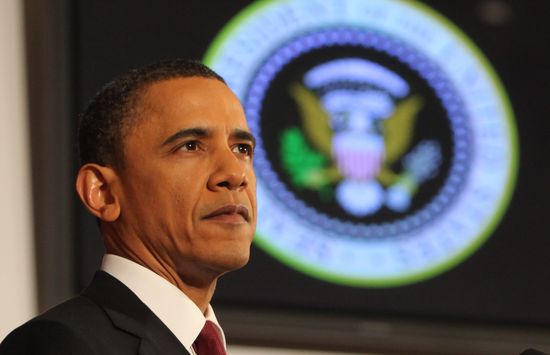
GT_PAULRYAN_04042011 The president’s walking away from the deficit commission he set up was, to my mind, one of those moments when his caution was not about the substance of the issue but the politics. He knows we need to cut entitlements and defense or face fiscal collapse. And yet he has allowed Paul Ryan to move into the vacuum Obama created on the most important domestic issue of the day. Ryan’s proposal, whatever you think of it, is serious. His proposal for Medicare looks to me like an extension of the Romney/Obama healthcare exchanges. His proposal for Medicaid – block grants to the states – will inevitably cut down on sky-rocketing healthcare spending. His tax reform is straight out of Bowles-Simpson. Alas, his op-ed is needlessly partisan in its initial lashing out at Obama. That’s not the way to start a real dialogue, which is what we desperately need. But the good news is that we finally have a political party being honest about what it takes to avoid falling off a fiscal cliff. It means sacrifice. And my objection to the Ryan plan really comes down to the injustice of imposing major sacrifices for the poor and elderly, while exempting the wealthy from any sacrifice at all. This is because of Ryan’s and the GOP’s intransigent, doctrinaire refusal to bring taxes back to their Clinton-era or Reagan-era levels, even as they have given themselves a great opportunity to raise revenues as painlessly as possible.

All the GOP has to do is make tax reform revenue-positive rather than revenue-neutral. Income tax rates would come down – but not quite as low as they might have. The money left over could reduce the burden on the poor. If he advocated serious cuts in defense, rather than the minor measures backed by Gates, he’d be on much firmer ground as well.

But this is clearly an opening bid – and a powerful rebranding of the GOP, after the Bush years, as fiscally serious. As David Brooks wrote this morning, we shall soon see what Obama is made of by how he responds. We were told that Obama did not embrace long-term fiscal reform in his State of the Union this year because he needed political cover from the right. Well, he’s got it now. Will he react by demagoguing the issue as the liberal blogosphere is doing – or by seeking a way to build on it, to trade cuts in Medicare and Medicaid for a revenue-positive tax reform and deeper defense cuts?

I don’t accept the logic that this cannot be done in the year before a general election. The massive debt and deficits can be ducked no longer. While I’m sure there are many legitimate complaints about Ryan, in this proposal at least, he gets real points for seizing the initiative on honest debt-reduction, and pushing it forward as a principal issue for the elections in 2012. For the first time, the Tea Party seems genuine and serious in its fiscal goals.

And the Democrats and Obama now have to offer a response. The question I’ll be asking is quite simply: how would they save $5.8 trillion from the federal budget over the next decade? Tell us, please.

(Photo: Getty Images).

King Barack I

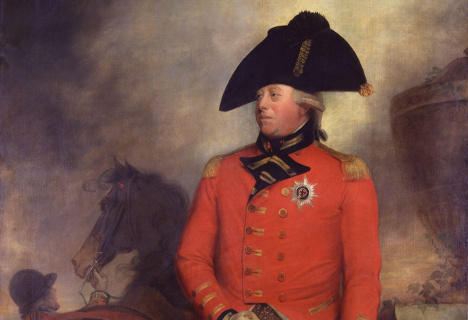
King-george-III

Many of us supported this president because he promised to bring back the constitutional balance after the theories of Yoo, Delahunty, et al put the president on a par with emperors and kings in  wartime. And yet in this Libya move, what difference is there between Bush and Obama? In some ways, Bush was more respectful of the Congress, waiting for a vote of support before launching us like an angry bird into the desert. Hillary Clinton, channeling her inner Cheney, said in a classified Congressional briefing that her administration would simply ignore the War Powers Resolution of 1973 that requires the president to seek Congressional approval within 60 days of the conflict starting. If the congress voted against continuing the war, it would be irrelevant to the administration. Beat that, King George II.

Rand Paul, meet Alexander Hamilton:

"[The Commander-in-Chief power] would amount to nothing more than the supreme command and direction of the military and naval forces, as first general and admiral of the confederacy: while that of the British king extends to the declaring of war, and to the raising and regulating of fleets and armies; all which, by the constitution under consideration, would appertain to the legislature."

Greenwald is having none of it:

The Obama administration is taking the position that not even the WPR can constrain the President, and (b) 1541(c) of that Resolution explicitly states that the war-making rights conferred by the statute apply only to a declaration of war, specific statutory authority, or "a national emergency created by attack upon the United States, its territories or possessions, or its armed forces." Plainly, none of those circumstances prevail here. That's why the Obama administration has to argue that it is empowered to ignore the WPR: because nothing in it permits the commencement of a war without Congressional approval in these circumstances; to the contrary, it makes clear that he has no such authority in this case (just read 1541(c) if you have any doubts about that).

The president is violating his constitutional duty to enforce the laws (to himself as well as anyone else). He has no constitutional right to simply waive the War Powers Resolution. In my view, we need a debate in the Congress on this as soon as possible.

(Painting Sir William Beechey's portrait of King George III. Wikimedia Commons.)

Exceptional And Unexceptional America

Glenn Greenwald, in that way he has, asks the toughest question about American exceptionalism. Yes, it’s clear Obama believes in the unique role of the US in global politics, and world history, despite the Big Lie from Romney et al. But do we all mean the same thing when we talk of this idea? And is this more than mere national solipsism and myth?

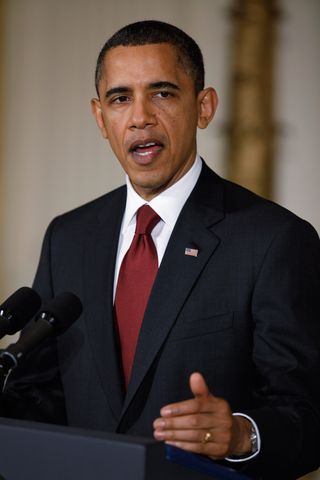
It’s easy to see where Romney, for example, gets his belief. Mormonism is the only all-American religion, placing Jesus in America itself (“I just got crucified, you guys”). But for Christians, the notion of God preferring one land-mass or population, apart from the Jewish people from whom the Messiah came, is obviously heretical. As a Catholic, I see no divine blessing for any country, and OBAMALIBYASPEECHChipSomodevilla:Getty the notion that God would make such worldly distinctions strikes me as surreal as it did when I first wrapped my head around the phrase “Church of England”. If God is God, one island on one planet in a minor galaxy is surely the same as any other, and the truth about our universe surely cannot be reduced to one country’s patriotism. Yes, we can ask, as Lincoln did, for God’s blessing. But seeking God’s blessing is not the same as being God’s country – with all the hubristic aggression that can lead to.
Some Straussians see Lincoln as the Second Founder and the abolition of slavery as the return of the West to natural rights. And it certainly seems true that in Lincoln’s words and America’s example, key ideas about human equality and dignity gained momentum – and you can hear those ideas today in the mouths of a new Arab generation, in a culture so alien to our own it is close to impossible to understand in its complexity. What deeper proof that these ideas are universal and true?

But this also reveals the limits of American exceptionalism. If America’s ideals are universal, they cannot be reduced to the ownership of one country. And that country’s actual history – as opposed to Bachmannite mythology – is as flawed as many others. Why, after all, did America need a Second Founding under Lincoln – almost a century after it was born? Which other advanced country remained so devoted to slavery until the late nineteenth century? Which other one subsequently replaced  slavery with a form of grinding apartheid for another century? Besides, much of the thought that gave us the American constitution can be traced back to European thinkers, whether in Locke or Montesquieu or the Enlightenment in general. Seeing America as the sole pioneer of human freedom is to erase Britain’s unique history, without which America would not exist. It is to erase the revolutionary ideas of the French republics. It’s historically false.

But was the discovery of America some kind of divine Providence? The Puritans certainly thought BUSH2010:Getty so. And the blessing of a vast continental land mass with huge resources is certainly rare in human history. But, of course, that land mass was available so easily because of the intended and unintended genocide of those who already lived there – which takes the edge off the divine bit, don’t you think? Call me crazy (and they do) but my concept of God does not allow for God’s blessing of genocide as a means for one country’s hegemony over the earth.

This is not to say that America doesn’t remain, by virtue of its astonishing Constitution, a unique sanctuary for human freedom. We are freer here in terms of speech than in most other advanced countries, cowed by p.c. laws and restrictions. We are freer here in labor and capital than most other countries. To feel pride in this is natural. It is why I love this place and yearn to be one of its citizens. And the vast wealth of an entire continent, unleashed by freedom’s flourishing, gave this land of liberty real and awesome global power, which it used to vanquish the two great evils of the last century – Nazism and Communism. This is the noble legacy so many now seek to perpetuate, with good intentions and benign hearts, despite the disastrous and costly interventions of the last decade.

But as the 20th Century wore on, this kind of power had its usual effect, and the establishment of a massive global military machine, as Eisenhower so presciently noted, created the risk of a permanent warfare sustained by domestic interests. Throw into the mix a bevy of intellectuals busy constructing rationales for a uni-polar world – on the neocon right and the neoliberal left – and we slowly became, at best, the indispensable nation and at worst, a benign imperial bully.

In other words, America’s ideals are not unique to America, and America’s success led it to the same temptations of great powers since ancient times. America’s exceptional freedom and exceptional wealth did not exempt it from unexceptional human nature or the unexceptional laws of history. To believe anything else is to engage in nationalist idolatry. In retrospect, Vietnam was a form of madness brought on by paranoia. In Iraq, America actually presided over 100,000 civilian deaths as it failed to perform even minimal due diligence in invading and occupying another country (while barely a few years later, we invoked – with no irony or even memory – the risk of mass murder as a reason to invade another country). And US forces are still there – and the same alliance that gave us the Libya campaign will surely soon be arguing for extending their presence as the Potemkin democracy slowly collapses. In Afghanistan, the graveyard of so many empires, we are busy sending drones to hit targets with inevitable civilian casualties in a war that has no end, no discernible goal, and has now lasted longer than any war in the country’s history. When America finds itself in wars where it can accidentally kill nine children gathering firewood, it seems somewhat abstract to talk uncritically of America’s moral superiority. And when America has also crossed the line into legalized torture, and refuses to acknowledge or account for it, let alone hold the war criminals responsible, it has lost the moral standing to dictate human rights to the rest of the world.

Obama had a chance to turn this around.

He did end the active torture of prisoners of war. He promised to end the war in Iraq, to close Gitmo and to reframe America’s relationship to the world. But he refused to bring the torturers of the last administration to justice, thereby effectively withdrawing from the Geneva Conventions. We remain in Iraq, we have much more aggressive war in Afghanistan, and Gitmo is still open. The kind of humiliations we once inflicted on prisoners of war are now inflicted on American citizens in custody, as in the case of Bradley Manning. And with all this still on our plate, Obama has just – unilaterally – committed America to an intervention in a third civil war in a third Muslim country, with the grave risk of our taking responsibility for another effort at nation-building abroad, when nation-fixing at home was the reason he was elected.

America is exceptional in so many ways. But when we use that exceptionalism to violate our own values, and to meddle in places we have no business or interest meddling in, then, in some ways, we are attacking that very exceptionalism, and ignoring its real power – the power of example and restraint, the belief that freedom can only be won by the people seeking it – not by those seeking to impose their ideals onto a recalcitrant world.

The glib hubris of the Libyan intervention is a sign that the change we hoped for really has morphed into the wet military dreams of neoconservatism and the utopian notion of the US as the rescuer of all those subjected to tyranny we believe we can opportunistically save – for a few days or weeks. What I see here is far from exceptional. It is the routine pattern of the rise and fall of all republics that become empires. It is what happened to Rome and Spain and Britain: Success, over-reach, hubris, bankruptcy and decline. And the withering of the sinews of a republic’s body – as in the supine, divided, incompetent Congress, and a court so deferent to the emperor’s unrestricted power in waging war wherever he pleases.

In this, especially with this Libya clusterfuck, Obama reverted to embracing the forces he was elected to resist and restrain. One appreciates the difficulty of this and the horrible moral dilemma of Benghazi; and I still hope for success – beause I see no sane alternative to Obama anywhere and no one can hope that the monster Qaddafi stays in power. But the Libya decision was a deep break with the essential argument for the Obama presidency – and that break is one that the Obamaites seemed not to grasp in their insular, secret and arrogant decision-making process. I fear it has already profoundly weakened the president’s credibility and strength – and will become as big a burden to him as Iraq was to Bush. He now appears not only more distant from his campaign promises – but also more incoherent. More important, it is impossible to sustain the image of this president as the antidote to Bush when, in picking another Muslim civil war to intervene in – however differently frame – he seems to be Bush-lite.

For those of us who wanted him – and still want him – to succeed, it is a crushing disappointment. Even if success emerges, this capitulation to the very strains that took the US into the ditch of 2008 is a form of pragmatism too far.

“America Is Different”

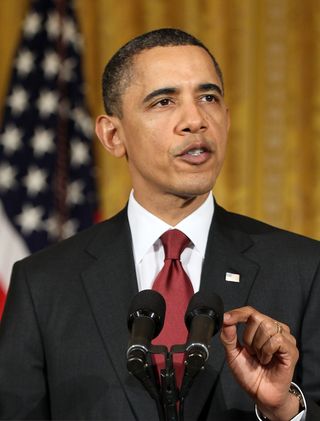
OBAMALIBYADennisBrack:Pool:Getty

That, it seems to me, was the core message of the president's speech on Libya. America is simply incapable of watching a slaughter take place – anywhere in the world – and not move to do what we can to prevent it. It is against our nature to let evil triumph in such a fashion. The Libyan example was particularly vital because a rare constellation of forces came together to make turning away even harder: European and Arab support for preventing mass murder; UN permission; America's "unique" capabilities; and an imminent massacre in Benghazi.

Obama the Niebuhrian put the moral in realism. Yes, we could not do this everywhere all the time; but we could do this when we did; and that was good enough. There was some sleight of hand here. Citing the UN Resolution as an external reason for war – when the US lobbied hard for it – was a touch too neat. But essentially Obama was challenging those of us who opposed this decision to ask ourselves: well, what would you do? If the US had insisted on looking away, America would have seemed morally callous, even compared with the French. The mass graves of Benghazi would take their place alongside the horrors of Srebrenica. And the impact on Arab opinion, especially on the younger generation that is so key to the future, would be fatal to America's long term interests.

I do not know whether the last is actually the case, or whether most young Arabs are understandably focused on the regimes they labor under rather than the murderous nutter in the North African desert. But secretary of state Clinton was in the region at the time and believed otherwise. And, yes, one appreciates that doing nothing represented a choice as well as doing something. And it too would have had unknowable consequences.

Was I persuaded? Not completely. The major objection – what happens now? – was not answered affirmatively by the president. It was answered negatively: there would be no military effort at regime change, as in Iraq; NATO, not the US, would soon be leading the mission; and, er, it may last a while. It is way too soon to celebrate a new model of international cooperation; but it seems striking to me that the rationale Obama invoked was very much GHW Bush in Kuwait rather than GW Bush in Iraq. That left Saddam in power for more than a decade. And yet Obama spoke as if Qaddafi's days were obviously numbered. I sure hope they are.

It wasn't Obama's finest oratory; but it was a very careful threading of a very small needle. That requires steady hands and calmer nerves than I possess. But this president emerges once again as a consolidator and adjuster of the past, not a revolutionary force for the future. And one hopes that the notion that he is not a subscriber to American exceptionalism is no longer seriously entertained.

He clearly believes in that exceptionalism – and now will live with its onerous responsibilities.

(Photo: Dennis Brack/Pool/Getty.)

The Imperial President

The president's speech was disturbingly empty. There are, it appears, only two reasons the US is going to war, without any Congressional vote, or any real public debate. The first is that the US  cannot stand idly by while atrocities take place. Yet we have done nothing in Burma or the Congo OBAMA0318AalexWong:Gettyand are actively supporting governments in Yemen and Bahrain that are doing almost exactly – if less noisily – what Qaddafi is doing. Obama made no attempt to reconcile these inconsistencies because, one suspects, there is no rational reconciliation to be made.
Secondly, the president argued that the ghastly violence in Libya is destabilizing the region, and threatening world peace. Really? More than Qaddafi's meddling throughout Africa for years? More than the brutal repression in Iran? And even if it is destabilizing, Libya is not, according to the Obama administration itself, a "vital national interest". So why should the US go to war over this?

None of this makes any sense, except as an emotional response to an emergency. I understand the emotions, and sympathize with the impulse to help. But I can think of no worse basis for committing a country to war than such emotional and moral anxiety. One fears this is Bill Clinton's attempt to assuage his conscience over Rwanda, rather than Obama's judicious attempt to navigate the Arab 1848. And as Obama said things like "Qaddafi has a choice," did you not hear echoes of Bush and Saddam?

At least Bush argued that Saddam posed a threat to the US. No one can seriously argue that Qaddafi poses such a threat. To launch a war on these grounds is to set a precedent that would require a kind of global power and reach that not even the most righteous neocons have pushed for. And I look forward to the actual Arab contributions to the military action. Presumably Egypt and Saudi Arabia will be involved. Or will it be what we now have – Qatar and, er, that's it? The Arab League has no real skin in this game. And one suspects, in the end, the narrative will be America bombing the Arabs again. How many civilians might the US kill in such an action? More civilians than we are currently killing in Pakistan and Afghanistan? Have we learned nothing?

The proper response to this presidential power-grab is a Congressional vote – as soon as possible.

That will reveal the factions that support this kind of return to the role of global policeman, and force the GOP to go on the record. I also look forward to the statements of the various Republican candidates in support of this president.

But it seems clear enough: exactly the same alliance that gave us Iraq is giving us Libya: the neocons who want to see the US military deployed across the globe in the defense of freedom and the liberal interventionists who believe that the US should intervene whenever atrocities are occurring. What these two groups have in common is an unrelenting focus on the reason for intervention along with indifference to the vast array of unintended consequences their moralism could lead us into. I do not doubt their good intentions and motives. No human being can easily watch a massacre and stand by. Yet we did so with Iran; and we are doing so in Yemen and Bahrain as we speak, and have done so for decades because we rightly make judgments based on more than feeling. 

A congressional vote is also important to rein in the imperial presidency that Obama has now taken to a greater height then even Bush. No plane should lift off, no bomb released, until the Congress has voted. I don't see why Obama should oppose this. He needs some Congressional support in an open-ended military commitment to ensure the protection of civilians in Libya.

(Photo: Alex Wong/Getty.)

Forget History (Or Not)

RASLANUFJohnMoore:Getty

Lawrence Kaplan, the co-author with Bill Kristol, of a spectacularly ill-informed book, The War Over Iraq, insists we try not to analogize the imminent war on the Libyan regime with any past precedents of war against a Muslim country. Well, I'm not. I'm analogizing it to present wars which still grind on in both Iraq and Afghanistan and both of which have spectacularly failed by any reasonable cost-benefit analysis and certainly on the grounds that Kaplan made back in 2003.

Then he cites three no-fly zone experiments, two in Iraq and one in Bosnia, two of which he acknowledges failed. So some history is to be forgotten – everything since 2003 and two failed no-fly zones – but some is to be remembered (the one success in Kurdistan). Hence presumably this parenthesis:

(Deceptive as they mean to be, some historical analogies do hold more explanatory power than others.)

Well, yes. Iraq and Libya are very different countries in very different periods. But the fundamental issues for using the US military to launch a war on either country are the same: What is the exit plan? Who are we actually supporting? How does a no-fly zone work without troops on the ground? Who would be involved in the coalition? How much could this cost? What could be the unintended consequences?

None of these questions is answered in the piece. Nor were they answered by Kaplan before the Iraq war (among Kaplan's confident assertions in 2003 was that there was no serious sectarianism in the country any more). In fact, Kaplan/Kristol mocked those asking the salient questions in the 2003 book. Money quote:

Predictions of ethnic turmoil in Iraq are even more questionable than they were in the case of Afghanistan… Unlike the Taliban, Saddam has little support among any ethnic group, Sunnis included, and the Iraqi opposition is itself a multi-ethnic force… [T]he executive director of the Iraq Foundation, Rend Rahim Francke, says, "we will not have a civil war in Iraq. This is contrary to Iraqi history, and Iraq has not had a history of communal conflict as there has been in the Balkans or in Afghanistan…"

A scholar that mis-informed now lectures us on Libya – and the Obama administration (which would not exist if Obama had backed the Iraq war) follows suit.

Kaplan cites widespread European support for intervening, to which the obvious reply is: let the French and British and Italians organize the Arab League to institute a no-fly zone. Let them pay for it themselves, and be prepared to tackle the entire set of consequences. If Sarko wants his Dubya moment, let him have one. And let's see how the Arab world in the long run views such action by colonial powers.

The US is broke, its military over-extended, in two ill-conceived wars that are still being waged at a staggering human and financial cost. Maybe we should ask Lawrence one simple question: what would you cut from the budget to afford such an open-ended military endeavor? If you cannot answer that one, you really have learned nothing from the disasters – fiscal and military – of the last decade.

More on the war we have just been told is happening here, here and here.

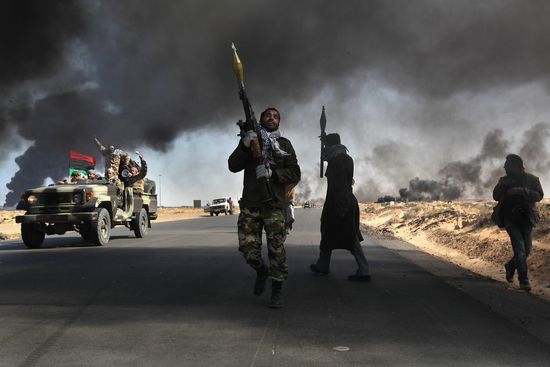
(Photo: Libyan rebels battle government troops as smoke from a damaged oil facility darkens the frontline sky on March 11, 2011 in Ras Lanuf, Libya. By John Moore/Getty.)

American Decline And The Right

Sam Roggeveen urges American conservatives to come to terms with the relative decline of US power – hard and soft – in the name of conservatism. This means finessing hard-edged realism by appreciating the meliorative forces of international institutions, and international law.

The battle within conservatism, to my mind, is partly between conservatives of faith/doctrine and conservatives of doubt/pragmatism. But it is also between Straussian conservatives who believe, in the end, in violence and those Oakeshottian conservatives who yearn for nonviolence, while understanding that at bottom, all politics – domestic and foreign – hinges on the threat of force.

Sam quotes Roger Scruton on the conservative approach:

Now, realists are not necessarily against the idea of international institutions such as the UN. As I said in the previous posts, they see such bodies as a useful stage for the international power struggle — a way to manage competition. But that misses their deeper purpose, which is to tame or sublimate the power contest. In my previous post I quoted the English conservative philosopher Roger Scruton, and here he is again on the importance of constitution. It is the conservative's desire, Scruton says,

…to see power not naked in the forum of politics, but clothed in constitution, operating always through an adequate system of law, so that it's movement seems never barbarous or oppressive, but always controlled and inevitable, an expression of the civilized vitality through which allegiance is inspired.

Scruton was talking about power and constitution within the state, and although such a "civilized vitality" is likely to be weaker in the international realm, there are enough similarities between domestic and international politics to allow the comparison.

What's striking to me is how many American conservatives actually long for the exercize of brute force or constant executive action in the face of a dramatically changing world. This they call strength – even after the debacles of Bush's executive whims. They see the role of an American president as mastering the world, controlling events, forcing everything through the prism of post-war American hegemony. But that hegemony is over, partly because of America's success in defeating the Soviets and China's and India's successes in forging a new economic order. The kind of hegemony Nixon or Reagan enjoyed was an accident of history. It will not be regained, by the laws of economics, and demography.

For a Straussian, this is an intolerable situation. And the response should be to ratchet up the American president's use of force, clarity of expression, and assumption of global leadership. But we have seen one president do this and it has resulted in a sharp decline in US power and influence – because it exposed the very military, cultural and economic limits of American hegemony.

For an Oakeshottian, it's not quite so simple. How does one manage a changing world, while being aware of the limits of force? How can one construct international laws and institutions that can guide the world toward a more peaceful and democratic future? How do we dispel the power of fundamentalism that risks plunging us all into deadly civilizational conflict? How do we use force effectively and with discrimination to advance these goals?

Think of the difference between George H W Bush in Kuwait and George W Bush in Iraq. Much of the right still longs for the swagger of the latter. The more discerning ones know better.

Inequality And The Right

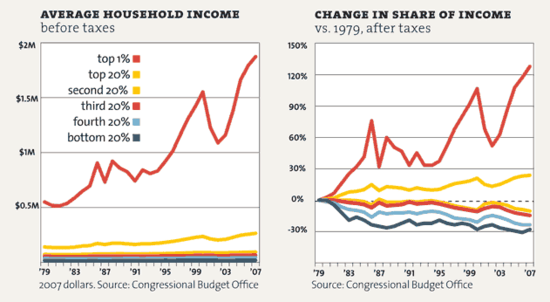
Inequality-p25_averagehouseholdincom

It's a subject that lies behind many of my readers' dissents from my small government, flat, simple taxation kind of conservatism. In Wisconsin, for example, it is impossible, I think, to separate the issues of public sector collective bargaining rights … and the broader context of a country polarized into two camps: the very, very rich, and everyone else. This is expecially true after the bank bailouts. There is a strong argument that bailing out the banks was the right, if distasteful, thing to do because of the threat their collapse would have had on the entire economy. But watching Wall Street rack up bonuses, carry on as normal, while teachers are being asked to take big benefit cuts … well, it's understandable why even level-headed Wisconsinites look a little Jacobin these days.

To many on the right, this inequality is a non-issue, and in an abstract sense, I agree. Penalizing people for their success does not help the less successful. But at a time of real sacrifice, it does seem to me important for conservatives not to ignore the dangers of growing and vast inequality – for political, not economic, reasons. And by political, I don't mean partisan. I mean a genuine concern for the effects of an increasingly unequal society. Last night, we watched "Winter's Bone" about meth-fueled social collapse in the heartland and then clicked over to watch "The Real Housewives Of Orange County." It was a bracing summary of where America increasingly finds itself. If you find this growing gulf unproblematic, I refer you to that leftist radical, Aristotle:

"It is clear then both the best partnership in a state is the one which operates through the middle people, and also that those states in which the middle element is large, and stronger if possible than the other two together, or at any rate stronger than either of them alone, have every chance of having a well-run constitution."

By "middle element," Aristotle means the middle class. The loss of it has destabilizing political consequences. Now, some of this may be unavoidable, given a globalized and increasingly automated economy. But it increasingly seems wrong to me to exempt the very wealthy from sacrifice, in the context of their gains in the last three decades, if we are to ask it of everyone else.

It's not about fairness. It isn't even really about redistribution, as we once understood that from the hard left. It's about political stability and cohesion and coherence. Without a large and strong middle class, we can easily become more divided, more bitter and more unstable. Concern about that is a legitimate conservative issue. And if someone on the right does not find a way to address it, someone on the left may well be empowered to over-reach.

Palin And Trig: There She Goes Again

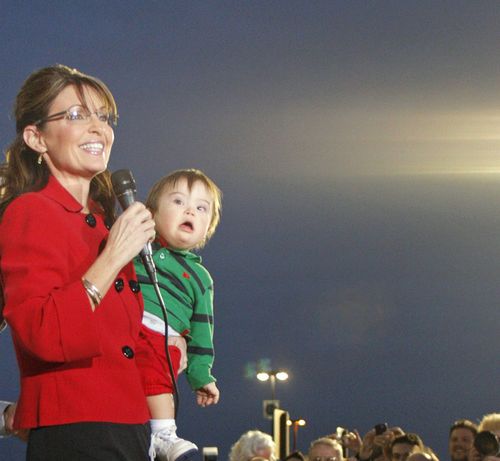
Trigsarah

And you thought I was the one with the unhealthy obsession. From an interview with Sarah Palin by the BBC on her relationship with the US media:

"SP: Let's take a couple of examples – and I don't really want to have to talk politics on one of the best days of our life here in Alaska – but I'll give you one more answer. Things like, that are misconstrued regarding rumours out there that are still in the media because reporters don't do their homework, too often, and they don't set the record straight – though I think it's their job to set the record straight – rumors like I didn't know that Africa was a continent, that's still out there, that's a lie.

Things like I censored books when I was a mayor up here in Alaska, that's a lie… [Governor Palin begins to walk away] … So again if I decide to run we know that we have to put up with a lot of the BS that comes from the media but …

It's not all of you guys but some of you still claim that Trig isn't my kid. I think that's an indication of screwed-up media.

JL: You were saying, your favourite from the media? Which one is that?

SP: Is that Trig is not my child, which is still out there in the media.

JL: How offensive is that? How do you deal with that?

SP: Would you be offended if someone said your child wasn't your child? It's offensive. OK, you know what, I'm really really trying to enjoy one of the best days of our lives." 

But this, of course, is untrue. On the censorship question, the MSM never claimed she had banned books as Wasilla mayor, even though she complained about some. It didn't help that her response was about Harry Potter, claiming, erroneously, that the books had not yet been published when she was mayor. They had been published and she did not ban them. But notice the defensive, irrelevant untruth. And here's USA Today clearly debunking the rumor in October 2008, with the following headline:

Palin did not ban books in Wasilla as mayor

So "reporters don't do their homework" and have not debunked this yet? As for the Africa issue, the MSM reporter who relayed this was Fox News's Carl Cameron. Talk about liberal media bias. Besides, the notion of her confusion about Africa came directly from first-hand witnesses.

Now to the other charge.

I know of no one in the MSM who has claimed that Trig is not biologically Palin's child. I certainly haven't. The NYT ran a front-page story based on the premise that the rumors were nuts. Other MSM reporters made a decision to slime other journalists for even asking the question. To the best of my knowledge, no reporter (outside the ADN) has ever directly asked her to provide easily available evidence, which is odd given the many bizarre parts of the story. This the Dish has – of the McCain campaign. It is my quixotic belief that it is the duty of elected officials to clear up genuine, empirically resolvable questions about their past. Obama rightly produced his birth certificate – however offensive the insinuation that he was ineligible to be be president. Palin refuses to produce any medical records – however offensive the question understandably is.

Frank Bailey, an estranged former close aide who totally believes Palin's account(s) of her fifth pregnancy, makes this point in his manuscript about the rumors that swirled in Alaska in March and April 2008, long before anyone outside asked the obvious questions:

We did our best to bombard both friendly and non-friendly media outlets with our outrage, blasting critics by suggesting their evil had no limit. In doing so, we stupidly ensured that everyone in the state now knew of the rumor, no matter how remote their village.

Now Palin has informed the BBC. That'll help, won't it? Bailey asks the obvious question:

Why didn‘t we just ignore the asinine rumor, thereby giving it the non-respect it was due? For the same reason we never ignored anything: we came to share Sarah‘s translucent skin.

And still she brings it up. And still she refuses to provide what Bailey called "a more simple solution," the easily available medical records. Maybe she is so offended she refuses to concede the premise that she even has to address the issue. But Bailey's manuscript also reveals her early attempts to engage the Alaska media to rebut the rumor. So she once tried to get past this, and then relapsed if it required doing anything more than show stretch marks. Now she brings it up unprovoked to attack the media again – without ever engaging in what we might call empiricism.

Surprise! She wants it both ways. Both victim and aggressor; an "open book" with several pages redacted. Yes, it's tough running for national office. You have to address stuff regular folks never have to. But she was the one who demanded physical evidence of a marriage license from her first political opponent, because his wife kept her maiden name. And that was a race for Wasilla mayor, not president of the US.

And the beat goes on.