The Scots And The English: Some Guilty Thoughts

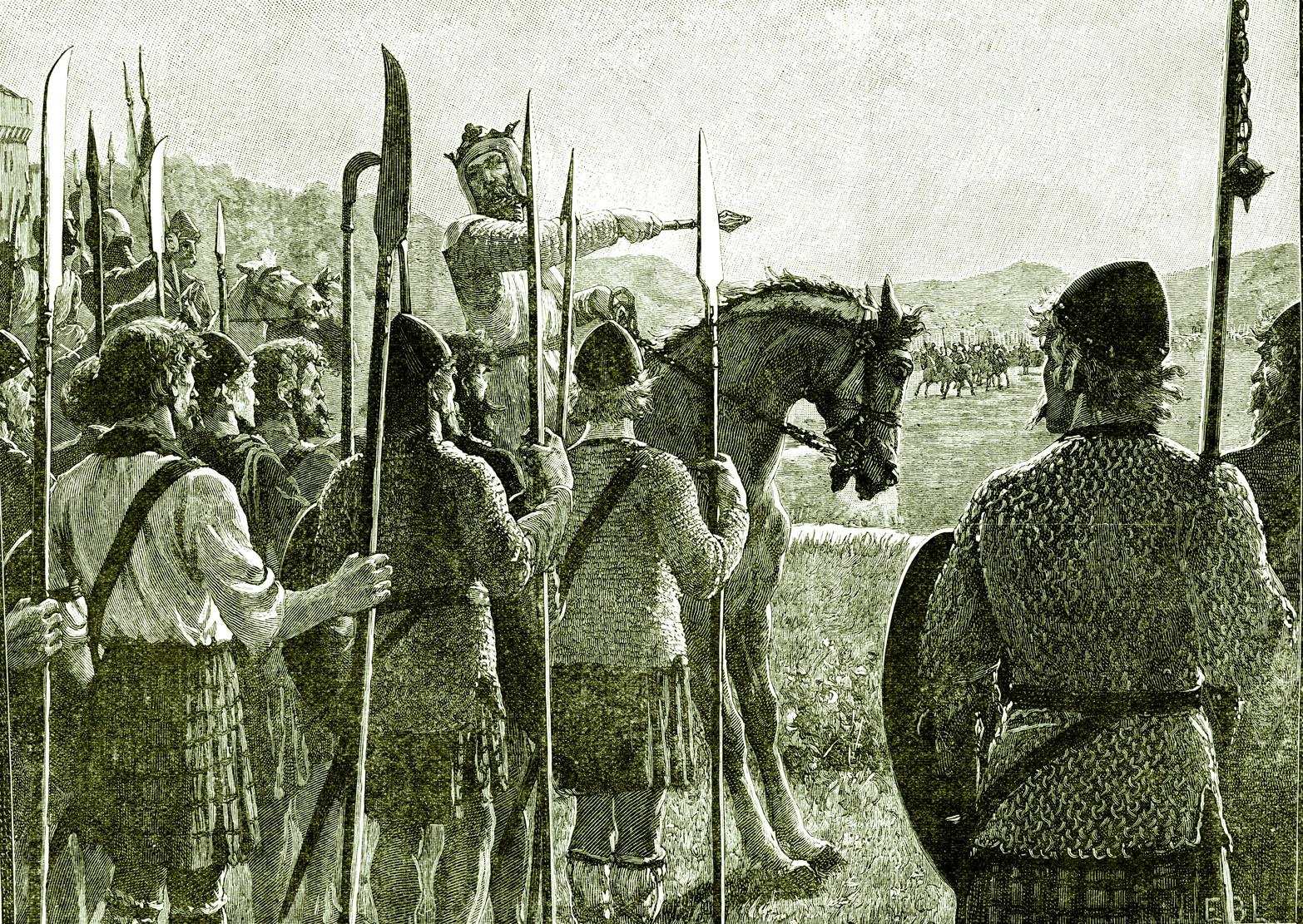
Battle of Bannockburn - Robert the Bruce reviewing his troops

Josh Marshall is bug-eyed at the possibility that the union of England and Scotland may soon end. The Sunday Times poll last weekend gave the markets the willies, and prompted what looked to me like a panicky bunch of last-minute concessions from London. My old chum Boris Johnson had a very Boris defense of Britain and “British” as core identities for a multicultural country in the Telegraph yesterday. Money quote:

The entity under mortal threat next week is Britain itself. You cannot refer to a state called “Britain” unless you include Scotland, because it is a basic fact of geography that Britain comprises everything from Land’s End to John o’Groats.

Look at the map – so often rendered by cartoonists from the 18th century onwards as Britannia sitting down: rump in east Anglia, feet in Cornwall, and topped off with that sweeping Scottish cerebrum and helmet. Chop it off – decapitate Britain at Carlisle and you can no longer call it Britain; and what goes for geography must go for politics, too. Take Scotland away from England and you are losing a critical part of our political nomenclature. There was no British government before the union with Scotland; there was no British electorate; there were no British interests. There was England and Wales, and there was Scotland. Take away Scotland, and we destroy Britain.

He’s not wrong – and part of the alchemy of Britain has always been the mixture of the shire and the highlands, the Angles and the Celts. Blair and Brown were both Scots. BoJo notes that the great Englishman, Samuel Johnson, needed his Scottish side-kick, James Boswell, to be fully who he is in our collective civilization. That’s the kind of national chemistry that independence might destroy. And it was a Scot, “Queen” James I, who cemented England’s religious settlement for a while after the death of Elizabeth I.

And yet … I have to say, I find myself a little emotionally indifferent, even as I am rationally persuaded by the argument that an independent Scotland with the pound as its currency could be headed for Greece-like status. And it’s that conflict between emotion and reason that will Nicola Sturgeon Continues Health Campaigndetermine the result. Maybe it helps Americans to understand those emotions if I examine my own. So why the indifference?
For one thing, Scotland is not like, say, California. It’s an ancient nation, and, unlike England, was never pacified by the Romans. It’s a prickly country, bristling often at England, its exports to London often having more than a bit of a chip on their shoulders. More to the point, it gets to have its own parliament and yet also have a full presence in the London parliament – an arrangement not accorded to the English. It’s politically well to the left of middle England, and is a big net beneficiary of British Treasury. After a while, if you’re English, and right-of-center, and taxed to the hilt, endlessly subsidizing the Scots in return for their thinly veiled disdain, you get a bit irritated. Deep, deep down in my Sussex soul, there’s a “fuck ’em” urging to come out, even as my own Irish ancestry gives me some emotional accord with the Scots.

And since “Britain” is at stake, why should one small part of it be the only part that has a say? What do the English think about Scottish independence? Or the Welsh? Or the Northern Irish? Why shouldn’t they be a part of the deliberation? I guess it says a huge thing about British democracy, decency and fairness that Scotland is being allowed this no-fault divorce option (one only has to look at Ukraine to see the alternative) – but it also says a lot about the way Scotland often wants to eat its cake and have it too.

“Britain” as an entity, moreover, is indistinguishable from empire. From 1707 on, the Scots played an outsize role in creating and sustaining that empire across the world – and I can understand why a thoroughly post-imperial country doesn’t quite have the collective martial spirit to keep it all together any more. A long while back, I saw this coming. Back in 1999, I wrote, after re-visiting my homeland, that:

As the century ends, it is possible, I think, to talk about the abolition of Britain without the risk of hyperbole.

The United Kingdom’s cultural and social identity has been altered beyond any recent prediction. Its very geographical boundaries are being redrawn … To begin with, Blair is proposing what amounts to the end of the unitary government of the United Kingdom. Scotland’s new Parliament will be elected in May, a symbol of self-government not known since the 16th century. In the referendum that sanctioned it, 74 percent of Scots voted in favor. More significant, a full 64 percent supported the notion that such a Parliament should have tax-raising powers, essentially replacing Westminster.

Blair has allowed the Scottish Parliament the leeway to lower or raise the British rate of income tax by only 3 percentage points. But the direction is clear enough. Blair clearly believed that by devolving some power to Scotland he would defuse the independence movement. Instead, the opposite could happen. The latest polls suggest that in the new Edinburgh Parliament the largest single party may well be the Scottish Nationalists, who see the new Parliament as a way station to full independence. Of the dozens of conversations I had in London about the future of the United Kingdom, literally no one I spoke with believed that Scotland would be a part of Britain in 10 years’ time…

What Blair has ushered in, in other words, may well turn out to be a return to a political Constitution last seen in the late Middle Ages: an English state with an almost independent European metropolis on the Thames, a feisty neighbor to its north and a half-heartedly controlled province to its west.

You end the empire, you unravel – through a new cosmopolitanism – the cultural power of Britishness, you see London emerging as essentially a separate country as well, and you devolve power more and more to Scotland … and, well, you can see why we are where we are. The logic of recent history – and ancient history – points solidly to an amicable divorce. This is not some sudden, unforeseen act of madness. It is the result of history and culture and economics.

And then there’s English nationalism as well. By far the most striking new development I saw in Britain at the turn of the century was the adoption of the English flag over the Union Jack:

When I left for America, the clear, simple symbol of England was the Union Jack. It is now increasingly the bare emblem of St. George: a red cross on a white background. You see it in soccer stadiums and emblazoned into the skulls of East End skinheads. In 1995, the biggest greeting-card distributor introduced a card to celebrate St. George’s Day on April 23. Within two years, as the journalist Jeremy Paxman pointed out, the number of cards sold had grown to 50,000.

And when I hoisted a flag on my cottage in Ptown during last year’s Olympics, it was the English flag, and not the British one, that I flew. For it is England I truly love. Scotland? Best of luck to them.

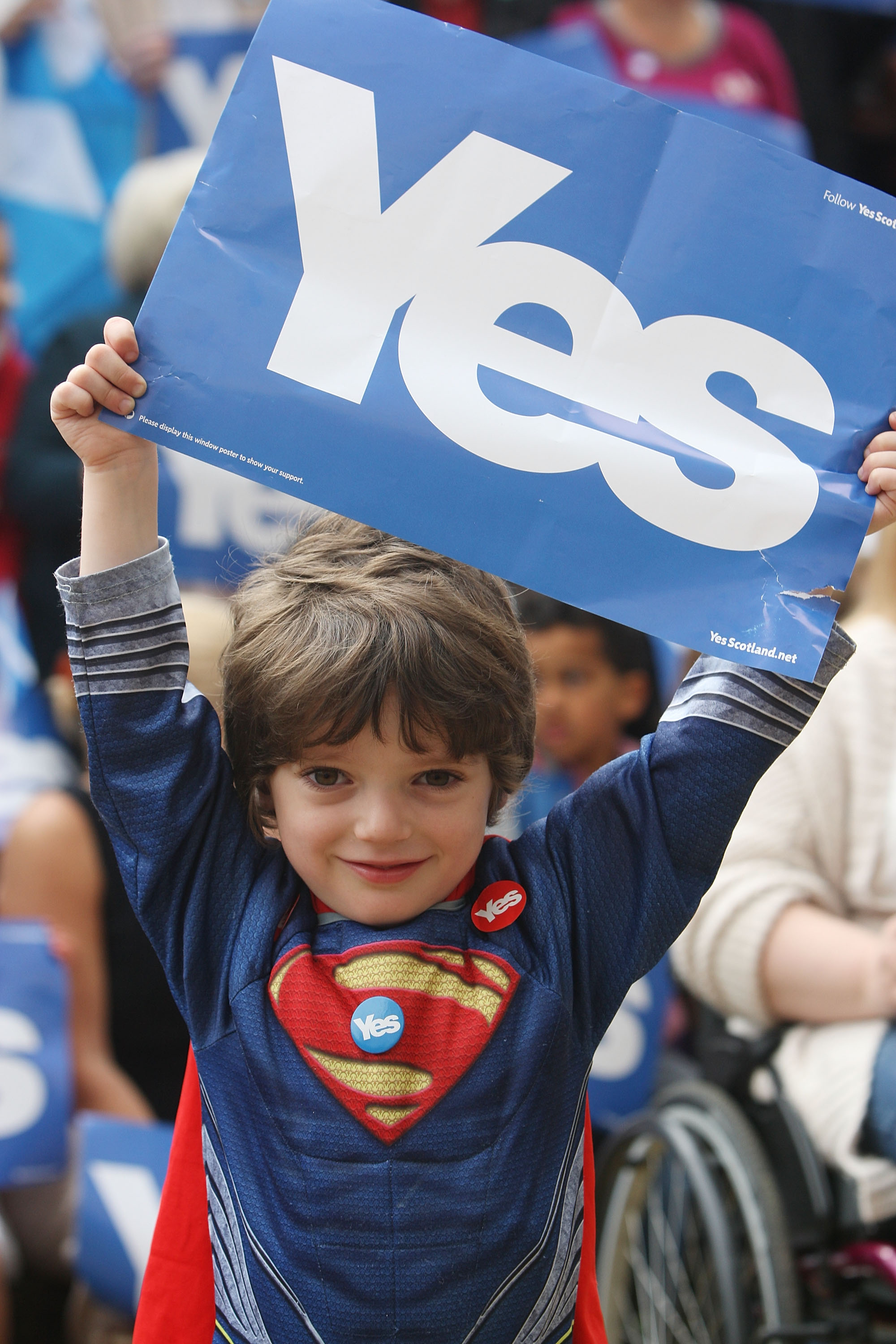
(Painting: Battle of Bannockburn – Robert the Bruce reviewing his troops before battle, 24 June 1314. Significant Scottish victory in the Wars of Scottish Independence and  the decisive battle in  First War of Scottish Independence. By Culture Club/Getty Images; Photo: Danny Barbieri, 4-years old, dressed in a Superman superhero outfit, holds aloft a Pro-Scottish independence ‘Yes Scotland’ campaign sign, as he and other supporters await the start of a press event in Glasgow, Scotland on September 8, 2014. By Jeremy Sutton-Hibbert/Getty Images)

“The Passion To Be Reckoned Upon Is Fear”

And so ISIS’ medieval brutality and horrifying videos have worked like a charm:

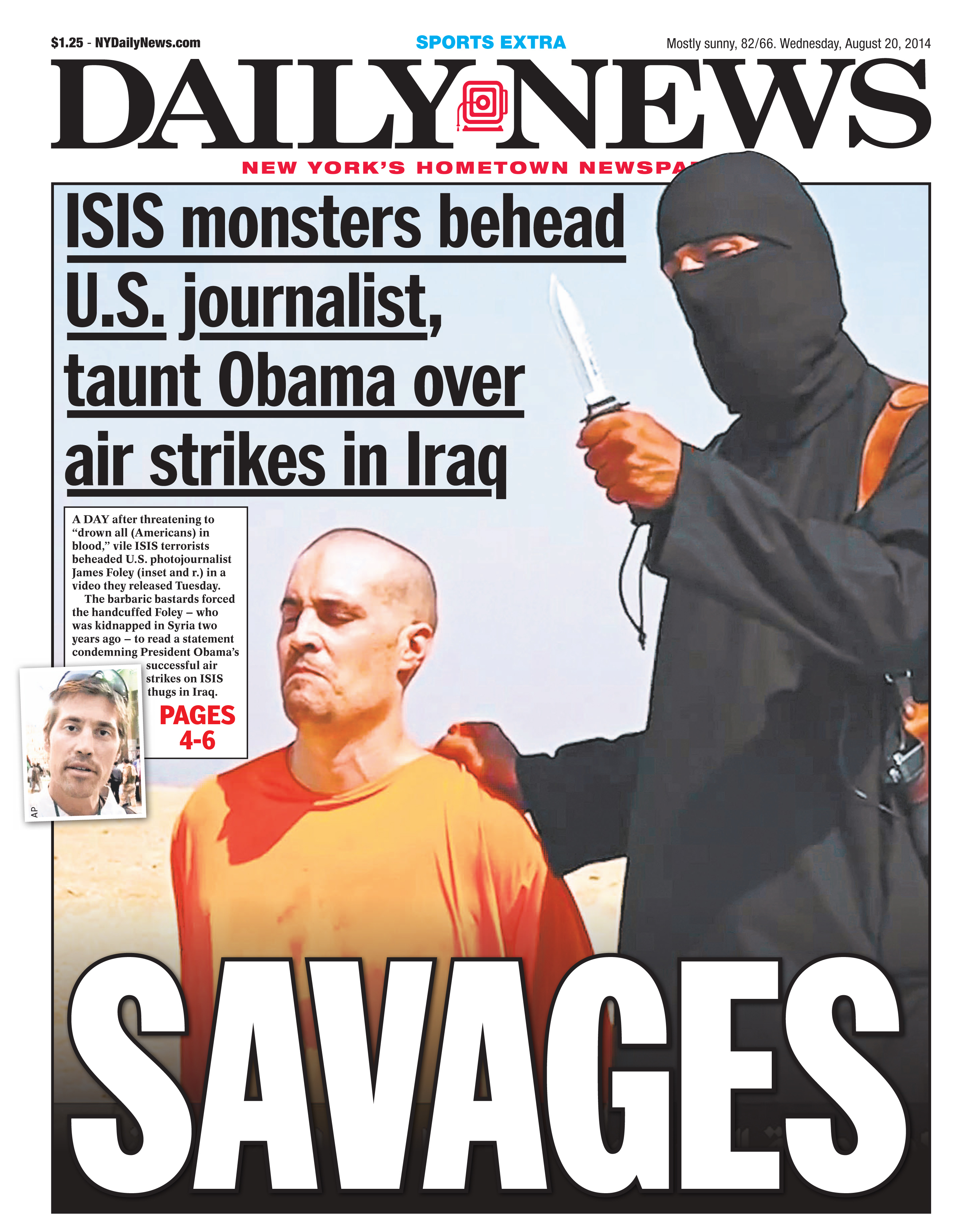
Support for military action has risen dramatically in just the past few weeks, coinciding with the beheadings of two American Daily News Front Page James Foleyjournalists, James Foley and Steven Sotloff, which were recorded on video and released to the world by Islamic State terrorists. Today, 71 percent of all Americans say they support airstrikes in Iraq — up from 54 percent three weeks ago and from 45 percent in June. Among those who say Obama has been too cautious, 82 percent support the strikes; among those who think his handling of international affairs has been about right, 66 percent support them.

Nearly as many Americans — 65 percent — say they support the potentially more controversial action of launching airstrikes in Syria, which Obama has not done. That is more than double the level of support a year ago for launching airstrikes to punish the Syrian regime for using chemical weapons … Nine in 10 Americans now see the militants as a serious threat to vital U.S. interests, and roughly 6 in 10 say they are a very serious threat.

But I have yet to see or be shown any solid intelligence that suggests that these fanatics are aiming at the US. We may well have a problem of home-grown Jihadists returning and wreaking havoc – but that is a manageable threat. And direct military intervention by the West could easily increase these losers’ incentives to strike us here at home. So, in that narrow sense, this return to fighting other people’s civil wars in the Middle East may actually increase the risks to us. That’s what I mean by “taking the bait“.

More worryingly, the president appears to be choosing September 11 to make the case for a war against ISIS in Iraq and Syria. The fear factor is thereby evoked all the more powerfully – and any return to normality, or restraint, or prudence that we have slowly achieved since then will be wiped away. I just ask you: did that fear and terror help us make wise decisions about foreign policy back then? Do we really want to recreate that atmosphere – with no solid evidence of a tangible threat to the US?

I await the president’s proof of ISIS’ threat to America and the West. And not the kind of intelligence that gave us the Iraq War. I await the proof of an eager coalition of every Iraqi sect to destroy ISIS – and a broad regional coalition united to prevent its consolidation of gains. Then, it seems to me, there must be a declaration of war by the Senate if this open-ended, unknowable military intervention is to be embarked upon. Every Senator and House member should be on record, ahead of the November elections, on this question. If they want war, they must take full responsibility for it, and not play partisan games to score points off it.

Maybe it’s because I was not exposed to the news cycle of the last few weeks that I still see things this way. Maybe I’m wrong and ISIS really does have the means and the will to attack the US or the West.

But in this march to another war in Mesopotamia, I recall that almost every US military intervention in the Middle East has backfired. Even the first Gulf War, deemed a great success, helped give us al Qaeda, as Lawrence Wright reminds us today in the New Yorker. Our intervention in Iraq eventually gave us ISIS. Our intervention in Libya gave us chaos and terror. The only intervention in that region that worked was a peaceful one, the UN-sponsored, Russia-brokered elimination of Syria’s WMD arsenal.

Notice also that this would be another pre-emptive war. We have not been attacked, as we were on 9/11. We are pro-actively entering a civil war in two countries simultaneously … because one malevolent group of Islamist terrorists threaten the region and because the regional actors have yet to take it on. This kind of responsibility is indeed neo-imperial. It’s open-ended and revives the delusion that we can change that part of the world more than it will change us.

But here we go again. Under this president. Into the unknown, propelled by fear and panic. The change we hoped for is evaporating into thin air. And the war drums get louder and louder every day, as if nothing, nothing, was learned in the past decade.

Are We Being Baited?

Here’s another thing I missed last month: the horrific beheadings of James Foley and Steve Sotloff. Jonah made, I thought, a key point:

Foley and Sotloff are but two among nearly 70 journalists killed while covering the conflict in Syria, hundreds who have been brutally murdered by ISIS jihadists in similarly gruesome fashion, and nearly 200,000 casualties of a civil war gone hopelessly off the rails.

And yet the two beheadings seem to have turned public and elite opinion in ways that none of this previous horror has. In a month, the Daily News Front Page James Foleydiscourse has shifted from whether to counter ISIS to how to do so. In a month, everyone has agreed, it appears, that ISIS is a menace and that there has to be a US-led coalition to degrade and defeat it. The slippery slope toward the logic of war – which would be, by any estimation, a mere continuation of the war begun in 2003 – has been so greased there seems barely any friction.

This is the striking new fact of America this fall: re-starting the war in Iraq is now something that does not elicit immediate and horrified rejection by the president or the Congress. The GOP is daring Obama to go all-in as GWB, Round Two.

We should be wary of this! David Carr has a typically rich assessment of the production values and staging of the two beheading videos by ISIS, and it seems quite clear why they were made:

The executioner is cocky and ruthless, seemingly eager to get to the task at hand. When he does attack his bound victim, only the beginning is shown and then there is a fade to black. Once the picture returns, the head of the victim is carefully arranged on the body, all the violence of the act displayed in a bloody tableau. There is another cutaway, and the next potential victim is shown with a warning that he may be next.

“It is an interesting aesthetic choice not to show the actual beheading,” Alex Gibney, a documentary filmmaker, said. “I can’t be sure, but they seemed to dial it back just enough so that it would get passed around. In a way, it makes it all the more chilling, that it was so carefully stage-managed and edited to achieve the maximum impact.”

Like the horrifying images of 9/11, these images scramble our minds. And they are designed to. They are designed to awake the primordial instincts and the existential fear that Salafist fundamentalists thrive on. The direct spoken message to Obama puts this unbalanced British loser on a par with the president of a super-power – and, by reacting so comprehensively to it – the president has unwittingly given these poseurs a much bigger platform. More to the point, by already committing the United States to ultimately destroying ISIS, the president has committed this country to a war he was elected to avoid. Don’t tell me about “no ground troops”. If your mission is destroying something, and ground troops become at some point essential to that mission, the mission will creep – or they will claim victory.

I will wait and give the president a chance to make his best case Wednesday night. But let me say upfront: I deeply distrust wars that are prompted by this kind of emotion, however justified the emotion may be.

I lost my judgment completely as 9/11 coursed through my frontal cortex – and made errors that helped spawn more terror (like the current ISIS-dominated Sunni insurgency in Iraq). Many, many of us did. And when these slick, cartoonish nihilists press buttons designed to generate a reaction that they can then leverage some more, they are pulling the strings, not us.

The struggle in the Middle East right now is an infinitely complex series of overlapping civil wars, religious wars, and sectarian passions, exacerbated by demography, water, and the breaking of Iraq in 2003. It seems clear they are going to rage for years if not decades. What’s happening in Sunni Iraq right now is exactly what happened during the first insurgency: Salafists taking advantage of Sunni resentment to build an insurgency. But the fissures are obvious: even now, ISIS is murdering fellow Sunnis as well as Shiites and Turkmen and every other kind of infidel. The regional actors – placing bets and money and arms on various factions – pull all sorts of strings that can make any American initiative moot. And if we prevail, we will win no friends, merely new enemies. Notice this important nugget in a recent NYT story on the desperate, besieged Shiite Turkmen of Amerli, who finally defeated ISIS with the help of US air-strikes:

The fact that American air power had helped was not as celebrated. Some of the militiamen had fought the Americans after the invasion of Iraq in 2003. Mr. Abdullah spoke for many when he said, “We do not like the Americans, and we didn’t need their airstrikes.”

And that’s if we save them from imminent death. I’m with James Medaille on this:

Allow me to offer one hard and fast rule: to Americanize a civil war is to lose it. Not immediately, alas. In the short term, you get “mission accomplished”; in the long term, you get defeat. As soon as America takes over, America loses. The Vietnam War was going to be won or lost by the Vietnamese. The only question was which faction would triumph. When one faction entrusted their responsibilities to the Americans, they felt less need to defend themselves. Their defense became an American responsibility. When you outsource your defense, you become defenseless.

If we didn’t learn by now that trying to control or effect change in that part of the world by proxy or directly is a mug’s game, our amnesia truly is debilitating.

I await a full explanation of the actual, specific threat that ISIS poses to the US that requires a declaration of war; I certainly expect that the president should go to the Senate for a declaration of war after a robust debate; and I want an airing of all the many unintended consequences of entering into that vortex again.

What is happening in Iraq right now isn’t a war of Islam against the West. It is Islam against itself. And by making it our war, we may simply be endorsing a self-fulfilling prophesy. If any president were elected to avoid that, it was Obama.

The World From Off-Grid

photo(3)

When I first started blogging fourteen years ago, I always gave myself a month off in August. I’d never worked as hard as a journalist before, and the absorption of so much information together with the expenditure of so much energy and attention made me long for the empty days of late summer. And, of course, when I look now at the kind of blog I produced back then, it seems like a luxurious well of indolence. In a regular month, I’d write 70 posts; now the number is around a thousand  – made possible by the team that now edits, creates and curates this blog. If the ratio of time off to blog-posts were calculated, even a month off now is really a week off back then. The exhaustion is more extreme; the recovery longer; the pace ever-faster.

It is fashionable to speak of the end of blogs these days, but in fact, almost everyone now has a blog, it seems to me. Everyone’s Facebook page is a blog of sorts; Twitter is a more efficient way of showering the world with little links and ideas (aka blogging like Glenn Reynolds, who was, in retrospect, a tweeter as a blogger); Instagram makes everyone a photo-blogger and aggregator. And so the month off becomes, in fact, much more necessary – and yet far more elusive. I get to take a month off because I own this thing – but it is not lost on me that, these days, that is almost a fathomless luxury. And to go not simply off-grid, but off-off-grid (in a place where no Internet signal can be found) suggests the desperation for rest and peace that we now all routinely experience.

So what do I see from off-off- the grid? I don’t see our virtual lives as chimerae, or imposters, or fakes. Like David Roberts, I see them as often rich aspects of our social lives, more accessible to the introvert (ahem), and opening up new avenues of communication and understanding. Roberts channels Montaigne here:

I don’t have any illusions about the inherent moral/spiritual superiority of meatspace friends and interactions. I don’t view my online life as some kind of inauthentic performance in contrast to a meatspace life lived as the Real Me. I can trace a great deal of the richness in my life back to digital roots.

The fact is, all our interactions are performances, even those interactions we experience as purely internal (that internal monologue). They are all shaped by larger cultural and economic forces. That’s because human beings are social creatures, not contingently but inherently. We are always ourselves in relation to someone or something; interacting with others is how children form their sense of being separate, autonomous agents. There is no homunculus, no true, authentic, indivisible self or soul underneath all the layers of social intercourse. It’s social all the way down.

I don’t think I’d go that far – there are things called genes, after all – but I do share his rejection of the notion that virtual life is inherently worth less than real life.

The trouble is that virtual life is like a cuckoo in the real life nest; it crowds out our real lives by seeming to replace them with something more addictive, compulsive, and energizing. And it requires discipline to keep it in its valuable, but delimited, space.

The trouble with one big off-grid break, in other words, is that it can become a means to be more effective at the virtual stuff once you get back to it. You get the rest and the perspective you need but only to dive back into the online rush. Our real lives become merely means to perpetuate our virtual lives; our play is designed to buttress work rather than to exist for its own sake. And those virtual lives distort us and exhaust us.

This seems to me to have a particular bite when it comes to my line of work. The president has been criticized for seeming to blame social media for exaggerating a sense of global crisis by broadcasting every single destabilizing incident in the world to everyone in the world, generating narratives and emotions that can overwhelm steady or sober analysis. But I think he’s onto something. To take the last month. All I hear from people is the sense that the world has been falling apart. And I’m not denying the genuineness of the feeling. But when I ask myself what has changed since I took off, I see nothing truly new. Russia continues to dick around with eastern Ukraine; the latest Sunni insurgency in Iraq has been beaten back a bit, but is still strong; the militarization of the police in the US has been more fully understood after Ferguson (Radley Balko, your hour is now); and the president should never, ever wear a tan suit.

Does that sound too calm an analysis? Maybe, and it usually takes a little time for me to acclimate myself to the news cycle and the conversation. So give me some time to get excitable again. But I’d wager the only reason I feel this way is that I was not pressed up against the window of unfolding history, trying to figure it out every minute of every day. Which perspective gets things right? A balance, surely, of the two. And a balance we have not yet mastered.

(Photo: a back route to Black Rock City, Nevada)

Back From The Desert

It’s particularly impressive, it seems to me, that Grover Norquist went to Burning Man and wrote this about it to be published on the Tuesday after. I can barely type even now, and it’s been almost a week since I left. I guess we had somewhat different experiences.

Which is the point, no? I loved this post on the Burning Man blog defending Grover from all the haters (which kinda channeled Freddie’s great post):

While you may disagree with [Grover] about aspects of Burning Man, and while his experiences of 2014′s Burning Man may not be your experiences, there’s absolutely no doubt that he did, in fact, experience Burning Man: that he got out of it what the rest of us get out of it, and that he wants more the same way we all do.

Good for him.  Good for us.  Not only because if “radical self-expression” means anything at all it means having your own opinions about important issues, and if “radical inclusion” means anything at all it means not imposing a party line if we can possibly avoid it.  More than that:  why would we want to belong to a movement so precious that you already have to agree with a set of pre-fabricated conclusions just to get your foot in the door?

Screw that.  If that’s what you want, there are already plenty of places you can go where people will sit around agreeing with each other in total smugness, thoroughly convinced that if there were to somehow be another opinion in the world it would be wrong because it would be different.

Screw that.

Yeah, screw that.

At this point, I suppose, I am expected to give my version of my week in the desert, in the bowels of a throbbing, mobile homosexual sheep (for that was my camp). But as I got more and more used to what was, to all intents and purposes, another world for a week, I realized I 10671349_756474594394418_1653192549247640600_ndidn’t want to share much of it with the outside. It was a wondrous experience, one hard to convey in words, in which a merry band of brothers made new friendships and deepened old ones. I need a special space for where words don’t matter and I would only befoul it with more words. So if you want to understand it – and I can’t say I fully do yet – go there. No one can experience it for you.

For me, part of its allure was that I was with an old dear friend, and part was its utter separation from my normal life. I had no phone service, let alone an Internet connection. I put my wallet away as soon as I got there. From then on, I had total freedom to explore a place which total freedom had created. My friend took almost poignant care of me – while occasionally (okay, often) bursting into laughter at something I had said or done. I guess it’s good to get laughed at in the desert once in a while. And we laughed a hell of a lot.

Two moments stick in my mind.

One night as we were traversing the darkest playa, the colored lights on our bikes serving as some kind of guide, we came across one of the countless art cars. This was a relatively simple one: it looked like an iron house perched on wheels, with a spiral staircase inside which you ascended to reach the second floor … which had nothing but a balcony. So we went out there and looked at the stars – you can actually see them there – and a tall dude in a white floor-length fur coat, covered with fairy lights, arrived with a ukelele. He proceeded, quite simply and quietly, to sing “Across The Universe” and we joined in.

And then, one morning, having stayed up all night (again), I was biking homeward in the gathering heat when I saw a man emerge from the dust ahead of me like an Old Testament prophet, holding a paper plate up high as if he were offering something to the gods. Then, in one of several Burning Man moments, I realized he was offering something to me. “Would you like some bacon?” he asked me, lowering the plate so I could see and deliriously smell the still-sizzling little things. “Yes, please,” I said, which was, at that point the extent of my conversational skills. I had nothing to offer him back, but by that time, I had gotten used to the random acts of kindness and generosity that peppered my time there. So I simply said thank you and went on my way.

A giant THANK YOU to the Dish team and the guest-bloggers who made my real vacation from everything possible: to the Dish staff who proved this blog can thrive independently of me, and who already edit and write most of the Dish with such flair, and passion and imagination – Chris and Patrick, Jessie and Chas, Matt, Jonah and Tracy, Alice and Phoebe; and to guest-bloggers Elizabeth Nolan-Brown, Bill McKibben, Sue Halpern, Freddie DeBoer and Alex Pareene. A thank you too to the reader who wrote her account of her own rape. It’s open tenderness like that that makes this such a vital, raw and real space.

And thanks to you for showing up in such large numbers – August was a huge traffic month without me – and sustaining the conversation about the world while I was in another one. So much happened while I was away that I am still grappling with all of it and will have much more to say tomorrow. But it was lovely for a while to be in something of a utopia, which like all utopias, cannot really exist, except as a mirage, and will always end in ashes and dust.

It stays with you, that sense of that place. And, with luck and grace, changes you.

See you in the morning.

(Photo of the BAAAHS sheep by Louisa Corbett.)

I’ve Seen Israel From Both Sides Now …

by Jonah Shepp

At one point or another in my short life so far, I think I have held every position on Israel that it is possible to hold, from militant support to equally militant opposition. But this summer, I briefly reverted to the right-wing Zionism of my teenage years, at least for the purposes of Facebook. Amid the Gaza war, my feed was suddenly inundated with denunciations of the racist, fascist, Zionazi terrorist state. There wasn’t much to love in the rants about the ZOG or conspiratorial nonsense about ISIS being an Israeli-American plot, but what really got my goat were comments like this one:

Settlers can go back to anti-semitic Europe where they came from! … Every last zionist shall be kicked out and notice the emphasis on the word zionist. Jews however are welcome to stay and woreship like they have among us for the past 1500 years. (sic)

This oft-expressed distinction between Zionists and Jews betrays a total misunderstanding of what Zionism is and what Israel means to most Jews. Palestinians who say that “the Zionists” must go but “the Jews” can stay need to come to grips with the fact that Zionism, at its core, is about creating a space where Jews do not need someone else’s permission to live. Diaspora Jews of my generation may be much less attached to Israel than our parents and grandparents, but when push comes to shove, we’d rather it exist than not, because we know that our permission to live freely and safely in any other country can be withdrawn at any moment. In our history as a people, we have seen it happen time and time again with devastating consequences. With a well-armed territorial state to our name, we no longer have to fear those consequences.

There is no question that anti-Semitism is alive and well in the world, and not only in its traditional strongholds in Europe, but is world Jewry really in such great danger as to match our insecurities? More importantly, given the imbalance of power between Israel and its enemies, can we really fear that it will cease to exist? Noah Millman took up that question the other day:

I have, myself, plenty of fears for Israel, a country with which I am deeply concerned, but essentially no fear at all that Israel will “cease to exist.” I don’t even know what that phrase means – that Israel will cease to define itself affirmatively as a “Jewish state”? That Israel will merge into a larger entity, or subdivide into smaller entities? Those would be big changes, yes, but “cease to exist” is a funny phrase to use for something could happen to the UK, or Belgium, or Canada. When I listen to both of them, what I think they mean is: that the Israeli Jewish population will cease to reside there; that Jews will move, en masse, to some other place or places, or will be physically annihilated. Does anyone really believe that kind of outcome is likely?

“Israel is not, in any meaningful sense, a provisional experiment,” he concludes, and both its supporters and its detractors ought to stop speaking of it as such. This, as I see it, really gets to the heart of the matter. Israel is a fait accompli; it is not going anywhere, no matter what Hamas feels the need to tell its constituents. We really ought to stop catastrophizing.

But Palestinian nationalism isn’t a provisional experiment, either, much though right-wing Zionists wish it to be. Netanyahu claims that there can’t be peace with the Palestinians until they get used to the idea that Israel is there to stay and stop espousing delusions of getting rid of it. But by persistently denigrating and stepping on Palestinian aspirations for fundamental rights and self-determination, his policies encourage a Palestinian discourse of resentment, fear, and hostility toward Zionism, Israel, and ultimately Jews. You can’t claim to wish for the day when Palestinians become OK with Israel while actively working to undermine that possibility. And it’s just nuts to pretend that Palestinians have no legitimate reason to feel angry and even hateful toward Israel. Until Israel grapples with the fact that its creation was indeed a nakba (catastrophe) for the Palestinians, and finds some way to make amends for that, the conflict will surely never end.

It would also behoove the Israeli right to acknowledge that Zionism has won, and how. Anti-Semitism may be rooted in the resentment of Jewish power, but the power Israel wields today is such that it really doesn’t matter what other countries think of it: nobody is going to wipe a wealthy, well-armed, nuclear power off the map. Israel’s choice isn’t between defending itself or being dismantled; it’s between continuing to exist with the support of other countries and world Jewry, or as a pariah state.

What disheartens me is that it seems to be on the latter path, as the center shifts farther to the right and the “Arab problem” takes up a shrinking segment of its public consciousness. When Tzipi Livni heads the dovish camp in the security cabinet and Netanyahu holds the center against a militantly anti-Arab right flank, it’s hard to see how this ends well. To some extent, this was inevitable: the influx of immigrants from post-Soviet countries after the fall of Communism brought a new demographic to Israel that despises the left on principle and has actually experienced persecution, so paranoid politics resonate especially strongly. The growing ultra-Orthodox population also contributes to the shift.

But Israel also made choices. Its leaders might have forced a two-state settlement at Camp David if they had taken the refugee problem seriously and proposed a bold solution to it. The Arab Peace Initiative has been on the table since 2002 and still stands, but who knows for how long? The Israeli right remains convinced that the Palestinians must learn to accept Israel before the occupation can end. That is about as convincing as someone claiming in 1960s America that the end of segregation would have to wait until black people stopped resenting white people. Peace is nearly always made between leaders before it is made between peoples. Israel is no exception to this rule; claiming otherwise just avoids the issue. And Israel must take the lead on this, precisely because the balance of power is so lopsided.

A permanent solution isn’t even necessary in the short term. Whether the parties finally opt for one state, two states, twelve states or no state, as Noam Sheizaf argues, what matters now is ending the occupation and the deep inequities it entails:

[O]nce Israeli society decides to end the occupation irrespective of the political circumstances, the power relations and various interests will determine the nature of the arrangements on the ground. That is the moment in time where we, Israelis, will need to conduct an honest conversation about the kind of arrangement we would rather negotiate (Palestinians would do the same probably). Such a debate cannot exist now because the one thing we can all agree on is prolonging the status quo.

A Second Look At The Giant Garbage Pile That Is Online Media, 2014

by Alex Pareene

burger-kings-online-garbage

WARNING: This is a post, by a media professional, about the media. If you are a normal human being, you will not and definitely should not care, except inasmuch as it’s part of a debate about whether or not we, the media, are failing you, the normal human being. If you are looking for something a little more general-interest, may I recommend, I dunno, a 10,000-word Grantland post about a prestige cable show. Or make some fantasy football trades. Or read a book, I don’t know!

On Wednesday, I wrote about Takes. My piece was a blog post, written on the fly, based on ideas that have been rattling around in my head for a while. If I’d taken the time – say a week, or a month – to organize those thoughts better, and clarify my argument, I would’ve written a very different – and almost certainly better – piece. But I didn’t do that (I am only guesting here at The Dish for one short week, after all), so I now cheerfully admit that, as my (friendly) critics contend, I conflated a few different Internet tropes. Specifically, in the words of Jack Dickey, I conflated “aggregated picayune garbage with the Take.”

So let’s get into this a bit more. Here are the primary types of garbage content that lots of money – money that could be spent on making good things – is currently being spent on producing:

No-value-added news blogging

This is “aggregated picayune garbage,” and it is the primary pollutant in the Great Pacific garbage patch of the Internet. It is just mass-produced debris, utterly valueless, thoughtlessly sent into the world without regard for quality, but solely because it fills the short-term need to have some sort of piece of content on which to sell ads.

This makes up 75 percent* of the content on TIME’s “Newsfeed” (“Chris Pratt Messes Up First Pitch at Cubs Game, Is Completely Charming About It,” “43.5 Socks Removed from Dog’s Stomach During Surgery“), with similar numbers at the Huffington Post, and the newsblogs of AOL and Yahoo and MSN. That’s just the general-interest news media. In other fields, it’s frequently worse, largely because shrinking budgets have decimated everything that isn’t cheap aggregation. Music and pop culture sites in particular are full of semi-identical news nuggets (“Kate Bush’s House in Danger of Falling Into the Sea,” “Kate Bush Is Literally Living Life on the Edge,”, “Kate Bush’s House Might Fall Into the Ocean”), as are sites dedicated to film, comics, and entertainment in general.

*(NB: All percentages and figures in this piece are just made-up, but feel right to me.)

This sort of newsblogging is also, to varying degrees, what makes up much of the Gawker Media* sites’ daily output, even as they’ve strived (successfully) to produce a lot of original material that isn’t aggregation. And to be fair to Gawker Media, they were among the first to do this at all. When they were the only game in town, this sort of newsblogging was an entertaining substitute for reading multiple newspapers, blogs and magazines. Now no one actually reads multiple newspapers, blogs, and magazines, besides the people who aggregate for a living. Everyone else just reads what comes in through their feeds, and all publishers are fighting to post the version of the story that ends up in the most feeds.

*(Disclosure: I worked at Gawker Media for many years. It taught me how to write and post little bits of news, with jokes, very quickly. I’ve spent the last few years learning how to do this more slowly, and at greater length.)

Reddit-chasing

This happens when someone at a website is like, “this is on the second page of Reddit so someone put it up.”

For example: Man Buys Every Pie At Burger King to Spite Shitty Little Brat” (Gawker, also Eater, Consumerist, Break, MSN Living, Gothamist, OC Weekly, Refinery 29, etc.)

These are often, though not always, Takes. In this example, some websites thought that the man was funny and good for doing this, and other websites thought that the man was bad. Others declined to pass judgment and instead asked their readers to simply ponder the implications of the story. “This Reddit Post Sums Up All of Humankind,” one site lied. (NB: There is zero evidence – as in absolutely none – that this story actually happened, beyond the claim made by an anonymous person on a message board who subsequently disappeared from that message board. No one who picked up the story really cared.)

Other examples: “Reddit gives two-year-old cancer patient a nonstop pizza transfusion” and 75 percent of BuzzFeed.

“Jon Stewart eviscerates”

This category also includes: “this celebrity Tweeted,” “this cable news guest or host said,” and “a thing happened at an award show.”

Viral bilge

This is the Upworthy/Viral Nova/Elite Daily nexus of “viral” content packaged with manipulative headlines. The worst part of it is that at some places (though not all), it involves nearly as many man-hours of labor (the creation and comparative testing of dozens of headlines, for example) to produce stupid garbage like “9 Charming Traits Class Clowns All Share That Landed Them In Detention Every Day” and “What These People Found In Their Attic Changed Their Lives Forever” as it would to create something actually edifying and interesting.

When these forms of aggregation are ubiquitous – and they’re everywhere, from USA Today to Cosmopolitan to all the Village Voice alt-weeklies to Glenn Beck’s The Blaze to The Bustle to the AV Club to SPIN to Complex – the only means sites have to differentiate themselves are “voice,” speed, and social/SEO juicing. “Voice” leads to the Take; it’s an adaptation to aggregation, designed to help sites differentiate otherwise identical content. The endpoint of Take Culture is “Thought Catalog,” where literally every take, from any person, no matter how stupid or offensive, is presented as just as valid, as every other Take, with the Takes that generate a lot of outraged inbound traffic the most equally valid of all.

This is not to demonize all aggregation and opinion-blogging. The Dish, for example, does both of those things quite well, because at The Dish, the aggregation is wide-ranging, instead of directed purely and cynically at latching onto a currently trending topic or getting some tiny bit of micro-news posted a split second faster than the dozen other sites that will also be posting that tiny bit of micro-news as quickly as possible. As for the opinion-blogging, well, say what you will about the man who has generously allowed me to crash at his place while he’s out of town, but no one can accuse Andrew Sullivan of producing Takes that he doesn’t strongly and sincerely believe in. (At the time he writes them, at least.) Opinion-blogging works when interesting writers have interesting, sincerely-held opinions. “Takes” are attempts to artificially replicate that process with whomever is handy and whatever opinions it seems plausible that someone might hold.

The majority of the shit described in this blog post is useless. The world doesn’t need 5,000 separate-but-barely-distinct versions of every damn story from every damn field of human endeavor. The people getting paid (barely) to produce those slightly differentiated versions of every story ever are wasting their time, unless “able to crop a picture of a celebrity in WordPress without help” becomes, suddenly, a much scarcer and more in-demand skill. The reader, in nearly every case, is getting a less-good version (or several less-good versions) of the story than whatever the original was. The vast majority of this sort of aggregation could be replaced with one curated Twitter feed that every website in existence could run on a siderail, and the media consumer would benefit. And even in that scenario, the bottom-rung producers of content are still effectively screwed. So I don’t know. Maybe it’s time to consider an organized aggregator work slowdown?

The Taking Of The Media

by Alex Pareene

The Awl’s John Herrman brings us his take on Takes, the online media phenomenon wherein nearly every single outlet that produces “content” finds itself compelled to produce some sort of content related to some sort of news (or pseudo-news), despite having no original reporting or intelligent analysis to add. The problem is that generating actual news is difficult, time-consuming and expensive. Writing incisive analysis requires time to process, reflect, and refine one’s arguments. But the Internet needs those Takes now, while the topic is trending:

Take creators might have caught themselves saying things like “that, my friends, is why you never take nude photos of yourself,” or “just a reminder that, actually, sex is natural.” There were Takes on privacy and gender and consent and free speech issued with and without conviction. Everyone with an outlet—or, really, everyone, since the great democratization of Take distribution tools coaxed previously private Takes out from bars and dining rooms and into the harsh sunlight—found themselves under the spell of that horrible force that newspaper columnists feel every week, the one that eventually ruins every last one: the dreadful pull of a guaranteed audience.

The “we need to have something on this” impulse leads to the worst (professional) writing on the web. We all learn this anew each time some poor 20-something content producer writes some exceptionally dumb take, and everyone spends a few hours piling on the outlet that published it. But the attention-grabbing Offensive Takes only obscure the fact that all the inoffensive takes – the ephemeral, aggregated, feather-light blog posts telling people who already know that something happened that something happened, produced solely in the hopes that the post will, through luck and a bit of dark magic, win the Facebook algorithm lottery – are the most depressing pieces of writing on the web, for the reader and the writer.

The Internet media is exploitative and unkind to its greenest employees. Most of the Takes are written by 20-somethings making a (comparative) pittance. The Take is barely, if at all, edited. The young Take-producer is given no time to learn to report, or to read anything other than Everyone Else’s Takes. Dozens of aspiring journalists now have clips files that consist of hundreds of these awful aggregated units of completely disposable Content. Here’s 80 words on something James Franco did. Here’s 100 words on ISIS. This is my link to a Daily Mail story about long-lost twins who married each other.

The Takes wouldn’t be produced if they weren’t profitable – or at least aspirationally, potentially profitable – to the publishers, but the defining feature of modern web publishing is that the Takes are ruining the Brands. When your worst, laziest, least-polished writing is also the most frequently published content at your publication, that writing defines the voice of your site. BuzzFeed would love to be known for its journalism, but the economics of journalism mean that there will simply always be more quizzes than reported stories. And BuzzFeed is actually an outlier: They have a lot of money and a massive editorial staff, meaning no one is holding a gun to anyone’s head forcing them to churn out lists. (In other words, the most alarming thing about BuzzFeed is that its dumbest material isn’t produced in haste out of necessity.)

This isn’t simply a problem for fast-and-cheap New Media – your Mediaites, Daily Callers, and (yes) Salons – it’s an issue at nearly every print publication with a regularly updated web site. Rolling Stone still produces a lot of Quality (expensive) journalism. Its politics page does its best to highlight it. But there, over in the siderail, are the aggregation and takes, published far more frequently than the actual magazine: “Watch George W. Bush Get Doused for ALS Ice Bucket Challenge.” “T.I. Writes Powerful Posts on Ferguson Aftermath.” “Kevin Spacey Pranks Clintons in ‘House of Cards’ Spoof.” “John Boehner Uses Billy Joel Pubs to Blast Obama’s Jobs Plan.” All of that stuff was already everywhere else before each of those posts was published (indeed, the fact that they were everywhere else is why they were published). Amusingly, it is all under the utterly dishonest rubric “BREAKING.”

A large number, if not a majority, of editors and publishers understand how untenable and embarrassing this is. But the Takes won’t stop until Facebook turns off the traffic fire-hose for good, at which point we’ll all be out of work anyway.


Update: Pareene’s Round Two on the subject is here.

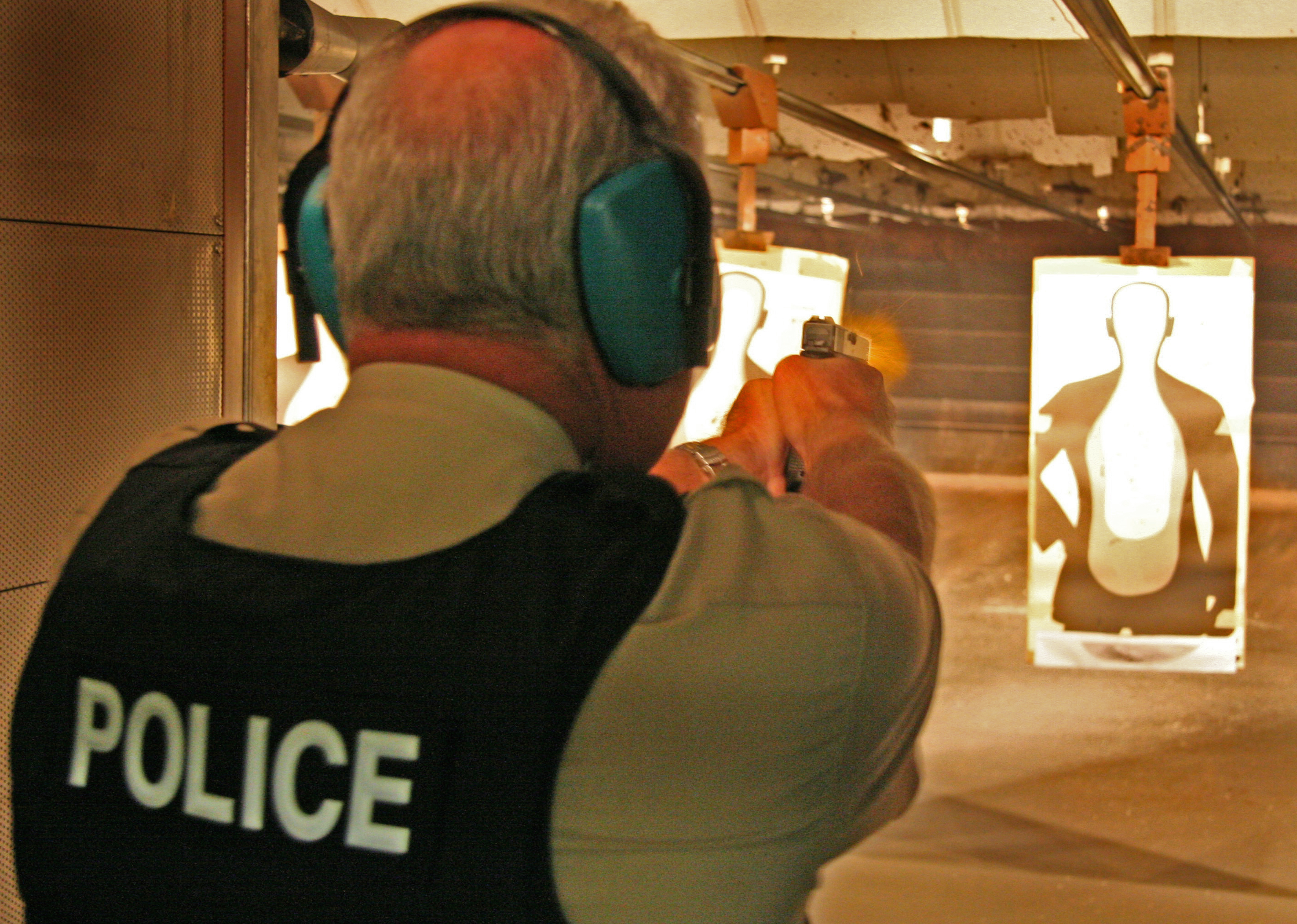
Stop Saying “Officer-Involved Shootings”

by Alex Pareene

SLUG: ME-Ammo DATE: August 23, 2007 CREDIT: James M. Threshe

Let’s talk about “officer-involved shootings.” That is the formal term, used by seemingly all American local news broadcasts, for when a cop shoots someone. Instead of saying “‘Cops’ crew member killed by police officer,” the headline is, “‘Cops’ crew-member killed after officer-involved shooting.” (It just sort of happened, after that shooting.) There is also “police involved shooting,” a term I first noticed being used by the local New York evening news team last May.

These terms are terrible and journalists should not use them. They are cop-speak. Local news reporters love nothing more than adopting cop-speak, because local news is built on manufacturing fear of crime and venerating of police officers, but both of these terms fail the crucial test of actually being coherent explanations of what happened. Of course police would invent an obfuscatory euphemism for when they shoot people – they would be fools not to try to come up with a nice way of saying “we killed someone” – but the press’ job is supposed to be to translate those euphemisms into plain English.

“Officer-involved shooting” absolves the person who actually pulled the trigger of responsibility, turning the shooting into an apparently inevitable act. The officer was just involved! As Natasha Lennard at Vice News puts it:

The phrase “police-involved shooting” is a careful construction, which, like the criminal justice system more broadly, tends to point blame away from cops. It is code for “the cops shot someone.”

To a reporter, “officer-involved shooting” should sound as grating to the ear as “bear-involved large mammal attack.”

The two terms, now ubiquitous, appear to be very successful modern coinages. Neither phrase seems to have been in usage at all before the 1970s. Usage of “officer involved shooting” soared during the 1980s and 1990s, with “police involved shooting” not catching on until the 2000s.

Screen Shot 2014-09-02 at 6.50.10 PM

Where did the term come from? The LAPD has, for years, produced an annual “Officer Involved Shooting” report (NYT) and has had an “officer involved shooting unit” since 1987 or earlier. I wouldn’t be surprised if the phrase made its way into the press’ lexicon via former LAPD chief (and racist paramilitary policing pioneer) Daryl Gates, a man who rarely shied from television cameras. (If anyone knows the actual origin of the phrase, please let us know: dish@andrewsullivan.com)

The International Association of Chiefs of Police, by the way, publishes “Officer-Involved Shooting guidelines” (pdf). The guidelines aren’t about how not to shoot someone, but more about what to do once you have shot someone. The entire document is sort of incredible in its careful consideration of the emotional and mental state of the officer, and its complete silence on the status of the person the officer actually shot. For example:

Following a shooting incident, officers often feel vulnerable if unarmed. If an officer’s firearm has been taken as evidence or simply pursuant to departmental policy, a replacement weapon should be immediately provided as a sign of support, confidence, and trust unless there is an articulable basis for deviating from this procedure. Officers should be kept informed of when their weapon is likely to be returned. Care should be taken to process and collect evidence from the officer as soon as practicable to provide an opportunity to change into civilian clothing.

It is vital that you give the officer his gun back as soon as possible, or else he might feel bad, about shooting someone.

I can’t say this definitively, because, as we’ve learned this month, there is no national database of police shootings, but American cops seem to shoot other people far more often than people shoot cops. The number of police killed by firearms peaked in the early 1970s, and has steadily declined since. It hasn’t cracked 100 officers in any year over the last decade. Meanwhile, around 400 people a year are killed in “justifiable police homicides,” according to the only official numbers available for police homicides. (And that report doesn’t even pretend to be a complete account of everyone killed by police officers.) “Police involved shooting” may not be quite as obfuscatory a phrase as it was designed to be, simply because the majority of American shootings “involving” cops seem to be shootings by cops.

(Photo: Montgomery County police officers qualifying at their indoor shooting range in Rockville, Maryland on August 23, 2007. For story on ammunition rationing due to the war in Iraq. By James M. Thresher/The Washington Post/Getty Images.)

Report: Andrew Cuomo Did Unsavory Thing Everyone Already Suspected He Did

by Alex Pareene

New York Governor Andrew Cuomo Gives Annual State Of State Address

It’s not a perfect measure of partisan leaning, but according to the 2012 election results, New York is more Democratic than California and Minnesota, two states where Democrats control the entirety of the state governments, and where things have not yet completely collapsed in a morass of welfare handouts and tax hikes. So it’s a bit strange that the Republican Party controls the New York state Senate, the body where, traditionally, liberal legislative priorities have gone to die. It’s stranger when you learn that New York voters did actually give Democrats the majority in the Senate in 2012, at which point a coalition of state Senate Democrats known as the Independent Democratic coalition broke off from the party and formally allied with the GOP. Thus, the longtime state Senate Republican majority – the majority that had successfully thwarted nearly every liberal policy push made by the previous two Democratic governors – was preserved.

Andrew Cuomo likes to paint himself as the governor who saved New York from the political dysfunction that typified state politics during the reigns of his predecessors, David Paterson and Eliot Spitzer. Cuomo is the man who forced the sclerotic state legislature to finally act on marriage equality, criminal justice reform, and gun control. You would think that such a governor would prefer to work with Democratic majorities in both state legislative bodies, because, you know, those are all Democratic party priorities that Republicans (mostly) oppose.

You would be wrong. Blake Zeff (full disclosure: he’s my former editor) has a story at Capital New York that confirms what most observers of New York politics already suspected: Cuomo was instrumental in forging the alliance between the IDC and the GOP, because he never actually wanted his own party to wield real power in Albany:

When the coalition was created, Cuomo spoke with IDC leader Jeff Klein to offer advice on how to publicly sell the arrangement and move it forward. According to multiple sources, the governor advised the leaders of the new alliance to emphasize “progress on key issues,” such as campaign finance reform, stop and frisk and increasing the minimum wage. (The conference would use just that language in its announcement, and later release a minimum wage report that February and campaign finance plan in April.)

To move the arrangement forward, the governor and Schwartz would talk directly to Republican leaders and Klein. To help make the coalition work, the governor regularly spoke (by phone and in person) with GOP deputy majority leader Tom Libous, who was effectively Cuomo’s go-to person in the Republican Senate conference. GOP majority leader Dean Skelos was also involved in the discussion, and the governor would talk often in particular with top Skelos aide Robert Mujica. Meanwhile, another top administration official, Joe Percoco, was dispatched to deal with the Senate Democratic conference to try to assuage their concerns even as the governor helped their rivals.

Why would Cuomo do this?

In part because Cuomo’s method of “getting things done” is actually a very old fashioned one, with a rich history of use in New York in particular: It involves shady back-room dealing, obsessive secrecy, strong-arming of opponents, and frequent outright dishonesty. (Spitzer did try similar tactics, but his fatal flaw was that he fought state Republicans instead of governing with – and like – them.) The IDC, then, has been extremely useful for Cuomo. The alliance allows him to push through legislation that liberals would balk at if they held power in the Senate, and the coalition also makes a convenient scapegoat for the times when Cuomo is unable – or, more likely, unwilling – to advance a particular liberal cause.

Cuomo, understand, is a ’90s vintage pro-corporate “New Democrat” – he’s still that Clinton-era DLC type who blames his party’s failings on traditional liberalism – and he is attempting to maintain power in a state where the Democratic Party is, mostly, to the left of the national party, especially on economic issues. But Cuomo believes the key to his own political future rests on appealing to right-leaning whites, because he assumes he won’t have to do anything in particular to win the votes of liberal, black, and Latino New Yorkers. And he seems to just genuinely dislike liberals, period. (See: his not-at-all subtle undermining of New York City mayor and economic populist Bill de Blasio.)

Cuomo is running for reelection this year, and he sort of belatedly realized that he may have a bit of a problem with the state’s liberals. So rather than risk an unpredictable three-way race, he negotiated himself the support of the left-wing Working Families Party. (He then promptly announced plans to undermine them by founding an unasked-for new political party, for women.) As part of his agreement with the WFP, Cuomo agreed to finally denounce the GOP-IDC alliance. He did not do so with much enthusiasm. This is the very alliance that thwarted Cuomo’s much-touted women’s equality and campaign finance bills, and the governor was still unwilling to publicly go on the record and say that he thought his own political party should control the state Senate:

Cuomo finally condemned the alliance, under pressure, after he was given a choice this spring by the Working Families Party between publicly calling for the IDC to caucus with Senate Democrats and losing WFP’s endorsement and ballot line to Fordham Law professor Zephyr Teachout, who he now faces in the primary. At first the governor resisted the demand, with two sources saying he initially refused to include it in a video he recorded for WFP delegates at the party convention in late May. But ultimately he blinked and made the deal, saying in the video, “the Senate has been a problem” and “we must change the leadership of the Senate.”

Cuomo can’t seem to wrap his mind around the crazy idea that maybe the easiest way to get things you support passed is to help elect people who also want those things to pass, instead of people who don’t support those things but are open to being bribed or threatened into changing their minds.

After the convention, Zephyr Teachout, Cuomo’s challenger for the WFP nomination, launched a Democratic Party primary campaign. The election is Tuesday, September 9. There’s a decent chance Cuomo will be forced to ditch the very conservative running mate he selected, which would be funny.