A Breakthrough In Boston?

The cops think they have clear video of a suspect planting the bombs. It could be a “game-changer” in the investigation. Follow more breaking tweets here.

A Defense Of Vengeance

Multiple People Injured After Explosions Near Finish Line at Boston Marathon

In an NPR interview, Fordham University law professor Thane Rosenbaum elaborated on the thesis of his new book, Payback: The Case for Revenge:

Most people think that eye for an eye suggests bloodthirstiness. What it really means is exactness. What it essentially means – and we get this from the Old Testament and, of course, in Hammurabi’s Code – that when a moral injury is created, a debt is created, and then payback is required, but it has to be specific. It has to be proportionate. And all an eye for an eye means is a way to prevent disproportionate revenge. Disproportionate revenge are blood feuds, recycling of vengeance, the Hatfields versus the McCoys.

Through the natural history of our species, we were able to manage revenge through tribes and individuals because people knew what enough – what was enough to be satisfied. And that means that when one loses an eye, they’re entitled to receive no more than an eye, but also no less than an eye. And in our system, unfortunately, with plea bargains, we’re very often shortchanged, and we’re constantly paying back less than an eye.

In another interview, Rosenbaum argues that to under-punish “is a kind of moral violation that we should find intolerable”:

I write about the woman in Iran who was blinded by a classmate, with acid thrown in her face. Originally the sentence was that a doctor would put acid in the eyes of the person who did that—truly an eye for an eye. This woman has been blinded and disfigured for the rest of her life, and why should the other person not experience the same thing? In the end, both the court and she decided not to go through with that remedy. Some people were relieved. But I think it at least sends a message that she was entitled to that.

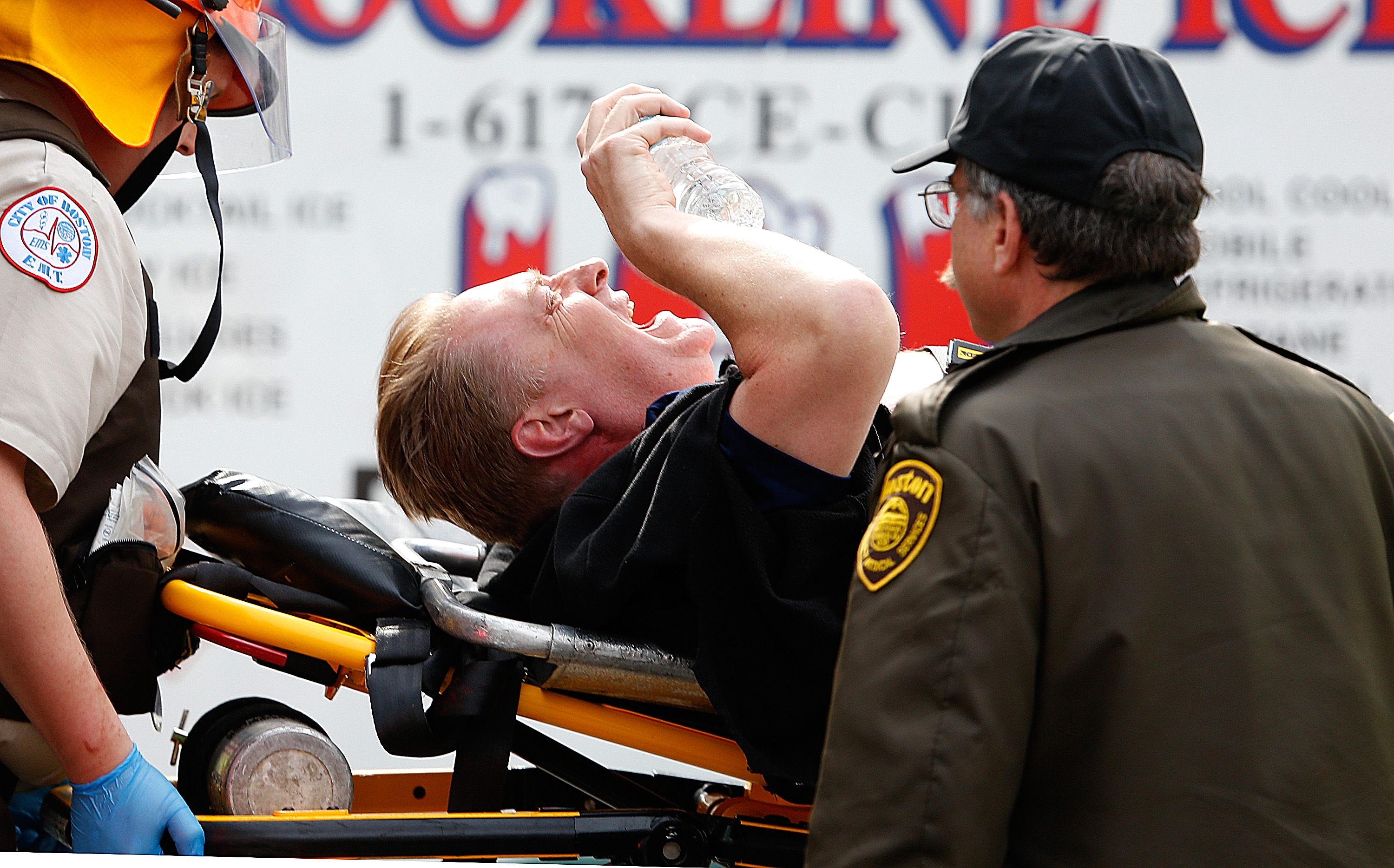
(Photo: A man is loaded into an ambulance after he was injured by one of two bombs exploded during the 117th Boston Marathon near Copley Square on April 15, 2013 in Boston, Massachusetts. Two people are confirmed dead and at least 23 injured after two explosions went off near the finish line to the marathon. By Jim Rogash/Getty Images)
Why Are Bombings So Rare In America?

Joyner asks:

[W]hile these attacks are thankfully rare, I can’t for the life of me figure out why. The Boston Marathon and the Super Bowl are comparatively easy to secure, because they’re one-offs, generate sufficient revenue to make a security investment reasonable, and obvious targets. It’s simply impossible to protect all of our schools, shopping malls, movie theaters, airports, and other places where hundreds and even thousands of people gather on a daily basis.

McArdle responds:

So why don’t they happen more? The most convincing answer I’ve gotten to that question is that fostering terror is only one of the aims of a terrorist attack. These attacks also function as recruiting, and as fundraising promotions for your terrorist organization. There are what you might call business considerations, in other words, and those business considerations dictate the kinds of attacks that terrorists want to carry out.

Peter Bergen provides another answer:

After 9/11 there was a rapid increase in the number of Joint Terrorism Task Forces around the country, which are made up of multiple law enforcement agencies working together to ferret out suspected terrorist activity. And following the 9/11 attacks, far more businesses started reporting to law enforcement suspicious purchases of any kind of material that could be used for bomb-making. As a result, since 9/11 bomb plots that have simply fizzled out have overwhelmingly been the rule.

Why We Fear Terrorism

Ross Pomeroy reviews research on the subject:

In 1987, psychologist and risk perception expert Paul Slovic skillfully summarized in the journal Science how we calculate risk. In general, humans tend to be wary and apprehensive of risks that are uncontrollable, potentially fatal, possibly catastrophic, and relatively unknown.

The danger of terrorism put in perspective:

In the last decade, you’d be hard-pressed to go one day without hearing about [terrorism]. However, as Reason‘s Ronald Bailey wrote in 2011, an American’s chances of being killed by a terrorist are approximately one in 20 million. Heck, even if all of the thwarted terrorist attacks over the last 10 years were carried out, that still would translate to a risk of one in 1.7 million. Compare that to an infinitely more dangerous activity you may undertake every morning: climbing into a car. The annual risk of dying in a motor vehicle crash is one in 19,000.

When Your City Is Wounded

Boston Deals With Aftermath Of Marathon Explosions

EJ Graff, a Bostonian, tries to process yesterday’s events:

To cripple the city all you’d have to do is take a gasoline tanker and crash it in one of the tunnels built by the Big Dig—you could take down a couple of major arteries and shut down the city for months. On the other hand, if you wanted to strike at our symbolic heart, at what it means to belong to this ludicrously snobby little city built on a harbor that was filled in, if you wanted to grab international headlines on a day when ordinary and extraordinary people from around the world were cramping their legs and exercising their hearts with ordinary and extraordinary joy, if you wanted to make a statement about what it means to be an American, then attacking the Marathon—which belongs to us all—on Patriots’ Day might be just right.

Kornacki, who grew up outside of the city, adds his thoughts:

Between texts and calls to friends and family, I lived on Twitter Monday afternoon, clicking on every link with new information and retweeting anything that seemed useful. It was Twitter at its best. It was also Twitter at its worst, a combination of tasteless tweets from the usual suspects and self-satisfied policing, as if what really mattered was who was saying what on social media. I had no patience for it, or for the speculation about who might have done it and why, or for anyone trying to wring some kind of deeper political or philosophical meaning from any of it. In every picture, I saw home. In every face, I saw an old friend or classmate or teacher colleague or neighbor.  We’ll find out who did this, hopefully soon, and part of me is trying to imagine a punishment harsh enough to fit this crime. The rest of me just wants to cry.

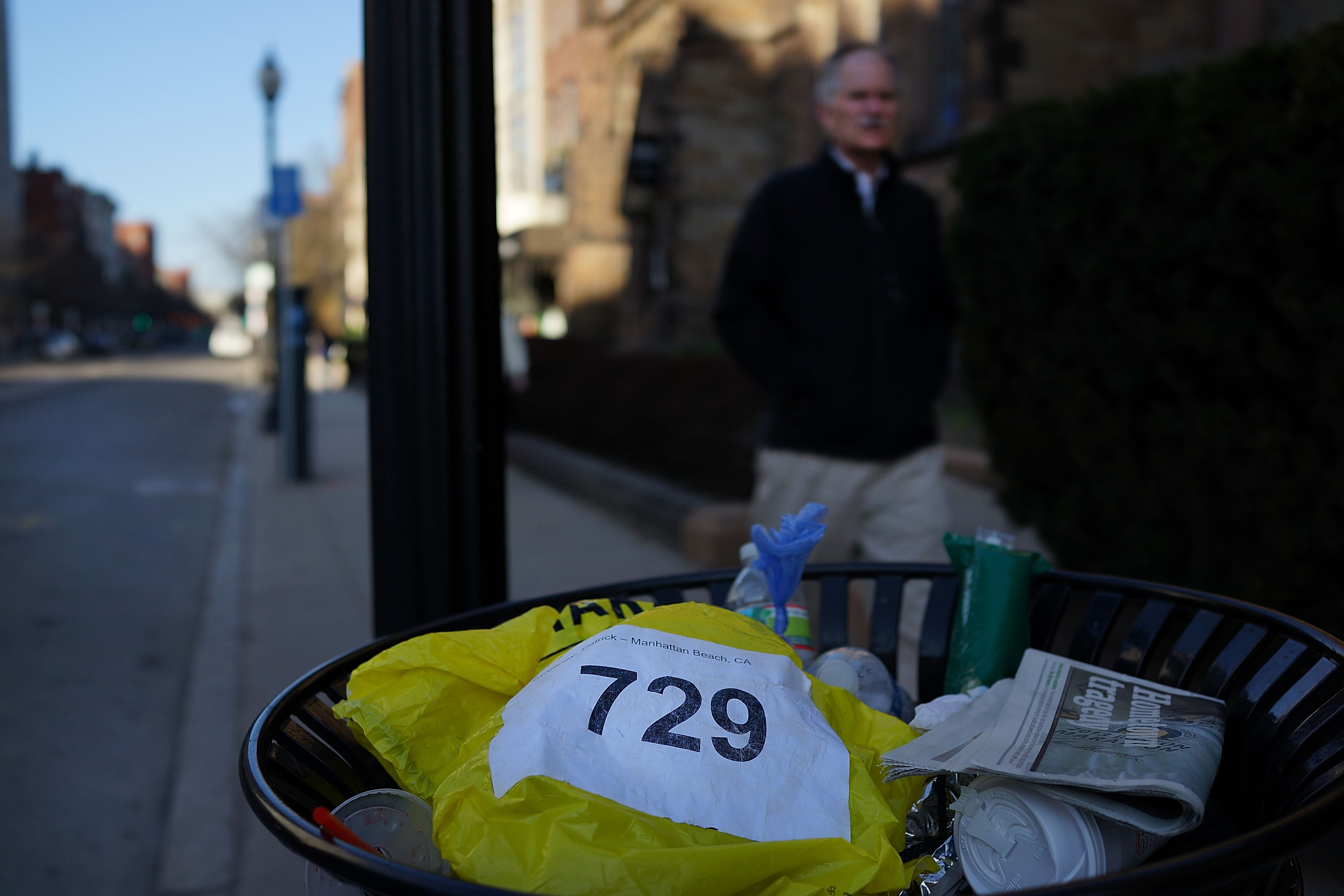
(Photo: A discarded runners bib is viewed near the scene of a twin bombing at the Boston Marathon on April 16, 2013 in Boston, Massachusetts. By Spencer Platt/Getty Images)

Terrorism Is Rare

keep-calm-and-love-boston-36

Bruce Schneier calls the Boston bombings “something that almost never happens”:

Remember after 9/11 when people predicted we’d see these sorts of attacks every few months? That never happened, and it wasn’t because the TSA confiscated knives and snow globes at airports. Give the FBI credit for rolling up terrorist networks and interdicting terrorist funding, but we also exaggerated the threat. We get our ideas about how easy it is to blow things up from television and the movies. It turns out that terrorism is much harder than most people think. It’s hard to find willing terrorists, it’s hard to put a plot together, it’s hard to get materials, and it’s hard to execute a workable plan. As a collective group, terrorists are dumb, and they make dumb mistakes; criminal masterminds are another myth from movies and comic books.

Douthat hopes that we will respond rationally:

Today’s attack, on the kind of event that countless cities hold and that even the most omnicompetent police force couldn’t make entirely secure, could easily lead to a further ratchet, a further expansion of preventive (or preventive-seeming) measures, a further intrusion of bureaucratic and paramilitary rituals into the rhythms of everyday life. Or it could be an opportunity to recognize the limits of such measures, the impossibility of achieving perfect security, and the costs of pretending that an extra ring of barriers and inconveniences will suffice to stop a determined evil from finding its way through.

We really do have to adopt a more stoic response to these acts of evil. It is the only long-term thing that deprives them of their power.

Sifting Through The Evidence

In response to the Boston Police Department’s request that the public submit video of the finish line to be parsed for clues, Alexis Madrigal offers a suggestion:

If Federal or local police do need help [with video analysis], they could reach out to Digital Media Evidence Processing Lab at the University of Indianapolis, which is run by the Law Enforcement and Emergency Services Video Association. …

After the Vancouver riots, police in that city brought the video they received from citizens to the lab. “Working around-the-clock shifts, analysts and technicians examined more than 5,000 hours of video while tagging more than 15,000 criminal events and individuals,” trade journal Evidence Magazine wrote in 2012. “The approach proved quite powerful. Whereas investigators required four months to process just 100 hours of video after the riots in 1994, the thousands of hours of video recorded in 2011 were processed and initially tagged in just two weeks.”

This will become the sad new ritual of mourning a tragedy: sending and processing the horrific memories of an event in hopes of finding evidence to bring criminals to justice.

Chronicling The Carnage

The Boston Globe’s Big Picture has the most stirring images from yesterday. A reader responds to what was probably the most gruesome photo to surface:

Please, please, I hope to find that the man in the wheelchair with the bilateral leg trauma (and amputations) has survived. He will be in every prayer I have the ability to pray. If you hear of him, please let us know.

He appears to be alive and stable. A little background on the young man here. By the way, the guy in the cowboy hat seen helping in the photo is also featured in this stirring Youtube, in which he recalls the carnage while shaking uncontrollably. He also appears to be the same guy holding up the American flag in the middle of the bomb site. His name is Carlos Arredondo and his remarkable backstory is here.

Quote For The Day

“I don’t know what’s going to be revealed to be behind all of this mayhem. One human insect or a poisonous mass of broken sociopaths. But here’s what I DO know. If it’s one person or a HUNDRED people, that number is not even a fraction of a fraction of a fraction of a percent of the population on this planet. You watch the videos of the carnage and there are people running TOWARDS the destruction to help out. … This is a giant planet and we’re lucky to live on it but there are prices and penalties incurred for the daily miracle of existence. One of them is, every once in awhile, the wiring of a tiny sliver of the species gets snarled and they’re pointed towards darkness.

But the vast majority stands against that darkness and, like white blood cells attacking a virus, they dilute and weaken and eventually wash away the evil doers and, more importantly, the damage they wreak. This is beyond religion or creed or nation. We would not be here if humanity were inherently evil. We’d have eaten ourselves alive long ago,” – Patton Oswalt.

As The Smoke Clears

Multiple People Injured After Explosions Near Finish Line at Boston Marathon

Charles Pierce reports from Boston:

Once I got to Copley Square, I sat down and talked to an EMT. He had been one of the first on the scene. The problem the EMTs had was that the bomb went off inside the security barricades. The barricades meant to protect the spectators briefly prevented the EMTs from reaching the injured. This was not the last of the day’s cruel ironies. The EMT told me that the first person he saw was a 5- or 6-year-old with blood on his face. He did not seem to be in any way injured. One of his parents lay on the ground next to him. The parent wasn’t moving.

Marc Herman points out that “today’s attack at the finish line appears to have coincided with the moment when, statistically, the largest number of runners — and presumably their friends and family — would be nearby.” Nicholas Thompson zooms out:

There’s something particularly devastating about an attack on a marathon. It’s an epic event in which men and women appear almost superhuman. The winning men run for hours at a pace even normal fit people can only hold in a sprint. But it’s also so ordinary. It’s not held in a stadium or on a track. It’s held in the same streets everyone drives on and walks down. An attack on a marathon is, in some ways, more devastating than an attack on a stadium; you’re hitting something special but also something very quotidian.

Ezra Klein focuses on the response to the tragedy:

If you are losing faith in human nature today, watch what happens in the aftermath of an attack on the Boston Marathon. The flood of donations crashed the Red Cross’s Web site. The organization tweeted that its blood supplies are already full. People are lining up outside of Tufts Medical Center to try and help. Runners are already vowing to be at marathons in the coming weeks and months. This won’t be the last time the squeakers run Boston. This won’t be the last time we gather at the finish line to marvel how much more we can take than anyone ever thought possible.

(Photo: Beacon Street near Kenmore Square remains empty for the use of emergency vehicles after two explosive devices detonated at the finish line of the 117th Boston Marathon on April 15, 2013 in Boston, Massachusetts. Two people are confirmed dead and at least 23 injured after two explosions went off near the finish line to the marathon. By Alex Trautwig/Getty Images)