A Long Way From Kyrgyzstan

Julia Ioffe, who spent her early childhood in Russia, explores the significance of the Tsarnaev brothers’ struggle to assimilate in the US as Chechens:

If the YouTube channel that is said to be [older brother] Tamerlan’s really is his, you can see him fervently clinging to this torn identity: It is full of Islam and Russian rap, which makes sense given the Soviet policy of Russifying Chechnya. In fact, Chechnya is still part of Russia and Russian, as well as Chechen, is its official language. Dzhokhar, who was either 9 or 11 when the family moved, may have been more assimilated than Tamerlan, but if that VKontakte page is his, it too is telling: VKontakte is the homegrown Russian rip-off of Facebook. The mere fact that he had a page on an exclusively Russian social network shows that the assimilation was not a complete one. Because emigrating at 11, or even 9, is hard, too. (The most revealing image of Dzhokhar is not the one of him hugging an African-American friend at his high school graduation, but the one of him sitting at a kitchen table with his arm around a guy his age who appears to be of Central Asian descent. In front of them is a dish plov, a Central Asian dish of rice and meat, and a bottle of Ranch dressing.)

When Jihad Meets Columbine

How Olivier Roy understands Western-bred Jihadists:

The main motivation is not religious. Most of the guys, they were normal, they were not especially religious. One of them who went to Tehran became religious. It is not the process of Islamicization, through going to mosque, through studying the Koran. They go for action, they take the al Qaeda thing because if you do that in name of Al Qaeda, you will have a far hotter act than if you do that in the name of something else. They are disconnected in fact from the Muslim community. Many security officials thought the best way to spot these guys was to use the local Muslim communities to control the radical mosques, to engage mainstream imams to ask for help. And most of them comply with that, they want to help but they can’t comply because they guys are not part of these communities. They are loners.

With the Western ones, there may be some strange fusion of loner Internet Jihadism with simple fame-seeking testosterone. But the idea that religious zeal is not behind this seems to me perversely blind.

Roy’s second point, however, is a vital one. This is not about mainstream Islam. It is not about tradition or Muslim communities as we have long known them, especially in America. It is about the fusion of the most extreme and violent versions of Islam (a religion whose founder committed violence), with global Internet culture, and the lost, desperate souls of modernity.

With such an easily available, literally explosive combination, it amazes me, in many ways, that we have not seen more of this before.

Should Tsarnaev Be Read His Rights?

Emily Bazelon worries because he hasn’t been Mirandaized:

[T]he next time you read about an abusive interrogation, or a wrongful conviction that resulted from a false confession, think about why we have Miranda in the first place. It’s to stop law enforcement authorities from committing abuses. Because when they can make their own rules, sometime, somewhere, they inevitably will.

Jason Mazzone counters:

A newsflash: Miranda does not in any way require the police to warn suspects taken into custody that they don’t have to answer questions or that they have a right to have an attorney present. All that Miranda says suspect-number-2is that if the interrogators don’t give the warnings, then (barring an exception), the government won’t be able to introduce into evidence at trial statements the unwarned suspect makes (or the fruits of those statements). Accordingly, there is nothing remotely unusual about the Tsarnaev situation. Millions of criminal suspects are questioned every year by the police (and other law enforcement officials) without ever being advised of their rights under Miranda. Police officers I know tell me they hardly ever Mirandize individuals they arrest because cases in which the arrestee’s statements are relevant to securing a conviction (especially in a world of plea bargaining) are quite unusual.

Sandy Levinson disagrees with Mazzone’s dismissal of Bazelon and considers Tsarnaev’s individual case:

As a practical matter, as Marty Lederman has suggested elsewhere, it is quite unlikely that Dzhokhar Tsarnaev is unaware that he has a right to remain silent, either because of his knowledge of American culture or because his alleged terrorism-masters in Chechnya would surely have had the wit to say (something like) “if you’re captured, remember that those wimp Americans will accord you a right to remain silent.” Also, as Marty has suggested, it is almost certainly the fact that a smart defense lawyer would not necessarily advise taking the fifth, precisely because there is so much evidence against him and the smart thing to do would be to strike a deal for, say, life imprisonment in return for singing like a canary (and verifying what he says by tracking down his leads).

As a practical matter, I don’t object. As a symbolic matter, I fear it reeks of post-9/11 panic. I’m just relieved we do not have a Romney administration or this American citizen would be getting prepped for being tortured, just as Jose Padilla was. Orin Kerr is on the same page as Mazzone:

[T]he government is still free to question Tsarnaev outside Miranda as long as the government accepts the uncertainty of whether those statements would be admissible in a criminal case against him.

Assuming that the evidence against Tsarnaev’s many different crimes over the last week is likely to be overwhelming, agents may not need any statements from him for a criminal case. They may simply want whatever intelligence he can provide for use in broader antiterrorism efforts, and Miranda is no impediment in that case. The agents are free to question Tsarnaev outside Miranda to gather intellligence as long as they don’t cross the line into coercing statements from him.

Freddie DeBoer has a different view:

Timothy McVeigh: killed 168 people. Injured over 800 more. Was motivated by political convictions. He was arrested, Mirandized, charged, appointed with legal counsel, and tried in a civilian court. Ted Kaczynski: killed three people. Injured 23 more. Was motivated by political convictions. He was arrested, Mirandized, charged, appointed with legal counsel, and processed through a civilian court. Eric Rudolph: killed two people. Injured at least 150 more. Was motivated by political convictions. He was arrested, Mirandized, charged, appointed with legal counsel, and processed through a civilian court.

If you recognize that the results of these legal cases were consonant with our system of jurisprudence and with justice, you cannot ask for a separate status for Dzhokhar Tsarnaev without supporting legal discrimination based on ethnicity and religion.

Scott Lemieux adds:

The local authorities that relied on coercive interrogations and didn’t follow professional procedures weren’t more likely to convict criminals, although they were more likely to convict the innocent. Miranda reflected this belief, and the intent of the rule was to inhibit coercive interrogations, because coercive interrogations were both wrong in themselves and produced unreliable information.

To refuse to inform Tsarnaev of his rights — outside of the acknowledged emergency exception to Miranda — sends the opposite message. It’s the message of the previous administration — i.e. that the rule of law and the “war on terror” are incompatible, that slapping the label “terrorist” on a suspect means that professional procedures that respect the rights of the accused can’t work.

Jeffrey Rosen’s related thoughts:

[N]o one has produced evidence showing that non-mirandized investigations, like enhanced interrogation, are necessary to procure valuable intelligence—the administration originally argued that the ordinary criminal justice system was adequate to try even the Guantanamo detainees. “We should use the rules we currently have, because no one has made a convincingly argument that the rules don’t work,” says [Dennis] Kenney, a policing scholar and former cop. “Collectively, you’ll find that the police are pretty comfortable with the rules as they are and if you talk to police leaders, they’re nervous about these kinds of changes.”

And Brian Beutler makes an important final point:

Miranda rights aren’t conferred on a suspect at the moment an officer of the law reads them to him. They’re fundamental. And if Tsarnaev awakes in the hospital aware that he doesn’t have to say anything, and demands an attorney, the FBI ultimately can’t deny him one.

Yes, Of Course It Was Jihad

There are many nuances to the story of Tamerlan and Dzokhar Tsarnaev – and there is no doubt that, like all human beings their acts were, as my shrink often unhelpfully puts it, “multi-determined.” And there is a huge amount to learn from the stoner kid who got caught up in his brother’s religious fanaticism. But Glenn Greenwald veers into left-liberal self-parody this morning:

The overarching principle here should be that Dzhokhar Tsarnaev is entitled to a presumption of innocence until he is actually proven guilty. As so many cases have proven – from accused (but exonerated) anthrax attacker Stephen Hatfill to accused (but exonerated) Atlanta Olympic bomber Richard Jewell to dozens if not hundreds of Guantanamo detainees accused of being the “worst of the worst” but who were guilty of nothing – people who appear to be guilty based on government accusations and trials-by-media are often completely innocent. Media-presented evidence is no substitute for due process and an adversarial trial.

But beyond that issue, even those assuming the guilt of the Tsarnaev brothers seem to have no basis at all for claiming that this was an act of “terrorism” in a way that would meaningfully distinguish it from Aurora, Sandy Hook, Tuscon and Columbine. All we really know about them in this regard is that they identified as Muslim, and that the older brother allegedly watched extremist YouTube videos and was suspected by the Russian government of religious extremism (by contrast, virtually every person who knew the younger brother has emphatically said that he never evinced political or religious extremism).

Legally, the case for the presumption of innocence is absolutely right. But come on.

One reason the Miranda rights issue is not that salient is that the evidence that this dude bombed innocents, played a role in shooting a cop, shutting down a city, and terrorizing people for a week is overwhelming and on tape. And yes, of course, this decision to commit horrific crimes may be due in part to “some combination of mental illness, societal alienation, or other form of internal instability and rage that is apolitical in nature.” But to dismiss the overwhelming evidence that this was also religiously motivated – a trail that now includes a rant against his own imam for honoring Martin Luther King Jr. because he was not a Muslim – is to be blind to an almost text-book case of Jihadist radicalization, most likely in the US. Tamerlan may have been brimming with testosterone as he found boxing an outlet for his aggression, bragging to his peers of his coolness and machismo and piety, and all of that may have contributed. Who knows if the delay in his citizenship application because he was beating his wife was the proximate cause. But does Glenn wonder why Tamerlan thought it was ok to beat his wife, whom he demanded convert to Islam? Does Glenn see no religious extremism here:

The dramatic confrontation between Tamerlan and his imam began when the 26-year-old interrupted a solemn Friday prayer service three months ago. The imam had just offered up assassinated civil rights icon Martin Luther King Jr. as a fine example of a man to emulate – but this reportedly enraged Tamerlan.

‘You cannot mention this guy because he’s not a Muslim!’ Muhammad recalled Tamerlan shouting, shocking others in attendance according to the LA Times. Kicked out of the mosque for his outrageous behavior, Tamerlan did return to the prayer service after his outburst according to Muhammad.

‘He’s crazy to me,’ said Muhammad. ‘He had an anger inside.… I can’t explain what was in his mind.’

This is from the Daily Mail – which is almost as unreliable as the New York Post – but the sourced quotes from his own imam seem legit. So we see perhaps the core of what is in front of our noses: this was not about Islam or being Muslim as such. Look at Tamerlan’s family and his own imam. They all saw a young man drifting into something far more extremist, fundamentalist and bigoted. His uncle saw it:

‘I was shocked when I heard his words, his phrases, when every other word he starts sticking in words of God. I question what he’s doing for work, (and) he claimed he would just put everything in the will of God.”

We see the sexual puritanism of the neurotically fundamentalist. We have his YouTube page and the comments he made in the photography portfolio. To state today that we really still have no idea what motivated him and that rushing toward the word Jihadist is some form of Islamophobia seems completely bizarre to me.

When will some understand how dangerous religious fundamentalism truly is? And when will they grasp that a religion that does not entirely eschew violence (like the Gospels or Buddhism) will likely produce violence when its extremist loners seek meaning in a bewildering multicultural modern world? This was an act of Jihad. That does not mean we elevate it above crime; it means we understand the nature of the crime. It only makes sense in the context of immediate Paradise, combined with worldly fame. And those convinced of the glories of martyrdom – of going out with a bang – are the hardest of all to stop.

(Video: Introductory clip from the YouTube account of Tamerlan Tsarnaev)

Update from a reader:

In your recent post about the issue of religious extremism and the alleged acts of terror by the Tsarnaev brothers, you said: “But does Glenn wonder why Tamerlan thought it was ok to beat his wife, whom he demanded convert to Islam?” Just a quick fact-check query. The coverage I seemed to recall reading and hearing indicated that although the elder brother, Tamerlan, was charged in some kind of domestic violence incident, as I understand the facts, it was for something he did to a former girlfriend who is NOT his current wife. And separately, as I understand the reporting, he did in fact push and convince his current wife to convert to Islam when they married, but it appears that that was not concurrent with domestic violence against her.

Sully And Hitch: When Fundamentalists Plant Bombs

Memorials And Sunday Services Held In Honor Of Boston Marathon Bombing Victims

After last week, back to the late night conversation  – and an eerily familiar discussion:

H: The idea of spreading, deliberately, terrible violence, toxic…

A: Why do you think this hasn’t happened? I mean, obviously it hasn’t happened because they can’t have gotten the serious weaponry, the WmDs, right? Otherwise it would’ve happened.

H: I don’t believe they’d have it and be hoarding it, no. Though I could be wrong about that, though: it seemed to me that upon acquisition, Saddam Hussein as a regime or al-Qaeda as a movement would use it at once, or as soon as possible, in a way that, oddly, I don’t think the Iranian regime would. I think they would have it to hoard it and use it as a threat. But, this is a very short gap of time between acquisition and use and it comes to the same thing.

A: But what we saw on 9/11 was sort of the existential fact that these people have been sanctioned, partly by their own eschatology, to believe that it is in fact a sign of the coming apocalypse. That they can act like the zealots acted in ancient Israel under the understanding that the end of the world was imminent—

H: And desirable.

A: And desirable, and that one’s actions were therefore…

H: Yup, they have that in common with all religions. They got the idea from perfectly respectable holy books that are available everywhere and are given to schoolchildren.

A: But at no point in human history have those kinds of people been able to access this kind of power, of destructive power. One isn’t even talking about the need to construct something difficult and enduring like a state or a civilization. One isn’t even talking about the ability to invent these things, it is to copy them or to steal them and deploy them in the crudest manner fashionable to kill as many—

H: To bring on the end, to prove that death is more adorable than life.

A: Yes.

H: Again a necessary religious belief.

A: The one thing I just want to come back to is how does one summon up the energy to fight this knowing it’s inevitable?

H: That’s an excellent question. Well, in the same way as one seeks, knowingly, to stave off or postpone death while accepting its inevitability. In the same way as one has, in some sense, a conscience. Because we, without these faculties, wouldn’t have progressed to the point where you and I could be talking and it could be on tape. Hah, “tape.” See how primitive I am.

A: Yes.

H: That it could be recorded and transmitted.

A: On some .mp3 file.

H: All we know is that without these qualities we wouldn’t have advanced the small distance that we have. I’m content to leave it at that. The mystery to me is that those who are impatient for it to be all over on the illusory belief that the next world, which by their own definition will be created by murder and torture — the transition to it will be accomplished by this apocalyptic, indifferent, pitiless destruction — will be better than the one we’ve got.

I have no idea what it’s like to believe this sort of thing, I think, but I think I can recognize evil when its staring me in the face. And so my resolution, to answer your question, would be not to not give an inch to it and in particular, not to make any excuses for it, not to say, “this is a protest against real human deprivation or suffering”—I won’t have it said that Osama bin Laden is a spokesman for the poor. I’m not having that.

A: We’re not going to have the slightest scintilla of disagreement about that. And I think it’s partly because I actually understand—in some ways, I think, your understanding of religion comes from a hostile point of view, mine comes from a less hostile point of view—but I do understand it. I do understand its power. I do understand why it can lead people to do these things.

H: I understand its power. But whereas I can — in a debate with, say, any kind of Republican or any kind of Leftist — I can back myself to be able, if I had to, or for money, or for a joke, or just as demonstration, to put their case for them, to make their speech, if I had to…I cannot imagine what it is like—

A: To like actually believe it.

H: No. Well, in some cases, I can, but in the case of the religious believer, I cannot. I don’t think it’s a limitation, either, on my curiosity or my mental power.

A: But in this country the biggest selling book is the Left Behind series, the biggest selling series.

H: But I’m sure the least read. It’s totally unreadable.

A: I can honestly testify to seeing people reading it on planes, in airports,

H: Do you see them turning the pages?

A: (Laughs) Yes!

H: Are they holding it the right side up?

A: You read this stuff and it’s like a terrible, terrible, sort of hackneyed, cribbed version of a Frederick Forsyth novel.

H: I’m serious, Andrew, actually, it’s torture for a literate person to read. And I don’t think that by making it written by illiterates it makes it easier for people who don’t read for pleasure to read. I say it’s technically unreadable; they maybe holding it and looking at and they may put it back reverently on the shelf when they get home—it’s not possible they’ve read all but eight words. It can’t be done. The Da Vinci Code is bad, but at least you want to find out what happens next. It’s bad beyond description…

A: Well of course—the Left Behind plot is riveting! Because, you know, you’re on an airplane then suddenly your best friend has disappeared…

H: Once. I can read that once. On a plane, particularly, or on a Greyhound bus. I presume the same is true on a bus or on a camel train.

A: (Laughs) But what I’m saying is, in this country—let’s say they haven’t read them. For the sake of argument I concede they haven’t read the whole bloody thing. They certainly bought it, that requires a certain commitment to the worldview that this thing represents, and what this thing represents is that, not only is the end of the world coming but it is a very desirable thing for it to come. I mean, you see these people rushing to a red heifer in Israel.

H: Indeed, they’re trying to grow the red heifer and in Iowa, now, they find a pseudo or corrupt geneticist who thinks he can grow one without a single white hair. But I hope it succeeds, I hope they get the heifer that doesn’t have a single white hair and it’s pure red, and I hope they do sacrifice it and scatter its ashes. It’ll be the same as every other messianic enterprise, it will end in a hideous disappointment for the morons.

A: No, you know what happens then! What happens then, is there’s a dictatorship of the proletariat and what happens then, is there has to be a vanguard of people who ensure that it occurs!

H: But Andrew, I’ve got to tell you that none of this would occur, even if all the preconditions are met, it will not happen—the temple will not come down from Heaven, the rapture will not take place, the Messiah will not come. The Messiah will not come and will not even call. This is axiomatic to me. The other form, in the secular right in the 50s, which you were recalling also – the John Birch Society was really quite strong, and it was made up of people who believed that President Eisenhower was a conscious agent of the communist conspiracy, that he was a paid enforcer of the Kremlin. Now, okay, you get up in the morning and you believe that, and then you still have to go down and get the groceries.

A: Right.

H: You still have to page through the newspaper. You still have to go and keep your doctor’s and dentist’s appointments. It doesn’t matter what you think, you can believe that if you like. That’s what Omar Khayyam says,

And do you think that unto such as you
a maggot-minded, starved, fanatic crew
God gave the Secret, and denied it me?
Well, well, what matters it! Believe that too.

It doesn’t matter what they think. Unless they’re willing to use deadly force to try and advance the process. Well, the same would be true if they were a secular movement, like fascism. I’m sorry, we’re not gonna be talked to in that tone of voice. We won’t negotiate at gunpoint, if you declare war on us you’ll be sorry, your people will be killed at a greater rate than ours. We promise it. We guarantee.

A: When you say, “your people” — let us say that Osama gets a suitcase, or some al-Qaeda group gets a suitcase.

H: We’d lose a city. We’d lose a city in a war against fascism.

A: And who do we fight? Where do we go? Who do we attack? I mean, that’s — who suffers for this? Do you take out the entire Middle East? What do you do?

H: No, that is indeed the worst aspect of the new situation. It’s—

A: Well it’s not just the worst aspect, it’s the central aspect, it’s the central conundrum.

H: Well, I said it’s the worst, I wasn’t saying it wasn’t central. For the moment, if we’re talking just about technology it’s actually very unlikely that anyone or any group could manage such a thing without at least a state machine that had at least some background to it or was willing to be a host or patron, perhaps deniably. That gives one a certain leverage. But ultimately, one has to face the thought of a small group, perhaps even born and raised in the country, could acquire at least the material, say, to poison the reservoir or release a virus.

A: I mean, you can download from the Internet the 1918 flu virus. It’s there. Presumably, if you have a smart enough biologist or somebody somewhere, you know, this is an ideology we’re talking about that is capable — I mean the 7/7 bombings, they were organized by people from Yorkshire…

H: No, this is and will be, as long as long as I live—however long that is, and I don’t want it shortened by these riff-raff, but it’s possible they can do that—a continuing source of anxiety. Because it proceeds from an anti-human ideology that, in the name of God, can be replicated like a plague anywhere in the world.

A: Now, we could talk about this the way we are, but let’s say you’re president in the United States—

H: Things will never be that perilous.

A: (Laughs) This astonishing, amorphous, constant, changing, invisible, largely, potential threat is never ending. You can, presumably, construct surveillance systems, there are all sorts of things maybe one can permanently set up. And let’s face it, the structure of self-defense, the war we’re talking about is permanent, it seems, at least to my mind as far as I can see, endless. There is no point at which these people—maybe there will come a point at which this thing will…

H: This is not a new thought to me though, Andrew, because the struggle against religion is a perpetual one, and against the toxins that it spreads. So it’s—

A: Nevertheless, you would equate the kind of struggle we’re dealing with here with the struggle against something like Soviet communism as ideology, right? It’s the same mindset, right?

H: No, I would not. The struggle against communism as an ideology is a quite separate thing in my mind, and still is, from the struggle against the Soviet Union as an imperial superpower, which wasn’t in fact able to use its agents and supporters in other countries to any such effect. And, actually it has to be said, it didn’t wish to do so in such a way as to spread random terror and disease. No, this is entirely different. This is the way in which fanaticism knows no law; it’s the way in which no one knew for several decades what to do about the so-called assassin movement because it appeared to be impermeable to deterrence or retribution. That it was terrifyingly irrational and for that reason very strong.

A: Right, we’re talking about the late nineteenth and early twentieth centuries?

H: No, no I’m talking a period much earlier than that, about which nobody knows very much because the story is somewhat legendary but the assassin—the hashishin as they’re sometimes called, because it was believed they were influenced by narcotics—who were able to kill monarchs and political rulers at will in the area roughly we would now call Turkey, Persia, Armenia, and so on. Controlled by a fanatical leader, in the end put down actually by a Muslim authority. But the terrifying thing about them was that they knew no fear, they believed they would go to heaven if they died, they were impervious to deterrence, impermeable to retribution and spread fear and trembling then for the same reason these people do now. There was nothing to bargain with, in rather the same way as the terror of Hitler and national socialism—somewhat different, I think, than that from the threat of Stalin and Stalinism—was that it was, in the literal sense, unappeasable. It was self-destructive; it secretly desired its own death and the death of others.

A: Except we now have the technological factor. Which multiplies, exponentially, the damage that can be done. We’re not just talking about the occasional assassination, we’re talking about the destruction of great cities, we’re talking about what would be the collapse, or at least an astonishing decline in the world economy, we’re talking about the end of trade as we know it, to some extent.

H: Well, yes, of civilized, trusting life. Everyday life. That’s why I’ve written a book saying faith is our enemy.

A: But you’re also saying that faith is eternal so, I mean, you can rail against this, but it won’t disappear off the face of the Earth. I mean, Jefferson believed that within a hundred years or so, the kind of religious faith that he talked about, the founders believed it would become a kind of Episcopalianism, they predicted that.

H: No, no, Jefferson went further than that; he said, “there is not a boy living now,” I think he said, “in America who will not die a Unitarian.” Amazing. Though, if you actually asked, absent a few centers of extreme biblical literalism in the country, what most people’s belief really is, whatever church they attend or whatever faith they profess, something not unlike a vague spiritual, humanitarian Unitarianism wouldn’t be far from it. Most secular Jews adopt a view not unlike that. Extreme tolerance, no insistence on monotheism…

A: We know that the form, by far the strongest element of American religion at this point in time is a much more severe form of inerrant biblical scriptural fundamentalism. By far.

H: I think you say that in error.

A: How?

H: And, well, I think you register them more because they have you in their…

A: In their sights?

H: Yes. It’s impossible to govern the United States, or even a state in the United States with this group, they’ll never win even a state government, and if they try it they’ll lose.

A: They already run every single state south of the Mason-Dixon line. They run the Republican Party!

H: No, they don’t. No, this, you see, this is just your gay paranoia. Your bum-banging paranoia.

A: No it’s not.

H: There’s no possibility these people can run a state let alone the Republican Party.

A: The president is one of them!

H: The president is not one, any more than any of his advisors or ministers are. This is the way the Democrats scare people into sending them money.

A: No, it’s what Fred Barnes is telling me. It’s not what the Democrats are telling me.

H: I’m sorry, I’ve been hearing it for 25 years, since I heard that they ran the Ronald Reagan administration, which is more near, by the way, to being true because Reagan was a bit nearer to being one of them. No, this is a threat inflation of diminishing returns.

What there is in this country, though, is a very large centrist swamp of people who essentially believe that religion is good for you, some faith is better than none, that religion should be charitable, should raise money for the poor, should look with kindness on the less fortunate and so forth. Jefferson wasn’t, in that sense, that wrong. But when the country is confronted with people who really are free of all doubt and all pity, such as those who attacked our civil society in September five years ago, it’s Jerry Falwell and Pat Robertson who come out at once to say, “yes, they are God’s verdict on us,” as you know they did. Indeed, they attributed this to sodomy and divorce, this attack. Well, that should surely have allowed American society to rally toward secularism and say, “we’re not having any of that talk.”

A: But they didn’t.

H: They did not. It’s a great opportunity missed. I’ve been spending the last five years of my life trying to repair that breach.

(Photo: Running shoes are placed at a makeshift memorial for victims near the finish line of the Boston Marathon bombings at the intersection of Newbury Street and Darthmouth Street two days after the second suspect was captured on April 21, 2013 in Boston, Massachusetts. By Kevork Djansezian/Getty Images.)

Boston’s Finest: Not Just The Cops, Ctd

Why the medical teams were especially prepared for last week’s tragedies:

Over the past two years, area hospitals had sent teams of doctors and nurses to citywide training exercises and run internal drills for mass casualty incidents like bombs, plane crashes, and fires. Vivid, citywide disaster simulations – conducted in 2011 and 2012 – put hundreds of officials through hypothetical 24-hour crisis situations. Boston is one of four U.S. cities whose all-hazards plan has been accredited by EMAP, the national emergency planning evaluation program. …

U.S. cities have been doing disaster drills for decades, and some exercises — such as Detroit’s World War II black-out drills or Portland’s 1955 “Operation Greenlight”  — have been of some magnitude. But in the last decade, the trend in disaster drills has moved from the purely local exercise to the vertically integrated simulation that coordinates a reponse across the different levels of government. “What is different,” Nelson says, “is the range and depth of missions they’re responding to.”

Earlier coverage here and here.

Learning From Boston

Memorials And Sunday Services Held In Honor Of Boston Bombing Victims

We decided to take a break from Boston bombing coverage over the weekend to gain some more perspective (and catch our breath). I’m with Goldblog on the dangers of media over-reach playing into terrorists’ hands:

I wrote earlier about resilience, about the need to move on as quickly as possible from terrorist incidents. To put it even more bluntly: The important thing for a society to do is to discourage wallowing. I’m not sure the American media will cooperate in this. Overdramatizing already dramatic events is a particular strength of ours, and milking these events of every ounce of emotion guarantees good ratings.

And that also goes for pageviews – the need for which obviously prepared the path for some of the lower media moments of last week.

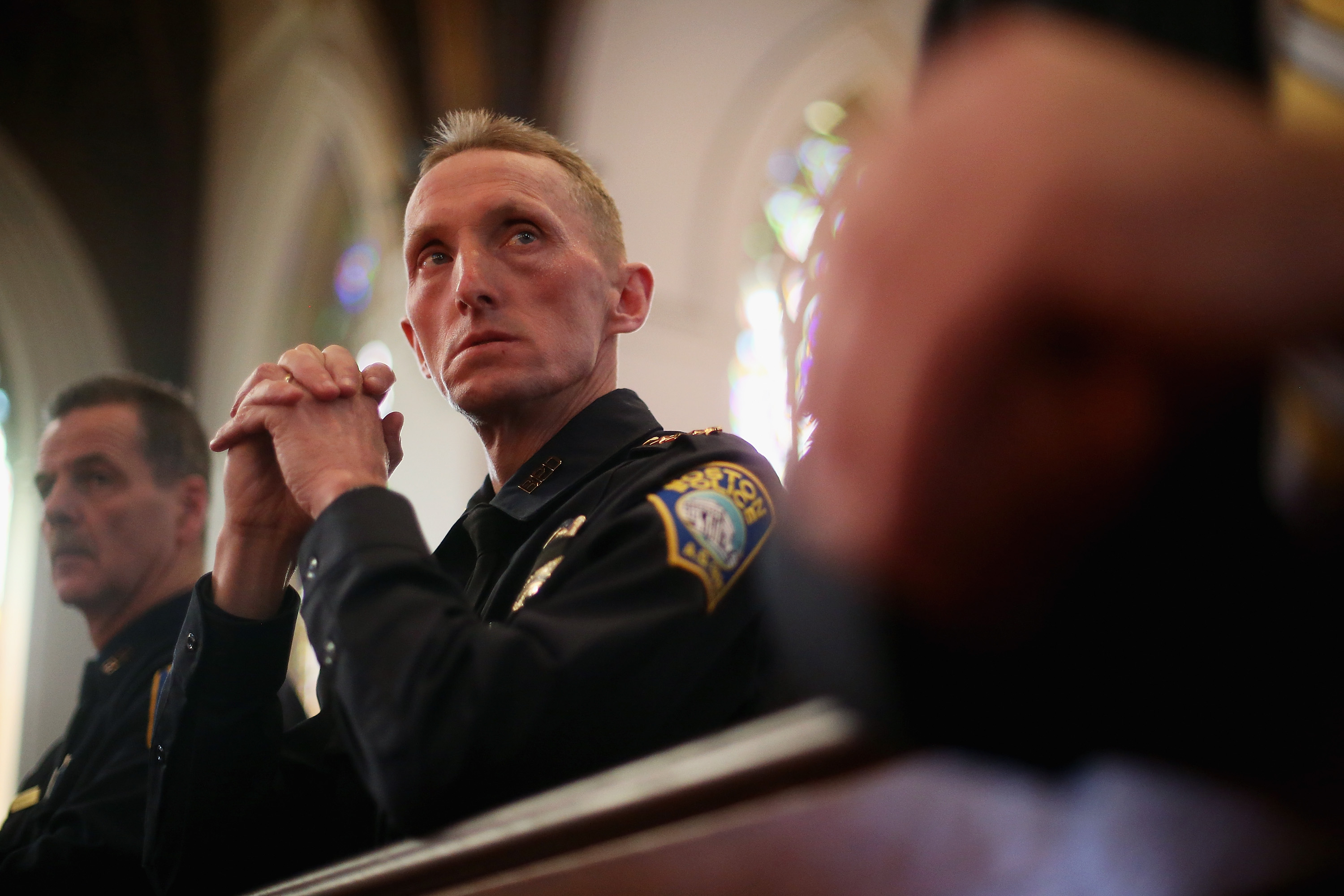
(Photo: Boston Police Department Superintendent William Evans (C) and Kevin Buckley (L) attend mass at the Cathedral of the Holy Cross on the first Sunday after the Boston Marathon bombings on April 21, 2013 in Boston, Massachusetts. The Mass honored the victims of the bombings and subsequent manhunt as well as first responders. By Mario Tama/Getty Images,)

The Other Heroes

Fertilizer Plant Explosion In West, Texas

Today, the mayor of West, Texas estimated that from 35 to 40 people have died in the small community of around 2700 people. Of the fourteen deaths so far accounted for, eleven were first responders. At least four were from the local volunteer Fire Dept. Some were killed rushing toward the scene of the original fire in the fertilizer plant – only to be engulfed by a fireball. A Facebook page lists some of the dead:

There’s a picture of 26-year-old Sean Collier, with the comment “You will never be forgotten.”

There’s a picture of Jerry Chapman, smiling with his red goatee, along with this caption: “Jerry Chapman was in class at the time the call went out for the initial fire at West Fertilizer Company. His friends and co-workers say he would not have missed a chance to go help people.”

There’s a picture of volunteer firefighter Joey Pustejovsky, standing next to his wife, wearing a yellow firefighter’s helmet.

One local resident posted: “Joey worked for us at Sears in the sporting goods area, always willing to help and to give the best service. My heart goes out to Kelly and his family at this time, it is just like him to be a first responder. May God give you peace.”

There’s a picture of Navarro County firefighter and West ambulance EMT trainee Perry Calvin, 37, who has been confirmed as one of the EMT personnel killed.

And there’s a picture of Dallas Fire-Rescue Capt. Kenny Harris, one of the dead, dressed in a crisp black uniform. He’s smiling.

I didn’t want the last post of this awful week to be about terrorists – but about the self-sacrifice of these American citizens. Four EMTs are still missing. Pray for them. Pray for West, Texas.

(Photo: Valley Mills Fire Department personnel view the railroad tracks near to the fertilizer plant that exploded yesterday afternoon on April 18, 2013 in West, Texas. By by Erich Schlegel/Getty Images.)