Labeling Terror

Fertilizer Plant Explosion In West, Texas

President Obama announced this week that the FBI is treating the Boston bombing as a case of terrorism, since explosives were used to target civilians. Yesterday, I likewise wrote that “happened in Boston was an act of terror.” Lisa Beyer demurs:

Actually, that’s not right. The U.S. federal code and the Federal Bureau of Investigation both include in their definitions of terrorism an element of political motivation. Having spent nearly a decade based in Israel, I understand the common impulse to fit any grave disturbance into an obvious narrative. While politicians, commentators and bystanders can afford such assumptions, the responsible authorities cannot. I remember a particular car bombing in Israel, which the media, as a matter of course, treated as a terrorist act. Evidence later emerged proving the bombing was an internal mob hit.

That’s a helpful perspective. My own definition was based on a simple idea: violence designed to terrorize a broader community – violence random and dangerous enough to affect far more people than those directly hurt. There’s no question that many Bostonians were terrorized by the bombings. But that definition would definitely fit Newtown as well – arguably more broadly. Maybe I was painting with too broad a brush. It’s also true that unintentional violence can terrorize. I cannot imagine how the citizens of West, Texas, feel this morning. They just witnessed an explosion far larger than Oklahoma City. (Despite the location near Waco and the mid-April date, I am assuming no one was behind the explosion.) Ackerman agrees with Beyer:

For some, “terrorism” will equate to an act committed by Muslims, no matter how many pre- and post-9/11 acts of terrorism were committed by non-Muslims.

It’s not fair. But it is real. That association can have dire consequences for innocent Muslims and non-Muslims, both from ignorant fanatics and from law enforcement. One of the biggest sources of speculation in journalism and on social media concerned a Saudi national questioned in the bombing. Yet Boston police commissioner Ed Davis said flatly [yesterday], “There is no one in custody.” The investigation is just beginning to interview Bostonians.

That’s to be expected: law enforcement has to run down what one investigator called the “voluminous” leads emerging in the hours after the explosions. After reports came through social media about police questioning Arabs who among the thousands running away from the Copley disaster area, people grimly joked that “Running While Arab” is the new “Driving While Black.”

The Saudi national, a student, turned out to be simply a victim himself. Brian Beutler blames Benghazi for the focus on the T-word: 

The media was listening for that word yesterday because they identified it as a potential source of a future, contrived political controversy; reporters were acting as opposition researchers for the people they cover, and identified a sin of omission. Like the inverse of when Obama said the private sector was “doing fine” and the press corps zeroed out everything else he said in the same press conference.

Waldman’s contribution to the debate:

Words certainly matter, but the idea that if we use the word “terrorism” to refer to a particular attack then we’re being strong, brave, and resolute, while if we call it, say, an “attack” then we’re being weak and cowardly, is just insane.

Yes, that’s a fetish now common on the let’s-panic right. It’s not about what happens. It’s a form of partisan self-expression. Which may be reason alone to be more circumspect before using it.

(Photo: Shattered glass covers items in the front of a thrift show after the West Fertilizer Company exploded April 18, 2013 in West, Texas. A massive explosion at the fertilizer company injured more than 100 people and left damaged buildings for blocks in every direction. The death toll from the blast, which occured as firefighters were tackling a blaze, is as yet unknown. By Chip Somodevilla/Getty Images.)
Processing The Pain

Boston Deals With Aftermath Of Marathon Explosions

A reader writes:

Your recent post on vengeance prompted this email. My Facebook wall has been telling me that I should “fight darkness with light” (and I agree); that I should use this attack to extend my circle of empathy to overseas massacres occurring against people who are unlike me (I also agree); that I should focus on the people who helped instead of the person who committed the massacre (and I remain in agreement). And yet I don’t just feel “sadness,” I actually feel hate. I hate the man who did this, about whom I need to know nothing else than the fact that he did this.

I’m sensing this is inexpressible in the current circumstances. Saying this on Facebook would not only be useless (like most Facebook postings), but could mark me as the barbarian in my peace-loving group of academic friends. And yet I look at my little son, with whom I wanted to attend the Chicago marathon this fall, and I feel that I would not “forgive” someone who killed or maimed him – I would want to rip his body apart. The only reason I would not do it is because I do find violence physically disgusting, and because I’d put myself in jail. But hate I would feel, and I do feel now. Impotent hate – hate that will not turn to action. But real, visceral hate.

I’m telling this to you “secretly” to see if there is any way to contextualize this feeling. Religion would not help – I’m an atheist and find no comfort in transcendent matters (other than art and “humanity talk,” which often works, but not today).

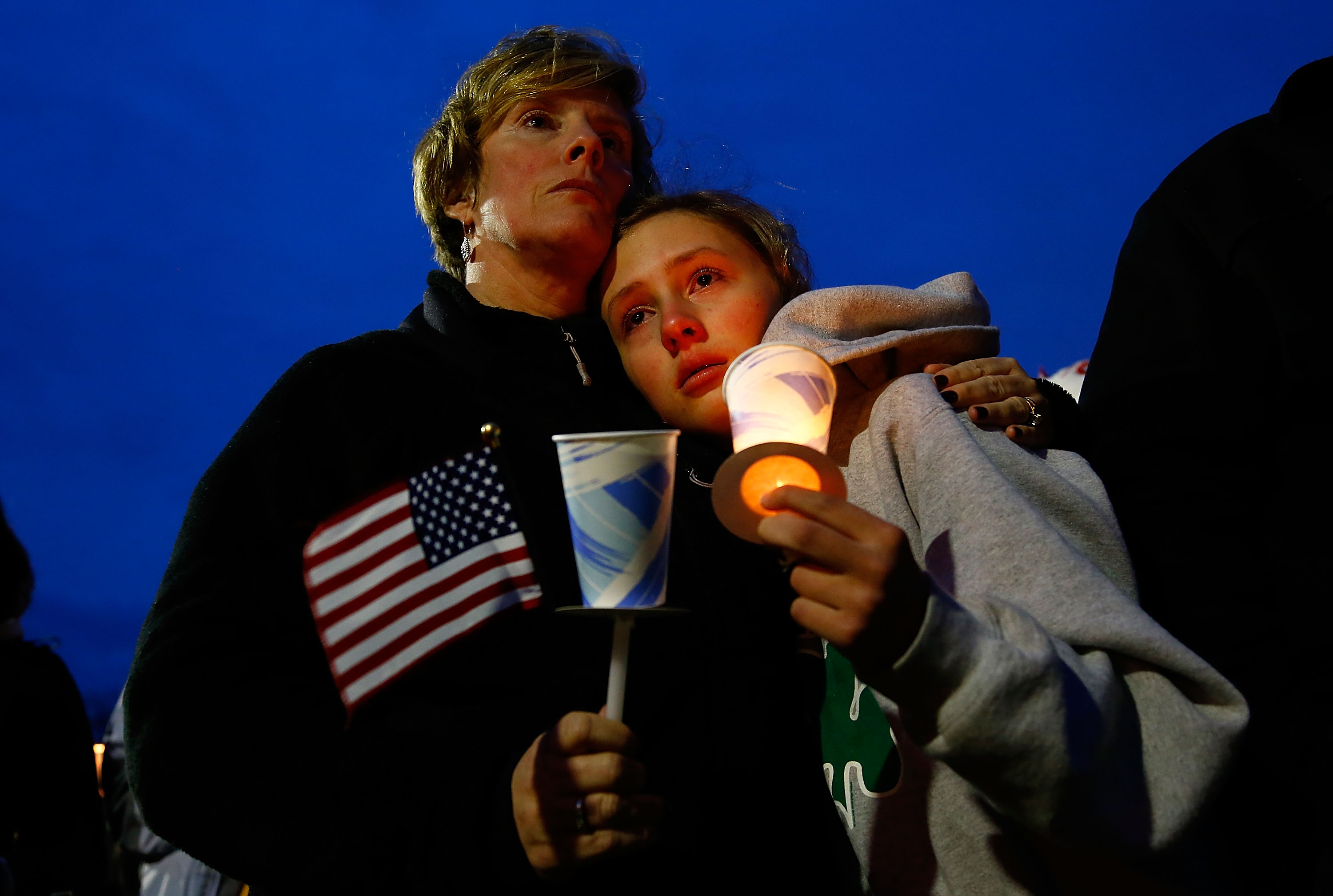
(Photo: A young girl cries with her mother during the vigil for eight-year-old Martin Richard, from Dorchester, who was killed by an explosion near the finish line of the Boston Marathon on April 16, 2013. The twin bombings resulted in the deaths of three people and hospitalized at least 128. By Jared Wickerham/Getty Images)

Boston’s Finest: Not Just The Cops

Sarah Kliff is amazed that, as of now, all of the marathon’s wounded have survived. Atul Gawande identifies reasons why Boston’s hospitals were ready:

Talking to people about that day, I was struck by how ready and almost rehearsed they were for this event. A decade earlier, nothing approaching their level of collaboration and efficiency would have occurred. We have, as one colleague put it to me, replaced our pre-9/11 naïveté with post-9/11 sobriety. Where before we’d have been struck dumb with shock about such events, now we are almost calculating about them. When ball bearings and nails were found in the wounds of the victims, everyone understood the bombs had been packed with them as projectiles. At every hospital, clinicians considered the possibility of chemical or radiation contamination, a second wave of attacks, or a direct attack on a hospital. Even nonmedical friends e-mailed and texted me to warn people about secondary and tertiary explosive devices aimed at responders. Everyone’s imaginations have come to encompass these once unimaginable events.

Feeling Others’ Rage

In the wake of the Boston bombings, Greenwald asks Americans to empathize with individuals in countries regularly bombed by the US:

[W]hatever rage you’re feeling toward the perpetrator of this Boston attack, that’s the rage in sustained form that people across the world feel toward the US for killing innocent people in their countries. Whatever sadness you feel for yesterday’s victims, the same level of sadness is warranted for the innocent people whose lives are ended by American bombs. However profound a loss you recognize the parents and family members of these victims to have suffered, that’s the same loss experienced by victims of US violence. It’s natural that it won’t be felt as intensely when the victims are far away and mostly invisible, but applying these reactions to those acts of US aggression would go a long way toward better understanding what they are and the outcomes they generate.

I note only that today, more than 55 Iraqi civilians were killed by a wave of terrorism, a function of the botched invasion, occupation and sectarian disintegration the US set in motion. On the day of the Boston marathon, a new post-occupation record of 65 deaths was recorded.

The Media Frenzy In Boston

Told in four tweets:

The Safety Of Marathons

Lydia DePillis argues that marathons are impossible to secure completely. Alyssa thinks tight security “would fundamentally change the nature of marathoning for both participants and spectators”:

As Erin Gloria Ryan wrote for Jezebel, much of the value of these events is in the interaction between large numbers of runners and large numbers of viewers in close proximity to them. “The spectators — people who show up and cheer with noisemakers and high fives and encouraging cheers and magic-markered tagboard signs that read “YOU ALL ARE CRAZY! KEEP RUNNING!”— are the people who matter most to runners,” she explained. ” Without those people, a marathon would just be an exercise in self-abuse from a large group of crazies. But there is meaning in marathoning: the people who watch.”

Russell Saunders zooms out and observes “the ironic failure of terrorism”:

It shouldn’t be an act of courage to dine out in Tel Aviv. It’s shouldn’t be an act of courage to buy groceries in Baghdad. It shouldn’t be an act of courage to earn your paycheck in a skyscraper in Manhattan.

And then it becomes one.

Which is the ironic failure of terrorism. Because of course people will continue to dine out in Tel Aviv and go to market in Baghdad and step on the elevator in New York City. Where previously they did so without thinking, now they do so in a quietly defiant way. Because people will refuse to obey the dictates of the depraved and craven, and will go on living their lives. They will locate the courage within themselves. They will keep running marathons.

Bruce Schneier’s words of advice:

The damage from terrorism is primarily emotional. To the extent this terrorist attack succeeds has very little do with the attack itself. It’s all about our reaction. We must refuse to be terrorized. Imagine if the bombs were found and moved at the last second, and no one died, but everyone was just as scared. The terrorists would have succeeded anyway. If you are scared, they win. If you refuse to be scared, they lose, no matter how much carnage they commit.

Crowd-Sourcing Police Work

4Chan_Image

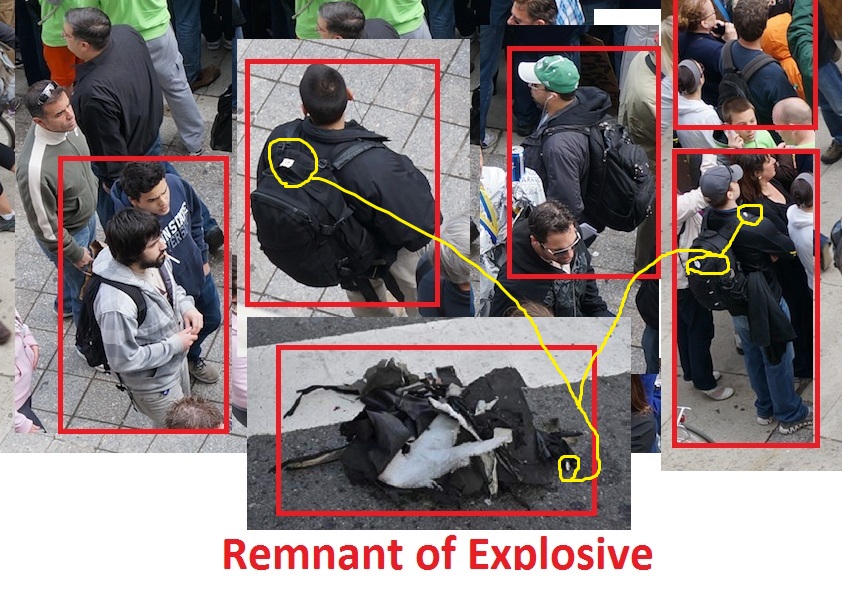
Reddit has a thread dedicated to finding the Boston marathon bomber(s). 4Chan is also on the case. Alexis begs them to stop:

Investigating these bombings is just not a job for “the crowd,” even if technology makes such collaboration possible. Even if we were to admit that Reddit was “more efficient” in processing the influx of media around the bombing, which would be a completely baseless speculation/stretch/defense, it still wouldn’t make sense to create a lawless space in which self-appointed citizens decide which other citizens have committed crimes. This would be at the top of any BuzzFeed list of the tried-and-true lessons of modern civilization. We have a legal system for a reason.

(Image from 4Chan’s round-up of Boston photographs)

Tweet Of The Day

There are conflicting reports and confusion all over cable news and Twitter this afternoon, so we will stay calm and blog on for now, until we spot something conclusive. Update: The FBI just issued a scathing statement:

Contrary to widespread reporting, there have been no arrests made in connection with the Boston Marathon attack. Over the past day and a half, there have been a number of press reports based on information from unofficial sources that has been inaccurate. Since these stories often have unintended consequences, we ask the media, particularly at this early stage of the investigation, to exercise caution and attempt to verify information through appropriate official channels before reporting.

Ellie Hall chronicles the clusterfuck.

“It Was All Just Supposed To Be Symbolic”

557949_10151600344921322_1462963247_n

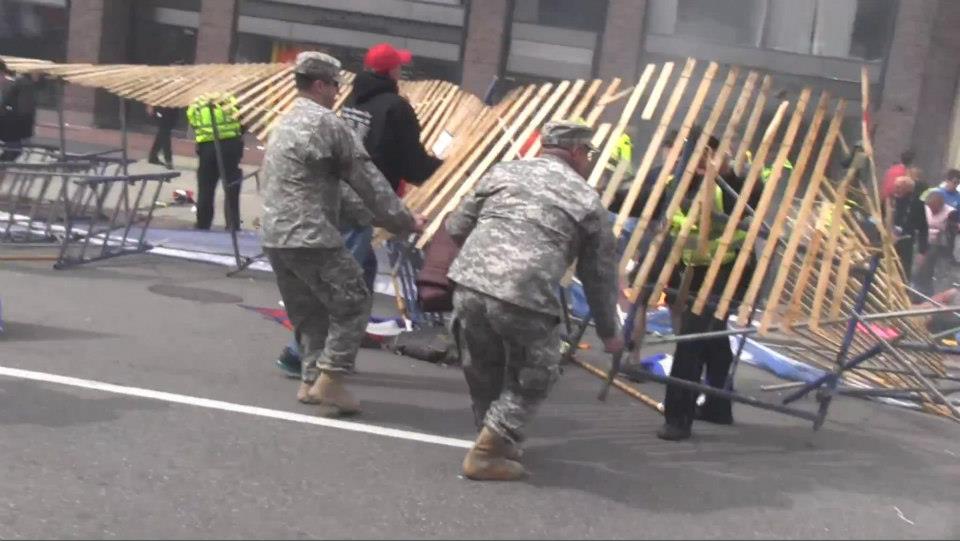
Some “Tough Ruck 2013” soldiers ran the Boston Marathon with “a military backpack weighing about 40 pounds. The rucks were filled with Camelbacks of water, extra uniforms, Gatorade, changes of socks—and first-aid and trauma kits.” They ran it in honor of their fallen comrades and those now committing suicide in record numbers under the weight of PTSD. The first-aid and trauma kits came in handy.

By the way, that dude in the cowboy hat who rescued the guy with the blasted-off lower leg? He’d lost one son in Iraq and another son to suicide because of his brother’s death. He was carrying pictures of both of them that day.

But suddenly he had a stranger’s life to save. So he did. Maybe we should start remembering him instead of fixating on whatever sick mind for whatever sick purpose planted those devices.

“A Tiny Moment’s Respite From The Worst Moment Of Their Lives”

A reader writes:

I finished the Boston Marathon on Monday and was nearby when the bombings happened.  I was never near any danger and witnessed only a few secondary effects of the bombings (people splattered with others’ blood, etc.), but the memory that sticks out is one that I thought you might be interested in for your Cannabis Closet series.  Just a little glimpse into life.   Feel free to post it if you want – I’m always happy to contribute to the Dish family:

At one point, an hour or so after the attack, I was drifting away from the scene and stopped to lean on a sort of cement railing, both to rest my weary body and to just think.  From a stairwell on the other side of the railing, I smelled the distinctive scent of pot.  I looked down and saw two well-dressed women, one white and one black, taking hits from a pipe.  One was holding the lighter and shielding the wind while the other inhaled.  It was a scene of strange intimacy.  The black woman noticed that their smoke was blowing in my direction and said, “Sorry, Marathon Man.”  I said something like, “No worries.  We could all use some relief right now.”

Then they both looked up at me and their words came tumbling out:

“We work at [high-end retail store].  It was right in front of our store.”  “There were legs and feet blown off.”  “There was blood everywhere.”  “People had whole parts of them blown off.”  “I saw someone’s foot.  Just there on the ground.” “People were blown apart.” “There were body parts all over.” “Everyone was covered with blood.”  “And parts of bodies.”

At a certain point, they were finishing each other’s sentences, looking to each other for confirmation that it had actually happened.  I imagined them, being evacuated from work, totally horrified, uncertain about where to go or how to deal with what they just saw, and then one of them inviting the other into this particular stairwell, to share a little secret one of them was carrying in their purse, meant for happier use, now just providing a tiny moment’s respite from the worst moment of their lives.

I did something I almost never do: I reached out and touched them both on the shoulders, gave them a little rub and a squeeze and said, my voice surprising me by cracking, “I’m glad you two are ok,” and I walked away.