Modernity, Faith, And Marriage

Abbeydavidmcnewgetty

Reading this piece by Rod Dreher is saddening to me. What separates Rod from many others on the right is his passionate sincerity. Even when he goes overboard, it’s all real. He’s not a cynic; and he grapples in ways many others on the social right do not with the fact of modernity, which makes the dream of cultural conservatives just that … a dream. And not of the future, but of the past. Rod longs, as many do, for a return to the days when civil marriage brought with it a whole bundle of collectively-shared, unchallenged, teleological, and largely Judeo-Christian, attributes. Civil marriage once reflected a great deal of cultural and religious assumptions: that women’s role was in the household, deferring to men; that marriage was about procreation, which could not be contracepted; that marriage was always and everywhere for life; that marriage was a central way of celebrating the primacy of male heterosexuality, in which women were deferent, non-heterosexuals rendered invisible and unmentionable, and thus the vexing questions of sexual identity and orientation banished to the catch-all category of sin and otherness, rather than universal human nature. To tell Rod something he already knows: Modernity has ended that dream. Permanently. Rod has read his Alasdair Macintyre. And – despairing (rightly) at the Catholic hierarchy’s inability even to have a reasoned conversation about what is going on and at its own sexual and psychological dysfunction and sin – Rod has joined the Orthodox church, perhaps the deepest as well as oldest of all Christian communities. I respect all that – profoundly. My own wrestling with the conflicts between Thomist teleology and modernity came in my 20s, when Oakeshott and Montaigne threaded the needle and when the fact of my own sexual orientation forced me to a reckoning others can perhaps escape. (The result: "Virtually Normal.") My faith has been more private since and more informed by mystery, reticence and doubt. And watching fundamentalist Christianity and Benedict-style Catholicism react to the last couple of decades has only confirmed for me what I suspected in my early adulthood: that their solutions to the modern problem are not solutions at all. They are wild lunges at something they hate almost as much as they misunderstand. If conservatism is to recover as a force in the modern world, the theocons and Christianists have to understand that their concept of a unified polis with a telos guiding all of us to a theologically-understood social good is a non-starter. Modernity has smashed it into a million little pieces. Women will never return in their consciousness to the child-bearing subservience of the not-so-distant past. Gay people will never again internalize a sense of their own "objective disorder" to acquiesce to a civil regime where they are willingly second-class citizens. Straight men and women are never again going to avoid divorce to the degree our parents did. Nor are they going to have kids because contraception is illicit. The only way to force all these genies back into the bottle would require the kind of oppressive police state Rod would not want to live under.

But how do those who are ready to live in this modern world coexist with those who still believe that it is not only misguided but evil? And, of course, vice-versa? There is only one way.

That way is to agree that our civil order will mean less; that it will be a weaker set of more procedural agreements that try to avoid as much as possible deep statements about human nature. And that has a clear import for our current moment. The reason the marriage debate is so intense is because neither side seems able to accept that the word "marriage" requires a certain looseness of meaning if it is to remain as a universal, civil institution. This is not that new. Catholics, for example, accept the word marriage to describe civil marriages that are second marriages, even though their own faith teaches them that those marriages don’t actually exist as such. But most Catholics are able to set theological beliefs to one side and accept a theological untruth as a civil fact. After all, a core, undebatable Catholic doctrine is that marriage is for life. Divorce is not the end of that marriage in the eyes of God. And yet Catholics can tolerate fellow citizens who are not Catholic calling their non-marriages marriages – because Catholics have already accepted a civil-religious distinction. They can wear both hats in the public square.

Rod believes that accepting my civil marriage as equal to his somehow erases the meaning of his own union. But it doesn’t. He is free as a person of faith to regard my civil marriage as substantively void and his as substantively meaningful; he is simply required as a member of this disenchanted polis to accept my civil marriage as legally valid. That’s all. Is that so hard? We can find a way forward to accommodate both our marriages in a public setting. I’m passionate, as every other defender of marriage equality that I know, in defending the rights of religious groups and churches to marry whosoever they want, according to whatever they believe, and to discriminate as religious groups in private contexts against those in their direct employ who violate those teachings. I defended the right to homophobia of both the Boy Scouts and the St Patrick’s Day parade. Heck, I’m even against hate crime laws. 

I have nothing against the voluntary and peaceful activities of any religious group, and regard these organizations as some of the greatest strengths of America. The idea that gay people somehow want to persecute these churches, that we’re out to get you, and hurt you and punish you is preposterous. The notion that there are rampaging mobs of gay people beating up on Christians is also unhinged. To take one flash-point between a radical Dominionist group deliberately trying to rub salt in the wounds of Castro Street bar patrons after closing hours – in which no one was hurt – as the harbinger of some kind of mass gay pogrom against Christians is daffy. To equate a few drunks gays with Bull Connor is deranged and offensive. There are elements on both sides who do not represent the core. That core can coexist with mutual respect in the context of legal and civil equality.

Sorry, Rod, but you and I have to live in the disenchanted world our generation was born into. The dreams of total pre-modern coherence – whether in the malign fantasies of the Taliban or the benign aspirations of theocons longing for the 1950s in the 21st century – are dreams undone by freedom. We live in a new world, and we can and should create meaning where we can, in civil society, in private, through free expression and self-empowerment. But we cannot enforce that old meaning on others by law. And we certainly cannot do so arbitrarily, to the sole detriment of only one group in society – homosexuals. Rod knows that restoring his definition of marriage would require above all restricting the rights and freedoms of heterosexuals in modern society. But he also knows that will never fly. My advice to the theocons: by picking solely on homosexuals to force back the sexual and spiritual freedom of modernity, you look awful, you are losing the next generation and you are buttressing cruelty and pain. In your heart of hearts, you don’t want to do that.

So listen to your heart. Accept civil equality not as a defeat but as an opportunity: to persuade and evangelize for something beyond the civil that still respects the integrity of the civil. That’s what America’s founders intended. It is part of their genius that today’s fundamentalists simply do not understand.

Prop 8: Chill

I totally understand the anger, hurt and pain now roiling the gay community and our families, especially in California. But it’s important to keep our heads. I’ve been in the middle of this fight for two decades. It’s important to remember that we have never had this level of public support for marriage equality before. In eight years in California alone, the majority in favor of banning marriage equality has gone from 61 to 52 percent. Meanwhile, California’s legislature has voted for it, 18,000 couples are legally married in California, and legally comparable (if still unequal) domestic partnerships are available. Very soon, thousands of gay couples will be able to marry in Connecticut. The one state with a history of marriage equality, Massachusetts, is showing how good and positive a reform it is. New York recognizes Massachusetts’ civil marriages.

Calm down. We are not experiencing a massive, permanent backlash.

The next generation overwhelmingly backs the right to marry, and there is no sign of cultural reversal, even if we have suffered some electoral set-backs. If Obama has taught us anything, it is to keep our eyes on the prize, and not always to react impulsively to hatred, bigotry or simple ignorance by exaggerating its power over us. We are winning. We lost this one, by an excruciatingly small margin. But the whole point of this movement is education in support of toleration. Even though we lost, we persuaded many of something they barely thought about a short time ago. I am immensely touched by the support of straight readers and all of you, gay and straight, who donated time and money to the No On 8 campaign. We need to remember this as well. And the sight of a small minority having basic equality stripped from them by a religiously-funded majority is itself educational. It has already changed minds. One thing we need to remember is dignity in defeat. That’s how it becomes victory.

And we need patience and relentlessness in explaining our lives. And how human they are. It’s not fair; we should have it all already. But we don’t. And in a democracy, that means persuasion, not fiat.

The Uncontrollable Marriage Movement

Yglesias counters Megan on the role of the courts. Matt is right that there is not some Gay Politburo deciding strategy in civil rights movements. I know something about this. I spent over a decade trying to persuade the HRC Politburo to take marriage equality seriously. But the only people the gay rights muckety-mucks take seriously are very very rich donors. But then actual, real, living gay couples sued for their equality, against the wishes of the gay establishment. That’s how this movement started in Hawaii, and Alaska, and Massachusetts. The Gay Politburo at a national level tried to stop it. Do you realize that no gay legal group would take on the first mariage case in Hawaii? A straight guy did it. I’m so glad Matt understands:

Say you’re living your life with your partner and you want to get married. But then the local legal authorities tell you that you can’t get married. That seems like unfair discrimination to you, so you inquire with an attorney. The attorney says, yes, your state has never allowed a man to be legally wed to another man, but he agrees with you that it’s unfair. And not just unfair, illegal, a violation of your state constitution’s guarantees of equal rights.

So you sue! Then the case comes before a judge and the judge thinks, yeah, the local authorities’ action is a violation of the state constitution’s guarantee of equal rights. Is the judge supposed to rule against you even though he thinks your case has merits, offering as his reasoning “it would be counterproductive to the long-term political strategy of the gay rights movement for me to offer the ruling I believe to be correct”? That doesn’t sound right.

And is Gay Rights Central Command suppose to somehow stop you from suing? How would they do that?

The fact is that as best I can tell most gay rights organizations agreed with Megan about this. As of a few years ago, their big idea was to push for what they saw as practical legislative goals — hate crimes laws and an Employment Non-Discrimination Act — to help slowly but surely continue to build legislative support for full equality before the law. But they had no ability to prevent various individuals in Hawaii, Massachusetts, California, and elsewhere from pursuing their legal rights as they saw fit.

The Wrong Path To Equality?

Megan discusses prop 8:

In general, courts are the wrong place to press these sorts of claims.  The courts were appropriate for civil rights because blacks were literally denied the right to participate in the legislative democratic process.  And on a practical level, they worked because a majority of people in the country were more than happy to force civil rights on an unhappy white southern minority.  Unfortunately, too many groups have decided that the success of civil rights can be widely applied to circumvent the electorate on issues where there is no public consensus.  Now widespread gay marriage seems quite a bit less likely for the near term than it would have been had we attacked the issue legislatively.

If Megan believes we would even have a sliver of the protections we now have in civil unions and domestic partnerships if we hadn’t fought for marriage in the courts and legislatures, she’s mistaken.

You don’t get half a loaf by asking for half a loaf. You get half a loaf by asking for the whole thing. And we did. In California, the legislature had already passed marriage equality, and the worst that has happened is that we are left with full civil unions on a state level. My further thoughts here. But as someone who has focused almost entirely on the persuasion and advocacy part of the equation, as opposed to the legal part, I am proud of my brothers and sisters forging the case in the courts alongside. We may have gotten a tiny but ahead of ourselves. But when you look at the last two decades of struggle over this, I still cannot believe how far we’ve come, and how many souls we have already touched. That’s what endures. And in the end, triumphs.

Oh, No, You Don’t

Camarriage1justinsullivangetty

Heart-breaking news this morning: a terribly close vote has stripped gay couples in California of their right to marry. The geographic balance shows that the inland parts of California voted for the Proposition and the coast and urban areas voted against it. Yes, it is heart-breaking: it is always hard to be in a tiny minority whose rights and dignity are removed by a majority. It’s a brutal rebuke to the state supreme court, and enshrinement in California’s constitution that gay couples are now second-class citizens and second class human beings. Massively funded by the Mormon church, a religious majority finally managed to put gay people in the back of the bus in the biggest state of the union. The refusal of Schwarzenegger to really oppose the measure and Obama’s luke-warm opposition didn’t help. And cruelly, a very hefty black turnout, as feared, was one of the factors that defeated us, according to the exit poll. Today this is one of the solaces to a hard right and a Republican party that sees gay people as the least real of Americans. But I realize I am not shattered. My own marriage exists and is real without the approval of others. One day soon, it will be accepted by a majority. And this initiative in California can and will be reversed, as California’s initiatives are much more fluid than those in other states; and the younger generation is overwhelmingly – 2 to 1 – in our favor. The tide of history is behind us; but we will have to work harder to educate people about our lives and loves and humanity. It cannot be denied that this feels like a punch in the gut. It is. I’m not going to pretend that the wound isn’t deep and personal, like an attack on my own family. It was meant to be. Many Obama supporters voted against our rights, and Obama himself opposes our full civil equality. The religious folk who believe that Jesus stood for the marginalization of minorities, and who believe that my equality somehow threatens their children, will, I pray, see how misguided they have become. And make no mistake: they won this by playing on very deep fears of gay people around kids. They knew the levers to pull.

But some perspective from someone who has fought this fight as long and as personally as anyone in this country. Twenty years ago, equality of gay couples was a mere idea. Forty years ago, it was a pipe-dream.

In the long arc of inclusion, we will miss our goals along the way from time to time. Today, we have full marriage rights in two states, we have many civil marriages in California that will remain in place as examples of who gay people really are, we have civil unions in many more places, and marriage rights in other parts of the world, as beacons to America. And this is a civil rights movement. It goes forward and it is forced back. The battle to end miscegenation took centuries. These are the rhythms of progress. Sometimes losing, and being shown to lose, shifts something in the minds of those watching as a small group is punished for daring to dream of full civil equality. In this battle we have already had far more defeats than victories. But each time, we have come closer to our goal. And in the hearts and minds and souls of so many, we have changed consciousness for ever.

California has full civil equality in law for gay couples. In time, full civil marriage equality – the only real measure of equality – will follow. And it will spread, state by state, more slowly now, and perhaps more organically from legislatures, rather than courts, which would not be the worst idea. And observing this backlash against us will reveal to many the cruelty of allowing majorities to take the rights of tiny minorities away.

If we had won this, this civil rights battle would be all but over. Now, it isn’t. So we get back to work, arguing, talking. speaking, debating, writing, blogging, and struggling to change more minds. The hope for equality can never be extinguished, however hard our opponents try. And in the unlikely history of America, there has never been anything false about hope.

(Photo: Justin Sullivan/Getty.)

Why Marriage Matters

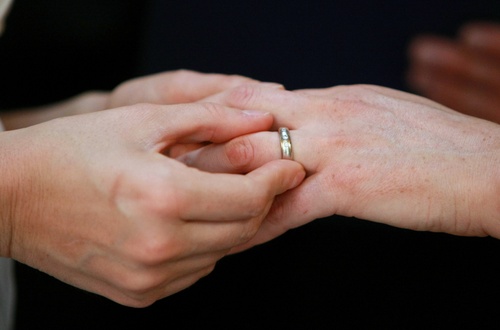
Ringjustinsullivangetty

Four years’ ago, before I ever dreamed it would happen to me, I wrote the following short essay for Time, trying to explain to people who might not fully understand why the m-word means so much to many of us gay men and lesbians. We may not be a majority of human beings – we are probably only 2 to 3 percent – but that doesn’t make us any less human beings, and for us, access to marriage, to full membership in our own families, is the dream of our lives, and the struggle of my own life. Please, do what you can in California not to have this taken away from so many:

As a child, I had no idea what homosexuality was. I grew up in a traditional home — Catholic, conservative, middle class. Life was relatively simple: education, work, family. I was raised to aim high in life, even though my parents hadn’t gone to college. But one thing was instilled in me. What mattered was not how far you went in life, how much money you earned, how big a name you made for yourself. What really mattered was family and the love you had for one another. The most important day of your life was not graduation from college or your first day at work or a raise or even your first house. The most important day of your life was when you got married. It was on that day that all your friends and all your family got together to celebrate the most important thing in life: your happiness — your ability to make a new home, to form a new but connected family, to find love that put everything else into perspective.


But as I grew older, I found that this was somehow not available  to me. I didn’t feel the things for girls that my peers did. All the emotions and social rituals and bonding of teenage heterosexual life eluded me. I didn’t know why. No one explained it. My emotional bonds to other boys were one-sided; each time I felt myself falling in love, they sensed it, pushed it away. I didn’t and couldn’t blame them. I got along fine with my buds in a nonemotional context, but something was awry, something not right. I came to know almost instinctively that I would never be a part of my family the way my siblings might one day be. The love I had inside me was unmentionable, anathema. I remember writing in my teenage journal one day, "I’m a professional human being. But what do I do in my private life?"

I never discussed my real life. I couldn’t date girls and so immersed myself in schoolwork, the debate team, school plays, anything to give me an excuse not to confront reality. When I looked toward the years ahead, I couldn’t see a future. There was just a void. Was I going to be alone my whole life? Would I ever have a most important day in my life? It seemed impossible, a negation, an undoing. To be a full part of my family, I had to somehow not be me. So, like many other gay teens, I withdrew, became neurotic, depressed, at times close to suicidal. I shut myself in my room with my books night after night while my peers developed the skills needed to form real relationships and loves. In wounded pride, I even voiced a rejection of family and marriage. It was the only way I could explain my isolation.

It took years for me to realize that I was gay, years more to tell others and more time yet to form any kind of stable emotional bond with another man. Because my sexuality had emerged in solitude — and without any link to the idea of an actual relationship — it was hard later to reconnect sex to love and self-esteem. It still is. But I persevered, each relationship slowly growing longer than the last, learning in my 20s and 30s what my straight friends had found out in their teens. But even then my parents and friends never asked the question they would have asked automatically if I were straight: So, when are you going to get married? When will we be able to celebrate it and affirm it and support it? In fact, no one — no one — has yet asked me that question.

When people talk about gay marriage, they miss the point. This isn’t about gay marriage. It’s about marriage. It’s about family. It’s about love. It isn’t about religion. It’s about civil marriage licenses. Churches can and should have the right to say no to marriage for gays in their congregations, just as Catholics say no to divorce, but divorce is still a civil option. These family values are not options for a happy and stable life. They are necessities. Putting gay relationships in some other category — civil unions, domestic partnerships, whatever — may alleviate real human needs, but by their very euphemism, by their very separateness, they actually build a wall between gay people and their families. They put back the barrier many of us have spent a lifetime trying to erase.

It’s too late for me to undo my past. But I want above everything else to remember a young kid out there who may even be reading this now. I want to let him know that he doesn’t have to choose between himself and his family anymore. I want him to know that his love has dignity, that he does indeed have a future as a full and equal part of the human race. Only marriage will do that. Only marriage can bring him home.

(Photo: Justin Sullivan/Getty.)

The Right To Discriminate

Aa1_35

Althouse makes marriage equality opponent Dean Broyles’s argument clearer:

Let me see if I can make Broyles’s point. I think he means to say that if same-sex marriage remains a legal right, enshrined in state constitutional law, then homosexual relationships will come to be regarded normal and good, and, consequently, anyone who objects to them will start to look like a bigot who should not be permitted to have his way. Thus, in order to preserve the right to discriminate against gay people and to keep schools from teaching children that gay couples are perfectly nice and so forth — all things Broyles wants — it’s important to outlaw gay marriage, because it will be a powerful force in changing perceptions about gay people and those who think gay people are doing something terribly wrong.

Yes! That’s it.

One reason I favor marriage equality is that the simple public fact of gay married couples will in itself teach something about the reality of gay people and our lives – without any school or parent having to say a thing. It gives us a way to talk about gay couples for the first time in human history without talking about sex acts. Now, there’s nothing wrong with sodomy, in my view. But it no more defines gay people than it defines straight people (and straight people’s sex lives are now overwhelmingly sodomitic in nature – i.e. non-reproductive).

Or to put it in a way that might appeal to social conservatives: grant marriage equality and we can stop talking about homosexuality. We can start talking about love and friendship and commitment and family – for gays and straights. We can leave this horrible identity politics division behind. To give one simple example. I have never sat down with my niece and nephew, who are nine and twelve, and told them I am gay. But they were both in our wedding, along with my husband’s family’s children. They see me and Aaron for who we are – all of us, defined by all we do and are. They know we are gay but we never had to say so. And there is nothing more moving than hearing my nephew talk of "uncle Aaron." 

(Photo: the two ring-bearers at my wedding.)

The Mormon Church vs Civil Marriage Equality

Mormonsgeorgefreygetty

The main reason the ban on marriage rights for gay and lesbian couples has been able to finance a massive advertizing campaign is that the LDS church is bankrolling the entire effort. Up to 40 percent of the financing comes from Mormons, who have also sent countless volunteers to the state to canvass door to door. It’s all legal, and totally within their democratic rights, but it is striking that one single religious grouping could invest so much in attempting to strip civil equality from gay couples:

Pollsters say that fueling the rise in support for Proposition 8 is an advertising blitz heavily bankrolled by the Mormon Church, which suggests, among other things, that if Proposition 8 doesn’t pass then schoolchildren will be indoctrinated about gay marriage.

Between 30% and 40% of the $25.5 million in donations raised as of last week by the "Yes" campaign has come from the Utah-based Church of Jesus Christ of Latter-day Saints, supporters of the measure say.

This strong alliance between the Mormon church and the Christianist evangelicals on the marriage issue in California goes back some way. Mitt Romney explained the Mormon-Falwell connection in Christianity Today:

[S]everal months ago, not long before he died, I had the occasion of having the Rev. Jerry Falwell at our home. He said that when he was getting ready to oppose same-sex marriage in California, he met with the president of my church in Salt Lake City, and they agreed to work together in a campaign in California.

The No on 8 side has made some errors: poor advertizing and the self-inflicted wound of Gavin Newsom. But watching one religious group swamp an initiative to remove civil rights from a minority is troubling to me. It appears to be based on religious doctrine, not secular argument. If you want to counter the influence of the Mormon church in California’s democratic process, donate here.

(Photo: George Frey/Getty.)

Bungling The Marriage Fight In California?

It’s still neck and neck in California, but the gay-Democratic establishment is still in the grip of focus-group Clintonism. Ann Rostow feels that prop 8 will pass as a result:

A positive message would have pre-empted attack ads. Instead we fell into their traps, forcing ourselves to insist that California can become a marriage equality state without a corresponding commitment to equal rights throughout its institutions. No, gay marriage won’t be taught in schools if Prop 8 fails. But neither will the idea that gay marriage is wrong. We can’t tell the voters that they can vote against Prop 8 on one hand, and preserve a homophobic public policy on the other. They can’t, and they know it and we should have asked, not just for the status quo of the last five months, but for a future of respect. We could have described that future in an attractive way and I think we’d be in better shape today if we had.

Dale Carpenter adds his two cents:

What’s interesting to me is that both sides have avoided the merits of allowing gay couples to marry. Gay-marriage supporters have done so, with focus-group tested messages in hand, because they suspect a large group of people even in a progressive statement are still deeply uncomfortable with homosexuality and certainly don’t like gay marriage. Gay-marriage opponents have done so, I presume, because they know that Americans don’t like to be seen as discriminating or opposing civil rights. So they paint gay marriage, instead, as itself a threat to the rights of religious people and parents. The theory seems to be that the side that’s most seen as defending rights is the side that wins.

I doubt that any months-long campaign of television ads, no matter their content, could really change the basic impulses most people have on this issue. Those impulses, whether they lead you to support or oppose gay marriage, are developed over a lifetime of experience. Very few people come to this issue without some fairly strongly held views. Such views are hard to dislodge.

Still, there’s something to Rostow’s hope that one day gay-marriage supporters might actually argue that gay marriage is a good thing. If we’re going to lose these ballot fights anyway, why not fight the good fight rather than the agnostic one?

Marriage Or Bust: Civil Unions Are Not Enough

The question raised and decided by the Connecticut Supreme Court and California’s Supreme Court is whether civil unions, with the same rights and responsibilities on a state level as civil marriage, are a fair equivalent to civil marriage, under the rubric of equal protection of the laws. This is Obama’s position. It is one on which I strongly disagree with him. My own explicit treatment of this particular aspect of the debate is in an essay published eight years ago in The New Republic. I stand by it. If you’re interested, check it out.

I think the core resistance to marriage equality stems from a deep suspicion that gay men are incapable of the responsibilities of marriage and will taint it if allowed to own the name. (Tellingly, you almost never hear the same argument about lesbians, who make up a majority of same-sex marriages and tend to be more monogamous than straight couples.) But even this argument falters on inspection. Money quote:

Look at it this way. Even if you concede that gay men–being men–are, in the aggregate, less likely to live up to the standards of monogamy and commitment that marriage demands, this still suggests a further question: Are they less likely than, say, an insane person? A straight man with multiple divorces behind him? A murderer on death row? A president of the United States?

The truth is, these judgments simply cannot be fairly made against a whole group of people.

We do not look at, say, the higher divorce and illegitimacy rates among African Americans and conclude that they should have the right to marry taken away from them. In fact, we conclude the opposite: It’s precisely because of the high divorce and illegitimacy rates that the institution of marriage is so critical for black America. So why is that argument not applied to homosexuals?

This, however, is to concede for the sake of argument something I do not in fact concede. The truth is that there is little evidence that same-sex marriages will be less successful than straight marriages. Because marriage will be a new experience for most gay people, one they have struggled for decades to achieve, its privileges will not be taken for granted. My own bet is that gay marriages may well turn out to be more responsible, serious, and committed than straight ones. Many gay men may not, in practice, want to marry. But those who do will be making a statement in a way no heterosexual couple now can. They will be pioneers. And pioneers are rarely disrespectful of the land they newly occupy. In Denmark, in the decade since Vermont-style partnerships have been legal, gays have had a lower divorce rate than straights. And that does not even take into account the fact that a significant proportion of same-sex marriages in America will likely be between women. If gay men, being men, are less likely to live up to the monogamy of marriage, then gay women, being women, are more likely to be faithful than heterosexual couples. Far from wrecking the neighborhood, gay men and women may help fix it up.