Obama’s Cowardice On Marriage

Jonathan Martin makes a point:

Because Obama is not where the far left wants him to be (marriage) and McCain not where the far right wants him to be (a federal ban), this is not something either will probably make front and center.

I see his point but I still bristle at the notion of marriage rights being a "far left" position. No straight person would ever regard his or her marriage as something of which only the "far left" would approve. And many very conservative gay couples who have gotten married because they want to affirm family life, responsibility and commitment would be surprised to learn that these values are now part of the "far left." It’s equally true that a federal ban is not meaningfully "far right." There is absolutely nothing conservative about amending the federal constitution to deal with a matter of social policy that is best left to the states. I wish these tired and misleading labels could be put to one side.

I should add that Obama’s position strikes me as transparently flimsy. His only defense of his support for full marriage rights without the m-word is a function, in his description, of comfort and religion. But he is very comfortable around gay people, gay couples and our families. And his own church actually favors equal marriage rights for gay couples – and its inclusion of gay people was obviously a reason why TUCC was attractive to Obama. Marriage is the one issue where Obama is still politically afraid, intellectually vacuous, and a moral coward.

This is the civil rights movement of our time. Whatever happened to the fierce urgency of now?

Conservatism and Marriage

Doug Kmiec writes:

It is often asked, as Marty’s helpful post does, how the acknowledgment of same-sex marriage harms marriage between a man and a woman.  The inability to give a simple, secular answer to this explains the California victory in favor of same-sex marriage more than the reasoning of the opinion.  That doesn’t mean there is not an answer.  There is a religious answer and it is anchored in the creation story recorded in the book of Genesis. 

The religious answer has a secular side, but it is less articulable.

Traditional marriage  has been accepted without argument for so long that the words custom and history substitute for analysis.  When more searching inquiry is made it is often related to the genuine belief that the institution of marriage and associated natural procreation should be (and has been for millennia) interrelated and very much worth preserving.  The story of the declining populations and cultures of Western Europe is debated, but troubling.   No one wishes the same for the United States, though it is hard to deny that marriages are occurring later and with less frequency (with a con-commitant rise in cohabitation and its various adverse instabilities and risks for children).  A smaller youthful population with a sizable graying demographic has many negative economic and social consequences manifest in everything from what does or does not get accomplished in schools to the coming bankruptcy of the Social Security system to much else that depends on the constant influx of new people, responsibly prepared to take up for the work of citizenship and community.

I love it when secular arguments are "less articulable" than appeals to Genesis. But there is an obvious secular, non-bigoted case against marriage equality. It’s the conservative, Hayekian resistance to any social change in a vital social institution with inherently unknowable future consequences.

But conservatives also realize that as societies change, institutions cannot remain frozen in time. Change is sometimes necessary and conservatives should see to it that such change is as careful not to disturb existing institutions any more than necessary. That’s why I’ve backed marriage equality for two decades (my first piece making this case was in 1989). By not creating a new institution, like civil unions or domestic partnerships, we disturb the social order less. By including gay couples in an existing institution, civil marriage, we integrate them. By following a federalist approach, we allow individual states to lead the way as laboratories of social reform.

I refuse to have this approach described by any other word than "conservative." It is, in my view, the only authentically conservative position in this debate.

Obama’s Open Letter To Gay Americans

Money quote:

As your President, I will use the bully pulpit to urge states to treat same-sex couples with full equality in their family and adoption laws. I personally believe that civil unions represent the best way to secure that equal treatment. But I also believe that the federal government should not stand in the way of states that want to decide on their own how best to pursue equality for gay and lesbian couples — whether that means a domestic partnership, a civil union, or a civil marriage.

The full thing after the jump:

I’m running for President to build an America that lives up to our founding promise of equality for all – a promise that extends to our gay brothers and sisters. It’s wrong to have millions of Americans living as second-class citizens in this nation. And I ask for your support in this election so that together we can bring about real change for all LGBT Americans. Equality is a moral imperative. That’s why throughout my career, I have fought to eliminate discrimination against LGBTAmericans. In Illinois, I co-sponsored a fully inclusive bill that prohibited discrimination on the basis of both sexual orientation and gender identity, extending protection to the workplace, housing, and places of public accommodation.

In the U.S. Senate, I have co-sponsored bills that would equalize tax treatment for same-sex couples and provide benefits to domestic partners of federal employees. And as president, I will place the weight of my administration behind the enactment of the Matthew Shepard Act to outlaw hate crimes and a fully inclusive Employment Non-Discrimination Act to outlaw workplace discrimination on the basis of sexual orientation and gender identity. As your President, I will use the bully pulpit to urge states to treat same-sex couples with full equality in their family and adoption laws. I personally believe that civil unions represent the best way to secure that equal treatment. But I also believe that the federal government should not stand in the way of states that want to decide on their own how best to pursue equality for gay and lesbian couples — whether that means a domestic partnership, a civil union, or a civil marriage.

Unlike Senator Clinton, I support the complete repeal of the Defense of Marriage Act (DOMA) – a position I have held since before arriving in the U.S. Senate. While some say we should repeal only part of the law, I believe we should get rid of that statute altogether. Federal law should not discriminate in any way against gay and lesbian couples, which is precisely what DOMA does. I have also called for us to repeal Don’t Ask, Don’t Tell, and I have worked to improve the Uniting American Families Act so we can afford same-sex couples the same rights and obligations as married couples in our immigration system. The next president must also address the HIV/AIDS epidemic. When it comes to prevention, we do not have to choose between values and science. While abstinence education should be part of any strategy, we also need to use common sense. We should have age-appropriate sex education that includes information about contraception. We should pass the JUSTICE Act to combat infection within our prison population. And we should lift the federal ban on needle exchange, which could dramatically reduce rates of infection among drug users. In addition, local governments can protect public health by distributing contraceptives.

We also need a president who’s willing to confront the stigma – too often tied to homophobia – that continues to surround HIV/AIDS. I confronted this stigma directly in a speech to evangelicals at Rick Warren’s Saddleback Church, and will continue to speak out as president. That is where I stand on the major issues of the day. But having the right positions on the issues is only half the battle. The other half is to win broad support for those positions. And winning broad support will require stepping outside our comfort zone. If we want to repeal DOMA, repeal Don’t Ask, Don’t Tell, and implement fully inclusive laws outlawing hate crimes and discrimination in the workplace, we need to bring the message of LGBT equality to skeptical audiences as well as friendly ones – and that’s what I’ve done throughout my career. I brought this message of inclusiveness to all of America in my keynote address at the 2004 Democratic convention.

I talked about the need to fight homophobia when I announced my candidacy for President, and I have been talking about LGBT equality to a number of groups during this campaign – from local LGBT activists to rural farmers to parishioners at Ebenezer Baptist Church in Atlanta, where Dr. Martin Luther King once preached. Just as important, I have been listening to what all Americans have to say. I will never compromise on my commitment to equal rights for all LGBTAmericans. But neither will I close my ears to the voices of those who still need to be convinced. That is the work we must do to move forward together. It is difficult. It is challenging. And it is necessary. Americans are yearning for leadership that can empower us to reach for what we know is possible. I believe that we can achieve the goal of full equality for the millions of LGBT people in this country. To do that, we need leadership that can appeal to the best parts of the human spirit. Join with me, and I will provide that leadership. Together, we will achieve real equality for all Americans, gay and straight alike.

Being A Better Husband

This tip struck home:

Take care of that late night snack or morning cereal bowl.  Setting them in the sink is one thing, but go that extra mile and actually put them in the dishwasher. After all, no one enjoys scraping bacon dip off a bowl that’s been sitting too long or smelling the chili from the night before. A beer bottle on the counter the next morning is even worse.

Sorry, hon. But some things gay husbands don’t have to worry about:

Remember, she’s your wife, not one of your buddies. Don’t burp during dinner, or squeeze one out during the movie as she’s reaching for the popcorn.

Yeah, we don’t much care. And we have Citrus Magic for the nasty ones.

Losing A Spouse

Or a country – one of many such stories:

After being kidnapped three times in his native Colombia, my partner was denied asylum after his case was pending 6 years in the United States. He left Christmas Day. Although he learned English, and got a GED just to become acculturated (holds a Master’s degree), we don’t want him here. Bad immigrant I guess. Can’t imagine what a good one might be, though. But unlike everyone else who has been highlighted in the “America won’t let us live here” series, I’m not so sad about leaving and joining him there. America is not who she claims to be. Regular readers of your blog will understand. I don’t hate my country. I love it. But for what it promises, not what it has become.

Sad when an American is embracing a Third World country because it offers greater liberty and opportunity. I can’t be the only one who feels this way.

He’s not. Here’s a site devoted to love exiles, denied the right to marry and thereby immigrate.

The Conservative Case For Gay Marriage (Again)

A response to my post. I think Reihan’s point is that social conservatism resists change and that therefore extending civil marriage rights to gay couples is inherently liberal. The reform corresponds with the evolution of civil marriage away from procreation and toward companionship – and social conservatives worry about such change. In that sense, I don’t disagree with Reihan’s point. The most coherent conservative objection to same-sex marriage is simply resistance to any tampering with a vital social institution. I respect that position; it’s certainly devoid of bigotry; and, as longtime readers know, I’m happy to let this evolution proceed state by state for Hayekian reasons.

But as societies change, conservatives have to adapt – at least if Burke is still regarded as a conservative. Aa12_2 Given that our society now has a huge number of openly gay couples, many with children, and that the law has to respond to this social reality, the practical decision conservatives have to make is: what shall we do about this? My fear, expressed almost two decades ago now, was that the ad hoc responses – domestic partnership, civil unions and the like – were as practically unavoidable as they were subtly undermining of marriage. Give gays domestic partnerships and marriage-lite and straights will demand them as well. And so marriage becomes less special and less constructive an institution.

I can see that, back in 1989, when I first made the case, the jump to full marriage equality seemed a leap. But two decades later? When it has become the norm in many countries and in one state? When civil unions exist in many other states? Why does it remain socially liberal to resist the conservative logic of including everyone within the same family structure, with the same responsibilities? And, of course, when you actually listen to the current advocates of banning such marriages – and unions – you do not hear nuanced or Hayekian social arguments very often. You hear Virtuallynormal truisms – "I believe marriage is between a man and a woman" – or religious invocations of the "sanctity" of a civil institution.

I suppose marriage equality is socially liberal in as much as it tries to defend and integrate a previously despised minority. But it is socially conservative in its attempt to envelop that minority in the traditions and responsibilities of family life. In this, it is exactly the same as welfare reform: ending a disincentive to family life among a minority that needs more social stability. I have to say that having finally begun to live a married life, all my previous intuitions about its integrating impact have been borne out more profoundly than I ever imagined.

If you can make the leap to seeing gay people as the equal of straight people, then encouraging their marriages to one another is arguably one of the most socially conservative measures now subject to national debate. That’s why it remains so saddening that so many social conservatives still regard it as definitionally anathema. I don’t think it’s a leap to believe that homophobia or fundamentalism are the critical stumbling blocks. Or that they are the real reasons for the resistance. 

Best Of The Dish 2007: A Married Man

Aa12_2

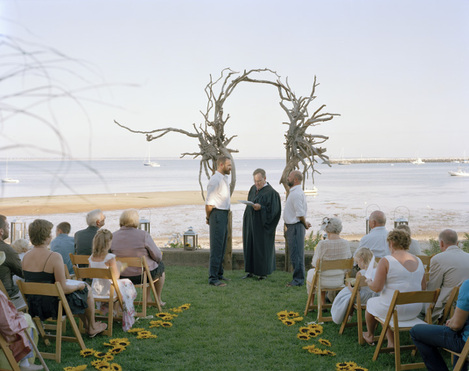
First published August 21 2007. Full wedding pics here.

So this is what it feels like? In a week’s time, I’ll be walking down the aisle with my soon-to-be husband. Our families are both coming for the big day. We’re getting hitched in Massachusetts, where I’ve lived every summer for the past decade or so, and which is the only state in the US where civil marriage is legal for everyone. Every now and again, I have to pinch myself. This is real? For me? It is hardly possible that it could be real for anyone. But me? After so long?

A brief personal history. In 1989, as a jejune junior editor at The New Republic, I got involved in an editorial argument about proposed domestic or civil partnerships for gay couples. The idea had emerged in the 1980s, in several major cities, partly because of the trauma of couples torn asunder by hostile relatives in the AIDS crisis. Some social conservatives were understandably worried that by setting up an institution like "domestic partnership," we were creating "marriage-lite", an institution that would spread to heterosexual couples and weaken the responsibilities and prestige of marriage itself. As a gay conservative, I found both arguments compelling. I saw the pressing need to give gay couples legal protection, but I could also see the danger of a easy-come-easy-go pseudo-marriage could pose for the society as a whole. The solution, however, seemed blindingly obvious to me. "Well, why not let gays get married as well?" I asked. "Isn’t that the true conservative position?"

My liberal bosses loved the idea of irritating conservatives with a conservative argument. So I obliged. The cover illustration was the first time a major magazine had put two guys on a wedding cake on the cover. And the piece created a mini-sensation. I enjoyed the buzz, but the more I thought about it, the more convinced I became that this was not just a necessary change, but a long-overdue one. With straight marriage no longer legally linked to children, and with gays desperately needing integration into their own families and society, it seemed like a no-brainer to me. It was a philosophical decision, not a personal one. I was in my twenties and had no intention of marrying myself. In fact, I was a pretty swinging bachelor. But it was the principle that mattered.

Almost two decades later, after years of intense political debate, after years of personal activism, court cases, Congressional testimony, threatened constitutional amendments, civil disobedience, and a global revolution in marriage rights, the political has now become personal for me. It’s a week away. And I officially have the jitters.

We decided on the most minimalist wedding possible – basically close family only. We’re getting married in the same place – a beach house – that we’re having the tiny reception. It’s a block down the beach from where we live. We have the license, the judge, the clothes, the menu, the photographer (although he hasn’t been in touch lately – gulp), and the rings. I’ve written out the civil liturgy. We’ve settled on the vows. I should relax now, right?

But the other night it hit me for the first time that this is really about to happen. I guess I just put it out of my head until it’s only a matter of a week or so away. My fiance, Aaron, and I have lived together for three years. I have no qualms about our actual relationship. For me, this is for life. But standing up in front of my family and my spouse’s and saying the vows out loud has me in a state of butterflies. I can go on TV and barely break a sweat, but I’m terrified of performing in front of my own family. I’m scared I’ll lose it. I bawled through the last same-sex wedding I went to. When I was diagnosed with HIV fourteen years ago, I assumed this day would never come. And now it has, the emotional impact is a little hard to measure.

You fight for something, never expecting it to happen, let alone to you, and then it does, and it can overwhelm. Taking yes for an answer can be harder than no. Maybe it’s a function of having over-thought this issue for so long; maybe it’s just handling a big family occasion of any sort (Christmas is bad enough). Maybe it’s a lifetime in which my actual relationships have always been private, or so targeted by political enemies I’ve become very defensive. Maybe I’m scared that two decades of passionate advocacy in theory is easier than a simple act in practice. But whatever the reason, going public with my husband – even in front of our supportive families – is suddenly much tougher than I expected. My throat is a little dry. My stomach is a little unsettled.

My sister emailed support:

"Don’t worry, it is natural to stress, I practically had a baby the day before mine! 75 to the church, another 75 in the evening, the food, the flowers, the photos, all those people watching me! On the day it just felt like a dream, I felt like I was letting out a huge breath all day, like that waiting to exhale, I exhaled all day and it was wonderful."

Our wedding is much smaller. My old friend and marriage advocate Evan Wolfson reassured me as well:

"You’re supposed to be in a zombie-state till the beauty of it breaks through."

Are zombies nervous? They never seem to be. They just stagger forward. Oh, well. Here goes …

"I, Andrew, take you, Aaron,
to be no other than yourself.
Loving what I know of you,
trusting what I don’t yet know,
with respect for your integrity,
and faith in your abiding love for me,
through all our years,
and in all that life may bring us,
for better or worse,
for richer or poorer,
in sickness and in health,
till death do us part,
I accept you as my husband
and pledge my love to you."

So revolutionary for some; so simple for me. For the first time in my adult life, I will have a home.