The Tea Party: More Anti-Gay Than All Seniors

To my mind, there are two widely believed myths about the Tea Party. The first is that they care about debt. I don't believe this, because a movement that actually cared about debt would have run a campaign specifically designed to propose ways to reduce it. They produced no such plan. Immediately after the election, moreover, they did a deal borrowing a huge amount more and adding $700 billion to the debt by refusing to let the Bush tax cuts sunset – the condition for the cuts' original passage, remember? The Tea Party is not an anti-debt movement; they are an anti-tax movement, that came about during a period in which taxes were lowered, while debt soared.

The second myth is that they are somehow unlike the Christianist right, and more tolerant and easy-going on social issues.

Again, I think this is wishful thinking. My own view is that they are hard-line Christianists in a different outfit – powdered wigs, muskets and red cheeks – and are outliers on issues of modernity – racial integration, women's rights, gay equality.

I mention this because PPP has just done a poll on marriage equality, something they are going to repeat to test trendlines. There is almost no difference between Tea Party views and regular Republicans. 52 percent of TPers and 52 percent of GOPers want no rights whatever for gay couples, either in civil unions or civil marriage. Only self-described "conservative" Republicans have a higher opposition at 57 percent. Moreover, on civil marriage for gays, TP support is at 17 percent, compared with 42 percent support for non-TPers.

Tea Partiers and Republicans are more anti-gay than all the over-65s.

Bonus poll points: minorities come out strongly in favor of legal gay relationships with 79 percent of Latinos and 62 percent of African-Americans in favor of either civil marriage or civil unions. And yes, TNC, a greater proportion of whites oppose recognition for gay relationships than blacks.

An Irish Sports Writer, Ctd

A reader writes:

This post is an example of a sort of self-gratifying internal epistemic closure that you maintain with respect to an aspect of your childhood that you cannot move beyond. There are still large segments of the Roman Catholic population in this country who venerate the Pope, obey the Bishop and agree completely with Bill Donohue about LGBT people and their concerns.

Last year, just north of Boston, the state legislature passed and the governor signed a bill instituting marriage equality in the State of Maine. The measure was subjected to a repeal referendum and the Roman Catholic Church, inside the state and across the nation, mounted a fervent campaign against marriage equality. Special collections were taken, statements read from the pulpit and sermons preached on multiple Sundays. Large amounts of money flowed into the anti-equality coffers from Catholic churches and organizations across the country. If we ever learn who funded NOM's contributions, we are likely to find even more RCC money.

A review of the voting demographics indicates that the RCC campaign had a decisive effect on the outcome – substantially greater than the purported impact of the black/protestant vote on Prop 8 in California. Maine has a large and still somewhat insular French-Canadian, Roman Catholic population. The voter turnout in both rural areas and urban neighborhoods with large FC/RC populations substantially exceeded predictions, and overwhelmingly supported repeal of marriage equality. This turned out to be the wild card that the pro-equality groups, who mounted a campaign that was commendable in many respects, did not even realize was in the deck. And it trumped them.

Yes, this is true. And it can count in close votes. But again: we're talking about a narrow vote to deny civil marriage to gay couples, something unimaginable only a decade ago. If Catholics had not shifted dramatically, the issue would not have come up in the first place. Another writes:

I am glad you said what I have always thought. I come from a Northeast Irish Catholic family where my Aunt, my first cousin and a second cousin who is a former priest have come-out in the last ten years and I was overwhelmingly proud of how accepting and understanding my family was.

Although I do not have anything remotely statistical to back this up, I think the reason for this is the same as it always is: experience (exposure is the better word, but I hate the connotation). The uncle who still lives with mom (who often spent some time in the seminary) has been a part of the typical Irish Catholic family as the third generation cop and the tough old grandma. We all knew what was up.

What Marriage Equality Won’t Do, Ctd

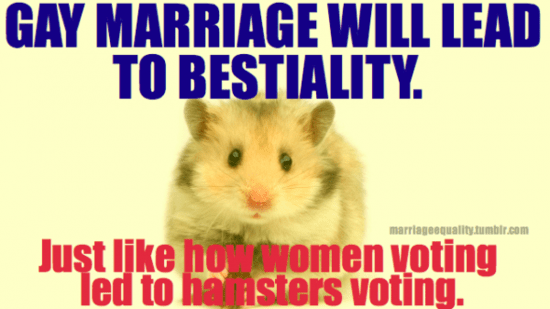
Hamsters

Eugene Volokh blesses Jon Rauch's "chill, gays" article – which is a little odd, as Jason Kuznicki points out. Volokh says he's for marriage equality but adds so many qualification and arguments from the far right, he sounds like Jeff Goldberg on Israeli West Bank settlements. Take Volokh's slippery slope argument from a year ago:

[P]eople who worry about slippery slopes generally — and who worry about slippery slopes in the field of sexual orientation and the law — can't be lightly dismissed. And it is reasonable for them to worry: If we have gotten this far partly through slippery slope effects, will we slip further, and to what? In particular, would this increase the likelihood of further broadening of antidiscrimination laws? Would it increase the likelihood that groups (such as the Boy Scouts) that discriminate based on sexual orientation will be excluded from tax exemptions, just as groups that discriminate based on race are often excluded from tax exemptions? Would it increase the likelihood that such groups will be excluded from generally available benefits?

Would it increase the likelihood of broader restrictions on anti-homosexuality speech — in government-run organizations, or in private organizations coerced by government pressure — by analogy to the broad support in many areas for restrictions on sexist speech? Would it increase the likelihood of restrictions on people's choosing roommates based partly on sexual orientation, or advertising such preferences in "roommates wanted" ads? Would it increase the likelihood of punishment of wedding photographers who refuse to photograph same-sex weddings (even if they have religious objections to participating this way in such ceremonies, and even if they feel that requiring them to photographing same-sex weddings compels them to create artistic works that they do not wish to create)? Would it increase the likelihood that legislatures will repeal religious institutions' partial exemptions from some bans on sexual orientation discrimination in employment?

But the slope stops slipping at some point. And when we slip too far we remain capable of walking back up the hill. A reader adds:

Whenever I hear the "churches will have to marry them" argument, I think of my straight cousin and his equally straight wife, both baptized and confirmed in the Catholic church. When they wanted to get married, they went to the church, the priest said the church wouldn't marry them because they hadn't been to mass or confession in years. Period. So they had to get married in a protestant church. If they couldn't force the church to marry them, how on earth could a same-sex couple force them to do so? 

This all relates to an old Ross Douthat post the Dish meant to respond to. A couple months ago, Douthat wrote a long second response to my criticism of his column . There are many points to disagree with. Here's his conclusion:

The benefits of gay marriage, to the couples involved and to their families, are front-loaded and obvious, whereas any harm to the overall culture of marriage and childrearing in America will be diffuse and difficult to measure. I suspect that the formal shift away from any legal association between marriage and fertility will eventually lead to further declines in the marriage rate and a further rise in the out-of-wedlock birth rate (though not necessarily the divorce rate, because if few enough people are getting married to begin with, the resulting unions will presumably be somewhat more stable). But these shifts will probably happen anyway, to some extent, because of what straights have already made of marriage. Or maybe the institution’s long decline is already basically complete, and the formal recognition of gay unions may just ratify a new reality, rather than pushing us further toward a post-marital society. Either way, there won’t come a moment when the conservative argument, with all its talk about institutional definitions and marginal effects and the mysteries of culture, will be able to claim vindication against those who read it (as I know many of my readers do) as a last-ditch defense of bigotry.

But this is what conservatism is, in the end: The belief that there’s more to a flourishing society than just the claims of autonomous individuals, the conviction that existing prohibitions and taboos may have a purpose that escapes the liberal mind, the sense that cultural ideals can be as important to human affairs as constitutional rights. Marriage is the kind of institution that the conservative mind is supposed to treasure and defend: Complicated and mysterious; legal and cultural; political and pre-political; ancient and modern; half-evolved and half-created. And given its steady decline across the last few decades, it would be a poor conservatism that did not worry at the blithe confidence with which we’re about to redefine it.

Like Volokh, Ross is engaging in a slippery slope argument, but Ross offers no concrete harms at the bottom of the hill. His argument is brilliant in its own way; you can't disprove invisible, immeasurable harms. It is a first principles argument that appeals to the genuinely conservative notion of preservation. But conservatism is not immune to change, it is not intent on cryogenically freezing the moral compromises of today and preserving them eternally. And conservatism must weigh unknowable potential pitfalls less heavily than known harms; what sort of perverse moral arithmetic would count the very tangible and painful consequences of denying marriage less than the immeasurable harms Ross fears?

Conservatism must have a vision for the future of marriage rather than a nostalgia for a time when marriage was primarily an economic institution. If heterosexual marriage is now about love and not necessarily about procreation (this is simply a social fact, as every recent court decision has been forced to acknowledge), and the love gays feel towards their spouses is equal to the love straights feel towards theirs, how can one logically deny marriage equality?

If love is created equal, then the institution that celebrates love ought to be open to all.

What’s So Grand About Marriage? Ctd

Manzi rushes to the defense of matrimony:

There is no practically-available social scientific method that can provide the kind of proof that Marcotte demands in a non-totalitarian society.

But it doesn’t follow that those who advocate continued legal support for traditional marriage are, as Marcotte puts it, “marriage chauvinists.” As I’ve written about elsewhere at length, I think the general principles for political action that flow from such a lack of scientific knowledge on a topic like this are: (1) a loose status quo preference, and (2) a regime of subsidiarity.

I'm with Jim on this, for what it's worth. It's why I support marriage equality. Why dream up a new institution – civil unions/domestic partnerships/civil partnerships – when there's a perfectly good one sitting around?

What Marriage Equality Won’t Do

Jason Kuznicki thrashes Eugene Volokh for worrying that marriage equality will infringe on religious freedom:

Yes, in 1983 Bob Jones University was forced to allow students to date interracially, on pain of losing its tax exemption, at which time it opted to keep the ban and lose the exemption. That case was highly unusual, as the IRS itself admits. And it’s a fairly tenuous analogy for three reasons. First, students at a university aren’t clearly analogous to congregants at a church. Second, being compelled to abandon restrictions on dating isn’t clearly analogous to being compelled to take an active part in performing a marriage. And third, certain churches still refuse to perform interracial marriages to this very day.

Yes, these churches are universally thought to be obnoxious, repulsive groups, and they deserve it. But when they run afoul of the law, it’s usually because of their violence, and never because blacks or Jews can’t get married within them. Volokh ought to know this, and to appreciate that the strict scrutiny given to laws abridging religious freedom means that we’re nowhere near seeing lawsuits against Presbyterians for declining to perform same-sex marriages. 


What They Least Want To Give Us

Linda Hirshman notes why the resistance to marriage equality and military service is so important to sustaining anti-gay stigma:

The right knows it can't make the state punish gays as sinners, for various constitutional reasons, so it is trying to make the state deny them the closest thing it has to consecration: the sacred bonds of warriors and the sanctity of marriage. …

It's a fight worth having, because the society rewards these secular symbols of goodness in countless unseen ways. Sure, military service is not a constitutional requirement for running for office, but it's a big leg up.

But what both do is imprint homosexuality with the core values of the right: marriage and service. Hence the cognitive dissonance. If being gay is the permanent "other", how can they also be the most admirable among "us"?

A Gay Institution

Mark Vernon, who is in a British civil partnership (CP) himself, argues for keeping CPs gay-only:

[N]ow that we have an institution that affords us the same legal protections as marriage, my sense is that we should allow CPs time to take shape as a gay institution – to toy with the historical and cultural specificities faced by lesbian and gay relationships, and not faced by straight ones… It takes time for institutions to grow the wisdom, as it were, that is good for people. What clearly doesn't help is the over-use of the blunt instrument of equality. It becomes the hammer that sees every issue as a nail.

It's a language that has, in recent times, served gay people well. But now that we have an institution that affords us the same legal protections as marriage, my sense is that we should allow CPs time to take shape as a gay institution – to toy with the historical and cultural specificities faced by lesbian and gay relationships, and not faced by straight ones.

I do not doubt that gay marriages and lesbian civil marriages have very different dynamics than many civil straight marriages. But the range of experience within straight marriages – from open to strictly monogamous, from arranged marriages to consecutive ones, from working mothers and stay-at-home fathers to classic patriarchy – seems to me to make the difference between all these and gay marriage much less impressive. A lesbian couple with kids, for example, seems to me to have more in common with a straight couple with kids, than with a post-boomer, career-driven straight couple with no intention of having children or a male-male partnership based on mutual support, emotional stability and a dog. 

And my real point here is that I think we should try not to balkanize society excessively.

If we can bring more people into the same civil institution, we reduce the divisions of identity politics, advance the notion of citizenship and humanity that trumps sexual orientation, and bring gay people into their own families and traditions. This is far preferable in my view to carving out a separate and equal ghettoized institution where gays are required to sequester themselves from their married heterosexual siblings and peer, where their gayness and not their humanity is the most salient fact about them.

Which helps reinforce one conservative case for marriage equality: it is opposed to identity politics. And it is a tragedy that so many conservatives who would otherwise oppose identity politics cannot see this.

Obama, Marriage And The Gay American Future

An Obama quote from yesterday:

I … think you’re right that attitudes evolve, including mine. And I think that [marriage equality] is an issue that I wrestle with and think about because I have a whole host of friends who are in gay partnerships. I have staff members who are in committed, monogamous relationships, who are raising children, who are wonderful parents. And I care about them deeply. And so while I’m not prepared to reverse myself here, sitting in the Roosevelt Room at 3:30 in the afternoon, I think it’s fair to say that it’s something that I think a lot about.

Actually, Obama's attitudes previously evolved in the opposite direction, since he (and his own church) favored marriage rights in 1996, as Dylan Matthews notes. So he was once in favor, then against, but now is leaning for again, but not yet. This pattern, if genuine, makes him almost unique among Americans. How many who were for marriage equality in 1996 are now against it?

This is so patently political it's frankly excruciating to read. But could the last Congress have realistically managed to repeal DOMA within two years in the biggest economic crisis in generations? In the real world, I doubt it, and doubt any president would have expended political capital on it in the circumstances. This is not an excuse; but it is a realistic explanation.

The failure to end DADT – which has massive popular support and is backed by even Bill O'Reilly – is a much bigger indictment of Obama, the Dems and the Human Rights Campaign.

And under Obama, we have done the important work of shifting public opinion and extending the areas where marriage equality is real, if only on a state level. We are, alas, working with a gutless Democratic party and a pathologically anti-gay party of the right. And for the next two years at the very least, the chances of any federal legislation that even acknowledges that gays exist, let alone deserve civil equality, are zero.

As the wider civilized world evolves forward, and America remains trapped in a polarized cultural gridlock, gay Americans will be increasingly be the most discriminated against in the developed world. This, I fear, is the deeper reality of one party captured by religious fundamentalism and another that sees gays as fundraising tools and people to be pitied. We will be alone again, as we fight to change the consciousness of the next generation and beyond.

The Unique Quality Of “Lifelong Heterosexual Monogamy” Ctd

While I was drifting thorough the dunes, Douthat responded to my criticism of his position on marriage equality. In my absence, Patrick focused on Ross's non-solution – watered-down "domestic partnerships" that would be "available to any couple who couldn’t legally marry each other" including, for instance, a "pair of cohabitating siblings or cousins." Reading Patrick's sane response boils down to a very simple question: how does creating a watered down form of marriage available for everyone (including, presumably, straight couples who could also get married if they chose) strengthen marriage? It doesn't. It profoundly weakens marriage. And that is where my own involvement in this started two decades ago – worrying about exactly the impact of domestic partnerships and civil unions would have on the important institution of civil marriage. In this choice, American conservatism chose the continued stigmatization of homosexuality to the strengthening of civil marriage. It chose, once again, reactionary ideology over pragmatic reform.

Ross promises a second response, which he has yet to write, but here is the conclusion of his first post:

If gay marriage were suddenly taken off the table (which it won’t be, obviously), I imagine we’d eventually reach a federalist equilibrium, where more conservative states backed versions of the Anderson-Girgis domestic partnership proposal, and more liberal states instituted gay-specific civil unions. That seems to me like the appropriate path for a post-closet, post-AIDS society to take: Let different jurisdictions experiment with different ways of recognizing the reality of gay relationships (and let gay culture experiment within and around them), while maintaining a distinct category called marriage that preserves and celebrates the lifelong-heterosexual-monogamy ideal.

I have no problem with federalism in this and never have, and see the wisdom of this social change being explored gradually in the test-tubes of the states, while the debate deepens and widens in the courts and legislatures. (So far, by the way: a massive non-event for society as a whole and a huge gain in self-esteem, responsibility and happiness among a once-persecuted few. Not bad for a social reform.) And so Ross's resurrection of the theocon response to a situation that, as he concedes, no longer exists and will not return is not an answer. It's a restatement of Ross's ideal state of affairs, not a response to reality. Maybe at one point, conservatives could have made this case. But – let's face it – their bigotry sadly prevented them.

But let's imagine it had happened that way and some conservatives had actually taken me seriously back in the late 1980s when I tried to make this case. And over time, these strangely named contraptions perforce acquired many of the legal attributes of marriage (as they do now identically in California) and, as in Britain, eventually came to be called marriages in common parlance. Are we really fighting here over semantics? And is it better to segregate ourselves this way when in fact we come from the same families with the same parents and same households?

And here, I think, is where the true issue lies. Ross wants to retain that symbolic, if utterly abstract distinction, simply because he believes that straight marriage (even the least religious, contracepted heterosexual union) is inherently superior to gay marriage, and wants to use the law and its symbolism to declare this ideal supreme over the homosexual coupling, and celebrate it and enforce it in the minds and souls of gay people as well as straight ones. In the end, I'm afraid, he is saying that his marriage is inherently superior to mine.

He has every right to believe that theologically, however personally hurtful it is; but I do not believe he is right to argue that politically or legally in a secular society. I would say the same to a gay church that asserted that the uniquely non-instrumental love of gay couples is somehow inherently superior to the reproductive utilitarianism of straight ones. We are all children of God – neither Greek nor Jew – and we are all citizens in a state that should not discriminate on the basis of things people cannot change. Especially, in my view, when it comes to the question of love.

As I have written, I revere heterosexual marriage and procreation. I revere the sacrament of Matrimony. But I also cherish just as much my God-given emotional and sexual orientation and the humanity and dignity of my gay brothers and sisters and know that their struggle to be more fully, lovingly human is fated to be no more or less successful than anyone else's. I extend an open hand of celebration and equality and struggle to Ross and his wife in recognition of our common humanity and citizenship.

He will not extend the same hand to me and my husband, except from a position of legal privilege and moral superiority.

In the end, that's what it is. That's what it has always been.