The Unique Quality Of “Lifelong Heterosexual Monogamy” Ctd

by Patrick Appel

A reader writes:

I like Ross Douthat and think he is a clever guy, but at some point he has to look over his own writing and realize he is arguing a losing hand.

Near the end of the segregation debate in the mid 60's, the thoughtful supporters of segregation were having a similarly tough time making their case.  It was no longer possible to argue that blacks were inferior.  Both societal conventions and empirical evidence had turned their back on those types of arguments.  Listening to King and Marshall make their thoughtful, articulate case against segregation had rendered the "inferiority" argument moot.  Instead, segregation supporters shifted, ignored black people, and began to make the argument for the "superiority" of white people.  They began to argue that the great inventions, philosophies and institutions that had been created by white people throughout history were the reason why whites needed to maintain an elevated status.

Needless to say, that tact proved to be completely unpersuasive. 

The inherent superiority of white people seemed like a dubious proposition given the large amount of white knuckleheads all of us meet on daily basis.  The dissonance between the white people's theoretical superiority and the inferiority of our everyday experiences turned that argument into something indefensibly silly.  Thomas Jefferson may have been superior, but that obnoxious jerk at the gym is clearly not.  Civil rights became codified in law and segregation ended as a legal creation, though its practical cessation was much slower to take hold.
 
I think that is where Ross finds himself now.  It is no longer viable to argue that homosexual unions are a danger and should be prevented.  Instead, he is arguing that heterosexual unions are superior in some way and deserve some elevated status.  That argument won't last long in the face of what all of us see every day – piles of rotten heterosexual marriages, infidelity, and all manners of unserious matrimony nonsense.  While there are many good marriages, we all know of heterosexual unions that seem anything but superior.  I am curious to see where Ross goes with this argument, but I sense it will crumble in the face of what is right in front of our noses.

The Unique Quality Of “Lifelong Heterosexual Monogamy” Ctd

DavidMcNewGettyImages
by Patrick Appel

As promised, Ross has responded to Andrew's defense of marriage equality. He mentions that a second post is in the works. I imagine Andrew will respond to both posts when he returns, but for now I'd like to focus on this bit:

[Conservatives in the 1970s] tended to interpret the spread of HIV as a case of an inherently self-destructive culture reaping what it had sowed. And that “inherently” assumption led them to ignore or downplay the conservative turn in gay culture that the disease inspired — a turn that led, eventually, to the arguments for gay marriage as the most stable and plausible alternative to the closet.

So what should conservatives have done instead? Basically, they should have pushed (in, let’s say, the early 1980s) for what Ryan Anderson and Sherif Girgis have urged as a contemporary compromise: A domestic partnership law designed to accommodate gay couples without being sexuality-specific. (In other words, it would be available to any couple who couldn’t legally marry each other: A pair of cohabitating siblings or cousins could enter into it as well, for instance.) This would have provided potential institutional support for gay monogamy, and a firm legal foundation for property sharing, visitation rights, and so on. It would have provided a legal standard for non-heterosexual households seeking to adopt a child. And no doubt various cultural forms and commitment rituals would have sprung up around it in the gay community. But at the same time, it would have maintained a real distinction between the general value of commitment and the specific and more societally-important value inherent in the traditional understanding of marriage.

Joe Carter has proposed a faux "civil union" along the same lines:

To me the civil unions should cover a broad range of domestic situations, such as two elderly sisters who share a home or a widowed parent of an adult child who has Down’s syndrome or other potentially disabling condition. Such legal protections should be completely desexualized and open to any two adults who desire to form a contractually dependent relationship.

Andrew's response at the time:

This is not support for civil unions. It is a simple codification of laws that enable any two people to make legal contracts. Every heterosexual already has access to both civil marriage and any or all of these other potential relationships. Homosexuals are uniquely discriminated against. Carter's proposal is actually designed to render gay relationships invisible and asexual. They are neither. It is designed to entrench the inferiority of the commitment of a gay person to his or her spouse in the law. It codifies inequality.

Beyond questions of inequality and asexuality, the introduction of a new social institution "available to any couple who couldn’t legally marry each other" strikes me as far more dangerous to heterosexual marriage than allowing gays into the institution. There are states and nations that allow civil unions, domestic partnerships, and same-sex marriages. I know of no nation or state that has adopted the sort of "domestic partnership" Ross promotes. The closest thing I can think of is France's civil union law, which has undermined marriage to a degree no marriage equality bill ever has.

The decline in the marriage rate worries Ross to no end, but his plan would only accelerate that trend. Marriage bundles financial and romantic interests together in one package. By unbundling, Ross makes marriage less attractive. Under Ross's proposal I'd be able to get a domestic partnership with my business partner, my neighbor, my housemate, my uncle, my cousin, my best friend – anyone who I can't marry already. By giving a non-romantic partner a financial stake in my life, and me in his, I've erased a primary motivation for marriage.

Ross says that this domestic partnership would allow for adoption. Following Ross's guidelines, let's pretend that I'm a heterosexual male in a domestic partnership with my heterosexual best friend. We decide that we want to adopt a child together, a right it appears we would have under Ross's law. What happens, several years later, when one of us meets a woman we want to marry? How do you resolve the domestic partners' financial obligations to each other and the custody battle? In what universe are the likely untended consequences from creating such a new social institution less worrying than allowing gays into an existing one?

(Photo: David McNew/Getty.)

Support For Marriage Equality Accelerating? Ctd

Ari Ezra Waldman updates us on the federal judge in Massachusetts who ruled last month that DOMA was unconstitutional:

This case was not appealed to the First Circuit, the appellate court sitting in New England.  This means that, as to Massachusetts, certain parts of DOMA, and its enshrined discrimination against same-sex couples, are officially unconstitutional.  No delays, no stays, no injunctions.  Just equality.

I have been delinquent in following the DOMA cases which strike me as potentially more fruitful than even the Walker decision. But I hope to tackle this soon. Meanwhile, John Culhane is bullish on the outcome of the Prop 8 case:

Should we then declare victory? To an extent, yes.

California has a population that’s estimated to exceed 38 million in the 2010 census, and is usually ahead of the curve when it comes to national trends. With the issue of marriage equality resolved in our favor here, the pressure for uniformity will increase dramatically; and, as in those states that already have achieved equality, resistance will tail off as people come to see that simple equality hasn’t caused cataclysmic results.

There’s more: Judge Walker’s careful and thorough decision, which powerfully braids facts and law, will create strong precedent for other courts to use when the issue comes before them. It might even figure into the Defense of Marriage Act litigation now working its way through the federal courts on the other side of the country (assuming an appeal by the Obama Administration, which still seems likely.)

Joe My God previews next week:

Interestingly, as the clock ticks down on Judge Walker's stay extension, Justice Kennedy will be in Hawaii to appear at the annual Ninth Circuit Judicial Conference, which runs Monday through Thursday next week. Kennedy is the scheduled speaker at 10:45am the day after Walker's stay expires.

Will Marriage Rights Come To Britain Soon As Well?

The UK has separate-but-equal civil partnerships that are recognized at a national level. But the Liberal Democrats are moving to support of full civil marriage equality for gay couples:

The Liberal Democrats are to use their first party conference in government to adopt a radical new policy calling for gay marriage. In a move that risks causing deep divisions with both the Tory right, and the traditional Methodist wing of the Lib Dems, a motion backed by the leadership will advocate civil partnerships being "converted" into full marriage. It would also allow couples to remain legally married when one partner undergoes a sex change. While senior figures in the party acknowledge that the move could prove divisive when it is debated in Liverpool next month, it is certain to be passed with the support of the grassroots who see equal rights as a totemic issue in the coalition.

A Lib Dem source said: "There will undoubtedly be some people that will speak against it, especially from the various religious groups. But this is something that the party as a whole has been calling for. It will be a key issue for us in defining ourselves against the Tories."

But Cameron is a strong supporter of civil partnerships and favors their being celebrated in religious sites as well. How he will handle this dissonance within the Coalition government will be fascinating.

The Unique Quality Of “Lifelong Heterosexual Monogamy” Ctd

[Re-posted from earlier today] PROP8JustinSullivan:Getty

Ross responds to Serwer's objections, by citing the celibate lesbian Catholic, Eve Tushnet. It's a long and complicated post but it boils down to the need especially to regulate heterosexuality by providing a procreative life-long ideal that is unique to them. The strongest point, I think, is this:

If you have a unisex model of marriage, which is what gay marriage requires, you are no longer able to talk about marriage as regulating heterosexuality and therefore you’re not able to say: Look, there are things that are different about heterosexual and homosexual relationships. There are different dangers, there are different challenges, and, therefore, there are probably going to be different rules.

Ross sharpens this by noting that in Massachusetts and Spain, for example, there are now three kinds of marriages: gay male, lesbian and heterosexual. Experientially, these are different things because of the power of gender. I do not dispute this at all. Ross, I think, is particularly worried about monogamy in this context – because it is so unnatural a state for most of us. The threat to monogamy, of course, is not universally – but largely – a function of testosterone and evolutionary biology. And the heterosexual marriage ideal offers social status to males to stick to one woman for the sake of children (and his wife).

Of course, actual real life-long monogamy is relatively rare, especially if you take into account pre-marital sex. And therefore, the ideals of monogamy and hypocrisy are deeply entwined. But the social conservative will be fine with some measure of hypocrisy as a concession to human nature as long as the norm is enforced. I know of no more sophisticated treatment of this than Jon Rauch's here and most acutely here.

Will marriage that encompasses gays and lesbians undermine this?

The first thing to say is that lesbians seem to be far more eager to marry than gay men. Duh. It's not because they're lesbians, it's because they're women. It follows, however, that lesbian couples are likely to be more monogamous than most straight couples as well as more numerous than gay males ones. So adding lesbians to the mix actually reinforces monogamy as an ideal and feminizes marriage in ways that Ross would presumably favor.

Gay men? I think it's fair to say that the fact that they are men makes monogamy less likely than even straight marriages. If Eliot Spitzer had married another Eliot Spitzer, he may have had more sex on the downlow and spent a lot less money on hookers. Male-male marriages that survive are likelier to have some kind of informal level of permission and forgiveness and defensible hypocrisy on this score than most male-female marriages or female-female marriages, especially if the men marry young. I think the honesty within these relationships can actually be a good thing and can help sustain a life-long commitment rather than weaken it. But I can also see why it might worry Ross if this became publicly celebrated rather than privately tolerated. Given the way in which the straight family as a whole is involved in such marriages, I believe private toleration will likely prevail over public celebration. But the defensible hypocrisy of straight marriages may have an extra twist here.

But here's the thing: what, exactly, is the alternative in a world where openly gay people and couples exist?

Ross has never told us. But it seems to me from the logic of social conservatism that those most in danger of the social chaos social conservatives fear are those who would benefit most from being subjected to the cultural power of this institution. We know the consequences of marital breakdown for the black and urban poor: immiseration, poverty and dysfunction. We also know the consequences of a society that allows gay men sexual freedom, while denying them any social institutions to channel their love and desire: 300,000 young corpses. But the social conservative who insists that the family is vital for the black underclass somehow believes it is just as vital to deny it to gay men. In fact, social conservatives are intent on preventing this integrating institution from helping, guiding and ennobling a group most vulnerable to the consequences of emotional and sexual chaos. (David Brooks is a clear example of someone on the right who has actually grappled with this incoherence, which is why he supports marriage equality).

So we return to the actual world of modern reality, rather than the abstract ideology that Ross seeks vainly to re-impose on the planet from some vantage point in the 1940s. For Ross' ideology is premised, as Eve's is, on the notion that there is no need to find an answer to the questions that arise in a society where a visible, open and clear minority are proudly gay. It is premised on an era of the closet that simply no longer exists and cannot be reimposed without enormous cruelty and more state power than any real conservative would tolerate. And notice how this ideology of marriage must inevitably express itself in reality in the example of Eve Tushnet: gays have to be celibate their entire lives. We have to cease to exist, really, as sexual beings. That could never be the case in fact – hence the appalling pain and cruelty and misery homophobia inflicted on countless human beings for centuries. But now it is impossible even to pretend that this could be the case. And yet here is Ross still trumpeting it. 

He's trumpeting it, I guess, because what he is essentially arguing for is the imposition of one church's flawed and anachronistic ideology onto a society that does not hold it. What holds him back is his reluctance to challenge the Vatican's Humanae Vitae dogma, and his conflation of that with civil law.

Meanwhile, in the real world, where real conservatives live and think, where faithful Catholics have to look their gay brothers and sisters in the eye and tell them they have no place in the family or civil society, people's lives are to be lived. And they will be lived – more deeply and fruitfully and responsibly by being included within the rubric of civil society and family life – than by being excluded cruelly from both.

One day, in my view, the Vatican will catch up with modern Catholics in understanding this. One day.

(Photo: Justin Sullivan/Getty.)
Support For Marriage Equality Accelerating?

Ssm8810

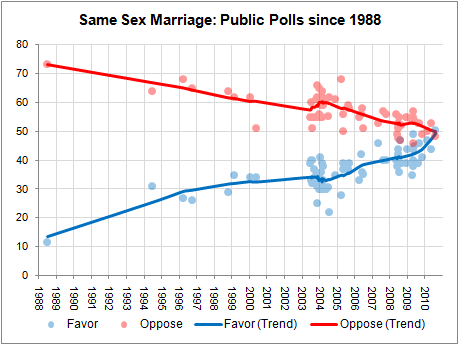
What backlash? CNN's latest poll, in the wake of the Walker decision, is easily the most promising to date for those of us in support of marriage rights for all. For the first time, a slim majority of all Americans backs not just marriage, but a constitutional right to marriage for gay couples. A majority, in other words, believes this to be a civil rights issue, which, of course, it is, because civil marriage has long been regarded as a fundamental civil right in American constitutional history. And a majority is in favor! I'm not sure what to make of a small discrepancy in wording – between whether gays already "have" such a right or whether they "should have" – but wouldn't go so far as Allahpundit in arguing it shows that this process should be driven solely by state legislatures.

I know it's messy, but surely the fact is that the classic American process is not, and should not be, either judicial tyranny or majority rule over a minority's rights. It's an ongoing interaction of the two. Would I prefer a total legislative and democratic victory for marriage equality? You bet I would. At the same time, can anyone gainsay our amazing progress in making the case?

In 1989, the idea was preposterous. But by relentless arguing, debate, litigation and legislative and ballot-box initiatives, we have moved the needle faster than anyone once dreamed of. When a proposition has 50 percent support, you can argue either that there is no need for the courts to act. But you could equally argue that with public support already this high, such a ruling could not meaningfully represent anything approximating "tyranny". Certainly far less so than when the courts struck down bans on inter-racial marriage which enjoyed very strong popular support at the time, especially in the states where they prevailed.

And the process of litigation – the public educative function of the courts – has clearly pushed opinion in favor over the years. Just having this issue in the public realm as one generation grew up has transformed public opinion. I see this dynamic as a distinctly American one, where the three branches of government and the people address emerging social issues in a messy, but healthy way. More to the point, those in the gay leadership (the Human Rights Campaign primarily among them) who did not want this movement, took a decade to support it, favored civil unions and domestic partnerships over an allegedly divisive call for full equality … have been proven totally wrong. Nate Silver on the accelerating support for marriage equality:

Something to bear in mind is that it's only been fairly recently that gay rights groups — and other liberals and libertarians — shifted toward a strategy of explicitly calling for full equity in marriage rights, rather than finding civil unions to be an acceptable compromise. While there is not necessarily zero risk of backlash resulting from things like court decisions — support for gay marriage slid backward by a couple of points, albeit temporarily, after a Massachusetts' court's ruling in 2003 that same-sex marriage was required by that state's constitution — it seems that, in general, "having the debate" is helpful to the gay marriage cause, probably because the secular justifications against it are generally quite weak.

That's why I was never afraid to publish and disseminate the opposition's arguments, as in my anthology, because I could see how transparently weak they are. And the notion that people cannot respond to reason on this issue, and are only motivated by animus, has simply been disproved in the last two decades.

Just look at the generation gap, or rather gulf. CNN's poll only looks at the over or under 50 issue, but there, nearly 60 percent of all the under-50s back marriage equality. Imagine what the numbers are for the under-30s. And the reason you may not be hearing more from the GOP on the subject is the remarkable alignment of Democrats and Independents on this topic – they are identical in outlook. It is the Republican party that is increasingly isolated – older, and more rural.

Of course, the same poll showed an even division on birthright citizenship and hefty opposition to the Cordoba Project. Maybe the new "other" is increasingly not the gays, but Muslims and the children of illegal immigrants. Sigh.

The Unique Quality Of “Lifelong Heterosexual Monogamy” Ctd

A reader writes:

Ross is just rationalizing a desire to hold on to an emotional image. He's made a cup out of string and wonders why it doesn't hold water.

Even old-school Catholics don't think marriage is about HAVING children. They think it's about RAISING children. Except for those that are so hardcore that they don't believe in adoption (they exist, but the rest of us ignore them). And when was the last time the Church ordered a divorce for a couple who found they couldn't get pregnant?

None of the other social and legal associations to marriage — power of attorney, family names, the sense that a couple is "really" together — are tied to childrearing. They've been there separately, even back when marriage was about property, and marriage is still the only way to get them. I don't know any childless straight couple about whom people think "Oh, they're not really married. Not really." The very idea is ridiculous.

The only reason marriage has traditionally been male-female is because most heterosexuals have traditionally been sour on homosexuality, for religious or other reasons. Take that away, as seems to be slowly but surely happening, and this tie disappears. There are still plenty of people who just flat don't approve of homosexuality. The group is shrinking, and good riddance. But they're the only ones with an intellectually honest argument against gay marriage. Anybody else is fooling themselves.

Ross is gazing despairingly at an ebbing tide. If he'd just walk forward a few feet he'd realize the ocean is still there. If you want to put marriage on a pedestal, go ahead, but don't do it because the spouses are heterosexual. Do it because they have figured out how to make marriage work. Because they raised awesome children, adopted or not. Because they work together to be a force for good in the world. You know, some reason that actually matters.

The Unique Quality Of “Lifelong Heterosexual Monogamy” Ctd

Continuing his writing on gay marriage, Douthat rebuts Noah Millman and Glenn Greenwald. He also notes that a response to the Dish is forthcoming. The Greenwald debate is a classic liberal-Tory divide. The liberal sees the law and culture operating independently; the Tory sees the law as influencing culture. I lean toward the Tory view. And I do not believe that the desire of so many gay couples to join together in civil marriage somehow undermines the institution. If anything, it is surely a sign of the resilience of the institution that in this day and age, so many are demanding access to it, who would previously have been excluded.

Who else is celebrating civil marriage today the way gay couples are? Have not gay people actually affected the culture recently in ways that celebrate rather than demean civil marriage? And have we not also in many ways adopted tradition as opposed to radicalism in this respect? My own vows, for example, were quite specific: till death do us part. I am sure we will have bumps on the road, and we are both human and will fail. But we committed to be there for one another for ever. We meant it. We are not alone. In this, many gays are actually embracing an ideal of civil marriage that many straights do not. Why can this not fit into an understanding of the social impact of this reform?

Some forget how those of us who were early supporters of marriage rights were first attacked from the gay left. I became anathema in the early 1990s in the gay establishment for my relentless focus on the issue. One book-store reading of Virtually Normal was actually picketed by the Lesbian Avengers – with posters of my face in the cross hairs of a gun. I was a heterosexist, patriarchal neo-fascist for insisting on this. Gays were supposed to be subverting marriage not joining it, just as we were supposed to be for destroying the military, not serving honorably within it. 

What maddens me about the right – what has driven me and so many into outright opposition – has been their refusal to acknowledge the conservative aspects of this movement, and the balls it took to take on the gay far left and identity politics in favor of civil integration in the polarized plague years. They saw a minority within a minority battling for responsibility and equality – and all they really saw were homos. With this minority, the GOP did first what it now does to so many. Instead of seeing many of us as allies, they pushed all of us into the enemy camp. Just as they will not concede the critical distinction between Muslims and Jihadists, or often fail in their rhetoric to acknowledge the great contributions of legal immigrants as opposed to illegal ones, so they pushed another minority away.

Their fears trumped their hopes; their bigotry trumped their humanity. With Muslims, Hispanics and gays, the GOP is about lumping us all together and demonizing and blaming us collectively for sins we did not commit and failures for which we are not responsible.

This is not conservatism, properly understood. It is fear.

The Unique Quality Of “Lifelong Heterosexual Monogamy” Ctd

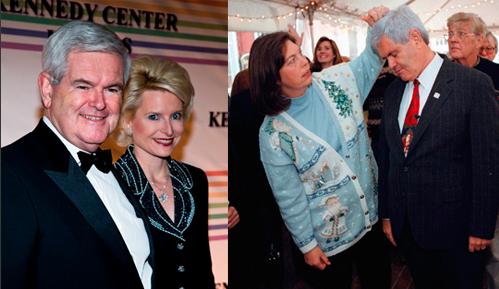
The Good Wives Photo Gallery on truTV.com's Crime Library_1281512009893

Gingrich's second of three wives, Marianne, gives blockbuster access to Esquire's John H. Richardson in a 8,300-word profile of the former Speaker. The following passage is making the most waves:

"There's somebody else, isn't there?" She kind of guessed it, of course. Women usually do. But did she know the woman was in her apartment, eating off her plates, sleeping in her bed?

She called a minister they both trusted. He came over to the house the next day and worked with them the whole weekend, but Gingrich just kept saying she was a Jaguar and all he wanted was a Chevrolet. "'I can't handle a Jaguar right now.' He said that many times. 'All I want is a Chevrolet.'"

He asked her to just tolerate the affair, an offer she refused. He'd just returned from Erie, Pennsylvania, where he'd given a speech full of high sentiments about compassion and family values.  The next night, they sat talking out on their back patio in Georgia. She said, "How do you give that speech and do what you're doing?"

"It doesn't matter what I do," he answered. "People need to hear what I have to say. There's no one else who can say what I can say. It doesn't matter what I live."

Steve Benen reviews the rest of Newt's record on marriage:

[He] haggled over the terms of his divorce from his first wife while she was in the hospital, recovering from uterine cancer surgery. He had already proposed to his second wife before he was divorced from his first. In the '90s, this happened again. Gingrich had an affair with a 33-year-old congressional aide — while spearheading the impeachment proceedings against President Clinton — and asked his third wife to marry him before he was divorced from his second.

And Marianne had just been diagnosed with multiple sclerosis. In follow-up posts to his piece, Richardson reveals more from his interviews ("As a reporter, I've always believed that everyone has some kind of inner coherence. … Until Newt Gingrich") and ponders Newt's 2012 aspirations ("so bad, he can taste it").

It's a gruesome spectacle and best left private – all marriages fail in some respects because we are all human; what matters is struggling to make them succeed. What makes this different is Gingrich's alleged statement:

"It doesn't matter what I do. People need to hear what I have to say."

This notion that the elite's responsibility is to preach values they do not believe in and do not practice is not the same as failing to live up to norms we all aspire to. It is not simply being human; it is cynicism. You see it in the neoconservative flattery of crude religious faith they quietly feel alienated from – and then the bashing of "liberals" for being more honest about it. Everyone who fails to live up to ideals deserves support. Those who lie about the ideals they actually hold, and use that as a cynical bludgeon in political warfare deserve no such thing.

(Getty images via TruTV.  Marianne is on the right.)

The Unique Quality Of “Lifelong Heterosexual Monogamy” Ctd

1281365841-straightaremagic2

Dan Savage is less delicate than my response to Ross:

[U]nless Douthat is prepared to call for laws that would compel straight people to live up to the same "sexual ideal" of marriage that somehow justifies discrimination against same-sex couples—and call for laws that would punish straight people who fail to live up to that ideal (no more marriage licenses for you, Mr. Limbaugh)—then Douthat's case for discrimination is just another serving of bullshit patties (albeit a fresher one) and Douthat himself is just another conservative scaremonger scapegoating gay people for the failings of straight people.

Or as Yglesias puts it:

Instead of holding heterosexuals up to a rigorous standard of conduct—no divorce, harsh & unforgiving attitude toward infidelity—we’re going to discriminate against the gay and lesbian minority and then congratulate ourselves on what a good job we’re doing of upholding our ideals.

Yeah, that just about sums it up. Greenwald steps in:

[I]f the arguments for the objective superiority of heterosexual monogamy are as apparent and compelling as Douthat seems to think, they ought not need the secular thumb pressing on the scale in favor of their view.  Individuals on their own will come to see the rightness of Douthat's views on such matters — or will be persuaded by the religious institutions and societal mores which teach the same thing — and, attracted by its "distinctive and remarkable" virtues, will opt for a life of heterosexual monogamy.  Why does Douthat need the State — secular law — to help him in this cause?