The Unique Quality Of “Lifelong Heterosexual Monogamy”

Ross is at his most Catholic today in his column on marriage equality, and I’d like to start a response by saying that he has conceded many secular points: that the life-long, monogamous heterosexual nuclear family is not natural and it is not the default definition of marriage in world history. Abandoning these defunct arguments – defunct because they are transparently untrue – is a helpful throat-clearing for which I’m most grateful.

Ross’ core argument is that “lifelong heterosexual monogamy at its best can offer something distinctive and remarkable — a microcosm of civilization, and an organic connection between human generations — that makes it worthy of distinctive recognition and support.” I’m going to repeat what I have said before: I don’t disagree with this at all. I remain in awe of the heterosexual life-long coupling that produces new human life. There is a miraculous, sacred, awe-inspiring aspect to it. I understand why this is a Sacrament, and have no interest in being included in such a Sacrament since it is premised on the very Thomist arguments Ross puts forward.

Sex for me has long been an intimation of the divine. Yes, we know that there are many ways human AA2_25 beings experience pleasure and transcendence – try magic mushrooms or a great Bordeaux or a rip-roaringly funny conversation or a quiet walk on a summer’s afternoon. I see all these things, as Ross does, I think, as part of the glories of divine creation (okay, maybe not the shrooms in his case). But the extreme, compelling, irresistible nature of the orgasmic pleasure – I know of nothing more sublime or self-losing – and the linkage to creating new life does make it special.

This is why the Catholic church upholds this as an ideal. And it does so with great wisdom. But, as Ross concedes, the question is whether this ideal should rest on its own laurels or needs to be elevated by law and doctrine to the highest level of human relationship, and also, in order to achieve this ideal, actively exclude others – both in the religious and the secular sphere?

We know the answer in the religious sphere. The church – even in its current High Ratzinger phase – opts for inclusion over exclusion. It allows the infertile to marry. It does not remove the Sacrament of Matrimony from those who do not produce kids. It even annuls countless marriages, many of which have been consummated, in enormously large numbers. It marries those past child-bearing age. It treasures adopted kids, even though they violate Ross’s parent-procreating “microcosm of civilization” ideal. And that’s only the Catholic church. The Protestant churches freely allow divorce and contraception – breaking both the monogamy and the procreative elements of Ross’s ideal (which is to say all of it). So in the religious sphere, the Church breaks its own ideal with regularity, and the other churches have long since given almost all of it up. And yet the Catholic church still insists that its ideal be enforced as an act of civil exclusion in the secular sphere, even on people who are atheists.

On what conceivable grounds, if you pardon the expression? Look at how diverse current civil marriages are in the US. The range and diversity runs from Amish families with dozens of kids to yuppie bi-coastal childless couples on career paths; there are open marriages and arranged marriages; there is Rick Santorum and Britney Spears – between all of whom the civil law makes no distinction. The experience of AA6_5 gay couples therefore falls easily within the actual living definition of civil marriage as it is today, and as it has been now for decades. To exclude gays and gays alone is therefore not the upholding of an ideal (Britney Spears and Larry King are fine – but a lesbian couple who have lived together for decades are verboten) so much as making a lone exception to inclusion on the grounds of sexual orientation. It is in effect to assert not the ideal of Catholic Matrimony, but the ideal of heterosexual superiority. It creates one class of people, regardless of their actions, and renders them superior to another.
Ross’s view is increasingly, therefore, one faction of one religion’s specific definition of Matrimony out of countless arrangements that are available for cohabitation in civil society and world history. It’s a view freely breached within his own church itself. And it has already been abandoned as a civil matter in some of the most Catholic countries on earth, including Spain and Argentina. And heterosexuals-only marriage is only a microcosm of civilization if you exclude all other relationships from civilization – friendship, citizenship, family in the extended sense, families with adopted, non-biological children, etc.

And – this is my main point – Ross’ argument simply ignores the existence and dignity and lives and testimony of gay people. This is strange because the only reason this question has arisen at all is because the visibility of gay family members has become now so unmissable that it cannot be ignored. Yes, marriage equality was an idea some of us innovated. But it was not an idea plucked out of the sky. It was an attempt AA16 to adapt to an already big social change: the end of the homosexual stigma, the emergence of gay communities of great size and influence and diversity, and collapse of the closet. It came from a pressing need as a society to do something about this, rather than consign gay people to oblivion or marginalization or invisibility. More to the point, it emerged after we saw what can happen when human beings are provided no structure, no ideal, and no support for responsibility and fidelity and love.
If you have total gay freedom and no gay institutions that can channel love and desire into commitment and support, you end up in San Francisco in the 1970s. That way of life – however benignly expressed, however defensible as the pent-up unleashed liberation of a finally free people – helped kill 300,000 young human beings in this country in our lifetime. Ross may think that toll is unimportant, or that it was their fault, but I would argue that a Catholic’s indifference to this level of death and suffering and utter refusal to do anything constructive to prevent it happening again, indeed a resort to cruel stigmatization of gay people that helps lead to self-destructive tendencies, is morally evil.

What, in other words, would Ross have gay people do? What incentives would he, a social conservative, put in place to encourage gay couples and support them in their commitments and parenting and love? Notice the massive silence. He is not a homophobe as I can personally attest. But if he cannot offer something for this part of our society except a sad lament that they are forever uniquely excluded, by their nature, from being a “microcosm of civilization”, then this is not a serious contribution to the question at hand. It is merely a restatement of abstract dogma – not a contribution to the actual political and social debate we are now having.

We gays are here, Ross, as you well know. We are human beings. We love one another. We are part of countless families in this country, pay taxes, work hard, serve the country in the armed services, and look after our own biological children (and also those abandoned by their biological parents). Our sex drives are not going away, nor our need to be included in our own families, to find healing and growth and integration that alone will get us beyond the gay-straight divide into a more humane world and society.

Or are we here solely to act as a drop-shadow to the ideal heterosexual relationship?

If so, what form would that drop-shadow take? What morsels from the “microcosm of civilization” are we permitted to have as citizens? And at what point does conceding the substance of gay needs in a civil union actually intensify the deliberate social stigma of exclusion from marriage, rather than mitigate it?

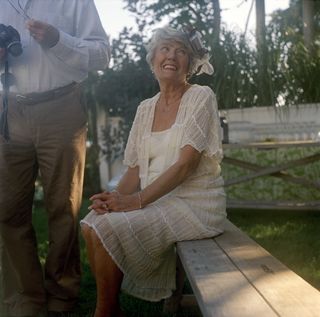
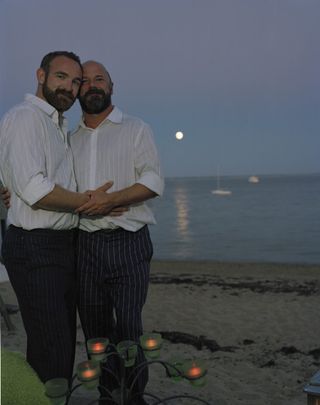
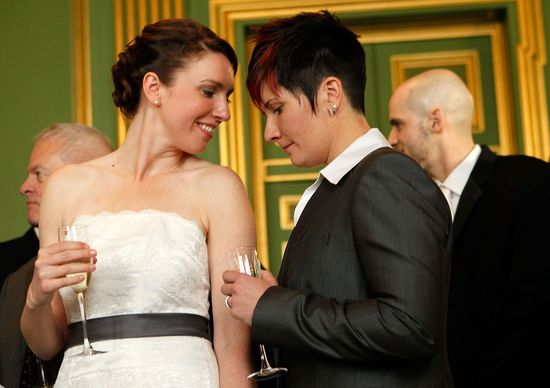
(Photos: My sister greets me after the ceremony three years ago; my mom enjoys one of the best days of her life; and Aaron and I share a moment as the moon rises (I was standing on a box – he’s 6’4″). How this violates my mother’s or my sister’s marriages is beyond me – and, more to the point, them.)

Dissent Of The Day

A reader writes:

Walker writes (and you quote):

“Race and gender restrictions shaped marriage during eras of race and gender inequality, but such restrictions were never part of the historical core of the institution of marriage.”

Huh?  “Race and gender restrictions shaped marriage during eras of race and gender inequality…?”  Um, there were no such “eras” unless he’s really speaking of one era: all of recorded history.  For there never was a time when gender did not matter in marriage.  Historically – a word the judge bends and shapes at will, but let’s assume it means what everyone knows it to mean – there never was a time when marriage referred to anything other than the union of man and woman.
 
So when he says that “such restrictions were never part of the historical core of the institution of marriage,” I begin to wonder if he is not taking advantage of California’s relaxed laws regarding the use of marijuana, because what he states is wrong in every possible way.  If ancient societies did not codify the illegality of gay marriage, it was only because marriage was, to them, so obviously meant for opposite-sex unions that it never occurred to them to make a law about it.  But written as a law or not, the fact is that historically (to use that term accurately and not as the Judge uses it) there was no gay marriage.  Nope, never.

There were homosexual relationships and, of course, gay people living together.  But such relationships were never called marriage.  Marriage has always, throughout all of history, referred to a union of men with women.  I suspect that “history,” to the Judge, means “How I think things should have been, and how I will – for the purposes of this ruling – assume they were, even though they weren’t.”  (But maybe that’s the marijuana talking.)
 
But you know, when your reasoning and logic rely upon faulty premises, you get yourself into trouble.  To prove just that point, it seems, he writes (and you quote):
 
“…plaintiffs’ relationships are consistent with the core of the history, tradition and practice of marriage in the United States.”
 
As the Judge might say, “Oh, gnarly, dude!”  Because as everyone knows, the very reason this trial occurred is because gay marriage is nowhere to be found in the “core of history, tradition and practice of marriage in the United States.”  And the very reason there is opposition to gay marriage is because a majority of the people of the state of California (in two referenda, remember) found it to be inconsistent with “the core of history, tradition and practice of marriage in the United States.”
 
The Judge gave us a good explanation for why he would have, and might have, voted “No” on Proposition 8.  He did not give us a good reason why the votes of everyone else should have been cast out, and his the only one that matters.

Leaving the marijuana issue out of it, and leaving all the other reasons Walker deployed out of it, we are back again to the historical argument: Because something never was, it never can be. My reader has a point, nonetheless, about the sentence he cites. In much of the world, and a whole swathe of America, racial restrictions were indeed integral to civil marriage from the get-go – since marriage meant procreation and racial "purity" was a core value. And for much of human history, marriage entailed ownership of women by men. Were these things integral to the meaning of marriage? You bet they were. So was the prohibition on divorce. Because these things no longer count, does this mean that marriage strictly speaking, has ceased to exist? If not, then what is the common thread that makes sense of marriage as an institution that is continuous?

Opponents of marriage equality say procreation, which is obviously untrue. Or heterosexuality, which is partly true (although many gay people entered into opposite-sex marriages for fear of social ostracism). But if a civil institution with enormous cultural meaning, social status and enumerated benefits, is to be defined by the exclusion of a minority, what of equal protection? That's what Walker is grappling with.

For the record, it is also untrue that gay relationships have never been formalized in the past, or referred to as marriages. In my anthology, you can read about many precedents, from Montaigne's diary to Africa and China and the Balkans and, yes, Massachusetts. Ever heard of what was once called a "Boston marriage"? Yes, in the West, these institutions never got legal status. Because gay people were easily suppressed. But they existed, as my reader acknowledges, and were understood as marriages by their participants.

Obama’s Marriage FAIL

Axelrod has no option but this, I suppose:

"The president does oppose same-sex marriage, but he supports equality for gay and lesbian couples, and benefits and other issues, and that has been effectuated in federal agencies under his control." 

But the whole point of this ruling is to contradict this statement. If the president does not support my right to marry, then he does not support my equality, according to the ruling. And you will note that Axelrod does not provide an argument as to why the president does not support civil marriage equality. Because the real argument would be: a) I'm too afraid of the culture war to take a stand; or b) I find the notion of two women getting married icky; or c) unlike my former congregation and whole swathes of American Christianity, my religious viewpoint demands that gay people be separated from the institution of civil marriage because it offends religious sensibilities. So which is it, Mr President? Are you really for equality or not?

The Conservatism Of Marriage Equality

Walker's critical point (and beautifully put):

The right to marry has been historically and remains the right to choose a spouse and, with mutual consent, join together and form a household. Race and gender restrictions shaped Weddingaisle marriage during eras of race and gender inequality, but such restrictions were never part of the historical core of the institution of marriage. Today, gender is not relevant to the state in determining spouses’ obligations to each other and to their dependents. Relative gender composition aside, same-sex couples are situated identically to opposite-sex couples in terms of their ability to perform the rights and obligations of marriage under California law. Gender no longer forms an essential part of marriage; marriage under law is a union of equals.
Plaintiffs seek to have the state recognize their committed relationships, and plaintiffs’ relationships are consistent with the core of the history, tradition and practice of marriage in the United States. Perry and Stier seek to be spouses;they seek the mutual obligation and honor that attend marriage, Zarrillo and Katami seek recognition from the state that their union is “a coming together for better or for worse, hopefully enduring, and intimate to the degree of being sacred.” Griswold, 381 US at 486. Plaintiffs’ unions encompass the historical purpose and form of marriage. Only the plaintiffs’ genders relative to one another prevent California from giving their relationships due recognition.

Plaintiffs do not seek recognition of a new right. To characterize plaintiffs’ objective as “the right to same-sex marriage” would suggest that plaintiffs seek something different from what opposite-sex couples across the state enjoy —— namely, marriage. Rather, plaintiffs ask California to recognize their relationships for what they are: marriages.

(Photo: the aisle of my own wedding ceremony.)

The Facts

Ambinder lists them:

Here are the relevant facts Walker finds:

1. Marriage is and has been a civil matter, subject to religious intervention only when requested by the intervenors.
 
2. California, like every other state, doesn't require that couples wanting to marry be able to procreate.

3. Marriage as an institution has changed overtime; women were given equal status; interracial marriage was formally legalized; no-fault divorce made it easier to dissolve marriages.

4. California has eliminated marital obligations based on gender.

5. Same-sex love and intimacy "are well-documented in human history."

6. Sexual orientation is a fundamental characteristic of a human being.

7. Prop 8 proponents' "assertion that sexual orientation cannot be defined is contrary to the weight of the evidence."

8. There is no evidence that sexual orientation is chosen, nor that it can be changed.

9. California has no interest in reducing the number of gays and lesbians in its population.

10. "Same-sex couples are identical to opposite-sex couples in the characteristics relevant to the ability to form successful marital union."

11. "Marrying a person of the opposite sex is an unrealistic option for gay and lesbian individuals."

12. "Domestic partnerships lack the social meaning associated with marriage, and marriage is widely regarded as the definitive expression of love and commitment in the United States.
The availability of domestic partnership does not provide gays and lesbians with a status equivalent to marriage because the cultural meaning of marriage and its associated benefits are intentionally withheld from same-sex couples in domestic partnerships."

13. "Permitting same-sex couples to marry will not affect the number of opposite-sex couples who marry, divorce, cohabit, have children outside of marriage or otherwise affect the
stability of opposite-sex marriages."

Remember, these are the FACTS that Walker has determined from the testimony and evidence. These facts will serve as the grounding for the legal arguments yet to come.

And, yes, they are facts. But they are also arguments, irrefutable arguments that yield only to the principle that change to an existing institution should be considered carefully and prudently. It's now 21 years since I first articulated the conservative case for marriage equality. Today, the compelling logic of the case reaches what can only be called an apotheosis.

DOMA Reax

MARRIAGEDCAlexWong:Getty

You can read the rulings here. Jack Balkin thinks they will be overturned:

I am a strong supporter of same sex marriage. Nevertheless, I predict that both of these opinions will be overturned on appeal. Whether one likes it or not– and I do not– Judge Tauro is way ahead of the national consensus on the the equal protection issue. I personally think that discrimination against gays and lesbians is irrational, but a federal district court judge– who must obey existing precedents, and who is overseen by a federal judiciary and a Supreme Court constituted as they currently are–is in a very different position than I am.

Perhaps more importantly, his Tenth Amendment arguments prove entirely too much. As much as liberals might applaud the result, they should be aware that the logic of his arguments, taken seriously, would undermine the constitutionality of wide swaths of federal regulatory programs and seriously constrict federal regulatory power.

David Kopel agrees:

Balkin is right to point out that the new federal health control law could be found unconstitutional by any court which applies the Tenth Amendment as seriously as did Judge Tauro.

Dale Carpenter:

On the whole, I don’t think Gill is one of the stronger judicial opinions supporting SSM.  Its reasoning is too cursory.  It doesn’t rely on the more obvious and to me more defensible argument: that discrimination against gays and lesbians is constitutionally suspect, deserving strict scrutiny.  And unless reversed by the First Circuit, Gill could turn out to be a short-lived and expensive victory for SSM when it reaches the Supreme Court (assuming the Prop 8 case doesn’t get there first).

Adam Serwer:

Balkin writes that the ruling is "way ahead of the national consensus on the the equal protection issue." Probably. As Gabriel Arana reported, that's certainly a concern moving forward with Perry v. Schwarzenegger. But the window of time during which Democrats equivocate by supporting civil unions instead of marriage equality is coming to a close — at some point soon those politicians sitting on the fence are going to have to pick a definitive side and risk the political consequences of either alienating the LGBT vote or their other, more religious core constituencies. That may happen before there's a genuine "national consensus" in favor of marriage equality.

A key question is whether the Obama administration will appeal the ruling, and, as Jake Tapper reports, they probably will.

Jillian Weiss:

The effect of the decisions will probably be put on hold during the course of the appeal.

The decisions only affect sections 2 and 3 of DOMA — the federal benefits part. It does not require interstate recognition of marriage equality. People married in Massachusetts will still get no respect in Florida.

The decisions also only affect people in Massachusetts, though that could expand on appeal. The decisions are probably not retroactive, so that people who paid extra taxes or were denied federal benefits based on DOMA will probably not be able to get their money back. 

Ampersand:

I think this decision puts the folks who have been saying “let the states decide,” while really opposing marriage equality, in an interesting position. The ruling says that the Federal government has to respect state decisions on this — even if a state decides to recognize same-sex marriages. Now most of those folks will have to come up with some rationalization to explain why when they said they wanted the states to decide, they didn’t mean that they wanted the states to decide.

Timothy Kincaid:

Taken together, it seems clear that Tauro finds that a distinction based on marriage is permissible. But one that is based on sexual orientation is not. This would seem to suggest that because states can determine marriage laws (Commonwealth), it can either allow or refuse same-sex marriage (until otherwise restricted). So those legally married same-sex couples in Massachusetts, Iowa, Connecticut, Vermont, New Hampshire, Washington DC, New York and Maryland and some 18,000 couples in California would be married in the eyes of the federal government while those in civil unions or domestic partnerships would not.

I have now read Hadley Arkes' response. I'd like to quote it, but it doesn't seem to grapple with the issues at all. It relies on definitional arguments about "marriage" – arguments that have actually already been resolved in Massachusetts and upheld by its legislature, governor and Supreme Judicial Court. And there is no discussion as to why a state should be prevented by the federal government from providing full equality to its citizens, without violating core principles of federalism. Arkes seems to imply that because the federal courts struck down miscegenation bans, the federal government can enforce – against state law – inequality for gay citizens and non-citizens. Maybe you can understand his case better.

It seems to me that, however this plays out in the courts, the reasoning in these cases, and the principles they inject into the discourse, are helpful. It does seem to me bizarre that I am married in both my places of residence – DC and Massachusetts – and my marriage license is identical to every other straight couple's. But the federal government – in a way unique in its entire history – refuses to acknowledge these clear state licenses solely on the basis of the fact that I'm gay.

The federal government is both refusing to recognize what it always recognized, and creating a two-tier system where gay couples are officially designated as worth less under the law than straight ones. And this is the position of the Obama administration. And they say they are pro-gay. They aren't. They like us kept very firmly in our place. And they will now argue in the courts that second class citizenship for two percent of the population is a principle they embrace and will continue to advance – even when the states have decided otherwise.

That's their prerogative. But they're full of it. Their position on marriage is about as coherent as their position on Afghanistan.

(Photo: Same-sex couple Alexandra Khalaf (R) and Amy Sokal share a monent after they exchanged vows during a group wedding March 20, 2010 at the Andrew W. Mellon Auditorium in Washington, DC. Ten same-sex couples participated in the mass wedding after the nation's capital became the sixth place in the nation that recognized same-sex marriage. By Alex Wong/Getty Images.)

Kagan Is For Marriage Equality?

That's what Maggie Gallagher is arguing:

Kagan waded into the DOMA case, amending a brief that offered “responsible procreation” as a reason for DOMA to instead explicitly reject procreation and child wellbeing as a reason for defining marriage as one man and one woman — undermining the law she claims to be defending. We’ve seen this tactic in state litigation before: Attorneys general pretend to defend the marriage law but sabotage the case by explicitly rejecting procreation as a reason for marriage. (See Jerry Brown in California.)

If you doubt my reading of Kagan’s record, see the Human Rights Campaign’s press release, which specifically cites her support for “marriage equality” in cases before the Supreme Court as a reason for voting for her. HRC and Maggie Gallagher agree: A vote for Elena Kagan is a vote for finding a constitutional right to gay marriage that will overturn marriage laws in every state.

Every state? And when you read HRC's statement, it says "issues related to marriage equality" not marriage equality itself. Althouse examines Kagan's record on the issue. I think she makes some fair points.

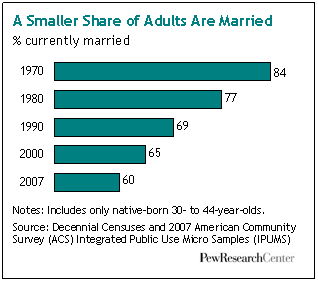
The “Trimmed Roots” And “Clipped Limbs” Of Marriage

PercentMarried

After pegging her article to Pew data on America's falling marriage rate, Emily Gould reviews recent books by women on marriage:

Why would a single woman write a whole book admonishing others to marry whomever they can? Why are those who are barred from the institution clamouring to swell the dwindling ranks of the legally bound? Why, when most marriages end in divorce, are weddings more fetishised than ever? To these niggling questions, Gilbert provides a kernel of an answer. Describing the decision to take a solo trip to Cambodia after a few particularly tense weeks of travel with her fiancé, she acknowledges that it is a mistake to believe we can have "equal parts intimacy and autonomy in our lives."

"Marriage has a bonsai energy," she writes. "It's a tree in a pot with trimmed roots and clipped limbs. Mind you, bonsai can live for centuries, and their unearthly beauty is a direct result of such constriction, but nobody would ever mistake a bonsai for a free-climbing vine." After spending so much time with Gottlieb's unequivocal endorsement of marriage and horror of singleness, it was a relief to read such a perfect evocation of the virtues and drawbacks endemic to both states.

But the real collective import of these recent books about marriage may just be that it’s impossible to read them and not think about how lucky women are to be able to live in a time when marriage is no longer compulsory. Now that women have a real choice about whether or not to enter the institution, statistics reveal the results of practical cost-benefit analyses. In this light, even the exhortation to “Marry Him!” reads like progress; implicit in it, after all, is the suggestion that, unless hectored, we very well might not.

I take all these points, and of course remain devoted to the idea that this is a choice and that making a marriage work should be left to the two spouses involved, not the government or society. But I also believe that as we mature as human beings, the idea of some clipped wings can be an expansion of freedom rather than a diminution of it. We benefit from trust and mutual love and support; we are freer because of it. And freedom is not compromised by a free choice to limit our options and train our virtues in a committed relationship. That goes for gays as well as straights. And oddly enough, I think gay men of all people could benefit the most.

Equality Is Equality For All

6a00d8341c730253ef01310f5895cf970c-500wi

by Chris Bodenner

Dan Savage counters those who say that marriage equality should not be a priority for poor minorities:

Wealthy gay couples—whatever their color—can hire lawyers to draw up wills and powers of attorney and jerry-rig some of the protections of marriage. Full marriage equality will allow all gay couples—regardless of color, regardless of economic resources—to access all of the protections of marriage. Marriage equality is a social justice issue.

Towleroad on the photo:

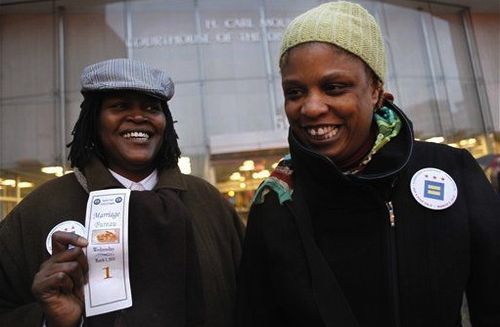
[DC residents] Sinjoyla Townsend and Angelisa Young, partnered for 12 years, were the first couple to receive a same-sex marriage license. Young said that "It's like waking up Christmas morning."

Marriage Equality Comes To DC

by Chris Bodenner

A last-ditch effort by marriage opponents failed:

“It has been the practice of the court to defer to the decisions of the courts of the District of Columbia on matters of exclusively local concern,” wrote Roberts, who made the decision without bringing in the full court. Roberts also cited the fact that although D.C. is autonomous, Congress could have passed a bill to disallow the city government from enacting the law, and it did not do so.

Marriages may be performed beginning March 9, as there is a waiting period of three business days after the issuance of licenses.

Dan Savage looks back at how the debate in the predominantly-black District was different from other campaigns:

And the lessons gay marriage campaigners, black and white, were supposed to take away [from Prop 8] were these: outreach to African Americans is hugely important [and they] take great offense when gay people or groups compare our struggle to the African American civil rights movement. But gay marriage supporters in D.C. did just that. … And this strategy was successful—with the African American members of the D.C. city council at least.

Timothy Kincaid looks ahead:

Were Justice Roberts an anti-marriage advocate, he may have been willing to lean towards granting the stay. It is, of course, far too soon and far to speculative to assume that this is a forerunner of his position on Perry v. Schwarzenegger, but it certainly weighs on the side of hope.