Gay Couples Gain Ground

The latest poll reveals that public opinion remains equally divided on the question of marriage equality. The shift from last year remains within the margin of error, and the basic balance is 50-50. Last year, it was 49 – 46 in favor; this year it's 50 – 47 against. I suppose some will argue that that's a turning of the tide, but it seems a trivial difference to me.

But the big news is that the debate over marriage has made a big difference on the debate about civil unions. A whopping 2 – 1 majority now favors civil unions for gay couples, defined in the poll as "giving them the legal rights of married couples in areas such as health insurance, inheritance and pension coverage?" That includes surprisingly big jumps among self-described conservatives: 

Support for such arrangements is now 15 points higher than it was a few years ago among conservatives; it's up 13 points among Republicans.

Meghan and Cindy McCain are more in touch with reality than John McCain. On ending the military ban on openly gay soldiers, the public overwhelmingly favors it, by 75 to 24 percent.

The other factor, however, is intensity of opinion, where the opposition is very intense. Those strongly in favor make up 31 percent; those strongly against 42 percent.

Two other notable nuggets. For those under 30, 65 percent favor marriage equality, a big jump from the last ABC poll, and the first time that number has exceeded 50 percent. And Independents are far, far closer to Democrats than Republicans on this issue. That suggests to me that this is becoming a liability for Republicans. They cannot avoid the issue since their base is so passionate about it, but in a general election, any emphasis on it will alienate a lot of Independents.

All I can say is that when we began this campaign in earnest two dacdes ago, I would have rubbed my eyes in disbelief at these numbers. I can't believe how far we've some, and I hope soon we will be able to stop arguing about it altogether and get on with our lives as equals.

Marriage And Biology

Heather Mac Donald worries about the "institutionalized severing of biology from parenthood":

The facile libertarian argument that gay marriage is a trivial matter that affects only the parties involved is astoundingly blind to the complexity of human institutions and to the web of sometimes imperceptible meanings and practices that compose them.

Equally specious is the central theme in attorney Theodore Olson’s legal challenge to California’s Proposition 8: that only religious belief or animus towards gays could explain someone’s hesitation regarding gay marriage. Anyone with the slightest appreciation for the Burkean understanding of tradition will feel the disquieting burden of his ignorance in this massive act of social reengineering, even if he ultimately decides that the benefits to gays from gay marriage outweigh the risks of the unknown.

This argument becomes less and less compelling as states and nations embrace marriage equality, the unknown becomes known, and no ill effects result. Another section of the article contradicts her central objection:

Even if gays never gain the right to marry, the practice of gay conception will presumably continue apace. Given that continuation, gay marriage at least preserves one strand of traditional child-bearing arrangements: raising children within the context of marriage.

Marriage Equality At The Supreme Court?

Law professor Vikram David Amar questions whether the Prop 8 trial will make it that far:

[This case is] destined for the Ninth Circuit. But whether it goes any farther depends on what the Ninth Circuit does. If the Ninth Circuit (either through a three-judge panel or the whole court sitting en banc) rules in favor of the plaintiffs and invalidates Proposition 8, then the Supreme Court may very well feel it must take the case, since same-sex marriage would be a federal right west of Rockies but not in most other parts of the country. But if the Ninth Circuit rejects the plaintiffs’ claims, don’t expect the Supreme Court to take the up the issue of same-sex marriage anytime soon. Still, when the Justices do address some future anti-same-sex-marriage measure enacted into law by a state — and down the road, they may have to do so — they’ll have the benefit of the trial record in the Proposition 8 case, as well the opinions and/or evidence from other cases that will have been decided in the interim.

Brian Leubitz agrees. I believe the great merit of the trial was educational, rather than legal.

I think the complete evisceration of the arguments of the anti-marriage equality crowd and exposure of their motivations were the key things. it would have been much better televised. But I feel about it the way I felt about Obama's Q and A with the GOP last Friday. When you can get the arguments directly in contact with one another, the overwhelming logic of marriage equality wins. That's why I was delighted to include in my own anthology the best critiques of the reform – because by showing that even the best arguments of the other side are weaker than ours, we move the ball forward.

Of course, we have a minority full of passionate intensity which so often overwhelms reason. But after a while, even they have to relent. As they did on inter-racial marriage which they opposed at the time with even more intensity.

Ted Olson’s Opening Statement

For the record:

This case is about marriage and equality.  Plaintiffs are being denied both the right to marry, and the right to equality under the law.

The Supreme Court of the United States has repeatedly described the right to marriage as “one of the vital personal rights essential to the orderly pursuit of happiness by free men;” a “basic civil right;” a component of the constitutional rights to liberty, privacy, association, and intimate choice; an expression of emotional support and public commitment; the exercise of spiritual unity; and a fulfillment of one’s self.

In short, in the words of the highest court in the land, marriage is “the most important relation in life,” and “of fundamental importance for all individuals.”

As the witnesses in this case will elaborate, marriage is central to life in America.  It promotes mental, physical and emotional health and the economic strength and stability of those who enter into a marital union.  It is the building block of family, neighborhood and community.  The California Supreme Court has declared that the right to marry is of “central importance to an individual’s opportunity to live a happy, meaningful, and satisfying life as a full member of society.”

Proposition 8 ended the dream of marriage, the most important relation in life, for the plaintiffs and hundreds of thousands of Californians.

In May of 2008, the California Supreme Court concluded that under this State’s Constitution, the right to marry a person of one’s choice extended to all individuals, regardless of sexual orientation, and was available equally to same-sex and opposite-sex couples.

In November of 2008, the voters of California responded to that decision with Proposition 8, amending the State’s Constitution and, on the basis of sexual orientation and sex, slammed the door to marriage to gay and lesbian citizens.

The plaintiffs are two loving couples, American citizens, entitled to equality and due process under our Constitution.  They are in deeply committed, intimate, and longstanding relationships.  They want to marry the person they love; to enter into that “most important relation in life”; to share their dreams with their partners; and to confer the many benefits of marriage on their families.

But Proposition 8 singled out gay men and lesbians as a class, swept away their right to marry, pronounced them unequal, and declared their relationships inferior and less-deserving of respect and dignity.

In the words of the California Supreme Court, eliminating the right of individuals to marry a same-sex partner relegated those individuals to “second class” citizenship, and told them, their families and their neighbors that their love and desire for a sanctioned marital partnership was not worthy of recognition.

During this trial, Plaintiffs and leading experts in the fields of history, psychology, economics and political science will prove three fundamental points:

First – Marriage is vitally important in American society.

Second – By denying gay men and lesbians the right to marry, Proposition 8 works a grievous harm on the plaintiffs and other gay men and lesbians throughout California, and adds yet another chapter to the long history of discrimination they have suffered.

Third – Proposition 8 perpetrates this irreparable, immeasurable, discriminatory harm for no good reason.

I

MARRIAGE IS THE MOST IMPORTANT RELATION IN LIFE

Plaintiffs will present evidence from leading experts, representing some of the finest academic institutions in this country and the world, who will reinforce what the highest courts of California and the United States have already repeatedly said about the importance of marriage in society and the significant benefits that marriage confers on couples, their families, and the community.  Proponents cannot dispute these basic facts.

While marriage has been a revered and important institution throughout the history of this country and this State, it has also evolved to shed irrational, unwarranted, and discriminatory restrictions and limitations that reflected the biases, prejudices or stereotypes of the past.  Marriage laws that disadvantaged women or people of disfavored race or ethnicity have been eliminated.  These changes have come from legislatures and the courts.  Far from harming the institution of marriage, the elimination of discriminatory restrictions on marriage has strengthened the institution, its vitality, and its importance in American society today.

II

PROPOSITION 8 HARMS GAY AND LESBIAN INDIVIDUALS, THEIR CHILDREN AND THEIR COMMUNITIES

Proposition 8 had a simple, straightforward, and devastating purpose:  to withdraw from gay and lesbian people like the Plaintiffs their previously recognized constitutional right to marry.  The official title of the ballot measure said it all: “Eliminates Right of Same-Sex Couples to Marry.”

Proponents of Proposition 8 have insisted that the persons they would foreclose from the institution of marriage have suffered no harm because they have been given the opportunity to form something called a “domestic partnership.”  That is a cruel fiction.

Plaintiffs will describe the harm that they suffer every day because they are prevented from marrying.  And they will describe how demeaning and insulting it can be to be told that they remain free to marry—as long, that is, that they marry someone of the opposite sex instead of the person they love, the companion of their choice.

And the evidence will demonstrate that relegating gay men and lesbians to “domestic partnerships” is to inflict upon them badges of inferiority that forever stigmatize their loving relationships as different, separate, unequal, and less worthy—something akin to a commercial venture, not a loving union.  Indeed, the proponents of Proposition 8 acknowledge that domestic partnerships are not the same as traditional marriage.  Proponents proudly proclaim that, under Proposition 8, the “unique and highly favorable imprimatur” of marriage is reserved to “opposite-sex unions.”

This government-sponsored societal stigmatization causes grave psychological and physical harms to gay men and lesbians and their families.  It increases the likelihood that they will experience discrimination and harassment; it causes immeasurable harm.

Sadly, Proposition 8 is only the most recent chapter in our nation’s long and painful history of discrimination and prejudice against gay and lesbian individuals.  They have been classified as degenerates, targeted by police, harassed in the workplace, censored, demonized, fired from government jobs, excluded from our armed forces, arrested for their private sexual conduct, and repeatedly stripped of their fundamental rights by popular vote.  Although progress has occurred, the roots of discrimination run deep and its impacts spread wide.

III

PROPOSITION 8 HARMS GAY AND LESBIAN INDIVIDUALS FOR NO GOOD REASON

Proposition 8 singles out gay and lesbian individuals alone for exclusion from the institution of marriage.  In California, even convicted murderers and child abusers enjoy the freedom to marry.  As the evidence clearly establishes, this discrimination has been placed in California’s Constitution even though its victims are, and always have been, fully contributing members of our society.   And it excludes gay men and lesbians from the institution of marriage even though the characteristic for which they are targeted—their sexual orientation—like race, sex, and ethnicity, is a fundamental aspect of their identity that they did not choose for themselves and, as the California Supreme Court has found, is highly resistant to change.

The State of California has offered no justification for its decision to eliminate the fundamental right to marry for a segment of its citizens.  And its chief legal officer, the Attorney General, admits that none exists.  And the evidence will show that each of the rationalizations for Proposition 8 invented by its Proponents is wholly without merit.

“Procreation” cannot be a justification inasmuch as Proposition 8 permits marriage by persons who are unable or have no intention of producing children.   Indeed, the institution of civil marriage in this country has never been tied to the procreative capacity of those seeking to marry.

Proposition 8 has no rational relation to the parenting of children because same-sex couples and opposite sex couples are equally permitted to have and raise children in California.  The evidence in this case will demonstrate that gay and lesbian individuals are every bit as capable of being loving, caring and effective parents as heterosexuals.  The quality of a parent is not measured by gender but the content of the heart.

And, as for protecting “traditional marriage,” our opponents “don’t know” how permitting gay and lesbian couples to marry would harm the marriages of opposite-sex couples.  Needless to say, guesswork and speculation is not an adequate justification for discrimination.  In fact, the evidence will demonstrate affirmatively that permitting loving, deeply committed, couples like the plaintiffs to marry has no impact whatsoever upon the marital relationships of others.

When voters in California were urged to enact Proposition 8, they were encouraged to believe that unless Proposition 8 were enacted, anti-gay religious institutions would be closed, gay activists would overwhelm the will of the heterosexual majority, and that children would be taught that it was “acceptable” for gay men and lesbians to marry.  Parents were urged to “protect our children” from that presumably pernicious viewpoint.

At the end of the day, whatever the motives of its Proponents, Proposition 8 enacted an utterly irrational regime to govern entitlement to the fundamental right to marry, consisting now of at least four separate and distinct classes of citizens:  (1) heterosexuals, including convicted criminals, substance abusers and sex offenders, who are permitted to marry; (2) 18,000 same-sex couples married between June and November of 2008,  who are allowed to remain married but may not remarry if they divorce or are widowed; (3) thousands of same-sex couples who were married in certain other states prior to November of 2008, whose marriages are now valid and recognized in California; and, finally (4) all other same-sex couples in California who, like the Plaintiffs, are prohibited from marrying by Proposition 8.

There is no rational justification for this unique pattern of discrimination.  Proposition 8, and the irrational pattern of California’s regulation of marriage which it promulgates, advances no legitimate state interest.  All it does is label gay and lesbian persons as different, inferior, unequal, and disfavored.  And it brands their relationships as not the same, and less-approved than those enjoyed by opposite sex couples.  It stigmatizes gays and lesbians, classifies them as outcasts, and causes needless pain, isolation and humiliation.

It is unconstitutional.
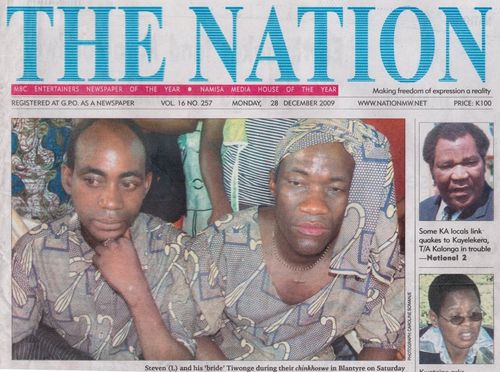
Marriage In Malawi

Nation1

These two heroes – one dressed as a bride – got married knowing the legal consequences:

Two Malawian men were arrested and charged with public indecency, police said on Tuesday, after becoming the first gay couple to marry in the conservative southern African state where homosexuality is illegal. Tiwonge Chimbalanga and Steven Monjeza publicly wed in a symbolic, traditional ceremony on Saturday.

"We arrested them last night at their home and charged them with gross public indecency because the practice is against the law," police spokesman, Dave Chingwalu, told Reuters.

Homosexuality is banned in Malawi and carries a maximum prison sentence of 14 years.

Chingwalu said the two men were likely to face further charges and would be held until further investigations have taken place.

It's almost certainly a response to the global marriage movement for gays that has begun to alter consciousness even in places like Malawi. But same-sex marriage has been an underground fact for centuries, because it is so natural for gay men and women to seek to solidify and bless their love and unions. Here's a passage from Montaigne's notebooks, included in my anthology, that provides some fascinating context for exactly the same thing centuries ago:

On my return from Saint Peter's I met a man who informed me humorously of two things: that the Portuguese made their obeisance in Passion week; and then, that on this same day the station was at San Giovanna Porta Latina, in which church a few years before certain Portuguese had entered into a strange brotherhood.

They married one another, male to male, at Mass, with the same ceremonies with which we perform our marriages, read the same marriage Gospel service, and then went to bed and lived together. The Roman wits said that because in the other conjunction, of male and female, this circumstance of marriage alone makes it legitimate, it had seemed to these sharp folk that this other action would become equally legitimate if they authorized it with ceremonies and mysteries of the Church.

Eight or nine Portuguese of this fine sect were burned.

As ever, Montaigne's dry wit about the naivete of these people is leavened by his obvious support for the activities of this "fine sect." Gay marriage is not new; it is as old as homosexuality, and the human need for love, commitment and companionship. For more examples – from medieval China to nineteenth century Boston, my anthology is comprehensive. Book here; kindle version here.

Equality In DC, Ctd

by Patrick Appel

Dale Carpenter gives his take:

If I’m right about the near-term prospects, marriage should be secure in the city. The lesson from Massachusetts and Vermont, and from California and Maine, is that the longer the day of electoral reckoning can be delayed the more likely it is that anti-SSM passions will subside. So, if gay marriage in D.C. survives 2010, it is probably here to stay.

D.C. will also be another test of the theory that, at least without expansive exemptions for religious objectors, there will significant erosion of religious liberty. The city’s Catholic leaders have already warned (some would say threatened) a loss of social services if the bill is passed because religious traditionalists who get city money won’t agree to treat gay couples equally.  These losses have not materialized in other jurisdictions recognizing gay marriage or civil unions, though Catholic Charities has stopped providing adoption services in Massachusetts.

Equality In DC

by Patrick Appel

Here's Adam Serwer on what happens now that DC has voted for marriage equality:

Shortly after the D.C. City Council voted 11-2 to extend marriage rights to same-sex couples in the District, the room erupted into cheers and applause. Leaders from each side scrambled into the hallway to field questions from reporters. Bishop Jackson warned that his group would be "bringing their voices to the Hill" in the hopes of persuading a Democratic Congress to overturn the marriage equality bill; Congress has a month to overturn D.C. laws after they've been passed and signed by the mayor. Overturning the law this way would require majorities against the bill in both houses and the signature of the president, which Mike DeBonis points out is an unlikely scenario. But DeBonis also notes that there are other ways Congress could circumvent the law, either by restricting the city's funding or by adding riders to unrelated bills. Still, all that it will take for marriage equality to become law in the District is for Congress to simply do nothing — something which Congress is generally pretty good at.

DCist argues that the marriage proceedings are also a victory for home rule.

The Mormon Move

It is possible to be cynical or begrudging in reacting to the LDS Church's SLCGeorgeFrey:Getty Mormon church in a far more positive and pro-gay position than any other religious group broadly allied with the Christianist right. They have made a distinction – and it is an admirable, intellectually honest distinction – between respecting the equal rights of other citizens in core civil respects, while insisting – with total justification – on the integrity of one's own religious doctrines, and on a religious institution's right to discriminate in any way with respect to its own rites and traditions.

I believe that there are forces of discrimination and bigotry within the Mormon church – and they have recently been ascendant. But that is true of most churches and most institutions. And what I have long observed among Mormons – unlike some other denominations – is also an American decency that tends to win out in the end. I've never met a nasty Mormon. They put many Christians to shame in their practice of their faith and the civility and sincerity with which they live their lives. And this decision in Salt Lake City – not an easy or inevitable one – to make a clear distinction between civil marriage and other civil protections is one worthy of respect.

I do not agree with it. I see no reason why civil marriage for non-Mormons should be banned because Mormons find it anathema to their doctrines – just as I see no reason why civil divorce should be banned because it violates the Catholic church's doctrines. But I can respect that position because I can respect the sincerity of that religious belief and see in this stance a genuine attempt to reach out and respect the rights of gay citizens in certain basic respects. Gays should and must reciprocate.

For this is not something that many other churches, including my own, have been able or prepared to do. I wish, of course, that Michael Otterson, who is also a decent and sincere man, had not framed the position in such a defensive way:

"The church supports these ordinances because they are fair and reasonable and do not do violence to the institution of marriage."

That's a lamentably inflammatory way to describe gay citizens' genuine attempt to seek equality in civil marriage – which we certainly don't see as "violence" in any way at all. But the extremity of that quote may well have been necessary to avoid a backlash among conservative Mormons. And I would much rather focus on the positive gesture than the back-handed swipe that accompanied it.

The other thing to say about this is that it speaks very highly of the strategy of Equality Utah, the state's main gay group, who decided to call the LDS bluff when the church said it was merely opposed to civil marriage – and not other protections for gay and lesbian citizens. Equality Utah immediately tried to get the church to endorse civil unions. That was a non-starter, but in response, we have this support for an anti-discrimination ordinance. Treating religious groups as interlocutors to be engaged, rather than as enemies to be attacked, has not been successful in most places. I did my best with the Catholic hierarchy in the 1990s and got little but contempt or terrified silence in response. Imagine the impact if the Pope came out and explicitly endorsed anti-discrimination laws for gay and lesbian people and used those words and expressed the kind of respect the Mormons just have. It would do a huge amount of good – for gay people and for the church. This Pope cannot do that; but the Mormons just did. More power to the Mormons.

For this degree of respect – even if it is not fully what I want or what gays truly deserve – we should reciprocate with respect as well. This is a moment of genuine dialogue and civil compromise. And it was accomplished in Salt Lake City among gay and straight Mormons and gay and straight non-Mormons in a way that other Christians in other places have been unable to replicate.

Leadership comes in the unlikeliest places. And when it does, we should thank God and be glad.

Marriage, Sex And Christianism

A reader writes:

As someone with a Christianist upbringing, I agree completely with your reader's take on marriage being about sex. (My husband and I, happily married — really — for 40 years, married at 21 because of it.)

That, combined with the Christianist belief that homosexuality is a choice because the God they believe in could not possibly create a homosexual, makes it unacceptable at its core and in the extreme. 

A couple of days ago you wrote: "So the right has a choice. They either double down and wage a war to strip gay couples of existing marriage rights, and use that reversal of rights to try to increase the stigma of homosexual orientation among the young. Or they can coopt the movement and use it to teach the virtues of marriage and family all round, inclusive of gay people."

As much as I long for them to choose the latter, I believe they cannot. All they CAN do, in their worldview is "humiliate, browbeat and stigmatize those of us building our relationships and families."

But, as you say, that is all they can do. And all the rest of us can do is hope their numbers decrease and that those on the fringe pull away from their intolerance and hatred. Because the core of them cannot change.

The reduction of marriage to sex and the reduction of sex to procreation does explain a huge amount of Christianist panic about marriage equality. Their bigotry is a function of their inability to see nuance of any kind and of their white–knuckled fear that their worldview is wrong, and therefore needs extreme reassertion.

The Pain In Maine II

A reader writes:

My straight son worked for the marriage equality campaign in Maine. I just got off the phone with him. He is sad and started crying. Not for himself but for those whose rights have been taken away and those who have been fighting for those rights for years. I have seldom been so proud as a Mother. I told my son that we should be satisfied. People like us who work hard for our ideals and follow our hearts have nothing to be ashamed of.

I also don't believe that the campaign has anything to be ashamed of. I was worried about the early ads, but they improved. The campaign organization, by all accounts, was superb. The money was there. The enthusiasm was there. The turnout was spectacular in an off-year.

The hard truth is: people are still afraid of this, and our opponents knew how to target their fears very precisely. They have honed it to an art – their prime argument now is that although adults can handle gay equality, children cannot. And so they play straight to heterosexuals whose personal comfort with gay people is fine but who sure don't want their kids to turn out that way. One way to prevent kids turning out that way, the equality opponents argue, is to ensure that they never hear of gay people, except in a marginalized, scary, alien fashion. And this referendum was clearly a vote in which the desire to keep gay people invisible trumped the urge to treat them equally.

The truth about civil marriage – why it is the essential criterion for gay equality – is that it alone explodes this core marginalization and invisibility of gay people. It alone can reach those gay kids who need to know they have a future as a dignified human being with a family. It alone tells society that gay people are equal in their loves and in their hearts and in their families – not just useful in a society with a need for talented or able individuals whose private lives remain perforce sequestered from view. 

This is why it remains the prize. And why our eyes must remain fixed upon it. In my view, the desperate nature of the current tactics against us, the blatant use of fear around children (which both worries parents and also stigmatizes gay people in one, deft swoop) are signs that what we are demanding truly, truly matters.

You can always tell what matters because it is the one thing our opponents are desperate to prevent. That is why, even in Washington State, even when they dilute marriage into "domestic partnership", the Christianist right is already promising to mount another referendum to repeal it again. They know that once civil marriage is accepted, the bigotry toward gay people has been dealt a terminal blow.

But guess what? Civil marriage is already here. It exists in several states already, it exists in the consciousness of an entire generation. It exists abroad in America's closest neighbor and in America's closest allies. The speed of the movement towards it is unprecedented in modern civil rights movements, even as it may seem crushingly slow to those who live under discrimination's weight. These defeats – even narrow defeats as in California and Maine – should not discourage us. The desperation and fanaticism of our opponents proves they know that this is the crucial battleground. And they're right.

But civil rights victories, the final and enduring ones, are always built on the foundations of defeats. Sometimes, the defeat of a minority's sincere aspiration to equality helps reveal the injustice of the discrimination and the cruelty of the marginalization. Sometimes, it helps show just how poorly treated we are, and galvanizes a community to fight back more fiercely as we saw in that amazing march on DC last month. That has certainly been true of previous civil rights movements. It is just as true of ours.

So congrats, Maine Equality. You did a fine job. Congrats, HRC. You helped. No congrats to Obama who is treating this civil rights movement the way Kennedy first treated his. But we don't need Obama.

We are the ones we've been waiting for. And we will win in due course, with a good spirit and keen arguments, and with passion and conviction in our hearts. We will win.