The Other Marriage Nail-Biter: Victory

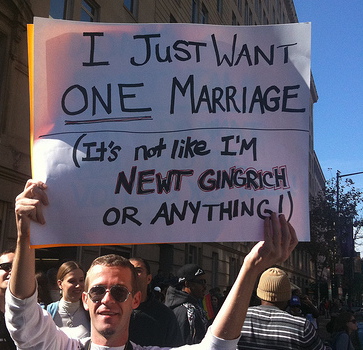
In Washington State, another referendum on gay couples' equality was also a squeaker. But in this one, gay couples won. The state's domestic partnership law grants gay couples all the rights of married couples at a state level. The usual forces tried to reverse it, as they tried in Maine. But in Washington, the gay side won by 51.1 to 48.9 percent. Again, it's such a slender margin, it's stupid to draw any vast conclusions.

But I do want to point out that, from the perspective of just a decade ago, to have an even split on this question in a voter referendum is a huge shift in the culture. In Maine, where the Catholic church did all it could to prevent gays from having civil rights in a very Catholic and rural state, gays do have equality but may now merely be denied the name. The process itself has helped educate and enlighten and deepen the debate about gay people in ways that never happened before the marriage issue came up.

I am heart-broken tonight by Maine, and I'd be lying if I said otherwise.

Somehow losing by this tiny margin is brutalizing. And because this is a vote on my dignity as a human being, it is hard not to take it personally or emotionally. But I also know that the history of civil rights movements has many steps backward as forward, and some of those reversals actually catalyze the convictions that lead to victories. A decade ago, the marriage issue was toxic. Now it divides evenly. Soon, it will win everywhere.

I know for many younger gays and lesbians, this process can seem bewildering and hurtful. But I'm old enough now to be able to look back and see the hill we have climbed in such a short amount of time, and the minds and hearts we have changed. Including our own.

Know hope.

A Gay Voice Against Marriage Equality

You have to search high and low but Andrew Breitbart tracked one down (one Charles Winecoff). Read the piece for yourself. It's a strange mix: mainly hathos at victim-mongering liberals (no big disagreement here); and an argument that gays should simply accept the cultural norms around marriage:

The traditional definition of family remains sacrosanct to most Americans, and has since long before the Stonewall Riots brought gay rights out of the closet.  There’s nothing wrong with trusting in the conventional notion of the nuclear family, just as there is nothing wrong with being openly gay.  These two belief systems need to learn to COEXIST, as the bumper stickers say.  And that requires a two-way street.

“But Spain allows gay marriage – and that’s a Catholic country!”  So what.  Spain doesn’t have three hundred million people living in it.

But seeking equality surely is a way for the two belief systems to coexist. Not a whit of heterosexuals' rights and privileges and families is affected, after all, and most of us who support marriage equality do so because we admire the stability that marriage gives straights. More to the point, Winecoff supports full and equal rights for gay couples under the law:

Should lesbians and gays who want to make a home and raise kids be discriminated against from the federal level down?  Of course not.  Should committed gay partners enjoy the same benefits as married heterosexual couples?  Absolutely – and as far as I can tell, in a growing number of states, they do (and if they don’t, trust me, they will).

So why am I defending the Mormons?  To crib from Flip Wilson, the 8MP trailer made me do it (which may indicate how effective the movie will be when it finally opens).

To my mind, this is Breitbartism. It is not a principled conservatism; it is a cultural anti-liberalism so deep it forces people to take positions they otherwise wouldn't. No one should take a position on civil rights because a movie trailer made them retch. Seriously. That's not an argument; it's a posture.

The Strange Logic Of Elizabeth Birch

The former head of the Human Rights Campaign has long been – along with the entire HRC board – cagey when it comes to her real opinions. Horrified by the movement for marriage equality in the 1990s, Birch helped pioneer the HRC strategy to punt on marriage equality and the military ban while pushing for hate crimes laws. That strategy is still in place and it's why the federal government is miles away from any recognition of gay couples, why DADT remains in force (and will remain in force throughout this Congress) and the attorney general has to say he isn't even aware of what the Maine referendum is even about.

I often wondered what the real motive for this strange fixation was. I thought it was fundraising: any direct-mailer will tell you that a pitch to save gay people from being murdered and left for dead on the streets is a good tool. HRC milked it for years and years ("You want to see more Matthew Shepards? Donate here if you don't.") It also asks for nothing from gay people. Under the hate crimes rubric, gays are asked to see themselves as sad, passive victims of hate, reaching out to government to protect them more than those just targeted for other reasons (having money, for example). But here is Birch's rationale, delivered in her much-postponed victory lap last evening:

"This was the moment that was required in order to have new laws follow."

Huh?

You have to have a federal hate crime law in order to recognize the existence of gay married couples? Or in order to stop the government persecuting servicemembers? How on earth did the civil rights movement for African-American equality unfold all the way to inter-racial marriage without a single hate crimes provision? I think Birch was saying: this was the easiest get, and thereby gets the gays marked in federal law as a protected victim class. Once gays are turned legally into victims, more laws can be passed enshrining that status.

The trouble is: victims are not servicemembers or married couples. Marriage and military service do require real things from gay citizens, real responsibilties and real equality. Victim laws merely require things from government. And that's why the hate crimes fixation makes sense from the HRC point of view. The campaign was a brilliant decades-long marketing measure to provide HRC with funding, while giving Democratic party officials an alibi for not tackling the actual question of equality. It was a way to give lawmakers cover for saying they oppose actual equality. I predict that this congress will be up for re-election with this as the single legislative achievement for gay equality. Which is how HRC lives for another fundraising cycle. And how they get their Democratic paymasters off the hook from the community.

But we'll see, won't we? Once again, I'd dearly love to be proven wrong. So make a fool of me. Please.

Marriage Equality = “The Extermination Of The Human Race”

This not-even veiled directly religious rally against equal marriage rights – there’s barely a secular argument in the entire event – should warm Karl Rove’s heart. If he can only get enough African-Americans to strip his own father of core civil rights, his career will not have been in vain. Note that only 150 people attended this anti-gay rally in DC. But also note the quality of the “arguments”:

The Right Splits On The Gays

Enhanced-buzz-10950-1255361554-8

There was a split response from the right to this weekend's events. One segment sympathized with upset gay activists or, at least, happily piled on the president. The other side, the Maggie Gallagher contingent, are unrepentant in seeing gay couples as the enemy. Glenn Reynolds:

My advice to the Gay Left is the same as my advice to the Tea Party

Right — if you don’t like what “your” politicians are doing, quit donating to ‘em and run somebody against them in the primary. They’ll notice. And the Gay Left and Tea Party Right might even want to talk to each other; they may find they’ve got more in common than they realize…

Except this isn't the "gay left". It's the gay right, left, and center as well. Have you noticed any gay Republicans opposing the repeal of DADT? Any gay people at all supporting the government's discrimination against its own citizens? But for too many boomers, if it's gay, it's left. For the next generation, that association doesn't hold any more. Maggie Gallagher:

Pity President Obama. He's done more, more quickly, for gay people than any president in history but it's clearly not enough. The leadership, the old heads, are trying to restrain and redirect their people. But gay Americans have imbibed the heady rhetoric of equality — not just any equality, they are the civil-rights movement of this century… The leveling wave of equality demands more, more, more, from government.

We want nothing from the government but to stop discriminating against us. We want to be left alone, as straight people are, allowed to serve our country without worrying, allowed to have legal security in our families as every straight person takes for granted. Why is that so hard to understand? Robert Stacy McCain:

If gay people vote Republican, they might not get the bullet-point agenda items demanded by HRC, but they will at least not have to accept the kind of two-faced, backhanded insults they get from Democrats who claim to be their "friends."

No, we'll get federal amendments to make us second class for ever, and state amendments designed to strip us of dignity and security. And vicious homophobic rhetoric to boot. Ed Morissey:

One can always tell an organization that fails to comprehend the nature and the reach of the blogosphere when “pajamas” gets used as a snide insult. Say, wasn’t this the same candidate who relied heavily on online activism and regularly hailed it as a sign of increased participation in politics? I guess Obama doesn’t value that participation any longer, at least not when being held accountable for his lack of action. 

David Bass:

So, in many ways, the homosexual rights coalition is becoming the evangelical Christian community of the left — a reliable voting pool that the Democrats can take for granted. Could it backfire? Maybe, but I doubt it. Similar to evangelicals, homosexual activists have no other viable third party option. They're stuck. So they make a lot of noise and hope the establishment listens.

Albert Mohler:

In the span of a single sentence, President Obama put his administration publicly on the line to press, not only for the repeal of the Defense of Marriage Act, but for the recognition that same-sex relationships are "just as real and admirable as relationships between a man and a woman." It is virtually impossible to imagine a promise more breathtaking in its revolutionary character than this — to normalize same-sex relationships to the extent that they are recognized as being as admirable as heterosexual marriage.

Saying it's breath-taking and revolutionary doesn't make it so. I see no revolution in the states that have already legalized marriage equality – just lower divorce rates than the Bible Belt, and happy, responsible gay couples and families. Quite why conservatives want to keep gay people marginalized, robbed of civic responsibility and cast out of the family remains a function of two things: fear and ignorance. One person at a time, we are doing what we can to defuse both. Obama, for all his ruthless caution, at least understands that. And I truly believe he does.
Bill Clinton Explains Why He’s Now For Marriage Equality

Anderson Cooper has the scoop. Amazingly, no one has asked him so directly before:

AC: You said you recently changed your mind on same-sex marriage. I’m wondering what you mean by that. Do you now believe that gay people should have full rights to civil marriage nationwide?

Clinton: I do. I think that, well let me get back to the last point, the last word. I believe historically, for two hundred and something years, marriage has been a question left to the states and the religious institutions. I still think that’s where it belongs. That is, I was against the constitutional amendment to ban gay marriage nationwide, and I still think that the American people should be able to play this side in debates.

But me, Bill Clinton personally, I changed my position. I am no longer opposed to that. I think if people want to make commitments that last a lifetime, they ought to be able to do it. I have long favored the right of gay couples to adopt children.

AC: What made you change your mind? Was there one thing?

Clinton: I think, what made me change my mind, I looked up and said look at all of this stuff you’re for. I’ve always believed that—I’ve never supported all the moves of a few years ago to ban gay couples from adoption. Because they’re all these kids out there looking for a home. And the standard on all adoption cases is, what is the best interest of the child? And there are plenty of cases where the best interest of the child is to let the gay couple take them and give them a loving home. So I said, you know, I realized that I was over 60 years old, I grew up at a different time, and I was hung up about the word. I had all these gay friends, I had all these gay couple friends, and I was hung up about it. And I decided I was wrong.

That our society has an interest in coherence and strength and commitment and mutually reinforcing loyalties, then if gay couples want to call their union marriage and a state agrees, and several have now, or a religious body will sanction it, and I don’t think a state should be able to stop a religious body from saying it, I don’t think the rest of us should get in the way of it.  I think it’s a good thing not a bad thing. And I just realized that, I was, probably for, maybe just because of my age and the way I’ve grown up, I was wrong about that. I just had too many gay friends. I saw their relationships. I just decided I couldn’t, I had an untenable position.

Marriage Matters

A reader writes:

I'll be honest, there was something about the pro gay marriage argument I didn't quite get until recently.  I've always detested the hate and illogical arguments spewing from the Right, and found Bush-Rove's cynical use of the issue in '04 sickening.   Ultimately though I found it RINGJustinSullivan:Getty to be one of those debates, fueled by culture war nonsense,  where both sides just ended up talking past each other.   We've reached a point where many social conservatives don't deny the need to give gay couples hospital visitation rights, survivor benefits, and all the other legal protections of marriage, yet the Left seemed content blowing past a fertile middle ground in favor of what seemed to me to be largely a semantical argument.  Why not secure gays the basic rights they've been denied and worry about what name is given to their relationship down the road?  Surely when those under 40 become the generation over 40, the controversy over calling it marriage will seem almost quaint.  

 In the hellish months of planning my wedding in June, I found myself quoting Chris Rock to my friends — can't get sent to war, can't get married, sign me up. Maggie and I started living together in 2004, and for years we shared expenses and were secure in our commitment to spend our lives together.  So besides spending a chunk of our savings on the wedding and developing a strained relationship with my parents (it's the nature of the beast someone won't like the wedding plans) I didn't see how my life was going be radically altered by marriage.

Well,

as anyone whose been married knows, I was wrong.

The bond between Maggie and I is infinitely stronger and my life is so much richer for having her as my wife.  I feel foolish for not having done it 3 years ago.   As I stood on the dunes in Truro where we got married, overwhelmed by the life changing event that I'd just experienced, I looked across the bay at Provincetown.  I thought of all the engaged gay couples we'd encountered while planning our wedding, I thought of all those personal stories your readers shared back when the Prop 8 debate was raging, and I thought of you and your husband.  I'd always been on the pro gay marriage side of the debate, but not until I actually got married did I understand the core of the debate itself.  There is no separate, but equal argument to be made on this issue — and any heterosexual, who has experienced the joys of marriage, is being intellectually dishonest in his attempt to make one.

Symbolism And Neutrality

Jon Rowe ABBEYDavidMcNew:Getty commitment in an emotional and sexual world which often pulls us away from that. It encourages shared sacrifice; it instills the disciplines of shared living; it promotes thrift; it integrates gay people into their own families and society; it harms no-one. In that sense I'm a weak libertarian, believing in a minimal state that can nonetheless encourage core shared values and social goods and treats the equal inclusion of minorities as something worth sacrificing for. That's the social conservative side of marriage equality – and the evolution of gay culture even in the past decade shows how that could occur, especially as the first generation of gay kids grows up knowing in advance that marriage is an option.

In fact, a great deal of this symbolism has to do with gay kids more than adults. If you are part of a family and your society tells you at an early age that you can have no family, no spouse and no integration into the world alongside your brothers and sisters in the future as an adult, that's a brutal psychic wound that leads to all sorts of subsequent problems and pathologies. I'd rather help mitigate that for the sake of some desperate young people, often isolated and alone and give them a chance for a solid future, with their families and communities as they have grown up in them. That's why I'm not a full-bore libertarian. And that's why marriage equality remains as much a conservative cause as a liberal one.

Secondly, Jon's solution is simply quixotic to me:

On disputed issues of “the good” that fall outside of governments minimal purview of enforcing our rights to life, political liberty and property, government should just stay out of it and leave issues up to individuals and private groups. That means privatize marriage, everyone gets that two person civil union for which The Witherspoon Institute argues and individuals and private groups, not government decides what is “marriage” just as they decide what is true “religion.”

I take the point theoretically. But does Jon faintly believe that this country will ever vote or courts will ever rule that an institution already judged profound and unalienable by the Supreme Court will be abolished? That's pure fantasy. The actual lives of gay people and their families, meanwhile, are not fantasy. And Robert George's arguments reflect little but medieval science, one version of theological control of politics (many religious people now embrace gay equality), and, more importantly, second-class status for gay couples. His civil unions for any two persons, straight or gay, who cannot marry – do not and would not carry the full rights of marriage. And they equate the lifetime emotional commitment of a gay couple to temporary friendships, contracts of domestic convenience, financial deals, or other extraneous couplings. What George is doing is removing gay people from family life, or only allowing them to function within it as aliens and outsiders.

Bill Clinton Supports Marriage Equality?

by Patrick Appel

I'm not as impressed as Conor. Chris Geidner slices and dices what Bill Clinton actually said about marriage equality:

[D]espite suggestions to the contrary, nothing in Clinton's statement is anywhere near a reversal on DOMA.  It certainly was not a statement that he supported a repeal of DOMA.  Section 2 of DOMA allows states to ignore same-sex marriages entered into in other states; Section 3 defines marriage at the federal level as between one man and one woman.  Clinton's statement was personally supportive of marriage equality and supportive of state actions that allowed for marriage equality.  That's all.

Though it's nice to have Bill Clinton pay lip service to marriage equality, I have a hard time forgiving him to for past anti-gay offenses. If Clinton was serious about equality, he would admit that DOMA was a mistake and work to repeal it.

Marriage In DC

Adam Serwer applauds gay rights activists in the district:

The face of LGBT leadership in D.C. is often black. Nationally, anti-gay-rights activists have had a great deal of success in encouraging black voters to oppose gay rights, partially because LGBT rights are seen — incorrectly — as a "white issue." But in Washington, D.C., the diverse composition of the marriage-equality movement means that marriage-equality activists don't have to "reach out" to the black community, because they're already part of it. That doesn't mean marriage-equality activists don't face serious obstacles in garnering support among African Americans, but it makes racial divisions harder to exploit. The lesson is clear — when the marriage-equality movement is integrated, outreach becomes less of an issue.

Ta-Nehisi chimes in:

Regrettably, I can't think of anywhere else like D.C. Atlanta, perhaps? But I don't see gay marriage coming to Georgia for another decade, at least.