What Was Obama Thinking?

A reader channels a lot of people's bafflement on the DOMA brief:

I'm floored by the Obama Administration's stance on DOMA. It doesn't make any legal sense. The only two plausible explanations i can think of:

Obama is taking a hard line on marriage to protect himself from the attack dogs when he ends DADT.

or  The language in this brief was written by the previous administration, and inadvertently and/or lazily regurgitated here, with or without his knowledge. I simply cannot fathom Elena Kagan arguing this with a straight face.

Me neither. My best bet is that it was a decision not to force a federal judicial ruling on DOMA yet, and was written with no real understanding of how it would impact already rattled gay supporters.

If that's true, there is a clear absence of political coordination on gay issues in the White House. Their communication needs work. And if they're only communicating with HRC, they need to widen the net. I'm trying to be constructive. There's a case for delaying these court fights federally. But in the absence of any legislative action from Pelosi or Reid and total silence from Obama, the viciously anti-gay rhetoric in this brief can easily be misread, and could do substantive harm to gay couples and our fight for civil equality.

The alternative explanation is that Obama actually wants to kill marriage equality in favor of separate but equal civil unions. But he cannot do that after so many states have already granted marriage equality. And he surely cannot believe that's what he was elected for.

The Crooked Line

Ilya Somin believes that California’s marriage equality decision from last year was a net positive:

It is now fairly clear that judicial rulings have helped the cause of gay marriage in the nation as a whole. But it’s worth noting that the 2008 pro-gay marriage court decision was a net plus for gay rights even within California itself. After all, the court’s decision upholding the validity of Proposition 8 also ruled that the 18,000 gay marriages that took place in California last year remain legally valid. That, of course, is 18,000 more gay marriages than would likely have occurred otherwise. Thirty-six thousand people who now can marry their partners of choice falls short of the ultimate objectives of the gay marriage movement. But it is nothing to sneeze at. Even a pro-gay marriage decision that ultimately gets reversed can be a net benefit to the cause. That doesn’t prove that the decision was legally correct. But it is a useful point to keep in mind in assessing the effectiveness of judicial power in promoting minority rights.

That’s why I’m not as concerned by the Boies/Olson lawsuit at a federal level. It’s almost certainly premature, and will probably not get very far. But what it does is reveal, especially in Olson’s strong and inspiring language, is that this is a civil rights issue, should not be a Democrat-Republican concern, and should command the support of all decent Republicans and conservatives eager to ensure equality under the law and greater stability and inclusion for gay citizens. Maybe it’s strategically unwise. But the public impact of that bipartisan statement is real. In the long run, that matters.

Sometimes losing is a form of winning if the result is that the argument gets more play and the debate advances. I remember testifying before the Congress on DOMA in 1996.

In those days, very few of us were in the marriage movement, and the gay rights leadership wanted us to go away almost as much as the Clinton administration. We knew we’d lose the vote. And I recall the then-head of the Human Rights Campaign, Elizabeth Birch, commiserating with me in advance on having to endure “hell week.” “Hell week?” I said. “Getting to make our case before the Congress of the United States for the first time in history is hell? For me, it’s heaven.” We lost; but we won. We laid down a marker. That crooked line is how civil rights advance.

Frankly, we deserved to lose Prop 8 after that absymal campaign. We need to prove we deserve to win such a vote next time. The loss has already sharpened our arguments, deepened our resolve, and helped persuade gay people and their families of the vital necessity of marriage as a civil right. What really matters in the long run, I deeply believe, is the cogency of our case. Hearing Ted Olson make it was, for me, a wonderful experience. He gets it. More Republicans and conservatives will.

A Big Victory For Equality?

A legal reader writes:

Have been through the Prop 8 opinion and dissents. It appears that this is a blockbuster pro-gay-rights decision, restricting the effect of Prop 8 to the effect of removing the designation of gay civil unions as "marriage," but upholding all equal rights previously declared by the Court; and, suggesting that if the opponents of gay rights were to try to restrict equal union rights for gays by constitutional change, such change would be an Amendment (not a revision) and thus would be procedurally much more difficult to accomplish.

Being able to lay claim to the word "marriage" is important, but in all other respects this appears to be a spectacular decision in favor of gay rights.

The decision leaves intact the holding of the Marriage Cases that gays have the fundamental "right to marry" under the California constitution, now and in the future; but unless and until the California constitution is again amended to the contrary, such unions cannot be called marriage.

Opponents of gay civil union rights could try another ballot initiative to expressly amend the constitution to ban such rights, but under the Court's ruling, that proposed amendment would have to ban such rights expressly to be effective. The Court's opinion makes clear that generally, amendments will not be interpreted to repeal constitutional rights by implication. The disfavor of repeal by implication is a longstanding legal principle, and the Court's use of it here is a deft way of sending this issue back to the political process while upholding gay civil union rights for the foreseeable future.  Under this approach by the Court, opponents of gay civil union rights would have to word any future proposed amendments in such a way as to expressly ban gay civil union rights, and as a result, their ability to secure a sufficient number of petition signatures to get the amendment on the ballot, and then a majority of votes at the polls, will be all the more difficult.

This is a very, very good day for the cause of gay marriage rights.

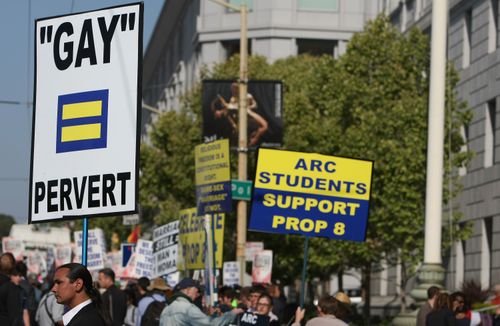
Prop 8 Reax

PROP8JustinSullivan:Getty

My take here. Chris Geidner doesn't approve of the pro-equality protests planned for today:

First, this is not a ruling about whether marriage equality is correct or just. This is a ruling about whether the California Constitution allows a measure like Proposition 8 to be voted into the Constitution by the people. Even if there is some overriding federal claim that marriage equality is guaranteed by the U.S. Constitution, it was not raised by the parties here. Second, we have spent the past decade decrying those who demean the legitimacy of court decisions by attacking them.  It would turn that principled stand on its head to say that this court, which previously held that marriage equality was guaranteed by the California Constitution, is somehow responsible in today’s decision for “denying an entire group of people our civil rights.” Third, and most simply, this is not the righteous anger exhibited this past fall.

Dan Savage:

The anti-gay bigots said before the decision that they wanted Prop 8 upheld and they weren't concerned about the 18K gay couples who wed while same-sex marriage was briefly legal in CA. That exposes their fundamental dishonesty. If they believe, as they claimed during the campaign, that married same-sex couples are a threat to the family, a threat to children, an invitation to hurricanes and earthquakes and wildfires, and that the existence of married gay couples somehow requires homosexuality to be taught in schools, how can they be indifferent to 18K married gay couples rattling around the state? Won't all those bad things still happen?

John Aravosis:

…the ongoing existence of these marriages, with no demonstrable harm being caused by their existence, will call into question, if not outright destroy, the bigots' argument for why the state has an interest in banning gays from getting married.

Ed Morrissey:

The 6-1 split is significant.  The previous ruling declaring gay marriage a right under California’s constitution was very narrow.  Three of the judges who voted for that decision went the other direction today.  They had little choice.  California allows constitutional amendments by referenda, and the backers of Proposition 8 followed the law scrupulously in getting it on the ballot.

Maggie Gallagher:

Even in California there is only one justice willing to strip 7 million voters of their core civil right, expressly guaranteed, to amend their own constitution. I should be grateful, right?

Malkin:

Will the anti-Prop. 8 mob restrain itself? Stay tuned.

John Culhane:

I’m overcome by a profound sense of grief. The courts are supposed to be on the side of justice and protection of the rights of minorities. This time, the California Supreme Court — admittedly with precedential justification — blinked. And I’m reminded again that people get to vote on my rights. I don’t think I’ll ever get used to that, or be able to regard these kinds of setbacks as “second-level disappointments.” Well, back to the political process — like it, or not.

Daphne Eviatar:

[T]he California court ruled today that voters can modify constitutional rights in California, so long as they don’t take them away altogether.

(Photo: Justin Sullivan/Getty.)
Benefits of Marriage Equality

by Richard Florida

Same-sex couples have been getting married for five years now in Massachusetts. Gary Gates of UCLA's Williams Institute has done the number-crunching and identified intriguing economic benefits.

"Data from the American Community Survey suggest that marriage equality has a small but positive impact on the number of individuals in same-sex couples who are attracted to a state. However, marriage equality appears to have a larger impact on the types of individuals in same-sex couples who are attracted to a state. In Massachusetts, marriage equality resulted in an increase of younger, female, and more highly educated and skilled individuals in same-sex couples moving to the state… The evidence that marriage equality may enhance the ability of Massachusetts to attract highly skilled creative class workers among those in same-sex couples offers some support that the policy has the potential to have a long-term positive economic impact."

A Sixth State For Marriage Equality

Readers know I favor strong legal language to ensure that no one's religious freedom can in any way be curtailed by civil equality for gay couples. That's why I think governor Lynch of New Hampshire is right to sign on to marriage equality – as he just did – as long as the following language is attached:

I. Notwithstanding any other provision of law, a religious organization, association, or society, or any individual who is managed, directed, or supervised by or in conjunction with a religious organization, association or society, or any nonprofit institution or organization operated, supervised or controlled by or in conjunction with a religious organization, association or society, shall not be required to provide services, accommodations, advantages, facilities, goods or privileges to an individual if such request for such services, accommodations, advantages, facilities, goods or privileges is related to the solemnization of a marriage, the celebration of a marriage, or the promotion of marriage through religious counseling, programs, courses, retreats, or housing designated for married individuals, and such solemnization, celebration, or promotion of marriage is in violation of their religious beliefs and faith.

Any refusal to provide services, accommodations, advantages, facilities, goods or privileges in accordance with this section shall not create any civil claim or cause of action or result in any state action to penalize or withhold benefits from such religious organization, association or society, or any individual who is managed, directed, or supervised by or in conjunction with a religious organization, association or society, or any nonprofit institution or organization operated, supervised or controlled by or in conjunction with a religious organization, association or society.

II. The marriage laws of this state shall not be construed to affect the ability of a fraternal benefit society to determine the admission of members pursuant to RSA 418:5, and shall not require a fraternal benefit society that has been established and is operating for charitable and educational purposes and which is operated, supervised or controlled by or in connection with a religious organization to provide insurance benefits to any person if to do so would violate the fraternal benefit society's free exercise of religion as guaranteed by the first amendment of the Constitution of the United States and part 1, article 5 of the Constitution of New Hampshire 

III. Nothing in this chapter shall be deemed or construed to limit the protections and exemptions provided to religious organizations under RSA § 354-A:18. 

IV. Repeal. RSA 457-A, relative to civil unions, is repealed effective January 1, 2011, except that no new civil unions shall be established after January 1, 2010.

If Gays Marry, Will African-Americans?

Heather Mac Donald offers an anti-marriage equality argument you don’t see very often; gay marriage might further depress marriage among African Americans. She writes:

It is no secret that resistance to homosexuality is highest among the black population (though probably other ethnic minorities are close contenders). I fear that it will be harder than usual to persuade black men of the obligation to marry the mother of their children if the inevitable media saturation coverage associates marriage with homosexuals. Is the availability of homosexual marriage a valid reason to shun the institution? No, but that doesn’t make the reaction any less likely.

What are the chances that gay marriage would further doom marriage among blacks? I don’t know. Again, if someone can persuade me that the chances are zero, then I would be much more sanguine. But anything more than zero, I am reluctant to risk.

This is a close equivalent to the argument about gays in the military: since some feel they have cooties, it would wreck the whole enterprise. At least Heather concedes the unfairness of it – using bigotry as a reason to perpetuate bigotry – but it does fall into the Byron York trap of treating one minority as somehow not being real or equally valid citizens. And while this might have remained a cruel, unjust but utilitarian model in the past (however trivial homophobia might be as a factor in shoring up African-American marriage), it doesn’t really work in a world where gay couples and their kids are public, unavoidable realities.

Once that happens, the dynamic is a little different. It becomes actively denying basic rights to one group in order to placate the prejudices of another. I can’t see how this could work in an open and free society. It’s so baldly discriminatory and unfair. One of her readers tries a different tack:

Virtually no law that we’ve made in human history can be guaranteed against negative unintended consequences. Ought we make no laws, then? Of course not. We try instead to make laws on the basis of reasonable, considered benefits to the law against reasonable expectations of what we are trading off.

Or perhaps it’s that you have a different framework for considering the role of the government and individuals. You seem to speak of marriage as if it’s a benefit that the government discretionarily hands out to individuals. Therefore, before we extend that benefit to more citizens, namely gay citizens, we ought require a compelling case to be made that such citizens are worthy of the right, including proper consideration of the potential negative consequences a detailed plan — a guarantee in fact — that these consequences can be avoided.

If that’s your default operating framework for government, it seems to me decidedly not conservative. For I believe the conservative position starts from the basis that individuals have a natural right to freedoms in their affairs, and that the essential role of government is to protect these rights, imposing limits upon them only when such rights can be shown to interfere with the rights of others or the collective good.

In the case of marriage, then, I think your assumed default position is exactly counter to a conservative stance. The onus should be those who seek to restrict an individual’s right to marriage to demonstrate why such a right interferes with the liberty or well being of the collective as a case against it. Failing such a compelling argument, the government ought take no position. Here you seem to be arguing for the opposite: an activist role for the government in regulating marriage, with your fundamental point being that we ought subject the freeing of some of the regulation (the prohibition against same sex partners) to higher scrutiny prior to agreeing to it.

Marriage Equality “Compromise”

Dale Carpenter:

Protecting religious liberty as a "compromise" position on SSM is gaining traction. The swing vote in the state senate came from a Democrat who just last week voted against the bill in committee, but switched after more protection for religious liberty was added. The amendment, she said, is “respectful to both sides of the debate and meets our shared goals of equality under the state laws for all of the people of New Hampshire.”

Religious persons already have most these rights – but if reaffirming religious liberty will reassure those opposed to marriage equality, it's hard to see the case against incorporating them into legislation. In fact, I see the Connecticut language as an inherently good thing.

It's critical, it seems to me, that the marriage movement in no way seem hostile to religious freedom and conscience. We support religious liberty just as we support heterosexual marriage. And the fact is: this change unsettles some people. I understand that, and we need to be more cognizant of it, and sensitive to it, instead of engaging, as some sadly have, in ad feminem abuse. (Yes, I'm talking about Miss California, who may not be terribly smart but whose position is not inherently bigoted and whose qualms can be accommodated without obloquy).

Strong religious liberty clauses alongside marriage equality laws make a hell of a lot of sense. Let's embrace them.

A Secular Case Against Marriage Equality?, Ctd.

Derb continues to make his case. His first point:

The comment thread here has me wondering how many conservatives we actually have reading Secular Right.

So, at a blog that tries to dispel the stereotype that all conservatives are religious, Derb sets up same-sex marriage as a litmus test for conservatism. He continues:

Same-sex marriage has never, so far as I know, been proscribed by law anywhere, because it never occurred to lawmakers that it was a thing anyone would want to do!

What about DOMA?

More to the point: homosexuality itself was outlawed through sodomy laws until very recently. Marriage wasn't a possibility in the light of greater bigotries. Derb goes on:

Hospital visiting. Still not getting it. If your hospital’s rules won’t allow gay lovers to visit, agitate to get the rules changed. What does this have to do with gay marriage?

Because the only way to demonstrate with adequate seriousness the relationship between two people of the same gender, especially when confronting prejudice or just plain ignorance from random hospital staffers, is with a marriage license. But Derb's bafflement is genuine. It simply never occurs to many straight people that their own marriages would ever be questioned, or that the massive array of rights that come with it would ever be infringed. And why would it occur to them? It's only when these things are stripped away that you realize how critical they are.

Is That A Sea Change I Hear?

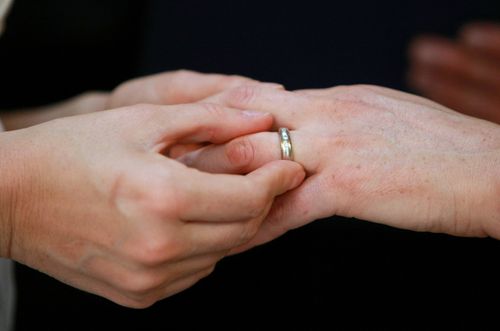
RINGJustinSullivan:Getty

The newest ABC/WaPo poll suggests a serious underlying shift in public opinion on several issues, with stability on some others. On two issues on which the Dish has campaigned for many years – decriminalization of marijuana and legalization of civil marriage for gay couples – some seismic change seems to have occurred. The CBS poll also revealed this. But there is now a tiny national majority in the ABC poll in favor of marriage equality – 49 – 46:

More than half, moreover — 53 percent — say gay marriages held

legally in another state should be recognized as legal in their states.

The surprise is that the shift has occurred across ideological

groups. While conservatives are least apt to favor gay marriage, they've gone from 10 percent support in 2004 to 19 percent in 2006 and 30 percent now — overall a 20-point, threefold increase, alongside a 13-point gain among liberals and 14 points among moderates. (Politically, support for gay marriage has risen sharply among Democrats and independents alike, while far more slightly among Republicans.)

Call me crazy (and they do) but that 30 percent of self-described conservatives now favor marriage equality is a massive achievement in terms of moving public opinion. But these folks are not conservative Republicans – which is why this issue could suddenly become a real problem for the GOP.

They are conservatives who also see themselves as Democrats and Independents:

Fifty-four percent of moderates and 52 percent of independents now favor gay marriage, up from 38 and 44 percent, respectively, in 2006. But the single biggest shift has come among moderate and conservative Democrats: in 2006, just 30 percent in this group said gay marriage should be legal. Today it's 57 percent. One other very pronounced difference is by age: Sixty-six percent of adults under age 30 support gay marriage. That drops to 48 percent of adults age 30 to 64.

Now check out the GOP base:

Seventy-five percent of evangelical white Protestants say gay marriage should be illegal, and 68 percent feel that way strongly. Similarly, 83 percent of conservative Republicans are opposed, 73 percent strongly.

Increasingly, Republican candidates need to take positions in primaries that anathematize them with the next generation. That cannot be good for any political party, and suggests that Rovism has more damage to do to the GOP brand before it is consigned to history.

(Photo: Justin Sullivan/Getty.)