A Secular Case Against Marriage Equality?

John Derbyshire tries to make it. Many of his commenters are fighting back. Here's one:

“But if hospitals have such rules [against same sex partner visitation] — a thing I find hard to believe in this PC-whipped age.” Try again. Gay man forced out of dying partner’s room at Oregon Health and Science University hospital. This is from a week ago. A woman in Florida, carrying documents, was kept out of the room while her partner of 18 years died. While their children stood by, no less. Why do people continually bury their heads in the sands about these things? “Oh, I can’t believe that people are so cruel!” It happens. We know it happens. We have documentation that it does. You know what stops it? The universally-understood bond of marriage.

The other major flaw with your argument is you never explain why extending marriage rights to gay couples will “mess” (with), “redefine” “overturn” or “overhaul” marriage. You simply assume your argument throughout.

When marriage changed from a property arrangement between a father a prospective husband, when women were changed from essentially chattel to equal partners, when marriage was changed from multiple wives to one – all of these did far more to change marriage then changing the gender of the two people involved in today’s civil marriage laws.

Last – “people who want to marry their ponies, their sisters, or their soccer team?” I thought equating homosexuality with bestiality and incest was limited to the religiously motivated. Disgusting. As for polygamy – marriage used to be that way in many cultures. Perhaps you had better ask historians why we changed away from it rather than ask the gays why they should have to preemptively defend against something for which they’re not asking.

Gay Marriage = Religious Freedom

Wilkinson passes this along. It’s a calm debunking of the last somewhat desperate argument by the anti-marriage equality advocates – that civil equality somehow destroys religious freedom. If anything, it seems to me, the public banning of civil marriage for gay couples itself privileges one religious conception of marriage against another. We forget how many people of faith support marriage equality. But we do not want to restrict the freedom of those who seek to champion heterosexual civil marriage; we merely seek an equal place at the table.

And that is surely the core difference between those who favor marriage equality and those who oppose it. We see this as both-and; they see it as either-or. I love and revere heterosexual marriage and want it defended and celebrated alongside my own; they regard my civil marriage as an abomination to be banned and kept inferior to their own. I think that core difference is why we’re winning – because, in the end, Americans like to see freedom expanded, not curtailed, and they are adult enough and secure enough to live with those they disagree with:

Dissent Of The Day

A reader writes:

I'll preface this by saying that on the issue of gay marriage, I completely agree with your position on legalization. That being said, I read your post on the National Review, and it displayed something about your argument that I've never really realized before, something a bit disturbing. What about the people, like me, who don't seek marriage as a path to social acceptance?

I am a heterosexual, not currently in a committed relationship, but always on the lookout for one. But at the same time, for myself personally, I don't believe in marriage. When I tell people this, I often receive the same skeptical looks that I'm guessing you receive when you talk to people about your views on gay marriage, and in many cases, even hostility. The fact that my belief on this matter is partly motivated by my agnosticism doesn't help matters, but my point is: when you talk about "social incentives for stable relationships" and ask questions like, "Do you think that straight men would be more or less socially responsible without the institution of civil marriage?" it sounds like an affront to the way of life I have freely chosen.

I get that gay people should be allowed to marry, and should absolutely be included in society as equals, but you seem to be implying, perhaps unintentionally, that being married, not just having the right to marry, is essential to social equality. I could have misinterpreted you here, but if not, where does this leave me? Am I not being socially responsible because I choose not to marry?

No, I'm not implying such a thing. The data show that marriage is good for people in general – but not all people. It's the right to marry that is essential to civil equality and social responsibility.

Vermont Reax

RINGJustinSullivan:Getty

James Joyner:

Regardless of one’s views on the merits of people of the same sex being allowed to marry, this is how drastic changes in social norms — and this is surely that — are supposed to take place.  Vermont is perhaps the most liberal state in the union and has every right to make this call for itself.  And the fact that this was done through an overwhelming vote of representatives accountable to the people rather than by judicial fiat makes the outcome much easier for opponents to swallow.

John Culhane:

Vermont becomes the first state to grant basic equality to gay and lesbian couples; again, without judicial compulsion of any kind. What might it mean? I’m hesitant to say too much so soon, but let me try this: The Vermont move could well energize other somewhat progressive state legislatures to follow suit: the other New England states (especially New Hampshire and Maine); New Jersey; and New York are the likeliest. Once that happens, I think the push for marriage equality in California becomes even stronger; Prop 8 could be repealed as soon as next year, even if, as expected, the California Supreme Court allows it to stand.

Dale Carpenter:

Getting two-thirds of each house of the state legislature to approve gay marriage is a much more impressive feat, in my view, than getting even a unanimous vote from a state supreme court, as occurred in Iowa just four days ago. Congratulations to the Vermont Freedom to Marry Task Force and everyone in the state who spent the lest nine years organizing, raising money, and lobbying legislators first to defend the state's civil unions and then to push for full marriage.

Rod Dreher:

It is increasingly obvious that the US Supreme Court is going to have to rule on this matter soon. It is an untenable situation for a same-sex couple to be married in Vermont and Massachusetts and Iowa, but not in Texas, Nevada and Montana. I believe SCOTUS will constitutionalize gay marriage, and that being the case, it might be better for my side if it gets done sooner rather than later. If done sooner, there might still be enough backlash left in the American people to get a constitutional amendment passed erecting a high barrier or protection around religious institutions.

Alas, A Blog:

Let the marriage segregationists push their hate. Let them rail against the concept of two loving people committing to one another for life. Let them insist that people who don’t follow the dictates of their chosen faith should be second-class citizens. Let them argue against love.

The fact is, they have already lost.

John Aravosis:

This is huge. On many levels. First, Iowa and Vermont both making marriage legal within days of each other, that creates the sense of a trend. Second, in Vermont, the legislature made marriage legal. Not the courts, the legislature. Why does this matter? Because Republicans have been arguing for years that the problem with gay marriage is that THE COURTS are making these decisions, rather than the people via their elected representatives. Well, today the people made the decision to legalize same-gender marriages through their elected representatives. What will Republicans say now? We've met their test, and passed. Either the GOP simply hates gays, or they need to admit that we won, fair and square, even by the rules they set down.

Sonja Starr:

What lessons will historians draw concerning the ability of courts to promote social change? As readers no doubt remember, Vermont's supreme court issued a landmark decision nearly ten years ago requiring reform of the marriage law, but holding that civil unions were a constitutionally permissible alternative to marriage. The legislature at that time chose civil unions, but over the course of the past decade, apparently, social norms in Vermont have shifted. Can the judicial decision be credited with triggering that shift, by starting a statewide (indeed, nationwide) conversation?

Average Gay Joe:

Expect social conservatives to bemoan this apparent sign of the Apocalypse in 5…4…3…

A Question Of Equality

Dreher pushes this article by law professor Paul Campos, a marriage equality proponent who found the Iowa decision distasteful:

 …the court said it was interpreting the equal-protection clause of the Iowa constitution, which, like the U.S. Constitution, guarantees the state’s citizens that they will be treated equally by the law. Yet, just as in the case of the federal constitution, this phrase is, as a practical matter, meaningless. It’s meaningless because a legal directive telling the government to treat people equally in and of itself decides nothing…

That’s because the concept of equal treatment requires treating things that are sufficiently alike in the same way—but that concept tells you nothing about whether the things you’re analyzing (such as opposite-sex and same-sex marriage) are sufficiently alike.
It should be unnecessary to point out that the question of whether same-sex unions are sufficiently like opposite-sex marriages to merit equal treatment is a political and moral question, which lacks any specifically legal content whatsoever.

But that is why so many of us who support marriage equality have spent years providing reasons for the similarity between the relationships now accorded the status of civil marriage and those that are not. We have discussed the question of procreation, of mutual financial support, of longevity, and the variety of arrangements which now come under the same civil rubric, among a whole variety of topics. These are arguments – and the Iowa court went over them in great detail and with great care. You can try and counter these arguments, but to dismiss them as meaningless is bizarre.

I might also add that it's perfectly clear that Rod has never actually read Virtually Normal, since so many of his objections were dealt with at great length in that book, and he seems oblivious to them. Could he do me a favor and give it a try?

Marriage Passes In Vermont!

BOAJustinSullivan:Getty

The House just over-rode the governor’s veto by 100 – 49. So marriage equality is now the law in another state. This is the first purely legislative decision to enact equal marriage rights in one state and thereby a truly historic day for American liberty. Marc comments here. A reader writes:

It’s snowing right now. There are so many things about this place that never cease to amaze me. Snow in April is one. The decency of so many people is another. My partner and I awakened this morning, resigned to what we felt was inevitable. I was too nervous to check the web for the news.

He called me to let me know: We still live in a magical place.

(Photo: Justin Sullivan/Getty.)

Iowa Reax

ENGAGEDDavidPaulMorris:Getty

Anonymous Liberal:

When you take a step back and look at the basic legal argument behind these cases, the correct answer is remarkably clear. So clear, in fact, that I’m quite certain that future generations of lawyers and law students will look at these cases and wonder why it took so long for the courts to reach such an obvious conclusion, particularly in light of the extensive (and directly analogous) case law dealing with miscegenation laws and segregation. Once you accept the premise that there is nothing wrong with being gay (a premise which, I think, the vast majority of people–especially educated people like judges–accept), it becomes nearly impossible to make a principled legal argument in defense of laws that prohibit gay people from being married. It’s just such an obvious and straightforward violation of equal protection.

Ben Smith:

It’s really a sweeping, total win for the gay-rights side, rejecting any claim that objections to same-sex marriage can be seen as “rational,” rejecting a parallel civil union remedy, and pronouncing same-sex marriages and gay and lesbian couples essentially normal.

Alex Koppelman:

The decision is particularly significant politically because of Iowa’s pivotal place in the presidential nominating process. The issue could play a big role in the state’s Republican caucuses come 2012, especially as it would take until then before a constitutional amendment prohibiting same-sex marriage could go to the voters. It’d be hard to blame former Arkansas Gov. Mike Huckabee, for instance, if he were dancing in the streets today. Someone like Huckabee, who already appeals to the evangelicals that play a key role in the GOP caucuses, could really benefit from this decision.

Ed Whelan writes against marriage:

The lawless judicial attack on traditional marriage and on representative government continues.

Will Duncan of the Marriage Law Foundation (an anti-marriage equality group):

The decision was unanimous that the marriage law is unconstitutional. It distorted the state’s interests in the marriage law and engaged in a little bit of mind-reading to suggest that the real reason a person would be concerned with redefining marriage is religious belief and that, the court thinks, is no real reason at all.

Pam Spaulding:

So much for blaming the coastal liberal radical homosexuals for this one.

(Photo: Paul Morris/Getty.)

Be Not Afraid, Rod

[Re-posted From Friday night.]

ABBEYDavidMcNew:Getty

Damon Linker responds to Dreher's latest. I've found the debate helpful, because Rod is nothing if not honest. His resistance to civil equality for homosexuals is built on two core arguments. The first is the inerrancy of the Bible for most Christians, rendering, say, marriage equality an intolerable fusion of Godliness and evil. The logical problem here is the selectiveness of the use of the Bible. As Damon notes:

Among many other things, Christian scripture and tradition affirm the legitimacy of slavery, claim that the Jews are cursed for killing Jesus, and assert that one must give away all of one's belongings and even learn to hate one's own family before following Christ. These are just a few of the matters on which contemporary Christians, including orthodox Christians like Rod, feel quite comfortable breaking with, or explaining away, scripture and tradition.

And it's a good thing, too, because it shows that they're willing to think for themselves about important moral issues and to use their minds to separate out what is enduringly true in scripture and tradition from the unexamined prejudices that shape and distort everything touched by human hands, very much including received religious norms, practices, and beliefs. The issue, then, is to determine why so many contemporary Christians have decided that the teaching on homosexuality — but not the teachings on slavery, Jews, and the most stringent requirements of becoming a disciple of Christ — deserves to be preserved.

With Catholics, the obvious counterpoint is civil divorce. Catholics do not recognize such divorces within the church nor the second and third marriages that follow them (leaving aside the rank hypocrisy of the annulment scam). But they are prepared to live in a civil society that allows for it as a civil secular matter, just as they live easily with infertile married couples, or post-menopausal couples getting married. Until Rod explains why homosexuals as such represent a unique threat, even while they make up a tiny section of society, his singling out of gays in order to uphold his views of natural law in the civil law will look and smell like animus, not reason.

Rod's second argument is as follows:

If homosexuality is legitimized — as distinct from being tolerated, which I generally support — then it represents the culmination of the sexual revolution, the goal of which was to make individual desire the sole legitimate arbiter in defining sexual truth. It is to lock in, and, on a legal front, to codify, a purely contractual, nihilistic view of human sexuality. I believe this would be a profound distortion of what it means to be fully human. And I fully expect to lose this argument in the main, because even most conservatives today don't fully grasp how the logic of what we've already conceded as a result of being modern leads to this end.

There is a conflation of a lot of things here, but they're fascinating and important and so worth teasing out more fully. Is allowing gay citizens to enter into civil marriages the culmination of the sexual revolution? I would say not. The culmination of the sexual revolution was at 4 am in the Mineshaft in the late 1970s. It is not the civil marriage of two elderly lesbians in a town hall in California in 2008.

I'm offering two extremes here, of course, for the sake of argument. But there is no question that gay life and culture and politics have evolved away from one toward another over the last two or three decades, a shift that Rod does not recognize. It does not mean that one has totally eclipsed the other. Nor does it mean that in a free society, individuals cannot and should not explore sexuality as they see fit. It simply means there has been a deep change in gay life and culture these past few decades and Rod seems utterly out of touch with this critical VN transformation. (He is also unfair in accusing me of operating from within a cocoon on this. I dare say I have debated more religious people on this than almost anyone else, produced an anthology of writing about marriage equality that included many opponents and have made my case in more Catholic and conservative and mainstream venues than I can count. I have also argued from within the natural law tradition for an acceptance of gay love and sexuality, and I certainly do not regard myself as a "nihilist" or "relativist" in this respect.)
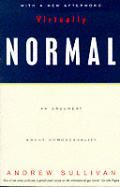
And in many ways, those on the counter-cultural left who always celebrated "queer sexuality" have found the marriage question – and the whole notion of civil integration – very problematic. Foucault would have regarded it as another form of oppression. Read Michael Warner's critique of my own Virtually Normal in The Trouble With Normal for a pretty clear account. Totally unrestricted sex as a form of human being, with anyone anywhere anyhow, might once have been a central goal of the gay rights movement, but the world is a lot more complicated today – and the change was no accident. What the marriage and military movement was about in the 1990s was shifting the focus of the movement from homosexual sex to homosexual life and dignity and responsibility. This didn't mean a denigration of sexual liberation or denying the power and mystery that sex has, or its relationship to human freedom – things that many gay men, to their credit, have long understood. But it did mean a clear shift away from the revolutionary thinking Rod fears so much. For many of us, the catastrophe of AIDS was a palpable, grueling reminder that without social structure, without integration, without responsibility, without the love and engagement and presence of their families, gay men were in grave danger. And so we worked past our grief and walked through the cultural minefield of the religious right and the pomo left to remake a movement. Rod may have forgotten, but I have not, how I and others were targeted as conservatives by the gay community for many years. Well: were we conservatives or radicals? Or were we simply trying to expand the civil space in which human beings can live with freedom and dignity?

Constructing legal and civil relationships within which to express our love and sexuality is not, in my view, "nihilist". Nor is the civil equality of gay people somehow a means "to make individual desire the sole legitimate arbiter in defining sexual truth." It is to take human love, body and soul, to be the central, meaningful human experience – a fundamentally Christian project. And it is to accept, as Christians have in so many other areas, that the modern world needs to be organized along principles that all citizens can accept, which means something more than a recourse to one group's religious texts, or, indeed, the arguments about them within those religious groupings.

Moreover, far from nihilistically renouncing nature, the marriage movement aims at reclaiming the mantle of nature for homosexuals alongside our heterosexual peers and siblings and parents. We know now that same-gender attraction, bonding and sex is ubiquitous in nature, and almost certainly has some evolutionary explanation. We know too, experientially, that the love cherished by many gay couples is real and beautiful and deeply human. It is not merely "contractual" or "nihilist". It is organic, natural and completing. It is humanizing and it is civilizing. History is full of such relationships, and they stand proudly alongside their heterosexual peers. The reduction of these shared lives and loves to abstract sexual acts is itself a form of bigotry. It is an attempt to reduce the full and complex human being to one aspect of his or her humanness. It is, in my view, anti-Christian to speak of gays the way this Pope does. The Christian calling is not to guard ferociously the ramparts of the 1950s out of fear but to listen to the experiences of gay people – what the Second Vatican Council calls the sensus fidelium – and try to integrate their humanity into the structures from which they have been so cruelly excluded, with such horrible human consequences, for so long.

It is Rod's self-evident panic at the thought of such an integration that has made some of us sit up and take note. There is some lurking fear that if this form of being human is recognized as equal in the civil sphere, let alone the sacred one, then the entire edifice of heterosexuality and marriage and family will somehow be destroyed or undermined. I do not believe that in any way. And I don't think it's possible to believe that without, at some level, engaging in homophobia – literally an irrational and exaggerated fear that the gay somehow always obliterates the straight, or that 2 percent somehow always controls the fate of 98 percent. This is where paranoia and panic take over. It is where homophobia most feels like anti-Semitism.

Be not afraid, as Pope John Paul II kept telling us. Of what should we not be afraid? We should not be afraid of the truth about ourselves.

(Photo: a gay couple by David McNew/Getty.)

Good News From California

Engageddavidpaulmorrisgetty

Reading all the accounts of the oral arguments on Prop 8 yesterday (for a diverse round-up, see here), I have to say there’s a chance of what, to my mind, is the optimal decision. The Justices seemed highly skeptical – and rightly so – that a voters’ initiative could not change the results of a controversial court decision. Since the No On 8 forces campaigned last year under the same assumption, it’s a little rich to see them now protest that the vote was not a real one anyway and they engaged in it only on the assurance that they would win. Moreover, if the court upholds Prop 8, we avoid giving the Hewitts and Romneys and Santora their "black robes" moment, an endless harangue about evil judges despotically dictating to God-fearing Americans. I’ve been in enough of those arguments to want to avoid them in future. They deflect debate from the real issue: that gay marriage is good for gays, straights and society as a whole. They give bigots a legitimate reason to oppose our equality, while allowing them to avoid the real arguments for it.

At the same time, I devoutly hope that the 18,000 existing civil marriages are not retroactively nullified.

Removing good faith, already-issued marriage licenses from couples who had every reason to believe they were valid when they got married seems repellent to me. It is cruel to allow a person’s marriage to be retroactively invalidated by a vote. Divorce is always wrenching. But having people who believe you are evil and immoral force you into a divorce is horrifying. It may give Rush Limbaugh a thrill to see gay couples torn apart under law, and their children suddenly deemed illegitimate, but most decent people would disagree.

More to the point: the biggest argument we have for marriage equality is the existence and life of so many married couples. Just like the battle to end the anti-miscegenation laws, the fight for gay equality will be immeasurably aided by the facts on the ground of the actual marriages so many find repugnant. Those marriages will help dispel fear and paranoia, will reveal the banal and admirable truth of many gay couples’ love and commitment, and expose the bigotry of those who refuse to accord them respect and dignity. Alongside these role models, emboldened and smartened up by previous battles, let’s take this to the people again. And win.

(Photo: Drew Cloud and Jacob Whipple, who are engaged to each other, watch a live broadcast as the California Supreme Court hears arguments for and against Proposition 8 on March 5, 2009 in San Francisco, California. The controversial proposition that prohibits gays and lesbians the right to marry is being challenged by the gay community. By David Paul Morris/Getty.)

Marriage, Religion And Family

Camarriage1justinsullivangetty

Candace Chellew-Hodge reacts to a new marriage equality poll:

While only 29 percent of those polled said they would support same-sex marriage, those numbers shot up 14 percent if assurances were made that by law “no church or congregation would be required to perform marriages for gay couples.” Never mind that no church at this very moment is required to marry anyone, gay or straight; that simple assurance means that 43 percent of all adults and 60 percent of younger adults would suddenly support same-sex marriage.

What level of paranoia and ignorance would lead people to believe that the government could force churches to perform marriages they disapprove of? I guess the kind of paranoia and ignorance advanced by the GOP base. But check out this fascinating story about China and marriage equality. The idea has swiftly taken hold in the country’s still vulnerable gay rights movement:

Li’s research in cities suggests about 91% of people are happy to work with gay colleagues – a higher rate than in US surveys – and that 30% back gay marriage.

She argues that Chinese culture has historically been more tolerant than others: "We don’t have religions which are absolutely against homosexuality, for example. But the pressure to marry is huge – far greater than in the west." Han, 27, thinks her parents know she is a lesbian. "But my mum told me I must have experience of marriage, no matter how long it lasts. I don’t think she hopes to change my sexuality, she just thinks my life will be more stable," said the media professional.

If you decouple the notion of "family" from fundamentalist religion, same-sex marriage is revealed as the socially conservative reform it actually is. Wouldn’t it be amazing if China got there first?