A Rudyite Responds To Romney

"To be blunt, Romney is saying:

It is legitimate to ask a candidate, "Is Jesus the son of God?"

But it is illegitimate to ask a candidate, "Is Jesus the brother of Lucifer?"

It is hard for me to see a principled difference between these two questions, and I think on reflection that the audiences to whom Romney is trying to appeal will also fail to see such a difference. Once Romney answered any question about the content of his religious faith, he opened the door to every question about the content of his religious faith. This speech for all its eloquence will not stanch the flow of such questions," – David Frum, NRO.

Huckabee Exposed

All the attention is understandably focused on Romney’s speech right now, but this Huckabee answer to a student question at Falwell’s Liberty University seems to me to be just as big a deal. He said that his rise in the polls is a function of people’s prayer and divine intervention, and compared his recent success with the miracle of the loaves and fishes. Check it out.

Romney Round-Up

Steven Taylor thinks he hurt himself:

Romney actually reinforced some of the prevalent criticisms of Mormonism, notably that it is ultimately too secretive (or, at least, very evasive) about its core doctrines when he suggests in the quote above that he basically doesn’t have to go into a detailed explanation of his church’s distinctive doctrines.

Larison quibbles with the "religious test" reference:

The religious tests to which the Constitution refers were tests imposed through law to screen for dissenters from a formally established, official doctrine.  You cannot have a religious test without a legally established church or religion to serve as the standard for that test.

Matt questions Romney’s crude notion that all faiths agree on the basics:

Most major religions do espouse a mostly-admirable moral creed. But old-style Mormon teaching on "the evil children of Laman and Lemuel" isn’t admirable. Arresting people for naming a teddy bear "Mohammed" isn’t admirable. Settlers who believe the entire West Bank is God’s gift to the Jewish people aren’t admirable.

Hayes believes the emotional timbre of Romney’s performance will help him get past the plastic problem.

The Romney Speech

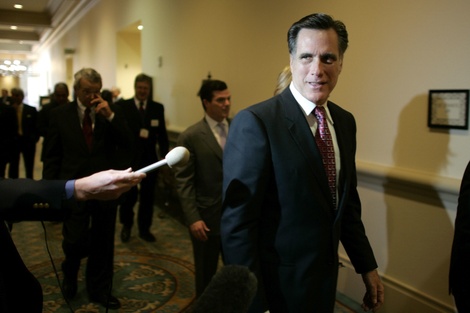
Romneyjoeraedlegetty

It is eloquent in many parts, stirring in its defense of religious liberty, with only a couple of notes off-key:

Americans tire of those who would jettison their beliefs, even to gain the world.

Ahem. But it has two deep flaws. The first is the absence of any notion that religious freedom includes the freedom to have no religion whatever. A president of the United States does not just represent people of all faiths, he also represents those who have none. There is a lacuna in Romney’s vision of religious tolerance, and it is a deliberate lacuna. In order to appeal to evangelicals, he places himself on their side against the other: the secularists. But that is simply another form of the religious test. By insisting on faith – any faith – as the proper criterion for public office, Romney draws the line, oh-so-conveniently, so as to include Mormonism but exclude atheism and agnosticism. And so he side-steps the critical issue in the debates over religion in public life: what if there is no unifying faith for a nation? What if faith itself cannot unify a nation – and, in fact, can divide it more deeply than any other subject? That is our reality. An intelligent and wise conservative would try to find a path to a common discourse that does not rest on religious foundations.

The second flaw is that he simply cannot elide the profound theological differences between the LDS church and mainstream Christianity. Since I’m a secularist – a Christian secularist – this doesn’t make a difference to me. But if you are appealing to religious people, especially fundamentalists, on the basis of faith, you cannot logically then ask them to ignore the content of the faith. The religious right have tried to do this with the absurd neologism, the "Judeo-Christian tradition," as if the truth-claims of Christianity and Judaism are not, at bottom, contradictory. But the "Mormon-Judeo-Christian tradition" is a step too far even for those who have almost no principles in using religion for political purposes.

I think it’s a tragedy that a man of Romney’s obvious gifts should be reduced to this. But he asked for it; and the petard he has been hoist on is his own. If you want a religious politics,  you’ll end up with one. That’s why Huckabee is the natural heir to the Rove project. And why Romney is falling behind.

(Photo: Joe Raedle/Getty.)

Yglesias Award Nominee

"Mona Charen calls it the "best political speech of the year," citing particularly the part about empty cathedrals in Europe. I liked it, but wondered that there was no mention whatsoever of those with no faith at all. They’re not a huge voting block, but many of them are patriotic Americans who respect their religious neighbors (not you, Michael Newdow). It would have been nice to hear that they make up part of the symphony as well," – Mary Katherine Ham, Townhall.com.

Romney, Flip-Flopping On Faith?

"I do not define my candidacy by my religion. A person should not be elected because of his faith, nor should he be rejected because of his faith," – Mitt Romney, at the George Bush Presidential Library and Museum today.

"We need to have a person of faith lead the country," – Mitt Romney, February 17, 2007. Video here. A Mormon complaint about Romney’s alliance with the Christianist right here.

Romney’s Problem Today

Larison is sharp as ever:

If he stresses what he has in common with Christian voters, he will be criticised for not being forthright and honest enough about his own religion, and if he acknowledges difference he is probably dooming himself to electoral oblivion by alienating Christian voters.  Yet recent polling shows that he is damaged even more by his evasiveness and reluctance to speak on the matter, which fits into the narrative that he is inauthentic (some might even say fraudulent).  Perhaps if Romney himself were not such an obviously protean, shape-shifting sort of candidate on his policy views, his unwillingness to speak about his religion would have appeared as wisdom and discretion, instead of coming across as yet another example of his inability to give a straight answer to a question.

At some point, a reputation for total cynicism backfires.

Ron Paul on Mitt Romney

Classy as usual:

"We live in times of great uncertainty when men of faith must stand up for American values and traditions before they are washed away in a sea of fear and relativism. I have never been one who is particularly comfortable talking about my faith in the political arena, and I find the pandering that typically occurs in the election season to be distasteful.

Our nation was founded to be a place where religion is freely practiced and differences are tolerated and respected. I come to my faith through Jesus Christ and have accepted him as my personal savior. At the same time, I have worked tirelessly to defend and restore individual rights and religious freedom for all Americans.

The recent attacks and insinuations, both direct and subtle, that Gov. Romney may be less fit to serve as president of our United States because of his faith fly in the face of everything America stands for. Gov. Romney should be judged fairly, on his record and his character, not on the church he attends."