Bishop Romney

A Mormon reader writes:

Mormonism’s soul is indeed divided – and the good thing about Romney’s run is that the leadership and the rank and file membership of Mormonism’s largest denomination (the LDS Church) are realizing that they have painted themselves into a corner.

By linking in the mid-70’s with the emerging Religious Right (to fight the ERA and the gay rights movement), the Mormons (who were until recent times gladly REJECTED the label of Romneymandelnganafpgetty "Christian" in favor of the more Biblical label of "Saint’) took this political alliance as a sign of their finally being accepted by mainstream Christians as fellow Christians.

Of course the Religious Right (the New Calvinists or New Puritans – as I call them) are not "mainstream" at all, but religious radicals who are working to establish a sort of Theo-democracy. As such they belong to the very sector of religious Americans who brutally persecuted Mormons in 1830’s Missouri, and then led the successful campaign to completely disenfranchise Utah Mormons between the 1886 and the 1890’s. Romney knows that he can’t come public with Mormon theology without completely losing the support of the New Calvinists but also many average Americans who, unfortunately, look to the New Calvinists for sound-bites on Christian belief and practice. Unlike orthodox Christianity, Mormon thelogy is polytheistic, teaching that the Gods organized the universe from pre-existing, eternal, uncreated chaotic elements. It rejects Original Sin. It rejects Salvation by Grace, teaching that individuals must "work out their own salvation" and "learn to become Gods [themselves] the same as all Gods before have done." At its inception, with the publication of "The Book of Mormon" in 1830, Mormonism rejected the doctrines of Biblical infallibility and Biblical literalism. As a Mormon, I was put-off by Romney’s disingenuousness when he was asked on a TV interview to explain how Mormonism differs from other Christian denominations. Romney tried to give the impression that he was unqualified to speak for the LDS Church, referring poeple to the Church’s website. When confronted with the fact that he has been an LDS Bishop, he tried to give the impression that, in a "lay church," the calling of a Bishop isn’t important.

This is untrue.
Bishops interview, and must approve every person in their Ward boundaries (aka Parish) who wishes to convert to Mormonism and be baptized. The process by which they do this (the Bishop’s Interview) is the means by which the Bishop finds out if the would-be-convert understands the LDS Church’s theology. If the would-be-convert is ignorant of certain doctrines, it is the Bishop’s job to instruct them in the theology before approving that person’s baptism. The Bishop also interviews every single member of his congregation yearly, to pastor them through any spirital crisis or tragedy, and to determine if each person is "keeping the commandments" (i.e., following Church dictates on lifestyle choices), is "active" (attending Church meetings regularly), and "has a testimony" (understands and accepts the Church’s theology.) A Bishop is aked almost daily by some individual or some organization with the LDS Church to explain some aspect of Mormon theology. Whenever a Mormon has a question or concern about any aspect of Mormon theology, they are instructed to ask their Bishop about it.

In short, one can not be a Bishop without understanding Mormon theology and how it differs from that of traditonal Christianity. In any given community, Bishop would be one of only a handful of LDS Church officers whose calling it is to speak the local press, local civic groups, etc. about Mormon theology and practice. No one else in the Church’s lay clergy CAN officially speak for the LDS Church other than an area’s Bishop and Stake President.

Romney is intentionally misleading the press by making it seem as if he is unqualified to discuss Mormon theology. Remember, besides being a Bishop, he served as a full-time Mormon missionary for two years. For two years, his full-time calling was specifically to teach Mormon theology to potential converts–not only explaining Mormon doctrine, but explaining how it differs from orthodox Christian doctrine. The LDS Church brags that young men come back from two year missions who a deeper understanding of their religion than that enjoyed by believers of other faiths. Is Romney the lone exception to this?

The fact is, Mitt Romney is probably one of the LDS Church’s MOST qualified speakers on the subject.

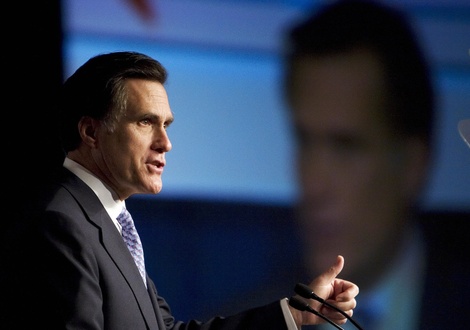
(Photo: Mandel Ngan/AFP/Getty.)

Mormonism’s “Divided Soul”

Ross argues:

As an outside observer, it seems to me that Mormonism has a divided soul – there’s a yearning for acceptance within the firmament of Christianity (and a hint of self-pity concerning other Christians’ unwillingness to welcome them with open arms), combined with a pride in everything that makes the Latter-Day Saints unique. I’m inclined to think the latter is the healthier sentiment for members of a young and rising faith. Attention, and the hostility that comes with it, is the price of being a successful religion, as the larger history of Christianity’s rise attests: You don’t see Christopher Hitchens writing polemics against the Mithraists or the cult of Isis, after all.

Here’s the rub for Romney in the newest Pew poll:

The group of Americans most likely to say they value religiosity in a president – white evangelical Protestants – is also the group most apt to be bothered by his religion.

More than one-in-three evangelical Republicans (36%) expressed reservations about voting for a Mormon, a level of opposition much higher than that seen among the electorate overall.

Bummer for Hewitt. David Kuo laments:

We are spending way too much time talking about theological nuances when we should be talking about legal and political and financial nuances. We are a country in a little bit of a stink right now and what we need are effective and impressive (but mostly effective) administrators in elective office. We don’t need to know much about their thoughts on this or that theological issue.

Romney’s Illegal Help

Uh-oh. The Globe piece is brutal:

Standing on stage at a Republican debate on the Gulf Coast of Florida last week, Mitt Romney repeatedly lashed out at rival Rudy Giuliani for providing sanctuary to illegal immigrants in New York City.

Yet, the very next morning, on Thursday, at least two illegal immigrants stepped out of a hulking maroon pickup truck in the driveway of Romney’s Belmont house, then proceeded to spend several hours raking leaves, clearing debris from Romney’s tennis court, and loading the refuse back on to the truck.

Here’s Hewitt’s spin:

Romney has done the right thing, and it will not impact his campaign at all…

But I should point out again, as I did when the first story broke, that the Boston Globe hates Romney and has gone to extraordinary lengths to hurt him, including staking out his house for the past three months to get this story. The Globe didn’t stake out even one of Kerry’s homes. The paper didn’t even press him to release his military records.

If that sounds a little rattled, can you blame him?

Romney Talks Mormonism

My bet is that his speech will be a Neuhaus-ghost-written defense of religion’s centrality to politics. I doubt a great deal that he will address all the conventional LDS-specific issues many evangelicals have. Romney clearly doesn’t want to talk about that at all, and I don’t blame him. But once you make your appeal on the grounds of faith to a religiously-based party, it’s tough to keep to secular reticence and privacy on the subject. Check out this clip: he looks extremely defensive and awkward. If this is how he comes across Thursday he’ll lose Mormon votes as well as evangelical ones.

Romney’s Big Mistake?

Ross writes:

Instead of making the conversation about issues where Huckabee is vulnerable and Romney isn’t, the Romney campaign has guaranteed that for the next two weeks at least and probably beyond, the media conversation will be about, well, Mormonism. If there were more time before the actual voting begins, that might not be the worst thing in the world; they could get the wave of coverage out of the way, inoculate themselves to some extent, and then shift gears and start hammering Huckabee on taxes and immigration and so forth. But there isn’t time: Christmas is coming, there’s a very narrow window in which to define Mike Huckabee as a Mexican-loving crypto-liberal, and the Romney campaign has just ensured that everyone will be talking about the Urim and the Thummim instead of the Arkansas gas tax. Unless Romney gives the best speech in the history of speeches, I just don’t see how that helps him win – in Iowa, New Hampshire, or anywhere.

I think it all depends on the speech itself. Romney will be given a national platform. How he handles it will be telling.

Romney’s Muslim-Free Cabinet

Reading both Mansoor Ijaz’s account of the exchange and Romney’s version, I’d say I believe Ijaz – because Ijaz has a detail that Romney misses. That detail is that Ijaz interrupted and clarified his question. My guess is that Romney was – surprise! – trying to calculate what his audience wanted to hear. Now we have evidence that he has given a similar answer before. Soren notes:

A combination of hypocrisy and implausible repeated non-denials is good material for a feeding frenzy.

You think?

A Mormon Question Romney Should Answer

I’m with Hitch on this one:

Until 1978, the so-called Church of Jesus Christ of Latter-day Saints was an officially racist organization. Mitt Romney was an adult in 1978. We need to know how he justified this to himself, and we need to hear his self-criticism, if he should chance to have one.

The awful history of the LDS church’s treatment of African-Americans requires an accounting by any leading Mormon, as Romney is, who didn’t protest at the time. I blogged a while back about Darron Smith, a black Mormon fired by Brigham Young University for compiling an anthology on the Mormon church’s historic demonization of African-Americans. It was an eye-opening read.