A Poem For Monday

dickinson3

A third selection from Emily Dickinson’s newly published “scraps”:

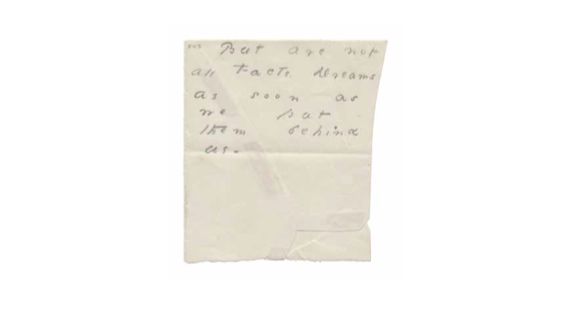
But are not

all   Facts   Dreams

as    soon    as

we      put

them     behind

us—

More in this series here and here.

(From The Gorgeous Nothings by Emily Dickinson © 2013 by Christine Burgin and New Directions. Transcription images copyright © 2013 by Jen Bervin and Marta Werner. Reprinted by permission of New Directions Publishing Corp.)

A Poem For Sunday

dickinson2

A second selection from Emily Dickinson’s newly published “scraps” and fragments:

Oh sumptuous

moment

slower   go

that I

till

may gloat    on

thee—

‘Twill    never

be   the   same

that

Now           I abundance

since

see—

Which    was   to

famish     then or

now—

the    difference

of Day

to

Ask      him

Unto   the Gallows

led–      called

With    morning

By

in    the sky

(From The Gorgeous Nothings by Emily Dickinson © 2013 by Christine Burgin and New Directions. Transcription images copyright © 2013 by Jen Bervin and Marta Werner. Reprinted by permission of New Directions Publishing Corp.)

A Poem For Saturday

Dish poetry editor Alice Quinn writes:

This week we’re featuring fragments or drafts of poems by Emily Dickinson, composed on envelopes or postal wrappers from the years 1864-1886. According to Jen Bervin and Marta Werner, the editors of the astonishingly dickinsononebeautiful book which gathers them together, The Gorgeous Nothings, they are culled  “from 1,414 contemporaneous drafts and 887 letter drafts.” Bervin writes, “Sometimes Dickinson’s writing fills the space of the envelope like water in a vessel or funnels into the triangular shape of the flap,” as is the case with the example we’re featuring today.

For those who live in or near New York City, there is a riveting exhibit at The Drawing Center of similar material, “sometimes referred to as ‘scraps’ within Dickinson scholarship,” as Bervin notes. Gazing at Dickinson’s  handwriting on the back of a Western Union telegram or a household memo or recipe is an experience not to be missed – truly breathtaking. The exhibit is up until January 10 at 35 Wooster Street.

The first selection:

In    this    short    life

that   only    lasts   an   hour

merely

How much-   how

little—is

within our

power

(From The Gorgeous Nothings by Emily Dickinson © 2013 by Christine Burgin and New Directions. Transcription images copyright © 2013 by Jen Bervin and Marta Werner. Reprinted by permission of New Directions Publishing Corp.)

A Poem For Sunday

wandasunpoem

“Two Times Baby” by Wanda Coleman:

he’s two nights gone for the second
time. two weeks before that he left
the rehab house and they wouldn’t take
him back. that was two years after he
left the penitentiary and broke two
hearts when he was paroled to my custody
on the condition of marriage. but it
would only take a couple of months before
he started backsliding, picking up the
old habits, old homies, old tracks.
it got to be too much for me and i was
two jumps from killing him when
he split. last time we made love was to
that Doors song of like refrain. now
that he’s gone all I seem to do is
remember how good the two of us got
when we put one-and-one together

(From Bath Water Wine © 1998 by Wanda Coleman. Reprinted by kind permission of Black Sparrow Books and David R. Godine, Inc. Photo by Steve Snodgrass)

A Poem For Saturday

poetrysocietyawards_9073

Last Friday, the poet Wanda Coleman died at Cedars-Sinai Medical Center in Los Angeles at the age of 67. David L. Ulin remembered her with these words:

Coleman was the conscience of the L.A. literary scene—a poet, essayist and fiction writer who helped transform the city’s literature when she emerged in the early 1970s….When she began to write, as a member of the Watts Writers Workshop that sprang up after the 1965 riots, L.A. literature was largely a literature of exile, produced primarily by those from elsewhere, who lingered briefly along the city’s glittering surfaces and did not invest the place with any depth. Working in the tradition of John Fante, Chester Himes and Charles Bukowski, Coleman invented a new way of thinking about the city: street-level, gritty, engaged with it not as a mythic landscape, but in the most fundamental sense as home.

On Thanksgiving Day, we posted a poem of Coleman’s, “Pigging Out,” dedicated to her husband. Today we’re featuring a poem about her daily life as an artist, and tomorrow we’ll run a self-portrait of this remarkable woman and poet, who received the Shelley Memorial Award from the Poetry Society of America in 2012, joining e.e.cummings (1945), Elizabeth Bishop (1953), Theodore Roethke (1962), and May Swenson (1968), among others. Here’s Coleman’s “Slave Driven”:

i barely niggle a living squirreling around
the home office. I work for myself as my own secretary.
it’s a shitty job, paperwork ceiling to floor. the
technology changes every few months. i’m on call
weekends and holidays. no benefits or perks.
there’s no vacation or overtime. the pay is less
than minimum wage.
it’s like every job I’ve ever had except I don’t drive
rush-hour traffic and can wear nightclothes if I want.
there are no racist vibes, no gender or sex preference
or intergenerational discrimination, quitting time
is determined by level of exhaustion.
i get no breaks. i sit all day.
i grab a bite while on duty
the boss never has anything
good to say

(From Ostinato Vamps © 2003 by Wanda Coleman. Reprinted by kind permission of the University of Pittsburgh Press. Photo of Coleman courtesy of the Poetry Society of America)

A Poem For Thanksgiving

“Pigging Out” by Wanda Coleman:

–for Austin

at the restaurant we sit down to wine
we are so hungry
the crisp appetizers/early loves
and lightly seasoned salad
we’ve developed appetites for the garlic & onion of life
gorging on a main course of dissatisfaction
over frustrated creativity in
economic plight
he chews over his brooklyn childhood
i pick at the tedium of youthful watts summers

we eat away the lousy jobs stunting our talent
we eat away the hot smog-filled day
we eat away the war in the headlines
we eat away the threat of nuclear holocaust
we eat away love-threatening pressures
we eat away the human pain we see/feel/
are stymied by

[pride is such thin dessert]

we eat until our smiles return
until fat and happy

(From Imagoes © 1983 by Wanda Coleman. Reprinted by kind permission of Black Sparrow Books and David R. Godine, Publisher.)

A Poem For Sunday

backstage

“Heroine” by Mary Szybist:

Just before the curtain closes, she turns
toward me, loosening
her gauzy veil & bright hair—

This, she seems to say, this
to create scene, the pure sweep of it,
this to give in, feel the lushness,
this & just a little theatrical lighting
& you, too, can be happy,
she’s sure of it—

It’s as if I cut her heart-whole from the sky,
rag & twist & tongue & the now terrible speed
of her turning

toward me like the spirit
I meant to portray, indefatigable—

see how bravely she turns, how exactly true to the turning,
& in the turning
most herself,
as she arranges herself for the exit

withholding nothing, unraveling
the light in her hair as her face

her bright, unapproachable face
says only that
whatever the next scene is,
she will fill it.

(From Incarnadine © 2013 by Mary Szybist. Reprinted by kind permission of Graywolf Press. Photo by Julija Rauluševičiūtė)

A Poem For Saturday

sink

In recent weeks, we’ve posted poems by all the nominees for this year’s National Book Award in Poetry. This past Wednesday, Mary Szybist was announced the winner for her book, Incarnadine.  The judges’ citation read, in part:

In her gorgeous second collection Mary Szybist blends traditional and experimental aesthetics to recast the myth of the Biblical Mary for this era…. Szybist probes the nuances of love, loss, and the struggle for religious faith in a world that seems to argue against it. This is a religious book for nonbelievers, or a book of necessary doubts for the faithful.

This weekend, we’ll post two poems from the book. In an interview on the National Book Foundation, Szybist said that the scene to which Incarnadine continually returns “portrays a human encountering something not human; it suggests that it is possible for us to perceive and communicate with something or someone not like us. That is part of what I find most moving about the scene: how it plays out the faith, the belief that that can happen—and can change us.”

We open with one of her most compelling poems evoking this encounter in a contemporary setting, “Annunciation Overheard from the Kitchen”:

I could hear them from the kitchen, speaking as if
something important had happened.

I was washing the pears in cool water, cutting
the bruises from them.
From my place at the sink, I could hear

a jet buzz hazily overhead, a vacuum
start up next door, the click,
click between shots.

“Mary, step back from the camera.”

There was a softness to his voice
but no fondness, no hurry in it.

There were faint sounds
like walnuts being dropped by crows onto the street,
almost a brush
of windchime from the porch—

Windows around me everywhere half-open—

My skin alive with the pitch.

(From Incarnadine © 2013 by Mary Szybist. Reprinted by kind permission of Graywolf Press. Photo by Rachel Zack)
A Poem For Friday

roadside

“Roadside Grave: Winter, Mass” by Franz Wright:

In the white is a name.
In the three worlds
it stands.  Wind
sounds, a world of one
color.
Name spoken,
once,
across a darkening field;
name being stitched,
very small, in white thread
in white cloth.

(From F/poems © 2013 by Franz Wright. Reprinted by kind permission of Alfred A. Knopf. Photo by Flickr user halfrain)