A Poem For Sunday

William_S_Burroughs

“I Dreamed I Met William Burroughs” by Franz Wright:

I met William Burroughs in a dream.
It was some sort of bohemian farmhouse,
and he was enthroned, small and skeletal,
in a truly gigantic red armchair.

When I asked him how he was, he replied,
Well, you know what they say—for best results
always mock and frighten lobster before boiling.
Franz—I like that name, Franz.  Childe Franz

to the dark tower something or other . . . Hey,
got a smoke? And quit worrying so much:
they can’t help themselves, they’re like abused dogs
and they’re going to react to affection and kindness

with uncontrollable savagery. Just tell them,
You’re out of my mind, pal. You’re out
of my mind.  Either that or, I’m out of yours.
That’ll keep them brain-chained to their trees.

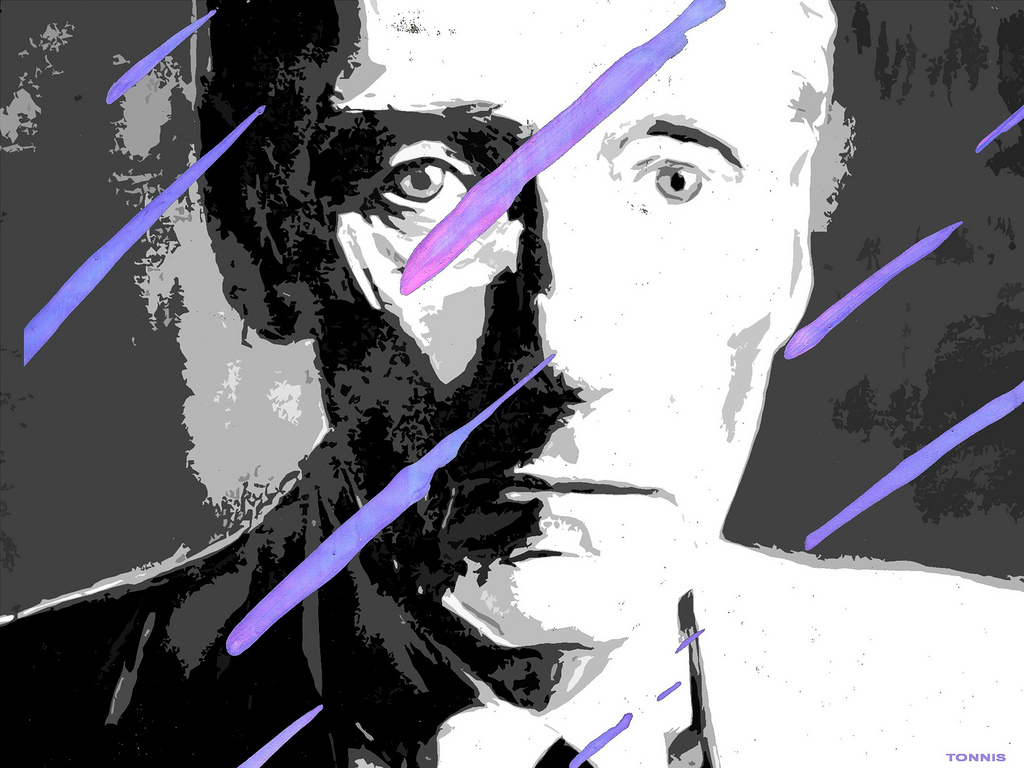
(From F/poems © 2013 by Franz Wright. Reprinted by kind permission of Alfred A. Knopf. Image of Burroughs by Christiaan Tonnis, via Wikimedia Commons)


A Poem For Saturday

stars

Franz Wright is a Pulitzer Prize-winning poet whose father, James Wright, also won that prize 32 years earlier. Franz is the author of 13 volumes of poems, the most recent entitled F/poems. He is also an accomplished translator of Rilke, Rene Char, and others, including (with his wife Elizabeth Oehlkers Wright) the Belarusian poet Valzhyna Mort in a volume entitled Factory of Tears. We’ll be featuring his poems this weekend, beginning with “Four in the Morning”:

Wind from the stars.
The world is uneasily happy—
everything will be forgotten.

The bird I’ve never seen
sang its brainless head off;
same voice, same hour, until

I woke and closed my eyes.
There it stood again:
wood’s edge, and depression’s

deepening
shade inviting me in
saying

No one is here.

No one was there

to be ashamed of me.

(From F/poems © 2013 by Franz Wright. Reprinted by kind permission of Alfred A. Knopf. Photo by Abri le Roux)

A Poem For Sunday

nycstreet

“Thought Problem” by Vijay Seshadri:

How strange would it be if you met yourself on the street?
How strange if you liked yourself,
took yourself in your arms, married your own self,
propagated by techniques known only to you,
and then populated the world? Replicas of you are everywhere.
Some are Arabs. Some are Jews. Some live in yurts. It is
an abomination, but better that your
sweet and scrupulously neat self
emerges at many points on the earth to watch the horned moon rise
than all those dolts out there,
turning into pillars of salt wherever we look.
If we have to have people, let them be you,
spritzing your geraniums, driving yourself to the haberdashery,
killing your supper with a blowgun.
Yes, only in the forest do you feel at peace,
up in the branches and down in the terrific gorges,
but you’ve seen through everything else.
You’ve fled in terror across the frozen lake,
you’ve found yourself in the sand, the palace,
the prison, the dockside stews;
and, long ago, on this same planet, you came home
to an empty house, poured a Scotch-and-soda,
and sat in a recliner in the unlit rumpus room,
puzzled at what became of you.

(From 3 Sections © by Vijay Seshadri, reprinted by kind permission of Graywolf Press. Photo by Jim Pennucci)

A Poem For Saturday

paris

This weekend we are featuring the work of poet and critic Vijay Seshadri, who was born in India and came to the US when he was five years old. A former member of The New Yorker‘s editorial staff, he now teaches writing at Sarah Lawrence College. Richard Wilbur has praised Seshadri’s poems as “wittily alive to everything, continually quick and surprising, expertly turned.” He’s published three collections, and the latest, 3 Sections, elicited these words of praise from the novelist Jonathan Franzen: “An extraordinarily naked modern consciousness, an intensely experienced dislocation, a beautiful intelligence: Seshadri’s poetry is exhilarating.”

Our first poem from Seshadri is “Visiting Paris”:

They were in the scullery talking.
The meadow had to be sold to pay their riotous expenses;
then the woods by the river,
with its tangled banks and snags elbowing out of the water,
had to go; and then the summer house where they talked—
all that was left of an estate once so big
a man riding fast on a fast horse
couldn’t cross it in a day. Genevieve. Hortense. Mémé.
The family’s last born, whose pale name is inscribed on the rolls
of the Field of the Cloth of Gold. As in the fresco of the Virgin,
where the copper in the pigment oxidizes to trace a thin green cicatrix
along a seam of Her red tunic,
a suspicion of one another furrowed their
consanguine, averted faces.
Why go anywhere at all when it rains like this,
when the trees are sloppy and hooded
and the foot sinks to the ankle in the muddy lane?
I didn’t stay for the end of the conversation.
I was wanted in Paris. Paris, astounded by my splendor
and charmed by my excitable manner,
waited to open its arms to me.

(From 3 Sections © by Vijay Seshadri, reprinted by kind permission of Graywolf Press. Photo by Thomas Claveirole)

A Poem For Friday

pinball

“Hubert’s Museum & Flea Circus (1937)” by Adrian Matejka:

Below constellations of pool balls scattering geometry’s
grace. Below pinball machines ringing like telephones
full of congratulations & the streetcar stutter of a movie
viewer: Jack Dempsey clubbing Luis Firpo or being
clubbed by Gene Tunney, depending on the reel & the day.
Below the heavy bag that, with each amateur punch, pulls
down the ceiling like confetti at the end of a parade.
Behind the man with the sagging eye who makes change
for the 25¢ admission by touch, & past the turnstile
that sticks sometimes, so he pushes himself up, dusts
sunflower shells from blue trousers, & exits his smudged
booth to make it work. After Congo the Wild Man’s
caterwaul & Sealo the Seal-Finned Boy’s handclaps,
as slick as fresh meat on the butcher’s table, Jack Johnson
comes out. Dog-eared blue suit & blue beret. Red wine
sipped through a straw: What would you like to know?

(From The Big Smoke © 2013 by Adrian Matejka. Reprinted by kind permission of Penguin Books. Photo by Steven Depolo)

A Poem For Sunday

candletablewine

“On Wanting to Tell [               ] about a Girl Eating Fish Eyes” by Mary Szybist:

–how her loose curls float
above the silver fish as she leans in
to pluck its eyes.

You died just hours ago.
Not suddenly, no.  You’d been dying so long
nothing looked like itself: from your window,
fishermen swirled sequins;
fishnets entangled the moon.

Now the dark rain
looks like dark rain.  Only the wine
shimmers with candlelight.  I refill the glasses
as we raise a toast to you
as so-and-so’s daughter—elfin, jittery as a sparrow—
slides into another lap
to eat another pair of slippery eyes
with her soft fingers, fingers rosier each time,
for being chewed a little.

If only I could go to you, revive you.
You must be a little alive still.
I’d like to put the girl in your lap.
She’s almost feverishly warm, and she weighs
hardly anything. I want to show you how
she relishes each eye, to show you
her greed for them.

She is placing one on her tongue,
bright as a polished coin—

What do they taste like?  I ask.
Twisting in my lap, she leans back sleepily.
They taste like eyes, she says.

(From Incarnadine © 2013 by Mary Szybist. Reprinted by kind permission of Graywolf Press. Photo by Andrew Malone)

A Poem For Saturday

shower

Recently we’ve posted poems by Frank Bidart and Lucie Brock-Broido, two of the nominees for this year’s National Book Award in Poetry. This weekend, we’ll sample poems by the other three nominees, Matt Rasmussen, Mary Szybist, and Adrian Matejka, so that those who have been reading along might be a bit invested in the outcome when the award is announced on November 20th. Our first selection is “X,” from “Elegy in X Parts” by Matt Rasmussen:

I found a small ring
of your black hair

in the shower.
It could have been

worn like a laurel
by a mole

or hung like a wreath
on death’s tiny door

(From Black Aperture by Matt Rasmussen © 2013 by Matt Rasmussen. Reprinted by permission of Louisiana State University Press. Photo by Phil Roeder)

A Poem For Friday

lakesunset

“Pax Arcana” by Lucie Brock-Broido:

The Amish housemaid lived in one small room inside the lemon cookie jar
Of our mother’s mother’s pantry at the lake in Canada.
Her linens were chenille and bumpy, worn. Her only jewels were bobby pins.
After supper, after covering the crust of the rhubarb pie with a tea towel,
She retired early to her room. She took off her cotton cap.
She undid the hooks and eyes of her stiff black apron-dress,
Stood reading the chapter from the longsome blue-bound book.
Just as the light on the lake was dimming, at the end of days,
She snuffed out her one late wicker-shaded lamp, and lit (with a curiously
Long-reaching safety match) the waxing crescent-moon above the provinces.
She folded her floury hands beneath her head
And went to her knees by the doll-sized bed.

(From Stay, Illusion © 2013 by Lucie Brock-Broido. Used by permission of Alfred A. Knopf, a division of Random House, Inc. Photo by Oleg Sidorenko)

A Poem For Sunday

Dalmatian_puppy_black_Orion

“Medieval Warm Time” by Lucie Brock-Broido:

Before the Iron Curtain, before the sadder
Century, the one I was born into as
A little Cosmonaut, creeping in bomb shelters
With Mr. White, the school custodian
Who shoveled the coal while I occupied the alcove
Of my ways, it was so warm inside.
That ice age was a little one, a few hundred years about
One thousand years ago. That was all before buttons
And their holes had been considered closure,
Before there was a left shoe from the right.
My mother’s hair was ginger-colored, somewhere where
It’s even colder than it will ever be again.
Everything I ever wished for—
A Dalmatian bounding spotted through the snow.

(From Stay, Illusion © 2013 by Lucie Brock-Broido. Used by permission of Alfred A. Knopf, a division of Random House, Inc. Photo via Wikimedia Commons)

A Poem For Saturday

fireflies

Last week, we posted three poems by Frank Bidart, one of the five nominees for this year’s National Book Award in poetry for his new collection, Metaphysical Dog. This week, we’ll post poems by another nominee, Lucie Brock-Broido, whose new book, Stay, Illusion, is praised by Dan Chiasson in this week’s New Yorker  for its “frolicsome gravity.” Our first selection from Brock-Broido is “A Girl Ago”:

No feeding on wisteria. No pitch-burner traipsing
In the nettled woods.  No milk in metal cylinders, no
Buttering.  No making small contusions on the page
But saying nothing no one has not said before.
No milkweed blown across your pony-coat, no burrs.
No scent of juniper on your Jacobean mouth.  No crush
Of ink or injury, no lacerating wish.
Extinguish me from this.
I was sixteen for twenty years. By September I will be a ghost
And flickering in unison with all the other fireflies in Appalachia,
Blinking in the swarm of it, and all at once, above
And on a bare branch in a shepherd’s sky.  No Dove.
There is no thou to speak of.

(From Stay, Illusion © 2013 by Lucie Brock-Broido. Used by permission of Alfred A. Knopf, a division of Random House, Inc. Photo by David DeHetre)