A Poem For Saturday

dish_levertov

Dish poetry editor Alice Quinn introduces Denise Levertov:

The poet Denise Levertov was born in 1923 to a Welsh mother and a Russian Jewish father who converted to Christianity and became an Anglican minister. She grew up in a suburb of London and had no formal schooling, but she read and wrote poetry from an early age, sending poems to T. S. Eliot when she was twelve. (He responded with a two-page letter.) She served as a civilian nurse during World War II and emigrated to American in 1948. Her social conscience led her to join forces with Muriel Rukeyser and many other prominent writers in vigorously protesting the war in Vietnam. She is most closely associated with poets of the Black Mountain School, Charles Olson, Robert Creeley, and Robert Duncan.

Today and in the days ahead, we will feature poems by this extraordinary woman, “a voice,” as Amy Gerstler has written, “committed to acute observation and engagement with the earthly, in all its attendant beauty, mystery, and pain.”

Here is “The Ache of Marriage”:

The ache of marriage:

thigh and tongue, beloved,
are heavy with it,
it throbs in the teeth

We look for communion
and are turned away, beloved,
each and each

It is leviathan and we
in its belly
looking for joy, some joy
not to be known outside it

two by two in the ark of
the ache of it.

(POEMS 1960-1967, copyright ©1966 by Denise Levertov. Reprinted by permission of New Directions Publishing Corp. Levertov’s work is available in ebook format.  Image of Denise Levertov via Wikimedia Commons)

A Poem For Sunday

lakecountry

Here’s another selection from Wordsworth’s The Prelude, or Growth of a Poet’s Mind:

Ye Presences of Nature in the sky
And on the earth!  Ye Visions of the hills!
And Souls of lonely places!  can I think
A vulgar hope was yours when ye employed
Such ministry, when ye through many a year
Haunting me thus among my boyish sports,
On caves and trees, upon the woods and hills,
Impressed upon all forms the characters
Of danger or desire; and thus did make
The surface of the universal earth
With triumph and delight, with hope and fear,
Work like a sea?
Not uselessly employed,
Might I pursue this theme through every change
Of exercise and play, to which the year
Did summon us in his delightful round.

(Photo by Glen Bowman of northwest England’s Lake Country, where Wordsworth lived for much of his most productive years.)

A Poem For Saturday

After two weekends devoted to the poetry of the late Seamus Heaney, we are continuing the thread by holding aloft one of his masters, William Wordsworth (1770-1850). Dish poetry editor Alice Quinn writes:

Seamus Heaney wrote transporting essays on the poetry of other poets, and today and in the William_Wordsworth_at_28_by_William_Shuter2days ahead, we will post excerpts from one of his favorite poems, The Prelude by William Wordsworth, all of them from Book One, devoted to the poet’s “Childhood and School-Time.”  In an article in The Guardian (February 10, 2006), Heaney wrote of Wordsworth’s achievement as “the largest and most securely founded in the canon of native English poetry since Milton” and described the poet as “an indispensable figure in the evolution of modern writing, a finder and keeper of the self-as-subject.”

In his beautiful sonnet sequence, Clearances, written after his mother’s death, Heaney enshrines with exquisite delicacy key moments in his childhood closeness to her. He cherished Wordsworth’s feeling for the centrality of childhood in the life of a poet, particularly the “uncanny moments.”

“It is not until Yeats,” Heaney wrote, “that we encounter another poet in whom emotional susceptibility, intellectual force, psychological acuteness, political awareness, artistic self-knowledge, and bardic representativeness are so truly and resolutely combined.”  And not since Yeats did we have the gift of another until Seamus Heaney.

Here’s our first selection from The Prelude or, Growth of a Poet’s Mind:

Dust as we are, the immortal spirit grows
Like harmony in music; there is a dark
Inscrutable workmanship that reconciles
Discordant elements, makes them cling together
In one society.  How strange that all
The terrors, pains, and early miseries,
Regrets, vexations, lassitudes interfused
Within my mind, should e’er have borne a part,
And that a needful part, in making up
The calm existence that is mine when I
Am worthy of myself! Praise to the end!

(Portrait of Wordsworth in 1798, around the time he began work on The Prelude, via Wikimedia Commons)

A Poem For Sunday

From “Clearances” by Seamus Heaney:

In Memoriam M.K.H., 1911-1984

When all the others were away at Mass
I was all hers as we peeled potatoes.
They broke the silence, let fall one by one
Like solder weeping off the soldering iron:
Cold comforts set between us, things to share
Gleaming in a bucket of clean water.
And again let fall. Little pleasant splashes
From each other’s work would bring us to our senses.

So while the parish priest at her bedside
Went hammer and tongs at prayers for the dying
And some were responding and some crying
I remembered her head bent towards my head,
Her breath in mine, our fluent dipping knives —
Never closer the whole rest of our lives.

(From Opened Ground: Selected Poems 1966-1996 © 1998 by Seamus Heaney. Used by kind permission of Farrar, Straus & Giroux.)

A Poem For Saturday

Dish poetry editor, Alice Quinn, reflects on the recent death of Seamus Heaney, the famed Irish poet we paid tribute with these three poems:

A friend of mine who lives in Ireland sent me a copy of The Irish Times from Saturday, August 31, 2013, the day after Heaney died. This newspaper, physically huge by American standards – it’s 22 inches deep by 14 inches wide – devoted five full pages to his obituary and commentary, with beautiful photographs of him as a schoolboy in 1954, at an anti-apartheid demonstration in 1985, with his family at the Nobel Prize ceremony in 1995, and at his desk at home in Sandymount in 2009. Also included were the covers of 12 of his books published by Faber & Faber. (Here in the U.S. his work is published with great pride by Farrar, Straus & Giroux.)

“What does it take to make a great poet?,” wrote Eileen Battershy, the Times’ literary correspondent. “Heaney made it look easy, because his poetic response was so instinctive, that surefooted balance of formal eloquence and the colloquial… Many artists regard themselves as members of the elect, but Heaney was different. He looked to language as sound and meaning. His was a musician’s engagement; there was an ancient, strongly tribal purity at work.”

The Dish ran poems by him just after the tragic news of his death reached our shores. We join the tide of those who can’t stop reading his poems and reflecting on his beautiful spirit and inspiring way of being.

We will post another round of poems by Heaney over the next few days. “Mid-Term Break,” presented below, is the poem that The Irish Times chose to run the day after his death. It’s an elegy to Heaney’s little brother Christopher, who was killed in a road accident at the age of four while Heaney was on scholarship at St. Columb’s College:

I sat all morning in the college sick bay
Counting bells knelling classes to a close.
At two o’clock our neighbours drove me home.

In the porch I met my father crying—
He had always taken funerals in his stride—
And Big Jim Evans saying it was a hard blow.

The baby cooed and laughed and rocked the pram
When I came in, and I was embarrassed
By old men standing up to shake my hand

And tell me they were ‘sorry for my trouble’.
Whispers informed strangers I was the eldest,
Away at school, as my mother held my hand

In hers and coughed out angry tearless sighs.
At ten o’clock the ambulance arrived
With the corpse, stanched and bandaged by the nurses.

Next morning I went up into the room. Snowdrops
And candles soothed the bedside; I saw him
For the first time in six weeks. Paler now,

Wearing a poppy bruise on his left temple,
He lay in the four-foot box as in his cot.
No gaudy scars, the bumper knocked him clear.

A four-foot box, a foot for every year.

(From Opened Ground: Selected Poems 1966-1996 © 1998 by Seamus Heaney. Used by kind permission of Farrar, Straus & Giroux.)

A Poem For Sunday

Bible and rosary

“The Argument of His Book” by Robert Herrick (1591-1674):

I sing of Brooks, of Blossomes, Birds, and Bowers:
Of April, May, of June, and July-Flowers.
I sing of May-poles, Hock-carts, Wassails, Wakes,
Of Bride-grooms, Brides, and of their Bridall-cakes.
I write of Youth, of Love, and have Accesse
By these, to sing of cleanly-Wantonnesse.
I sing of Dewes, of Raines, and piece by piece
Of Balme, of Oyle, of Spice, and Amber-Greece.
I sing of Times trans-shifting; and I write
How Roses first came Red, and Lillies White.
I write of Groves, of Twilights, and I sing
The Court of Mab, and of the Fairie-King.
I write of Hell; I sing (and ever shall)
Of Heaven, and hope to have it after all.

(Photo by Godong/Universal Images Group via Getty Images)

A Poem For Saturday

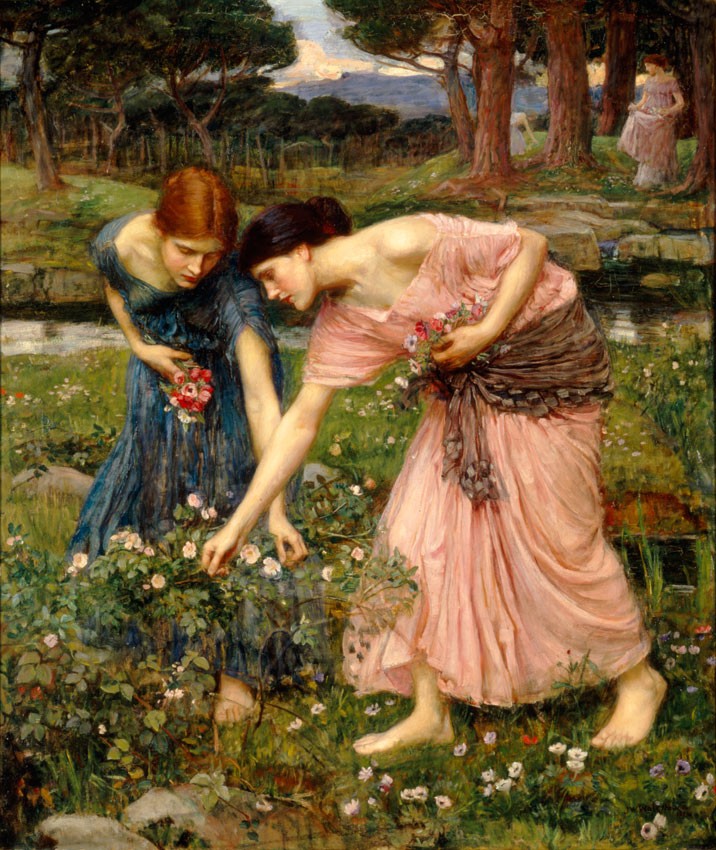
Waterhouse-gather_ye_rosebuds-1909

Robert Herrick (1591-1674) is one of the most noteworthy figures of early 17th-century British poetry and primarily known for his slew of poems chosen by anthologists W.H. Auden and Norman Holmes Pearson for Poets of the English Language, a superb five-volume set published by the Viking Press in 1950. Posting poems by Herrick over the next few days also allows us to champion the Poetry Foundation’s excellent website, where readers can find a fascinating bio on Herrick, the courtier poet to King Charles I who “died a poor country parson, whom no fellow poet seems to have commemorated with a verse-epitaph, much less an elegy.” The first poem we’re featuring is “To the Virgins, to Make Much of Time”:

Gather ye Rose-buds while ye may,
Old Time is still a flying:
And this same flower that smiles to day,
To morrow will be dying.

The glorious Lamp of Heaven, the Sun,
The higher he’s a getting;
The sooner will his Race be run,
And nearer he’s to Setting.

That Age is best, which is the first,
When Youth and Blood are warmer;
But being spent, the worse, and worst
Times, still succeed the former.

Then be not coy, but use your time;
And while ye may, goe marry:
For having lost but once your prime,
You may for ever tarry.

(Painting: Gather Ye Rosebuds While Ye May by John William Waterhouse, 1909, via Wikimedia Commons)

A Poem For Monday

by Alice Quinn

This embed is invalid

“A Drink of Water” by Seamus Heaney:

She came every morning to draw water
Like an old bat staggering up the field:
The pump’s whooping cough, the bucket’s clatter
And slow diminuendo as it filled,
Announced her. I recall
Her grey apron, the pocked white enamel
Of the brimming bucket, and the treble
Creak of her voice like the pump’s handle.
Nights when a full moon lifted past her gable
It fell back through her window and would lie
Into the water set out on the table.
Where I have dipped to drink again, to be
Faithful to the admonishment on her cup,
Remember the Giver fading off the lip.

(From Selected Poems: 1966-1987 © 1987 by Seamus Heaney. Used by kind permission of Farrar, Straus & Giroux)

A Poem For Sunday

by Alice Quinn

From “Clearances” by Seamus Heaney:

In Memoriam M.K.H., 1911-1984

The cool that came off sheets just off the line
Made me think the damp must still be in them
But when I took my corners of the linen
And pulled against her, first straight down the hem
And then diagonally, then flapped and shook
The fabric like a sail in a cross-wind,
They made a dried-out undulating thwack.
So we’d stretch and fold and end up hand to hand
For a split second as if nothing had happened
For nothing had that had not always happened
Beforehand, day by day, just touch and go,
Coming close again by holding back
In moves where I was x and she was o
Inscribed in sheets she’d sewn from ripped-out flour sacks.

(From Opened Ground: Selected Poems 1966-1996 © 1996 by Seamus Heaney. Used by kind permission of Farrar, Straus & Giroux)

A Poem For Saturday

by Alice Quinn

The supreme poet Seamus Heaney passed away yesterday in a Dublin Hospital at age 74.

No one alive wrote more eloquently about the art and the poets who meant the most to him: George Herbert’s “daylight sanity and vigor,” “the pure consequence of Elizabeth Bishop’s style,” “the bareface confrontation of Patrick Kavanagh’s,” “the crystalline inwardness of Emily Dickinson, ” “the visionary strangeness of Eliot,” Frost loved for “his farmer’s accuracy and his wily down-to-earthness,” Gerard Manley Hopkins “for the intensity of his exclamations, which were also equations for a rapture and an ache I didn’t fully know until I read him…”

Most of these quotations are drawn from his Nobel acceptance speech so characteristically titled “Crediting Poetry,” in which he wrote “I credit it because credit is due to it, in our time and in all time, for its truth to life…To begin with, I wanted that truth to life to possess a concrete reliability, and rejoiced most when the poem seemed most direct, an up-front representation of the world it stood in for  or stood up for or stood its ground against.”

“The redressing effect of poetry,” he wrote, “comes from its being a glimpsed alternative, a revelation of potential that is denied or constantly threatened by circumstances… Its projections and inventions should be a match for the complex reality which surrounds it and out of which it is generated.”

We’ll be posting poems by Seamus Heaney in tribute to him today and in the days ahead, beginning with the first poem, “Digging,” from his debut volume, Death of a Naturalist, published in 1966:

Between my finger and my thumb
The squat pen rests; snug as a gun.

Under my window, a clean rasping sound
When the spade sinks into gravelly ground:
My father, digging.  I look down

Till his straining rump among the flowerbeds
Bends low, comes up with twenty years away
Stooping in rhythm through potato drills
Where he was digging.

The coarse boot nestled on the lug, the shaft
Against the inside knee was levered firmly.
He rooted out tall tops, buried the bright edge deep
To scatter new potatoes that we picked
Loving their cool hardness in our hands.

By God, the old man could handle a spade.
Just like his old man.

My grandfather cut more turf in a day
Than any other man on Toner’s bog.
Once I carried him milk in a bottle
Corked sloppily with paper.  He straightened up
To drink it, then fell to right away
Nicking and slicing neatly, heaving sods
Over his shoulder, going down and down
For the good turf.  Digging.

The cold smell of potato mould, the squelch and slap
Of soggy peat, the curt cuts of an edge
Through living roots awaken in my head.
But I’ve no spade  to follow men like them.

Between my finger and my thumb
The squat pen rests.
I’ll dig with it.

(From Opened Ground: Selected Poems 1966-1996 © 1996 by Seamus Heaney. Used by kind permission of Farrar, Straus & Giroux)