A Poem For Saturday

Spencer Reece-page-001

Dish poetry editor Alice Quinn writes:

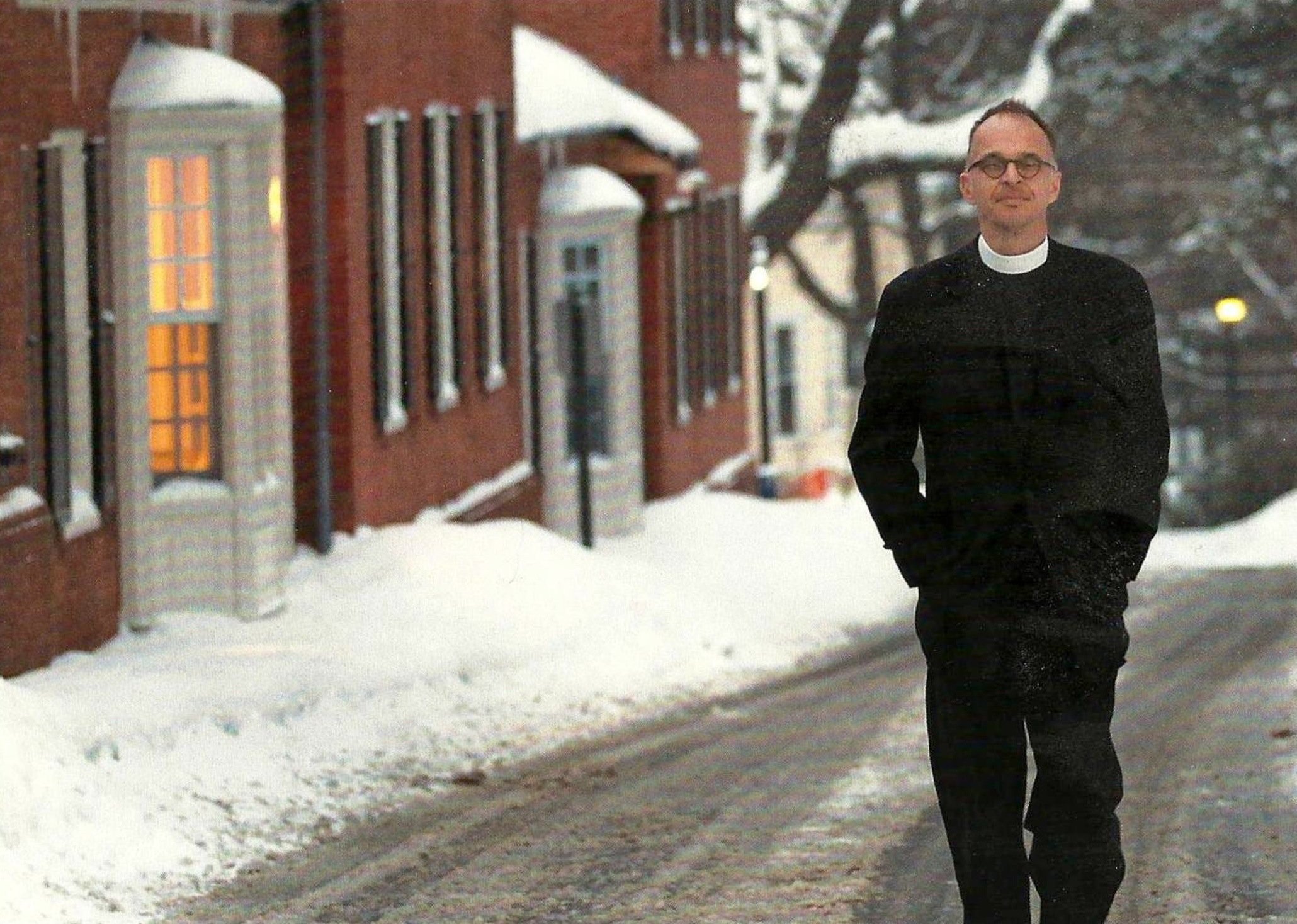
In the June 14th, 2003 issue of The New Yorker, a moving and beautiful poem entitled “The Clerk’s Tale” by Spencer Reece appeared on the back page, drawn from his debut volume of the same title chosen for The Bakeless Prize that year by Louise Gluck.

The poem began, “I am thirty-three and working in an expensive clothier,/ selling suits to men I call ‘Sir.’” The poem describes two gay men closing the store in a mall in Minneapolis on a snowy, winter evening. The speaker, younger of the two, says of his companion:

“Often, he refers to himself as ‘an old faggot.’
He does this bemusedly, yet timidly.
I know why he does this.
He does this because his acceptance is finally complete—
and complete acceptance is always
bittersweet.”

The poem later formed the basis for a short film directed and produced by James Franco. The poet, Spencer Reece, was subsequently ordained as an Episcopal priest. While working as a chaplain at Hartford Hospital, he felt inadequate without the Spanish language. Appealing to his bishop, he was transferred to an orphanage in Honduras, where he coached the schoolchildren to write poems. Now he has compiled an anthology of their poetry called Hope & Fury: Abandoned Childrens’ Voices, with gems like this one by Riccy, age 14:

Rose

This young
rose, it represents all of us here.
Careful! It is the prettiest young rose
we have: life needs love,
love needs life.

James Franco is now the executive producer of the documentary-in-the-making about the orphanage, Our Little Roses. Today and in the days ahead we’ll post poems from Spencer Reece’s new book of poems, The Road to Emmaus, just published by Farrar, Straus & Giroux.

“ICU” by Spencer Reece:

Those mornings I traveled north on I-91,
passing below the basalt cliff of East Rock
where elms discussed their genealogies.
I was a chaplain at Hartford Hospital,
took the Myers-Briggs with Sister Margaret,
learned I was an I drawn to Es.
In small group I said, “I do not like it,
the way young black men die in the ER,
shot, unrecognized, their gurneys stripped,
their belongings catalogued and unclaimed.”
In the neonatal ICU, newborns breathed,
blue, spider-delicate in nests of tubes.
A Sunday of themselves, their tissue purpled,
their eyelids the film on old water in a well,
their faces resigned in plastic attics,
their skin mottled mildewed wallpaper.
It is correct to love even at the wrong time.
On rounds, the newborns eyed me, each one
like Orpheus in his dark hallway, saying:
I knew I would find you, I knew I would lose you.

(From The Road to Emmaus © 2014 by Spencer Reece. Reprinted by permission of Farrar, Straus & Giroux. Photo of Spencer Reece © Lawrence Schwartzwald, used with his permission.)

A Poem For Sunday

13088747563_3394ddb557_b

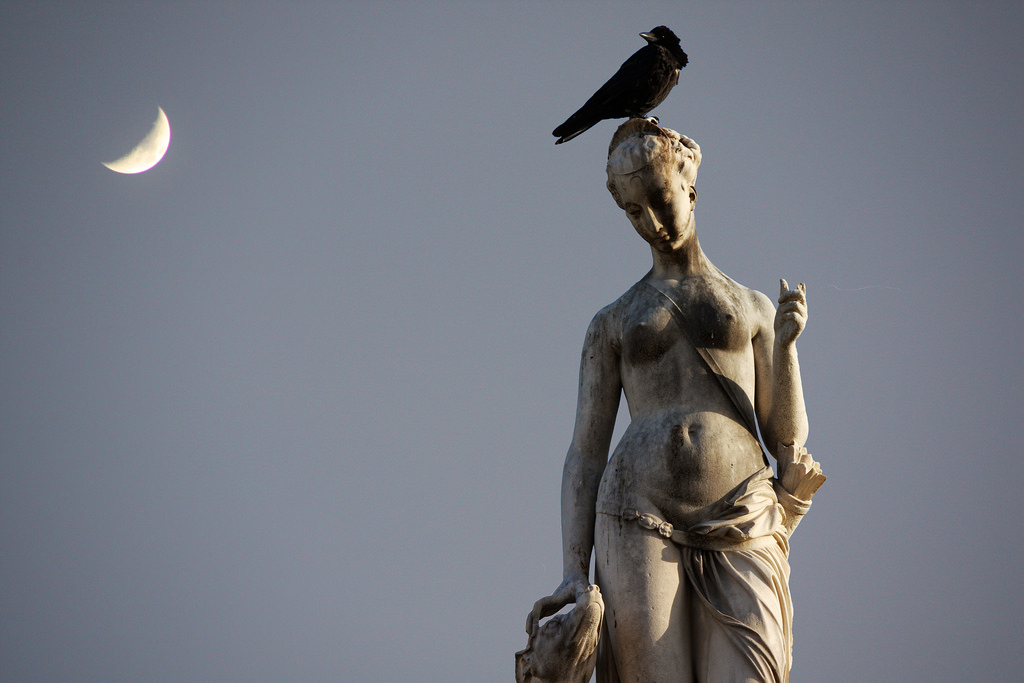
“Not a Raven” by Nina Cassian:

A bird—very close to me,
a kind of relative,
showed me a hidden spring
in the woods.
I tasted it,
and suddenly leaves covered my body.
Two squirrels
jumped on my shoulders.
The spring itself
engulfed my legs
like a transparent weed.

We stayed like this
till evening fell.

Then the bird announced to me
my youth had come to an end.

(From Continuum: Poems © 2008 by Nina Cassian. Used by permission of W.W.Norton & Company. Photo by Martin Fisch)

A Poem For Saturday

4308200246_22192ca51c_b

Dish poetry editor Alice Quinn writes:

The exiled Romanian poet Nina Cassian died peacefully at her home on Roosevelt Island in New York City on Monday, April 14th, at the age of 89, having watched as usual Jeopardy, her favorite television show. That seems perfectly fitting for this witty, stalwart, and profound woman whom Stanley Kunitz called “a world-class, high-spirited, fierce, intelligent, uncompromising, and wonderfully nervy poet.”

Margalit Fox wrote the obituary for the New York Times, which tells the story of Nina’s coming to and remaining in this city she loved. I had the privilege of accepting a round of poems by her—four in all—and printing them on a single page in The New Yorker in 1990, including “Ballad of the Jack of Diamonds,” translated by Richard Wilbur and featured in the Times obituary.

Today and in the days ahead, we’ll post poems from Continuum, the last book of hers to be published here from a list of more than forty the world over, including poetry collections, novels, and translations into the Romanian of Shakespeare, Brecht, Celan and others.

“My Father” by Nina Cassian:

My father now fills the world
with his being. I presume
he grew immensely in approaching
the supreme hour, DOOM . . .

His baldness is the moon itself
as he steps from shore to shore.
He was never so saintly
and he’s more earthly than ever before.

My father abandons my flesh.
I keep his eyeglasses instead,
to wear them when the dream comes by,
not to be blinded or fall out of bed.

(From Continuum: Poems © 2008 by Nina Cassian. Used by permission of W.W.Norton & Company. Photo by Phil Roeder)

A Poem For Sunday

Caravaggio_-_The_Incredulity_of_Saint_Thomas

From “Easter” by George Herbert (1593-1633):

Rise heart; thy Lord is risen. Sing his praise
Without delayes,
Who takes thee by the hand, that thou likewise
With him mayst rise:
That, as his death calcined thee to dust,
His life may make thee gold, and much more, just.

Awake, my lute, and struggle for thy part
With all thy art.
The crosse taught all wood to resound his name,
Who bore the same.
His stretched sinews taught all strings, what key
Is best to celebrate this most high day.

Consort both heart and lute, and twist a song
Pleasant and long:
Or, since all musick is but three parts vied
And multiplied,
O let thy blessed Spirit bear a part,
And make up our defects with his sweet art.

(Caravaggio’s The Incredulity of St. Thomas, 1602, via Wikimedia Commons)

A Poem For Good Friday

Eccehomo1

Dish poetry editor Alice Quinn writes:

A new biography of the English poet George Herbert (1593-1633) by John Drury, Music at Midnight, has occasioned a lovely essay by Nicholas Lezard in The Guardian this week. To introduce the poems we’ve chosen for this Easter weekend, we’ll quote the opening of Lezard’s piece:

The devil, whatever people may say, doesn’t have all the best tunes. Of all the lyric poetry our language has produced, George Herbert’s is among the most musical, poignant, direct and, at the same time, subtle and intelligent. It makes allowances for the weakness of the heart—often, indeed, that is its primary subject—and nine-tenths of the poetry that survives is about God.

Herbert’s poetry was passionately admired by T.S.Eliot, W.H.Auden, and Elizabeth Bishop, who wrote, “The three qualities I admire in the poetry I like best are: Accuracy, Spontaneity, Mystery. My three ‘favorite’ poets—not the best poets, whom we all admire, but favorite in the sense of one’s ‘best friends,’ etc. are Herbert, Hopkins, and Baudelaire.

For more on Herbert, you might peruse the contemporary poet Alfred Corn’s illuminating essay on Herbert’s life as a country priest and poet. It can be found on the Poetry Society of America website here.

“Redemption” by George Herbert:

Having been tenant long to a rich Lord,
Not thriving, I resolved to be bold,
And make a suit unto him, to afford
A new small-rented lease, and cancel th’ old.
In heaven at his manour I him sought:
They told me there, that he was lately gone
About some land, which he had dearly bought
Long since on earth, to take possession.
I straight return’d, and knowing his great birth,
Sought him accordingly in great resorts;
In cities, theatres, gardens, parks, and courts:
At length I heard a ragged noise and mirth
Of theeves and murderers: there I him espied,
Who straight, Your suit is granted, said, & died.

(Antonio Ciseri’s, Ecce homo, a depiction of Pontius Pilate presenting a scourged Christ to the people, via Wikimedia Commons)

A Poem For Saturday

7070703905_46df3efc8e_o

Dish poetry editor Alice Quinn writes:

Bernadette Mayer has won the Poetry Society of America’s 2014 Shelley Memorial Award, established by the will of the late Mary P. Sears in 1929 and awarded by nomination only to a living American poet selected with reference to his or her genius and need. The lineage of this award is mighty, beginning with Conrad Aiken in 1930 and running the gamut of great American figures, from e.e.cummings in 1945 and May Swenson in 1968 to Etheridge Knight in 1985 and Martin Espada and Lucia Perullo in 2013.

“Incidents Report Sonnet # 5 ( for Grace also)” by Bernadette Mayer:

Now you must remember that bed
we slept in head to feet in upstate new york.

David who was probably four
had just so badly injured his foot.

We had scared the wits out of the kids
playing hide & seek outdoors in the dark.

We ate Canadian Oat Bread and baked
millions of potatoes for our charges.

You and I took notes on everything
including Colin’s dream ravings.

I’m forgetting to mention many things
including attempting to swim in the shallow stream.

Then we got into our tiny bed together
with our shared immortal fear of love.

(From A Bernadette Mayer Reader © 1992 by Bernadette Mayer. Used by permission of New Directions Publishing Corporation. Photo by Sean McMenemy)

A Poem For Wednesday

Stern,_Gerald

Dish poetry editor Alice Quinn writes:

Tonight, Wednesday, April 9th at 7pm, at the National Arts Club in New York City at 15 Gramercy Park, the Poetry Society of America’s annual awards ceremony will take place, offering emerging and established poets recognition at all stages of their careers. The event is free and open to the public, with details available here. The awards recognize everything from a single poem written by a high school student to the organization’s highest honor, the Frost Medal, which celebrates lifetime achievement in the art. This year’s recipient is Gerald Stern, who published his first book, Lucky Life, in 1977 at age fifty-one and who has since published more than a dozen collections of poems and two marvelous books of essays, receiving along the way the Ruth Lilly Poetry Prize, the Wallace Stevens Award, the National Book Award, and many other honors. The sonnet below is from his newest book, In Beauty Bright.

“Too Late” by Gerald Stern:

Too late now to look for houses
to give readings, to flirt, to eat blueberries,
to dance the polka—or just to be in the
Serbian-American club in Duquesne
near that horrible McKeesport, near
that horrible Kennywood Park, and take
a sip, a bite, and half fall off my
stool, and grab her and whirl for fifteen
straight, or just to feel her breasts
against me and to loosen my tie, or just to
drive home slowly, sometimes even
on the streetcar tracks themselves,
that 68 trolley I loved so much, the
love seats and the rattling glass windows.

(From In Beauty Bright © 2012 by Gerald Stern. Used by permission of W.W.Norton & Company. Photo of Stern at the Miami Book Fair International in 2011 by Rodrigo Fernández, via Wikimedia Commons)

A Poem For Monday

moonreeves

This weekend we featured poems from debut collections. Here’s one more, “According to Scholars, Everything” by Roger Reeves, from his volume King Me, published by Copper Canyon Press:

—so long these days: the nineteenth century,
the twentieth century, the novel,
and now the night: prince of flowers: boatless
oars at the edge of a cold beach: sometimes,
we are asked to prove who we are: stranger
in the house of strangers: here, I remember
the white bee making a black zero above
our heads, the hairs of a gray cat pulled
from the back of our throats, placed on a dish
that would bear nothing more remarkable
than this: refuse: fat moon: peach pit: lamplight
spilling its affliction over our feet:
your hand and now your mouth starting a gash
below my nipple, a gash I do not wish closed.

(From King Me © 2013 by Roger Reeves. Reprinted with kind permission of Copper Canyon Press. Photo by Shaer Ahmed)

A Poem For Sunday

beginningoftrust

As mentioned yesterday, this weekend we’re featuring poems from debut collections of poetry. Below is “Beginning of Trust” from Waiting for Saint Brendan and Other Poems by David McLoghlin, published by the Irish press Salmon Poetry:

I’ve forgotten for how long now
I have fallen asleep
knowing you’ll be there tomorrow.
It influences even the way I breathe
and rest into dreams.

And I’m here,
listening to you breathe beside me
in the night light:
I’m here, looking at you,
amazed at your trust
in sleep, in love, in me.

I want to wake you
and tell you what has happened.

(From Waiting for Saint Brendan and Other Poems © 2012 by David McLoghlin. Reprinted with kind permission of Salmon Poetry. Photo by Peter Smida)

A Poem For Saturday

Diamonds last forever but a blossom is beautiful too

This weekend we’ll be featuring poems from exciting debut collections. The first is “To a Camellia Blossom” from She Has a Name by Kamilah Aisha Moon, just published by Four Way Books:

I saw your pretty head lying
beneath the bush. Without
thinking, I kneeled
and cradled you, petals sighing
into grateful palms.  Beauty face down
is an abomination. Why
must you suffer the weight
of early perfection?  Your vividness
lifts me, lifts all. I wanted
to hold you. Just like that.
Until. I know this kind
of blooming well, to be
so lush, insides so swollen with life
that what was meant to hold you up
can’t. I wasn’t meant
to hold you, yet here we are
on this stray, brisk day in April
trembling and fulfilled, unlikely
and true. Before I knew what
to call you, I reached and imagined
season after season.  Unmoored.

(From She Has a Name © 2013 by Kamilah Aisha Moon. Reprinted with kind permission of Four Way Books. Photo of a Camellia Theaceae blossom by Thomas Mueller)