Obamacare’s Economic Check-Up

The CBO report released yesterday (pdf) found that found Obamacare will produce “a decline in the number of full-time-equivalent workers of about 2.0 million in 2017, rising to about 2.5 million in 2024.” Waldman puts a positive spin on the news:

The important thing to understand about the reduction in the labor force is that this is exactly what was supposed to happen. When you eliminate “job lock,” where people who’d like to leave their jobs can’t because if they do they won’t have health insurance, a certain number of people are going to take advantage of their newfound mobility. In some cases you might be able to construe it as a loss to the economy, say if a productive full-time worker cuts back to part time because she can. But in many cases it’s something to celebrate: an American exercising their freedom.

Yglesias is on the same page:

Obamacare will kill jobs in the same way that Social Security kills jobs. By making it easier for people in certain circumstances to get by without a job. But your mileage may vary on this. The point, however, is that we’re talking about people quitting not about people getting fired.

Douthat’s worries that Obamacare “might reduce financial hardship while actively disincentivizing upward mobility overall”:

2 million is a much, much uglier number than the 800,000 figure the C.B.O. cited in its last report. Maybe the early estimate was right and this one is wrong, or (just as likely) maybe both are off in one direction or the other. But it does seem like we may be dealing here with something that isn’t just a consequence of rejiggering the employer-provided model, and that actually reflects a more universal dilemma of welfare-state liberalism: Namely, that when the government moves to help people at the bottom of the income distribution, its assistance often creates perverse incentives, both by making it easier for the beneficiaries not to work at all and (when the assistance is means-tested) by imposing a steep marginal tax rate on upward mobility of any kind.

Cohn notes an important detail:

CBO didn’t actually say Obamacare would lead to 2 million fewer jobs. It said that Obamacare would lead to the “equivalent” of 2 million fewer jobs. In reality, CBO expects a much larger group of people to reduce their hours by a much smaller amount. Only a relative few will stop working altogether.

Suderman focuses on the costs of Obamacare:

Taken by themselves, Obamacare’s insurance provisions will increase the deficit by $1.4 trillion. The Affordable Care Act is a sprawling piece of legislation with a variety of revenue mechanisms built in that are supposed to offset the significant cost of the law. But CBO broke out the provisions that are specifically related to the provision of insurance coverage—the cost of the subsidies, the Medicaid expansion, the penalty payments made as a result of the mandate, the tax on high-end coverage, etc.—and found that, over the next 10 years, they will increase the deficit by $1.48 trillion. … This doesn’t mean that Obamacare, as a legislative whole, is now scored as a deficit hike. But it does mean that its central component, the coverage expansion scheme, is.

Greg Ip is unsurprised by the working hours reduction:

This is an unavoidable characteristic of a progressive system of taxes and transfers. As income taxes rise, they become an even bigger disincentive to work and invest; but we accept that distortion as the price of equity. Similarly, means-tested transfers that phase out with income represent high, implicit marginal tax rates and thus disincentives to work. We accept this distortion because it seems preferable to the alternatives: transfers that aren’t means tested, or no transfers at all.

Drum agrees that this is “a shortcoming in all means-tested welfare programs”:

If we simply had a rational national health care system, available to everyone regardless of income, then none of this would be an issue. There might still be a small income effect, but it would probably be barely noticeable. Since everyone would be fully covered no matter what, there would no high effective marginal tax rate on the poor and no reason not to work more hours. Someday we’ll get there.

Avik Roy admits that “any health-reform plan that seeks to offer coverage to the uninsured will have this type of effect on the labor market.” But he still rails against Obamacare:

The negative effect of Obamacare on the labor market is far worse than any Republican alternative would be, because the ACA dramatically expands Medicaid, and because the law heavily subsidizes health insurance for those nearing retirement. In addition, Obamacare depresses economic growth through a $1 trillion tax increase, and increases the cost of hiring new workers, because of its employer mandate requiring most businesses to offer health coverage to every worker.

Barro weighs in:

Broadly, one key goal of health policy should be to let people make work decisions without worrying about how those decisions affect their health insurance. The CBO report shows that Obamacare partly furthers that goal (by making insurance available to more people, regardless of income or employment status) and partly inhibits it (by withdrawing benefits from people who work more). Efforts to optimize the policy should focus on de-linking work decisions from insurance, not simply on maximizing the amount of labor supply.

Barro also notes that fewer workers should mean higher wages:

Obamacare alters the employer-employee relationship in a way that empowers employees. When an employee is dependent on his job not just for a wage but for health insurance, he is less able to threaten to leave if he doesn’t get a raise. Severing the work-insurance link strengthens the employee’s hand in bargaining — which is bad for employers and good for workers.

Cillizza imagines the political consequences of this report:

Close your eyes for a minute and fast forward to October. And imagine yourself sitting in a Charlotte hotel room watching TV. And this ad comes on: “Kay Hagan voted for Obamacare, a law whose rollout was so botched that a million people decided to not even sign up for health coverage. And the non-partisan Congressional Budget Office says Obamacare will cost America 2 million jobs. Kay Hagan voted wrong. Now it’s time to vote her out.” That’s a VERY tough hit on any Democratic incumbent who voted for the Affordable Care Act.

Chart Of The Day

Combat Experiences

Mark Thompson looks at the relationship between combat experience and mental health problems:

After years of debating to what degree repeated deployments and other factors play a role in post-traumatic stress and traumatic brain injuries—and the anxiety, depression and suicidal tendencies they can trigger—this chart indicates that it is the number of combat events, more than the time deployed, that drives up mental-health problems (of course, the two tend to travel together, but not always).

The U.S. military has been plagued by epidemics of mental-health problems since the wars in Afghanistan and Iraq began. The graphic shows that while troops can withstand several of what the Army calls “combat experiences,” their mental armor begins breaking down once they experience 10 or more such events.

What Insurer Bailout?

Chait demolishes a GOP talking point:

The risk corridor program could end up paying more than it takes in, in which case it will wind up subsidizing insurers. Conservatives have assumed as a simple given that the risk corridors will pay out more than they take in.

[Yesterday’s] CBO report predicts just the opposite: that insurance companies will be paid $8 billion, but will pay back $16 billion. The risk corridor program is therefore predicted to result in a net expenditure of negative $8 billion. Repealing risk corridors would increase the projected deficit. If we accept the spurious equation of a subsidy with a bailout, then the Republican plan to repeal risk corridors would be a bailout, and the risk corridors would be the opposite of a bailout.

Edwin Park warns that repealing “the risk corridors would result in higher premiums”:

 [Insurers] aren’t sure who will ultimately enroll in the marketplaces and their need for health care.  As a result, without the risk corridors (and other risk-mitigation tools) insurers would have to charge higher premiums in 2015 and 2016 to offset the risk of this uncertainty, making coverage less affordable.  Some insurers may opt to not participate in the marketplaces at all.

Earlier Dish on the risk corridors here and here.

Who Has The Right To Die?

In the Netherlands, a clinic that provides euthanasia for people whose doctors won’t sign off on it has ignited a debate over whether allowing psychiatric patients to undergo assisted suicide is acceptable:

Clinic Director Pleiter thinks giving psychiatric patients a chance at assisted suicide is important. “We are dealing with a group of patients that have no other place to go, that are also being ignored by psychiatry,” he said. “We are looking at their requests seriously, we treat them in all fairness. I believe it was a deliberate choice for the lawmakers to offer space legally, to which both patients with physical as well as psychological problems can turn.”

But where does one draw the line? Because these patients are not physically ill, the evaluations of independent psychiatrists are under scrutiny. Does this mean any person suffering from serious depression can shop around until he or she finds someone willing to help with suicide? And euthanasia is not only for old people. How young can you be and still get legal help if you want to die? How far should society go to overcome the biologically inbuilt threshold that makes it hard to take one’s own life by aiding someone to do so?

The Dish’s thread on suicide is here.

Paying With Pogs

The early ’90s fad has seen a fascinating resurgence:

When the US military deployed soldiers to Afghanistan in 2001 for Operation Enduring Freedom, nickels and dimes probably weren’t important concerns. But soon, commanders realized that importing US coins for army purchases was, cumulatively, too heavy: there was simply no room for chump change in supply shipments.

800px-AAFESpogsIn stepped the Army Air Force Exchange Service (AAFES), the Army’s merchandise supplier and foreign base exchange operator since 1895. On its website, the AAFES pledges to “go where you go in serving our troops worldwide.” And that they did: in November 2001, they brought pogs back into play and began shipping them to Afghanistan. They drastically reduced the weight of shipments: $100 in quarters (5 pounds, 1 ounce), was reduced to 14 ounces in equivalent pog currency. …

The pogs worked. Soldiers use them to this day to buy anything sold in the 181 AAFES department stores across 30 countries (and all 50 US states). In addition, the AAFES has partnered with over 1,000 major retail and food chains; pogs are now valid as a form of currency at Taco Bell, Cinnabon, Burger King, and Popeyes.

Update from a reader:

The pogs post cracked me up. When I was in Afghanistan in 2010, someone had glued perfectly cut and cropped pictures of dicks/balls/hairy asses to the pogs. Whoever was doing it had produced them so well that they looked and felt just like the regular pogs, except instead of a picture of a bald eagle or an American flag or whatever, it was a picture of a giant butt-plug. These pogs, of course, made it into the circulation of the base economy, and were also accepted by the locals at the small bazaar. Senior officers grumbled, I’m sure, but as far as I know, the person producing them was never caught.

(Photo by Wikipedia user Lando242)

Whom Does Gentrificiation Hurt?

Profiling some of New York’s newly mixed neighborhoods, Justin Davidson notes that the “link between a neighborhood’s economic fortunes and the number of people being forced to move away, while anecdotally obvious, is difficult to document”:

In 2005, Lance Freeman, a professor of urban planning at Columbia, examined national housing statistics to see whether low-income residents move more often once their neighborhoods start to gentrify. His conclusion was that they don’t. Mobility, he suggested, is a fact of American life, and he could find no evidence to suggest that gentrification intensifies it. Instead, it appears that many low-income renters stay put even as their rents go up. … [Freeman] doesn’t doubt that displacement occurs, but he describes it as an inevitable consequence of capitalism. “If we are going to allow housing to be a market commodity, then we have to live with the downsides, even though we can blunt the negative effects to some extent. It’s pretty hard to get around that.”

That infuriates the British scholar Tom Slater, who sees Freeman’s data studies as largely irrelevant because, he has written, they “cannot capture the struggles low-income and working-class people endure to remain where they are.” Freeman waves away the binary rhetoric. “You can’t boil gentrification down to good-guy-versus-bad-guy. That makes a good morality play, but life is a lot messier than that.”

Art History In The Internet Age

A PhD student objects to Obama’s lighthearted dig against her field:

In the coming years, it’s likely that visual literacy will become a key skill, alongside textual literacy, for workers throughout our economy. This is why it’s important for President Obama to understand that art historians don’t simply teach the historical development of artistic styles; more critically, we teach people how to look at images. I don’t think he would make a public statement against teaching our children to read … so why should he implicitly ridicule teaching people how to read images, when images are now as important as text in the construction of our common culture?

It’s especially worrisome for a politician, of all people, to casually dismiss the very field most responsible for training American citizens in visual literacy (now that the arts are all but banished from high school curricula). Political campaigns and culture wars alike are now waged through images as much as through soundbites – just ask Michael Dukakis. An informed electorate has to know how to decode visual information: not just art history majors, but all Americans, should learn how to read images.

There’s No App For Inequality

Last week, Clay Shirky argued that “number of high-school graduates underserved or unserved by higher education today dwarfs the number of people for whom that system works well.” Freddie doesn’t think technology can solve this problem:

[E]ducating “nontraditional” students– administrator speak for poor students, students whose parents are themselves uneducated, minority students, and students who struggled in high school– is really hard. Look, I don’t doubt that the American university system has failed these students in any number of ways. I could go on at length about those failures. But at some point you have to actually grapple with reality, which is that for a complex and controversial set of reasons, some people are harder to educate. Not everyone is equally capable of educational success. They just aren’t. I’m dedicated to the task as getting as many marginal students in and through as possible, and I think that’s an absolute moral need for our colleges and our society. But it’s not going to work for everyone, and it’s going to take great efforts, and online models are precisely the opposite of what’s likely to work. …

Pleasant lies about everyone’s ability to succeed in college, particularly in a new kind of college where by design individual students receive far less attention, are politically pleasing but practically destructive.

Alan Jacobs adds:

I’m still waiting for just one school in financial straits to completely restructure its priorities in favor of a near-total focus on the teaching of undergraduates. Then maybe others will follow. But in any event the idea that MOOCs are preferable to such genuine reform strikes me as nuts.

Need A Break From The Wintry Weather?

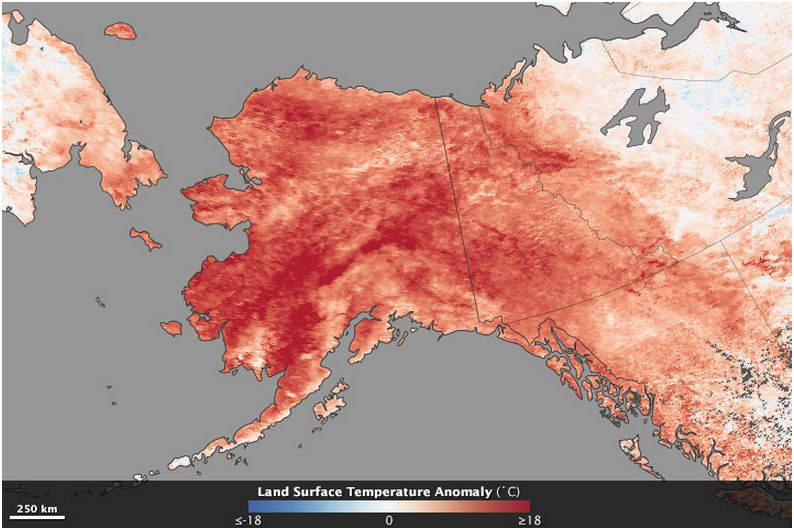
alaska heat wave january 2014 climate change global warming february 4 nasa photos sochi olympics weather forecast

Visit Alaska, where temperatures are 40 degrees above average:

The abnormal spate of warmness – which far as I can tell has not been addressed by weatherperson Sarah Palin – forced the cancellation of skiing events, with one organizer saying, “We just don’t have the snow and way too much water in the hills to put together a quality race.” It also led to the 2014 Yukon Quest Sled Dog Race being launched in downtown Fairbanks, rather than its historical starting line on a frozen river, because the river ice was so thin spectators would’ve fallen through it. …  To give people an idea how freaky an event this was for the 49th State, NASA has put together a visualization of phenomenal temperatures from January 23 to the 30th. Based on satellite readings, the map shows warm-weather abnormalities spreading in red all across the region.