And He Won

Here’s a gritty bio of a successful local Republican politician:

The third time was the charm for Koering. In 1996 and in 2000, Koering, a small business owner and farmer, ran against veteran DFL Senator Don Samuelson of Brainerd. Koering lost both times, thought it wasn’t from lack of work. The first time, he knocked on 16,000 doors in the district, fitting that campaign work in between twice a day milking of his 60 cow dairy herd. In 2000, he repeated the effort, again fitting it into twice a day milkings. Still determined, Koering ran again, but he had more time in 2002. He had sold the herd after the second campaign. Koering’s defeat of Samuelson, who was then president of the Senate, was one of the 2002 legislative election’s biggest surprises.

Koering views his job to be "giving people a hand up, not a hand out". This biennium, he will focus on health care, education and some bonding projects for his district. Koering has again introduced legislation to make English the official language of Minnesota, and he continues to advocate for gun rights and pro-life legislation.

He describes himself not as ultra conservative or ultra liberal but rather as a realist, and says he has not made up his mind on all issues- for example, the statewide smoking ban. Koering says such a ban walks a "fine line" between health, personal rights, and property rights.

Oh, and he’s openly gay, and just won his primary. See how tolerance can actually help the GOP?

Fire. Rumsfeld. Now.

A NRO reader makes what I believe is an obvious point:

It is the truest maxim of Washington policymaking that most big mistakes can be traced back to a time when key decision makers underestimated the American public.

Rumsfeld underestimated the American public’s ability to withstand both casualties and a long war. Both of which we by and large have withstood and done so without a single member of the administration coming forth and saying "We are going to fight until we win. The country will have to sacrifice to make that happen." – which is basically all that would have been necessary to have had 500K in country and five years of public support in the 60s …

Yep: Rummy was still obsessed with Vietnam. And he was so so wrong. The reason I am and have been so angry at this administration is because I believe we had an astonishing chance to turn around the Arab-Muslim world with a serious effort to transform Iraq, and Bush didn’t trust the American people enough to do it. I regard that as a betrayal of his 9/11 promise. And so we have the worst of all worlds: an ineffective intervention that weakens and divides us, while strengthening and emboldening the enemy. Why could he not have urged a major expansion of the military, a gas tax to pay for the war, and an intervention with enough troops and enough of the right kind to succeed? I expect Vietnam-crippled Democrats to do what the Bush administration has done. Instead, we got Vietnam-crippled Republicans.

Pot and Hep C

Weeed1

A serious study finds that allowing patients with Hepatitis C to use marijuana helps them tolerate the side-effects of their medications – and so saves their lives. One word: duh. I have friends who are alive today solely because marijuana helped them stay on their meds during the crippling over-dosing that occurred in the early days of anti-retroviral therapy for HIV. Of course, the pot may also actually provide these people with something called pleasure as well. But despite that drawback, the health consequences alone make this a no-brainer. It frustrates me that we even have to debate this. There is no rational debate to be had.

Quote for the Day II

"They can search each laptop for possible terrorist-type writing and confiscate cell phones, white powder, shoelaces, car keys, pencils, anything sharp or cylindrical or made of glass, and interrogate people randomly, putting them naked into cold rooms with ugly music played at top volume. It’s all fine with me. I’m a liberal and we love ridiculous government programs that intrude on personal freedom. But where are the conservatives who used to object to this sort of thing?" – Garrison Keillor, in the Chicago Tribune. Not all of us have disappeared. And some are actually stirring anew.

Benedict and Islam

Benedictandrewmediciniap_2

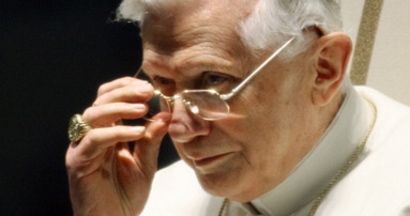
And it’s on this insistence that Benedict is saying something quite striking about Islam. Benedict insists on the Greek "logos" as inherent in the Christian tradition, and "logos" demands a freely chosen faith, and certainly not a faith imposed by violence. What’s striking to me about Benedict’s account of Islam is his suggestion that compulsion and violence are not extrinsic to Islam but intrinsic to its vision of humankind’s relationship with the divine. He began his homily by referring to a "dialogue carried on – perhaps in 1391 in the winter barracks near Ankara – by the erudite Byzantine emperor Manuel II Paleologus and an educated Persian on the subject of Christianity and Islam, and the truth of both." At the core of the divide is the role of logos – reason – in faith. If reason is not intrinsic to faith, then violent imposition of religion is possible, even mandatory:

In the seventh conversation ("di√°lesis" – controversy) edited by professor Khoury, the emperor touches on the theme of the jihad (holy war). The emperor must have known that sura 2:256 reads: "There is no compulsion in religion." It is one of the suras of the early period, when Mohammed was still powerless and under [threat]. But naturally the emperor also knew the instructions, developed later and recorded in the Koran, concerning holy war.

Without descending to details, such as the difference in treatment accorded to those who have the "Book" and the "infidels," he turns to his interlocutor somewhat brusquely with the central question on the relationship between religion and violence in general, in these words: "Show me just what Mohammed brought that was new, and there you will find things only evil and inhuman, such as his command to spread by the sword the faith he preached."

The emperor goes on to explain in detail the reasons why spreading the faith through violence is something unreasonable. Violence is incompatible with the nature of God and the nature of the soul. "God is not pleased by blood, and not acting reasonably ("syn logo") is contrary to God’s nature. Faith is born of the soul, not the body. Whoever would lead someone to faith needs the ability to speak well and to reason properly, without violence and threats … To convince a reasonable soul, one does not need a strong arm, or weapons of any kind, or any other means of threatening a person with death…."

The decisive statement in this argument against violent conversion is this: Not to act in accordance with reason is contrary to God’s nature. The editor, Theodore Khoury, observes: For the emperor, as a Byzantine shaped by Greek philosophy, this statement is self-evident. But for Muslim teaching, God is absolutely transcendent. His will is not bound up with any of our categories, even that of rationality. Here Khoury quotes a work of the noted French Islamist R. Arnaldez, who points out that Ibn Hazn went so far as to state that God is not bound even by his own word, and that nothing would oblige him to reveal the truth to us. Were it God’s will, we would even have to practice idolatry.

As far as understanding of God and thus the concrete practice of religion is concerned, we find ourselves faced with a dilemma which nowadays challenges us directly. Is the conviction that acting unreasonably contradicts God’s nature merely a Greek idea, or is it always and intrinsically true?

Benedict’s answer is that it is always and instrinsically true. Which means that, without fundamental reform, without a Muslim reformation, a central part of Islam is always and intrinsically false. And it is this divide that lies at the heart of our current civilizational conflict. This seems to me to be the Pope’s message. In the current climate, it is an inflammatory but courageous one.

(Photo: Andrew Medicini/AP.)