The End of Serial, Part One

by Michelle Dean

Tomorrow morning will see the airing of the very last episode of Serial. At this point everyone’s spilled so much ink on the podcast you might be feeling some fatigue, but I’ll throw my own writing on the subject your way anyway. I’ve been following closely and also doing some reporting on the subreddit that became a sort of second character on the show as things moved along. It has been a strange, sad, and oddly moving to experience and observe this phenomenon. I’m still trying to figure out what to make of it all.

I’ll write more in the morning once I’ve heard the episode, but it seemed worth recording my last-Serial-eve feelings of trepidation with you. I am not expecting fireworks tomorrow. I am expecting a whimper.

I may be wrong to do so. It’s of course possible Koenig will announce that she has found evidence either that Adnan Syed is either innocent or guilty of the murder he is now in prison for. But more likely, I think, is that we’ll get a kind of meditation on how weird this whole experience has been for Koenig herself. And then she’ll sign off. And we’ll all be left looking at each other, wondering exactly what it is we’ve done by opening this whole case up to rabid public attention if there was no endgame in sight.

It may sound like I’m condemning Koenig there. I’m not. I’m oddly sympathetic to her. I don’t think she could have predicted the rabid attention this podcast got, and I especially don’t think she could have predicted that the last episode of this show would come freighted with so many feelings. Tonight has got to be a strange night of her life.

And you know, I’ve done enough of my own reporting to know that this is the way things are, if you do non-fiction. Sometimes stories don’t pan out. Life doesn’t offer happy endings. Telling stories about other people involves, all too frequently, hurting them. It most certainly involves leaving them to their own devices after you’re done reporting, to live on their lives as people who were once written about. I think most of my weird feelings amount to that, actually: what will happen to Adnan Syed now, one the white hot spotlight of national obsession leaves him?

Designing A Less Deadly Police Force

by Dish Staff

Outrage In Missouri Town After Police Shooting Of 18-Yr-Old Man

Seth Stoughton wants police training to “emphasize de-escalation and flexible tactics in a way that minimizes the need to rely on force, particularly lethal force”:

Police agencies that have emphasized de-escalation over assertive policing, such as Richmond, California, have seen a substantial decrease in officer uses of force, including lethal force, without seeing an increase in officer fatalities (there is no data on assaults). It is no surprise that the federal Department of Justice reviews de-escalation training (or the lack thereof) when it investigates police agencies for civil rights violations. More comprehensive tactical training would also help prevent unnecessary uses of force. Instead of rushing in to confront someone, officers need to be taught that it is often preferable to take an oblique approach that protects them as they gather information or make contact from a safe distance. Relatedly, as I’ve written elsewhere, a temporary retreat—what officers call a “tactical withdrawal”—can, in the right circumstances, maintain safety while offering alternatives to deadly force.

Officers must also be trained to think beyond the gun-belt.

The pepper spray, baton, Taser, and gun that are so easily accessible to officers are meant to be tools of last resort, to be used when non-violent tactics fail or aren’t an option. By changing officer training, agencies could start to shift the culture of policing away from the “frontal assault” mindset and toward an approach that emphasizes preserving the lives that officers are charged with protecting. Earlier this year, officers took just that approach in Kalamazoo, Michigan, relying on tactics and communication rather than weaponry to deal with a belligerent man carrying a rifle. As a result, a 40-minute standoff ended with a handshake, not an ambulance. The Seattle Police Department offered an even more dramatic example in 1997, when they eventually ended an 11-hour standoff with a mentally ill man wielding a samurai sword by making creative use of a fire-hose and a ladder. The suspect was apprehended with only minor bruises, and no officers were injured.

Finally, police executives need to move beyond the reflexive refusal to engage in meaningful review of police uses of force. Police may act in the heat of the moment, although not nearly as often as is commonly believed, but that should not insulate their choices from review.

(Photo: A police officer watches over demonstrators in Ferguson, Missouri protesting the shooting death of teenager Michael Brown on August 13, 2014. By Scott Olson/Getty Images)

Hackers Now Forcing Us to Defend The First Amendment By Way of James Franco

by Michelle Dean

Sony has more or less given up on The Interview, it seems, in light of threats from the shadowy collective that’s claimed credit for hacking them. They’re telling theatres they don’t have to run the film. They have done so even though DHS seems not to find the threats particularly credible. A large number of theatres, apparently, have taken them up on the offer. Naturally, this is inspiring consternation.

Judd Apatow is fulminating about the cowardice of the theatres: “Will they pull any movie that gets an anonymous threat now?” I doubt it. Because the problem here is really that the theatres are faced with an anonymous threat everyone knows about. Whatever substance of the threats might or might not have, no one wants to be the movie theatre chain that took the risk in full view of the American public. Post-Aurora, it is regrettably easy to imagine how things might happen, and it would only take one person to cause a serious problem. I bet those theatres feel their hands are tied.

Theirs aren’t the only ones, by the way. All over Twitter I’m suddenly seeing calls to see The Interview as a matter of defending freedom of speech. And you know, I’ve been skeptical of the way that Sony executives have been defending the privacy of their business records in the aftermath of the hack. But I take the point that it’s infuriating to be held hostage to this sort of thing. We don’t yet know whether we’re talking about fourteen-year-olds in someone’s basement or people who are actually dangerous.

I just think that the most infuriating thing of all might be that we’re going to feel the tug of civic obligation to see what looks like a very terrible movie. And all in the name of the First Amendment. That’s #democracy2014 for you.

The Case For Mass Transit, In One Image

by Dish Staff

manhattan-crossings.0

This is what Manhattan would look like if everyone had to drive to work:

According to Vancouver highway engineer Matt Taylor, the island would need 48 new bridges that would each have to carry eight lanes of traffic … Taylor arrived at that number by noting that 2,060,000 people commute to Manhattan daily. Under ideal conditions, a single lane can convey about 2,000 vehicles per hour, so to let 2.06 million cars on to the island within a four-hour period, you’d need at least 380 additional bridge lanes — or roughly 48 new eight-lane bridges. Of course, you’d also need somewhere to put all those extra cars. Taylor calculates that they’d require about 24 square miles in total, which is exactly the land area of Manhattan. In other words, you’d need to build a layer of underground parking that takes up the entire borough to fit all the cars driven in by commuters.

America’s Tortured Conscience, Ctd

by Dish Staff

Earlier today, Will pondered the roots of American support for torture. Keating suspects more gory details would change minds:

Whether you use the word or not, Americans are OK with torture because they believe it’s effective at gaining information that couldn’t be obtained by any other means. The fact that the Senate report knocked down that argument doesn’t seem to have gotten much traction.

If not torture, what do Americans oppose? Things start to change when you get really specific. A recent post on the Washington Post’s Post Everything site by three political scientists notes that when you ask specifically about techniques like “waterboarding,” “sexual humiliation,” and “exposure to extreme heat/cold,” most Americans do oppose them. They’re less bothered by “stress positions” or “sleep deprivation,” which I would imagine is a function of the fact that people don’t understand what they are.

Bouie isn’t so sure:

Americans like punishment. Not only do we have the world’s highest incarceration rate—716 inmates for every 100,000 people, compared to 475 for every 100,000 in Russia and 121 for every 100,000 in China—but we also have among the most draconian punishments of any nation in the developed world. … It’s not just that Americans want a system that metes out punishment, it’s that—despite our Eighth Amendment—we are accepting of the cruelest punishment. And while it’s not legal, it exists and it’s pervasive. In theory, our prisons are holding cells for the worst offenders and centers for rehabilitation for the others. Inmates can work, learn, and prepare themselves for a more productive life in society. In reality, they are hellscapes of rape, abuse, and violence from gangs and guards.

Emily Badger looks at the demographics:

A majority of nearly every group — non-whites, women, young adults, the elderly, Midwesterners, suburbanites, Catholics, moderates, the wealthy — said that torture of suspected terrorists can be often or sometimes justified. A majority of only one other group beyond liberals and Democrats disagreed: people with no religion.

Drum finds public support for torture “the most discouraging part of the whole torture debate”:

It’s one thing to learn that Dick Cheney is every bit the vicious wretch we all thought he was. But time after time since 9/11, polls have shown that the American public is basically on his side. As a nation, we simply don’t believe that a comprehensive program of state-sanctioned torture is wrong. On the contrary: we think it’s just fine as long as it’s done to other people. If we’re a Christian nation, as we’re so often reminded, we’re still an Old Testament one.

An Alternative To “No”?

by Dish Staff

In a recent meditation on the language of consent, which featured in one of the Dish’s roundups on the UVA rape debacle last week, Susan Dominus searched for a “linguistic rip cord” to help young women reject unwanted sex “without the mundane familiarity of ‘no’ or the intensity demanded in ‘Get off or I’ll scream'”:

One phrase that might work is “red zone” — as in, “Hey, we’re in a red zone,” or “This is starting to feel too red zone.” Descriptive and matter-of-fact, it would not implicitly assign aggressor and victim, but would flatly convey that danger — emotional, possibly legal — lay ahead. Such a phrase could serve as a linguistic proxy for confronting or demanding, both options that can seem impossible in the moment. “We’re in a red zone” — the person who utters that is not a supplicant (“Please stop”); or an accuser (“I told you to stop!”). Many young women are uncomfortable in either of those roles; I know I was.

In an ideal world, clear consent will always precede sex, and young women (and men) who do find themselves in a tricky situation will express their discomfort firmly. But in the imperfect world in which we live, new language — if not red zone, then some other phrase that could take off with the universality of slang — might fill a silence.

But McArdle pours cold water on the idea:

I understand what Dominus is trying to do, but I don’t think it will work.

Twenty-five years after I registered for college, we’re still searching for an alternative to the stark simplicity of “No.”  And unfortunately, there’s just no substitute. If you want to “teach men not to rape” — a formulation that floated around the Internet a lot in the days after the Rolling Stone story was published — then you need to give them a rule that can be clearly articulated, and followed even if you’ve had a few.

That’s why “no means no” worked so well, even if it wasn’t perfect. It’s a heuristic that even a guy who’s been sucking at the end of a three-story beer funnel can remember and put into practice. The rule obviously needed some refinement, by adding other equally clear rules — like “if she’s stumbling drunk or vomiting, just pretend she said no, because she’s not legally capable of consent.” But the basic idea, of listening to what the woman is saying, not some super-secret countersignals you might think she is sending, is exactly the sort of rule that we need in the often-confusing, choose-your-own-adventure world of modern sexual mores.

Men (No Longer) At Work

by Dish Staff

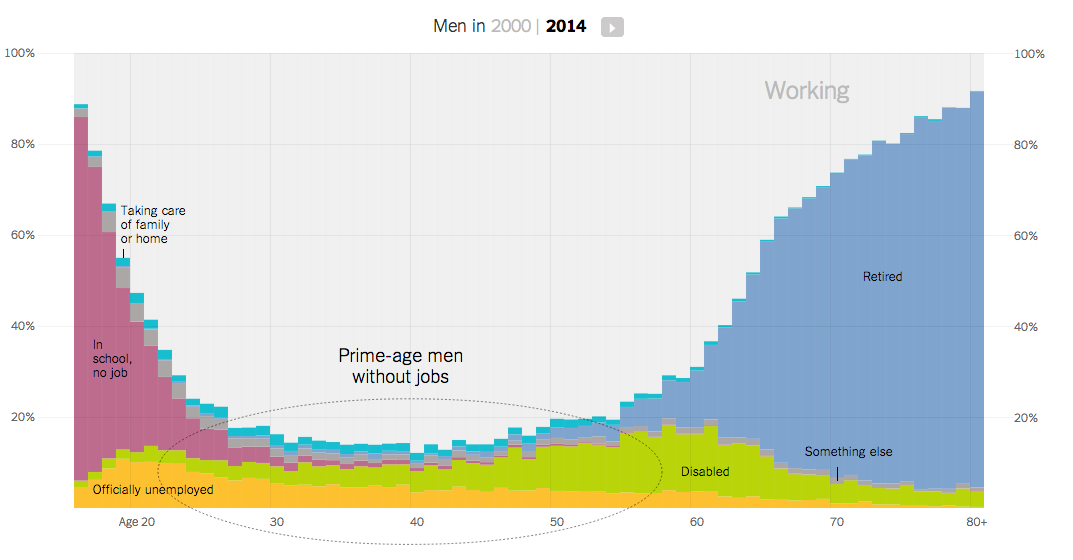
Screen Shot 2014-12-16 at 5.33.21 PM

Binyamin Appelbaum looks into the causes of the decline in America’s male work force:

Working, in America, is in decline. The share of prime-age men — those 25 to 54 years old — who are not working has more than tripled since the late 1960s, to 16 percent. … Many men, in particular, have decided that low-wage work will not improve their lives, in part because deep changes in American society have made it easier for them to live without working. These changes include the availability of federal disability benefits; the decline of marriage, which means fewer men provide for children; and the rise of the Internet, which has reduced the isolation of unemployment. …

The resulting absence of millions of potential workers has serious consequences not just for the men and their families but for the nation as a whole. A smaller work force is likely to lead to a slower-growing economy, and will leave a smaller share of the population to cover the cost of government, even as a larger share seeks help. “They’re not working, because it’s not paying them enough to work,” said Alan B. Krueger, a leading labor economist and a professor at Princeton. “And that means the economy is going to be smaller than it otherwise would be.”

At the same time, Amanda Cox points out, many older men are postponing retirement:

The decline of traditional pension plans and rising education levels, which are associated with less physically demanding jobs, may both help explain why the elderly are working longer. The full retirement age for Social Security benefits also began gradually increasing in 2000.

Some countries have developed policies that encourage older people to leave the labor force, so they do not “crowd out” younger workers. But studies across countries and time suggest that crowding-out may not actually be a problem. Economies do not appear to have a fixed number of jobs. When more older people are working, they are earning money that they will then spend in ways that may create more jobs for young people, for example. Even if this is the case, though, the rise of elderly employment in recent years has not provided enough of a lift to put more young people back to work.

Derek Thompson suspects that more is at play here than employment, suggesting that the American male is having a full-on identity crisis:

Looking to the future, one aspect of the decline of work that might not receive enough attention is identity. If the future of work isn’t quite biased against men, it certainly seemed biased against the traditional idea of manliness. Construction and manufacturing, two male-dominated industries, are down 3 million jobs since 2008. Most of those jobs are dead, forever. Meanwhile, the only occupations expected to add more than 100,000 jobs in the next decade are personal care aides, home health aides, medical secretaries, and marketing specialists, all of which are currently majority female. …

The economy is not simply leaving men behind. It is leaving manliness behind. Machines are replacing the brawn that powered the 20th century economy, clearing way for work that requires a softer human touch.

Elf On The Shelf Is How Kids Learn To Love the NSA

by Will Wilkinson

Elf on a Shelf

I didn’t know what Elf on a Shelf was until maybe last week, and when I found out, I didn’t like it one bit. The little guy’s a spy! A spy! A gentle playtime introduction to the idea of a pervasive but ultimately benevolent surveillance state. No good! Bad for the children!

It is a comfort to discover, from Peter Holley’s charming Washington Post piece, that I am not alone in this response:

For some, the Elf on the Shelf doll, with its doe-eyed gaze and cherubic face, has become a whimsical holiday tradition — one that helpfully reminds children to stay out of trouble in the lead-up to Christmas.

For others — like, say, digital technology professor Laura Pinto — the Elf on the Shelf is “a capillary form of power that normalizes the voluntary surrender of privacy, teaching young people to blindly accept panoptic surveillance and” [deep breath] “reify hegemonic power.”

I mean, obvs, right?

The latter perspective is detailed in “Who’s the Boss,” a paper published by the Canadian Centre for Policy Alternatives, in which Pinto and co-author Selena Nemorin argue that the popular seasonal doll is preparing a generation of children to uncritically accept “increasingly intrusive (albeit whimsically packaged) modes of surveillance.”

Exactly. You might not cotton to Pinto’s academic argot, but she’s got the right idea. If you didn’t know, the way the Elf on the Shelf works, according to the massively popular accompanying story book, is that this creepy elf is Santa’s intelligence agent lurking in your house, keeping tabs on whether the kids are naughty or nice and reporting back to the jolly old goat. The kids aren’t supposed to touch the elf, a misdeed that might disqualify them from getting presents from Santa. And parents jerk the kids around by moving the elf from room to room so that the kids can’t ever be sure where it is.

In Pinto’s paper with Selena Nemorin, they write:

What is troubling is what The Elf on the Shelf represents and normalizes: anecdotal evidence reveals that children perform an identity that is not only for caretakers, but for an external authority (The Elf on the Shelf), similar to the dynamic between citizen and authority in the context of the surveillance state.

I suppose most people will think this sounds nutty. Well, you know what I think is nutty? I’ve got an infant son, and it’s damned hard to find clothes that don’t have sports balls or modes of transportation on them, and impossible to find anything intended for a boy in pink. People (and the market that caters to their preferences) seem weirdly dogged about making damn sure that their babies’ outward appearance strictly conforms to our most debased and simplified gender stereotypes. I mean, people need to know what sex your baby is so they know how to treat it, right? To know whether to buy it a tiara or a truck? To know say whether to say the tot is “pretty” or a “li’l scamp.” Who knows what confusion might ensue if the my wee tiny baby boy appears in public wearing a pink hat, or is not exposed very early to objects and clothing emblazoned with pro-sports propaganda! If it’s just normal to worry about that sort of thing, then I would submit that, logically speaking, it ought not to seem so nutty to worry that Elf on a Shelf might be preparing your child to complacently accept surveillance from an unaccountable authoritarian state.

When Felix is old enough, we’ll get ourselves an Elf on the Shelf, and I’ll tell him no presents will come until he finds the little rat and burns him alive. (This plan might need some work.)

Anyway, this video is great:

(Photo by Lisa Werner/Getty Images)

Executive Amnesty: The Court Battle Begins

by Dish Staff

ICE Detains And Deports Undocumented Immigrants From Arizona

Ruling in what otherwise would have been a fairly straightforward deportation hearing, District Judge Arthur J. Schwab issued an opinion (pdf) yesterday declaring President Obama’s executive action on immigration unconstitutional. Lyle Denniston explains Schwab’s ruling, which could send the matter to the Supreme Court sooner than expected:

“The President may only ‘take care that the laws be faithfully executed’; he may not take any Executive action that creates laws.” The new policy, the judge went on, is not an exercise of presidential discretion on when to prosecute individuals for a violation of the nation’s laws, but was in fact a legislative action beyond the president’s constitutional authority.

Instead of being a form of case-by-case judgment about which individuals are to be deported, Judge Schwab found, the policy “provides a systematic and rigid process by which a broad group of individuals will be treated differently than others based upon arbitrary classifications.” Rejecting the government’s claim that the policy only delays deportation and does not create any new legal rights for those who benefit from it, the judge declared that the policy provides those who qualify with “substantive rights.” He ultimately concluded: “President Obama’s unilateral legislative action violates the separation of powers provided for in the United States Constitution as well as the Take Care Clause, and, therefore, is unconstitutional.”

As Sahil Kapur points out, Schwab is no stranger to controversy. Ian Millhiser picks apart the judge’s argument:

One case that Schwab does not cite is Arizona v. United States, where the Supreme Court said that the executive branch has “broad discretion” in matters of deportation and removal. As Arizona explains, a “principal feature of the removal system is the broad discretion exercised by immigration officials.” Executive branch officials, moreover, “must decide whether it makes sense to pursue removal at all.”

Notably, Arizona also indicates that this broad discretion flows from federal immigration law — i.e. laws that were enacted by Congress. This matters because Schwab’s opinion concludes that Obama’s “unilateral” policy “violates the separation of powers provided for in the United States Constitution as well as the Take Care Clause.” In essence, Schwab concludes that the president lacks the authority to act in the absence of authorization by Congress. Schwab does not even discuss the possibility that Obama’s actions may actually be authorized by Congress. Thus, even if Schwab’s reading of the Constitution is correct — itself a questionable proposition — the judge does not even discuss another major source of law that can justify the president’s actions.

Ilya Somin is not persuaded by Schwab:

Schwab complains that generalized “threshold criteria” will “almost wholly determine eligibility” for deferred deportation under the president’s order. But any exercise of prosecutorial discretion – no matter how “case by case” it may be, must include consideration of criteria that that end up wholly determining the outcome. That’s the whole point of using criteria in the first place. Unfortunately, Judge Schwab fails to even consider the possibility that the key distinction he relies on might be unsound.

If the Supreme Court were to adopt Judge Schwab’s reasoning, federal law enforcement agencies would be barred from issuing general systematic guidelines about how their officials should exercise prosecutorial discretion. The exercise of discretion would then become arbitrary and capricious. Alternatively, perhaps they could still follow systematic policies, so long as those policies were not formally declared and announced to the public, as the president’s order was. Neither possibility is particularly attractive, and neither is required by the Constitution.

Neither is Jonathan Adler:

It is true, as Judge Schwab notes, that the President’s announced policy identifies broad criteria for deferring removal of individuals unlawfully in the country.  This would appear to make the action somewhat legislative, but I don’t think it’s enough to make the action unlawful.  The new policy does not preclude the executive branch from revoking deferred action in individual cases and does not create any enforceable rights against future executive action.  It’s no more unconstitutional than a US attorney telling the prosecutors in his office not to prosecute low-level marijuana possession absent other factors that justify federal prosecution.

Overall, Orin Kerr finds the opinion bizarre:

I was astonished by the legal contortions that Judge Schwab undergoes to get to the point that he can rule on Obama’s policy — and then the way he backs off the implications of his own ruling. Unless I’m just missing something unique to immigration law, it’s an exceedingly strange opinion.

As it happens, the ruling dropped on the same day as this piece by Somin, arguing that Obama’s actions are entirely constitutional:

Because of the enormous scope of federal criminal law, presidents routinely exercise extraordinarily broad discretion in deciding which violations to prosecute. Far more violators are ignored than punished—or even investigated. … Article II of the Constitution states that the president must “take Care that the Laws be faithfully executed.” But that requirement does not mean that the president has an absolute duty to prosecute all violations of federal law, or that he cannot choose which ones to pursue based on policy considerations. If it did, virtually every president in the last century or more would be in violation.

Allahpundit, for one, doesn’t buy it:

The question is this: Whom would you rather see punish O for that, the courts or the voters? In theory, there’s already a check on the president in all this — voters can simply express their disgust by refusing to vote for him or his party’s successor next time around. But that means, without a judicial or legislative counter, we’ll have to endure this power grab for two more years with no remedy. Is that tolerable?

But it’s hard to see this ruling standing when even Bushies like John Yoo oppose it:

To be clear, Yoo’s objection to Schwab’s decision is entirely procedural. Yoo, who once argued that the executive can use many forms of torture despite the fact that federal law explicitly forbids such activities, believes that President Obama’s decision to allow immigrants to remain united with their families is executive overreach. Yet Yoo also criticizes Schwab for opining on the immigration policy’s constitutionality when the issue was not properly before his court. As Yoo notes, “[t]his is not a case where the executive order applies, because the Obama administration is not allowing an illegal alien to remain in the country.” Thus, the case presents “no real dispute over the law, because regardless of whether the executive order is constitutional or not, it would make no difference in [this defendant’s] case.”

(Photo:: A Honduran immigration detainee, his feet shackled and shoes laceless as a security precaution, boards a deportation flight to San Pedro Sula, Honduras on February 28, 2013 in Mesa, Arizona. By John Moore/Getty Images)